
AI DISPATCHER FOR EMERGENCY DISPATCH
One emergency shouldn’t blow up 8 appointments.
AC down at 2 PM. Burst pipe at 6 AM. Dead panel after hours. Emergency dispatch software that reroutes the right tech in seconds — and keeps the rest of the day’s schedule on time. One AI engine, every trade.
EMERGENCY DISPATCHING
Why one emergency callout
burns the rest of your day.
One callout, the whole board shifts
An emergency drops in at 1 PM. You pull one tech off their route. Three other appointments fall behind. One fire becomes four — manually, every time.
Nearest tech isn’t always the right tech
The closest van on the map isn’t always the one with the EPA 608, the gas-line license, or the part on the truck. Wrong dispatch means a second trip you eat.
After-hours rotation breaks under pressure
The on-call tech gets paged for a job they can’t legally do. Or Dave’s been on rotation three nights in a row because the rotation never tracks fairness.
A “5-minute reroute” costs an hour
Calling the tech. Calling the next customer. Updating the board. Fixing the route. Every emergency burns 30–60 minutes of dispatcher time you don’t get back.
HOW AI DISPATCHER HELPS
Three things that change
how you handle emergencies.
01
Priority triage that
protects revenue
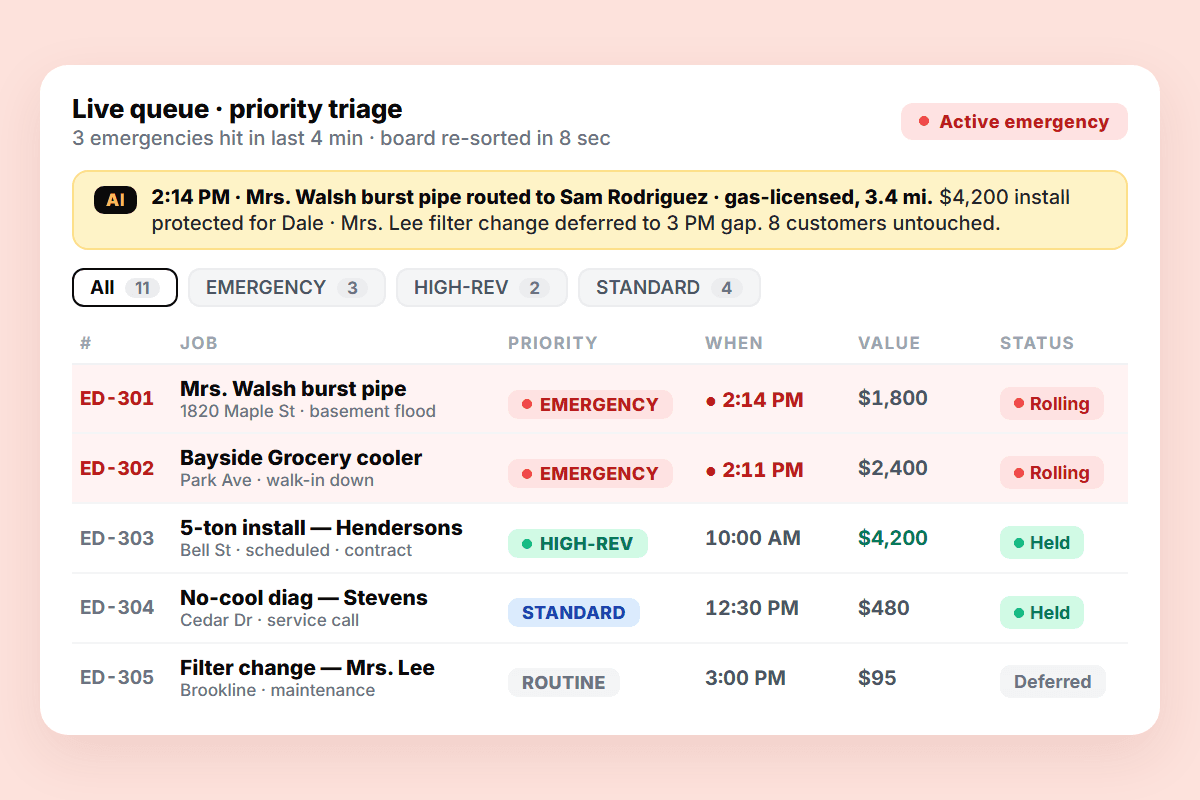
Every job gets tagged with one of four priority levels — EMERGENCY, URGENT, STANDARD, ROUTINE. A flooding callout outranks a filter change. A $4,200 install holds its morning slot over a $95 service. The board re-sorts itself instead of you choosing who to call back.
02
Live re-route with
day-protection
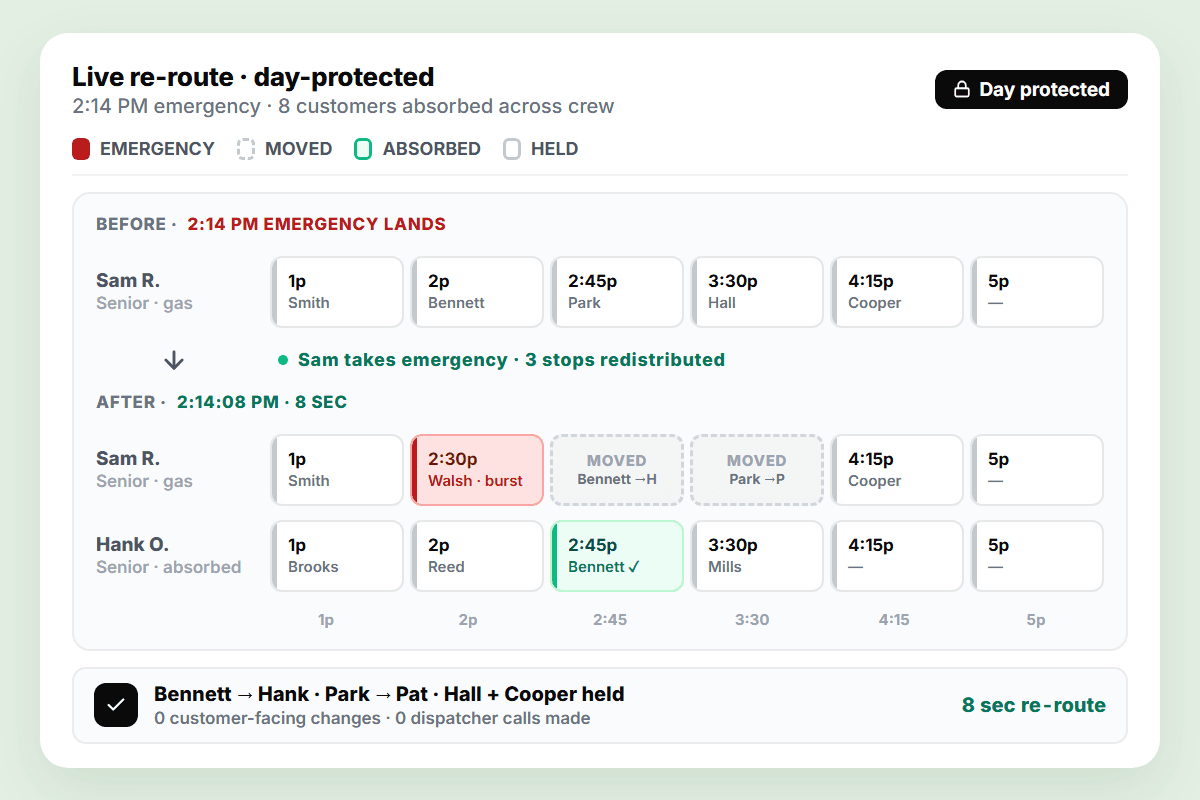
The emergency lands. The AI finds the tech with the lightest afternoon AND the right capability, reroutes them, and redistributes their remaining stops across the crew — before the dispatcher confirms with one tap. The other eight customers don’t even know the day changed.
03
Skill-aware
emergency assignment
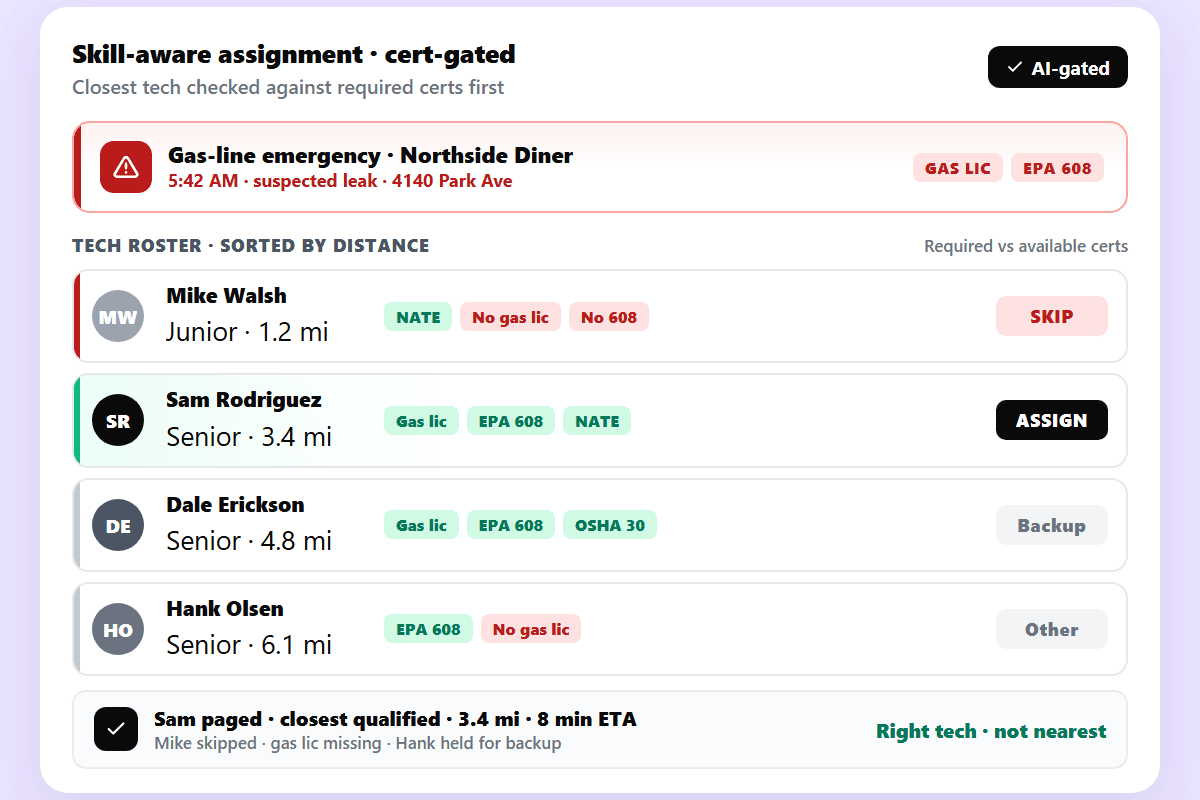
A gas-line emergency won’t page a non-gas-licensed tech. A burst-pipe at 5 AM won’t ping the apprentice. AI Dispatcher checks every emergency against tech certs, license tier, and current workload — so the right tech rolls, not just the closest one.
Why emergency-response pros love Dispatcher AI?
AC down at 2 AM? Burst pipe at dawn? Gas-line emergency mid-route? AI Dispatcher keeps your crew on time when the call queue explodes. It auto-tags every emergency by priority, matches certified techs to the call type, and reroutes the right tech in under 10 seconds — before the next call hits.
Book a Demo Now
WORKS WITH YOUR DISPATCH STACK
Connects to the tools emergency-heavy shops actually use.
AI Dispatcher sits on top of your existing software. Emergencies flow in, optimized re-routes flow back. No migration. No disruption — even during the worst week of the year.
ServiceTitan
Pull live emergency tickets, tech certs, and customer SLA tiers. Push prioritized re-routes back the second a callout hits.
Housecall Pro
Import emergency bookings and on-call availability. Emergency reassignments push back with accurate ETAs and SMS to the customer.
ServiceTrade
Commercial fire, life-safety, and MEP teams get emergency dispatch that reads work orders, asset history, and SLA-locked response windows.
QuickBooks
Emergency rates, after-hours premiums, and overtime hours flow straight into invoicing — no manual rate-coding after the night.
READY?
Stop dispatching emergencies
by gut feel.
See how AI Dispatcher triages every emergency by priority, reroutes the right tech in seconds, and protects the rest of your day. Free trial — no credit card.
No credit card required · Live in 30 minutes · Cancel anytime
Frequently Asked Questions
How does emergency dispatch software handle multiple emergency calls at once?
FieldCamp’s AI Dispatcher tags every incoming call with one of four priority levels — EMERGENCY, URGENT, STANDARD, ROUTINE — at the moment of intake. When three emergencies hit at 2 PM in July, the board re-sorts in under 10 seconds: the AI assigns each emergency to the tech with the lightest afternoon plus the right cert, redistributes their displaced stops across the rest of the crew, and pushes ETA confirmations to every affected customer. The dispatcher reviews exceptions, not the whole rebuild. Powered by priority dispatch routing.
Does AI dispatch route to the nearest technician or the right technician for an emergency?
The right technician, every time. FieldCamp’s skill-based dispatching treats cert eligibility as a hard constraint — a gas-line emergency is never offered to a non-gas-licensed plumber, a commercial refrigeration EPA 608 job is never routed to a residential-only tech. The optimizer balances drive distance, cert match, license tier, and current workload, then assigns the qualified tech with the cheapest re-route — not just the closest van.
What happens to my other appointments when an emergency reroutes a technician?
They stay on time. When AI Dispatcher pulls a tech off their route for an emergency, it simultaneously redistributes their remaining stops across the rest of the crew based on drive radius, skill match, and current workload — before the dispatcher confirms the emergency assignment. The other eight customers receive automated ETA updates if their slot shifts, and most never see a change because the redistribution absorbs inside the existing day’s capacity. Powered by dynamic rerouting.
How does FieldCamp handle after-hours emergencies and on-call rotation?
After-hours calls bypass the dispatcher entirely. The system reads the call type, checks the on-call rotation, validates the next-up tech against the required cert, and pages directly. If the on-call tech lacks the cert — a non-EPA-608 tech for a commercial refrigeration call — the page skips them and goes to the next qualified tech in the rotation. Rotation fairness is tracked across the last three shifts so the same two techs do not absorb every weekend. See on-call scheduling for the full mechanism.
Can AI Dispatcher prioritize emergencies by revenue or customer SLA tier?
Yes. The four-level priority engine reads customer tier, contract value, and SLA window alongside job urgency. A property-management contract customer with a 4-hour SLA outranks a residential walk-in for the same emergency type. A $4,200 install holds its morning slot over a $95 emergency-rate filter change. Priority is a weighted score the AI optimizes against, not a single field. See revenue-priority dispatch for the full breakdown.
Does FieldCamp work with my existing CRM or do I need to migrate my data?
FieldCamp sits on top of your existing FSM. Two-way OAuth integrations connect to ServiceTitan, Housecall Pro, Jobber, ServiceTrade, Salesforce Field Service, MS Dynamics, and Service Fusion. Jobs, techs, certs, schedules, and customer data sync in real time. No data migration, no rip-and-replace. Setup runs in under 30 minutes. Custom integrations via REST API or CSV import for any FSM not on the list. See full integration list.
How fast does AI Dispatcher actually reroute when an emergency lands?
Under 10 seconds from emergency intake to a new board state. The optimizer evaluates every tech’s current location, remaining workload, cert eligibility, and route detour cost, picks the best assignment, redistributes downstream stops, and surfaces the result with a one-tap confirmation for the dispatcher. The dispatcher’s role becomes review and approve, not build and call.
Does emergency dispatch cap overtime when the day cascades into night?
Yes. Workload balancing tracks live billable hours per tech against a daily OT threshold. When an emergency would push a tech into overtime, the system flags the cost, proposes reassigning the stop to a tech under cap, or holds the stop for the next day if the SLA allows. Ownership sees the overtime cost projection before approving the assignment — the OT bill is not a Friday surprise.
How long until AI Dispatcher is handling real emergencies in my shop?
Typical field service shops are running production emergency dispatch within 2-3 weeks. Time depends on data hygiene — clean tech cert records, accurate truck loadouts, and SLA-tier tagging on the customer file — more than software setup. The integration with your existing FSM goes live in 30 minutes; the cert and capacity records typically take a few days to clean up; the AI then runs a shadow week alongside your dispatcher before going live on emergencies.