---
title: "How to Charge for Travel Time in 2026"
url: "https://fieldcamp.ai/blog/how-to-charge-for-travel-time/"
date: "2026-03-19T15:10:13+00:00"
modified: "2026-10-05T06:07:32+00:00"
type: "Article"
resource: "https://fieldcamp.ai/blog/how-to-charge-for-travel-time/"
timestamp: "2026-10-05T06:07:32+00:00"
author:
name: "Jeel Patel"
categories:
- "Uncategorized"
word_count: 5557
reading_time: "28 min read"
summary: "Travel time costs money—fuel, vehicle wear, opportunity cost, and actual time spent driving instead of generating revenue. Yet many field service businesses either undercharge or fail to…"
description: "Complete guide to traveling charges. Real contractor rates, step-by-step pricing formulas, free calculator & profit tips. Updated with %currentyear% mark..."
keywords: "how to charge for travel time, Uncategorized"
language: "en"
schema_type: "Article"
related_posts:
- title: "Free General Contractor Invoice Template"
url: "https://fieldcamp.ai/general-contracting-software/invoice-template/"
- title: "Quickbooks"
url: "https://fieldcamp.ai/hvac-software/quickbooks/"
- title: "AI Agents"
url: "https://fieldcamp.ai/hvac-software/ai-agents/"
---
# How to Charge for Travel Time in 2026
_Published: March 19, 2026_
_Author: Jeel Patel_

> Travel time costs money—fuel, vehicle wear, opportunity cost, and actual time spent driving instead of generating revenue. Yet many field service businesses either undercharge or fail to…
Travel time costs money—fuel, vehicle wear, opportunity cost, and actual time spent driving instead of generating revenue. Yet many field service businesses either undercharge or fail to charge altogether, eating into profit margins that determine whether you thrive or merely survive.
With inflation pushing operational costs higher and customer expectations demanding faster response times, [field service automation](https://fieldcamp.ai/workflow-builder/) has become essential for managing travel efficiently while charging appropriately.
Whether you’re a [solo contractor](https://fieldcamp.ai/team-management/) or managing a [team of technicians](https://fieldcamp.ai/team-management/), having a clear travel fee structure protects your bottom line while staying competitive.
#### Quick Stat:
According to the Bureau of Labor Statistics, the average price of regular gasoline reached $3.42 per gallon in early 2026, up 4.2% from the previous year —making untracked travel costs an even bigger drain on your margins.
This comprehensive guide walks you through detailed strategies for charging travel time, real-world examples from successful businesses, and practical tools to implement travel charges that clients understand and accept.
## How should you charge for travel time?
1. [**Hourly rate**](#1-hourly-rate-method): charge travel time at 50–100% of your regular service rate.
2. [**Per mile**](#2-permile-method): a fixed rate per mile that covers fuel, vehicle wear and time.
3. [**Flat fee**](#3-flat-fee-method): a set fee by distance zone or service area.
4. [**Hybrid**](#4-hybrid-approach): combine methods by distance, time or job type.
5. [**Dynamic**](#5-dynamic-travel-pricing-timeofday-or-demandbased): different rates by time of day, day of week or urgency.
Whichever you pick, apply it to every customer the same way, and tell them before the job, not after.
## Why Charging for Travel Time Matters?
Many service businesses view travel as a “cost of doing business” and absorb it into their operating expenses. This approach works fine for local routes with short distances, but it becomes unsustainable when you’re covering larger territories or dealing with traffic-heavy urban areas.
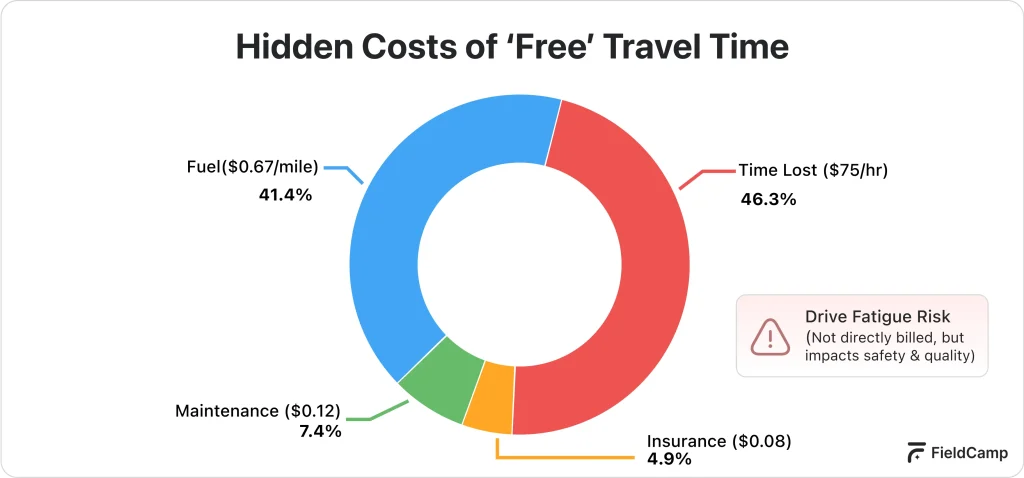**The Hidden Costs of “Free” Travel:**
- **Fuel expenses** average $0.70 per mile (IRS, 2026)
- **Vehicle maintenance,** including oil changes, tire wear, and unexpected repairs
- **Insurance costs** that increase with business mileage
- Opportunity cost of time that could be spent on billable work (see our [hourly rate guidelines](https://fieldcamp.ai/blog/how-much-to-charge-per-hour/) to maximize your earning potential)
- **Driver fatigue** is affecting the quality and safety on subsequent jobs
According to the Bureau of Labor Statistics, field service businesses that implement travel charging see profit margins increase by 15-25% within the first year *(BLS, 2024)*. More importantly, clear travel policies reduce client disputes and set professional expectations from the start.
**When Travel Charges Make Sense:**
- Jobs located more than 15-20 minutes from your base location
- Rural areas requiring a significant drive time
- Emergency or same-day service calls
- Multi-stop routes with inefficient routing
- High-traffic areas where travel time is unpredictable
**When to Absorb Travel Costs:**
- Regular maintenance contracts where travel is built into the monthly rates
- High-value jobs where travel represents less than 10% of the total cost
- Local [service areas](https://docs.fieldcamp.ai/online-booking/service-areas-in-fieldcamp) within a defined radius
- Competitive situations where travel fees might cost you the job
### Streamline Your Travel Billing from Day One
Manually calculating mileage, tracking drive time, and adding travel fees to invoices eats into the time you could spend on billable work. FieldCamp automates the entire process — from GPS route tracking to invoice generation.
[Book a demo](https://calendly.com/jeel-fieldcamp/30min "Claim a Demo Now")
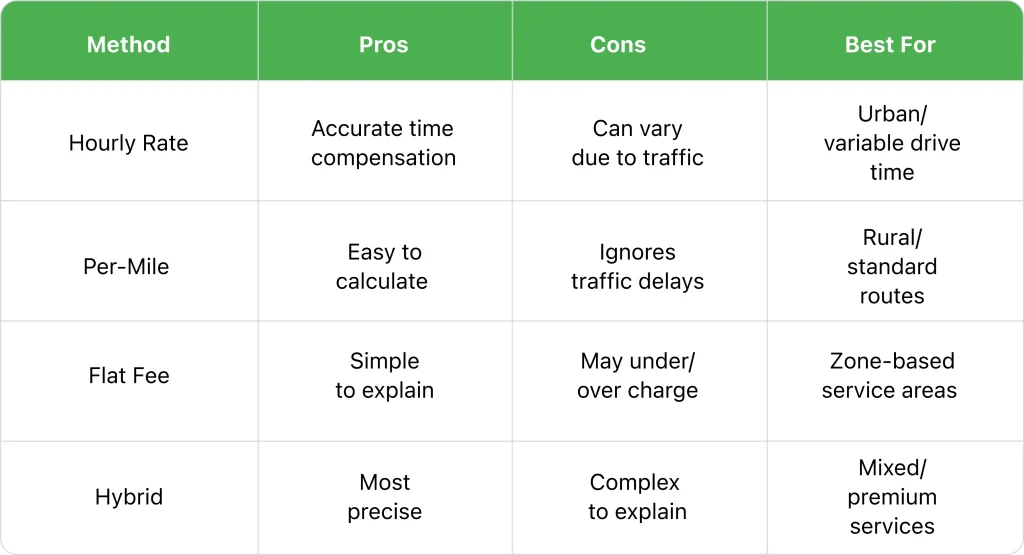
## Five Proven Travel Pricing Methods
Choosing the right travel pricing method depends on your service type, typical distances, and client preferences. Here’s how each approach works, with real examples and clear pros and cons.
### 1. Hourly Rate Method
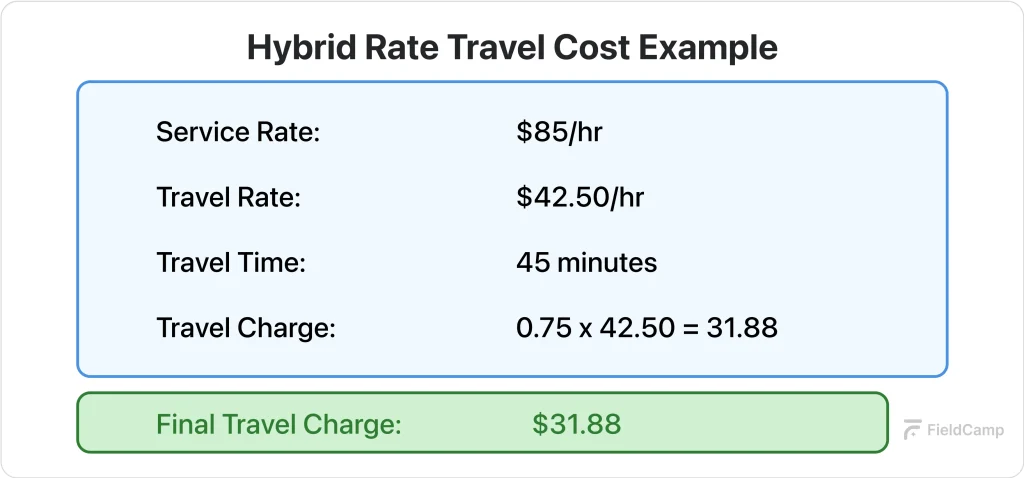
**How it works:** Charge an hourly rate for time spent traveling, typically 50-100% of your regular service rate. **Formula:** Travel Time (hours) × Travel Hourly Rate = Travel Charge
✓
Directly compensates for actual time spent
✓
Easy for clients to understand
✓
Fair for both short and long drives
✓
Rewards efficiency improvements
✕
Requires accurate time tracking
✕
It can seem expensive for short distances
✕
Traffic delays increase costs unpredictably
✕
May discourage clients from booking distant jobs
**Best used for:** Service calls where time is the primary cost factor, or when travel time varies significantly between jobs.
#### Helpful Read:
Need help determining your base service rates before calculating travel charges? Our [professional service pricing guide](https://fieldcamp.ai/blog/service-pricing-guide/) covers hourly rate strategies across all field service industries.
### 2. Per-Mile Method
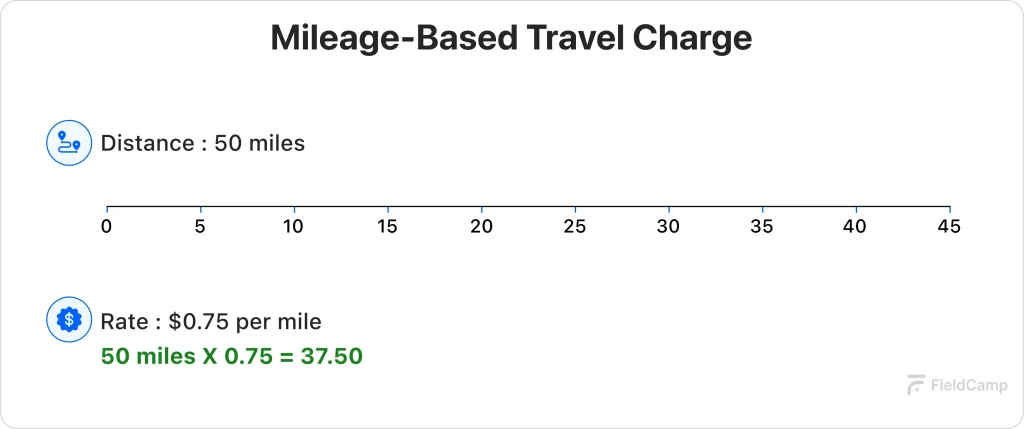
**How it works:** Charge a fixed rate per mile traveled, covering fuel, vehicle wear, and time.
**Formula:** Total Miles × Per-Mile Rate = Travel Charge
**Industry Benchmarks:**
- **HVAC/Plumbing:** $0.75-$1.25 per mile
- **Electrical:** $0.65-$1.00 per mile
- **Cleaning Services:** $0.50-$0.85 per mile
**Landscaping:** $0.60-$0.90 per mile
#### Helpful Read:
HVAC contractors using modern and the [best scheduling apps](https://fieldcamp.ai/hvac-software/best-apps/) report 25% more accurate mileage tracking and billing compared to manual methods.
**Example Calculation:**
- Distance to job: 25 miles (round trip: 50 miles)
- Rate: $0.75 per mile
- **Travel charge: 50 × $0.75 = $37.50**
✓
Transparent and easy to calculate
✓
Covers actual distance costs
✓
Predictable for both you and clients
✓
Aligns with IRS mileage rates
✕
Doesn’t account for traffic or road conditions
✕
May undercharge for time in heavy traffic
✕
Requires accurate mileage tracking
✕
Fixed rate regardless of vehicle efficiency
**Best used for:** Regular service routes, rural areas with consistent travel conditions, or businesses with standardized vehicle fleets.
### 3. Flat Fee Method
**How it works:** Charge a predetermined fee based on distance zones or service areas.
**Example Zone Structure:**
- **Zone 1 (0-10 miles):** No travel charge
- **Zone 2 (11-20 miles):** $25 travel fee
- **Zone 3 (21-35 miles):** $45 travel fee
**Zone 4 (35+ miles):** $65 travel fee
✓
Simple to communicate and implement
✓
Reduces billing complexity
✓
Clients know costs upfront
✓
Easy to adjust rates by zone
✕
May overcharge for short distances
✕
Undercharges for time-intensive routes
✕
Less precise than other methods
✕
Requires regular zone rate updates
**Best used for:** Businesses with defined service areas, emergency services, or when simplicity is prioritized over precision.
### 4. Hybrid Approach
**How it works:** Combines multiple methods based on distance, time, or job characteristics.
**Example Structure:**
- **Base fee:** $15 for any job over 10 miles
- **Plus mileage:** $0.50 per mile over 15 miles
- **Plus time:** $25/hour for travel time over 30 minutes
**Calculation Example:**
- Distance: 28 miles (one way)
- Travel time: 45 minutes
- Base fee: $15
- Mileage charge: (28-15) × $0.50 = $6.50
- Time charge: (45-30) ÷ 60 × $25 = $6.25
- **Total travel charge: $15 + $6.50 + $6.25 = $27.75**
✓
Most accurate cost recovery
✓
Flexible for different situations
✓
Can optimize for profitability
✓
Accounts for multiple cost factors
✕
Complex to explain to clients
✕
Requires detailed tracking
✕
More billing administration
✕
Potential for calculation errors
**Best used for:** Businesses serving diverse geographic areas with varying traffic conditions and job types.
### 5. Dynamic Travel Pricing (Time-of-Day or Demand-Based)
**How it works:** Charge different travel rates based on:
- Time of day (rush hour vs off-peak)
- Day of week (weekend premium)
- Urgency (emergency/same-day vs scheduled)
#### Example Structure
| Time Window | Travel Rate | Use Case |
|---|---|---|
| Off-peak (10 AM–3 PM, Mon–Fri) | $20/hour | Standard appointments |
| Rush hour (7–9 AM, 4–7 PM) | $40/hour | Premium time slots |
| Weekends | $35/hour | Weekend surcharge |
| Emergency (same-day) | $60/hour | Urgent requests |
#### Best For
- Metro areas with severe traffic congestion (LA, NYC, Chicago, DC, SF)
- Businesses with flexible scheduling (not emergency-only services)
- Commercial clients who book in advance
#### Real Example
A Denver HVAC company charges:
- $25 travel fee for 11 AM–2 PM appointments (lowest demand window)
- $50 travel fee for 8 AM appointments (highest demand + traffic)
- $75 emergency fee for same-day calls
**Result:** 60% of customers now book in the 11 AM–2 PM window (saving the company’s most profitable techs for complex jobs during peak hours).
#### When to Use Dynamic Pricing?
- You have consistent demand across multiple time windows
- Your [scheduling software](https://fieldcamp.ai/blog/best-work-order-scheduling-software/) can enforce time-based rates automatically
- You want to smooth out [job scheduling](https://fieldcamp.ai/scheduling/) peaks (reduce 8 AM rushes)
#### When to Avoid It?
- You’re 100% emergency/on-demand (no scheduled appointments)
- Your market is price-sensitive and values simplicity
- You don’t have scheduling software to track time windows
Free policy card
### Five methods on this page. Your office needs one, written down
Tick one method, set your zone bands and who may waive them, fix the round-trip rule and write your answers to the usual objections. Fill it once and keep it by the phone.
## Real Businesses, Real Results
Here’s how field service companies across different industries successfully implemented travel pricing:
### Sarah’s Plumbing — Phoenix, Arizona
- **Challenge:** Losing money on long-distance jobs in sprawling Phoenix metro area
- **Solution:** Flat $35 fee for service zones 15–25 miles out
- **Result:** Added $18,000 in previously lost revenue in Year 1
**Sarah’s takeaway:** “We used to eat the cost of driving 40 minutes each way to North Scottsdale. The $35 fee covers gas, wear-and-tear, and our technician’s time. Customers understand it — they’re driving that far to get to work too.”
### Metro HVAC — Chicago, Illinois
- **Challenge:** Techs spending 90+ minutes in traffic for jobs just 15 miles away during rush hour
- **Solution:** Dynamic travel rate
- Off-peak: $25/hour
- Rush hour (7–9 AM, 4–7 PM): $40/hour
- **Result:** Rush hour jobs became profitable; scheduling shifted naturally to off-peak hours
**Owner’s insight:** “Chicago traffic is brutal. A 15-mile job at 8 AM could take 90 minutes. The dynamic rate either compensates us fairly or encourages customers to book at 10 AM instead. Win-win.”
#### Pro Tip:
Use [AI-powered dispatch scheduling](https://fieldcamp.ai/ai-dispatcher/) to automatically assign the closest available technician to each job — reducing drive time and making your travel fees more competitive.
### Green Lawn Care — Rural Montana
- **Challenge:** Complex zone pricing confused customers (many ranchers and farmers)
- **Solution:** Simplified to flat $0.60/mile rate
- **Result:** Billing disputes dropped 80%
**Why it worked:** “Our customers drive tractors and trucks. They get mileage. When we explained ‘$0.60/mile round-trip — same as IRS rate,’ they instantly understood. No pushback.”
### Elite Electrical — Los Angeles, California
- **Challenge:** Competing with local electricians in specific zones; travel fees made them look expensive
- **Solution:** Built travel into higher onsite service rates (no separate line item)
- Shop rate: $95/hour
- Onsite rate (within 10 miles): $115/hour
- Onsite rate (10–20 miles): $135/hour
- **Result:** Customers didn’t perceive “extra fees” — just saw one hourly rate
**Owner’s note:** “Some customers react poorly to line items. We tested pricing transparency vs built-in rates. Built-in rates converted 22% better. People hate ‘nickel-and-diming’ but accept zone-based pricing.”
## Calculating Your True Travel Costs
Before setting travel rates, understand what it actually costs to put a technician on the road. Many businesses underestimate these expenses and end up subsidizing travel from their profit margins.
### Direct Vehicle Costs
- **Fuel Expenses:** Calculate your average fuel cost per mile based on current gas prices and vehicle efficiency.
#### **Formula:** (Current Gas Price ÷ Vehicle MPG) = Cost per Mile
**Example:**
**Fuel cost: $3.50 ÷ 22 = $0.16 per mile**
Gas price: $3.50/gallon
Vehicle MPG: 22 miles/gallon
- **Maintenance and Repairs:** Factor in regular maintenance (oil changes, filters, belts) plus unexpected repairs. The IRS standard business mileage rate of $0.70 per mile (IRS, 2026) provides a good baseline that includes these costs.
- **Vehicle Depreciation:** Business use accelerates vehicle depreciation. Calculate annual depreciation and divide by expected business miles.
- **Insurance Costs:** Commercial vehicle insurance costs more than personal use. Factor the additional premium into your per-mile calculation.
### Time-Based Costs
- **Driver Wages:** Include the hourly wage plus employer taxes, benefits, and workers’ compensation for time spent traveling.
- **Opportunity Cost:** Time spent driving is time not generating revenue. If your technician bills typically $75/hour, that’s potential revenue lost during travel.
**Example Total Cost Calculation:**
- Fuel: $0.16/mile
- Vehicle maintenance: $0.12/mile
- Insurance: $0.08/mile
- Depreciation: $0.15/mile
- **Total vehicle cost: $0.51/mile
- Driver wage: $25/hour
- Benefits and taxes: $8/hour
- **Total labor cost: $33/hour**
For a 20-mile, 30-minute trip:
- Vehicle costs: 20 × $0.51 = $10.20
- Labor costs: 0.5 × $33 = $16.50
- **Total cost: $26.70**
To maintain a 25% profit margin, charge: $26.70 ÷ 0.75 = **$35.60**
Not sure about your calculations? Use our [travel pricing calculator](https://fieldcamp.ai/service-price-calculator/) to determine profitable travel rates based on your specific costs quickly.
#### Free Tool:
Calculate precise labor costs, including travel time, with our [free labor cost calculator tool](https://fieldcamp.ai/labor-cost-calculator/) designed for field service businesses.
## How Much to Charge per Mile for Travel: Mileage Rates by Industry
The IRS standard business mileage rate for 2026 is **$0.70 per mile**, up from $0.67 in 2025. But most field service businesses charge more than the IRS
rate because it only covers vehicle operating costs — not your time, not your expertise, and not the billable hours you’re losing while driving.
Here’s what contractors actually charge per mile in 2026:
| Industry | Per-Mile Rate | Typical Range | Notes |
|---|---|---|---|
| HVAC | $0.90–$1.50/mile | 15–40 mile radius | Higher for emergency calls |
| Plumbing | $0.75–$1.25/mile | 10–30 mile radius | Often bundled into service call fee |
| Electrical | $0.65–$1.00/mile | 15–35 mile radius | Commercial jobs charge more |
| Cleaning | $0.50–$0.85/mile | 5–20 mile radius | Tighter service area |
| Landscaping | $0.60–$0.90/mile | 10–25 mile radius | Trailer/equipment adds cost |
| Handyman | $0.50–$0.75/mile | 10–20 mile radius | Plus service call fee |
| Pressure Washing | $0.70–$1.00/mile | 15–30 mile radius | Equipment transport factored in |
| Pest Control | $0.55–$0.80/mile | 10–25 mile radius | Route density matters most |
### Do You Charge Mileage Both Ways?
This is one of the most common questions field service owners ask. The answer depends on your pricing model:
- Yes, charge both ways if, you use a per-mile rate and the customer is outside your primary service zone. Most contractors who charge explicitly per mile calculate the round-trip distance. A 20-mile job at $0.85/mile = $34 round trip ($17 each way).
- No, charge one way if, you’re routing multiple jobs in the same area. Charging round-trip mileage for every stop on a route of 5 jobs would overcharge customers and make your pricing uncompetitive.
- The hybrid approach most successful contractors use: charge round-trip mileage for the first and last job of the day, but only one-way incremental mileage between jobs on the same route. This is fair and defensible if a customer questions it.
### How to Charge Mileage to Customers?
**Step 1**: Calculate your true per-mile cost. Take your annual vehicle expenses (fuel, insurance, maintenance, depreciation) and divide by miles driven.
For most service trucks, this lands between $0.45–$0.65/mile.
**Step 2**: Add your time cost. If you earn $75/hour and drive 30 mph average in your service area, your time costs $2.50/mile. Your true cost is vehicle ($0.55) + time ($2.50) = $3.05/mile. This is why per-mile pricing alone often undercounts.
**Step 3**: Choose your method. For jobs under 15 miles, a flat service call fee is simpler and converts better. For jobs over 15 miles, per-mile pricing is transparent and fair.
**Step 4**: Present it clearly. On your invoice, show it as: “Travel — 22 miles round trip × $0.85/mile = $18.70” or simply “Service area surcharge: $25.” Customers accept what they can understand.
### Per-Mile vs Flat Fee: When to Use Each
| Scenario | Best Method | Why |
|---|---|---|
| Dense urban area (under 10 miles) | Flat fee ($25–$50) | Simpler, traffic makes per-mile unfair |
| Suburban spread (10–25 miles) | Zone-based flat fee | Predictable for both sides |
| Rural / long distance (25+ miles) | Per-mile rate | Fair reflection of actual cost |
| Emergency / after-hours call | Flat fee + premium | Customer wants certainty, not math |
| Multi-stop route day | One-way incremental | Avoids double-charging |
## Factors That Influence Travel Pricing
Travel charges shouldn’t be one-size-fits-all. Several factors should influence how much you charge for different situations.
### 1. Distance and Location
**Urban vs. Rural Considerations:**
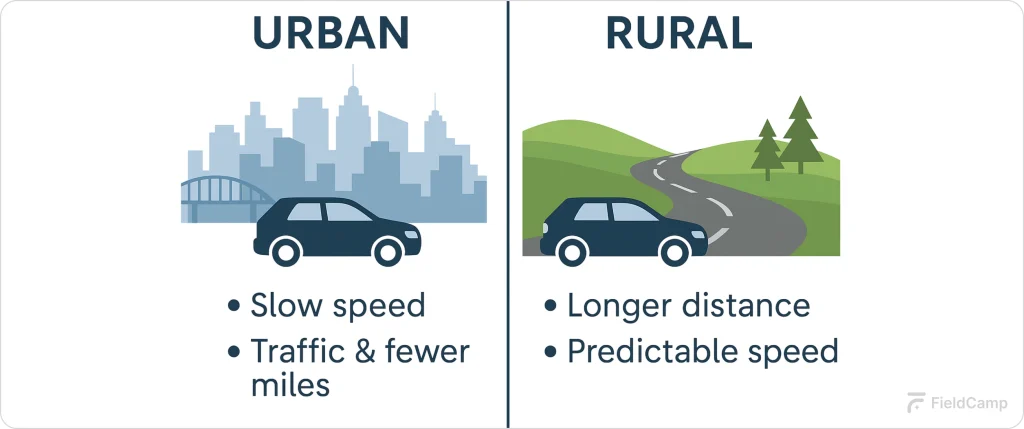
- **Urban areas:** Heavy traffic increases time but not distance
- **Rural areas:** Longer distances but predictable travel times
- **Mixed territories:** Hybrid approaches work best
**Service Area Strategy:** Define your primary service area, including travel, and then charge incrementally for zones beyond that radius.
### 2. Traffic and Road Conditions
- **Peak vs. Off-Peak Pricing:** Consider charging premium rates for travel during rush hours when time costs increase significantly.
- **Seasonal Adjustments:** Winter conditions, construction zones, or tourist season traffic may justify temporary rate increases.
### 3. Job Value and Urgency
- **High-Value Jobs:** For large projects, travel costs become a smaller percentage of total billing and may be absorbed or discounted.
- **Emergency Services:** Same-day or emergency calls typically justify premium travel rates—sometimes 150-200% of standard charges.
- **Regular vs. One-Time Clients:** Reward loyal customers with reduced or waived travel fees while charging full rates for one-time service calls.
### 4. Vehicle and Equipment Requirements
- **Standard Service Vehicle:** Base your standard travel rate on your most common vehicle type.
- **Specialized Equipment:** Larger trucks, trailers, or specialized equipment may justify higher travel rates due to increased fuel consumption and operating costs.
Every project is different. Plug your numbers into our [pipe volume calculator](https://fieldcamp.ai/plumbing-software/pipe-volume-calculator/) to get a more accurate picture.
Free tool
### Want a starting rate before you fill in the card? Use the pricing calculator
Put in your own costs and it works out a price you can quote from. Then write the travel rate you settle on into your policy.
## Industry-Specific Travel Rate Guidelines
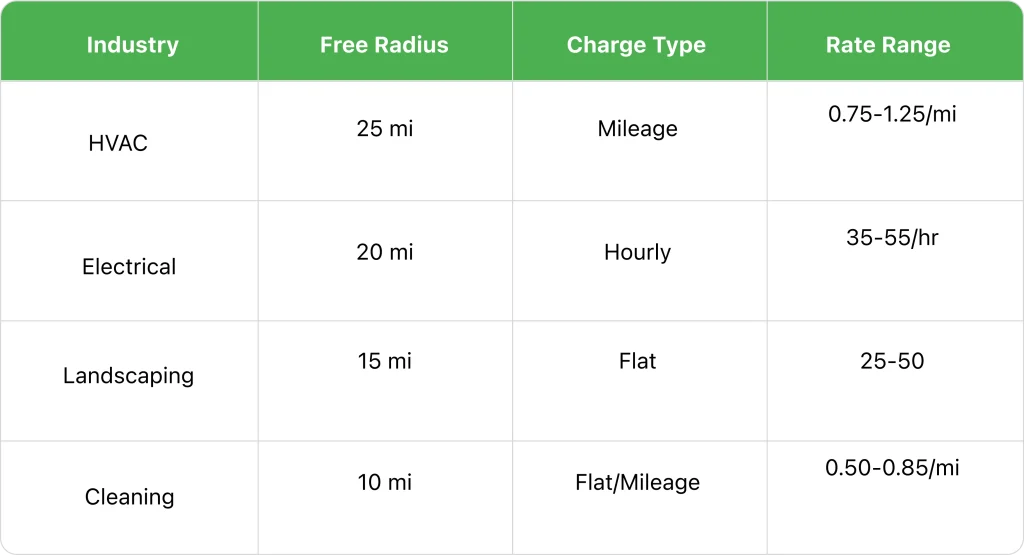
Different service industries have established norms for travel charging. Understanding these benchmarks helps you stay competitive while protecting profitability.
### HVAC and Plumbing Services
**Typical Structure:**
- Service area radius: 15-25 miles (no charge)
- Beyond service area: $0.75-$1.25 per mile or $45-$75 flat fee
- Emergency calls: 50-100% premium on travel charges
*Source: ACCA Industry Survey, 2024*
These are general ranges, but your costs will vary. Use our [HVAC CFM calculator](https://fieldcamp.ai/hvac-software/cfm-calculator/) to narrow it down for your situation.
#### Helpful Read:
Optimize your [HVAC travel routing](https://fieldcamp.ai/route-optimization/) and reduce unnecessary costs with [proven dispatching strategies](https://fieldcamp.ai/hvac-software/dispatching-tips/) that save fuel and increase daily job capacity.
### Electrical Contractors
**Common Approaches:**
- Hourly travel rate: $35-55/hour (portal-to-portal)
- Mileage rate: $0.65-$1.00 per mile
- Flat zone fees: $25-60 depending on distance
*Source: NECA Contractor Pricing Guide, 2024*
### Cleaning Services
**Standard Practices:**
- Local area: No travel charge within a 10-mile radius
- Extended area: $0.50-$0.85 per mile or $15-35 flat fee
- Multiple locations: Discount for route efficiency
*Source: International Sanitary Supply Association, 2024*
### Landscaping and Lawn Care
**Pricing Models:**
- Maintenance routes: Travel built into contract pricing
- One-time services: $25-50 travel fee or $0.60-$0.90 per mile
- Equipment delivery: Additional fees for large machinery transport
*Source: National Association of Landscape Professionals, 2024*
### Handyman and Repair Services
**Flexible Approaches:**
- Service call fee: $35-75 (includes basic travel)
- Extended travel: Additional $0.50-$0.75 per mile beyond 20 miles
- Multi-job discounts: Reduced rates for multiple stops
*Source: Handyman Connection Industry Report, 2024*
### Pressure Washing
**Pressure Washing Services** Travel Considerations:
- Equipment transport: Higher fuel costs due to trailer weight
- Water access requirements: May limit service areas
- Typical rates: $35-55 travel fee or $0.70-$1.00 per mile. For detailed pricing strategies, see our [pressure washing pricing](https://fieldcamp.ai/blog/how-much-to-charge-for-pressure-washing/) guide.
## Urban vs Rural: Regional Travel Pricing Strategies
Travel pricing isn’t just about distance — geography, traffic, and local market norms dramatically impact what works.
**Urban/Metro Areas**
### Los Angeles, California
- **Challenge:** Traffic can turn a 10-mile job into a 60-minute drive during rush hour
- **Common practice:** Time-based travel fees ($30–50/hour) OR dynamic rates (higher during peak traffic)
- **Example rate:** HVAC contractors charge $45 travel fee for 8 AM appointments, $25 for 11 AM appointments
- **Why it works:** Customers understand LA traffic; they’re stuck in it too
### New York City / NYC Metro
- **Challenge:** Tolls + parking + congestion pricing
- **Common practice:** Flat zone fees that include tolls (e.g., “$75 to come to Manhattan from Brooklyn includes $15 toll”)
- **Example:** Electricians add $20–40 “Metro Access Fee” for Manhattan jobs
- **Customer acceptance:** High — NYCers know everything costs more in Manhattan
### Chicago, Illinois
- **Challenge:** Rush hour can triple drive time (especially I-290, I-90/94)
- **Common practice:** Time-based travel billing (start clock when truck leaves, stop when tech arrives)
- **Example rate:** $35/hour travel rate during peak, $20/hour off-peak
- **Why it works:** Billing actual time = fair; customers can choose off-peak appointments to save
**Rural/Suburban Areas**
### Rural Montana / Wyoming / Dakotas
- **Challenge:** Jobs can be 50–100+ miles apart; explicit per-mile fees feel excessive
- **Common practice:** Flat regional rates or minimum distance fees (e.g., “0–25 miles included, $50 flat for 25–50 miles, $100 for 50–100 miles”)
- **Why it works:** Ranchers and farmers understand long distances; flat fees feel fair (vs “$120 for 200 miles round-trip”)
### Texas (Rural Hill Country, Panhandle)
- **Challenge:** Massive service areas (some HVAC companies cover 200+ mile radius)
- **Common practice:** Tiered flat fees by county (e.g., “$50 in Williamson County, $100 in Burnet County, $150 in Llano County”)
- **Customer acceptance:** Very high — Texans expect to pay for distance in rural areas
### Midwest Small Towns (Iowa, Nebraska, Kansas)
- **Challenge:** Low competition means customers have fewer options; price sensitivity is high
- **Common practice:** Build travel into service call minimum (e.g., “$95 minimum includes travel within 30 miles”)
- **Why it works:** Simpler; no sticker shock from seeing $95 service + $40 travel as two line items
**Suburban Sprawl Markets**
### Phoenix/Scottsdale, Arizona
- **Challenge:** Metro area is 500+ square miles; “local” can mean 40 miles
- **Common practice:** Zone-based flat fees (e.g., Central Phoenix free, North Scottsdale +$35, Surprise/Goodyear +$50)
- **Example:** Plumbers use 85XXX zip code zones for pricing
- **Customer acceptance:** High — Phoenicians understand distance between Scottsdale and Goodyear
### Atlanta, Georgia
- **Challenge:** Traffic (Spaghetti Junction, I-285) makes time unpredictable
- **Common practice:** Hybrid model: Free travel within I-285 loop, $1/mile outside, $50 flat fee for beyond 30 miles
- **Why it works:** I-285 is a clear boundary Atlantans recognize
#### Key Takeaway:
Match your pricing model to your market’s geography AND psychology:
- **Mixed:** Hybrid (free within X miles, $Y/mile beyond, $Z flat for distant jobs)
- **Dense urban:** Time-based or traffic-dynamic fees
- **Sprawling suburban:** Zone-based flat fees
- **Rural:** Tiered flat rates or county-based fees
## How to Present Travel Charges to Clients?
The key to client acceptance is transparency and advanced communication. Never surprise clients with travel charges after work is completed.
### **1.** Communication Strategies
- **During Initial Inquiry:** “Our service area includes free travel within 15 miles of [your location]. For jobs beyond that, we charge $0.75 per mile to cover fuel and travel time. Based on your address, that would add approximately $25 to your service call.”
- **In Written Estimates:** Always break out travel charges as a separate line item rather than burying them in labor costs.

### 2. Positioning Travel Charges Positively
- **Focus on Value:** “Our travel charge ensures we can serve customers throughout the region while maintaining our rapid response times.”
- **Emphasize Fairness:** “We believe in fair pricing—clients closer to our shop shouldn’t subsidize travel costs for distant jobs.”
- **Highlight Competitive Rates:** “Our travel rate of $0.75 per mile is below the IRS business rate and includes all fuel, vehicle, and time costs.”
### 3. Client Objections
- **“Other companies don’t charge for travel.”** Response: “That may be true, but those costs are typically built into higher service rates. Our transparent pricing lets you see exactly what you’re paying for.”
- **“The travel charge seems high.”** Response: “I understand that concern. Let me break down what’s included: fuel, vehicle maintenance, insurance, and our technician’s time. It works out to about [X%] of your total service cost.”
- **“Can you waive the travel fee?”** Response: “For jobs over $X or regular maintenance contracts, we’re happy to discuss including travel in the service rate. For this size job, the travel charge helps keep our base rates competitive for all customers.”
Angle · Objections
### Write the answer to “why am I paying for your drive?” before the customer asks
The three objections above come up on every phone line. The policy card has a space for each one, in your own words and with your own numbers, so whoever answers says the same thing.
## When to Build Travel into Service Rates Instead?
Not every business should charge explicit travel fees. Sometimes, building travel costs into your base service rate leads to better conversions and fewer objections.
### Signs You Should Hide Travel Fees
- **You serve a small, defined service area (e.g., one city or county)** → If 90% of jobs are within 15 miles, a separate travel fee feels like nickel-and-diming
- **Your market has strong price sensitivity** → Residential customers (especially homeowners) react poorly to “add-on” fees
- **Competitors don’t advertise travel fees** → If your competitors’ websites say “flat $125 service call,” explicit travel fees make you look more expensive (even if total price is the same)
- **You want simpler billing/sales conversations** → One rate = easier to quote, easier to explain, faster close
## Three Ways to Hide Travel Fees (Without Losing Money)
#### Option 1: Minimum Service Call Fee
**How it works:** Set a minimum that includes 1 hour of work + travel within your primary zone
**Example:**
- “$125 minimum service call (covers 1 hour + travel within 15 miles)”
- Additional hours: $95/hour
- Outside 15 miles: $15 per additional 5-mile increment
**Best for:** Plumbers, electricians, HVAC techs serving metro areas
**Psychological win:** Customers see “$125 minimum” as reasonable. They don’t see a $95 service + $30 travel fee breakdown (which feels like two charges).
#### Option 2: Zone-Based Hourly Rates (Higher Onsite vs Shop Rates)
**How it works:** Charge 20–30% more for onsite work (vs shop/remote rates)
**Example (Appliance Repair):**
- Shop/bench repair rate: $80/hour
- Onsite rate (Zone 1: 0–10 miles): $100/hour
- Onsite rate (Zone 2: 10–20 miles): $120/hour
- Onsite rate (Zone 3: 20+ miles): $140/hour
**Best for:** Repair businesses that can do some work in-shop (appliances, computers, small equipment)
**Why customers accept it:** They understand “onsite is more expensive.” The price difference feels justified (you’re coming to them), not like an arbitrary fee.
#### Option 3: Bundled “Service Area Surcharge” (Built Into Quotes)
**How it works:** Don’t list “travel” as a line item. Instead, increase labor or project subtotal by 10–15% for distant jobs.
**Example (Pressure Washing):**
- Job in your home city: Quote $350
- Same job 25 miles away: Quote $400 (includes $50 hidden travel cost in “labor” line)
**Best for:** Project-based businesses (landscaping, pressure washing, painting, cleaning)
**Customer perception:** They see one total price. No “travel fee” objection.
## When You Should Charge Explicit Travel Fees?
Despite the above, transparent travel fees work better when:
- **You serve large rural areas (50+ mile jobs are common)** → Customers expect travel fees; hiding them makes quotes inconsistent
- **You’re in commercial/B2B markets** → Property managers, facility managers, and business owners expect itemized invoices
- **Your competitors are transparent about travel fees** → If others charge $X service + $Y travel, match their format
- **You offer emergency/after-hours service** → Customers accept premium fees for urgency; transparency builds trust
### Bottom Line
Test both approaches. Track conversion rates for 30 days with explicit fees, then 30 days with hidden fees. Let data decide.
## Tools and Technology for Travel Tracking
Here’s what an all-in-one field service platform looks like in action:
[Accurate travel billing](https://fieldcamp.ai/invoicing-software/) requires reliable tracking. Manual calculations lead to errors, disputes, and lost revenue.
### Automated Mileage Tracking
- **GPS-Based Solutions:** Modern [field service software](https://fieldcamp.ai/) automatically tracks vehicle movements, calculates distances, and applies your travel rates to invoices.
- Automated travel tracking is just one component of comprehensive [field service optimization](https://fieldcamp.ai/blog/field-service-optimization/), which also includes routing, scheduling, and resource management.
### Time-Based Tracking
- **Portal-to-Portal Timing:** Track total time from when technicians leave the shop until they return, distinguishing between travel time and on-site work.
- **Job-to-Job Routing:** For multi-stop days, calculate travel time between individual jobs rather than round-trip from base.
### Integration with Billing Systems
- **Automated Invoice Generation:** The best systems pull travel data directly into invoices, eliminating manual entry and reducing billing errors.
- **Client Portal Access:** Provide clients with access to route maps and time logs to justify travel charges when questioned.
## Common Mistakes to Avoid
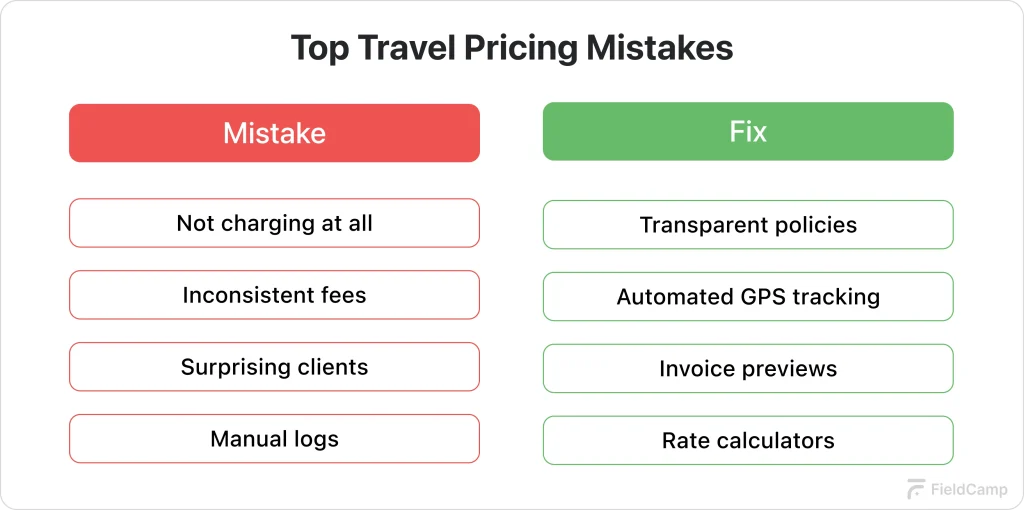
Learning from others’ mistakes saves time, money, and client relationships. Here are the most frequent travel pricing errors and how to avoid them.
### Undercharging or Not Charging
- **The Problem:** Many businesses either don’t charge for travel or set rates too low to cover actual costs.
- **The Solution:** Calculate your true cost per mile and time, then add appropriate profit margin. Review and adjust rates annually.
### Inconsistent Application
- **The Problem:** Charging some clients travel fees while waiving them for others creates confusion and perceived unfairness.
- **The Solution:** Establish clear policies and apply them consistently. Document any exceptions and the business reasons for them.
Angle · Consistency
### A policy the office re-invents on every call is not a policy
Charging one customer and waiving the next is the mistake this guide names. The card holds the one written exception and who may approve it, so a waived fee is a decision, not a mood.
### Poor Communication
- **The Problem:** Surprising clients with travel charges after work is completed leads to disputes and collection issues.
- **The Solution:** Discuss travel policies during initial contact and include charges in written estimates.
### Inadequate Tracking
- **The Problem:** Manual mileage logs are error-prone and difficult to defend if questioned.
- **The Solution:** Use GPS-based tracking systems that provide accurate, defensible documentation. Detailed [field service reporting](https://fieldcamp.ai/blog/field-service-reports/) provides the data necessary to justify travel expenses and identify opportunities for optimization.
### Zone Pricing Errors
- **The Problem:** Setting zone boundaries that create cliff effects where neighboring addresses have dramatically different travel charges.
- **The Solution:** Use gradual rate increases or switch to per-mile pricing for more equitable charging.
### Ignoring Market Conditions
- **The Problem:** Setting travel rates without considering local competition or client expectations.
- **The Solution:** Research competitor policies and adjust your approach to remain competitive while protecting profitability.
### Should I Charge Round-Trip or One-Way Travel?
Most field service businesses charge round-trip mileage because the return trip is a real cost (fuel, time, vehicle wear). However, some businesses charge one-way mileage when:
- They schedule multiple jobs in the same area on one day (“the next customer covers the next leg”)
- The job is on the route home from another appointment
#### Best Practice
- Charge round-trip for single, isolated jobs
- Consider one-way discounts when you have 2+ jobs in the same zone on the same day
#### Example
- **Job #1 (solo trip):** Charge 40 miles round-trip at $0.60/mile = $24
- **Jobs #2 & #3 (same neighborhood, same day):** Charge 20 miles one-way each at $0.60/mile = $12 each
## Ready to Optimize Your Travel Pricing?
Smart travel pricing protects your profit margins while maintaining competitive service delivery. The key is choosing the right method for your business model, communicating clearly with clients, and tracking accurately to ensure proper billing.
Whether you implement per-mile rates, hourly charges, or zone-based fees, consistency and transparency build client trust while protecting your bottom line. **Streamline travel tracking and billing with FieldCamp.** FieldCamp’s scheduling, route planning and integrated invoicing cut out manual steps while ensuring accurate travel charges every time. [Book a demo](https://calendly.com/jeel-fieldcamp/30min) → and see how easy profitable travel pricing can be.
## Frequently Asked Questions
**How do I determine whether to charge for travel time?**
Start by calculating your average monthly travel costs, including fuel, vehicle maintenance, and driver wages. If travel represents more than 5% of your total operating expenses, you should implement travel charges. Also consider charging if you regularly travel more than 15-20 minutes to job sites.
**What’s the difference between charging hourly vs per-mile for travel?**
Hourly rates compensate for actual time spent regardless of distance, making them ideal for urban areas with heavy traffic. Per-mile rates are more effective for rural areas with consistent speeds. Hourly rates typically range from 50-100% of your service rate, while mileage rates average $0.50-$1.25 per mile, depending on your industry.
**Should I charge different travel rates for emergency vs scheduled jobs?**
Yes, emergency or same-day calls typically justify 50-100% higher travel rates due to route inefficiency and immediate response requirements. Make sure this premium is clearly communicated when clients request emergency service.
**How do I handle travel expenses for multiple stops in a single day?**
For route efficiency, charge travel from your shop to the first job, then mileage between subsequent jobs, and return travel to your shop. Some businesses offer discounts when jobs are geographically clustered on the same day.
**Can I include travel time in my regular hourly rate, rather than charging separately?**
You can, but this approach often leads to undercharging for distant jobs and overcharging for local ones. Separate travel charges provide transparency and ensure fair pricing based on actual costs incurred.
**What should I do if a competitor doesn’t charge for travel?**
Research whether they’re building travel costs into higher service rates or operating with lower profit margins. Focus on communicating the value and transparency of itemized pricing rather than matching potentially unsustainable competitor practices.
**How often should I review and update my travel rates?**
Review travel rates quarterly and adjust them annually based on changes in fuel costs, vehicle expenses, and wage increases. Implement changes with a 30-60 day notice to existing clients and update your website and marketing materials accordingly. Track key [field performance metrics](https://fieldcamp.ai/blog/field-service-metrics/), including travel efficiency, fuel costs per job, and profit margins, to optimize your travel pricing strategy
**Is there a maximum distance I should travel regardless of travel charges?**
Most successful field service businesses limit their service area to within a 45-60 minute drive time. Beyond that, travel costs often exceed job profitability, and response times become uncompetitive. Consider partnerships with local contractors for distant work.
**How much should I charge for a travel fee?**
Most field service businesses charge between $25 and $75 as a flat travel fee for jobs within their primary service area (typically 15–25 miles). For jobs
beyond that radius, add $0.65–$1.25 per additional mile depending on your industry. HVAC and electrical contractors tend to charge on the higher end due to
heavier equipment and specialized vehicles. Cleaning and pest control businesses typically stay on the lower end because tighter routes keep costs down.
**How do I bill for travel time as a contractor?**
There are three common billing approaches. First, include travel in your service call fee — a single line item like “Service call: $85” that covers the
first 30 minutes of travel plus diagnosis. Second, bill travel time at 50–75% of your regular hourly rate as a separate line item. Third, use zone-based
pricing where customers in Zone 1 (0–15 miles) pay no travel fee, Zone 2 (15–30 miles) pays $35, and Zone 3 (30+ miles) pays $65. The zone method is the
MostWhat should I charge per mile for travel? popular because customers can see exactly where they fall before booking.
**What should I charge per mile for travel?**
The IRS standard mileage rate for 2026 is $0.70/mile, but this only covers vehicle costs. Field service contractors typically charge $0.65–$1.25 per mile to
also account for time and lost billable hours. Your per-mile rate should be at minimum: (annual vehicle costs ÷ annual miles) + (your hourly rate ÷ average
mph in your area). For most service businesses, this works out to $0.85–$1.10 per mile.
**Do plumbers charge for travel time?**
Yes, most plumbers charge for travel time, though how they charge varies. According to industry data, 68% of plumbing businesses include travel in a flat
service call fee (typically $75–$125), while 22% charge a per-mile rate ($0.75–$1.25/mile), and about 10% absorb travel costs into their hourly rate.
Emergency plumbing calls almost always include an explicit travel or dispatch fee, ranging from $95–$175 depending on time of day and distance.
### The travel charge policy card
One method, your zone bands, a round-trip rule and your objection answers, on a two-page card you fill once. No call required.
### See scheduling, routing and invoicing on one job record in FieldCamp
Estimates and invoices on the same job record, so the travel line you quoted is the travel line you bill.
[Book a demo](https://calendly.com/jeel-fieldcamp/30min "Book a demo")
---
_View the original post at: [https://fieldcamp.ai/blog/how-to-charge-for-travel-time/](https://fieldcamp.ai/blog/how-to-charge-for-travel-time/)_
_Served as markdown by [Third Audience](https://github.com/third-audience) v3.6.1.1_
_Generated: 2026-10-05 06:07:33 UTC_