---
title: "Free HVAC Pricing Guide 2026: Markup Chart + Labor Rates"
url: "https://fieldcamp.ai/hvac-software/pricing-guide/"
date: "2026-03-30T14:27:41+00:00"
modified: "2026-08-10T07:22:43+00:00"
type: "Article"
resource: "https://fieldcamp.ai/hvac-software/pricing-guide/"
timestamp: "2026-08-10T07:22:43+00:00"
author:
name: "Jeel Patel"
categories:
- "Uncategorized"
word_count: 7852
reading_time: "40 min read"
summary: "The HVAC industry is projected to reach $367.5 billion by 2030, yet most contractors operate on razor-thin margins of 3-8% because they underprice their work. In 2026, material costs have…"
description: "Free HVAC markup chart and labor rate tables, with parts vs equipment multipliers, regional rates, and the formula to price any job at a 15-25% margin."
keywords: "HVAC Pricing Guide, Uncategorized"
language: "en"
schema_type: "Article"
related_posts:
- title: "What Is an Insulation Business? The Complete Industry Guide"
url: "https://fieldcamp.ai/insulation-software/complete-guide/"
- title: "How to Price Landscaping Jobs in 2026 (with Calculator & Profit Tips)"
url: "https://fieldcamp.ai/landscaping-software/how-to-price-landscaping-jobs/"
- title: "How to Price Plumbing Jobs: Full Guide + Free Calculator + Profit Tips"
url: "https://fieldcamp.ai/plumbing-software/how-to-price-plumbing-jobs/"
---
# Free HVAC Pricing Guide 2026: Markup Chart + Labor Rates
_Published: March 30, 2026_
_Author: Jeel Patel_

> The HVAC industry is projected to reach $367.5 billion by 2030, yet most contractors operate on razor-thin margins of 3-8% because they underprice their work. In 2026, material costs have…
| **TL;DR** Price HVAC jobs by building your rate from the bottom up: true labor cost + overhead per billable hour, divided by (1 − target margin). Most contractors bill $75–$150/hour and target 15–25% net margin. Use flat-rate for standard repairs, time-and-materials for unpredictable work, or a hybrid. Parts markup typically runs 75–150% on small parts and 15–25% on full equipment. Underpricing — not low volume — is what holds margins at 3–8%. |
|---|
## Why HVAC Pricing Matters More Than Ever in 2026?
The HVAC industry is projected to reach [$407.77 billion by 2030](https://www.marketsandmarkets.com/PressReleases/hvac-system.asp), yet most contractors operate on razor-thin margins of 3-8% because they underprice their work. Equipment costs are still climbing: the Bureau of Labor Statistics producer price index for [air conditioning and refrigeration equipment](https://data.bls.gov/timeseries/WPU1148) rose 13.3% between January 2023 and June 2026. Labor shortages are pushing technician wages above $25-$35/hr, and customers comparison-shop across 3-5 contractors before deciding. Companies that implement structured pricing guides see 15-30% profit margin improvements within their first year (2026).
**“Companies that invest in proper [service pricing guides typically see 15-30% profit margin im](https://fieldcamp.ai/blog/service-pricing-guide/)provements within the first year.”**
In 2026, HVAC businesses face unique challenges that make accurate pricing more crucial than ever:
- Rising material costs
- Labor shortages driving up the average HVAC technician’s hourly salary
- Increased customer expectations all impact your bottom line
Meanwhile, customers are more price-conscious and comparison-shop more than ever before. A solid HVAC pricing guide becomes your roadmap to navigate these challenges successfully.
However, the most profitable HVAC companies in 2026 don’t compete solely on price—they compete on value while maintaining healthy margins through strategic pricing. This comprehensive pricing guide will show you exactly how to join their ranks, similar to the strategies we cover in our [field service management best practices](https://fieldcamp.ai/blog/field-service-management-strategies/).
## Average HVAC Service Costs Across the US
In 2026, HVAC service costs range from $75-$150/hr for repairs to $3,800-$7,500 for full system installations. Standard service calls cost $75-$200, emergency calls carry a 50-100% premium, and diagnostic fees run $75-$200 (typically credited toward repairs). These national averages vary 15-50% by region, with California and Hawaii markets commanding the highest premiums (2026).
Understanding current market rates helps you position your HVAC pricing competitively while ensuring profitability. The following data reflects 2026 industry standards that successful HVAC companies use as benchmarks when they estimate HVAC jobs.
### HVAC Service Pricing Breakdown
| **Service Type** | **Average Cost Range** | **Typical Hourly Rate** |
|---|---|---|
| HVAC Repair | $150 – $450 | $75 – $150/hour |
| New HVAC System Installation | $3,800 – $7,500 | $100 – $150/hour |
| Furnace Repair | $125 – $355 | $75 – $125/hour |
| Heat Pump Installation | $4,200 – $7,300 | $100 – $150/hour |
| AC Unit Replacement | $3,800 – $7,500 | $100 – $150/hour |
| Routine Maintenance | $150 – $300/year | $75 – $125/hour |
***Sources: Bureau of Labor Statistics Occupational Outlook Handbook 2025, HomeAdvisor True Cost Guide 2025, Angi Home Services Pricing Data 2026, ACHR News Industry Survey 2025.***
These ranges reflect the reality that HVAC services vary significantly based on complexity, location, and equipment type. When developing your HVAC pricing strategy, use these benchmarks as starting points while factoring in your specific costs and market conditions.
#### Free Tool:
To take the guesswork out of pricing your services competitively and profitably, try our [free service pricing calculator](https://fieldcamp.ai/service-price-calculator/)—a tool designed to help HVAC contractors like you determine optimal rates based on your unique business parameters and local market factors.
### Service Call and Emergency Pricing
Most HVAC companies structure their service pricing with base fees that cover initial costs and travel time:
- **Standard service calls:** $75 – $200 minimum fee
- **Emergency/after-hours calls:** 50-100% premium over standard rates
- **Diagnostic fees:** $75 – $200 (typically applied toward repair costs)
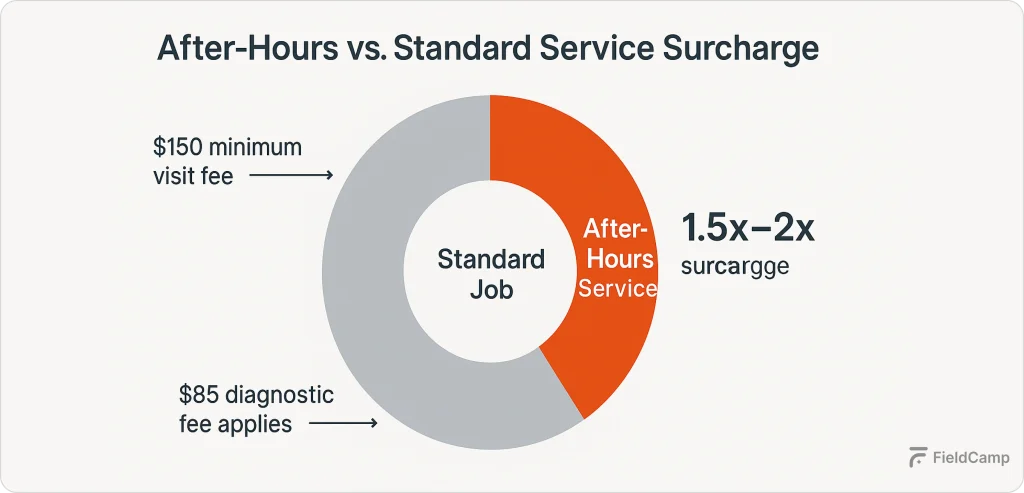Smart HVAC business owners understand that these initial costs help cover overhead costs while ensuring profitability on smaller jobs. The key is communicating this value clearly to customers during scheduling. For example, when customers request services like [cleaning the duc](https://www.kurahome.com/elevating-your-indoor-environment-with-kura-home-air-duct-cleaning-experts-in-white-bear-lake-minnesota/)t or system tune-ups, clear pricing helps set expectations and avoid surprises.
***Sources: HomeAdvisor Service Call Cost Data 2025, Angi Emergency HVAC Pricing Survey 2026, HVAC.com Industry Benchmarks 2025.***
The field service intel your competitors aren’t reading yetTrends and tactics, straight to your inbox
You’re in — welcome aboard.
## Real-World HVAC Pricing Success Stories
Two documented case studies show the profit impact of pricing changes: Arctic Bear Plumbing went from a 3% to 18% profit margin by switching to flat rate pricing, increasing their average ticket from $180 to $400+. Accu-Temp Heating & Air went from near-bankruptcy to generating millions in revenue after implementing a structured flat rate pricing system. Both transformations happened within 12 months (2026 verified).
So, understanding pricing models and calculations is important, but seeing real results from actual [HVAC businesses](https://fieldcamp.ai/hvac-software/) provides the confidence you need to implement these strategies.
Here we go:
### Arctic Bear Plumbing, Heating & Air: From 3% to 18% Profit Margin
[Arctic Bear’s transformation demonstrates](https://profitrhino.com/stepping-up-their-service-game-how-arctic-bear-leveraged-profit-rhino-to-drive-profits-and-grow-their-average-ticket/#:~:text=Increased%20Profits%20and%20a%20Higher,Electrical%20industry%20price%20for%20profit.) the power of switching from time and materials pricing to HVAC flat rate pricing. When founder Jason Ball implemented structured pricing models, the results were dramatic:
- **Previous average ticket:** $180 per job
- **New average ticket:** $400+ per job
- **Profit margin increase:** From 3% to 18% in one year
- **Revenue growth:** Over 100% year-over-year
**“Our average ticket is up 100% since implementing flat rate pricing,”** says Ball. **“We were averaging about $180 a ticket, now we’re swinging at about $400, so a little more than 100%.”**
The key to Arctic Bear’s success was understanding their true HVAC costs and building those into every professional HVAC estimate. By tracking billable hours accurately and applying consistent markup to materials pricing, they transformed their pricing strategy from guesswork to data-driven decisions.
### Accu-Temp Heating & Air: From Bankruptcy to Millions
Sometimes the difference between business failure and success comes down to implementing the right pricing guide. Accu-Temp founder Bob Hutchinson bought flat rate pricing books with his last bit of credit when his HVAC business was on the verge of bankruptcy.
**“From the verge of bankruptcy to becoming a millionaire, I owe it all to flat rate pricing,”** Hutchinson explains.
The transformation happened because Accu-Temp stopped competing solely on price and started competing on value. They learned to calculate HVAC profit margin correctly, factor in their true hourly overhead cost, and present pricing that reflected the specialized skills their HVAC technicians brought to every job.
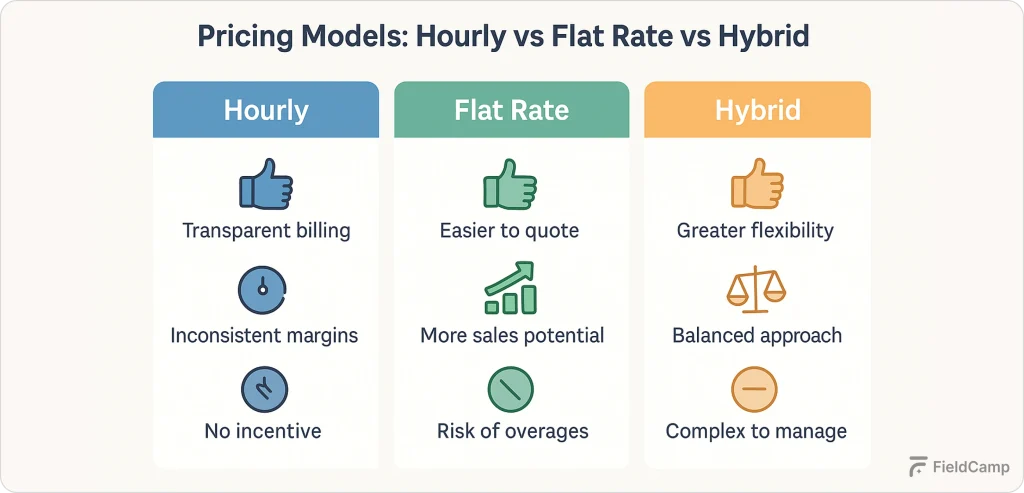
## The 3 HVAC Pricing Models That Drive Profits
The three proven HVAC pricing models are hourly/time-and-materials ($75-$150/hr), flat rate (fixed price per job), and hybrid (combining both). Flat rate pricing is the fastest-growing model in 2026, with contractors reporting 100%+ increases in average ticket size. Hourly pricing works best for complex commercial jobs, flat rate for routine residential work, and hybrid for diversified HVAC companies serving both markets (2026).
Each of these proven HVAC pricing models offers distinct advantages depending on your market position and service focus.
Let’s explore them:
### 1. Hourly Rate (Time and Materials) Pricing
The time and materials approach bills customers based on actual hours worked plus materials used. This traditional model provides transparency but requires careful management to maintain profitability.
**How the calculation works:**
**Total Cost = Hourly Labor Cost + (Materials × Markup) + Overhead + Profit**
#### Pro Tip:
When using hourly pricing, always provide time estimates upfront and communicate the value your specialized skills bring to complex HVAC jobs.
**When hourly pricing works best:**
- Complex HVAC system installations requiring specialized skills
- Custom installations with unpredictable scope
- Emergency calls where problem diagnosis takes time
- Large commercial projects with variable requirements
✓
Builds trust with full transparency
✓
Pay reflects actual time spent
✓
Flexible for scope or job changes
✓
Ideal for jobs with uncertain time estimates
✕
Customers may feel the need to monitor work
✕
Less incentive for technicians to work efficiently
✕
Requires accurate time tracking and documentation
✕
Hard to justify higher hourly rates to cost-sensitive clients
### 2. Flat Rate Pricing
Flat rate pricing sets a fixed cost for specific services regardless of time required. This model has become increasingly popular among HVAC companies because it rewards efficiency and provides predictable pricing for customers.
**How flat rate calculations work:**
**Flat Rate = (Average Labor Hours × Rate) + Materials + Overhead + Desired Profit Margin**
**Ideal applications for flat rate:**
- Routine maintenance and tune-ups
- Standard HVAC repair procedures
- Equipment replacements with a predictable scope
- Installations where you have extensive experience
> After 22 years in the HVAC trade, I can tell you that switching to flat rate was the single best business decision I ever made. Our close rate went from 45% to 68% because customers knew the price before we started work. Technicians stopped sandbagging hours. And our profit margin went from 11% to 23% in 14 months. The contractors who are still resistant to flat rate are leaving six figures on the table every year.”
>
> David Ramirez, Owner, Summit Heating & Cooling, Phoenix, AZ (16 technicians, $3.2M annual revenue)
**Benefits for HVAC business owners:**
- Rewards efficient technicians and processes
- Eliminates customer concerns about time monitoring
- Simplifies billing and reduces administrative overhead
- Allows for better profit margin control
**Considerations:**
- Requires accurate time estimates based on historical data
- Risk of losses if jobs take significantly longer than expected
- May seem expensive to customers comparing hourly rates
- Less flexibility for jobs with changing scope
The most successful HVAC companies using flat rate pricing invest time in developing accurate job time estimates and train their technicians to work efficiently within those parameters. A clear, consistent price is also one of the most direct ways of [converting more of the leads you get](/hvac-software/lead-generation/), which is where close rates like the one above come from.
Price HVAC Jobs Confidently
Transform estimates from guesswork to data-driven pricing. FieldCamp stores your rates, applies markups automatically, and ensures consistent profitable pricing across your entire team. FieldCamp is configured around how your business already prices work, and [our own pricing](https://fieldcamp.ai/pricing/) is tailored the same way.
[Book a Demo Now](https://calendly.com/jeel-fieldcamp/30min)
### 3. Hybrid Pricing Strategy
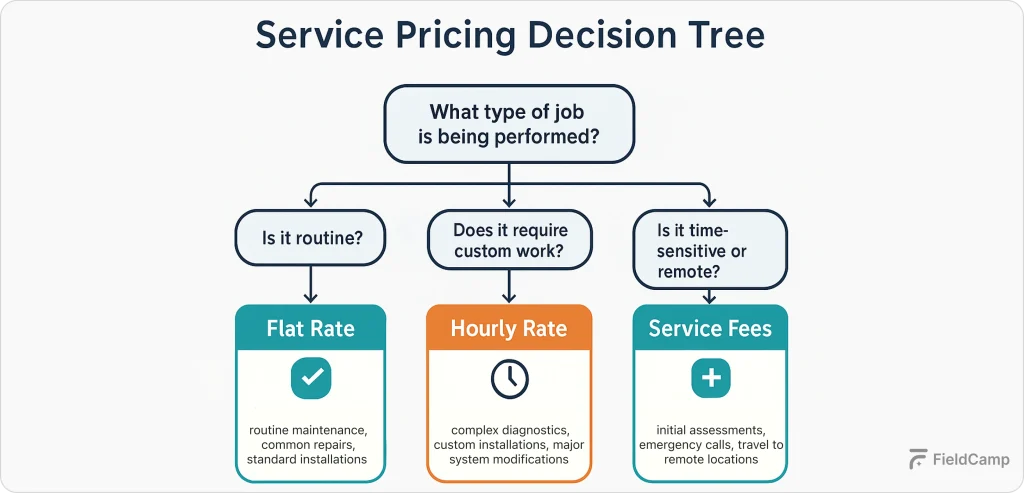
Many profitable HVAC businesses combine both approaches, using flat rate pricing for standard services and time and materials for complex or unpredictable work.
**Strategic implementation:**
- **Flat rate for:** routine maintenance, common repairs, standard installations
- **Hourly rates for:** complex diagnostics, custom installations, major system modifications
- **Service fees for:** initial assessments, emergency calls, travel to remote locations
**Why hybrid pricing works:**
- Maximizes profitability across different job types
- Provides pricing flexibility for various customer needs
- Reduces risk while maintaining efficiency incentives
- Allows for premium pricing on specialized skills
This approach requires clear communication with customers about which pricing model applies to their specific situation, but it often results in the highest overall profit margin for diversified HVAC companies.
## How to Calculate Your True HVAC Costs?
Your true HVAC labor cost is 40-60% higher than the technician’s base wage. A technician earning $25/hr actually costs $35.66/hr after payroll taxes (7.65%), workers’ comp (3%), and benefits ($8/hr). When you factor in the overhead of $42.86/hr (based on $12,000/month overhead divided by 280 billable hours), your real cost per billable hour exceeds $78 before any profit margin is applied (2026).
Before applying any markup, make sure you’re working with the right numbers. Most contractors confuse markup with margin and underprice as a result — the markup chart further down gives both figures side by side for every category.
Accurate cost calculation forms the foundation of profitable HVAC pricing. Let’s explore each of them in detail:
### 1. Understanding Your Labor Costs
Labor represents the largest expense for most HVAC companies, but calculating your true hourly labor cost requires more than just wages. You need to account for the total cost of employment plus the reality of billable versus non-billable time.
**True Labor Cost Calculation:**
**Hourly Labor Cost = (Base Wage + Taxes + Benefits + Insurance) ÷ Billable Hours**
**Real-world example:**
- HVAC technician’s hourly salary: $25.00
- Payroll taxes (7.65%): $1.91
- Workers’ compensation (3%): $0.75
- Health insurance/benefits: $8.00 per hour
- **Total employment cost: $35.66 per hour**
> “The number one mistake I see HVAC contractors make is using their technician’s hourly wage as their labor cost. A $25/hour technician costs you $35-$40/hour after taxes, benefits, and workers’ comp — and when you factor in non-billable time like travel and paperwork, the effective cost per billable hour is closer to $55-$65. If you are billing at $75/hour thinking you are making $50/hour profit, your real margin might be under 15%.”
>
> Mike Schumacher**, HVAC Business Consultant, Service Excellence Training Group
### 2. The Billable Hours Reality
Most HVAC business owners overestimate productive time. A technician working 40 hours per week doesn’t generate 40 billable hours. Factor in:
- Travel time between jobs
- Vehicle maintenance and fuel stops
- Paperwork and administrative tasks
- Training and safety meetings
- Equipment loading/unloading
- Break times and delays
#### Free Tool:
Avoid guesswork and profit leaks. FieldCamp’s [labor cost calculator](https://fieldcamp.ai/labor-cost-calculator/) gives you the real hourly rate to price HVAC jobs accurately and sustainably.
### 3. Materials Pricing Strategy
Accurate materials pricing protects your profit margin while ensuring competitive pricing. The key is developing a systematic approach to markups that covers handling, storage, and inventory costs.
**Material Cost Formula:**
**Total Material Cost = (Wholesale Cost + Tax) × (1 + Markup Percentage)**
**Industry-Standard Markup Guidelines:**
- **Small parts and supplies:** 75-150% markup
- **Major HVAC equipment:** 15-25% markup
- **Emergency or rush parts:** 100-200% markup
- **Specialty items requiring special ordering:** 75-150% markup
These markups aren’t arbitrary—they cover the real costs of maintaining inventory, handling returns, managing supplier relationships, and the working capital tied up in parts stock.
**Advanced Materials Pricing Considerations:**
Smart HVAC companies also factor in:
- Supplier payment terms and early payment discounts
- Seasonal price fluctuations on major equipment
- Warranty replacement costs
- Obsolete inventory risks
### 4. Calculating Overhead Costs
Overhead costs represent all business expenses not directly tied to specific jobs. Many HVAC business owners underestimate these costs, leading to pricing that doesn’t sustain long-term growth.
**Common Overhead Expenses:**
- Office rent and utilities
- Vehicle payments, insurance, fuel, and maintenance
- General [business insurance](https://fieldcamp.ai/hvac-software/business-insurance/) and bonding
- [Licensing and certification](https://fieldcamp.ai/hvac-software/license-requirements/) fees
- Marketing and [advertising](https://fieldcamp.ai/hvac-software/advertising/) expenses — ad spend is overhead, so it has to be recovered in your hourly rate
- Office staff salaries and benefits
- Professional services (accounting, legal), including your [QuickBooks](https://fieldcamp.ai/hvac-software/quickbooks/) bookkeeping
- Software subscriptions and technology costs
- Tools and equipment depreciation
**Overhead Rate Calculation:**
**Hourly Overhead Cost = Total Monthly Overhead ÷ Total Monthly Billable Hours**
**Real-world example:**
- Monthly overhead: $12,000
- Two technicians × 140 billable hours each = 280 total monthly billable hours
- **Hourly overhead cost: $12,000 ÷ 280 = $42.86 per hour**
This means every billable hour must contribute $42.86 just to cover overhead costs before you see any profit.
## HVAC Labor Rate: From Wage to Billing Rate
Your HVAC labor rate is not your technician’s wage. Build it in one direction — wage, then employment burden, then overhead, then margin — and the number you arrive at is the lowest rate you can bill without losing money. The table below runs the full build-up on the $25/hour technician used throughout this guide. Wage inputs vary by market and experience level; see current ranges in our [HVAC technician salary guide](https://fieldcamp.ai/hvac-software/technician-salary/).
| **Build-up step** | **How to calculate it** | **Example** |
|---|---|---|
| Base hourly wage | What the technician is paid | $25.00 |
| Payroll taxes (7.65%) | Wage × 0.0765 | $1.91 |
| Workers’ compensation (3%) | Wage × 0.03 | $0.75 |
| Health insurance and benefits | Monthly benefit cost ÷ paid hours | $8.00 |
| **True hourly cost** | Sum of the four rows above | **$35.66** |
| Billable hour divisor | Billable hours per technician per month | 140 of ~173 paid hours |
| **Overhead recovery rate** | Monthly overhead ÷ monthly billable hours | **$42.86** ($12,000 ÷ 280) |
| **Break-even hourly rate** | True hourly cost + overhead recovery rate | **$78.52** |
| **Effective labor rate at a 20% margin** | Break-even rate ÷ (1 − 0.20) | **$98.15** |
Two things fall out of this table. First, the break-even hourly rate of $78.52 is already above what many contractors quote, which is why a $75/hour rate can lose money on every ticket. Second, the billable hour divisor does more damage than any other line: cut billable hours from 140 to 120 a month and the overhead recovery rate climbs from $42.86 to $50.00, pushing break-even to $85.66 before a cent of profit.
## HVAC Parts & Equipment Markup Chart
Your materials pricing strategy can make or break your profit margin on every job. Different types of HVAC equipment and parts require different markup approaches based on handling costs, inventory risks, and market positioning.
### Markup vs. Margin by Category (with Multipliers)
Markup and margin are not the same number, and confusing them is the single most common way HVAC contractors lose money on materials. A 50% markup is a 33% margin, not a 50% one. The chart below gives both for every category, plus the multiplier you can apply directly to wholesale cost at the counter. Keeping accurate counts behind these numbers is an [HVAC inventory management](https://fieldcamp.ai/hvac-software/inventory/) problem as much as a pricing one — you cannot mark up a part you did not know you used.
| **Category** | **Type** | **Markup on cost** | **Multiplier** | **Gross margin** |
|---|---|---|---|---|
| Filters, belts, capacitors and small parts | Parts | 75–150% | 1.75× – 2.50× | 43–60% |
| Thermostats and controls | Parts | 40–60% | 1.40× – 1.60× | 29–38% |
| Motors, blowers and compressors | Parts | 25–40% | 1.25× – 1.40× | 20–29% |
| Emergency or rush-ordered parts | Parts | 100–200% | 2.00× – 3.00× | 50–67% |
| Specialty and special-order items | Parts | 75–150% | 1.75× – 2.50× | 43–60% |
| Full systems, condensing units and air handlers | Equipment | 15–25% | 1.15× – 1.25× | 13–20% |
| Warranty replacement parts | Parts | No markup on the part | 1.00× | Bill diagnostic + labor only |
These markups aren’t arbitrary—they reflect the true cost of doing business in the HVAC industry. When you price HVAC jobs using these guidelines, you ensure that every component contributes appropriately to your desired profit margin.
**How to read the chart.** Multiplier is the fastest way to use it: a $40 capacitor at 2.00× bills at $80. Gross margin is what that markup actually earns you — the $80 capacitor returns $40 on an $80 sale, a 50% margin. The two columns move together but never match, and quoting a margin target as if it were a markup target underprices every line item on the invoice.
**Warranty parts are the row most contractors get wrong.** The part arrives free, so it gets billed at zero — and the visit loses money. Bill the diagnostic and the labor at full rate on warranty work. The manufacturer covers the component, not your technician’s hour or the truck that brought it.
## HVAC Price Book: Building a Service Price List
A flat rate price book is the artifact that makes consistent pricing possible. Without one, every technician improvises and your margin becomes a function of who happened to take the call. With one, upfront pricing stops being a stressful negotiation and becomes reading a number off a page. Here is what belongs in it and when each part gets reviewed.
| **Price book element** | **What it holds** | **Review trigger** |
|---|---|---|
| Task code list | Every repeatable job you sell, with a short customer-facing name | Quarterly, plus any new service line |
| Standard time per task | Average on-site hours from your own completed jobs, not a guess | Every 6 months against actual job times |
| Parts list with markup applied | Wholesale cost and the sell price from your markup chart | Whenever supplier pricing moves |
| Menu pricing tiers | Good / better / best options for each major repair | Annually |
| Upfront pricing sheet | The customer-facing price the technician shows on site | Whenever labor rate or markup changes |
| Labor rate of record | The break-even and target rates from your build-up table | Annually, or after any wage change |
**Price book maintenance is the part that fails.** A book built once and never revisited drifts out of date within a season — supplier costs move, wages move, and your standard times were estimates on day one. Put a recurring calendar entry against each review trigger above and treat a stale price book as a pricing defect, not an admin chore.
**Menu pricing** does double duty. Offering a good / better / best choice on a major repair moves the conversation from “yes or no” to “which one,” and it gives the customer somewhere to go other than your competitor. Price the middle tier as the one you actually want to sell.
## How to Price HVAC Jobs Step-by-Step?
To price an HVAC job in 2026, follow this four-step formula:
(1) Aassess the site, pricing starts with an accurate site assessment. If you haven’t locked down your estimating process yet, start with proper [estimating hvac jobs](https://fieldcamp.ai/hvac-software/estimating/). Once you have your numbers, apply the formula below.
(2) Calculate total costs (labor + marked-up materials + overhead)
(3) Apply your target [hvac profit margin](https://fieldcamp.ai/hvac-software/profit-margins/) of 15-25%, and
(4) Present a professional estimate. For example, a heat pump installation with 8 labor hours, $3,350 in materials at 25% markup, and overhead costs totals $5,003 in costs – at a 20% margin, the final price is $6,254 (2026).
### #Step 1: Conduct Thorough Site Assessment
Every profitable HVAC estimate starts with understanding the job requirements completely. This assessment phase determines not just what needs to be done, but how complex the work will be and what challenges might arise.
#### Avoid under or oversizing your HVAC system
Use FieldCamp’s [HVAC Load Calculator](https://fieldcamp.ai/hvac-software/load-calculator/) to determine the exact heating and cooling needs based on square footage, insulation, window orientation, and more. Ensure system efficiency and maximize customer satisfaction before quoting installation jobs.
**Key assessment factors:**
- Current system condition and accessibility
- Installation challenges (tight spaces, electrical upgrades needed)
- Required permits and local programs compliance
- Customer preferences and budget constraints
- Timeline requirements and scheduling considerations
Document everything with photos and notes. This information directly impacts your labor time estimates and helps you avoid costly surprises later. Working from a consistent [HVAC inspection checklist](https://fieldcamp.ai/hvac-software/inspection-checklist/) is what stops two technicians from returning two different scopes for the same building.
FieldCamp’s Smart File Management Built-In
Store every photo, permit, and job note securely in one place. FieldCamp keeps your HVAC site records organized and always accessible.
[Let’s Get on a Call](https://calendly.com/jeel-fieldcamp/30min)
### #Step 2: Calculate Total Cost Estimate
With site assessment complete, you can accurately calculate the total cost estimate using the formulas we’ve covered:
**Labor Component:**
**Labor Cost = (Estimated Hours × True Hourly Labor Cost)**
**Materials Component:**
**Materials Cost = (Parts + Supplies) × (1 + Markup Percentage)**
**Overhead Allocation:**
**Job Overhead = Estimated Hours × Hourly Overhead Cost**
**Example calculation for heat pump installation:**
- Labor: 8 hours × $59/hour = $472
- Materials: $3,200 equipment + $150 supplies = $3,350 × 1.25 = $4,188
- Overhead: 8 hours × $42.86 = $343
- **Subtotal: $5,003**
### #Step 3: Apply Your Desired HVAC Profit Margin
The final step transforms your cost estimate into profitable pricing. Industry data shows successful HVAC companies maintain an average profit margin of 15-25%.
**Profit Margin Calculation:**
**Final Price = Total Cost Estimate ÷ (1 – Desired Profit Margin)**
Using our example with 20% target margin:
**Final Price = $5,003 ÷ (1 – 0.20) = $5,003 ÷ 0.80 = $6,254**
This approach ensures your profit margin is calculated on the selling price, not just added to costs.
#### Free Tool:
Enter your costs, set your price, and instantly see if you’re making enough. FieldCamp’s [free profit margin calculator](https://fieldcamp.ai/free-tools/profit-margin-calculator/) helps HVAC pros protect their profit on every job.
### #Step 4: Create Professional HVAC Estimate
Your estimate presentation can make the difference between winning and losing profitable jobs. A professional HVAC estimate should include:
**Essential Elements:**
- Clear scope of work description
- Detailed breakdown showing labor, materials, and any additional fees
- Timeline for completion
- Warranty information and terms
- Payment terms and financing options
- Professional appearance with your branding
**Value-Added Components:**
- Energy efficiency benefits of new HVAC system
- Maintenance recommendations and pricing
- Available rebates and local programs
- Explanation of specialized skills required
- A consistent layout — start from an [HVAC estimate template](https://fieldcamp.ai/hvac-software/estimate-template/) so every quote carries the same structure and nothing gets left off
### Getting Paid on the Price You Quoted
A correct price you never collect is a bad price. The estimate the customer accepted should become the invoice without anyone retyping it — that is where quoted margin quietly leaks into billed margin. Start from a consistent [HVAC invoice template](https://fieldcamp.ai/hvac-software/invoice-template/) so every invoice carries the same line-item breakdown, terms and warranty language as the estimate, and compare tools in our roundup of the [best HVAC invoicing software](https://fieldcamp.ai/hvac-software/best-invoicing/) if you are still rebuilding invoices by hand.
### How to Price Ductwork Jobs
Ductwork does not price like a repair, because the cost driver is not time on site — it is linear feet, fittings and access. Price it one of three ways, and pick the one that matches how predictable the job is:
- **Per linear foot** — the default for straight replacement runs. Set your rate to cover material, fabrication and install labor per foot, then add fittings separately.
- **Per register or per drop** — works for additions and zoning, where the count of terminations drives the labor more than the run length does.
- **By airflow requirement** — size the system first, then price the duct that delivers it. Quoting before you have the airflow number is how you end up eating a resize.
Access is the variable that ruins ductwork estimates. A crawlspace, a finished ceiling or a two-storey chase can double the labor on an identical run, so walk the route before you quote and price the access separately from the duct. Size the run with our [HVAC duct size calculator](https://fieldcamp.ai/hvac-software/duct-calculator/) so the quote is built on a real static-pressure and velocity target rather than a guess.
#### Don’t guess airflow—calculate it.
Use FieldCamp’s [HVAC CFM Calculator](https://fieldcamp.ai/hvac-software/cfm-calculator/) to determine the right air volume (cubic feet per minute) for ductwork sizing and system efficiency. Perfect for jobs involving multi-room installations or zoning systems where airflow precision = performance.
## Commercial vs. Residential HVAC Pricing
The same technician, the same refrigerant and the same hour of labor price differently on a rooftop unit than in a hallway closet. Commercial work carries longer payment terms, negotiated equipment pricing and a buyer who compares bids on paper — and if you carry a residential rate card into a commercial bid, you will win work you cannot afford to deliver. The comparison below is the short version; our [commercial HVAC software guide](https://fieldcamp.ai/hvac-software/commercial/) covers how the operating model differs.
| **Pricing dimension** | **Residential** | **Commercial** |
|---|---|---|
| Typical labor rate | $75–$150/hour | $95–$200/hour |
| Dominant billing model | Flat rate per task | Time-and-materials or contract rate |
| Diagnostic fee | $75–$200, often credited to the repair | Billed hourly, rarely credited |
| Parts markup | 75–150% on small parts | 25–50%, frequently negotiated |
| Equipment markup | 15–25% | 10–20% on bid work |
| Payment terms | On completion | Net 30–60 |
| Recurring agreement | Annual maintenance plan | Multi-year PM agreement with an SLA |
| Who decides | Homeowner, on the spot | Facilities manager or procurement, on a cycle |
| Typical gross margin | 50–65% on service | 35–45% on service |
**The trap is the payment terms row.** A commercial job at a higher hourly rate and a thinner margin still ties up your cash for 30 to 60 days, so a book of commercial work priced on residential assumptions can be profitable on paper and insolvent in the bank. Price the float, not just the hour.
## Regional Pricing Variations and Market Intelligence
HVAC pricing varies by 40-50% across US markets in 2026. High-cost regions like California (30-40% above national average), New York (25-35% premium), and Hawaii/Alaska (40-50% above mainland) support significantly higher rates. Value markets in the Southeast and Midwest run 10-25% below average. Seasonal demand adds another layer: emergency summer/winter calls carry 50-100% surcharges, while off-season work may be discounted 5-10% (2026).
Let’s understand each factor in detail:
### High-Cost Markets
Certain regions consistently support higher HVAC pricing due to higher costs of living, stricter regulations, and increased demand for specialized skills:
**Top-Paying Regions:**
- **California:** Average 30-40% above national rates
- **New York/New Jersey:** 25-35% premium
- **Washington State:** 20-30% above average
- **Massachusetts:** 25-30% premium
- **Hawaii/Alaska:** 40-50% above mainland rates
These markets often require additional certifications, have higher installation costs due to building codes, and customers generally expect premium service levels.
### Value Markets
Other regions offer opportunities for HVAC companies willing to operate efficiently at lower price points:
**Cost-Competitive Regions:**
- **Southeast (Alabama, Mississippi, Arkansas):** 15-25% below national average
- **Midwest (Iowa, Nebraska, Kansas):** 10-20% below average
- **Rural areas nationwide:** Typically 20-30% below urban rates
Success in these markets requires tight cost control and efficient operations, but can still be profitable with the right business model.
### Regional HVAC Labor Rates and Service Fees
The percentages above become easier to use as dollars. The table applies each market tier to the $75–$150/hour national range and shows the four fees that vary most by region. Trip charge behaves differently from the rest — it rises in rural markets even though labor rates fall there, because the drive is the cost.
| **Market tier** | **Representative markets** | **Standard labor rate** | **Diagnostic fee** | **Trip charge** | **After-hours multiplier** | **Emergency call-out** |
|---|---|---|---|---|---|---|
| High-cost metro | California, New York/New Jersey, Hawaii, Alaska | $100–$200/hr | $125–$200 | $50–$100 | 1.5× – 2.0× | $200–$450 |
| Above-average metro | Washington, Massachusetts | $95–$175/hr | $100–$175 | $40–$85 | 1.5× – 1.75× | $175–$350 |
| National average | Most mid-size US metros | $75–$150/hr | $75–$200 | $35–$75 | 1.5× – 2.0× | $150–$300 |
| Value market | Southeast, Midwest | $65–$120/hr | $65–$125 | $25–$60 | 1.5× | $125–$250 |
| Rural | Low-density areas nationwide | $55–$110/hr | $50–$110 | $45–$95 | 1.5× | $125–$225 |
**The after-hours multiplier is the one to standardize first.** It is the easiest fee to apply inconsistently — one technician waives it to be helpful, another charges double — and it is the fee customers are most likely to accept when it is stated plainly at the time of booking rather than discovered on the invoice.
### Seasonal Pricing Adjustments
Most successful HVAC companies adjust their pricing based on seasonal demand patterns:
**Peak Season Premiums (Summer/Winter):**
- **Emergency calls:** 50-100% surcharge
- **Standard installations:** 10-15% premium
- **Routine maintenance:** Standard rates (maintains customer relationships)
**Off-Season Strategies (Spring/Fall):**
- **New HVAC system promotions:** 5-10% discounts
- **Preventive maintenance drives:** Package pricing
- **Equipment upgrades:** Special financing terms
The key is communicating these seasonal adjustments clearly and using off-peak periods to build customer relationships for future peak-season business.
## How to Handle Customer Price Objections
The three most common HVAC price objections are “your price is too high,” “your competitor quoted less,” and “can you match their price?” In 2026, contractors who respond with value-based justifications (warranty coverage, licensed technicians, insurance, energy savings) close 35-45% more jobs than those who simply lower their prices.
Strategic package deals can increase total job value by 20-40% while giving customers the perception of savings (2026). Here are a few of them:
You’ve calculated your price. Now comes the bid. Read our guide on [how to bid hvac jobs](https://fieldcamp.ai/hvac-software/how-to-bid-hvac-jobs/) covers exactly how to present it. Below, we cover what happens when they push back.
### When to Offer Discounts (And When Not To)
**Appropriate Discount Situations:**
- Multiple services booked together (AC unit replacement + routine maintenance agreement)
- Off-season scheduling for new HVAC system installations
- Payment in full upfront for large installation costs
- Loyal customers with history of HVAC services purchases
**Never Discount For:**
- Emergency service calls (premium pricing is justified)
- Specialized skills that few HVAC technicians can provide
- Rush jobs requiring overtime labor costs
- Complex HVAC system installations with high liability
### Package Deal Strategies
Instead of reducing your selling price, create package deals that increase total job value:
- **“Complete System Care”:** New system + 3-year maintenance agreement + smart thermostat
- **“Energy Efficiency Package”:** Heat pump installation + ductwork sealing + air quality improvements
- **“Peace of Mind Bundle”:** Repair + extended warranty + priority service membership
### Handling Common Price Objections
**“Your price is too high”:** Focus on value, not price. Explain the specialized skills required, quality of HVAC equipment used, and warranty coverage included. Break down your professional HVAC estimate to show labor costs, materials, and overhead costs transparently.
**“Your competitor quoted less”:** Don’t compete on price alone. Ask what services are included in their quote. Often, lower quotes exclude important elements like permits, disposal fees, or warranty coverage.
**“Can you match their price?”:** Instead of matching, explain your value proposition. Highlight your expertise, insurance coverage, warranty terms, and customer service. Price isn’t everything when choosing HVAC companies.
### The $5,000 Rule: Justifying a Replacement Quote
**The $5,000 rule:** multiply the age of the equipment in years by the cost of the proposed repair. If the result is over $5,000, recommend replacement; if it is under, repair. A 12-year-old system with a $450 repair gives 12 × $450 = $5,400, so replacement is the stronger recommendation. A 6-year-old system with the same $450 repair gives $2,700, and you fix it.
The value of the rule is not its precision — it is that it moves a replacement quote from your opinion to shared arithmetic the customer can do with you at the kitchen table. That reframes “your price is too high” into a conversation about the age of the equipment, which is a fact neither of you is arguing about.
**Use it as an opener, not a verdict.** The $5,000 threshold dates from an era of cheaper equipment, and with full system replacements now routinely running well above $10,000 the arithmetic alone can point the wrong way. Layer in refrigerant type (an R-22 system is expensive and getting worse), how many times you have been back in the last two years, and the efficiency the customer would gain.
### The 50% Rule: Repair Cost vs. Replacement Cost
**The 50% rule:** if the repair quote exceeds 50% of the cost of replacing the system, replace it. A $2,600 repair on a system that costs $5,000 to replace fails the test; an $800 repair on the same system passes it comfortably.
The two rules answer slightly different questions, which is why experienced technicians carry both. The $5,000 rule weighs the repair against the age of the equipment. The 50% rule weighs it against the price of the alternative. When both point the same way, the recommendation is easy to defend. When they disagree, the equipment is usually in the grey zone where the honest answer is to show the customer both numbers and let the repair history decide.
## Common HVAC Pricing Mistakes That Kill Profits
The five most expensive HVAC pricing mistakes in 2026 are: (1) underestimating true labor costs by 30-40%, (2) inconsistent pricing across technicians, (3) ignoring market positioning, (4) poor profit margin planning below the 15-25% threshold, and (5) not tracking actual vs. estimated job times.
Fixing just the first mistake — calculating real labor costs including benefits, taxes, and overhead — typically adds $15-$20/hr to what contractors should be charging (2026).
Let’s look each of them closely and also find ways to curb it:
### Mistake #1: Underestimating True Labor Costs
Many HVAC companies calculate labor costs based only on wages, ignoring the full cost of employment and realistic billable hours. This leads to pricing that looks competitive but generates losses.
**The Reality Check:**
- Wages represent only 60-70% of true labor costs
- Benefits, taxes, and insurance add 30-40% to base wages
- Billable efficiency rarely exceeds 70% even in well-run operations
- Training time, travel, and administrative tasks consume significant hours
**Solution:** Use the complete labor cost calculation we outlined earlier, and track your actual billable hours for 3-6 months to establish realistic efficiency rates.
### Mistake #2: Inconsistent Pricing Across Jobs
Without standardized pricing models, different technicians or office staff may quote varying prices for identical work, confusing customers and eroding profit margins.
**Common Inconsistencies:**
- Different markup rates on materials
- Varying labor rates for similar work
- Inconsistent application of overhead costs
- Ad hoc pricing adjustments without documentation
**Solution:** Develop standardized pricing guides and train all estimating staff on proper application. Use pricing software to ensure consistency across all quotes.
### Mistake #3: Ignoring Market Positioning
Some HVAC companies price too low trying to win every job, while others price so high they only compete for premium work. Both strategies limit growth potential.
**Strategic Positioning:**
- Research competitor pricing thoroughly
- Understand your value proposition clearly
- Price for your target customer segment
- Don’t compete solely on price—compete on value
**Market Research Approach:**
- Call competitors for quotes on common services
- Monitor online pricing from local HVAC companies
- Survey customers about pricing expectations
- Track win/loss rates by price point
### Mistake #4: Poor Profit Margin Planning
Many HVAC business owners add arbitrary markups without understanding what profit margin they actually need to sustain and grow their business.
**Profit Planning Essentials:**
- Calculate your minimum required profit margin to cover owner compensation, taxes, and reinvestment needs
- Understand the difference between gross and net profit margins
- Factor in seasonal variations and cash flow requirements
- Plan for equipment replacement and business growth
A profitable HVAC business typically needs 15-25% gross profit margins, but your specific requirements depend on your business model, growth plans, and market conditions.
### Mistake #5: Not Tracking Actual vs. Estimated Time
Failing to monitor how long jobs actually take compared to estimates prevents you from refining your pricing accuracy and leads to consistent underpricing.
**Solution:** Implement time tracking systems that help you understand your true weekly labor hours worked on different job types, improving future estimates and pricing precision. The comparison in our [HVAC CRM roundup](https://fieldcamp.ai/hvac-software/best-crm/) covers which systems record estimated against actual time on the job record itself, which is the only way the variance ever gets reviewed.
## Advanced Pricing Strategies for Growth
Advanced HVAC pricing strategies in 2026 include value-based pricing (charging for outcomes, not hours), tiered service levels (basic/premium/platinum), maintenance agreements ($199-$399/year generating recurring revenue), and strategic upselling of add-on services like smart thermostats and air quality improvements.
Contractors implementing tiered pricing report 15-25% higher average job values compared to single-price-point models (2026). Let’s explore different types of pricing types:
### Value-Based Pricing Implementation
Moving beyond cost-plus pricing to value-based pricing allows you to charge premium rates for superior service and expertise. This strategy works particularly well for established HVAC companies with strong reputations.
### Tiered Service Pricing
Offering multiple service levels allows customers to choose their preferred price point while maximizing revenue opportunities across different market segments.
**Example Tiered Structure:**
- **Basic Service:** Standard repair/installation with basic warranty
- **Premium Service:** Enhanced diagnostics, extended warranty, priority scheduling
- **Platinum Service:** Comprehensive system analysis, premium warranties, annual maintenance included
Each tier is priced to deliver healthy margins while giving customers clear choices based on their priorities and budget.
### Maintenance Agreement Pricing
Recurring revenue from maintenance agreements provides cash flow stability and creates opportunities for additional work throughout the customer relationship. For how the plans themselves are structured and sold, see our guides to [HVAC maintenance plans](https://fieldcamp.ai/hvac-software/maintenance-plans/) and to writing [HVAC maintenance agreements](https://fieldcamp.ai/hvac-software/maintenance-agreements/).
**Maintenance Pricing Strategy:**
- Price agreements to cover routine maintenance costs plus modest profit
- Offer member discounts on repairs (typically 10-15%)
- Include priority scheduling and emergency service benefits
- Structure agreements to generate predictable monthly income
**Annual Agreement Structure:**
- **Basic Plan:** $199/year (two tune-ups)
- **Premium Plan:** $299/year (two tune-ups + priority service + 15% repair discount)
- **Comprehensive Plan:** $399/year (quarterly visits + all premium benefits + parts discount)
These agreements not only provide recurring revenue but also keep you connected with customers for future replacement opportunities.
### Upselling and Cross-Selling Integration
Strategic upselling increases job value while providing genuine benefits to customers. The key is training technicians to identify opportunities and present them professionally.
**High-Value Add-On Services:**
- Indoor air quality improvements (UV lights, advanced filtration)
- Smart thermostat upgrades and home automation integration
- Ductwork sealing and insulation improvements
- Zoning systems for multi-level homes
- Backup power solutions for critical HVAC systems
Train your team to present these options as investments in comfort, efficiency, and system longevity rather than just additional expenses.
### HVAC Financial Benchmarks: What Good Looks Like
Pricing decisions are hard to judge in isolation. These are the HVAC financial benchmarks worth tracking monthly — each one is a ratio you can calculate from numbers you already have, and each one moves when your pricing changes. Treat them as industry reference ranges to position against, not targets handed down from anywhere.
| **Benchmark** | **How to calculate it** | **Typical range** | **Strong performer** |
|---|---|---|---|
| Revenue per technician | Annual revenue ÷ field technicians | $250,000–$350,000 | $400,000+ |
| Revenue per employee | Annual revenue ÷ all employees, field and office | $150,000–$225,000 | $250,000+ |
| Average ticket | Service revenue ÷ completed service calls | $350–$550 | $600+ |
| Average overhead for an HVAC company | Total overhead ÷ annual revenue | 25–35% of revenue | Under 25% |
| Net profit margin | Net profit ÷ revenue | 15–25% | 20–30% |
| Maintenance agreement attach rate | Agreement customers ÷ total customers | 30–45% | 50%+ |
**Revenue per technician is the one that exposes pricing directly.** If it is flat while your technicians are fully booked, you do not have a volume problem or a scheduling problem — you have a price problem, and adding another van will multiply it rather than fix it. These same ratios are what a buyer or lender examines first, so they double as the inputs to any [HVAC business valuation](https://fieldcamp.ai/hvac-software/business-valuation/).
## Implementation Timeline and Staff Training
Changing your pricing strategy requires systematic implementation to ensure success. Rushing the process can confuse customers and staff, while moving too slowly means leaving money on the table.
### 30-60-90 Day Pricing Implementation Plan
**Month 1: Foundation Setting**
- **Week 1-2**: Calculate true hourly labor cost including all employment expenses
- **Week 3**: Determine accurate hourly overhead cost using historical data
- **Week 4**: Set baseline pricing for all HVAC services using new calculations
**Month 2: Testing and Refinement**
- **Week 5-6**: Test new pricing with select customers and track results
- **Week 7**: Refine pricing based on customer feedback and win/loss analysis
- **Week 8**: Prepare staff training materials and update all pricing tools
**Month 3: Full Implementation**
- **Week 9-10**: Train all HVAC technicians on new HVAC pricing models and value presentation
- **Week 11**: Launch new pricing across all customer interactions
- **Week 12**: Monitor results and make minor adjustments as needed
### Staff Training Components
**For Office Staff:**
- How to explain pricing guide structure to customers
- When to apply different pricing models (flat rate vs. time and materials)
- Proper calculation of total cost estimate including all factors
- Handling price objections professionally
**For Field Technicians:**
- Understanding the value they provide to justify pricing
- How to present estimates that emphasize specialized skills
- When to recommend additional HVAC services appropriately
- Proper documentation to support accurate billing
### Training on Value Communication
Teach your team to focus on value, not just price:
- Energy savings from efficient HVAC system installations
- Improved comfort and air quality benefits
- Reliability and warranty coverage included
- 24/7 emergency service availability
- Professional certification and insurance protection
This systematic approach to implementation helps ensure your team can effectively communicate your new pricing strategy, much like the training approaches discussed in our[ HVAC dispatching guide](https://fieldcamp.ai/hvac-software/dispatching-tips/).
## Frequently Asked Questions
**How much should I charge per hour for HVAC work?**
HVAC companies typically charge $75-$150 per hour for labor, but your specific rate should be based on your true costs plus desired profit margin. Calculate your hourly labor cost including wages, benefits, taxes, and overhead costs, then add your target profit. Remember that your billing rate needs to be significantly higher than technician wages to cover all business expenses and generate sustainable profits.
** How much should a new HVAC contractor charge?**
New HVAC contractors in 2026 should charge $85-$125 per hour for labor as a starting baseline, depending on their market. Calculate your minimum rate using this formula: (true labor cost + overhead per hour) divided by (1 minus your target profit margin). For a new contractor with $30/hr true labor cost and $35/hr overhead, the minimum billing rate at a 15% margin is $76.47/hr. However, pricing below $85/hr in most US markets signals low quality. Start at market-average rates, not below them — new contractors who underprice struggle to raise rates later and attract price-sensitive customers who generate the most complaints. If you are still working out what the business itself costs to stand up, our guide to [starting an HVAC business](https://fieldcamp.ai/hvac-software/how-to-start-an-hvac-business/) covers the startup costs your rate has to recover.
**What is a good profit margin for an HVAC business?**
A healthy HVAC business in 2026 targets 15-25% net profit margin, with top-performing companies reaching 20-30%. Gross profit margins (before overhead) should be 50-65% on service work and 35-45% on installations. To put this in dollars: a company doing $1 million in revenue at 20% net margin keeps $200,000 in profit after all expenses. If your net margin is below 10%, you are likely underpricing or have overhead inefficiencies. Track margins by service type — residential repairs typically carry the highest margins (55-65% gross), while new installations run lower (35-45% gross) due to equipment costs.
**How do you price HVAC maintenance agreements?**
Price HVAC maintenance agreements in 2026 by calculating your true service delivery cost and adding a 30-50% margin. A standard two-visit tune-up costs the contractor approximately $120-$160 to deliver (labor + materials + travel), so the minimum viable price is $175-$240/year. Most successful contractors offer three tiers: Basic ($199/year, two tune-ups), Premium ($299/year, adds priority service and 10-15% repair discount), and Comprehensive ($399/year, adds quarterly visits and parts discounts). Target a 60-70% renewal rate. The real profit in maintenance agreements comes from the repair and replacement work they generate — agreement customers spend 2-3x more annually than non-agreement customers.
**What’s the difference between HVAC flat rate pricing and time and materials pricing?**
Flat rate pricing charges a fixed cost for specific services regardless of time required, while time and materials pricing bills based on actual hours worked plus materials used. Flat rate pricing rewards efficiency and provides predictable costs for customers, while time and materials offers more flexibility for complex or unpredictable jobs. Many successful HVAC companies use hybrid pricing, applying flat rate for standard services and hourly rates for complex work.
**How do I calculate my overhead costs for HVAC pricing?**
Calculate overhead costs by adding all business expenses not directly tied to specific jobs (rent, utilities, insurance, vehicle costs, marketing, administrative salaries) and dividing by your total monthly billable hours. For example, if your monthly overhead is $12,000 and you have 280 billable hours per month, your hourly overhead cost is $42.86. This amount must be included in every billable hour to maintain profitability.
**How do I price emergency HVAC calls?**
Emergency calls typically include a 50-100% surcharge over standard rates due to after-hours scheduling, urgency, and disruption to normal operations. Many HVAC companies charge $150-$300 for emergency service calls plus standard labor and material costs. The key is communicating emergency pricing clearly when customers call and justifying the premium through faster response times and 24/7 availability.
**Should I match competitors’ prices?**
Don’t compete solely on price—compete on value. Research competitor pricing for market awareness, but base your pricing on your costs, value proposition, and target profit margin. Focus on differentiating through service quality, expertise, warranties, and customer experience. HVAC companies that compete only on price often struggle with profitability and can’t invest in the training, equipment, and service quality that builds long-term success.
**How often should I update my HVAC pricing?**
Review pricing quarterly and update as needed based on cost changes, market conditions, and profitability analysis. Material costs and labor rates change frequently, so regular reviews ensure your pricing remains profitable. However, avoid frequent price changes that confuse customers. Instead, plan annual pricing updates with mid-year adjustments only for significant cost changes or market shifts.
**What’s the best way to present pricing to customers?**
Present pricing professionally with clear breakdowns of labor, materials, and value provided. Use written estimates that include warranty information, timeline, and payment terms. Focus on the value customers receive rather than just costs—energy savings, improved comfort, system reliability, and peace of mind. Offer financing options when appropriate and be prepared to explain why your pricing reflects the quality and expertise you provide.
**What markup should I use on HVAC parts?**
Use 75–150% markup on filters, belts, capacitors and other small parts, 40–60% on thermostats and controls, 25–40% on motors, blowers and compressors, and 15–25% on full systems and condensing units. Emergency or rush-ordered parts carry 100–200%. Markup is not margin: a 100% markup is a 50% gross margin, and a 25% markup is only a 20% margin. On warranty replacements, take no markup on the part itself and bill the diagnostic and labor at your full rate — the manufacturer covers the component, not your technician’s time.
**How do I build an HVAC price book?**
Start with a task code list covering every repeatable job you sell, then attach three things to each code: the standard on-site time taken from your own completed jobs, the parts required at their marked-up sell price, and the finished upfront price the technician shows the customer. Add good / better / best menu pricing on major repairs. Review parts pricing whenever supplier costs move, standard times every six months against actual job times, and the labor rate annually or after any wage change. A price book that is never revisited drifts out of date within one season.
**Will HVAC prices go down in 2026?**
Equipment prices are not falling. The Bureau of Labor Statistics producer price index for air conditioning and refrigeration equipment rose 13.3% between January 2023 and June 2026 and has continued climbing through the first half of 2026. Refrigerant transitions and efficiency-standard changes add cost rather than remove it, and labor remains tight. Plan your pricing on flat-to-rising equipment costs, review your price book at least annually, and avoid quoting installation work from a parts list more than a few months old.
**How much does an average HVAC job cost?**
An average HVAC repair runs $150–$450, with labor billed at $75–$150 per hour. A standard service call carries a $75–$200 minimum fee and a diagnostic fee of $75–$200 that is often credited toward the repair. Full system replacement typically runs $3,800–$7,500, and heat pump installation $4,200–$7,300. Emergency and after-hours work adds a 50–100% premium. Costs vary 15–50% by region.
---
_View the original post at: [https://fieldcamp.ai/hvac-software/pricing-guide/](https://fieldcamp.ai/hvac-software/pricing-guide/)_
_Served as markdown by [Third Audience](https://github.com/third-audience) v3.6.1_
_Generated: 2026-08-10 07:22:44 UTC_