
Landscaping dispatch software
Dispatch software that recovers the day when the rain rolls in at 9am.
AI landscaping dispatch software that re-sequences crews live when conditions change, keeps recurring lawn care scheduling tight, and matches the right truck and equipment to every job before the crew rolls.
Definition
What is landscaping dispatch software?
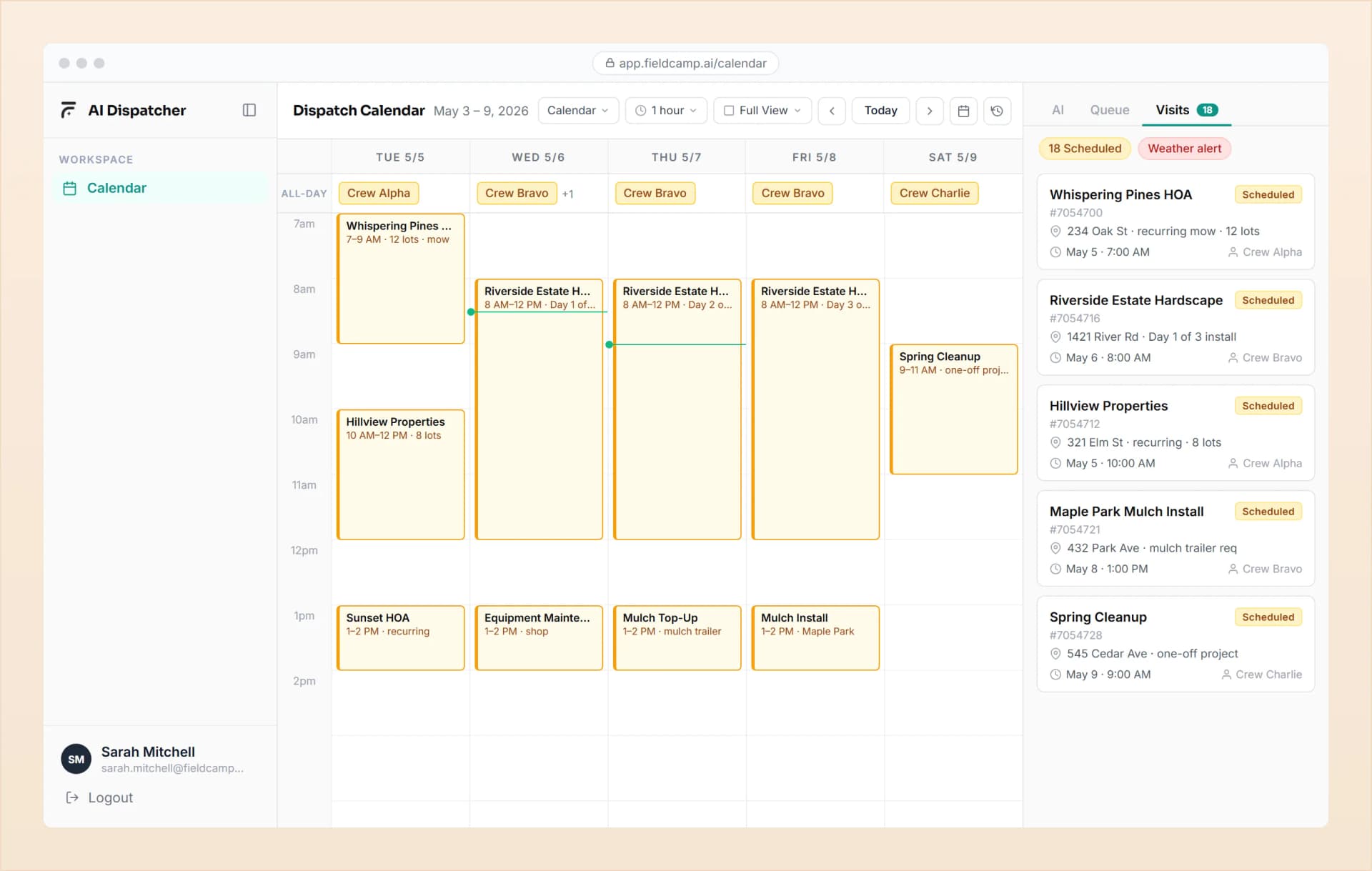
Landscaping dispatch software is software that automatically matches each lawn care visit or install job to the best available crew — based on equipment on the truck, service-area zone, route density, and working hours — without a human dispatcher pulling up a calendar.
The AI dispatcher treats crews as first-class objects, not individual techs. Equipment loaded on each truck is a hard constraint. When the dispatcher flags a disruption — rain at 9am, a sick crew member, a truck breakdown — the day re-sequences in seconds with indoor-friendly work pulled forward.
FieldCamp is included in every plan and serves as an AI dispatcher for landscapers running crew-based operations. Human dispatchers still own exceptions: customer escalations, scope changes, and judgment calls on weather windows.
Trusted by crew-based landscaping contractors across North America
GreenScape Co.
TurfPro Group
Cedar & Stone
EverGrow Lawn
Hilltop Landscapes
What’s broken in landscaping dispatch
Six reasons your route capacity disappears every rainy morning.
If you’ve ever called six crews mid-route to find indoor filler work, you already know the pain.
01
9am rain shuts down six crews.
Calendar tools don’t react. The schedule keeps showing fixed slots while crews sit in trucks. Dispatcher spends till 1pm hunting fillers — half the day’s capacity gone.
02
Mulch trailer on a mow-only day.
The crew with the mulch trailer gets sent to a route of mow-only stops. Equipment mismatch caught at the first stop, half the morning lost to a truck swap.
03
Recurring routes drift visit by visit.
Same five Tuesday lawns, different crew every week. Density that took a season to build erodes after one or two reshuffles. Drive time creeps up.
04
3-day install broken up by recurring visits.
Hardscape Day 2 gets interrupted because Tuesday recurring lawns have to happen too. Install crew sent to mow, project loses momentum.
05
One crew with 14 stops, another with 7.
No workload balancing. Capacity assigned by the order jobs arrived. By Friday, one crew is exhausted while another is asking for filler work.
06
Crew sent across zone lines.
Zone rules are suggestions, not enforced. A crew assigned to one territory ends up an hour from home base because nobody flagged the drift.
The 9am rain problem
When rain rolls in mid-route, the day re-sequences itself.
Landscaping crews don’t fail one job at a time — they fail by the day. Rain at 9am means six crews mid-route are suddenly idle, and the schedule built last night is already wrong. Calendar-only landscaping scheduling software keeps showing the same fixed visits in the same fixed slots while paid crew time burns.
Without weather-aware re-dispatch
every disrupted morning
With FieldCamp’s AI Dispatcher
same morning, replanned in seconds
Built for crew-based landscaping
One AI engine for every landscaping dispatch challenge.
Crew composition, equipment, recurring density, multi-day chains — all priced into the same routing decision, every minute.
Live re-dispatch under disruption
Rain, breakdown, callout, long job — schedule re-sequences in seconds. Indoor-friendly work fills the gap. Outdoor work resumes from the updated sequence.
Route-density routing
Recurring lawn care stays tight. The optimizer keeps each crew’s stops geographically dense — the right crew gets the best route in one pass instead of street by street.
Equipment-aware dispatch
Mowers, edgers, blowers, mulch trailers, irrigation kits don’t all fit on one truck. Each job matches the truck that already has the right equipment loaded — before the crew rolls.
Workload balancing across crews
No crew ends Friday with 14 stops while another has 7. Capacity is balanced across the day, not assigned in the order jobs arrived.
Multi-day project chaining
3-day install — hardscape, planting, irrigation — stays intact across the week. The same crew on the project on consecutive days, protected from being broken up by recurring visits.
Service-area zones
Lawn care territories enforced as routing rules. A crew assigned to a zone doesn’t appear in another zone’s job pool. Recurring visits stay anchored to the zone they were sold in.
How it works
Four steps every landscaping dispatch decision goes through.
From recurring lawn intake to weather-disrupted morning recovery — every dispatch decision runs through these four layers, fast enough that crews feel it as a single experience.
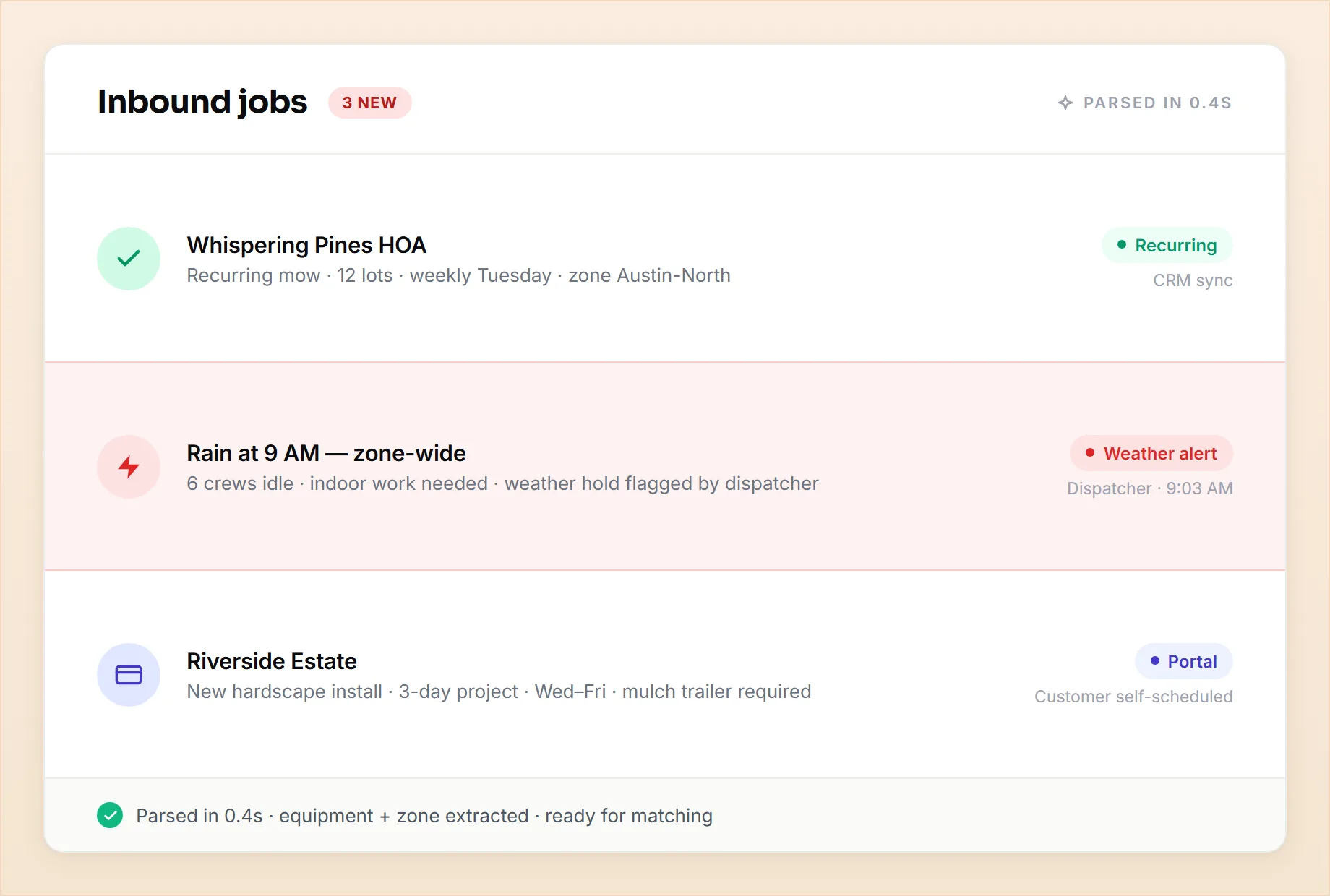
Jobs arrive from your CRM, customer portal, or recurring-visit generator. The dispatcher parses each job: service type, customer location, equipment requirement, service-area zone, and visit window.
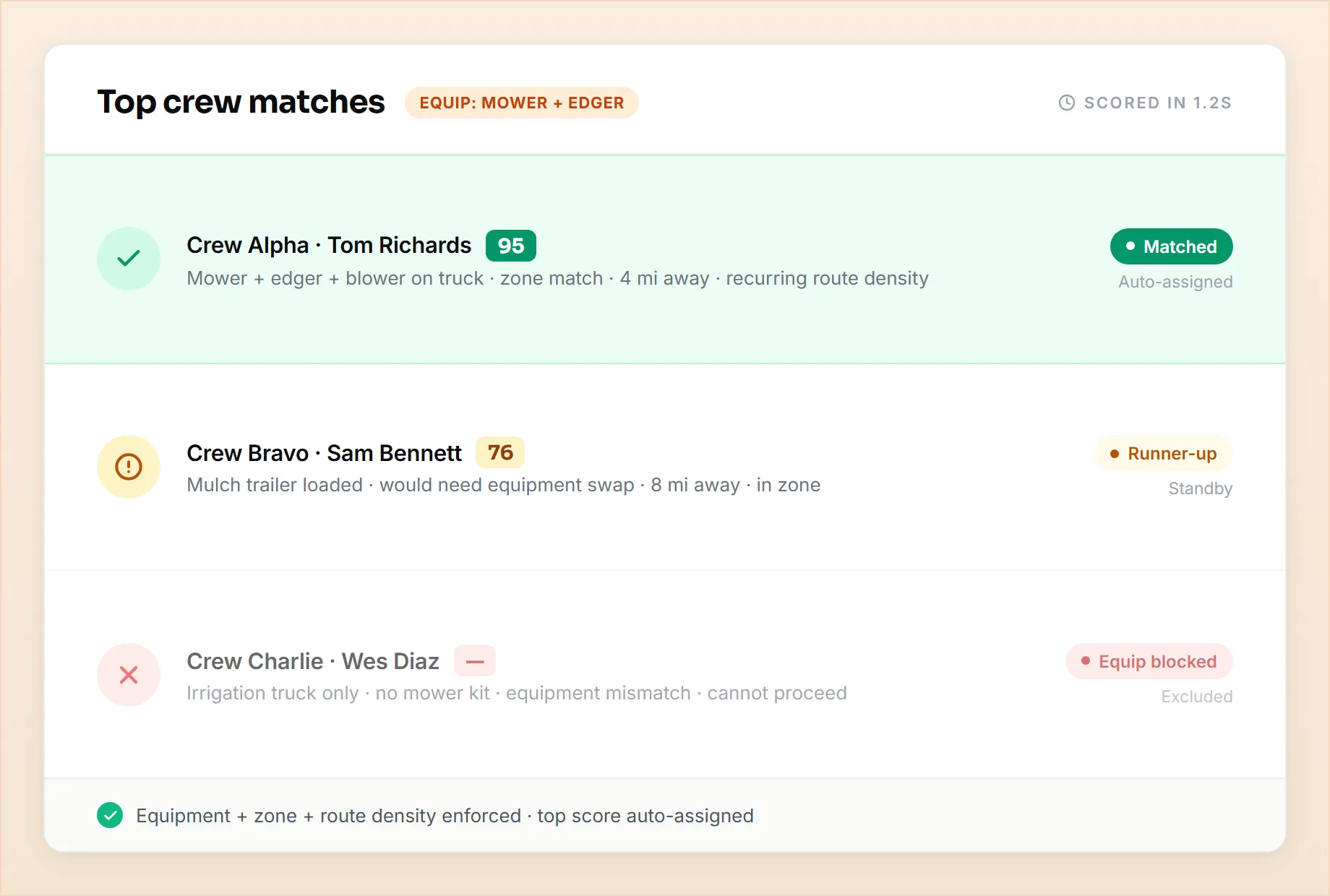
The optimizer scores every crew across the planning horizon at once. Equipment on the truck, current route density, working hours, and zone rules all weigh in. Powered by route dispatching and equipment dispatching.
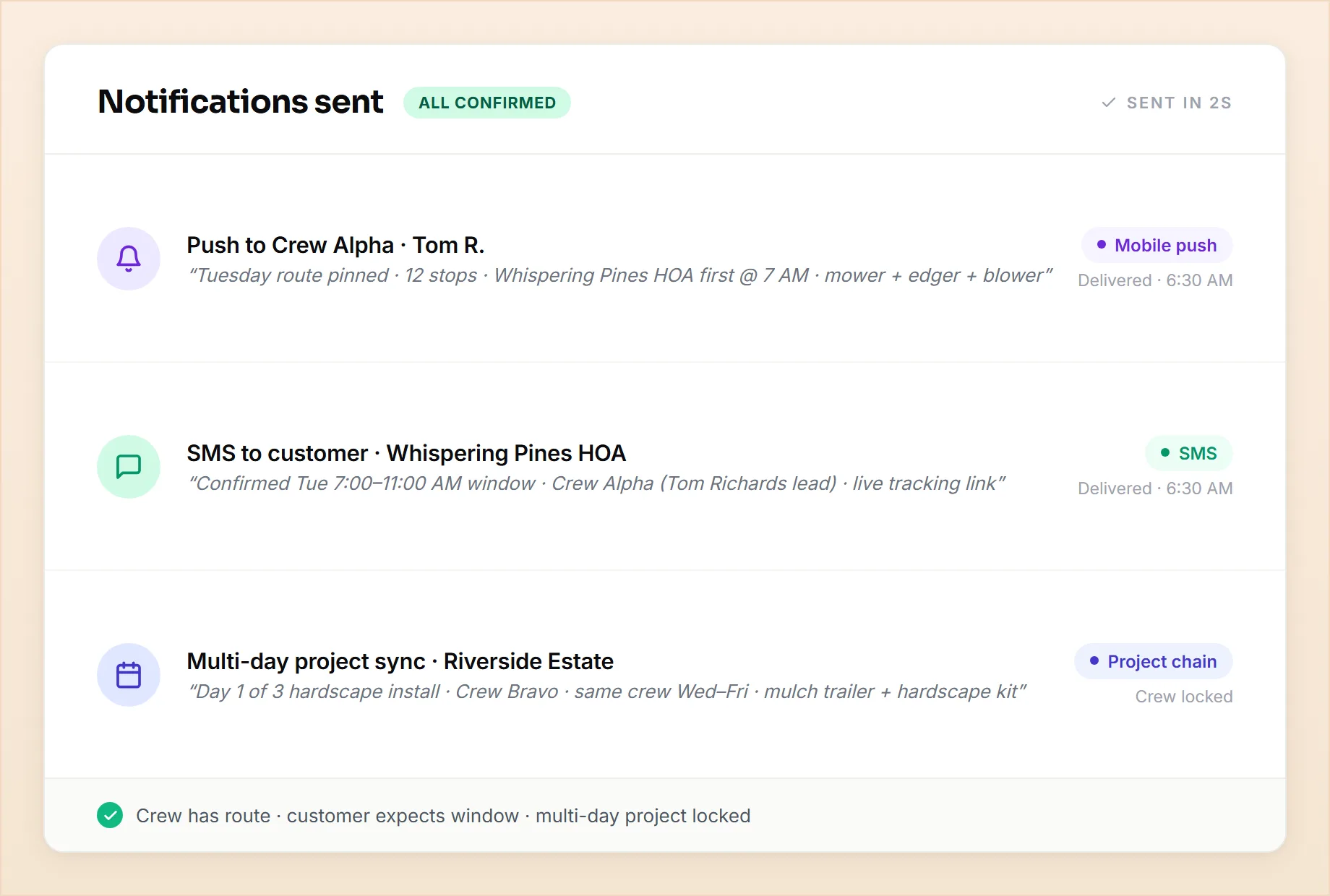
The matched crew gets the job pinned to a specific stop in the day’s route. Customer gets a confirmed window — and an automatic update if rain or breakdown shifts it.
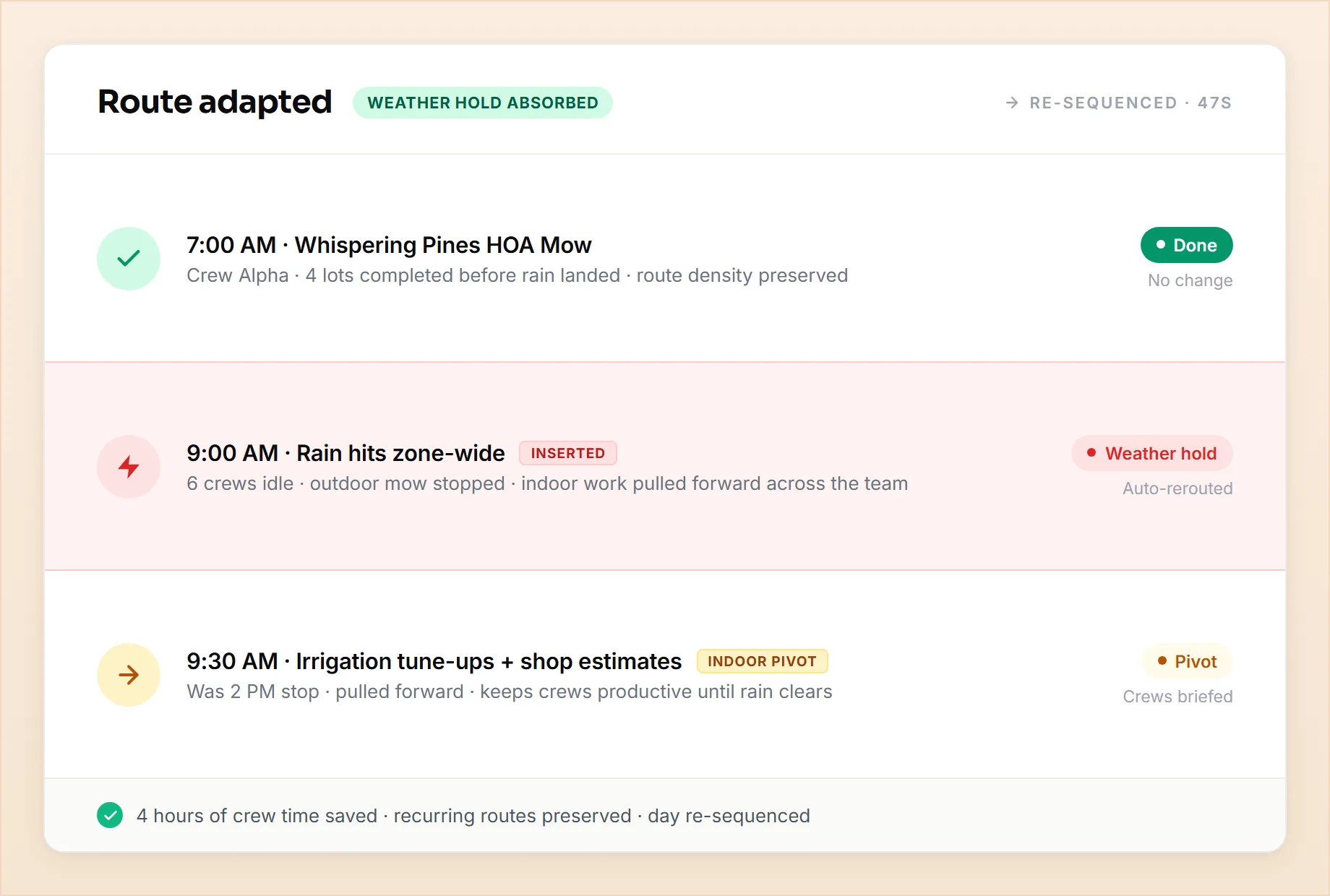
When weather, breakdowns, or a long job change the day, dynamic rerouting re-sequences the rest of the week. Recurring visits stay in their zones, project days stay chained, and the dispatcher approves drift instead of rebuilding the schedule. Note: FieldCamp does not pull weather forecasts — the dispatcher (or a webhook from your weather tool) tells it conditions changed.
Manual vs FieldCamp AI
Why your dispatcher’s calendar isn’t built for crews and weather.
“It looks like it does everything that I want it to do throughout the pipeline. And that’s really important. If you’re trying to find one platform that talks to itself without having multiple systems, this is it.“
Frequently Asked Questions
What is landscaping dispatch software?
Landscaping dispatch software automatically matches each lawn care visit or install job to the best available crew based on equipment on the truck, service-area zone, route density, and working hours. FieldCamp’s landscaping dispatch software is included in every plan, and human dispatchers still own exceptions like customer escalations and weather-window judgment calls.
Does landscaping dispatch software dispatch by crew?
Yes. Landscaping crew scheduling software treats crews as first-class objects. Each crew has a truck, a roster of techs, and a loaded equipment set, and the optimizer matches jobs to the crew as a unit. Individual techs roll up to a crew for the day. The dispatcher never tries to send half a mow crew to one job and half to another.
How does AI lawn care dispatch software handle live disruption like rain, sick crews, or breakdowns?
When the dispatcher flags a disruption — rain at 9am, a sick crew member, a truck breakdown — AI lawn care dispatch software re-sequences the day in seconds using dynamic rerouting. Indoor-friendly work like irrigation tune-ups, equipment maintenance, and shop estimates is pulled forward, and outdoor work resumes from the updated sequence once the dispatcher clears the affected zones. FieldCamp does not pull weather forecasts or weather APIs — the dispatcher (or a webhook from your weather tool) tells it conditions changed.
Does landscaping scheduling software handle recurring lawn care plus one-time install projects?
Yes. Landscaping scheduling software runs recurring visits and project days on the same dispatch board. Recurring routes stay tight in their zones, and multi-day projects chain across consecutive days without being broken up by recurring lawn care visits.
Does landscape contractor software know which truck has the mower vs. the mulch trailer?
Yes. In landscape contractor software, equipment is loaded onto the truck or crew profile and treated as a hard constraint. A crew without the right equipment is never matched to a job that needs it, regardless of proximity.
Does it flex for seasonal volume swings (spring cleanup, fall leaves)?
Yes. The optimizer scales with job volume — when spring cleanup or fall leaf season triples the queue, the same dispatch rules continue to balance crew load and respect zones. Crew capacity, working hours, and overtime caps are configured per-crew, so seasonal staffing changes flow through without re-doing the rules.
Does landscaping dispatch software work without an existing CRM?
Yes. Landscaping dispatch software runs as a standalone product or layered on top of an existing system of record. It connects via REST API, two-way sync with major field-service CRMs, and direct CSV import.
How long until landscaping dispatch software is running our real schedule?
Typical landscaping migrations are running production crew-based dispatch within 2-3 weeks. Time depends on zone, equipment, and recurring-route data hygiene more than software setup.
Ready?
Stop losing the day to a 9am rain. Smarter landscaping dispatch, redesigned by AI.
Plug AI Dispatcher into your existing FSM, or run it with the full FieldCamp suite. Either way, your crews stay productive through the disruption.