
Roofing dispatch software
AI dispatch built for roofing: multi-day projects, truck capacity, storm-event surge.
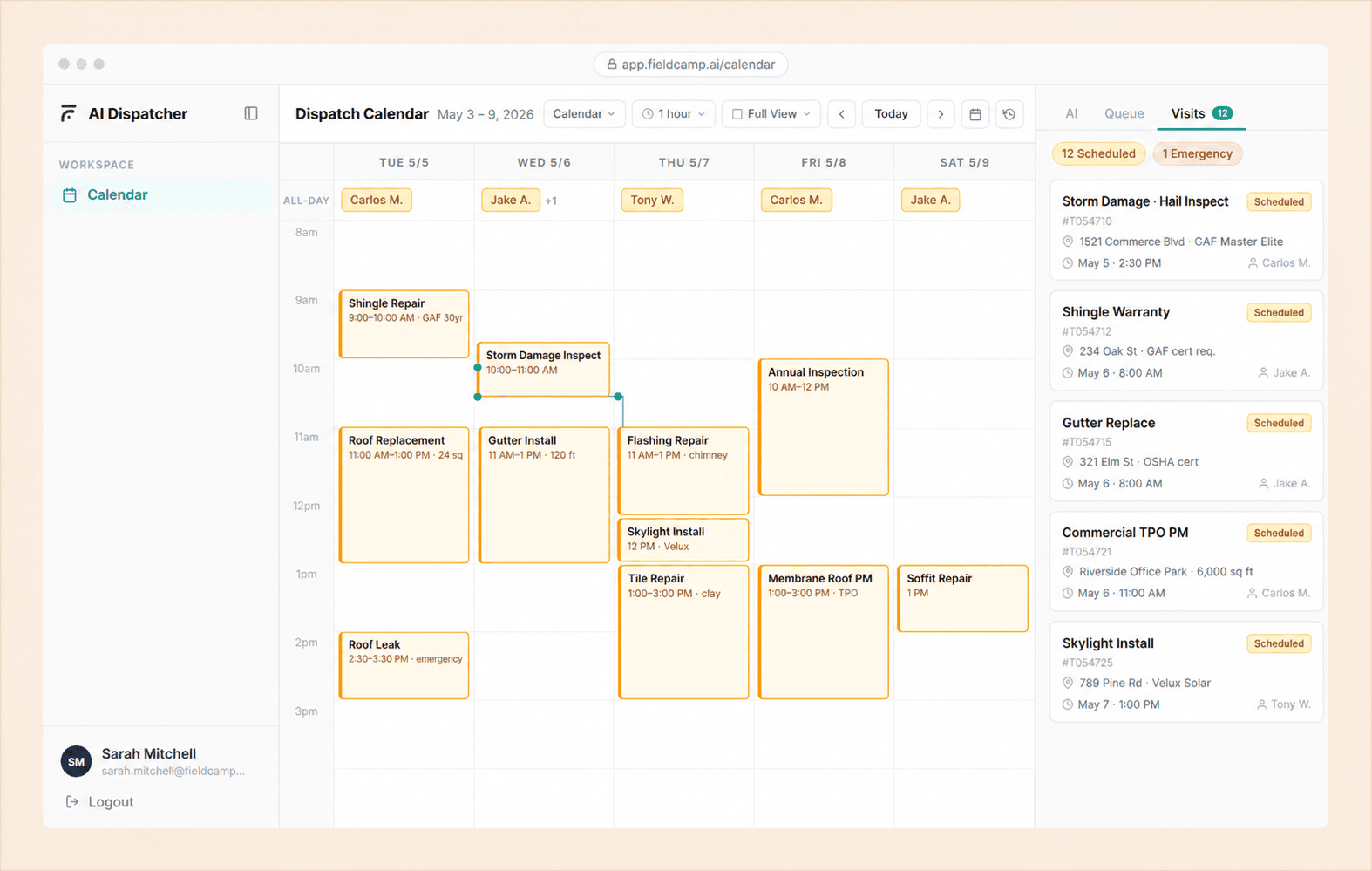
FieldCamp’s roofing dispatch software chains 5-day commercial reroofs as one plan, enforces material capacity per truck, and re-sequences the week when a hailstorm drops 200 inspection requests overnight. The AI Dispatcher gives roofing contractors AI-powered roofing scheduling, capacitated crew dispatch, and commercial roofing scheduling on the same dispatch board.
Definition
What is roofing dispatch software?
Roofing dispatch software is software that automatically chains multi-day commercial reroofs, capacitates material loadouts per truck, and re-sequences the week when a storm event drops a surge of inspection requests overnight — without a human dispatcher rebuilding the calendar by hand every time a 5-day project slips half a day.
The AI dispatcher treats multi-day project integrity as a hard constraint, not a hopeful assumption. Roofing scheduling software like FieldCamp’s keeps the same crew on the same reroof across all 5 days — Day 3 doesn’t get handed off to a crew that hasn’t seen the deck.
FieldCamp’s AI dispatcher for roofing contractors is included in every plan. Human dispatchers still own exceptions: insurance-claim status changes, supplemental approvals, and adjuster-scheduling coordination.
Trusted by residential + commercial roofing contractors across North America
Summit Roofing
Cascade Roofers
Beacon Roof Co.
Stoneridge Roofing
Northpoint Roofing
What’s broken in roofing dispatch
Six reasons your roofing week falls apart by Wednesday.
If you’ve ever sent a crew to Day 3 of a reroof they’ve never seen, you already know the pain. Here’s what AI Dispatcher fixes.
01
Day 3 of reroof handed off to wrong crew.
5-day commercial reroof. The original crew is pulled for storm inspections. Day 3 lands on a crew that’s never seen the deck — half a day lost to ramp-up.
02
Truck rolls without ridge-vent SKU.
Crew shows up to install ridge vent. Truck has shingles, underlayment, fasteners — no ridge vent. Drive back to the yard, lose 90 minutes.
03
Storm-day inspection surge: 200 in queue.
Hail event at 11pm. By 7am, 200 inspection requests in the inbox. Dispatcher tries to slot them into a week that’s already 90% booked. Reroofs in progress get yanked.
04
Boom lift double-booked across crews.
One boom lift, two commercial reroofs scheduled to use it on the same Tuesday. No one knew until the second crew arrived on-site.
05
Material delivery out-of-sync with crew day.
Crew rolls Tuesday morning. Shingle delivery scheduled for Tuesday afternoon. Three idle hours, then a rushed half-day, then overtime.
06
Insurance vs retail jobs mixed on same board.
Insurance reroofs run on supplemental-approved status. Retail jobs run on signed contracts. The board doesn’t separate them — adjuster-pending jobs eat retail capacity.
The 5-day commercial reroof problem
When the storm queue hits a reroof mid-flight.
Roofing contractors run multi-day reroofs alongside same-day inspections. When a hailstorm drops 200 inspection requests overnight, calendar-only roofing dispatch software can’t preserve in-flight reroof integrity while absorbing the surge — by Wednesday the 5-day project has slipped three days and a retail customer has been bumped twice.
Without multi-day chaining
what most roofing scheduling software does today
With FieldCamp’s AI Dispatcher
same week, planned with multi-day integrity as a hard constraint
Built for roofing operations
One AI engine for every roofing dispatch challenge.
Multi-day chaining, truck capacity, storm surge, equipment — all priced into the same routing decision, every minute.
Multi-day project chaining
5-day commercial reroofs locked as one plan. The same crew stays on the same deck across all 5 days — Day 3 doesn’t get handed off to a crew that hasn’t seen the project.
Capacitated truck routing
Shingle pallets, ridge vent, fasteners, ice-and-water — every truck has a material loadout. The optimizer enforces capacity per stop. No more rolls without the SKU.
Storm-surge re-dispatch
200 inspection requests overnight? Dynamic rerouting absorbs them across non-locked crews in seconds. In-progress reroofs stay locked, retail capacity stays protected.
Equipment-aware dispatch
Boom lifts, magnetic sweepers, dumpster swaps — every shared piece of equipment lives on a single record. No more double-booked lifts or sweepers stranded across town.
Workload balancing across crews
One crew stuck on insurance work, another idle on retail — that imbalance shows up before payroll. The optimizer levels project days and labor hours across the bench.
Service-area zones
Crews cluster naturally by region. Insurance and retail can run different zone rules. The optimizer keeps each crew’s day inside one geographic block instead of crossing the metro.
How it works
Four steps every dispatch decision goes through.
From estimate to closed-out reroof — every dispatch decision runs through these four layers, fast enough that crews feel it as a single experience.
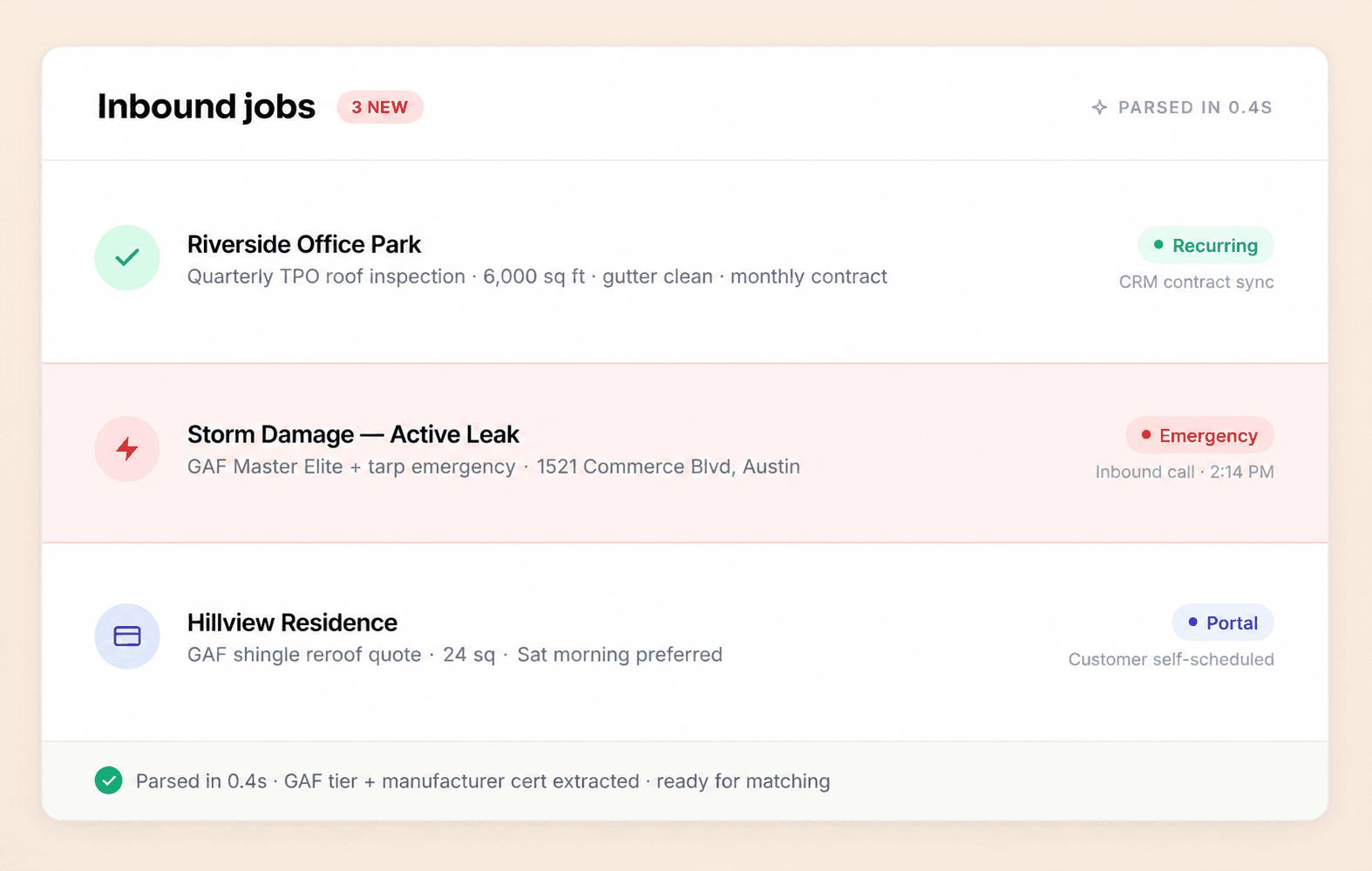
Reroofs, inspections, supplements, storm callouts land from your CRM, customer portal, or adjuster intake. The dispatcher parses each job: project duration, material loadout, equipment needs, claim status.
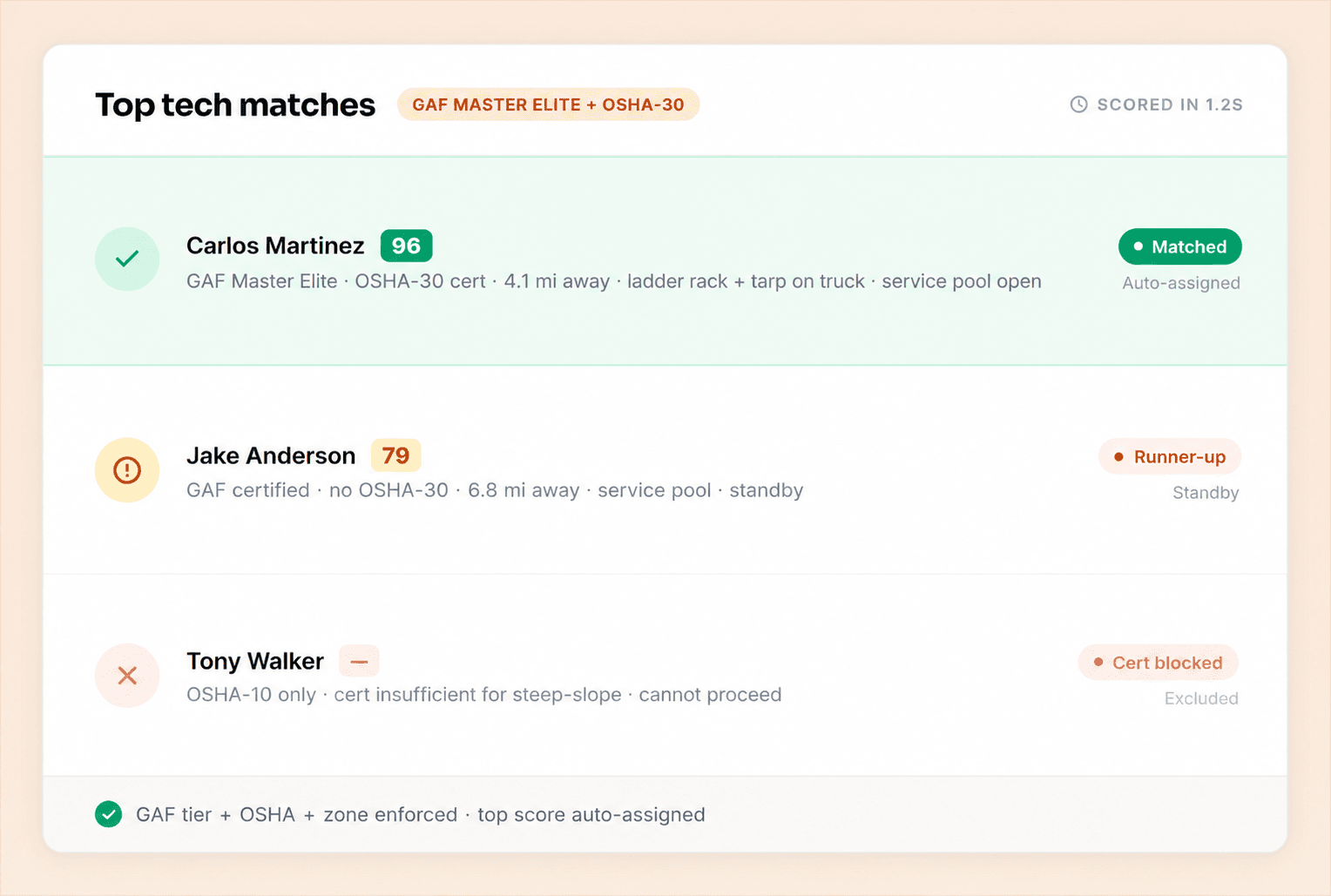
The optimizer scores every crew across the next 30 days. Multi-day availability, truck loadout, equipment access, and workload all weigh in. Powered by multi-day route planning and capacitated vehicle routing.
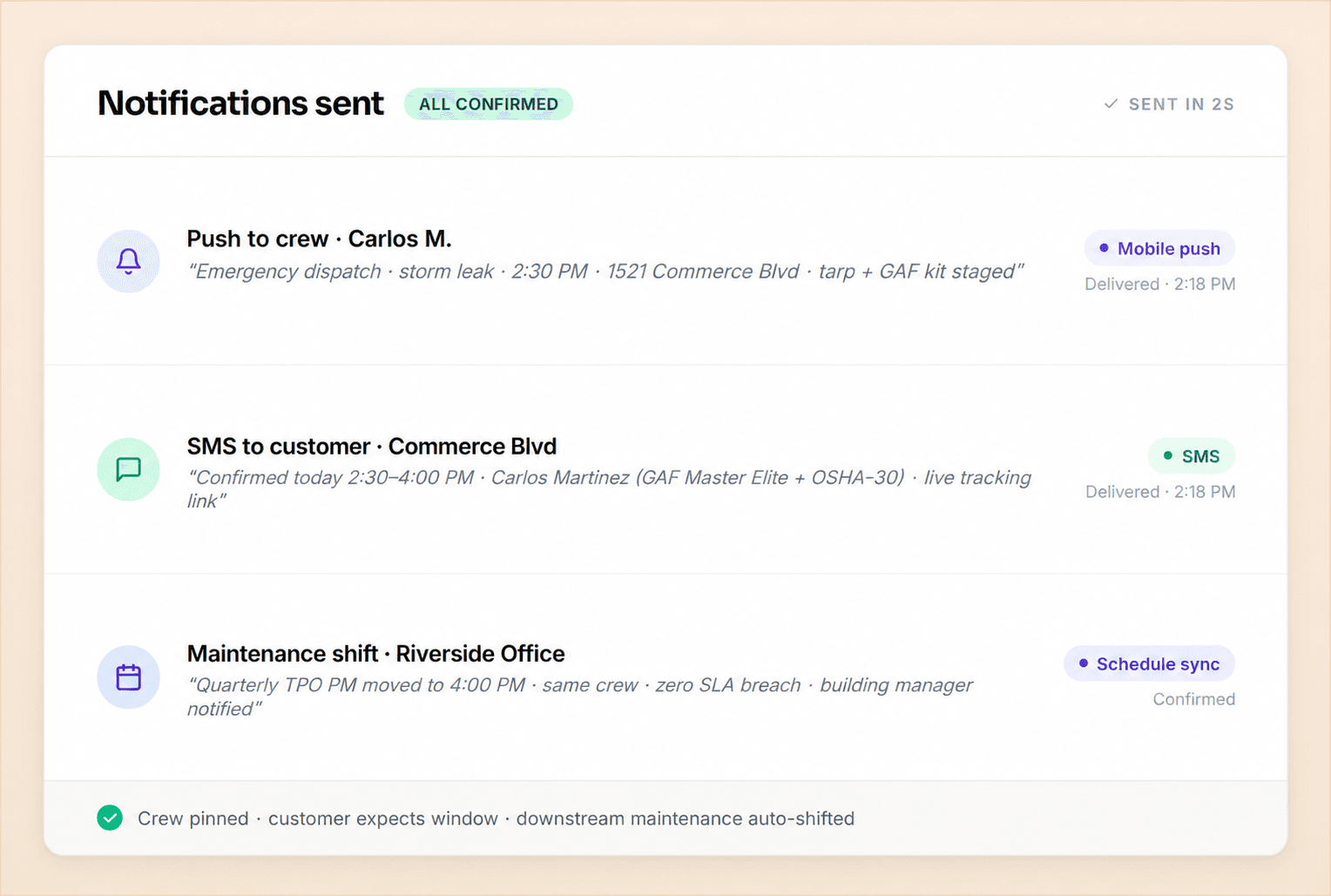
The matched crew gets the full plan pinned to their schedule. Customers get a confirmed start date and crew identity. Adjusters get a status-locked timeline.
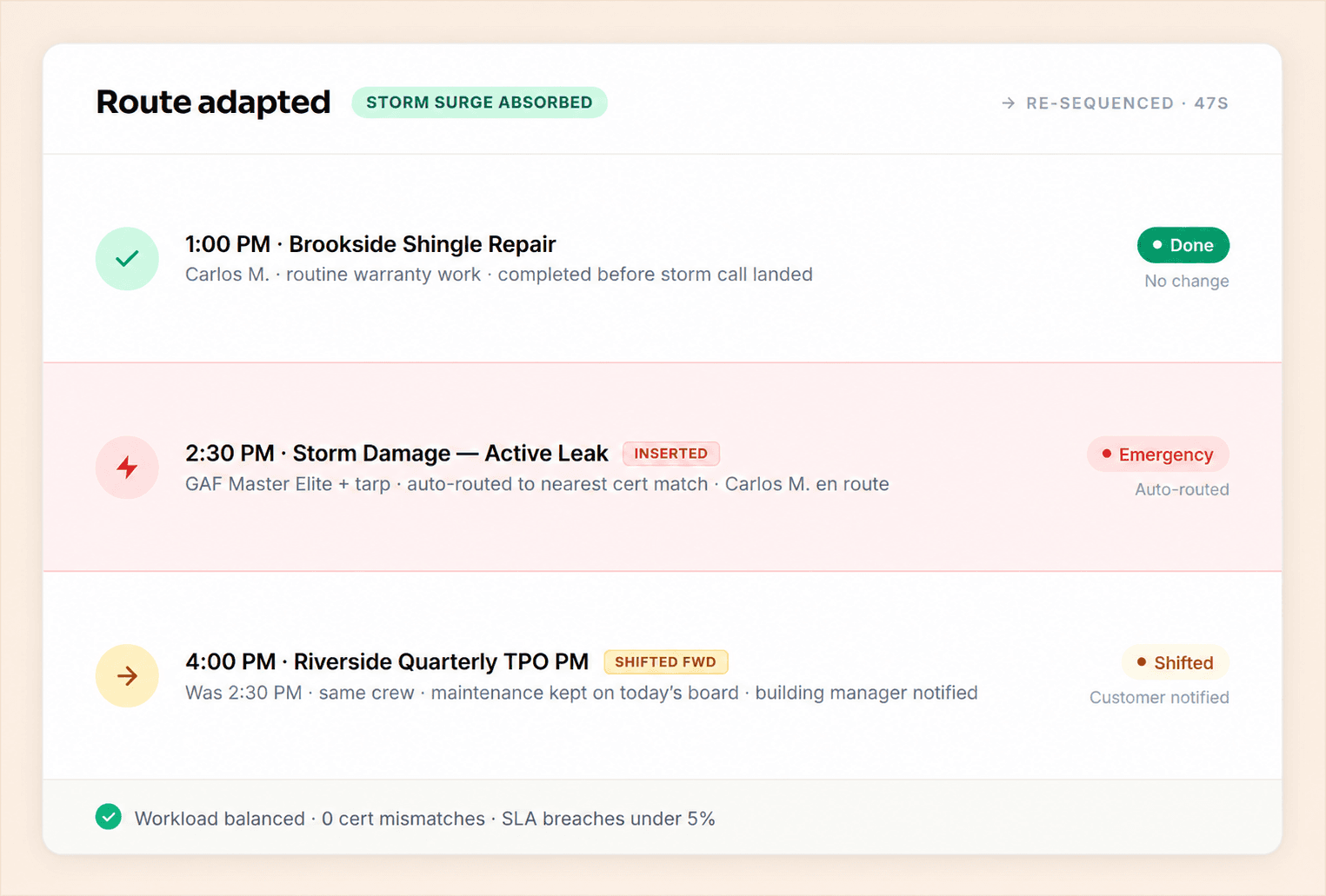
When 200 storm inspections drop overnight, dynamic rerouting absorbs them across non-locked crews in seconds. In-progress reroofs stay locked to their crew. The dispatcher approves the absorbed surge with one click.
Manual vs FieldCamp AI
Why your dispatcher’s whiteboard isn’t built for multi-day roofing.
“It looks like it does everything that I want it to do throughout the pipeline. And that’s really important. If you’re trying to find one platform that talks to itself without having multiple systems, this is it.“
Frequently Asked Questions
Does roofing dispatch software handle multi-day commercial reroofs?
Yes. 5-day, 10-day, or longer reroofs are chained as one plan. The same crew stays locked to the project across all days, and downstream weekly capacity is reserved automatically. Day 3 never gets handed off to a crew that hasn’t seen the deck. Multi-day project integrity is treated as a hard constraint by the optimizer.
How does roofing dispatch software handle a storm-day inspection surge?
Dynamic rerouting absorbs the surge across non-locked crews in under 60 seconds. In-progress reroofs stay locked to their crew through the surge — they don’t get yanked to inspections. The dispatcher approves the absorbed inspections with one click. Powered by dynamic rerouting.
Can roofing dispatch software enforce truck material capacity?
Yes. Shingle pallets, ridge vent, ice-and-water, fasteners, underlayment — every truck has a configured material loadout. The optimizer enforces capacity per stop. A truck without ridge vent is never matched to a job that needs ridge vent installation, regardless of proximity.
Does the AI dispatcher track shared equipment like boom lifts and dumpsters?
Yes. Boom lifts, magnetic sweepers, dumpster swaps, ladder racks, and any other shared equipment live on a single record with availability windows. The optimizer never double-books a boom lift across two crews on the same day. Equipment availability is a hard constraint at dispatch time.
How does roofing scheduling software keep insurance and retail jobs separate?
Insurance reroofs run on supplemental-approved status. Retail jobs run on signed contracts. Each lane has its own caseload caps and scheduling rules. The optimizer doesn’t let adjuster-pending insurance jobs eat retail capacity, and signed retail jobs aren’t bumped to make room for unverified supplements.
Does roofing dispatch software sync with material delivery schedules?
Yes. Shingle, underlayment, and accessory delivery dates sit on the job record. The optimizer aligns crew start time with material on-site time — no more three idle hours waiting for the shingle truck.
Does roofing dispatch software handle insurance-claim documentation?
Photo documentation, supplemental claims, and adjuster scheduling sit upstream of dispatch and are not part of AI Dispatcher’s scope. The dispatch board respects pre-defined claim status (in-progress, supplemental approved) when scheduling next-phase crews.
Does the AI dispatcher for roofing work without an existing CRM?
Yes. The AI Dispatcher runs as a standalone product or layered on top of an existing system of record. It connects via REST API, two-way sync with major field-service CRMs (ServiceTitan, AccuLynx, JobNimbus, Roofr), and direct CSV import for storm event intake lists.
How long until roofing dispatch software is running our real schedule?
Typical roofing-contractor migrations are running production multi-day dispatch within 2-3 weeks. Time depends on data hygiene — clean crew capacity records, truck loadouts, and equipment availability — more than software setup.
Ready?
Ditch the dispatch grind. Smarter roofing schedules, redesigned by AI.
Plug AI Dispatcher into your existing FSM, or run it with the full FieldCamp suite. Either way, your 5-day reroofs finish on Day 5.