
AI DISPATCHER · REVENUE-PRIORITY DISPATCH
$4,200 install should not lose its morning slot to a $95 filter change.
Most dispatch boards rank jobs by who called first. AI Dispatcher ranks them by revenue, margin, customer tier, and contract value — then gives the high-revenue work the fresh-morning slot when the tech is sharp and the route has not yet drifted.
REVENUE-PRIORITY DISPATCHING
Why high-margin jobs
lose to low-margin jobs.
The board ranks by who called first
Mrs. Lee called at 7 AM for a filter change. Mr. Patel called at 8:15 for a full system replacement. The 9 AM slot goes to Mrs. Lee. The $4,200 job lands in the 2 PM slot when the tech is tired.
The senior tech rolls to the filter change
The dispatcher assigns by availability, not by job value. Dave, the master tech, takes the filter change. Mike, the journeyman, takes the install. Quality risk, rework risk, customer dissatisfaction risk.
The high-value job runs at 2 PM
The install lands at 2 PM. By 5 PM the tech is in overtime, the day’s route has cascaded, and the customer wonders why their $4,200 job got squeezed into a tired hour.
The margin leak shows up monthly
The dispatcher does not see job value on the board. Margin leaks 3–5 percentage points a month. The owner finds it in the P&L review four weeks later. By then the pattern has run 80 times.
HOW AI DISPATCHER HELPS
How AI Dispatcher
prioritizes by revenue.
01
Four priority levels —EMERGENCY, HIGH-REVENUE, STANDARD, ROUTINE
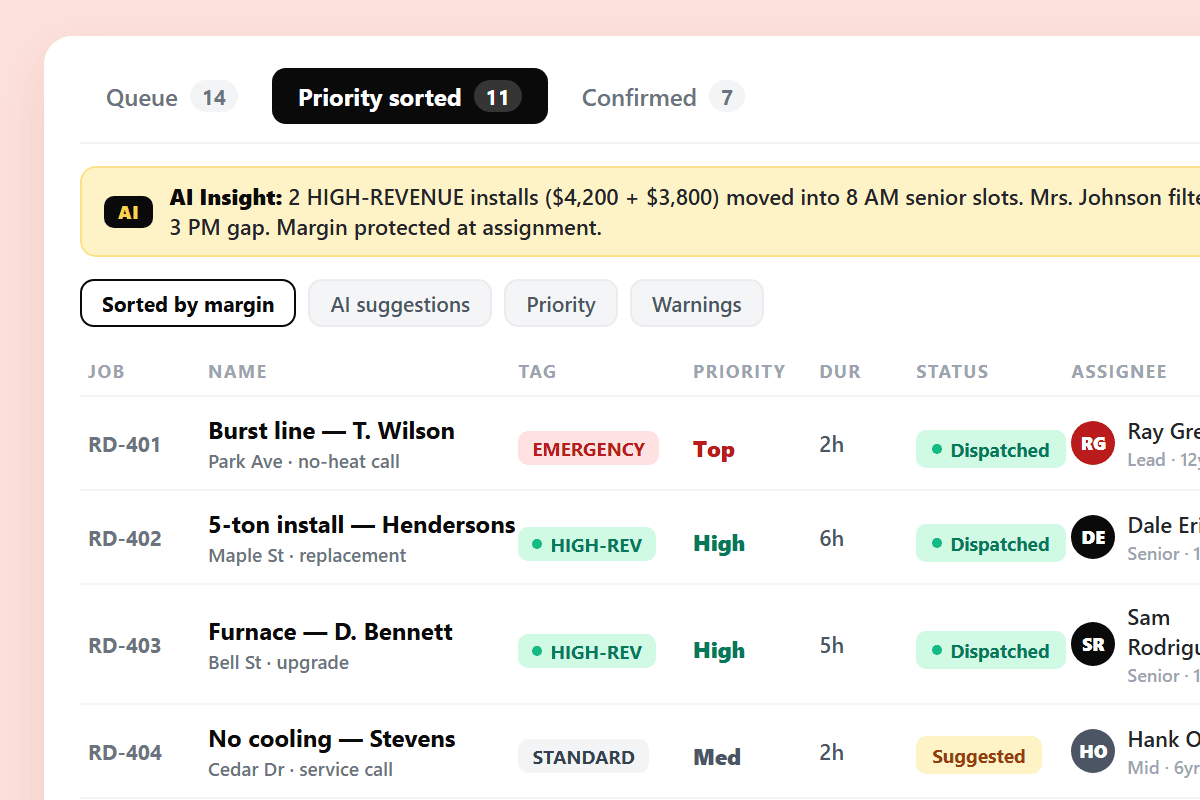
Every job gets one of four priority levels at intake. EMERGENCY jumps everything. HIGH-REVENUE (installs, replacements, contract upgrades) holds the morning slots and senior techs. STANDARD (service calls, repairs) fills the body of the day. ROUTINE (maintenance, filter changes, inspections) fills the gaps and the late-day slots. The board sorts itself by margin, not by call time.
02
Fresh-morning slots
reserved for revenue
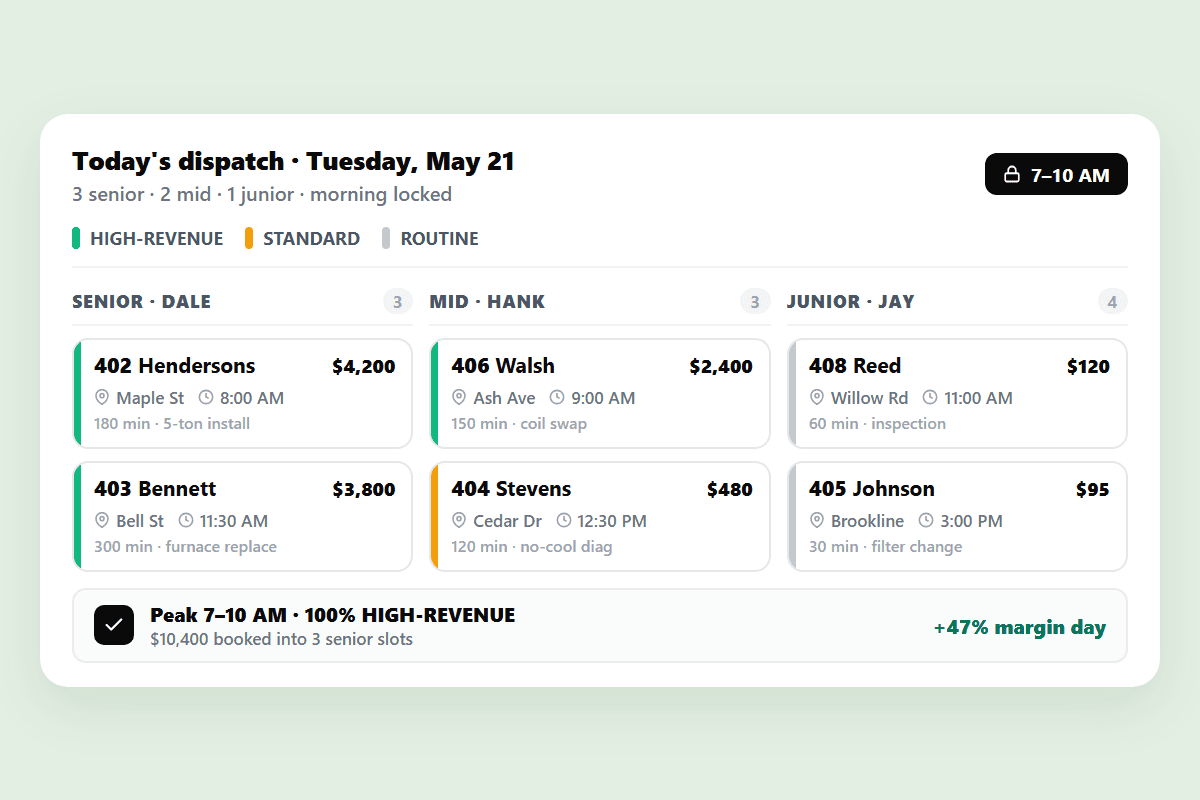
The 7-10 AM window is when techs are sharpest, routes are clean, and customers expect their full attention. AI Dispatcher locks those slots for HIGH-REVENUE work. A $95 filter change cannot consume a $4,200 install slot just because Mrs. Lee called earlier. Maintenance work fills the late-day gaps, where filter changes belong.
03
Senior techs assigned
to high-margin jobs
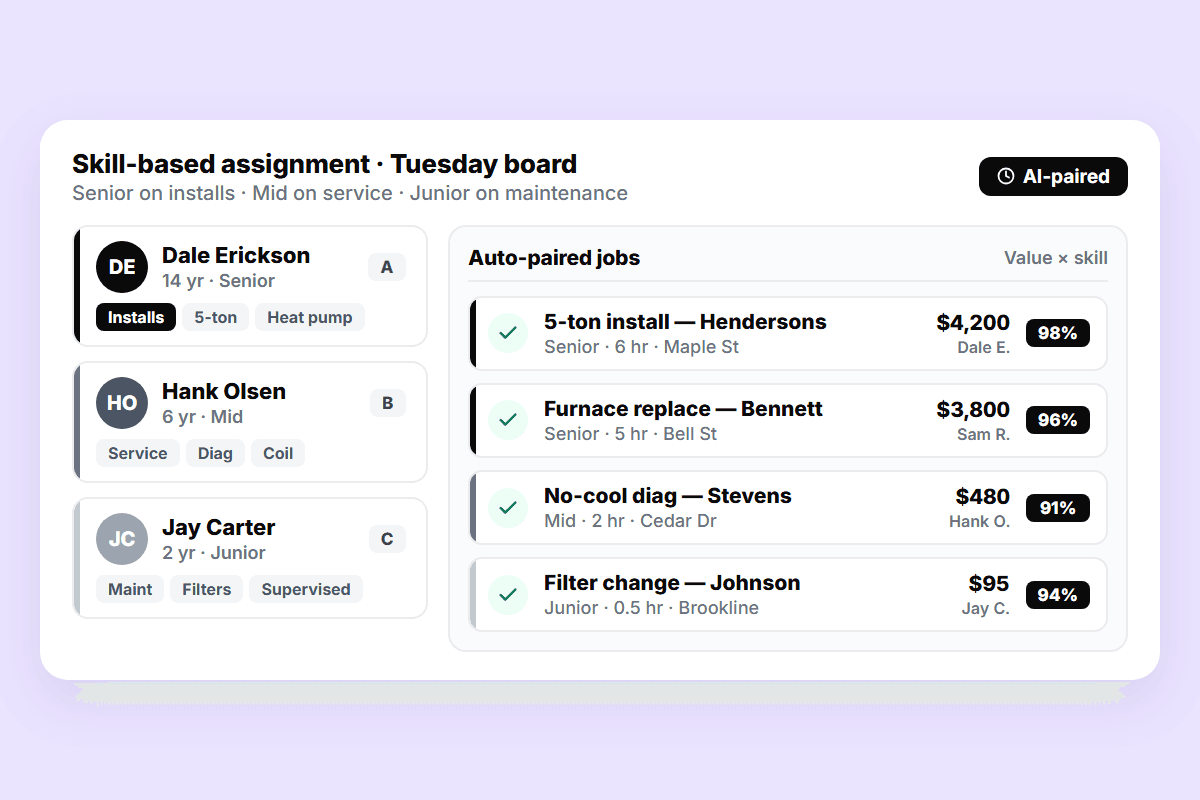
A $4,200 install on a journeyman is a $400 rework waiting to happen. AI Dispatcher pairs job value with tech skill — senior techs on installs, replacements, and contract upgrades; mid-tier techs on service calls; juniors on maintenance with supervision. Margin protected at the assignment layer, not at the QA layer.
Most dispatch boards rank by call time. The P&L pays for it.
A shop running on call-time ranking leaks 3-5 percentage points of margin per month — the high-value job that should have run at 9 AM with a senior tech instead runs at 2 PM with a journeyman, the install gets sloppy in places that show up six months later as warranty work, and the owner does not see the pattern until the P&L review. AI Dispatcher rebuilds the board ranking by revenue and margin so the leak closes at the assignment layer, not after the work is already booked wrong.
Book a Demo Now
WORKS WITH YOUR DISPATCH STACK
Connects to the tools field service ownership actually uses.
AI Dispatcher sits on top of the existing FSM. Job values flow in from quotes and contracts, revenue-priority routing flows back into the schedule.
ServiceTitan
Pull quote values, customer tier, contract MRR. Push revenue-ranked assignments back.
Housecall Pro
Import job estimates and customer profiles. Revenue tag flows into routing automatically.
Jobber
Sync invoice estimates and recurring contract values. High-revenue jobs hold their morning slots.
QuickBooks
P&L visibility on margin per job, per tech, per day. Ownership sees the revenue-priority pattern in the dashboard.
READY?
Stop leaking margin
to a board that ranks by call time.
See how AI Dispatcher ranks jobs by revenue, reserves fresh-morning slots for high-value work, and pairs senior techs with high-margin jobs. Free trial — no credit card.
No credit card required · Live in 30 minutes · Cancel anytime
Frequently Asked Questions
How does AI Dispatcher prioritize jobs by revenue instead of call time?
Every incoming job gets one of four priority levels at intake — EMERGENCY, HIGH-REVENUE, STANDARD, ROUTINE — based on quote value, customer tier, and contract MRR. EMERGENCY jumps everything. HIGH-REVENUE (installs, replacements, contract upgrades) holds the morning slots and senior techs. STANDARD (service calls, repairs) fills the body of the day. ROUTINE (maintenance, filter changes, inspections) fills the gaps and the late-day slots. The board sorts itself by margin, not by call time. Powered by route dispatching.
Why should high-revenue jobs hold the morning slots?
The 7-10 AM window is when techs are sharpest, routes are clean, and customers expect their full attention. A $4,200 install run at 9 AM has lower rework rates, higher customer satisfaction, and shorter on-site time than the same install at 2 PM with a tired tech on a cascaded route. AI Dispatcher reserves the AM window for HIGH-REVENUE work. Filter changes go to the late-day gaps, where filter changes belong.
How does revenue-priority dispatch protect margin?
By closing the leak at the assignment layer instead of the QA layer. Manual dispatch leaks 3-5 percentage points of margin per month — the high-value job runs late, a junior tech installs sloppy, the warranty work shows up six months later. AI Dispatcher rebuilds the board ranking by revenue and margin: HIGH-REVENUE jobs get the morning, senior techs, and clean routes. Margin protected before the work starts, not after.
Does AI Dispatcher pair senior techs with high-margin jobs automatically?
Yes. A $4,200 install on a journeyman is a $400 rework waiting to happen. Skill-based dispatching pairs job value with tech skill — senior techs on installs, replacements, and contract upgrades; mid-tier techs on service calls; juniors on maintenance with supervision. The dispatcher does not have to remember the pairing rule — the optimizer enforces it on every assignment.
What if an emergency lands on a HIGH-REVENUE morning slot?
EMERGENCY outranks HIGH-REVENUE. The four-level priority engine has a strict hierarchy — an emergency always preempts a scheduled high-revenue job, but the optimizer redistributes the displaced install to the next-best slot with the same senior tech, not just any open hour. The customer with the install gets a real ETA update, not a “we’ll get to it” call. See emergency dispatch — exception logic.
How does the system know which jobs are HIGH-REVENUE?
Quote values, job types, customer tier, and contract MRR flow in from your existing FSM. Installs, replacements, and contract upgrades over a configurable threshold (default $1,500 quote value) tag as HIGH-REVENUE automatically. Repeat customers on premium tiers tag higher. The dispatcher can override per-job — but the default classification is automatic from the data already in ServiceTitan, Housecall Pro, or Jobber.
Does ownership see the revenue-priority pattern in real time?
Yes. The QuickBooks integration surfaces margin per job, per tech, per day in a P&L dashboard. Ownership sees the revenue-priority pattern in real time instead of finding the margin leak four weeks later. The 80-times-a-month pattern that used to surface in the monthly review surfaces in the daily dashboard now.
How long until AI Dispatcher is running revenue-priority dispatch?
Typical field service shops are running revenue-priority dispatch within 2-3 weeks. Time depends on data hygiene — clean quote values, accurate tech skill tiers, and customer-tier tagging on the customer file — more than software setup. The integration with your existing FSM goes live in 30 minutes; the priority rules and tech-tier records typically take a few days to clean up; the AI then runs a shadow week alongside your dispatcher before going live.