
10 Best Insulation Contractor Software of 2026 for Growing Insulation Businesses
February 2, 2026 - 28 min read


February 2, 2026 - 28 min read

| TL;DR: If you run an insulation business and still coordinate crews through spreadsheets and group texts, you are leaving money on the table. This guide breaks down the 10 best insulation contractor software options in 2026, covering everything from scheduling and AI dispatching to spray foam estimating and commercial project management. FieldCamp leads for insulation businesses that need AI-powered dispatching with skill-based crew assignment, while Plexus Insulation is the go-to for large commercial projects with Gantt charts and task dependencies. We reviewed each tool based on scheduling, insulation-specific features, ease of use, and real value for money. |
Here is a number that should stop every insulation contractor in their tracks. According to the Department of Energy, heating and cooling account for 50 to 70 percent of the energy used in the average American home.
That means insulation is not some niche trade. It is one of the highest-demand services in home improvement, and the companies doing this work are busier than ever.
But being busy does not mean being efficient. If you have ever spent your Sunday evening texting crew leads to figure out who is available Monday, or lost a job because you could not answer “when can you start?” without checking three different calendars, you already know the problem.
Most insulation jobs are not one-day visits. A typical residential project runs two to five days. Day 1 might need a fiber crew for prep, Day 2 a spray foam team for application, and Day 3 a different crew for cleanup and finishing.
Try managing that across five active projects with 10 crew members using a spreadsheet. It breaks down fast.
We talked to over 30 insulation contractors while putting this guide together, and the pattern was clear. Companies running four or more crews were spending five to 10 hours per week just coordinating who goes where on which day. That is an entire workday lost to scheduling every single week.
The right insulation contractor software fixes this by organizing jobs, assigning the right crews automatically, and keeping field teams and office staff on the same page. Whether you need a simple scheduling app for a small crew or a full insulation business management platform for scaling operations, the tool you pick matters.
This guide reviews the 10 best options available right now. We evaluated each platform based on scheduling capabilities, insulation-specific features, ease of use, mobile app quality, and value for money.
Methodology: Software was evaluated based on scheduling and dispatch capabilities, insulation-specific features, ease of use, mobile app quality, integration options, and suitability for residential versus commercial operations.
Want the audio version instead? Listen to the podcast episode.
Before diving into detailed reviews, here is a snapshot of all 10 platforms to help you quickly identify which ones match your requirements.
| Software | Best For | Multi-Day Jobs | AI Features | Starting Price |
| FieldCamp | AI dispatching and workflow automation | Yes | AI dispatching, Command Center | Custom pricing |
| Plexus Insulation | Commercial/industrial projects | Native (stages + Gantt) | Skill-based suggestions | Contact sales |
| FieldGroove | Spray foam estimating | Manual | No | ~$50/user/mo |
| Builder Prime | All-in-one CRM + estimating | No | No | Contact sales |
| Cleri | AI voice commands | Partial | Cleo AI assistant | Contact sales |
| STACK | Commercial takeoffs and bidding | No | No | Contact sales |
| Allpro Insulator | Reporting and analytics | No | No | Contact sales |
| Hearth | Customer financing | No | No | Contact sales |
| Jobber | Simple one-day jobs | No | No | $25/mo |
| ServiceTitan | Enterprise operations | Partial | No | $15,000+/yr |
Each platform below has been evaluated based on user reviews, feature documentation, and real-world use cases. The reviews cover key features, pricing, platform availability, and honest assessments of strengths and limitations.
FieldCamp is an AI-native field service automation platform built for service businesses that want to automate operations, not just organize them. For insulation contractors managing multiple crews, certifications, and job sites, it solves the core problem that eats up your time: figuring out who should go where.
Most field service tools give you a calendar and let you drag jobs around. That is not automation. That is a digital whiteboard. FieldCamp works differently. The AI dispatching system automatically assigns jobs based on crew skills, certifications, location, and availability.
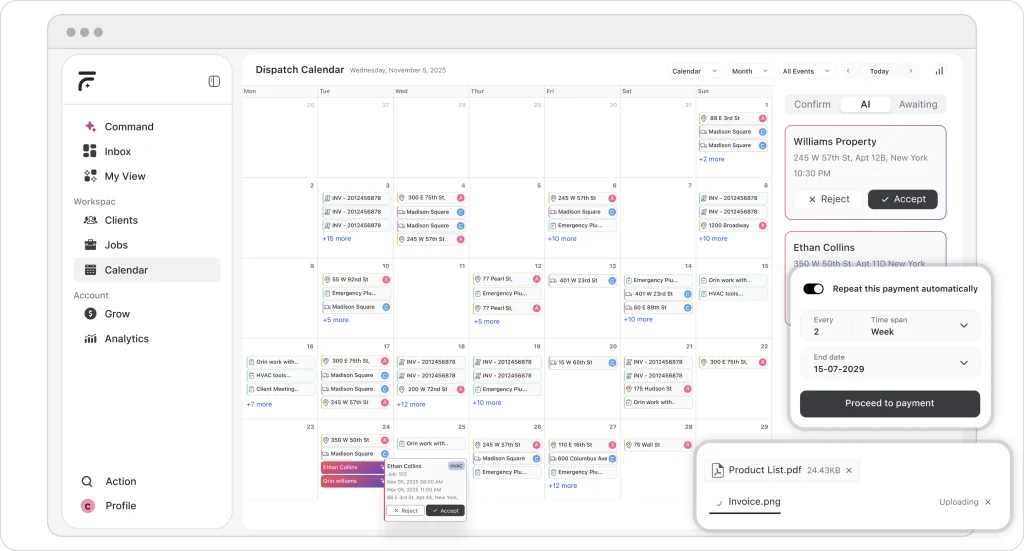
When you have a spray foam job come in, it goes to your spray foam certified crew. When someone calls in sick, the system reassigns their jobs automatically. You stop playing calendar Tetris and start running your business.
The platform supports multi-day jobs, which matters for insulation work where a typical residential project spans two to five days. You can schedule jobs that run across multiple days without creating separate entries for each day. The visual calendar shows your entire week at a glance, and your crews see their schedule on their phones before they leave the shop.
Beyond scheduling, FieldCamp covers the full job lifecycle. The Command Center (Handy) lets you control operations using plain English.
Type “schedule the Johnson job for Tuesday with Marcus’s crew” and it happens. Ask “What spray foam jobs do we have next week?” and you get your answer.
When jobs are complete, invoicing happens automatically. The system generates invoices from job details, so you are not re-entering information. Workflow automation handles the repetitive tasks: job marked complete triggers invoice, invoice overdue triggers reminder, and new lead triggers follow-up task. Set it once, and it runs forever.
Key Capabilities:
Pricing: Custom pricing based on your business size and needs. See current pricing.
| Pros | Cons |
| AI dispatching eliminates manual job assignment by matching crews to jobs based on skills, location, and availability | Newer platform with less review history on G2 and Capterra compared to Jobber or ServiceTitan |
| Spray foam jobs automatically go to spray foam certified crews without you touching anything | More capability than solo operators or one-crew companies typically need |
| Command Center lets you schedule jobs, check revenue, and manage operations by typing plain English | No Gantt charts for complex commercial project management with task dependencies |
| Workflow automation handles invoicing and follow-ups, so you are not chasing paperwork | |
| Multi-day job support handles insulation projects that span multiple days | |
| Crews see their schedule on their phones before leaving the shop | |
| 30-minute setup to get operational, no six-month implementation |
Who it is best for: Insulation contractors with four or more crews who spend hours each week on manual scheduling and want AI to handle job assignment automatically. If your biggest pain point is coordinating which crew goes where, FieldCamp eliminates that problem.
If your insulation business focuses on commercial and industrial projects, Plexus is built for the complexity that commercial work demands. This platform handles multi-phase projects with task dependencies and capacity planning that residential tools cannot match.
Commercial insulation is a different animal from residential work. You are dealing with phase-based timelines, task dependencies, and capacity planning across large teams working on multiple projects simultaneously.
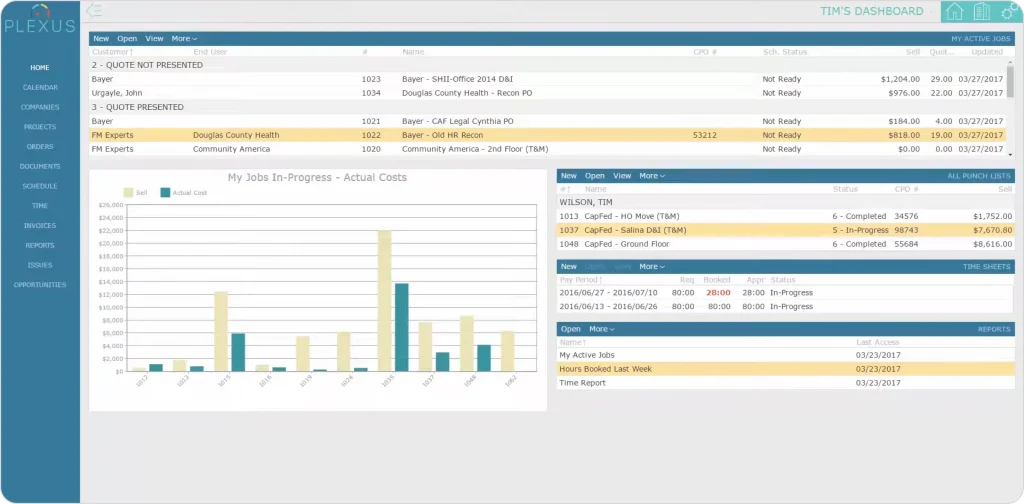
Plexus handles this through multi-stage orders where each phase operates independently. Your foam team and batt crew work on separate phases without affecting each other’s status, and target dates auto-adjust as tasks complete.
The scheduling module suggests employees based on skills and qualifications, matching workers to appropriate tasks automatically. A capacity view shows available manpower across your entire operation, and soft scheduling lets you reserve hours for upcoming projects before assigning specific people.
This is essential if you are bidding on commercial projects months in advance and need to know whether you have the workforce to deliver.
Key Capabilities:
Pricing: Enterprise pricing requires contacting the Plexus sales team directly.
| Pros | Cons |
| Multi-stage orders keep complex multi-phase projects organized in a single view | Enterprise pricing requires contacting sales, not transparent |
| Gantt charts with task dependencies auto-adjust timelines as work progresses | Longer implementation timeline compared to simpler tools |
| Skill-based crew suggestions match certified workers to appropriate insulation tasks | More tools than most residential insulation operations need |
| Capacity planning reserves manpower for upcoming commercial projects |
Who it is best for: Commercial insulation contractors managing multi-phase industrial projects with task dependencies and large teams. If you need Gantt charts and capacity planning, Plexus delivers.
FieldGroove has carved out a solid niche among insulation contractors who live and die by their estimates. If your biggest operational headache is quoting spray foam jobs accurately rather than scheduling crews, this platform tackles estimating at a level that generic tools cannot match.
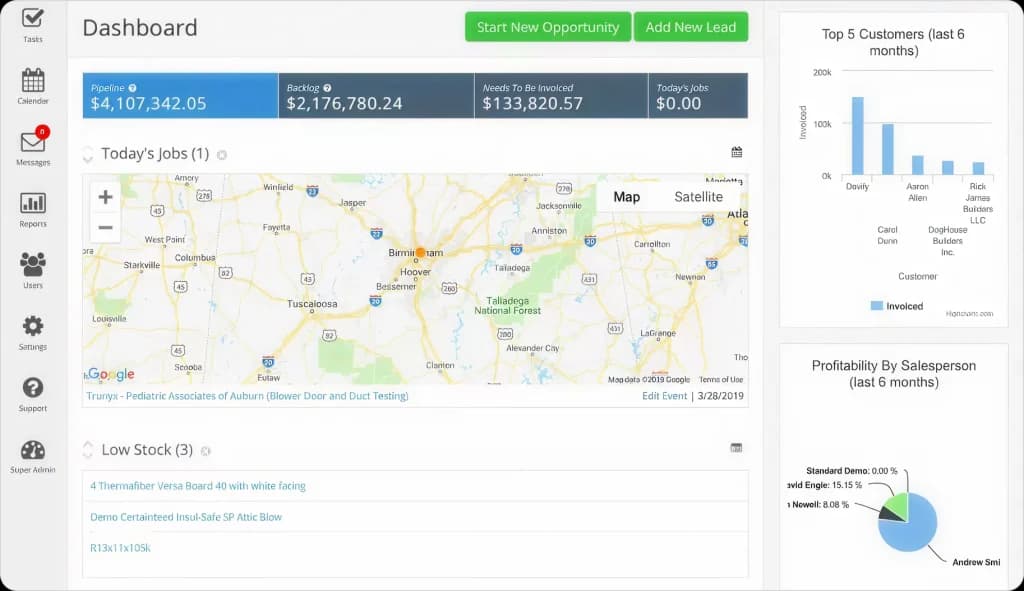
The standout feature is auto-calculating board feet, coverage, and material costs. Anyone who has ever manually calculated how many board feet of closed-cell foam a 2,400 square foot attic needs knows how tedious and error-prone that process gets.
FieldGroove handles the math so you can focus on winning the job. On-site quoting lets you generate professional estimates right at the customer’s kitchen table, which makes a real difference in close rates.
For small insulation companies focused on spray foam insulation, where estimating accuracy matters more than advanced crew scheduling, FieldGroove is a practical choice.
Key Capabilities:
Pricing: Starts at approximately $50 per user per month.
| Pros | Cons |
| Auto-calculates board feet, coverage, and material costs for spray foam jobs | No AI scheduling or automated crew assignment |
| On-site quoting generates professional estimates in real time | Basic scheduling requires manual calendar management |
| QuickBooks integration keeps financial data in sync | Limited automation compared to newer platforms |
| Straightforward interface for smaller insulation teams |
Who it is best for: Small insulation companies where spray foam estimating accuracy matters more than advanced scheduling automation.
Builder Prime comes from the sales side. If you lose more revenue from dropped leads than from scheduling inefficiency, this platform addresses that problem with a CRM pipeline that tracks every prospect from first contact to closed deal.
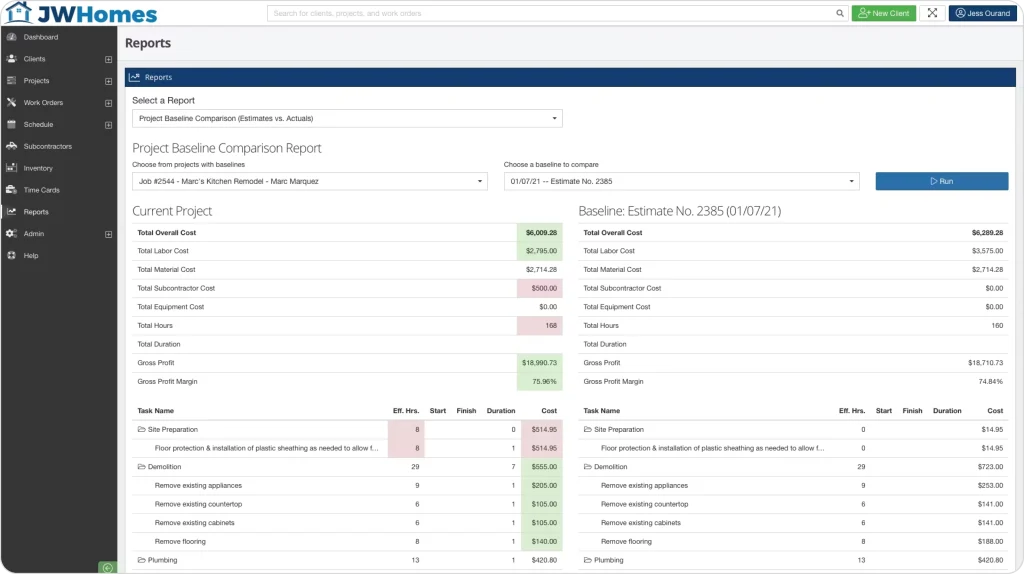
The lead pipeline is where Builder Prime shines. Automated SMS and email follow-ups fire without manual effort, so homeowners who requested an insulation quote three weeks ago do not fall through the cracks. Professional branded estimates with mobile signature capture help you close jobs right in the field.
Builder Prime works across home improvement trades, not just insulation. If your company also handles HVAC, roofing, or other services alongside insulation, having one platform for all operations makes sense.
Key Capabilities:
Pricing: Requires contacting Builder Prime sales for a quote.
| Pros | Cons |
| Lead pipeline CRM with automated SMS and email follow-ups | Not insulation-specific, no spray foam calculations or board-feet estimating |
| Branded estimates with mobile signature capture | No AI dispatching or automated crew assignment |
| Production management, including work orders and subcontractor tracking | Pricing requires contacting sales |
| Integrations with QuickBooks, CompanyCam, Google Calendar, and more |
Who it is best for: Home improvement contractors where lead management is the bigger bottleneck than scheduling.
Cleri takes a completely different approach to insulation software. Its headline feature is Cleo, an AI assistant that lets your crews manage jobs through voice commands. If you have ever tried to type a job update while standing on a ladder in a 140-degree attic, you will immediately understand why this matters.
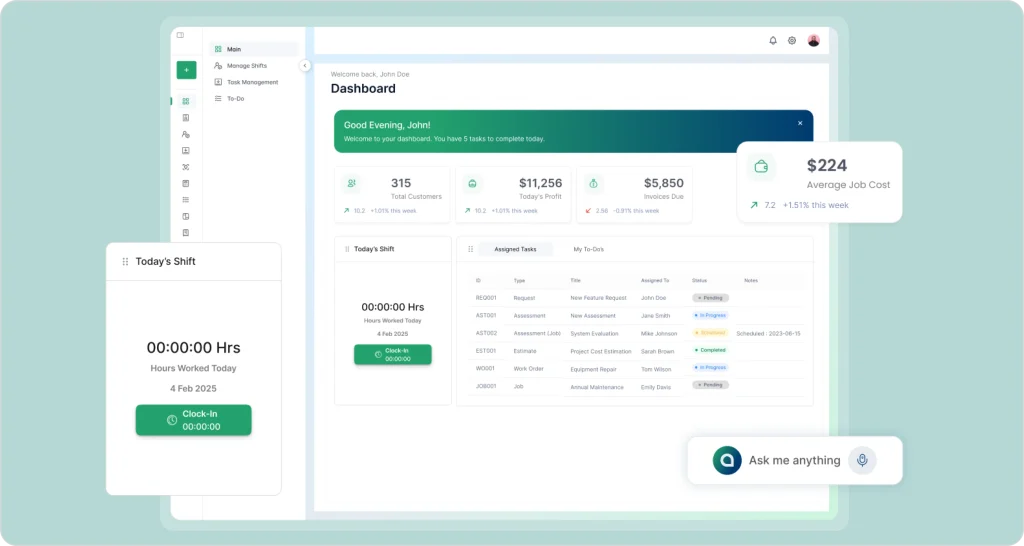
The voice-first design removes the barrier that most field service apps create for insulation crews. Your team leads can schedule installs, update job status, and log materials without pulling off gloves or climbing down from a crawlspace.
Cleri is a newer platform in the insulation space, so it does not have the track record of more established tools. But the approach is genuinely innovative for companies where field usability is the primary pain point.
Key Capabilities:
Pricing: Requires contacting Cleri sales for a quote.
| Pros | Cons |
| Voice-powered AI assistant handles scheduling and invoicing hands-free | Newer product with less market track record than established platforms |
| Crew assignment with labor estimates tailored by insulation type | Limited independent reviews available on G2 or Capterra |
| Real-time tracking of job timelines and crew locations | Voice accuracy in noisy job site environments needs testing before committing |
| Dedicated crew app for field teams |
Who it is best for: Insulation contractors where hands-free field operation is the priority.
STACK is the tool commercial insulation contractors reach for when accuracy on bids determines whether they win or lose projects. If you spend hours measuring blueprints and calculating material quantities for commercial insulation bids, STACK digitizes that entire process.
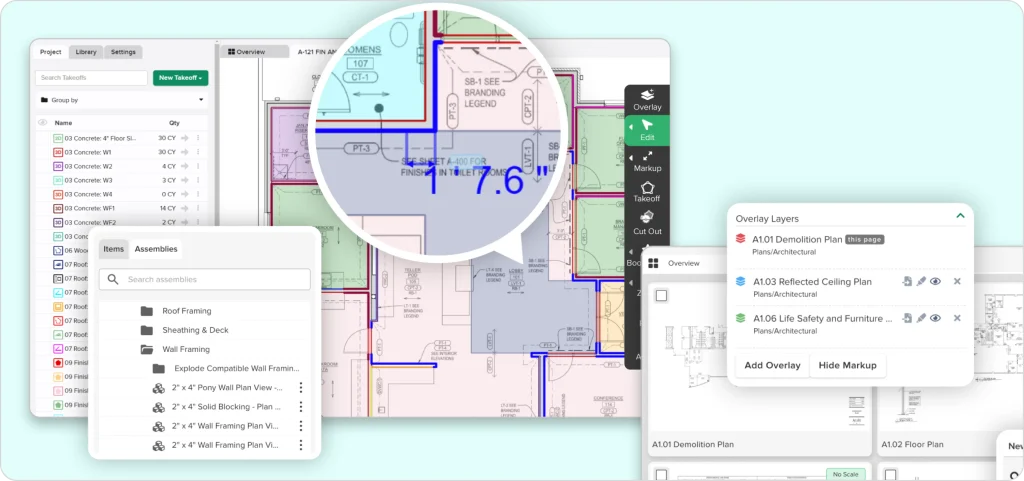
Digital takeoff tools let you measure directly from plans with insulation-specific calculation formulas for coverage, materials, and labor. Instead of printing blueprints and running a scale ruler across them, you do everything on screen with formulas that account for insulation R-values, material densities, and waste factors.
STACK focuses on the estimating and bidding side of commercial insulation. It is not a daily operations platform, so you will need a companion tool for crew scheduling and field service optimization.
Key Capabilities:
Pricing: Enterprise-style sales process with pricing provided after consultation.
| Pros | Cons |
| Digital takeoffs from blueprints eliminate manual measurements | Estimating-focused only, not a full operations platform |
| Insulation-specific calculation formulas for coverage, materials, and labor | You need separate software for crew scheduling and dispatch |
| Cloud collaboration for multiple estimators on the same project | Enterprise-style sales process, pricing not transparent |
| Bid management tracks proposals and win rates |
Who it is best for: Commercial insulation contractors focused on winning bids through accurate takeoffs from blueprints.
Allpro Insulator has been around longer than most platforms on this list, and that longevity shows in the depth of its reporting. If you want granular visibility into your insulation business metrics, from job margins to crew performance across foam, cellulose, and fiberglass jobs, Allpro provides analytics that newer platforms have not caught up to yet.
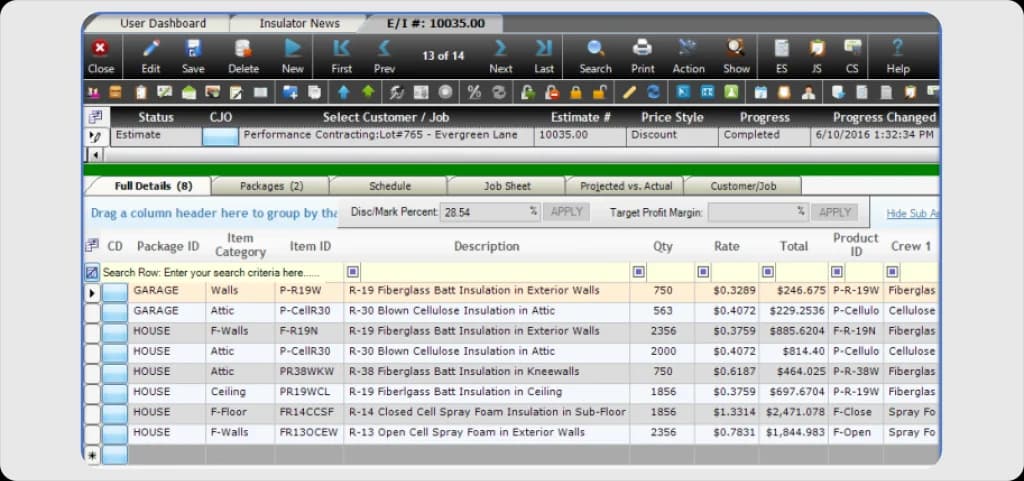
The platform offers over 300 reports and dashboards built specifically for insulation operations. You can track profitability by insulation type, identify which crews are most efficient, and spot patterns in material waste.
Allpro supports all insulation types, including foam, cellulose, and fiberglass. The trade-off is a dated interface that feels like it was designed in a different era of software.
Key Capabilities:
Pricing: Requires contacting Allpro Insulator directly for pricing.
| Pros | Cons |
| 300+ reports and dashboards built specifically for insulation businesses | Dated interface compared to modern software platforms |
| Supports foam, cellulose, and fiberglass insulation types | No AI features or mobile-first design |
| Automated estimating removes guesswork from job quoting | Limited web presence and fewer independent community resources |
| QuickBooks data exchange with one-click sync |
Who it is best for: Data-driven insulation contractors who prioritize reporting depth and analytics over modern user experience.
Hearth is not insulation software in the traditional sense. It is a financing platform. But if you have ever lost a $5,000 insulation job because the homeowner could not pay the full amount upfront, Hearth solves that specific problem in a way that no scheduling tool can.

The platform lets homeowners finance insulation projects from $1,000 to $250,000 with terms up to 12 years and FICO scores as low as 550 accepted. Branded prequalification lets customers check rates without impacting their credit score. According to Hearth’s published data, contractors report a 30% average increase in job size and 17% improvement in close rates when financing is offered.
Hearth works alongside your existing operations, so pair it with a scheduling tool to handle crew coordination.
Key Capabilities:
Pricing: Requires contacting Hearth sales for contractor program details.
| Pros | Cons |
| Customer financing from $1,000 to $250,000 with terms up to 12 years | Financing-focused only, limited scheduling and operations features |
| FICO scores as low as 550 are accepted, expanding your customer base | Not a standalone solution, requires separate software for daily operations |
| Branded prequalification without impacting customer credit scores | Pricing requires contacting sales |
| Contractors report 30% average increase in job size when financing is offered |
Who it is best for: Insulation contractors who lose jobs to price objections and want to offer financing options.
Jobber is the platform that most insulation contractors have heard of, and for good reason. It delivers the most intuitive scheduling experience in the market with transparent pricing that starts at $25 per month. If most of your work is single-day blown-in or batt installs, Jobber gets the job done without overcomplicating things.
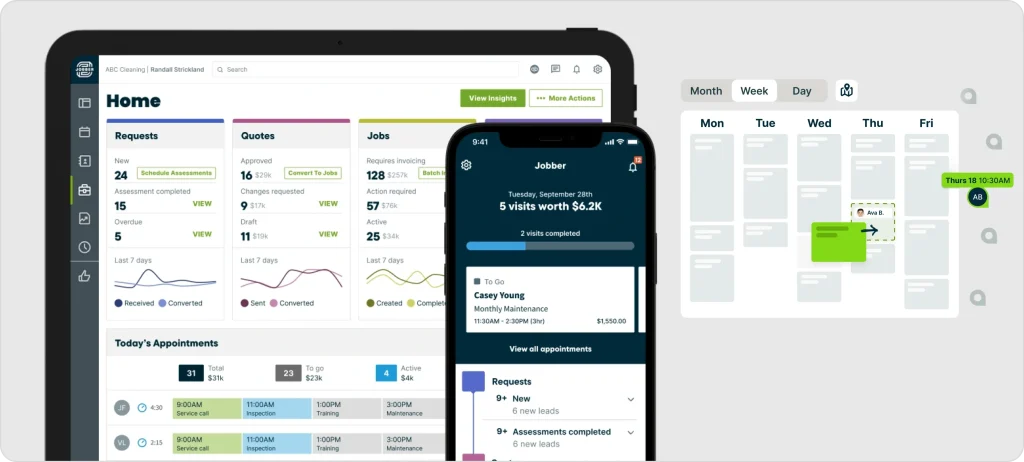
The drag-and-drop calendar is genuinely easy to use. Your office staff can learn it in under an hour. Route optimization plans efficient paths between jobs. Multi-option estimates with good, better, and best pricing tiers increase average ticket size without a hard sell. The integration ecosystem is the broadest on this list, connecting with QuickBooks, Stripe, Mailchimp, and dozens of other tools.
Here is where Jobber falls short for insulation businesses specifically. It is designed for single-visit service jobs. A three-day insulation job in Jobber requires creating three separate jobs and manually coordinating them. There is no AI dispatching, no automated crew assignment, and no workflow automation.
Key Capabilities:
Pricing: Starts at $25 per month for the Core plan. The Grow plan at $109 per month supports up to 15 users.
| Pros | Cons |
| Most intuitive interface with under-one-hour onboarding | No AI dispatching or automated crew assignment |
| Transparent pricing starting at $25 per month with no hidden fees | Multi-day jobs require creating separate entries and manual coordination |
| Broadest integration ecosystem, including QuickBooks, Stripe, and Mailchimp | No workflow automation |
| Route optimization reduces drive time between job sites | No insulation-specific calculations or features |
| Multi-option estimates increase average ticket size |
Who it is best for: Small insulation operations running mostly single-day jobs who want simple, affordable scheduling.
ServiceTitan is the heavyweight of field service software. If your insulation company runs 100+ trucks across multiple branches and pulls in millions in revenue, this is the platform that can handle that scale. For everyone else, it is probably overkill.
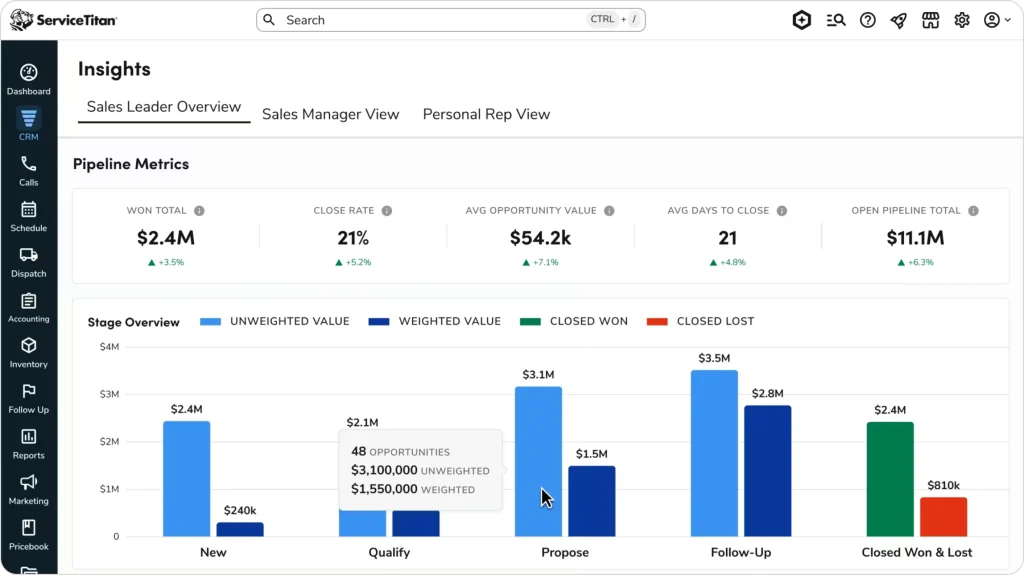
The feature count exceeds 500, covering scheduling, dispatch, marketing, advanced reporting, and more. The mobile app is the most robust we tested, with full offline functionality and digital price books. Multi-branch support manages multiple locations from one platform. Marketing tools include call tracking, reputation management, and membership programs.
The trade-off is cost and complexity. ServiceTitan starts at $15,000+ per year with implementation timelines of three to six months. It is designed primarily for HVAC, plumbing, and electrical trades. Insulation is not a core use case.
Key Capabilities:
Pricing: Starts at $15,000+ per year with required onboarding investment.
| Pros | Cons |
| 500+ features covering every aspect of field service operations | $15,000+ per year minimum puts it out of reach for most insulation businesses |
| Best mobile app with full offline functionality and digital price books | Three-to-six-month implementation requiring dedicated resources |
| Multi-branch management from one platform | Designed for HVAC, plumbing, and electrical, not insulation-specific |
| Advanced reporting, KPI tracking, and marketing tools | 500 features when most insulation contractors need a handful |
| Largest ecosystem of add-ons and integration partners |
Who it is best for: Enterprise insulation operations with 100+ trucks, multi-branch needs, and a budget of $15,000+ per year.
Different situations call for different tools. These recommendations match platforms to specific insulation business needs.
Top Pick: FieldCamp
FieldCamp delivers AI dispatching that automatically assigns jobs based on crew skills, certifications, location, and availability. Spray foam jobs go to spray foam certified crews without you touching anything. When someone calls in sick, jobs are reassigned automatically. Workflow automation handles invoicing and follow-ups. For insulation businesses spending hours each week on manual scheduling, FieldCamp eliminates that problem.
Also Great: Cleri for voice-powered AI if hands-free field operation is the priority.
Top Pick: Plexus Insulation
Plexus provides Gantt charts, task dependencies, and stage-based project management that commercial insulation contractors need. Multi-phase industrial projects require this level of complexity management.
Also Great: STACK for commercial estimating and digital takeoffs from blueprints. Pair STACK with FieldCamp or Plexus for full operations coverage.
Top Pick: FieldCamp
Small insulation businesses with two to 10 crews hit a growth wall when spreadsheet scheduling breaks down. FieldCamp is built to scale from solo operators to multi-crew operations with a 30-minute setup. No six-month implementations.
Also Great: Jobber for operations running mostly single-day jobs who want the simplest possible interface.
Top Pick: FieldGroove
FieldGroove auto-calculates board feet, coverage, and material costs for spray foam jobs. If estimating accuracy is your biggest pain point, rather than scheduling, FieldGroove tackles that specifically.
Use our free insulation estimate template as a starting point.
Top Pick: ServiceTitan
Companies with 100+ trucks, multi-branch operations, and $10 million+ revenue need ServiceTitan’s depth. It covers 500+ features, the strongest mobile app, and the largest integration ecosystem.
Selecting the right insulation contractor software depends on matching features to your situation.
AI dispatching versus manual scheduling is the first decision. If you spend hours each week figuring out which crew goes where, AI dispatching from FieldCamp eliminates that. If your scheduling is simple enough to manage manually, Jobber works fine.
Operation type separates residential from commercial solutions. Residential insulation contractors need fast scheduling with skill-based crew assignment. Commercial contractors need Gantt charts, task dependencies, and capacity planning.
Crew size determines your complexity needs. At two or three crews, spreadsheets work. With four or more crews, you need software that automates crew assignment. With 10+ crews, you need AI-powered dispatching that scales without adding admin staff.
Insulation-specific features like spray foam calculations and board-feet estimating matter if estimating accuracy is your pain point. FieldGroove, STACK, and Allpro Insulator excel here.
Mobile app quality matters when crews need job details in the field. ServiceTitan has the strongest mobile app overall. FieldCamp shows crews their schedule on their phones with real-time updates.
Choosing the best insulation contractor software transforms how you manage crews, schedule jobs, and grow your business.
For insulation businesses spending hours each week on manual scheduling, FieldCamp’s AI dispatching and workflow automation eliminates that problem. Spray foam jobs automatically go to certified crews. Invoices are generated when jobs are completed. The system handles the coordination so you can focus on the work.
Commercial contractors working on large industrial projects will find Plexus Insulation’s Gantt charts and multi-stage orders essential for managing complexity.
Small operations running single-day jobs will appreciate Jobber’s transparent pricing and intuitive interface.
The right software eliminates manual scheduling, reduces errors, and lets you scale without adding admin staff. Review the comparison table above to identify which solution matches your situatio
Take Your Insulation Business Beyond Spreadsheets
Spreadsheets solve two-crew scheduling problems. Growing an insulation business requires tools built for operations: AI dispatching, workflow automation, invoicing, and client management under one roof.
The best insulation contractor software depends on your specific needs. For insulation businesses that want AI to handle crew assignment automatically, FieldCamp provides AI dispatching that assigns jobs based on skills, certifications, location, and availability, plus workflow automation for invoicing and follow-ups. For commercial projects with task dependencies, Plexus Insulation offers Gantt charts and multi-phase project management. For small operations focused on spray foam estimating, FieldGroove provides deep material calculation tools. Evaluate your primary pain point and match it against each platform’s core strength.
For AI-powered scheduling that automates crew assignment, FieldCamp stands out. The AI dispatching system assigns jobs based on crew skills, certifications, location, and availability without manual intervention. Spray foam jobs automatically go to spray foam certified crews. For simple manual scheduling at the lowest cost, Jobber starts at $25 per month with an intuitive drag-and-drop calendar. The right choice depends on whether you want automation or simplicity.
Pricing ranges from $25 per month to $15,000+ per year, depending on features and company size. Jobber starts at $25 per month for basic scheduling. FieldCamp supports custom pricing with AI dispatching and workflow automation. FieldGroove runs approximately $50 per user per month. Enterprise platforms like ServiceTitan start at $15,000 per year. Several platforms,s including Plexus, Builder Prime, Cleri, and STACK require contacting sales for pricing.
You can, but you may hit limitations. Generic platforms like Jobber are designed for single-visit service jobs. For insulation work that spans multiple days, generic software requires creating separate job entries and manually coordinating them. If your biggest challenge is crew assignment, generic tools lack AI dispatching that automatically matches jobs to certified crews. Purpose-built options like FieldCamp handle insulation workflows more efficiently.
Essential features for insulation contractor software include scheduling with multi-day job support, skill-based crew assignment (spray foam certified versus fiber trained), mobile app access for field crews, estimating and quoting tools, invoicing and payment processing, and customer communication. For growing operations, AI dispatching that automatically assigns jobs based on skills and availability eliminates hours of manual coordination each week.
At two or three crews, spreadsheets and manual coordination often work fine. The breaking point typically comes at four or five crews when scheduling takes five or more hours per week, coordination requires constant texting, and you cannot answer “when can you start?” without checking multiple calendars. If you are approaching that point, evaluating purpose-built tools before the inefficiency starts costing you jobs makes sense.
Start by exporting your current data, including customer lists, crew information, and pending jobs. Choose software based on your scheduling needs and crew size. Input crew skills and tag who has a certified insulation contractor license for spray foam versus fiber. Run both systems in parallel for one to two weeks, then train your crews on the mobile app using a real job. Most contractors complete the switch in one to two weeks. FieldCamp offers a 30-minute setup to get operational.
Two platforms offer meaningful AI capabilities for insulation contractors. FieldCamp uses AI dispatching to automatically assign jobs based on crew skills, certifications, location, and availability. The Command Center lets you manage operations using natural language commands. Cleri offers Cleo, a voice-powered AI assistant built for hands-free field use. FieldCamp focuses on dispatching intelligence, while Cleri focuses on voice-driven field operations.