
36 Cleaning Business Ideas to Start in 2026 (Low Cost to High Profit)
January 29, 2026 - 38 min read

January 29, 2026 - 38 min read

Table of Contents
| TL;DR: If you’re working with minimal capital, residential house cleaning, window cleaning, and Airbnb cleaning all start under $600. Looking for the highest profit potential? Post-construction cleaning can generate $100K+, commercial kitchen cleaning reaches $150K+, and pressure washing businesses report $200K+ annually. Beginners should consider house cleaning, move-in/out cleaning, or car detailing, all of which require no experience to start. For predictable recurring revenue, focus on office janitorial contracts, pool cleaning routes, or medical office cleaning where clients pay monthly. |
The cleaning business industry is booming. In 2026, the global market is valued at $472 billion and is growing at 7.1% annually.
With nearly 3 million cleaning jobs in the US and profit margins ranging from 10–28%, it’s one of the most accessible businesses to start, whether you have $500 or $50,000.
But here’s the challenge: there are dozens of cleaning business types, and picking the wrong one can mean months of wasted effort.
This guide breaks down 36 cleaning business ideas organised by startup cost, profit potential, and experience level, so you can find the right fit for your situation.
KEY HIGHLIGHTS
Cleaning Industry Trends for 2026
Before diving into specific ideas, it’s helpful to understand what separates a $ 30,000/year side hustle from a $ 200,000/year operation.
According to the latest cleaning industry trends and statistics, several factors drive profitability:
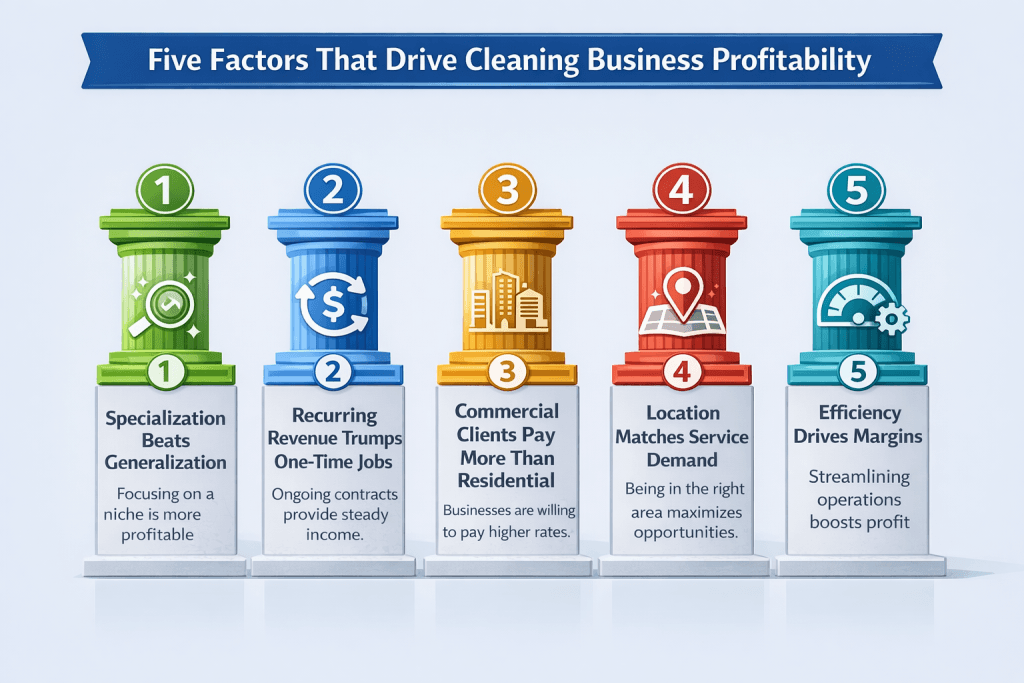
1. Specialisation beats generalisation
Niche services (post-construction, biohazard, commercial kitchens) command higher rates because they require specific skills or equipment. General residential cleaning is a competitive market; specialised services, on the other hand, have fewer providers.
2. Recurring revenue trumps one-off jobs
A single office cleaning contract worth $2,000/month beats chasing 20 individual house cleaning clients. Contract-based models create predictable cash flow.
3. Commercial clients pay more than residential clients
Businesses have larger budgets and longer contracts. The commercial cleaning segment alone is projected to reach $336 billion by 2031.
4. Location matters
Demand varies by geography. Pool cleaning thrives in Arizona; chimney sweeping dominates in New England. Airbnb cleaning explodes in tourist destinations. Match your service to your market.
5. Efficiency drives margins
Using a cleaning schedule app and optimising routes can increase your profit margin by 15–20% without adding clients.
Rather listen than scroll? Here’s the podcast version.
Not every cleaning business fits every person. Use this quick-reference table to find ideas that match your situation:
| Your Situation | Best Cleaning Business Ideas | Section |
| Under $1,000 to invest | Residential cleaning, window cleaning, move-in/out, Airbnb | Low-Cost Ideas |
| No experience | House cleaning, car detailing, laundry service | Low-Cost Ideas |
| Want $100K+ income | Post-construction, commercial kitchen, biohazard, pressure washing | High-Profit Ideas |
| Prefer steady contracts | Office janitorial, medical offices, schools, pools | Recurring Revenue |
| Want low competition | Trash bin cleaning, boat cleaning, chimney sweeping | Niche Ideas |
| Looking for emerging opportunities | Disinfection services, AI-optimized cleaning | Specialty Ideas |
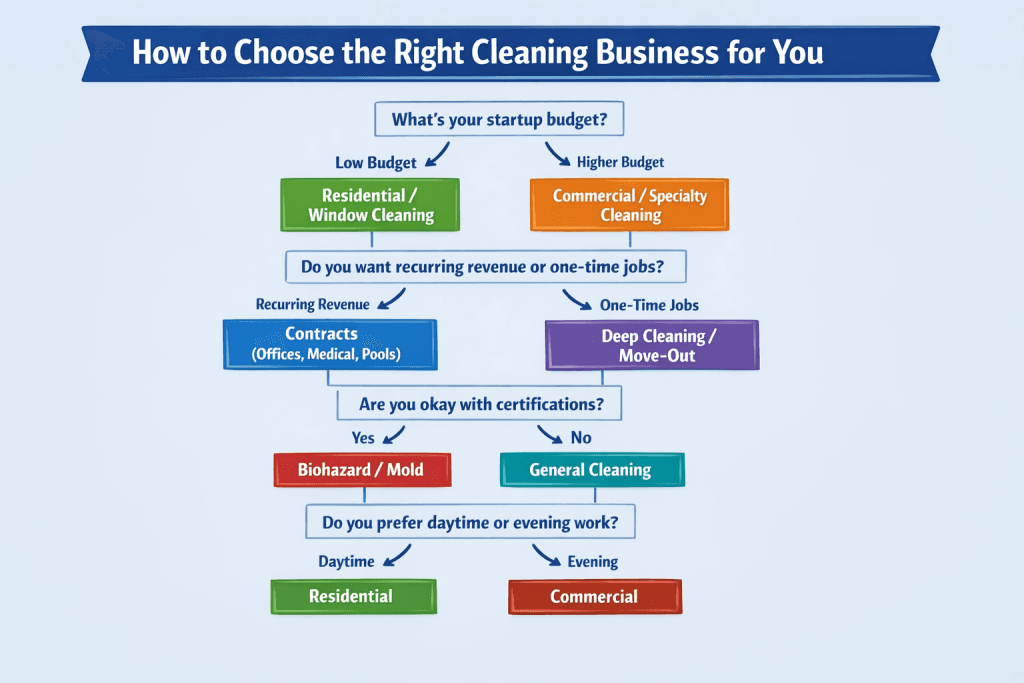
Once you’ve identified your category, explore the specific ideas below. Each includes startup costs, earning potential, demand factors, and geographic considerations.
These ideas require minimal upfront investment, little to no experience, and can often be started within a week. Perfect for testing the market or building a side income.
This is where most people start—and for good reason. Nearly every neighborhood has families willing to pay for regular house cleaning.
The basics:
What the work looks like:
You’ll dust, vacuum, mop, clean bathrooms, and tidy kitchens. Some clients want weekly visits; others prefer bi-weekly or monthly deep cleans. Most residential jobs take 2–4 hours, depending on home size.
Where demand is highest:
Suburban neighborhoods with dual-income families. Areas near good schools (parents are busy). Urban apartments where people work long hours. College towns during move-out season.
How to stand out:
The residential market is crowded, so differentiation matters. Consider specializing: pet-friendly cleaning, eco-friendly products, senior-focused services, or homes with allergies. You could also offer premium add-ons like interior window cleaning, refrigerator deep cleans, or oven scrubbing.
Getting started:
You need a vacuum, mop, bucket, microfiber cloths, and basic cleaning solutions. Many cleaners start using supplies clients already have. It reduces your upfront costs, and some clients prefer their own products anyway.
Figure out your pricing early. Too low and you’ll burn out; too high and you won’t land clients.
Pro tip: Use a house cleaning cost calculator to quote jobs accurately instead of guessing.
Don’t overlook this one. Window cleaning has surprisingly high margins and steady demand; homeowners hate doing it themselves.
The basics:
What the work looks like:
Interior and exterior window cleaning for homes and businesses. You’ll use squeegees, scrubbers, and extension poles. Jobs range from small residential (8–12 windows) to large commercial buildings.
Where demand is highest:
Everywhere, honestly. But a few areas stand out: urban centers with high-rise buildings (commercial contracts), coastal regions (salt buildup requires frequent cleaning), and upscale neighborhoods where curb appeal matters.
How to stand out:
Offer subscription packages, quarterly exterior cleaning at a discounted rate locks in recurring revenue. Bundle with gutter cleaning or pressure washing for larger tickets. Commercial accounts (storefronts, office buildings) provide steadier work than residential.
Getting started:
Basic kit: professional squeegee, scrubber, extension pole (for second-story windows), bucket, cleaning solution, and ladder. Total investment under $600. You can add water-fed pole systems later for high-rise work, but that’s not necessary to start.
Every time someone moves, that property needs a deep clean. And people move constantly, especially in rental-heavy markets.
The basics:
What the work looks like:
You’re cleaning empty properties between tenants. This means deep cleaning everything: inside cabinets, behind appliances, baseboards, light fixtures, ceiling fans, and window tracks. It’s more intensive than regular house cleaning, which is why it pays more.
Where demand is highest:
College towns (massive turnover every May and August). Military bases (families relocate frequently). Any area with lots of rental properties. The end of each month is always busy.
How to stand out:
Speed and reliability matter here. Property managers need units ready fast, sometimes same-day. If you can guarantee a quick turnaround, you’ll win contracts. Build relationships with property management companies; one contract with a 50-unit apartment complex provides steady monthly work.
Getting started:
Same supplies as residential cleaning, plus some extras: heavy-duty degreaser for kitchens, scrub brushes for grout, and a good step ladder. The real investment is building relationships with property managers and real estate agents.
This niche barely existed a decade ago. Now it’s one of the fastest-growing segments in cleaning.
The basics:
What the work looks like:
Quick turnovers between guests. Check-out might be 11 am, check-in at 3 pm, and you need to clean, change linens, restock supplies, and make the place photo-ready in that window. It’s fast-paced work with tight deadlines.
Where demand is highest:
Tourist destinations: beach towns, ski resorts, mountain getaways, wine country, and urban areas with lots of visitors. Anywhere you see a high density of Airbnb listings.
How to stand out:
Hosts love reliability. Show up when you say you will, communicate proactively, and never miss a turnover. Offer extras: linen service (you wash and store backup sets), restocking (toiletries, coffee, supplies), and property inspection (reporting maintenance issues). Use software to sync with host calendars automatically.
Getting started:
Find Airbnb hosts in your area through local Facebook groups, Airbnb host meetups, or simply by messaging hosts directly through the platform. One host with multiple properties can become your entire workload.
Create professional invoices with a cleaning invoice template. Hosts appreciate clean documentation that they can expense.
People love their cars. They also hate cleaning them. That’s your opportunity.
The basics:
What the work looks like:
Interior and exterior vehicle cleaning, ranging from basic washes ($30–$50) to full detailing with waxing, polishing, leather conditioning, and engine cleaning ($200–$400+).
Where demand is highest:
Affluent suburbs (people with nice cars who don’t want to wash them). Business districts (busy professionals). Car dealerships (fleet detailing). Exotic car communities. Corporate accounts for fleet vehicles.
How to stand out:
Go mobile, you drive to the client instead of them coming to you. This convenience commands premium pricing. Specialize in luxury vehicles or offer ceramic coating services for an upsell. Corporate fleet accounts provide recurring revenue.
Getting started:
Basic supplies: portable pressure washer or foam cannon, wet/dry vacuum, microfiber towels, interior cleaners, exterior soap, wax, and polish. A van or truck with your equipment makes mobile service efficient. You can start with just a sedan and a tote of supplies.
Regular cleaning maintains a home. Deep cleaning transforms it. And people pay significantly more for transformation.
The basics:
What the work looks like:
Everything regular cleaning covers, plus: behind and under appliances, inside cabinets and drawers, baseboards, light fixtures, ceiling fans, vents, door frames, and all the spots people never touch. A deep clean takes 4–8 hours, depending on home size and condition.
Where demand is highest:
Universal. But demand spikes seasonally: spring cleaning (March–April), pre-holiday prep (November), and before hosting events.
How to stand out:
Create packages: “Spring Refresh,” “Pre-Holiday Deep Clean,” “Post-Party Recovery.” Take before/after photos with permission—they’re incredibly effective for marketing.
Getting started:
Same supplies as residential cleaning, plus specialty items: grout brush, ceiling fan duster, baseboard cleaning tool, and heavy-duty degreaser. Market deep cleaning as an upsell to your regular residential clients.
Here’s a trend worth paying attention to: green cleaning is the #1 industry trend according to ISSA (the cleaning industry’s trade association). And it’s not slowing down.
The basics:
What the work looks like:
Same cleaning services, different products. You use non-toxic, biodegradable, environmentally sustainable supplies. Some eco-cleaners also emphasize reusable materials, minimal plastic, and carbon-conscious practices.
Where demand is highest:
Urban areas with health-conscious populations. Regions with strong environmental awareness (Pacific Northwest, Northeast, Colorado, California). Families with young children or pets. People with allergies or chemical sensitivities.
How to stand out:
Get certifications (Green Seal, EPA Safer Choice). Educate clients on what makes your products different. Use refillable containers and minimize waste visibly. Some clients will pay 25% more just for peace of mind.
Getting started:
Research eco-friendly product lines. Initial costs may be slightly higher, but premium pricing more than compensates.
Pair this with AI cleaning services for route optimization, reducing drive time cuts your carbon footprint, and appealing to eco-conscious clients.
This might be the lowest-cost cleaning business you can start. You might already own the equipment.
The basics:
What the work looks like:
Pick up dirty laundry, wash, dry, fold, and deliver. Some services add ironing, dry cleaning drop-off, or specialty item care (delicates, linens).
Where demand is highest:
Urban apartments without in-unit laundry. Busy professionals who hate doing laundry. College students. Elderly clients who struggle with the physical demands. Airbnb hosts who need linen service.
How to stand out:
Offer subscription packages (weekly pickup at a fixed rate). Provide same-day or next-day turnaround. Expand to commercial accounts: Airbnbs, salons, gyms, massage studios, businesses that go through lots of towels and linens.
Getting started:
Use your own washer and dryer, or partner with a laundromat. Your personal vehicle handles delivery. Commercial accounts provide volume that makes laundromat costs worthwhile.
Here’s a niche most cleaners ignore, which is exactly why it’s worth considering.
The basics:
What the work looks like:
Decluttering, organizing, sweeping, and deep cleaning garages, basements, attics, and storage areas. May include pressure washing concrete floors, organizing shelving, and helping clients decide what to keep, donate, or trash.
Where demand is highest:
Suburban areas with single-family homes (more garage and basement space). Peak seasons: spring cleaning, before holidays, and the moving season.
How to stand out:
Offer organization alongside cleaning. Partner with junk removal companies, you clean and organize; they haul away what clients don’t want. Before/after photos are incredibly compelling for this niche.
Getting started:
Market through neighborhood Facebook groups and Nextdoor. Homeowners in your area are your target market, and hyperlocal marketing works well. A pressure washer helps with concrete floors, but it isn’t required to start.
Here’s a market that’s only going to grow: America’s population is aging, and seniors need help maintaining their homes.
The basics:
What the work looks like:
Regular house cleaning with extra attention to the needs of elderly clients. This might include help with laundry, light organization, and simply being a consistent, trustworthy presence. Many seniors value the companionship as much as the cleaning.
Where demand is highest:
Retirement communities. 55+ neighborhoods. Areas with aging populations. This is a long-term growth market—the 65+ demographic is expanding faster than any other.
How to stand out:
Build trust through reliability and consistency. Seniors value seeing the same person every time. Get bonded and insured, their families will ask. Offer additional light assistance (taking out trash, changing lightbulbs, simple errands) if you’re comfortable.
Getting started:
Partner with senior centers, home health agencies, elder care attorneys, and geriatric care managers. Word-of-mouth referrals are incredibly powerful in this community. Once you earn trust with one client, their friends will call.
Learn more ways to find your first customers in our guide on how to get clients for your cleaning business.
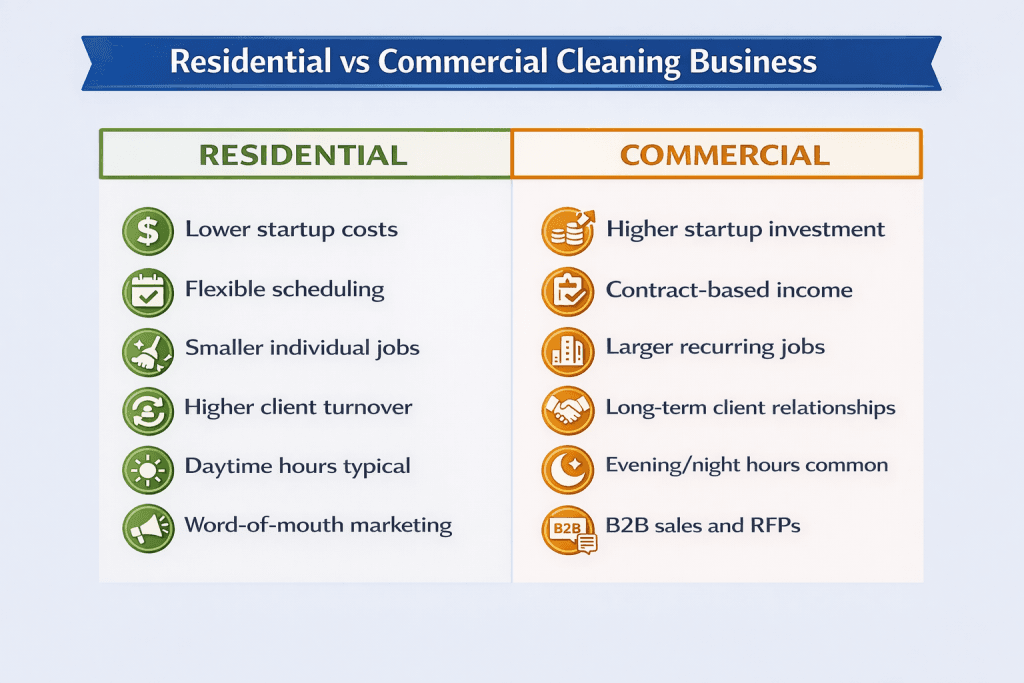
Ready to think bigger? These businesses require more upfront investment or specialized knowledge, but the income potential is substantially higher. If you want to build a real company with employees, these are your best bets.
Ask any cleaning business owner which niche pays best, and post-construction almost always comes up.
The basics:
What the work looks like:
Cleaning newly built or renovated properties before anyone moves in. You’re removing construction dust (which gets everywhere), cleaning windows (often still have stickers and paint), polishing fixtures, scraping adhesive residue, and making the space move-in ready. The work is divided into “rough clean” (mid-construction) and “final clean” (before handoff).
Where demand is highest:
Growing metro areas with new housing developments. Commercial construction zones. Track local building permits to spot opportunities before your competitors.
How to stand out:
Relationships are everything in this niche. Contractors want reliable partners who meet tight deadlines and don’t need babysitting. Once you prove yourself to one general contractor, you’ll get referrals to others. Be responsive, show up on time, and deliver consistent quality.
Getting started:
You’ll need heavy-duty vacuums (construction dust kills regular vacuums), scrapers, industrial cleaning supplies, and PPE. One good relationship with a busy contractor can provide steady work year-round.
Important: construction sites have higher liability requirements. You’ll need proper insurance and a cleaning business license for your area.
Restaurants legally must maintain clean kitchens. Health departments enforce it. That’s recurring revenue built into the business model.
The basics:
What the work looks like:
Deep cleaning commercial kitchens: hood vents and exhaust systems, grease traps, ovens, fryers, grills, refrigerators, floors, and walls. This isn’t wiping down counters, it’s intensive degreasing work that regular kitchen staff can’t do.
Where demand is highest:
Anywhere with restaurants. Urban dining districts, suburban restaurant rows, shopping centers with food courts. Hospitals, schools, and corporate cafeterias also need this service.
How to stand out:
Get certified (IKECA for exhaust cleaning is respected). Provide compliance documentation that restaurants can show health inspectors. Offer flexible scheduling, most restaurants need cleaning done after closing or before opening.
Getting started:
Requires specialized degreasing equipment and chemicals. Jobs often happen late at night or early morning when kitchens are closed. Start with independent restaurants, then pursue larger accounts (chains, hotels, hospitals). One restaurant chain contract can fill your schedule.
This isn’t for everyone. But if you can handle the work, it pays extremely well.
The basics:
What the work looks like:
Cleaning scenes involving blood, bodily fluids, or hazardous materials. This includes crime scenes, unattended deaths, trauma, hoarding situations with biohazard elements, and infectious disease decontamination. The work requires strict safety protocols and proper disposal procedures.
Where demand is highest:
Every area needs this service, but larger metro areas have more volume. Work comes through police departments, property managers, funeral homes, and insurance companies.
How to stand out:
Certifications are essential; you can’t do this work without proper training. Beyond that, compassion and discretion matter. You’re often working with grieving families. Professionalism means respecting their situation while doing thorough work.
Getting started:
Significant investment in training (OSHA certification, hazmat training) and equipment (PPE, specialized cleaning agents, biohazard disposal containers, and protocols). Build relationships with first responders and property managers.
Mold is a health hazard that homeowners can’t ignore. When they find it, they need professional help fast.
The basics:
What the work looks like:
Identifying mold colonies, setting up containment to prevent spread, removing affected materials, treating surfaces, and implementing preventive measures. May include air quality testing before and after.
Where demand is highest:
Humid climates (Southeast US, Pacific Northwest). Coastal areas with salt air and moisture. Flood-prone regions. Older homes with moisture issues in basements or crawl spaces.
How to stand out:
IICRC certification is the industry standard. Partner with home inspectors who find mold during inspections; they need someone to refer buyers to. Insurance adjusters are another referral source.
Getting started:
Requires specialized equipment: HEPA air scrubbers, dehumidifiers, containment materials, PPE, and antimicrobial treatments. Often pairs with water damage restoration for a broader service offering.
This is the backbone of the cleaning industry, a $225+ billion market in the commercial segment alone.
The basics:
What the work looks like:
Regular cleaning of offices, retail stores, warehouses, and commercial buildings. Services include trash removal, restroom cleaning and restocking, floor care (vacuuming, mopping, buffing), surface sanitization, and break room cleaning.
Where demand is highest:
Business districts, office parks, industrial areas, and shopping centers. Every commercial building needs janitorial services—it’s just a matter of who provides them.
How to stand out:
Reliability and consistency matter more than rock-bottom pricing. Offer flexible scheduling (nights, weekends, holidays). Provide quality assurance through checklists and inspections. Use technology like workload balancing with AI to optimize crew assignments and reduce costs.
Getting started:
Start with smaller accounts (local businesses, small offices) and build references. Respond to RFPs from property management companies. One large contract with a Fortune 500 company can transform your business overnight.
High demand, satisfying work, and excellent profit margins. Pressure washing checks a lot of boxes.
The basics:
What the work looks like:
Cleaning exterior surfaces with high-pressure water: driveways, sidewalks, decks, patios, fences, house siding, roofs, parking lots, and commercial buildings. Some jobs take an hour; others take all day.
Where demand is highest:
Universal, but especially strong in humid climates (mildew and algae growth), coastal areas (salt buildup), and regions with hard water staining. HOA communities often require regular exterior cleaning.
How to stand out:
Learn soft washing for delicate surfaces (roofs, painted wood, stucco). Bundle with gutter cleaning or exterior window washing. Target entire HOA neighborhoods; one contract covers dozens of homes.
Getting started:
Entry-level pressure washer ($300–$500), surface cleaner attachment (makes driveways faster), hoses, and cleaning solutions. Commercial-grade equipment ($2,000+) handles bigger jobs faster and lasts longer. A truck or trailer helps with mobility.
An established niche with steady demand and good repeat business.
The basics:
What the work looks like:
Deep cleaning carpets and upholstered furniture using hot water extraction (steam cleaning). Includes pre-treatment, extraction, spot treatment for stains, and optional protective treatments.
Where demand is highest:
Universal. Higher frequency in homes with pets, children, or allergy concerns. Commercial accounts (offices, hotels, apartment complexes) provide volume.
How to stand out:
Specializes in difficult stains: pet urine, red wine, coffee. Offer area rug cleaning (pickup and delivery). Pursue commercial accounts; one hotel contract with 100+ rooms is significant revenue.
Getting started:
Portable extractors ($2,000–$3,000) let you start smaller. Truck-mounted systems ($15,000+) are faster, more powerful, and signal professionalism to clients. Most successful carpet cleaners eventually upgrade to a truck-mount.
An underserved market that requires as much empathy as cleaning skill.
The basics:
What the work looks like:
Cleaning severely cluttered homes. This goes beyond normal decluttering—we’re talking floor-to-ceiling accumulation, blocked walkways, and sometimes biohazard conditions (spoiled food, animal waste). The work requires coordination with family members and often mental health professionals.
Where demand is highest:
Every community has hoarding situations. Referrals come from social workers, therapists, adult protective services, family members, and estate attorneys.
How to stand out:
Approach with compassion. People with hoarding disorder often feel ashamed, and aggressive or judgmental attitudes will backfire. Offer ongoing maintenance plans to prevent recurrence. Partner with mental health providers who specialize in hoarding.
Getting started:
Requires patience, strong organizational skills, and often junk removal capabilities (or a partnership with a junk removal company). PPE and biohazard training are useful for severe cases.
The real money in cleaning isn’t from one-time jobs, it’s from contracts. These business models prioritize predictable monthly income.
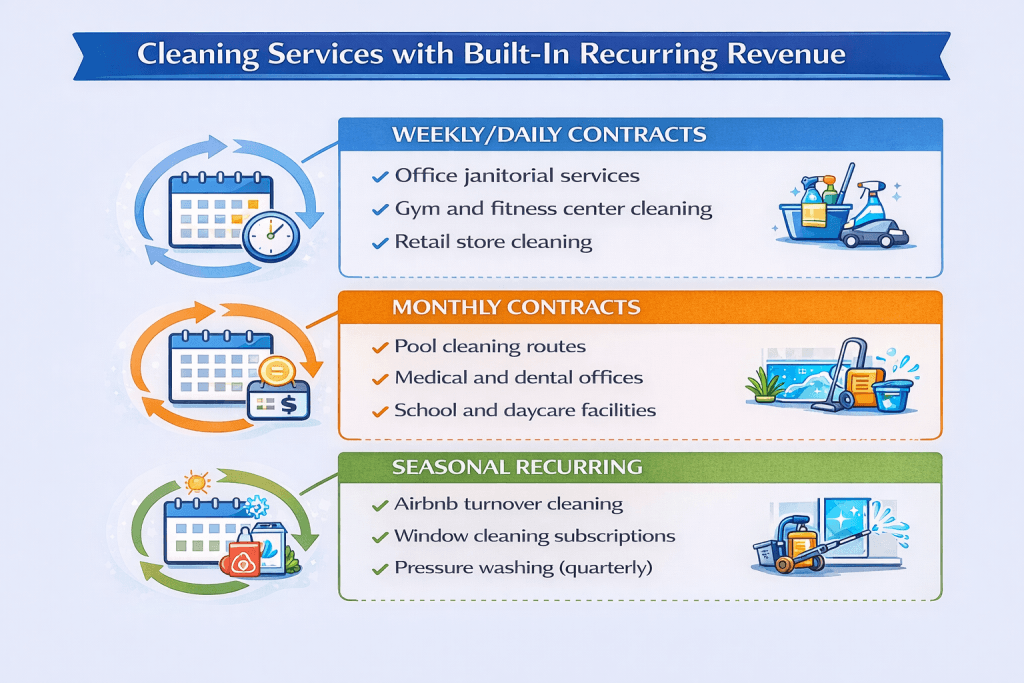
Land a few solid contracts, and you’ve got stable, predictable income for years.
The basics:
What the work looks like:
Regular cleaning of office spaces: emptying trash, cleaning restrooms, wiping surfaces, vacuuming or mopping floors, restocking supplies. Some contracts include periodic deep cleaning (carpet shampooing, window washing).
How to land contracts:
Network with property managers and office managers. Respond to RFPs. Offer competitive pilot periods so prospects can test your quality. Once you’re in, deliver consistent service; switching cleaning companies is a hassle most businesses want to avoid.
Scaling efficiently: Multiple contracts require smart scheduling. Use multi-day scheduling tools to optimize routes and crew assignments.
Healthcare facilities pay premium rates because they have compliance requirements that regular cleaners can’t meet.
The basics:
What the work looks like:
Cleaning medical environments with strict attention to infection control. Proper disposal of biohazard waste, sanitization of exam rooms, and HIPAA-compliant handling of any documents you encounter.
How to stand out:
Get training in healthcare cleaning standards. Provide detailed compliance documentation. Medical practices need cleaners they can trust; reliability and thoroughness command premium rates.
Gyms generate a lot of sweat. They need daily cleaning, period.
The basics:
What the work looks like:
Equipment sanitization, locker room and restroom cleaning, floor care (gym floors take a beating), and general facility tidying. Often scheduled early morning or late at night.
Market factors:
Health-consciousness isn’t fading. Gyms know their members pay attention to cleanliness, especially since the pandemic. Daily cleaning isn’t optional.
Large facilities with stable, long-term contract potential.
The basics:
What the work looks like:
Classroom cleaning, restroom sanitization, cafeteria cleaning, and floor care. Summer deep cleaning during breaks provides additional revenue.
How to land contracts:
Public schools typically use RFP processes; watch for announcements. Private schools and daycares may contract directly. Background checks and sometimes certifications are required.
If you live in the right climate, pool routes are goldmines of recurring revenue.
The basics:
What the work looks like:
Weekly visits to skim debris, vacuum, brush walls, check and balance chemicals, clean filters, and inspect equipment. Each pool takes 30–60 minutes.
Where demand is highest:
Warm climates with year-round pool season: Florida, Arizona, California, Texas, and Nevada. Seasonal in northern states, but concentrated demand during the summer months.
Scaling:
A route of 40+ pools provides a full-time income. Each pool typically pays $100–$200/month for weekly service.
Reliable contracts with predictable schedules and straightforward work.
The basics:
What the work looks like:
Floor care (retail floors see heavy foot traffic), restroom cleaning, trash removal, surface dusting, and entrance cleaning. Usually done outside business hours.
How to land contracts:
Approach local business owners directly. Respond to RFPs from retail property management companies. Shopping centers often contract cleaning for multiple stores.
These under-the-radar niches have fewer competitors and often command premium rates because of their specialized nature.
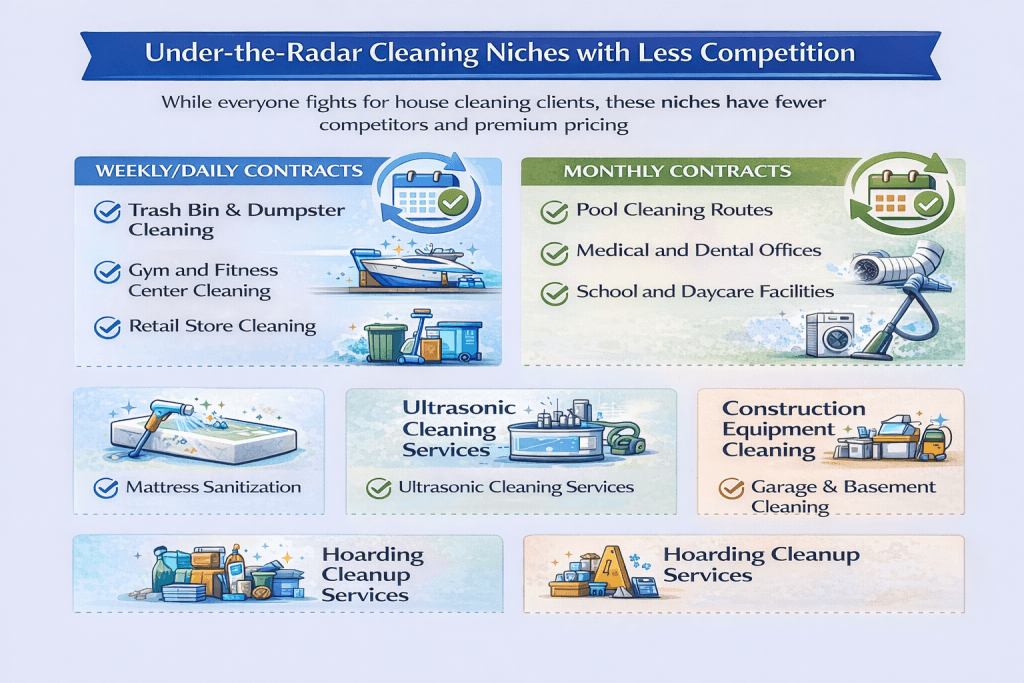
Yes, people will pay you to clean their garbage cans. It’s a real business with real demand.
The basics:
What the work looks like:
Sanitizing and deodorizing residential trash bins after collection day. Using pressure washing and sanitizing solutions to eliminate odors, bacteria, and grime. Work typically happens curbside right after garbage trucks run.
Where demand is highest:
HOA communities (rules often require clean exteriors). Suburban neighborhoods with families. Hot climates where bin odors get unbearable in summer.
How to stand out:
Offer monthly subscription packages. Target entire neighborhoods for route efficiency. If you’re already on a street, you might as well clean every bin that wants service.
Getting started:
Requires a truck, pressure washer, water tank, and sanitizing solution. Custom bin-cleaning trailer systems exist, or you can build your own setup.
Wealthy clients who hate cleaning their own boats. High margins, loyal customers.
The basics:
What the work looks like:
Interior and exterior boat cleaning: hull washing, deck scrubbing, interior detailing, canvas cleaning, and brightwork polishing. Can expand to waxing, bottom painting prep, and winterization services.
Where demand is highest:
Marinas and yacht clubs. Coastal cities with recreational boating. Lake communities with vacation homes. Anywhere wealthy people keep boats.
How to stand out:
Offer mobile service at marinas, and boat owners appreciate not hauling their vessel somewhere. Provide seasonal packages: pre-season prep, post-season winterization, and monthly maintenance during boating season.
A classic trade that’s far from dead—especially in regions with cold winters.
The basics:
What the work looks like:
Cleaning fireplace chimneys to remove creosote buildup (fire hazard), inspecting for damage, and identifying maintenance needs. Can expand into dryer vent cleaning, minor repairs, and fireplace installations.
Where demand is highest:
Cold climates where wood-burning fireplaces are common: New England, the Midwest, and mountain regions. Older homes with original chimneys.
How to stand out:
Get CSIA (Chimney Safety Institute of America) certified; it’s the industry credential that builds trust. Offer comprehensive inspections alongside cleaning.
A safety-focused service with growing awareness and easy upsell potential.
The basics:
What the work looks like:
Cleaning lint buildup from dryer vents to prevent house fires. The US Fire Administration reports 2,900 dryer fires annually, and lint buildup is the leading cause.
Where demand is highest:
Universal. Single-family homes, multi-unit apartment buildings, laundromats—anything with dryers.
How to stand out:
Partner with HVAC companies that don’t offer this service. Bundle with air duct cleaning. Market the fire safety angle; it’s compelling.
A niche most people don’t know exists, until they have allergies or stains.
The basics:
What the work looks like:
Deep cleaning mattresses using UV sanitization, steam cleaning, or specialized extraction equipment. Removes dust mites, allergens, stains, and odors.
Where demand is highest:
Growing allergy awareness drives residential demand. Hotels and Airbnbs need mattress freshening between guests. Parents with young children (accidents happen).
How to stand out:
Market to allergy sufferers and parents. Bundle with carpet cleaning for efficiency.
A technical niche with unique B2B opportunities.
The basics:
What the work looks like:
Using ultrasonic cleaners (high-frequency sound waves in liquid) to clean delicate items: jewelry, watches, musical instruments, medical equipment, firearms, and industrial parts.
Where demand is highest:
Near jewelry districts, music schools, medical facilities, gun shops, and manufacturing areas.
How to stand out:
Specialize in one vertical and become the go-to provider. Partner with jewelers, instrument repair shops, or medical equipment suppliers.
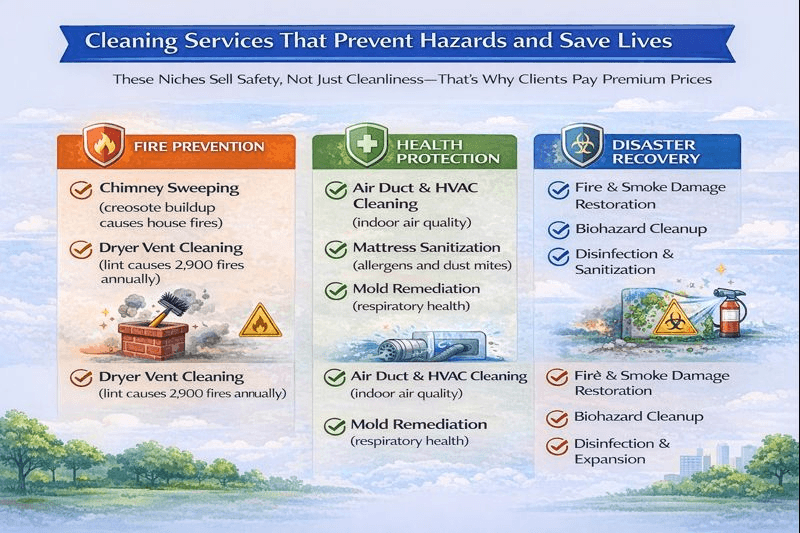
Indoor air quality concerns keep driving demand for this service.
The basics:
What the work looks like:
Cleaning dust, debris, and contaminants from HVAC ductwork to improve air quality and system efficiency. Recommended every 3–5 years for most homes.
Where demand is highest:
Universal, but higher in dusty climates, areas with poor air quality, and homes with individuals who suffer from allergies.
How to stand out:
Get NADCA certification; it’s the industry standard. Offer before/after photos and air quality testing to demonstrate value.
These emerging or specialized services offer differentiation in a crowded market.
Real estate market fluctuations create opportunities for those paying attention.
The basics:
What the work looks like:
Cleaning and preparing bank-owned (REO) properties for sale. Includes trash removal, interior cleaning, yard work, and sometimes minor repairs.
How to land work:
Partner with REO real estate agents, banks, and asset management companies. When foreclosure rates rise, demand spikes.
Fast turnaround work for anyone who enjoys variety.
The basics:
What the work looks like:
Pre-event setup assistance and post-event cleanup for weddings, conferences, concerts, corporate events, and parties.
Where demand is highest:
Event centers, hotels with conference facilities, outdoor venues, and convention cities.
A B2B opportunity most cleaning businesses overlook.
The basics:
What the work looks like:
Cleaning heavy equipment, machinery, and fleet vehicles for construction companies, rental yards, and industrial operations.
Where demand is highest:
Construction hubs, industrial areas, and equipment rental companies.
Insurance-backed work with high project values.
The basics:
What the work looks like:
Cleaning and restoring properties after fire or smoke damage. Removing soot, neutralizing odors, and salvaging contents. Works directly with insurance companies.
How to land work:
Build relationships with insurance adjusters and restoration contractors. Become their trusted cleaning partner.
A service category that barely existed before 2020. Now it’s here to stay.
The basics:
What the work looks like:
Deep disinfection of commercial spaces using EPA-registered hospital-grade disinfectants, electrostatic sprayers, and documented protocols.
Where demand is highest:
Schools, offices, healthcare facilities, gyms, and any business prioritizing health and safety.
How to stand out:
Offer certified protocols with documentation. Flexible scheduling around business operations.
You don’t need a background in cleaning to succeed. Here’s the straightforward path:
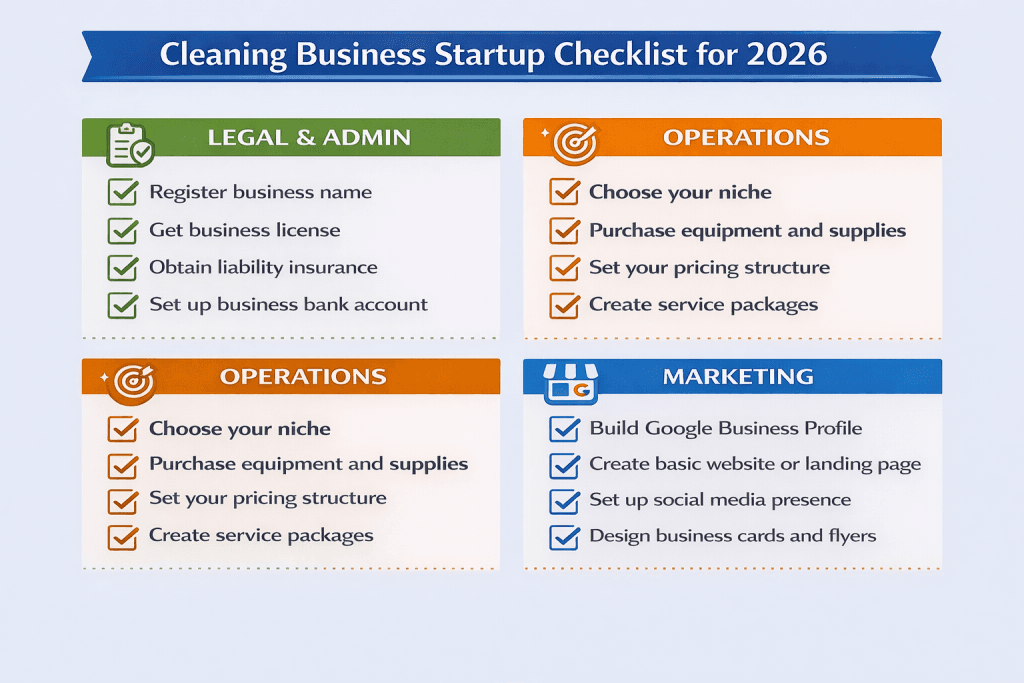
1. Pick your niche
Use this guide to select a service matching your budget, location, and goals. Starting focused beats, trying to offer everything.
2. Handle the legal basics
Register your business and get a cleaning business license. Requirements vary by state and city; check what your area requires.
3. Get insured
General liability insurance protects you if something goes wrong. Most policies cost $500–$1,000/year for small operations. Clients will ask about insurance, especially commercial insurance.
4. Set your prices
Research local rates and understand your costs before quoting. Our guide on how to charge for cleaning services breaks down the math.
5. Land your first clients
The hardest part of any business. Figure out how to get cleaning clients for your business with strategies from free to paid.
6. Deliver exceptional service
Quality and reliability generate referrals. According to industry research, referral programs deliver 25x ROI, higher than any other marketing channel. Do great work, and your clients will do your marketing for you.
7. Market and scale
Once you have a client base, learn how to market a cleaning business to grow beyond word-of-mouth. Invest in SEO for your cleaning business for sustainable lead generation.
The cleaning industry offers something for everyone. Whether you have $500 or $50,000 to invest, want a flexible side hustle or a scalable enterprise, or prefer working in homes or commercial buildings, there’s a cleaning business that fits.
Your next steps:
Manual Operations Are Becoming a Competitive Disadvantage.
Your clients compare you to every service they use: Uber, Amazon, DoorDash. They expect instant confirmations, easy rescheduling, and digital invoices. “That’s how we’ve always done it” is costing you jobs.
Commercial cleaning and specialty services typically have the highest profit margins at 15–28%. The most profitable niches include:
The key to profitability is specialization. Niche services face less competition and command higher rates than general residential cleaning.
Several options require minimal or no upfront investment:
You can also start by offering services, getting paid upfront (or a deposit), and using that income to purchase supplies.
Based on cleaning industry trends and statistics, the highest-demand services include:
Referrals and LSAs can generate leads within days. Google Business Profile improvements show results in 2-4 weeks. SEO typically takes 3-6 months for a significant impact. Consistency matters more than any single tactic.
The most affordable cleaning businesses to start:
All of these can realistically launch within a week with basic supplies.
Your pricing affects how you market. Too cheap and you’ll attract price-shoppers who churn. Too expensive without clear value, and you’ll lose quotes. Learn how to charge for cleaning services to find the right balance for your market.