
How to Price Painting Jobs
March 3, 2026 - 38 min read


March 3, 2026 - 38 min read

Table of Contents
| TL;DR: Yes, a cleaning business is profitable. Most US cleaning companies earn 10-28% net profit margins depending on service type. Residential cleaning averages 10-15%, commercial cleaning 15-20%, and specialty services like carpet or pressure washing hit 20-28%. Startup costs run $1,000-$5,000, and owners earn $50,000-$340,000+ annually depending on scale and efficiency. |
Starting a cleaning business in 2026 is one of the fastest ways to enter a $110+ billion industry; but most new owners underestimate what it truly costs to launch and run it properly. It’s not just mops and vacuums. Licenses, insurance, marketing, vehicles, and the right systems all impact your startup budget.
In this complete breakdown, we’ll walk through real cleaning business startup costs, from lean solo launches under $2,000 to fully equipped commercial operations exceeding $15,000. You’ll also learn where new owners overspend, where you should never cut corners, and how smart planning can reduce costs by up to 60%.
And just as important as what you spend is how you manage it. Using dedicated cleaning business software from day one helps you control scheduling, invoicing, route planning, and client communication; preventing costly mistakes that slow growth before it even starts.
Let’s break down exactly what it takes to launch the right way.
KEY HIGHLIGHTS
Check Cleaning Business Startup Costs in 2026
The traditional “cost-first” approach leaves painters underpaid and overworked. This profit-first framework reverses the equation—start with your desired income, then build pricing that guarantees it.
Key Takeaways:
Most painters price jobs by adding up costs and hoping there’s profit left over. That’s backwards—and it’s why 64% of painting contractors earn less than $50,000 annually despite working 50+ hour weeks.
The Profit-First Pricing Framework flips this model. Instead of asking “What will this job cost?” you start by asking “What do I need to earn?” Then you build pricing structures that guarantee those earnings—whether you’re a solo painter, running a crew, or managing commercial contracts.
This comprehensive guide walks you through painting job pricing from profit backwards to costs, with tailored strategies for solo operators, small crews, and commercial contractors. You’ll learn 8 proven pricing formulas, get access to 3 downloadable tools, and discover how AI-powered estimating is transforming the painting industry.
Whether you’re learning how to price painting jobs for the first time or refining an established painting business pricing strategy, this framework ensures you’re paid what you’re worth—not what the market thinks you should accept.
Traditional painting pricing starts with costs: labor hours + materials + overhead, then adds a small profit margin (10-15%). This seems logical but creates three critical problems:
Problem 1: Race to the bottom. When everyone calculates the same costs, the only way to win bids is lowering prices—which means lowering your profit.
Problem 2: Undervaluing expertise. A 10-year painter who works twice as fast earns the same per job as a beginner who takes twice as long. Your efficiency is punished, not rewarded.
Problem 3: Income caps. Cost-first pricing ties earnings to hours worked. Want to earn more? Work more hours. That’s not a business—that’s a job with extra steps.
⚠️ WARNING: If you’re consistently winning 70%+ of bids, your prices are too low. The sweet spot is 30-50% win rate for residential work, 20-40% for commercial.
The Profit-First Pricing Framework reverses the equation:
This approach guarantees profitability before you quote a single job. Let’s build your framework step by step.
Most painters dramatically underestimate what they need to charge per hour. Here’s how to calculate your true minimum rate.
Profit-First Rate Formula:
Minimum Hourly Rate = (Desired Annual Income + Business Expenses) ÷ Annual Billable Hours
Example calculation for a solo painter:
Minimum Hourly Rate = $100,000 ÷ 1,440 = $69.44/hour
This is your break-even rate before profit margin. To build in a 25% profit cushion:
Target Billable Rate = $69.44 ÷ (1 – 0.25) = $92.59/hour
Round to $95/hour as your target billable rate.
💡 PRO TIP: Most painters only bill 25-35 hours per week despite working 40-50 hours. The rest is estimates, travel, admin, and material pickup. Factor this into your calculations or you’ll consistently underprice.
For painting crews, calculate your fully-loaded labor cost:
Crew Labor Cost Formula:
Hourly Crew Cost = (Base Wages × Crew Size × Burden Multiplier) + Supervision Cost
Burden multiplier accounts for payroll taxes (7.65%), workers’ comp (8-15% for painting), unemployment insurance, and benefits. Typical burden: 1.25-1.35x base wages.
Example for a 2-person crew:
Loaded Labor Cost = [($25 + $18) × 1.30] + $15 = $70.90/hour
Add your 25% profit margin: $70.90 ÷ 0.75 = $94.53/hour crew billing rate
🔑 KEY TAKEAWAY: Your crew billing rate should be 2.5-3.5x your lowest crew member’s base wage. If you’re billing less than 2.5x, you’re losing money after overhead and profit.
Different business models require different pricing approaches. Here are the three primary painting business archetypes and their optimal pricing strategies.
Best for: Independent contractors, 1-2 person operations, residential-focused
Recommended pricing model: Flat-rate pricing with hourly fallback
Why it works: Customers prefer price certainty, and you’re rewarded for efficiency. A job that takes you 8 hours earns the same as one that takes 12 hours for a slower painter.
Typical rates (2026):
Profit margin target: 30-35%
Tools needed: Detailed pricing book (200+ common jobs), painting estimate template, mobile quoting capability
Best for: Residential and light commercial, multiple concurrent jobs, growth-focused
Recommended pricing model: Hybrid flat-rate + per-unit pricing
Why it works: Flat rates for standard residential jobs, per-square-foot pricing for larger commercial work. This balances customer expectations with scaling efficiency.
Typical rates (2026):
Profit margin target: 25-30%
Tools needed: Job costing software, crew scheduling system, AI-powered estimating, profitability tracking per job type
Best for: Commercial projects, government contracts, property management, large-scale residential
Recommended pricing model: Per-unit pricing with change order markup
Why it works: Commercial clients expect competitive per-unit pricing. Profit comes from volume, efficiency, and disciplined change order management.
Typical rates (2026):
Profit margin target: 15-25%
Tools needed: Bidding software, job scheduling, field service management platform, labor productivity tracking
| Business Model | Primary Pricing Method | Ideal Customer Type | Avg Profit Margin | Scalability |
| Solo Painter | Flat-rate + hourly | Homeowners, small residential | 30-35% | Low |
| Small Crew | Hybrid flat/sq ft | Residential + light commercial | 25-30% | Medium |
| Commercial Contractor | Per-unit + contract | Property managers, commercial | 15-25% | High |
💡 PRO TIP: Many successful painting businesses start as Solo (high margin, low volume), transition to Small Crew (balanced), then selectively take Commercial work (lower margin, higher volume). Don’t rush the progression—master each stage’s pricing model before scaling.
Most versatile formula for interior and exterior work.
Square Footage Formula:
Total Price = (Square Footage × Rate per Sq Ft) + Fixed Costs
How to calculate paintable square footage:
Example: Interior bedroom (12′ × 14′, 8′ ceilings)
Rate ranges by surface type:
Simplest pricing model for residential painters—customers love the clarity.
Room-Based Formula:
Room Price = Base Room Rate + Ceiling Premium + Trim Premium + Condition Multiplier
Standard room rates (2026):
| Room Type | Base Rate | + Ceiling | + Trim | Typical Total |
| Small bedroom | $250-400 | +$100-150 | +$75-125 | $425-675 |
| Master bedroom | $350-550 | +$150-200 | +$100-175 | $600-925 |
| Living room | $400-700 | +$175-250 | +$125-200 | $700-1,150 |
| Kitchen | $300-500 | +$125-175 | +$150-250 | $575-925 |
| Bathroom | $200-350 | +$75-125 | +$50-100 | $325-575 |
Condition multipliers:
Example: Master bedroom in fair condition with ceiling and trim
Never charge materials at cost—markup covers procurement time, inventory risk, and profit.
Material Markup Formula:
Material Charge = Material Cost × (1 + Markup Percentage)
Standard markup ranges:
Why higher markup on supplies? Brushes and tape may only cost $20, but you invested $2,000+ in tools and equipment. The markup amortizes those investments.
Example material calculation:
💡 PRO TIP: Track material waste and theft. Most painters experience 8-12% material loss. Build this into your markup or you’ll slowly bleed profit.
Use hourly pricing for unpredictable work: repairs, touch-ups, color consultations, scope-unclear projects.
Hourly Rate Formula:
Hourly Rate = (Labor Cost + Overhead Allocation + Profit Margin) × Inefficiency Factor
Inefficiency factor accounts for learning curves, interruptions, and customer changes. Typical: 1.15-1.25x (meaning jobs take 15-25% longer than ideal conditions).
Example solo painter hourly rate:
For crew rates, use the loaded crew cost from Formula 2.
When to use hourly pricing:
Alternative to square footage for trim-heavy exteriors.
Linear Foot Formula:
Total Price = (Linear Feet × Rate per LF) + Prep Premium + Height Premium
Linear foot rates (2026):
Prep premium: $500-2,000 depending on scraping, caulking, repair extent
Height premium:
Example: Two-story home exterior
Commercial clients expect per-unit pricing for budgeting and comparison.
Commercial Per-Unit Formula:
Price per Unit = (Labor Hours per Unit × Crew Rate) + (Materials per Unit × Markup) + Overhead & Profit
Typical commercial units:
Example: 50-unit apartment complex (2BR units)
💡 PRO TIP: Commercial pricing is volume-dependent. A 10-unit project might be $2,000/unit, but a 100-unit project could be $1,400/unit due to efficiency gains. Build volume discounts into your pricing matrix.
Most painters underestimate overhead by 30-50%. Here’s what you’re missing.
Fixed monthly overhead (typical solo painter):
Total monthly overhead: $1,850-4,150
If you bill 120 hours/month, your overhead is $15.42-34.58 per billable hour.
⚠️ WARNING: Insurance is non-negotiable. Operating without general liability ($1M minimum) and workers’ comp (if you have employees) exposes you to catastrophic financial risk. One lawsuit can bankrupt an uninsured painting business.
Beyond fixed overhead, every job has variable costs:
Build these into your pricing or they’ll erode your profit margin.
Let’s apply the formulas to four common painting scenarios.
Job scope: 1,800 sq ft home, 3 bedrooms, 2 baths, living room, kitchen, all walls and ceilings, no trim
Pricing approach: Room-based flat rate
Calculation:
Profitability check:
Job scope: 2,400 sq ft two-story home, wood siding, trim, gutters, moderate prep
Pricing approach: Square footage + linear foot hybrid
Calculation:
Profitability check:
💡 PRO TIP: Exterior jobs have higher weather risk. Build a 10-15% weather contingency into your estimates for jobs scheduled during rainy seasons.
Job scope: 8,000 sq ft office space, walls only, must work evenings/weekends
Pricing approach: Per-square-foot with after-hours premium
Calculation:
Profitability check:
Fix: Increase after-hours premium to 40% → $20,160 quoted price → 5% profit margin ✓
This example shows why running the numbers BEFORE quoting is critical.
Job scope: 30-unit apartment complex, 2BR units, interior walls/ceilings only
Pricing approach: Per-unit pricing with volume discount
Calculation:
Profitability check:
Error caught: Materials underestimated. Actual materials closer to $450/unit.
Still too high—likely labor underestimated too. Rerun with 14 hours/unit:
This example shows why detailed job costing and tracking actual vs estimated costs is essential.
The painting industry is being transformed by AI-powered estimating and quoting tools. Here’s how modern painters are cutting estimate time by 90% while increasing accuracy.
Traditional painting estimates take 45-90 minutes per job:
At $95/hour opportunity cost, each estimate costs you $70-140 in unbilled time. If you quote 3 jobs per week, that’s $10,920-21,840 in annual lost revenue.
FieldCamp’s AI-powered painting estimating reduces estimate time to 3-5 minutes:
Time saved: 40-85 minutes per estimate Revenue recovered: $63-134 per estimate Annual impact: $9,828-20,904 recovered revenue (at 3 estimates/week)
Background: Mid-sized painting company (6 painters), residential and light commercial
Challenge: Estimates took 60+ minutes, win rate was 32%, couldn’t track job profitability
Solution: Implemented FieldCamp’s AI estimating + job costing
Results after 6 months:
Key insight: “We thought we were profitable on kitchen repaints until job costing showed we were losing money on 40% of them. We raised prices 22% on that category and our overall margin jumped 8 points.” — Operations Manager
🔑 KEY TAKEAWAY: AI doesn’t just save time—it reveals hidden profit leaks. Job costing data shows which services are profitable and which are dragging down your margins.
Resource 1: Painting Job Pricing Calculator (Excel) → Download free painting pricing calculator
Input your labor rates, material costs, and desired profit margin. Get instant pricing for 50+ common painting jobs. Includes square footage calculator and material estimator.
Resource 2: Painting Estimate Worksheet (PDF) → Download estimate worksheet
Printable checklist for on-site estimates. Ensures you capture all measurements, surface conditions, and pricing factors. Prevents costly omissions.
Resource 3: Profitability Tracking Checklist (Spreadsheet) → Download job profitability tracker
Track estimated vs actual hours, materials, and profit for every job. Identify which job types are most/least profitable. Includes monthly profit dashboard.
Wrong response: “I can do it for less”
Right response: Break down value, not just cost.
Script: “I understand price is important. Let me show you what’s included: [pull out estimate]
Our price reflects the quality and protection you’re getting. Cheaper quotes often cut corners on prep or use inferior paint. Would you like me to explain what those differences mean for your home’s value?”
💡 PRO TIP: Customers who choose the lowest bid are also the most likely to leave bad reviews and demand free rework. Sometimes losing a price-focused customer is the best business decision.
Problem: Customer asks “Can you also paint the garage while you’re here?”
Wrong response: “Sure, I’ll throw it in”
Right response: “Absolutely! Let me write up a quick change order so we’re both clear on the added cost.”
Change Order Markup: 25-40% higher than original job pricing
Example:
Get written approval before starting additional work. Verbal “go ahead” leads to payment disputes.
Customer: “Can you start tomorrow? I need it done by Friday.”
Standard rate: $4,500 Rush premium: 30-50% Rush quote: $4,500 × 1.40 = $6,300
Why charge rush premiums:
Offer tiered rush options:
Let customer choose urgency vs cost tradeoff.
Winter (slow season): Maintain pricing but offer value-adds
Spring/Summer (busy season): Raise prices 10-15%
💡 PRO TIP: Don’t discount in slow season—add value instead. Discounting trains customers to wait for sales. Value-adds maintain your rate structure while making the deal attractive.
Offer Good/Better/Best packages to capture different customer segments.
Good Package – Budget-Friendly
Better Package – Recommended
Best Package – Premium
Psychological pricing: 60% of customers choose the middle “Better” option. The “Best” tier makes “Better” look reasonable.
Commercial opportunity: Property managers love predictable budgets.
Annual Maintenance Contract Structure:
Example contract:
Benefit to painter: Predictable cash flow, reduced marketing costs, volume discounts on materials
Benefit to client: Budget certainty, maintained property value, reliable vendor
A cleaning business is profitable. Industry data consistently shows that cleaning businesses earn 10–28% net profit margins, with startup costs as low as $1,000–$5,000. The global cleaning services market was valued at $415.93 billion in 2024 according to Grand View Research and is projected to grow 6.9% annually through 2030, making it one of the most accessible and profitable service businesses to start.
The short answer: cleaning is one of the most profitable small business models in the US. Unlike restaurants (which fail at a 60% rate in year one) or retail (with razor-thin 2–5% margins), cleaning businesses combine low overhead, recurring revenue, and steady demand.
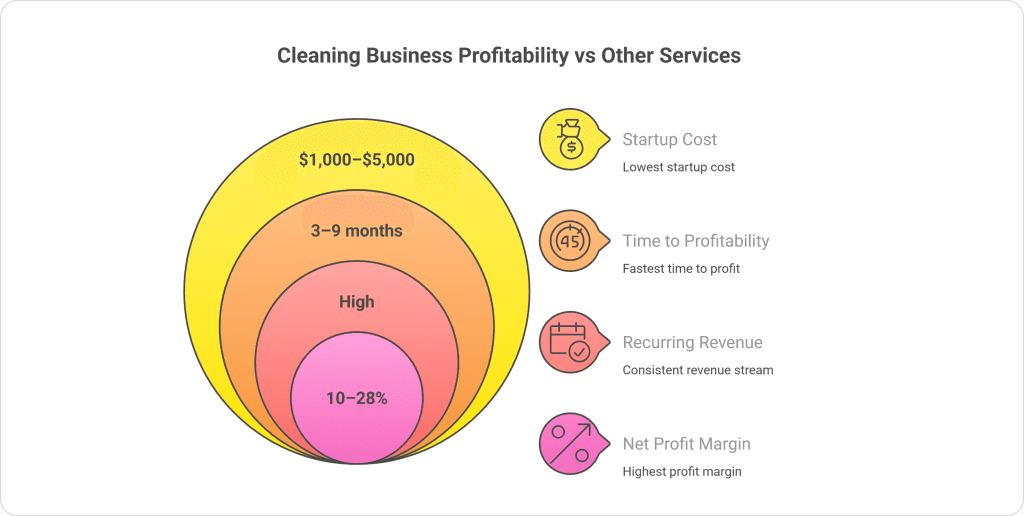
Here is what makes the cleaning business profitable compared to other service businesses:
| Factor | Cleaning Business | Plumbing | HVAC | Landscaping |
| Startup Cost | $1,000–$5,000 | $10,000–$50,000 | $15,000–$100,000 | $5,000–$20,000 |
| Time to Profitability | 3–9 months | 6–18 months | 12–24 months | 6–12 months |
| Recurring Revenue | High (weekly/biweekly) | Low (as-needed) | Seasonal | Seasonal |
| License Requirements | Business license only | Trade license required | Trade license + EPA cert | Varies by state |
| Net Profit Margin | 10–28% | 8–18% | 10–20% | 5–15% |
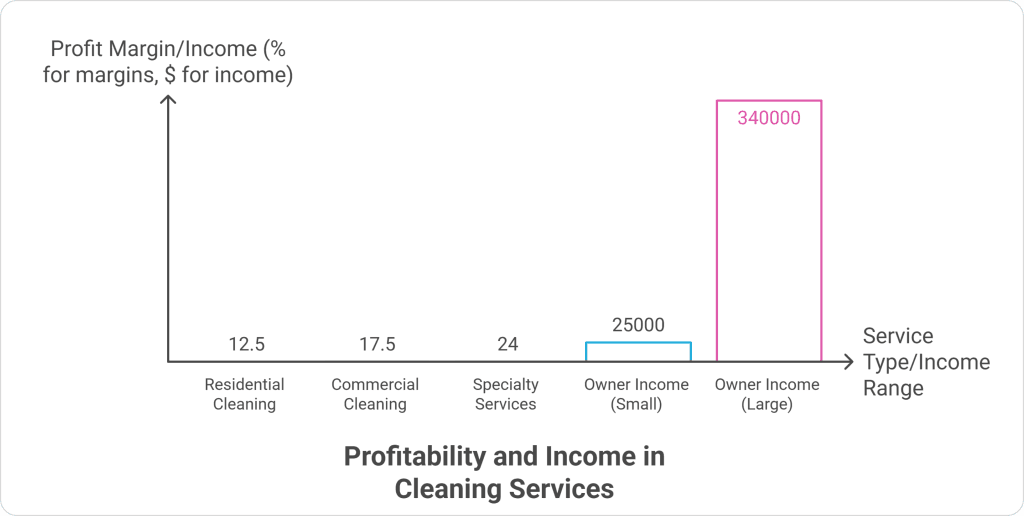
According to ZipRecruiter, the average income for cleaning business owners in the US exceeds $120,000 annually. Some owners earn between $25,000 and nearly $340,000 per year, depending on their business model, team size, and efficiency.
With the right field service management software and a solid pricing strategy, a cleaning business can become profitable within the first quarter of operations.
Pro Tip: The biggest predictor of cleaning business profitability is not how many clients you have. It is how efficiently you serve them. One owner with 20 optimized recurring clients will out-earn another with 40 poorly-routed one-time jobs.
Cleaning business profit margins range from 10% to 28% depending on service type. Residential cleaning averages 10–15% net margins due to competitive pricing and high labor costs. Commercial cleaning reaches 15–20% through larger contracts and recurring schedules. Specialty services like carpet cleaning, pressure washing, and post-construction cleanup earn 20–28% because they require specialized skills and equipment that justify premium pricing.
Understanding these margins helps you decide where to focus your energy and resources. Here is a breakdown:
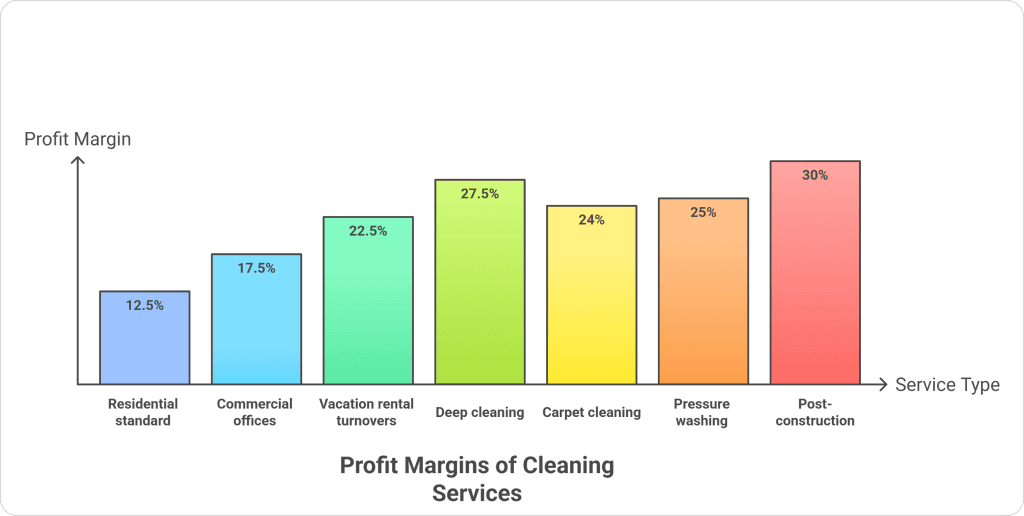
| Cleaning Service Type | Typical Profit Margin | Average Job Price | Recurring Potential |
| Residential (standard) | 10–15% | $150–$250/home | High (weekly/biweekly) |
| Commercial (offices) | 15–20% | $0.11/sq ft | Very high (contracts) |
| Vacation rental turnover | 15–30% | $100–$300/turnover | High (seasonal) |
| Deep cleaning | 20–35% | $200–$400/visit | Medium (quarterly) |
| Carpet cleaning | 20–28% | $150–$300/job | Medium (2x/year) |
| Pressure washing | 22–28% | $200–$500/job | Low-medium (annual) |
| Post-construction | 25–35% | $500–$2,000/project | Project-based |
Let’s walk through a real example to show how cleaning business profitability works in practice:
Scenario: Small residential cleaning operation, two teams of two cleaners each.
Now, if the owner raises prices to $300 per home (still competitive in most US markets), weekly revenue jumps to $6,000 and profit doubles to $1,470, pushing the margin to 24.5%.
That is why how to charge for cleaning services is the single most important decision you will make.
Key Takeaways: The difference between a 10% and 25% profit margin often comes down to one thing: pricing. Most new cleaning business owners underprice their services by 15–30%. Getting pricing right from day one is the fastest path to a profitable cleaning business.
Cleaning business owners in the US earn anywhere from $25,000 to $340,000+ annually. The average sits around $120,000 per year, according to ZipRecruiter data. Your actual income depends on whether you clean solo, manage a small team, or run a multi-crew operation. The biggest leap in owner income happens when you move from doing the cleaning yourself to managing teams and systems.
Here is what income looks like at different stages:
| Business Stage | Annual Revenue | Owner Income | Key Driver |
| Solo cleaner (part-time) | $25,000–$50,000 | $20,000–$40,000 | Hours worked |
| Solo cleaner (full-time) | $50,000–$80,000 | $40,000–$60,000 | Jobs per day |
| Small team (2–3 employees) | $120,000–$350,000 | $60,000–$120,000 | Team efficiency |
| Growing operation (4–7 employees) | $350,000–$750,000 | $120,000–$200,000 | Systems + recurring clients |
| Multi-crew (8+ employees) | $750,000–$1.5M+ | $200,000–$340,000+ | Delegation + route optimization |
Residential cleaning income: A solo cleaner charging $250 per home and completing four jobs per week earns $48,000 per year. Add a second cleaner, double the jobs, and revenue hits $96,000 before expenses.
Commercial cleaning income: A 10,000-square-foot office at $0.11 per square foot earns $1,100 per visit. Three facilities cleaned weekly generates $165,000+ per year. Commercial contracts also provide more predictable revenue.
Pro Tip: The fastest way to increase owner income is not getting more clients. It is converting one-time clients into recurring weekly or biweekly accounts. Recurring clients reduce marketing costs, improve routing efficiency, and create predictable revenue. Use a field service CRM to track client retention and automate follow-ups
Starting a cleaning business costs between $1,000 and $5,000, making it one of the lowest-cost businesses to launch in the US. Most solo operators start for under $2,500 and reach breakeven within three to nine months. The low investment-to-return ratio is a major reason the cleaning industry attracts more new entrepreneurs every year. For a complete breakdown, read our guide on cleaning business startup costs.
| Cost Category | Budget Range | Notes |
| Cleaning supplies & equipment | $300–$600 | Vacuum, mop, microfiber cloths, chemicals |
| Business registration & licensing | $40–$500 | LLC or sole proprietor, state fees vary |
| General liability insurance | $500–$1,500/year | Required for most commercial contracts |
| Marketing (initial) | $300–$1,500 | Google Business Profile, flyers, cards |
| Vehicle costs | $0–$5,000 | Use personal vehicle or lease |
| Software | $0–$100/month | Scheduling, invoicing, CRM |
| Total startup | $1,000–$5,000 |
Use our free cleaning estimate template to professionally quote jobs from day one and protect your margins.
Pro Tip: Track every dollar from the start. Use the house cleaning cost calculator to ensure your pricing covers supplies, labor, overhead, and desired profit. Many new owners forget to account for drive time, insurance, and marketing costs, which silently eats their margins.
Cleaning business profitability depends on five core factors: pricing strategy, labor efficiency, client retention, overhead management, and service mix. Getting even one of these wrong can turn a profitable cleaning business into a break-even operation. Getting all five right is how owners hit 20%+ margins consistently.
Flat-rate pricing protects your margins better than hourly billing. When you charge by the hour, faster work means less pay. Flat rates reward efficiency.
| Pricing Method | Best For | Margin Impact |
| Flat rate per home | Residential recurring | Protects margin, rewards efficiency |
| Per square foot | Commercial contracts | Scalable, easy to quote |
| Hourly rate ($35–$60/hr) | Unpredictable jobs (hoarding, deep clean) | Variable margin |
| Tiered packages | Upselling add-ons | Higher average ticket |
Labor is 50–60% of total costs in most cleaning businesses. Every minute of wasted time, from inefficient routing to poor scheduling, directly cuts into profit.
Smart AI-powered job scheduling and route optimization can reduce drive time by 35% and help your teams complete 30–40% more jobs with the same crew.
Recurring weekly and biweekly clients are the backbone of a profitable cleaning business. They create predictable revenue, lower marketing costs, and improve routing efficiency.
Track these overhead categories monthly:
Adding higher-margin specialty services like deep cleaning, carpet cleaning, or move-out cleaning increases average job value without proportionally increasing costs.
Warning: The most common profitability killer in cleaning businesses is underpricing. Industry benchmarks show many new owners set prices 15–30% below what the market supports. Research your local competition thoroughly before setting rates.
Even profitable cleaning businesses can see margins shrink if operational issues go unchecked. Most profit losses are not from major failures. They are everyday inefficiencies that quietly add costs and reduce billable hours. Here are the eight biggest profit killers and how to avoid each one.
Many owners set prices based on what they think customers will pay rather than what jobs actually cost. Calculate your loaded labor rate (hourly wage + taxes + benefits + overhead) before setting any prices. Use a free labor cost calculator to get accurate numbers.
Driving between scattered jobs is one of the highest hidden costs. A cleaning team spending 45 minutes driving between homes instead of 15 minutes loses two to three billable hours per week.
Using AI dispatch scheduling clusters jobs geographically and minimizes windshield time.
Relying on one-time jobs forces constant marketing spend and creates unpredictable revenue. Aim for 70%+ recurring revenue within your first year.
Customers adding “quick favors” like wiping inside appliances, moving furniture, or cleaning extra rooms without payment erodes margins fast. Use digital checklists and forms to define scope clearly.
Delayed invoicing leads directly to cash flow problems. Send invoices the same day the job is completed using invoicing software.
The cleaning industry has one of the highest turnover rates in the service sector. Each lost employee costs $3,000–$5,000 in recruiting, training, and lost productivity.
Supply costs, fuel, and insurance increase every year. Review and adjust prices annually. Prepare customers in advance with professional communication.
Without job costing data, you cannot identify which services, clients, or routes are profitable and which are losing money. Field service reporting makes this visible.
Increasing cleaning business profitability comes down to two levers: reduce costs per job and increase revenue per client. Companies that standardize pricing, optimize routes, build recurring plans, and automate admin work consistently hit stronger margins. Here are proven strategies that cleaning business owners use to push margins from 10% to 25%+.
Weekly, biweekly, and monthly recurring clients create predictable revenue and reduce marketing spend. A client paying $200 biweekly generates $5,200/year with minimal acquisition cost after the first booking.
Ovens, fridges, windows, interior cabinets, and deep cleans deliver some of the highest profit per minute because material costs are low and labor is predictable.
| Add-On Service | Additional Charge | Time Required | Estimated Margin |
| Inside oven cleaning | $25–$40 | 15–20 min | 70–80% |
| Inside fridge cleaning | $25–$35 | 15–20 min | 70–80% |
| Interior window cleaning | $5–$10/window | 5–10 min/window | 65–75% |
| Baseboard detail | $30–$50 | 20–30 min | 60–70% |
| Laundry service | $20–$30/load | Passive time | 80%+ |
Route inefficiency is one of the biggest hidden expenses. Cluster jobs by neighborhood and day of the week. Tools like AI route optimization automatically plan the most efficient paths for your crews.
Manual invoicing delays cash flow. Set up automated payment collection with card-on-file billing so you get paid the moment the job is marked complete.
Monitor labor-to-revenue ratio, job duration, and average ticket size. This data helps you identify your most profitable services and the ones dragging down margins.
| If this describes you… | Consider this niche | Why |
| Just starting out, limited budget | Residential (standard) | Low equipment cost, fast client acquisition |
| Want predictable income, larger contracts | Commercial (offices) | Recurring contracts, higher volume |
| Have experience, willing to invest in equipment | Specialty (carpet, pressure washing) | Highest margins (20–28%), less competition |
| Located near tourist areas or rentals | Vacation rental turnover | Premium pricing, consistent seasonal demand |
| Want to scale quickly with teams | Mix of residential + commercial | Diversified revenue, balanced risk |
Pro Tip: Do not try to serve every cleaning niche from day one. Start with one service type, master your operations, then expand. Cleaning business owners who specialize first and diversify later build stronger margins than those who spread themselves thin from the start.
The most profitable cleaning businesses run on systems, not hustle. They use technology to handle scheduling, dispatching, routing, and invoicing so the owner can focus on growth rather than daily firefighting.
With FieldCamp’s AI-powered scheduling and dispatch management, you can:
Sam, the founder of HeyMaid (a North Carolina cleaning company), chose FieldCamp to build his subscription-based cleaning business from day one:
“I’ve been looking at tons of field service software, and it was so refreshing to see FieldCamp. It looks clean, it feels modern, it wasn’t built 15 years ago. You can tell it was built on top of AI, not the other way around.”
Whether you are a solo cleaner or managing multiple crews, the right field service automation software is the operating system that makes everything else work.
Learn more about how to start a cleaning business or explore strategies for how to get clients for your cleaning business.
Key Takeaway: Technology is not optional for a profitable cleaning business in 2026. Owners using scheduling software, automated invoicing, and route optimization consistently report 15–25% higher margins than those managing operations manually.
Step 1: Set prices based on loaded labor cost + target margin → Step 2: Build a recurring client base (weekly/biweekly) → Step 3: Optimize routes to reduce drive time → Step 4: Automate invoicing and payment collection → Step 5: Track job costs and adjust unprofitable services → Result: Consistent 20–28% net profit margins
Yes, a cleaning business remains highly profitable in 2026. The global cleaning services market is growing at 6.9% annually. US demand for residential and commercial cleaning continues to increase. Net profit margins of 10–28% are common, and startup costs stay low at $1,000–$5,000. Owners who use modern scheduling and routing tools see stronger margins than ever.
A solo cleaner earning $4,000–$6,000 per month in revenue can expect $400–$1,500 in monthly profit after expenses. A small team operation (two to three employees) generating $10,000–$25,000 in monthly revenue typically nets $1,500–$5,000 in profit. Margins improve significantly as you add recurring clients and optimize routing.
Yes. Many cleaning business owners earn six figures. Solo cleaners reaching $100,000+ in annual revenue is common with full schedules and proper pricing. Owners managing three to five employees regularly earn $120,000–$200,000+ in total compensation. The path to six figures requires moving from hourly work to managing teams and systems.
Specialty cleaning services like carpet cleaning, pressure washing, post-construction cleanup, and mold remediation are the most profitable, with 20–28% net margins. Commercial cleaning with recurring contracts offers the most predictable revenue. The best approach for most owners is starting with residential cleaning (lower startup costs) and gradually adding higher-margin specialty services.
Most cleaning businesses reach breakeven within three to nine months. Low startup costs ($1,000–$5,000) and the ability to generate revenue from day one help. Businesses that focus on recurring clients and efficient pricing often turn profitable within the first quarter. Full profitability (covering owner salary plus retained profit) typically takes six to 12 months.
Commercial cleaning generally offers higher profit margins (15–20% vs. 10–15% for residential) and more predictable revenue through contracts. However, residential cleaning is easier to start, requires less equipment, and offers faster client acquisition. Many successful owners run both: residential for steady cash flow and commercial for growth. Learn more about pricing strategies in our cleaning services pricing guide.
A solo cleaner needs 15–20 recurring clients (biweekly at $200–$250 each) to generate $70,000–$100,000 in annual revenue. After expenses, this supports $40,000–$60,000 in owner income. A small team needs 40–60 recurring clients to sustain two to three employees and generate meaningful profit. Focus on client retention over acquisition, as keeping existing clients is five times cheaper than finding new ones.