
How to Grow a Cleaning Business: 12 Strategic Steps That Actually Work in 2026
January 29, 2026 - 25 min read

January 29, 2026 - 25 min read

| TL;DR: Growing a cleaning business comes down to six things: stop underpricing, build a referral system, keep the clients you have, hire at the right time (not too early, not too late), create systems before you scale, and track your numbers religiously. Most cleaning businesses plateau between $80K-$150K because owners work in the business instead of on it. The 12 strategies below show you how to break through that ceiling, whether you’re a solo cleaner ready to hire or a small team pushing toward $500K+. |
Here’s what nobody tells you about running a cleaning business:
Getting clients isn’t the hard part. Keeping them, scaling without burning out, and actually making money after expenses, that’s where most owners get stuck.
I’ve seen it dozens of times. Someone starts a cleaning business, hustles hard for a year, builds up a solid client base, and then… nothing. They hit a wall somewhere between $80K and $150K. They’re working 50-hour weeks, exhausted, turning down jobs because there’s no time, and wondering if this is as good as it gets.
It’s not. Not even close.
The cleaning industry is a $450+ billion global market growing at 7.19% annually. There’s more than enough room for your business to scale. But growth doesn’t happen by accident. It happens when you stop trading hours for dollars and start building something that runs without you mopping floors every day.
This guide covers 12 strategies that actually work to grow a cleaning business.
If you’re still figuring out how to launch, start with our guide on how to start a cleaning business. But if you’re past that stage and ready to scale, keep reading.
We’ll also talk about how the right cleaning business software can automate the busywork so you can focus on growth.
But first, let’s get into what actually moves the needle.
KEY HIGHLIGHTS
Grow Your Cleaning Business
Let’s get specific. “Growth” is a vague word people throw around without defining it.
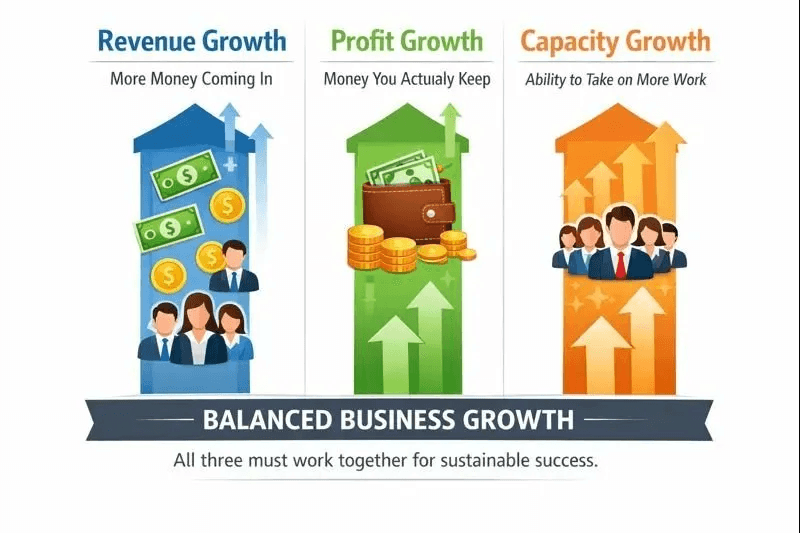
For a cleaning business, there are three types of growth, and they’re not the same thing:
Revenue growth means more money coming in. More clients, bigger jobs, higher prices. This is what most people think of when they say “growth.”
Profit growth means more money you actually keep. You can double revenue and still make less if your costs grow faster. Margins matter more than top-line numbers.
Capacity growth means your ability to take on more work. This requires hiring, building systems, or using technology to become more efficient.
Here’s the trap: most cleaning business owners confuse being busy with growing.
Prefer watching instead? Check out the video below!
Working 60-hour weeks, rushing from job to job, barely keeping up with your schedule, that’s not growth. That’s a job you accidentally created for yourself. One where you’re the employee, the manager, and the owner all at once.
Real growth means building a business that can scale beyond your personal labor. Where you’re not the bottleneck.
That’s what these 12 strategies are designed to do.
Short on time? Hit play and listen while you work.
🏗️ Long-Term Play – foundational decision that shapes everything else
Most cleaning business owners take any job that comes their way. Residential? Sure. Commercial? Why not. One-time deep cleans, recurring weekly visits, post-construction mess, whatever pays.
This “say yes to everything” approach feels smart when you’re hungry for revenue. But it’s actually killing your growth.
When you serve everyone, you can’t market effectively to anyone. Your messaging gets watered down. Your operations get complicated. And you never become known for anything.
The cleaning businesses that grow fastest pick a lane and own it:
When you niche down, you can charge more (specialists always earn more than generalists), create marketing that actually resonates, and build referral networks within your industry.
What to do this week: Write a one-paragraph description of your ideal client. What type of property? What’s their budget? What’s their biggest pain point? Get specific. “Anyone who needs cleaning” isn’t a niche, it’s a trap.
🔄 Medium-Term – set up in a week, builds momentum over 1-3 months
Referrals are the highest-ROI growth channel for cleaning businesses. This isn’t opinion, it’s math.
Word-of-mouth influences all purchasing decisions. Referred clients have higher lifetime value, lower acquisition cost, and churn less often than clients who found you through ads or Google.
The problem? Most cleaning business owners hope for referrals but don’t systematize them.
Hoping isn’t a strategy.
A referral program that actually works:

The best time to ask for a referral? Right after you’ve done a great job, the client is happy. That’s when you have the most goodwill.
For more ways to bring in new clients, check out our guide on how to get clients for your cleaning business. For the full marketing picture, read marketing your cleaning business.
⚡ Quick Win – can implement this week, impact within 30 days
This one’s uncomfortable, so let’s just say it directly:
Most cleaning businesses undercharge by 15-30%.
If you’re fully booked, working constantly, and still not hitting your income goals, the problem isn’t that you need more clients. The problem is your pricing.
Low prices attract price-sensitive clients. Price-sensitive clients haggle, complain more, and leave the moment someone cheaper comes along. You’re building your business on the least loyal customers.
When to raise your prices:
How to raise prices without losing everyone:
1. Grandfather existing clients – Keep their current rate for 60-90 days, then implement a modest increase (5-10%). Most won’t leave.
2. New pricing for new clients immediately – There’s no reason to offer new clients your old rates.
3. Introduce premium tiers – Add a “deep clean” or “white glove” option at higher rates. Some clients will happily pay more for more.
4. Communicate value, not apology – If you do raise rates, don’t apologize. Explain what’s improved: better supplies, insurance, reliability, and experience.
Not sure if you’re priced right? Use our house cleaning cost calculator to benchmark your market. For a complete breakdown, read how to charge for cleaning services.
⚡ Quick Win – start today, compounds over time
Here’s a stat that should change how you spend your time:
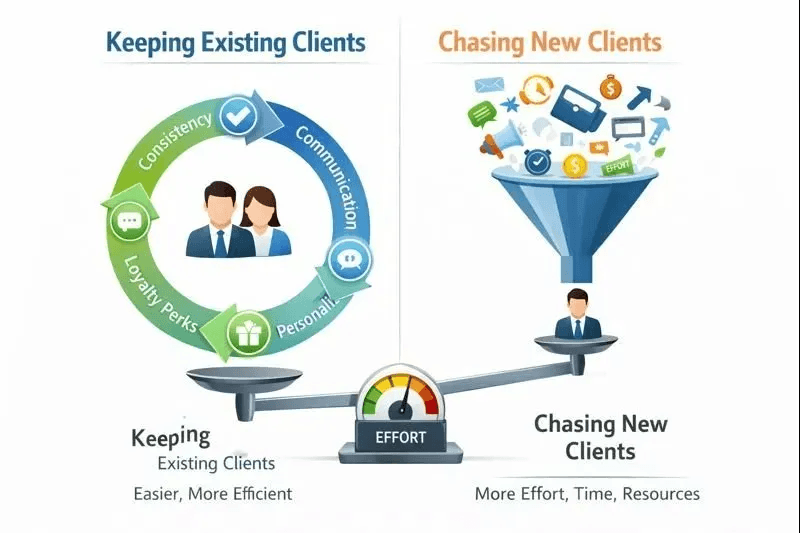
Acquiring a new client costs 5x more than keeping an existing one.
And existing clients have a 60-70% likelihood of booking again, versus just 5-20% for new leads.
Yet most cleaning business owners spend 90% of their energy chasing new clients and 10% keeping current ones happy.
That ratio should be flipped.
Retention tactics that actually work:
A CRM makes this manageable at scale. Pipeline management tools let you see every client’s status, from new lead to long-term account, so nothing falls through the cracks.
What kills retention:
Keep your clients, and growth takes care of itself.
⚡ Quick Win – introduce add-ons at your next job
Before chasing new clients, ask yourself: can you sell more to the ones you’ve got?
Upselling an existing client is faster, easier, and more profitable than finding a brand new one. They already trust you. They already have their credit card on file. The hardest part, getting them to say yes the first time, is done.
High-margin add-on services:
Specialty services with premium pricing:
The package bundling strategy:
Create three tiers so clients can self-select into higher-value options:
| Tier | What’s Included | Positioning |
| Basic | Standard clean—floors, surfaces, bathrooms, kitchen | Entry price point |
| Standard | Basic + kitchen appliances, baseboards, dusting details | Most popular option |
| Premium | Standard + interior windows, rotating deep clean areas | Highest value |
Most clients pick the middle option. Some pick premium. Everyone pays more than your old one-size-fits-all rate.
🔄 Medium-Term – set up in a day, results build over 2-6 months
This is non-negotiable in 2026:
Over 80% of people find cleaning services through online search. And 46% of all Google searches have local intent—meaning people are looking for services near them, right now.
If you’re not showing up when someone searches “house cleaning near me” or “cleaning service [your city],” you’re invisible to the majority of potential clients.
Your Google Business Profile is the most important piece of digital real estate you own. More important than your website. More important than Instagram.
How to optimize your Google Business Profile:
Reviews are your growth engine:
One simple script: “Thanks so much for having us today! If you have 30 seconds, a Google review would really help us out. Here’s the link.”
For a deeper dive into search visibility, read our complete guide on SEO for cleaning businesses.
7. Hire Your First Employee (At the Right Time)
🏗️ Long-Term Play – major decision, plan 2-3 months ahead
This is the hardest growth hurdle for solo operators. And the most important one.
You can’t scale past your own physical capacity. There are only so many hours in a day, and you can only clean so many homes. At some point, hiring isn’t optional; it’s the only path forward.
But timing matters. Hire too late, and you burn out, quality suffers, and you turn down good work. Hire too early, and you don’t have enough jobs to keep them busy, cash flow suffers, and you end up letting them go.
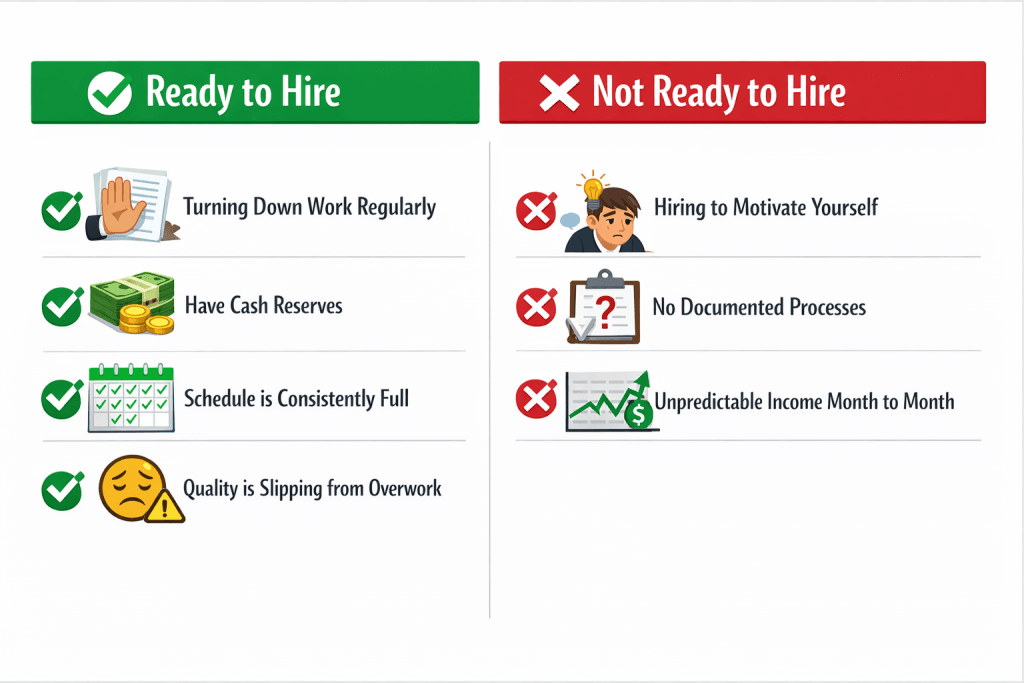
Signs you’re ready to hire:
Signs you’re NOT ready to hire:
The math that makes hiring work:
If you bill clients $45/hour and pay an employee $18/hour, you keep $27/hour in gross profit on their labor. One full-time employee working 30 billable hours per week generates roughly $3,500/month in gross profit for you—while you’re not even there.
That’s how you stop trading time for money.
Hiring tips that prevent headaches:
Before you hire, make sure you’re properly licensed. Requirements vary by state; see our cleaning business license guide.
Once you have a team, workload balancing becomes critical. You need to distribute jobs fairly so no one burns out while others sit idle.
🏗️ Long-Term Play – invest 2-4 weeks now, saves months later
Here’s a truth that took me too long to learn:
You cannot scale chaos.
If your business runs on memory, sticky notes, and “I’ll figure it out when I get there,” hiring employees will make everything worse, not better. Every problem you have now will multiply.
Systems are what let you grow without losing your mind.
You need documented processes for:
| Area | What to Document |
| Cleaning | Room-by-room checklists, which products to use where, time standards per room type |
| Client communication | Booking confirmation templates, reminder messages, follow-up scripts |
| Invoicing | Room-by-room checklists, which products to use where, and time standards per room type |
| Quality control | Post-job inspection checklist, how to handle client complaints |
| Hiring & training | Job posting template, interview questions, day-by-day training schedule |
This doesn’t have to be complicated. A Google Doc for each process is fine to start.
Free resources to get you started:
For scheduling, a cleaning schedule app prevents double-bookings and keeps everyone on track.
A client management system stores preferences, service history, and notes in one place, so anyone on your team can deliver consistent service, even if they’ve never met the client before.
🏗️ Long-Term Play – sales cycle takes 1-3 months, but contracts last years
Commercial cleaning accounts for 49.7% of the global cleaning market revenue. It’s the biggest slice of the pie.
And there’s a reason for that.
Why commercial contracts change the game:
| Factor | Commercial | Residential |
| Contract size | $500 – $5,000+/month | $100 – $300/job |
| Revenue predictability | High (monthly contracts) | Variable |
| Scheduling | Predictable (usually evenings/weekends) | Scattered |
| Client acquisition cost per dollar of revenue | Lower | Higher |
| Relationship type | Professional, transactional | Personal, high-touch |
One small office contract paying $1,500/month equals roughly 10-15 residential clients. And it’s one relationship to manage instead of 15.
Good entry points for commercial cleaning:
The commercial sales process is different:
Residential clients decide fast, sometimes on the same call. Commercial takes longer.
Commercial clients expect polish. Your proposals and invoices need to look professional. Use our house cleaning invoice template to create clean documents.
🔄 Medium-Term – first partner in 2-4 weeks, referrals build over months
The fastest way to get clients is to borrow someone else’s.
Strategic partnerships let you tap into existing relationships and trust that someone else built. Done right, they become a consistent source of leads without spending money on ads.
High-value partnerships for cleaning businesses:
| Partner Type | Opportunity |
| Real estate agents | Move-in/move-out cleanings for buyers and sellers |
| Property managers | Regular unit turnovers between tenants |
| Airbnb hosts | Turnover cleaning between guests |
| Interior designers | Post-project cleaning after renovations |
| Home organizers | Cleaning after organization sessions |
| General contractors | Post-construction cleaning |
How to approach a potential partner:
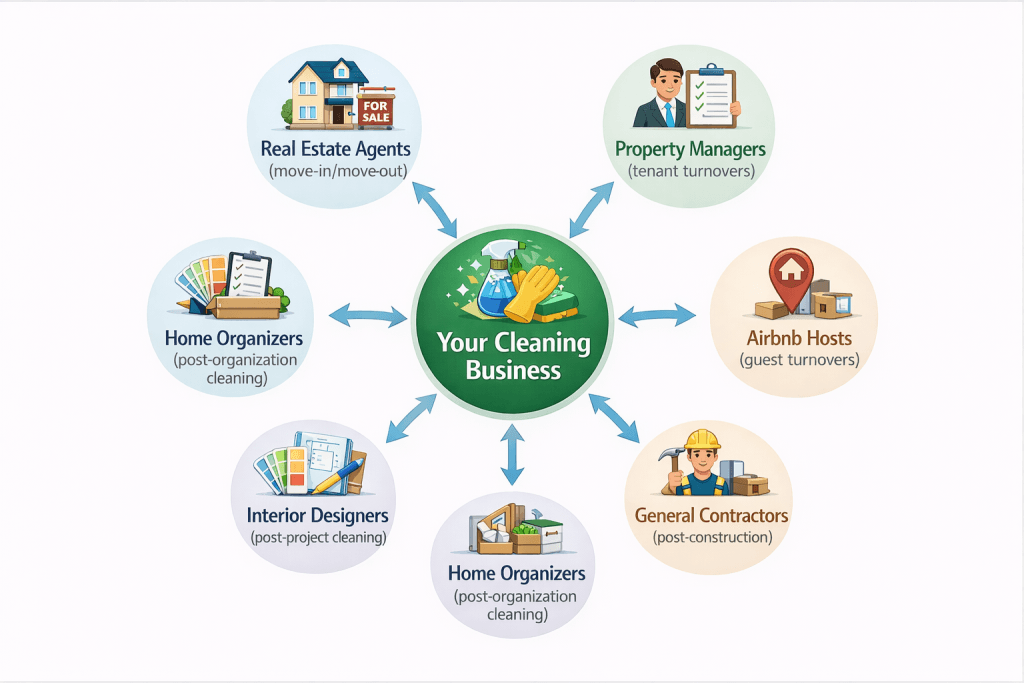
Even one strong relationship with a busy real estate agent can generate 5-10 new jobs per month. That’s worth more than most marketing campaigns.
🔄 Medium-Term – set up in 1-2 weeks, ROI within 60 days
When you had 5 clients, you could manage everything in your head. Scheduling was a calendar. Invoicing was a Square receipt. Client notes were… memories.
At 30+ clients with employees, that approach breaks down.
Manual processes become bottlenecks. You spend hours on admin work instead of growing. Mistakes happen, double bookings, missed follow-ups, and late invoices.
Technology that pays for itself:
| Tool | What It Does | Why It Matters |
| Scheduling software | Prevents double-bookings, handles reschedules | Fewer headaches, happier clients |
| Route optimization | Plans the most efficient path between jobs | Less driving, more cleaning, lower fuel costs |
| CRM | Tracks client info, preferences, history | Personalized service without relying on memory |
| Automated invoicing | Sends invoices immediately, tracks payments | Faster collection, professional image |
| Online booking | Lets clients book 24/7 without calling | Captures leads while you sleep |
The ROI is measurable: Businesses using field service software report 35%+ revenue increases in their first year.
AI in cleaning services is changing how businesses handle dispatching, estimating, and client communication. Features like multi-day scheduling let you plan the whole week in advance instead of scrambling each morning.
The right software doesn’t just save time, it makes your business sellable. Because the systems exist outside your head.
Back-to-Back Cleaning Jobs Are Good. Back-to-Back Admin Isn’t.
Automate the cleaning scheduling and invoicing. Spend your time on work that pays.
⚡ Quick Win – start a simple dashboard this week
Because it does.
You can’t improve what you don’t measure. And most cleaning business owners have no idea what their actual numbers are. They know roughly how much came in last month. They have a vague sense of expenses. But margins? Client acquisition cost? Churn rate? No clue.
Metrics you should track monthly:
| Metric | What It Tells You | Healthy Range |
| Gross revenue | Total money coming in | Depends on your goals |
| Net profit margin | Total revenue from the average client over time | 10-28% |
| Client acquisition cost | What do you keep after all expenses | Varies by channel |
| Client lifetime value | Total revenue from average client over time | Should be 3x+ your CAC |
| Churn rate | % of clients you lose each month | Under 5% |
| Average job value | Revenue per cleaning | Track trends |
| Operating expenses | Cost to run the business | 25-30% of revenue is typical |
Monthly review questions:
Set up a simple dashboard. FieldCamp Analytics automates much of this if you’re using the platform for scheduling and invoicing.
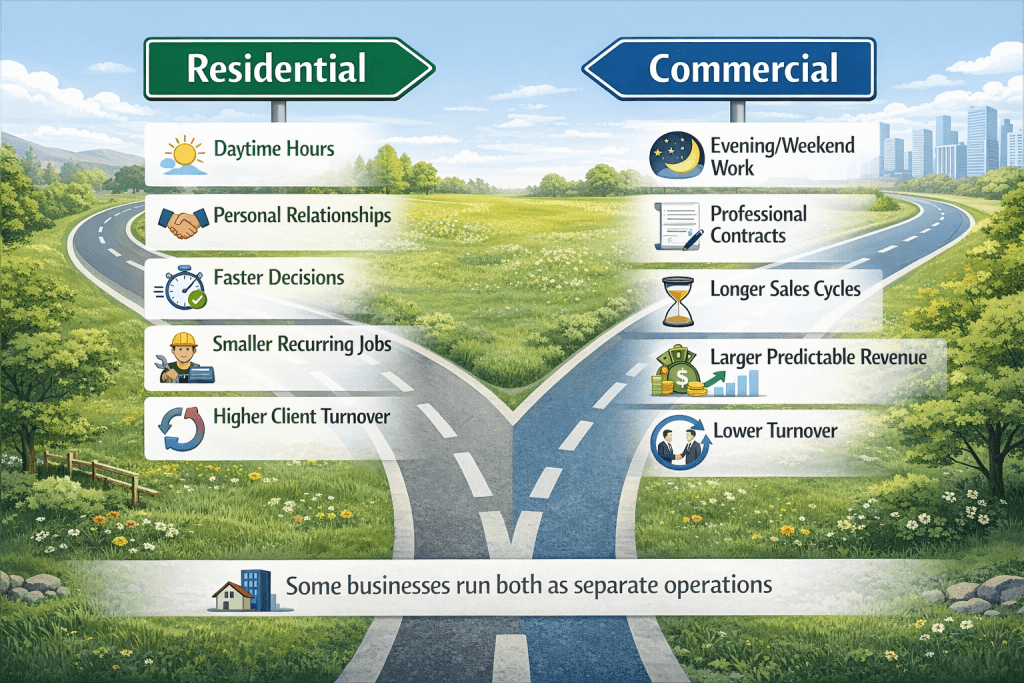
This isn’t a right-or-wrong question. It’s a strategic choice based on what you want your business to look like.
| Factor | Residential | Commercial |
| Contract size | $100-300/job | $500-5,000+/month |
| Sales cycle | Fast (days) | Slow (weeks or months) |
| Profit margin | 10-28% | 10-15%, but volume-based |
| Client retention | Lower (life changes, moves) | Higher (contracts) |
| Competition | High | Moderate |
| Work hours | Daytime, weekdays | Evenings, weekends often |
| Relationship style | Personal, high-touch | Professional, transactional |
Residential makes sense if:
Commercial makes sense if:
Can you do both? Yes, but run them as separate operations. Different marketing, different pricing, different processes. Trying to blend them creates confusion.
Every business is different, but here’s what typical growth looks like:
Year 1: Building the Foundation
Year 2: First Hire
Year 3+: Real Scaling
What accelerates growth: Niching, systems, commercial contracts, partnerships, technology
What slows it down: Underpricing with no systems, trying to do everything yourself, saying yes to everyone, ignoring your numbers
If you’re not growing, one of these is probably why:
7. Not knowing your numbers: You’re flying blind. You don’t know what’s working, what’s profitable, or where money is leaking.
Growing a cleaning business isn’t about working more hours. It’s about working smarter, building systems, making strategic choices, and focusing on what actually moves the needle.
Here’s where to start:
You don’t need all 12 strategies running at once. That’s a recipe for overwhelm. Pick 2-3 that fit where you are right now, execute them well, and stack from there.
The three highest-ROI strategies are: a referral program that rewards existing clients for sending new ones, optimizing your Google Business Profile for local search, and building partnerships with real estate agents or property managers. Paid ads work but require a budget. For a complete guide, read how to get clients for a cleaning business.
Solo operators average around $56,000/year. Owners with employees and good systems typically earn $100,000-$150,000. Top performers with multiple teams hit $250,000-$340,000+. Commercial operations can scale even higher.
A healthy net profit margin is 10-28%. Solo operators often achieve 20%+ because labor costs are just their own time. Larger operations with employees typically run 10-15% margins but make it up in volume.
Residential offers faster startup, daytime hours, and personal client relationships. Commercial provides larger contracts, more predictable revenue, and less client turnover. Many successful cleaning businesses do both, but treat them as separate divisions.
Most owners see real momentum within 12-18 months of focused effort. Reaching $100K typically takes 1-2 years. Scaling to $250K+ usually requires 3-5 years, employees, and real systems in place.
At minimum: scheduling, invoicing, and basic CRM. As you grow, add route optimization, online booking, and automated follow-ups. All-in-one platforms like FieldCamp handle everything in one place.
You don’t compete on their terms. You compete on yours. Niche down, deliver better service, build real relationships, and dominate your local reputation. Big companies can’t match the personal touch and flexibility of a well-run small operation.