
How to Price Electrical Work in 2026: Proven Formulas + Rate Data
February 26, 2026 - 31 min read


February 26, 2026 - 31 min read

Table of Contents
| TL;DR: This guide covers everything you need to price electrical work profitably in 2026– from hourly rates and flat-rate strategies to real-world pricing examples and formulas. Average electrician rates: $50–$130/hr, depending on experience and region Master formula: Total Price = Labor + Materials + Overhead + Profit Margin Target profit margin: 15–25% for residential, 10–20% for commercial |
The US electrical contracting industry is one of the largest trade sectors, yet most electrical contractors leave 10-15% profit on the table by underpricing their work.
Whether you’re a seasoned master electrician or just starting your electrical contracting business, knowing how to price electrical work accurately is the difference between barely breaking even and building a profitable, sustainable business.
Pricing electrical jobs isn’t about picking a random hourly rate or matching your competitor’s prices. It requires understanding your true costs, regional market rates, material markups, overhead expenses, and profit margins-then applying the right pricing model for each type of work.
This comprehensive electrician pricing guide walks you through everything you need to price electrical work profitably in 2026, including proven pricing formulas, real-world examples with actual math, regional rate data, and strategies for emerging services like EV charger installations and smart home wiring.
If you prefer listening over reading? Check out the above podcast on Spotify.
KEY HIGHLIGHTS
Pricing Guide for Electrical Work
Electrician hourly rates in 2026 range from $50 to $130 per hour for most residential and light commercial work, with significant variation based on experience level, geographic location, and service type. If you’re wondering how much to charge per hour as an electrician, understanding these rate benchmarks helps you position your pricing competitively while maintaining healthy profit margins.
According to BLS electrical wages, your experience level and licensing status directly impact what customers expect to pay and what you can command in the market:
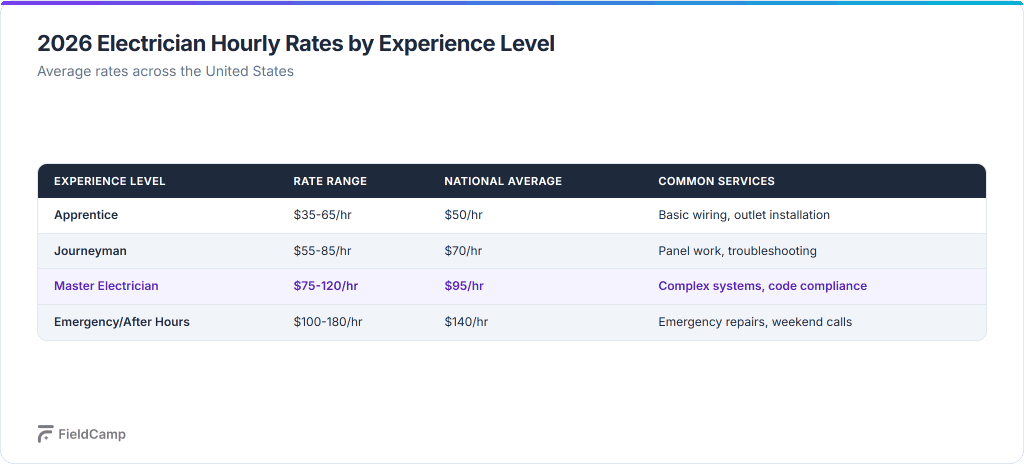
| Experience Level | Hourly Rate | Typical Jobs |
| Apprentice | $25–$45/hr | Assist with wiring, basic outlet work |
| Journeyman | $50–$90/hr | Standard residential/commercial |
| Master Electrician | $90–$150/hr | Complex systems, inspections, code work |
Apprentice rates are typically 40-60% of journeyman rates and should only be charged when an apprentice works independently on simple tasks. Most jobs require oversight from a journeyman or master electrician, which drives the final billing rate.
Master electricians command premium rates because they can pull permits, perform final inspections, design complex systems, and take full liability for code compliance, a value that justifies the higher cost.
Most electrical contractors charge a service call fee of $75-$200 that covers the first hour of work plus travel time. This ensures you’re compensated even if the customer cancels or the job takes less than an hour.
Industry standard is a 1-2 hour minimum charge, meaning even a 15-minute outlet replacement gets billed at your minimum rate. This protects you from losing money on small jobs that require the same travel time and overhead as larger projects.
Diagnostic fees typically run $50-$100 as a separate charge before repair work begins. Some contractors waive the diagnostic fee if the customer approves the repair, while others charge it regardless. The latter approach protects you from customers who are just price shopping.
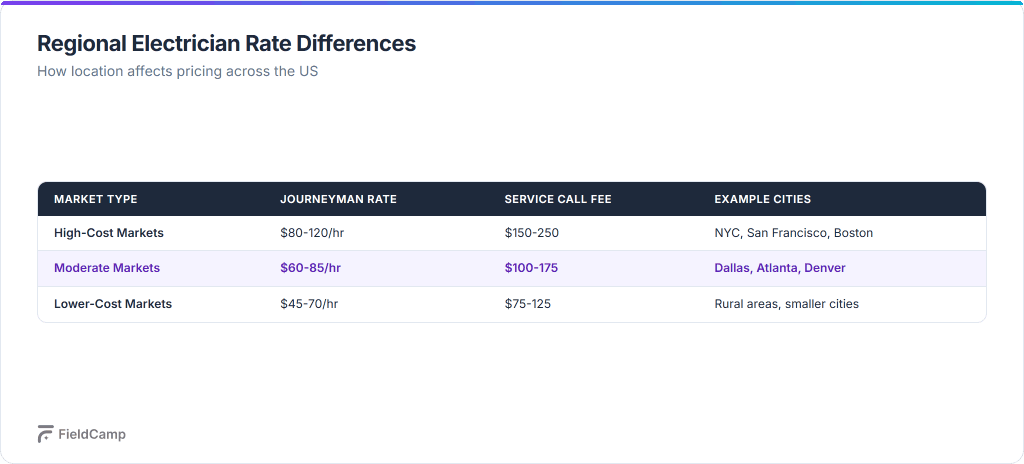
Geographic location has a massive impact on what you can charge for electrical work. Understanding regional pricing differences is critical to competitive positioning and maintaining profitability across different markets.
| Market Type | Hourly Range | Example Cities |
| High-Cost Markets | $100–$150/hr | NYC, San Francisco, LA, Boston |
| Moderate Markets | $65–$100/hr | Dallas, Atlanta, Denver, Chicago |
| Lower-Cost Markets | $45–$75/hr | Rural areas, the Midwest, and Southern states |
High-cost markets justify premium rates due to higher licensing costs, insurance requirements, permit fees, cost of living, and vehicle/parking expenses. Your electrician software should help you track these regional overhead differences so you can adjust pricing accordingly.
Beyond simple hourly rate differences, regional factors that affect electrical contractor pricing strategy include:
Prevailing wage requirements: States like California, New York, and Illinois require prevailing wage rates on public works projects, often 30-50% above market rates. Factor this into your bidding strategy for government contracts.
Licensing and insurance costs: High-cost states charge $500-2,000+ annually for master electrician licenses, while lower-cost states may charge $100-300. Workers’ compensation insurance rates also vary dramatically, from 5-8% of payroll in competitive states to 15-20%+ in high-risk states.
Permit complexity and costs: Major cities like NYC, San Francisco, and Chicago have complex permitting processes that add $200-1,000+ to project costs compared to streamlined rural jurisdictions.
Market saturation: Oversaturated markets (many electricians competing) drive prices down, while underserved rural areas or booming metro areas support premium pricing.
Don’t assume you need to price at the bottom of your regional range. Many successful electrical contractors position themselves in the top 25% of local pricing by emphasizing reliability, quality, licensing, insurance, and warranties.
There’s no single “right” way to price electrical work; successful electrical contractors use different pricing models depending on the job type, customer expectations, and complexity. Our Complete Service Pricing Strategy Guide covers 12 proven methods across all trades, but here’s how they apply specifically to electrical work.
Understanding when to use each model is critical to maximizing profit while winning jobs.
Hourly pricing charges customers your loaded labor rate plus materials with a markup. It’s best for troubleshooting, diagnostic work, and complex or unpredictable jobs where you can’t accurately estimate time in advance.
Pros: Covers your actual time investment, fair for complex work that takes longer than expected, and customers perceive it as transparent.
Cons: Customers dislike open-ended pricing and may feel anxious about costs, creating perverse incentives to work slowly, and requiring detailed time tracking and invoicing.
Use hourly pricing for service calls, troubleshooting, code violations, old wiring investigations, and any job where the scope is unclear until you start working.
Flat-rate pricing offers customers a fixed price for standard services regardless of how long the job takes. It’s the preferred model for repeatable services like outlet installations, ceiling fan installations, and panel swaps.
Pros: Customers love price certainty and are more likely to approve work immediately, rewards your efficiency and experience, and higher perceived value drives better profit margins.
Cons: Risk if the job takes significantly longer than estimated, requires building a detailed price book, and doesn’t work well for complex or unusual jobs.
Successful electrical contractors build flat-rate pricing books with 200+ common services. FieldCamp’s quotes and estimates feature helps you create and manage flat-rate pricing so you can provide instant quotes in the field.
Per-unit pricing charges per outlet, per circuit, per square foot, or per device installed. It’s common in new construction, renovations, and commercial work where the job scope involves repeating the same task many times.
Typical per-unit rates:
Per-unit pricing simplifies estimating on large jobs and makes it easy for customers to understand the total cost. The key is ensuring your per-unit rate includes all labor, materials, permits, and profit, not just direct costs.
Value-based pricing sets prices based on the value delivered to the customer, not just time and materials. It’s most common in commercial and specialty work where downtime costs are high or where your expertise solves a critical problem.
For example, a restaurant losing $5,000 per day in revenue due to a power outage will gladly pay $2,000 for immediate emergency service, even if the actual repair only takes 3 hours. That’s value-based pricing.
Comparison of Pricing Models:
| Model | Best For | Revenue Predictability | Customer Preference | Profit Potential |
| Hourly | Complex/diagnostic | Low | Low | Medium |
| Flat-Rate | Standard services | High | High | High |
| Per-Unit | New construction | Medium | Medium | Medium |
| Value-Based | Commercial/specialty | Medium | Varies | Highest |
Most successful electrical contractors use a hybrid approach: flat-rate pricing for 70-80% of residential work, hourly for diagnostic and troubleshooting, per-unit for new construction, and value-based pricing for commercial and emergency work.
Pricing electrical work profitably requires a systematic approach that accounts for all your costs, positions you competitively in your market, and ensures healthy profit margins. Follow these nine steps every time you price a job.
Before setting your rates, research what competitors charge in your area. Check competitor websites, call for quotes on common services, review local trade association data, and consult Bureau of Labor Statistics regional wage data.
When learning how to bid electrical jobs competitively, know where you want to position yourself: budget (bottom 25%), mid-range (middle 50%), or premium (top 25%).
Premium pricing requires differentiation-better service, faster response times, superior warranties, or specialized expertise. Don’t compete on price alone unless you have a structural cost advantage.
Most electricians underestimate their true labor cost by 20-30% because they only consider base wages. Your true hourly cost includes base wage, burden rate (benefits, taxes, workers’ comp), and efficiency factors.
Formula: True Hourly Cost = (Base Wage + Benefits + Taxes + Workers’ Comp) × Efficiency Factor
The burden rate typically adds 25-35% above base wage to cover payroll taxes, health insurance, workers’ compensation insurance, unemployment insurance, and other benefits.
The efficiency factor accounts for non-billable time (travel, training, admin, downtime). If your techs are productive 85% of their work hours, use an efficiency factor of 1.18 (1 ÷ 0.85).
NECA’s Manual of Labor Units provides industry-standard productivity benchmarks for hundreds of electrical tasks to help refine your estimates.
Example calculation:
This $46.02 is your break-even labor cost before overhead and profit. If you only charge $50/hr, thinking you’re making $20/hr profit, you’re actually only netting $4/hr after true labor costs, not enough to cover overhead.
Electrical materials should be marked up 20-50% depending on the category, handling requirements, and market norms. Never charge materials at cost; markup covers procurement time, inventory carrying costs, warranty exposure, and profit.
Standard markup ranges by category:
Higher markups are justified for specialty items, low-volume purchases, items requiring special handling, and products where you provide selection guidance or design services.
As a general rule, most profitable electrical jobs follow the 60/40 split: labor represents roughly 60% of total costs, while materials account for 40%. If your jobs consistently deviate from this ratio, review your pricing structure.
Always use current supplier pricing, not last year’s costs. Copper prices fluctuate significantly, and LED fixture costs continue to drop. Update your material cost database quarterly to avoid underpricing.
Use FieldCamp’s electrical estimate template to organize material lists and automatically apply consistent markup percentages.
Overhead includes all business expenses that aren’t directly tied to a specific job: insurance, vehicle costs, tools and equipment, licensing, office and administrative costs, and marketing.
Formula: Hourly Overhead Rate = Total Monthly Overhead ÷ Monthly Billable Hours
Common overhead expenses for electrical contractors:
For example, if your total monthly overhead is $3,000 and you bill 160 hours per month, your overhead rate is $18.75/hour. This must be added to every job to ensure overhead is fully covered.
Typical overhead as a percentage of revenue ranges from 13-20% for electrical contractors.
If your overhead percentage is higher than 20%, look for inefficiencies or consider raising prices. AI-powered scheduling can help reduce overhead by optimizing routes and maximizing billable time.
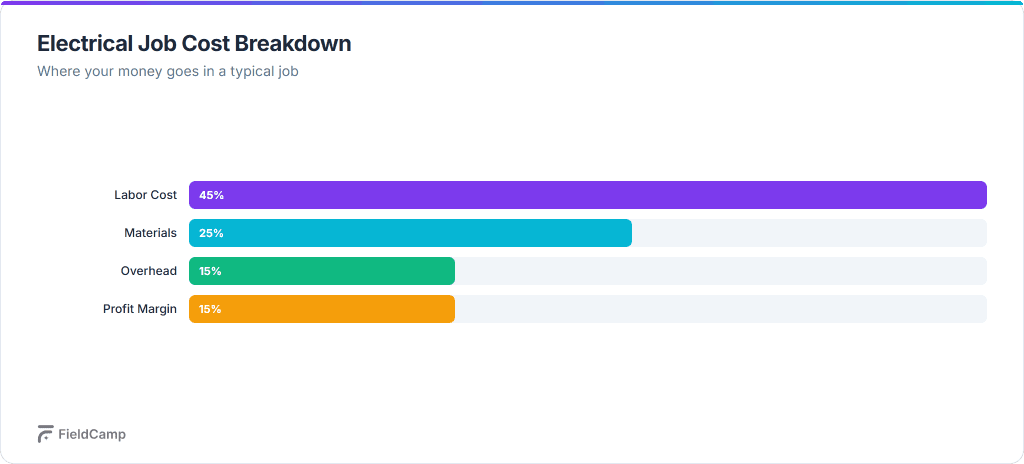
After covering labor, materials, and overhead, you need profit. Profit isn’t greed-it’s what funds business growth, equipment purchases, emergency reserves, and owner compensation.
Formula: Selling Price = Total Costs ÷ (1 – Desired Profit Margin)
Target profit margins by service type:
If your total costs (labor + materials + overhead) are $100 and you want a 20% profit margin, your selling price should be $100 ÷ (1 – 0.20) = $125.
Don’t confuse profit margin with markup. A 20% margin requires a 25% markup.
Many electrical contractors underprice by using markup when they should use margin calculations. Use FieldCamp’s free profit margin calculator to get the math right every time.
Now combine all components into your final price using the master pricing formula:
MASTER FORMULA: Total Price = (Labor Hours × True Hourly Cost) + (Materials × Markup) + Overhead + Profit
This formula ensures every cost is covered and you hit your target profit margin. Use it for every estimate until it becomes second nature.
For flat-rate pricing, calculate prices using this formula for each service in your price book, then round to clean numbers ($147.63 becomes $150). Track actual costs over time and adjust flat-rate prices quarterly.
Your estimate should include: business information, client information, detailed scope of work, materials list with costs, labor time estimate, timeline for completion, payment terms, estimate validity period (typically 30 days), and warranty terms.
Professional estimates win more jobs and reduce disputes. Use FieldCamp’s electrical estimate software to create branded, detailed estimates in minutes instead of hours.
The base formula gives you a starting point, but real-world jobs require adjustments for complexity, accessibility, emergency timing, permit requirements, and hazardous conditions.
Common adjustment multipliers:
Don’t be afraid to charge more for difficult jobs. Customers understand that challenging conditions require more time, specialized skills, and higher risk.
Track actual costs versus estimated costs for every job type. Identify which services are most and least profitable. Adjust your pricing quarterly based on material costs, win rate (target 30-70%), and profitability data.
If you’re winning every bid, your prices are too low. If you’re winning 80%+ of bids, raise your prices immediately.
If you’re winning less than 30%, you’re either priced too high or not selling value effectively. The sweet spot is 30-70% win rate, depending on how selective you want to be.
Use FieldCamp’s easy-to-use and manage invoices and track profitability per job type, monitor actual costs vs estimates, and identify pricing opportunities, all from one dashboard.
Theory is helpful, but seeing the full pricing formula applied to real jobs makes it actionable. Here are four common electrical jobs with complete cost breakdowns.
A customer needs a new 120V outlet installed in their garage.
Cost breakdown:
Final price: $150 (rounded)
This might seem expensive for a simple outlet, but it correctly accounts for your service call minimum, true costs, and ensures profitability even on small jobs. Customers who balk at this price aren’t your target market.
A homeowner needs to upgrade from a 100-amp to a 200-amp service panel to support HVAC upgrades and EV charger installation.
Cost breakdown:
Final price range: $2,200-$2,500
Panel upgrades are high-value services that customers understand and justify premium pricing. Emphasize the safety improvements, increased capacity, and code compliance in your estimate.
Some markets support $3,000-3,500 for panel upgrades. Don’t undercut yourself by matching the lowest competitor price.
A 2,000 square foot home built in 1965 needs complete rewiring due to outdated knob-and-tube wiring and a lack of grounded circuits.
Cost breakdown:
Final price range: $13,000-$15,000
Large rewiring jobs often fall into the $8,000-$15,000 range, depending on home size, accessibility, and finishes. Don’t price these jobs hourly-use per-square-foot pricing ($6-7.50/sq ft) or fixed-bid pricing to reduce customer anxiety about open-ended costs.
A homeowner wants a Level 2 EV charger installed in their garage for a new electric vehicle.
Cost breakdown:
Final price: $1,200-$1,500 (if customer supplies charger)
Full installation with charger: $2,000-$3,000
EV charger installations are high-margin opportunities because the service is in high demand, relatively new (less price competition), and customers understand the value. Remind customers about the federal 30% tax credit (up to $1,000) available through 2026-it makes the investment more attractive.
Position EV charger installation as a specialty service requiring load calculations, permit expertise, and code knowledge of NEC Article 625 requirements.
Use this comprehensive price list as a baseline for common electrical services in 2026. Adjust for your local market, experience level, and positioning strategy.
| Service | Price Range | Avg. Time |
| Outlet installation/replacement | $125–$300 | 30-60 min |
| GFCI outlet installation | $150–$350 | 30-60 min |
| Light switch replacement | $75–$200 | 15-30 min |
| Ceiling fan installation | $150–$400 | 1-2 hrs |
| Light fixture installation | $130–$450 | 30-90 min |
| Smoke/CO detector (hardwired) | $150–$300 | 30-60 min |
| Dedicated circuit installation | $200–$500 | 1-3 hrs |
| 200-amp panel upgrade | $2,000–$3,500 | 6-10 hrs |
| Sub-panel installation | $500–$1,500 | 3-5 hrs |
| Whole-home rewire (avg home) | $8,000–$15,000 | 3-7 days |
| EV charger installation (Level 2) | $1,200–$3,000 | 3-5 hrs |
| Generator installation (whole-home) | $5,000–$15,000 | 1-2 days |
| Smart thermostat installation | $150–$350 | 30-60 min |
| Recessed lighting (per light) | $150–$300 | 30-60 min |
| Outdoor/landscape lighting | $500–$3,000 | 2-8 hrs |
| Surge protection (whole-home) | $250–$500 | 1-2 hrs |
| Knob-and-tube removal | $5,000–$12,000 | 3-7 days |
| Solar-ready wiring | $1,000–$3,000 | 4-8 hrs |
| Hot tub/spa wiring | $500–$1,500 | 3-5 hrs |
| Commercial tenant buildout | $5–$12/sq ft | Varies |
Every electrical job is unique. These five factors significantly impact final pricing beyond base rates and formulas.
Simple outlet installations and switch replacements can use flat-rate pricing with confidence. Complex jobs involving load calculations, multi-circuit design, code interpretation, or integration with other systems require higher rates and more detailed estimating.
Apply complexity multipliers of 15-30% for first-time services, unusual layouts, integration with smart home systems, or jobs requiring extensive planning and design work.
Material costs fluctuate significantly based on commodity prices and supply chain conditions. In 2026, copper wire prices are trending upward due to increased demand from EV charging infrastructure and renewable energy projects, while LED fixture costs continue to decrease as technology matures.
Smart home devices, EV chargers, and battery backup systems command premium pricing because they’re relatively new, require specialized installation knowledge, and customers perceive them as high-value investments.
Update your material costs quarterly and adjust pricing immediately when major cost increases occur. Don’t absorb high cost increases-pass them through to customers with clear explanations.
Most electrical work beyond simple device replacements requires permits. Permit costs range from $50 to $500+, depending on job scope and jurisdiction. Always include permit costs in your estimate-never absorb them or make them optional.
NEC 2023 has been adopted in most states and expands arc-fault circuit interrupter (AFCI), ground-fault circuit interrupter (GFCI), and tamper-resistant receptacle requirements. These code requirements increase material costs and installation time compared to pre-2020 installations.
Factor in inspection time, potential re-inspections, and the risk of code-related complications when pricing permitted work. Consider adding a $100-300 “permit management fee” to cover the administrative work of pulling permits, scheduling inspections, and ensuring compliance documentation.
Older homes (pre-1970s) require 20-40% pricing premiums due to knob-and-tube wiring, hidden wiring paths, plaster walls (harder to patch than drywall), lack of grounded circuits, undersized panels, asbestos concerns, and unclear wiring routes.
Multi-story homes, difficult attic access, crawl space work, and properties with finished basements all increase labor time by 10-30% compared to single-story homes with accessible electrical routes.
Inspect the property before providing a final quote so you can accurately assess accessibility challenges. Don’t commit to flat-rate pricing on older or complex properties without seeing the actual conditions.
Emergency electrical work commands significant pricing premiums because you’re displacing other work, responding outside normal hours, and solving urgent customer problems.
Emergency and after-hours rate multipliers:
| Timing | Rate Multiplier | Example ($80/hr base) |
| Standard weekday (8 am-6 pm) | 1.0x | $80/hr |
| Evenings (after 6 PM) | 1.5x | $120/hr |
| Weekends | 1.5–2.0x | $120–$160/hr |
| Holidays | 2.0–2.5x | $160–$200/hr |
| Emergency (immediate response) | 2.0–3.0x | $160–$240/hr |
Don’t apologize for emergency pricing. Customers who call at 10 PM with no power understand they’re paying a premium for immediate service. The contractors who hesitate to charge appropriately for after-hours work are leaving significant revenue on the table.
Make your emergency pricing clear on your website and during dispatch so there are no surprises on the invoice.
Smart electrical contractors are capturing market share and premium pricing by specializing in emerging services that most competitors haven’t fully embraced yet.
Electric vehicle sales are growing 25%+ year-over-year, creating massive demand for home charging infrastructure. EV charger installation is one of the highest-margin electrical services in 2026.
Pricing by charger level:
The federal 30% tax credit (up to $1,000) for residential EV charger installation is valid through July 2026. Emphasize this credit in your marketing and estimates-it reduces customer out-of-pocket costs and makes your pricing more competitive.
Position yourself as an “EV charging specialist” and create a dedicated service page on your website. This emerging service is expected to grow 10x over the next five years as EV adoption accelerates.
Smart home technology is moving from luxury to standard, especially in new construction and high-end renovations. Pre-wiring packages for new construction range from $1,500-$5,000 depending on the number of zones, devices, and automation complexity.
Retrofit smart switch and hub installations run $500-$2,000 for typical homes. This is high-margin work because material costs are relatively low, installation is straightforward, and customers perceive significant value from automation capabilities.
Offer “smart home ready” pre-wire packages for new construction: structured wiring for lighting control, automated blinds, security systems, smart locks, and distributed audio/video. Builders increasingly expect this as a standard offering.
Some states and jurisdictions now require “solar-ready” wiring in new construction, creating automatic demand for this service. Solar-ready wiring (conduit runs, panel space, disconnect placement) costs $1,000-$3,000, depending on the system size planned.
Battery backup system installation (Tesla Powerwall, Enphase, etc.) requires 4-6 hours of specialized labor at $100-150/hr plus equipment costs.
Total labor for battery backup installation runs $3,000-$5,000 beyond equipment costs.
This work requires an understanding of NEC Article 690 (Solar) and Article 706 (Energy Storage Systems). Invest in training and position yourself as a renewable energy specialist to capture this growing market segment.
Whole-home surge protection is an easy $250-500 upsell that takes only 1-2 hours to install. Position it as “insurance against $10,000+ in equipment damage” from lightning strikes, utility surges, and grid instabilities.
The profit margin on surge protection is excellent because material costs are low ($75-150), but customers perceive significant value. Offer it as a standard add-on during panel upgrades, generator installations, and any service call where you’re already at the panel.
With increasing extreme weather events and grid instability, whole-home surge protection is an easier sell in 2026 than it was five years ago.
Your estimate is often the first detailed impression customers have of your professionalism. A clear, thorough estimate wins more jobs and prevents disputes.
Every electrical estimate should include:
Detailed estimates reduce questions, build confidence, and differentiate you from competitors who provide vague “ballpark” quotes.
Know the difference:
Use estimates for residential service work where you haven’t fully inspected the property. Use quotes for standard flat-rate services and new construction where the scope is well-defined. Use bids for commercial projects with detailed specifications.
Build Electrical Estimates That Win Jobs and Protect Your Margins
Your pricing formula, material markups, and overhead are calculated automatically in seconds. But estimating is just the start. FieldCamp gives you the full ecosystem: scheduling, dispatch, invoicing, job costing, analytics dashboards, and a mobile app, everything an electrical contractor needs to run a profitable business from one platform.
Once you master the fundamentals of pricing electrical work, these advanced electrical contractor pricing strategies help you maximize profitability and grow strategically.
Most electrical contractors wait too long to raise prices, leaving money on the table for months or years. Raise prices immediately when:
Don’t announce price increases to existing customers unless you’re mid-project. Simply apply new rates to new estimates going forward. Most customers won’t notice 5-10% increases, and the ones who do probably weren’t your ideal customers anyway.
When customers say “that’s too expensive,” don’t immediately drop your price. Instead, break down value:
If you compete on price alone, you’ll attract the worst customers and struggle to maintain profit margins. Compete on reliability, quality, safety, responsiveness, and warranty instead.
Strategic upselling increases average job value by 20-40%. Common electrical upsells include:
Offer annual maintenance agreements for commercial clients and high-end residential customers. Recurring revenue from maintenance agreements stabilizes cash flow and provides built-in lead generation for larger projects.
Not all electrical services are equally profitable. Track actual hours versus estimated hours for every job type to identify your most and least profitable services.
If outlet installations consistently take 30% longer than estimated, either your estimates are wrong or your process needs improvement. Adjust pricing or improve efficiency, but don’t let unprofitable services drag down your business.
Use job costing software to automatically track profitability per service type, identify pricing opportunities, and make data-driven decisions about which services to emphasize or deprioritize. Best electrician apps include built-in profitability dashboards to surface these insights.
Double down on high-margin services through targeted marketing, specialized training, and premium positioning. Raise prices on low-margin services or stop offering them entirely-your goal is profit, not revenue.
Accurate pricing requires tracking real costs, creating detailed estimates quickly, and adjusting based on actual performance data. Field service management software built for electrical contractors can streamline this entire process.
Key features that help with pricing accuracy:
The right software helps electrical contractors price jobs accurately, win more bids, and maintain healthy profit margins. FieldCamp’s pricing lets you pay only for the features you actually need, so you’re not overpaying for tools you won’t use.
Bottom Line: Pricing electrical work profitably requires understanding your true costs, choosing the right pricing model for each job type, positioning yourself strategically in your market, and continuously tracking performance to refine your rates. Use the formulas and strategies in this guide to stop underpricing your electrical services and start building a sustainably profitable electrical contracting business in 2026.
Electricians should charge $50-$130 per hour, depending on experience, location, and job type. Apprentices typically charge $25-45/hr, journeymen $50-90/hr, and master electricians $90-150/hr. High-cost markets like NYC and San Francisco support rates at the top of these ranges, while rural and lower-cost markets trend toward the bottom.
Target profit margins of 15-25% for residential electrical work and 10-20% for commercial work. Emergency and specialty services can command 25-40% margins due to urgency and specialized expertise. These profit margins are after all labor, materials, and overhead costs are covered.
Use flat-rate pricing for standard, repeatable services like outlet installations, ceiling fans, and switch replacements. Customers prefer price certainty, and you earn more for efficiency. Use hourly pricing for diagnostic work, troubleshooting, and unpredictable jobs where the scope is unclear. Most successful electrical contractors use a hybrid model with 70-80% flat-rate services.
Mark up electrical materials 20-50% depending on the category. Wire and conduit: 25-30% markup. Panels and breakers: 30-40% markup. Fixtures and devices: 35-50% markup. Material markup covers procurement time, inventory costs, and warranty risk and contributes to overall profitability. Never sell materials at cost.
Apply a 1.5-3x multiplier to your standard hourly rate for emergency work. Evenings (after 6 PM): 1.5x. Weekends: 1.5-2x. Holidays: 2-2.5x. Immediate emergency response: 2-3x. Customers expect to pay premiums for after-hours and urgent service, so don’t hesitate to charge appropriately.
Most electrical work beyond simple device replacements requires permits. Permit costs range from $50-$500+, depending on job scope and jurisdiction. New circuits, panel upgrades, EV chargers, generators, and structural work all typically require permits and inspections. Always include permit costs as a separate line item in your estimate-never absorb them.
Commercial electrical jobs typically have lower profit margins (10-20%) than residential work (15-25%) but offer higher volume and recurring contracts. Factor in prevailing wage requirements, Davis-Bacon Act compliance for government-funded projects, bonding and insurance costs, longer payment terms (30-60 days), and more complex bidding processes when pricing commercial work.
Charge $1,200-$3,000 for Level 2 residential EV charger installation, depending on distance from the panel, whether panel upgrades are required, permit complexity, and whether the customer supplies the charger unit. Remind customers about the federal 30% tax credit (up to $1,000) available through 2026-it significantly reduces their out-of-pocket costs.
A standard 200-amp electrical panel upgrade costs $2,000-$3,500, including labor, materials, permits, and inspections. Costs increase to $4,000+ for 400-amp service if the meter base needs replacement, if the service entrance requires upgrades, or if the job requires significant wall repairs. Higher-cost markets command prices at the top of these ranges.
Review your pricing quarterly at a minimum. Update pricing immediately when material costs change significantly (copper, wire, panels), your win rate drops below 30% or exceeds 70%, local code requirements change, or you add certifications and specialized services. Track actual costs versus estimates continuously and make micro-adjustments as you identify profitability gaps.
Rate data sourced from the Bureau of Labor Statistics Occupational Employment Survey, National Electrical Contractors Association (NECA), and the NFPA National Electrical Code 2023. Tax credit details per IRS Section 30C, Alternative Fuel Infrastructure Credit.