How to Start a Spray Foam Insulation Business in 2026 (Complete Guide)
January 15, 2026 - 22 min read


January 15, 2026 - 22 min read

Table of Contents
You’ve seen the trucks. You’ve heard what spray foam contractors charge. And you’ve probably done the math: $3,000 to $7,000 for a day’s work sounds a lot better than whatever you’re doing now.
But here’s what the YouTube gurus don’t tell you: spray foam isn’t a “buy a rig and start spraying” business. It’s a technical trade with serious startup costs, mandatory certifications, and enough ways to fail that most new contractors don’t make it past year two.
This guide covers what it actually takes to start a spray foam insulation business, the real costs, the certifications you can’t skip, the equipment decisions that matter, and the mistakes that sink most newcomers.
| TL;DR: Starting a spray foam insulation business costs $60,000–$200,000, depending on equipment quality. You’ll need manufacturer certification ($675–$2,100), OSHA training, proper insurance ($12,000–$25,000/year), and possibly a state contractor license. Timeline from training to first job: 8–12 weeks. Expect gross margins of 40–60% and net margins of 20–30% once established. |
Prefer listening over reading? We broke down this guide into a short podcast episode covering spray foam insulation startup costs, equipment decisions, and common mistakes new contractors make.
The spray foam insulation market was valued at $750 million in 2024 and is projected to grow at a 6.7% CAGR through 2027, with the U.S. controlling 45% of the global market share. Energy efficiency mandates, rising utility costs, and stricter building codes continue driving demand. In the U.S., spray foam demand is strongest in states with aggressive energy codes and extreme climate zones.
But here’s what most “how to start” guides don’t tell you: this isn’t a business you can bootstrap with a few thousand dollars and YouTube tutorials. The chemicals are hazardous. The equipment is expensive. And a single bad spray job can cost you a lot in rework and destroy your reputation before you’ve built one.
This guide covers the real numbers, actual licensing requirements by state, equipment decisions that matter, and the operational systems you need to run profitably, not just get started.
KEY HIGHLIGHTS
How to Start Spray Foam Insulation Business
We reviewed startup costs from equipment manufacturers (Graco, PMC), training programs (SPFA, manufacturer academies), and insurance providers specializing in spray foam contractors. Licensing requirements were verified against official state contractor boards, including California CSLB, Arizona ROC, Florida DBPR, and 45+ other state authorities. Pricing data reflects 2025-2026 market rates from industry surveys and contractor interviews. Last verified: January 2026.
The spray foam insulation market has grown steadily, driven by energy efficiency regulations and building code changes favoring high-performance insulation.
Market snapshot:
Why it’s attractive:
Why it’s difficult:
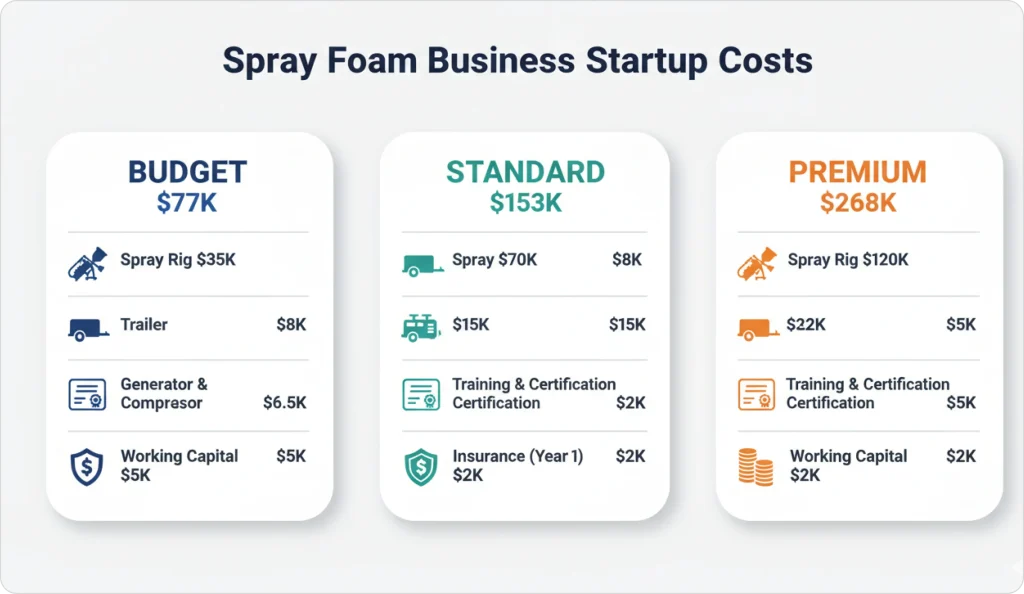
The real answer: more than most people expect.
| Component | Budget | Standard | Premium |
| Spray Rig/Proportioner | $35,000 | $70,000 | $120,000 |
| Trailer (enclosed) | $8,000 | $15,000 | $35,000 |
| Compressor & Generator | $6,500 | $15,000 | $22,000 |
| Spray Guns & Hoses | $3,000 | $5,000 | $7,000 |
| Safety Equipment | $3,000 | $5,000 | $8,000 |
| Initial Chemical Inventory | $5,000 | $8,000 | $12,000 |
| Training & Certification | $2,000 | $3,500 | $5,000 |
| Insurance (Year 1) | $8,000 | $15,000 | $25,000 |
| Licenses & Permits | $500 | $1,500 | $3,000 |
| Marketing | $1,000 | $3,000 | $6,000 |
| Working Capital | $5,000 | $12,000 | $25,000 |
| TOTAL | $77,000 | $153,000 | $268,000 |
Reality check: The “budget” column gets you started but leaves no margin for error. Most successful contractors start in the “standard” range.
Proportioner (the core of your rig):
| Model | Price Range | Best For |
| Graco Reactor E-20 | $22,000–$28,000 | Small residential jobs |
| Graco Reactor E-30 | $28,000–$35,000 | Residential, light commercial |
| Graco Reactor H-40 | $45,000–$55,000 | High-volume commercial |
| PMC PH-2 | $35,000–$45,000 | Mid-range versatility |
The above details are taken from: Graco Reactor Series
Trailer requirements:
Generator:
Before you start, you need to understand the two types of spray foam; they have different applications, costs, and profit margins.
| Property | Open-Cell | Closed-Cell |
| R-Value per inch | R-3.5 to R-4.0 | R-6.0 to R-7.0 |
| Density | 0.5 lb/cu ft | 2.0 lb/cu ft |
| Moisture Barrier | No (vapor permeable) | Yes (vapor retarder) |
| Air Barrier | Yes | Yes |
| Structural Strength | Minimal | Adds racking strength |
| Cost per Board Foot | $0.35–$0.55 | $1.00–$2.00 |
| Typical Applications | Attics, interior walls | Crawl spaces, rim joists, exterior, roofing |
| Factor | Open-Cell | Closed-Cell |
| Material Cost | Lower | Higher |
| Labor Time | Faster application | Slower (multiple passes) |
| Profit Margin | Lower per job, higher volume | Higher per job, lower volume |
| Equipment Wear | Less demanding | More demanding |
| Best For Starting | Residential attics, walls | Crawl spaces, commercial |
Recommendation: Most new contractors start with open-cell residential work (attics, walls) because it’s higher volume, more forgiving, and builds experience. Add closed-cell capabilities as you grow.
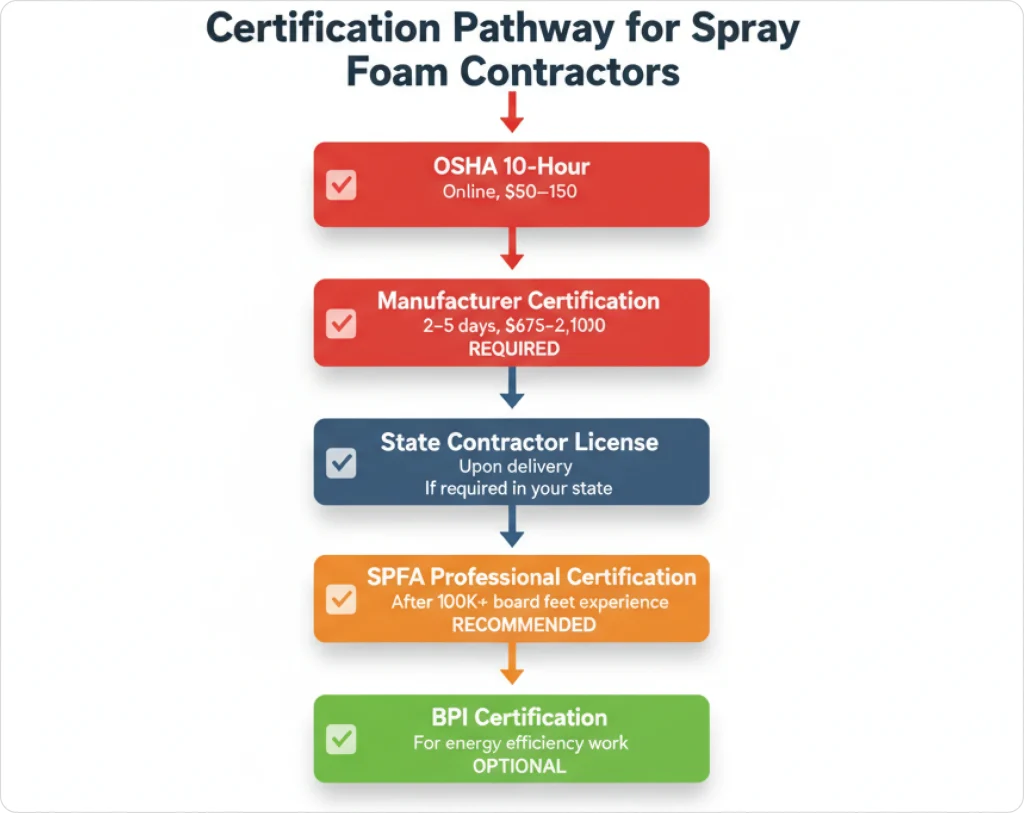
You cannot skip this section. Without proper certification, chemical suppliers won’t sell to you, and your insurance won’t cover claims.
Every spray foam chemical manufacturer requires contractors to complete their training before purchasing materials. This is non-negotiable.
Major manufacturers:
What to expect:
The Spray Polyurethane Foam Alliance (SPFA) offers the industry’s most recognized professional certification program.
Certification tiers:
1. SPF Assistant: Entry-level, no experience required
2. SPF Installer: Requires 100,000+ board feet of experience
3. SPF Master Installer: Requires 500,000+ board feet of experience
4. SPF Project Manager: For crew/project management
Cost: $1,450–$2,100 (significant discounts at SPFA conventions)
Renewal: Annual
If you plan to work with utility rebate programs, weatherization assistance, or position yourself as an energy efficiency contractor, Building Performance Institute (BPI) certification is important.
Relevant certifications:
Cost: $250–$450 exam fee (plus training costs)
Renewal: Every 3 years
Why it matters:
OSHA 10-Hour Construction Safety training is required by many states and commercial job sites. Covers hazard recognition, fall protection, and respiratory protection (critical for spray foam).
Cost: $50–$150 online.
Duration: 10 hours.
Complete certifications in this order:
1. OSHA 10-Hour: Do this first (online, can complete immediately)
2. Manufacturer Certification: Schedule 2–5-day training
3. Equipment Training: Upon delivery of your rig
4. State Contractor Exam: If required in your state
5. SPFA Certification: After gaining field experience
6. BPI Certification: If pursuing energy efficiency work
Licensing requirements vary by state. Some states require specific insulation contractor licenses (California C-2, Arizona C-40, Nevada C-3). Others require general contractor credentials above certain project thresholds. Some states have no state-level requirement at all.
Quick reference:
| License Type | Example States |
| Specific insulation license | California, Arizona, Nevada, Hawaii |
| General/specialty contractor | Florida, Michigan, Georgia, Virginia |
| No state license required | Texas, Colorado, Ohio, Indiana |
📋 Before you spray your first job, make sure you’re legally covered.
Read our complete Insulation Contractor License Requirements by State guide for everything from state-specific licenses to insurance minimums and certification costs.
Key point: Even in states without licensing, you still need business registration, local permits, and insurance.
Spray foam contractors need more insurance coverage than typical contractors due to technical risks: overspray, off-ratio foam, and chemical exposure claims.
Essential coverages:
| Coverage | Minimum | Annual Cost |
| General Liability | $1M/$2M | $3,000–$8,000 |
| Workers’ Comp | State minimums | $4,000–$12,000 |
| Commercial Auto | $1M combined | $2,000–$5,000 |
| Inland Marine (Equipment) | Replacement value | $1,000–$3,000 |
| Pollution Liability | $1M minimum | $1,500–$4,000 |
Total annual insurance budget: $12,000–$25,000
For detailed insurance requirements by state, see our Insulation Contractor License Requirements by State guide.
Standard general liability policies often exclude overspray and chemical drift damage. One overspray claim on a neighbor’s car or property can cost more than a year’s profit.
Get pollution liability coverage or an endorsement; this isn’t optional for spray foam contractors.
| Equipment | Lead Time | Notes |
| Proportioner (new) | 2–4 weeks | Longer for customized setups |
| Custom enclosed trailer | 4–8 weeks | Stock trailers available faster |
| Generator | 1–2 weeks | Stock availability varies |
| Initial chemical order | 1–2 weeks | Requires completed certification |
Recommendation: Order equipment 6–8 weeks before the target launch date.
Budget $5,000–$10,000 annually for maintenance. This isn’t optional; spray foam equipment requires consistent care.
Daily maintenance:
Weekly maintenance:
Scheduled maintenance:
Neglecting maintenance leads to:
Spray foam is weather-dependent. Understanding these limitations affects your scheduling, revenue projections, and geographic viability.
| Factor | Open-Cell | Closed-Cell |
| Substrate Temperature | Minimum 40°F | Minimum 40°F |
| Ambient Temperature | 60–100°F ideal | 60–100°F ideal |
| Humidity | Below 80% | Below 80% |
| Surface Condition | Dry, clean | Dry, clean |
| Season | Impact | Strategy |
| Winter (Cold climates) | Limited exterior work; substrate heating may be needed | Focus on interior work, crawl spaces |
| Summer (Hot/humid) | Early morning starts; humidity issues | Start early, avoid afternoon humidity peaks |
| Rainy periods | Cannot spray on wet surfaces | Schedule flexibility, interior backup jobs |
Business planning: In northern climates, expect 2–4 months of reduced productivity. Build this into your annual revenue projections and cash flow planning.
Spray foam chemicals (MDI isocyanate and polyol) require proper handling. This isn’t just about compliance; it’s about protecting yourself, your crew, and your customers.
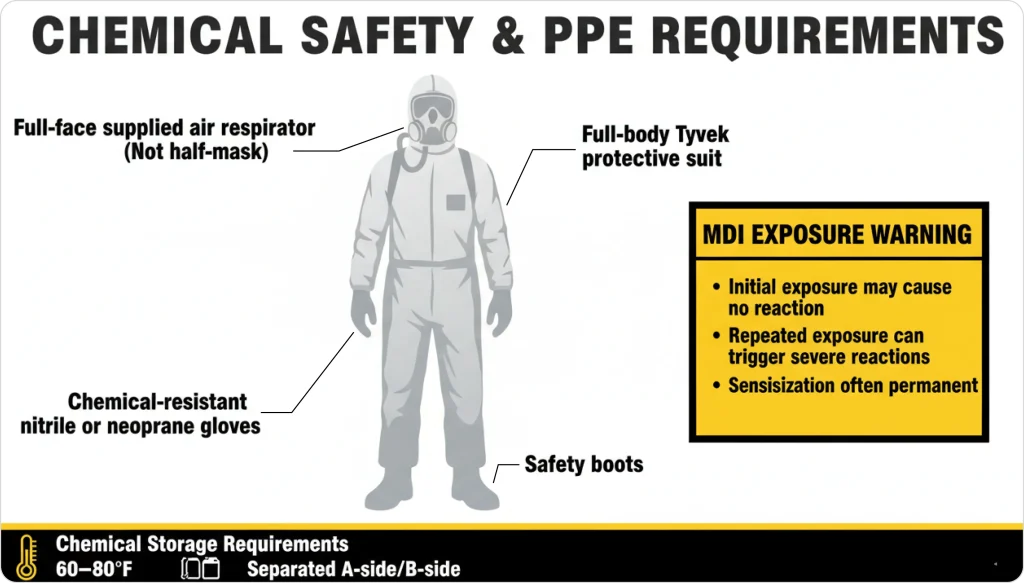
MDI (methylene diphenyl diisocyanate) is the “A-side” chemical in spray foam. It’s a respiratory sensitizer, meaning:
| Equipment | Requirement | Notes |
| Respirator | Full-face supplied air respirator | Half-mask with cartridges is NOT adequate during spraying |
| Protective suit | Full-body Tyvek or similar | Prevents skin contact |
| Gloves | Chemical-resistant (nitrile or neoprene) | Replace frequently |
| Eye protection | Full-face shield or respirator face shield | Chemical splash protection |
| Requirement | Details |
| Temperature | 60–80°F (chemical performance degrades outside this range) |
| Shelf life | 6–12 months, depending onthe product |
| Location | Climate-controlled trailer or storage area |
| Separation | Keep A-side and B-side chemicals separated |
Pricing spray foam requires understanding the difference between square feet and board feet.
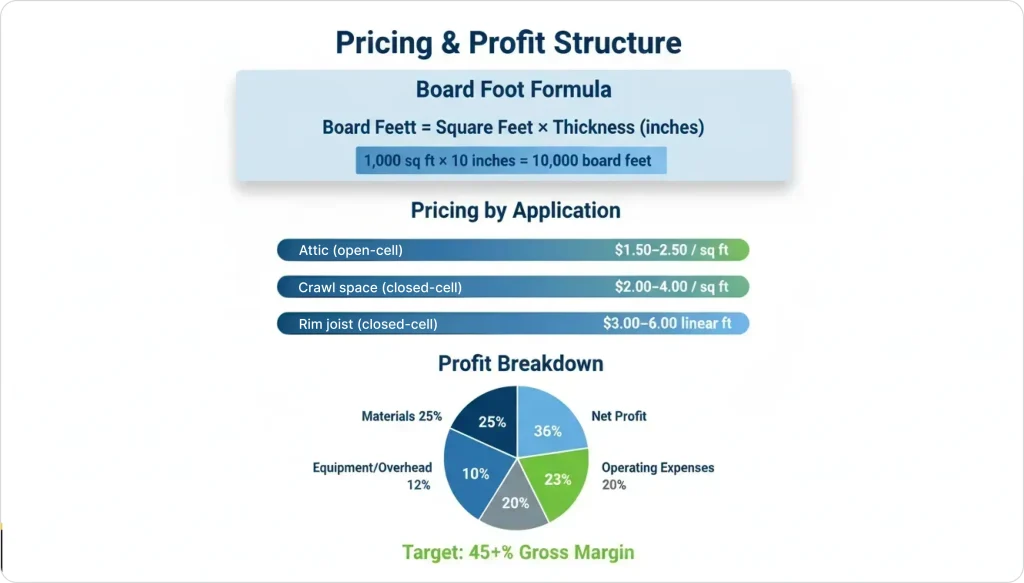
Board foot = Square feet × Inches of thickness
Example: 1,000 sq ft attic at 10 inches of open-cell
Always price by board foot, then convert to customer-friendly square foot pricing.
| Application | Foam Type | Typical Thickness | Price Range | Notes |
| Attic floor | Open-cell | 10–12″ | $1.50–$2.50/sq ft | Highest volume residential |
| Attic roofline | Open-cell | 6–8″ | $1.25–$2.00/sq ft | Creates a conditioned attic |
| Wall cavity | Open-cell | 3.5″ | $1.00–$1.75/sq ft | New construction |
| Crawl space | Closed-cell | 2–3″ | $2.00–$4.00/sq ft | Moisture/vapor control |
| Rim joist | Closed-cell | 2–3″ | $3.00–$6.00/linear ft | High-margin upsell |
| Metal building | Closed-cell | 1.5–2″ | $1.50–$2.50/sq ft | Commercial applications |
| Cost Category | % of Revenue | Notes |
| Materials (chemicals) | 20–30% | Varies by open vs closed-cell |
| Labor | 15–25% | Higher for complex jobs |
| Equipment/overhead | 10–15% | Maintenance, depreciation, insurance |
| Gross Margin | 40–60% | Target 45%+ minimum |
| Operating expenses | 15–25% | Admin, marketing, vehicle |
| Net Margin | 20–30% | After all expenses |
Establish minimum job prices to ensure profitability on small jobs:
| Job Type | Minimum Price | Rationale |
| Any spray foam job | $800–$1,200 | Setup time is the same regardless of size |
| Crawl space | $1,500+ | Access difficulty, safety requirements |
| Rim joist only | $600–$800 | Quick job, high margin |
Never compete on price. Low prices attract price-shoppers who will leave you for $50 less. Price for value and quality.
| Operation | Jobs/Week | Avg Revenue/Job | Annual Revenue | Net Profit (22%) |
| Solo + helper | 3–4 | $3,500 | $550K–$730K | $120K–$160K |
| 2-person crew | 4–5 | $4,000 | $830K–$1.04M | $180K–$230K |
| 2 crews | 8–10 | $3,800 | $1.58M–$1.98M | $350K–$435K |
Reality check: These numbers assume:
Year 1 will be lower while you build reputation and systems.
Your fastest path to consistent work is through other contractors, not homeowners.
Target relationships:
How to approach:
Google Business Profile:
Website basics:
Direct-to-homeowner work has higher margins but longer sales cycles. Effective channels:
Manual operations collapse by month three. Set up systems before you launch.
| System | Purpose | Options |
| CRM / Lead Management | Track leads, follow-ups, and customer history | FieldCamp CRM, Jobber, ServiceTitan |
| Estimating | Professional quotes, pricing consistency | Estimate templates, job costing software |
| Scheduling | Job scheduling, crew dispatch | AI dispatch scheduling tools, calendar systems |
| Invoicing | Fast invoicing, payment collection | Invoicing software, QuickBooks |
| Route Optimization | Minimize drive time between jobs | Route optimization tools |
Without systems:
Understanding tax incentives helps you sell more jobs and provide value to customers.
As per the IRS, homeowners can claim tax credits for qualifying insulation improvements:
How to use this in sales:
The problem: Low prices attract price-shoppers who disappear for $50 less. You work harder, make less money, and build no loyalty.
The fix: Price for 45%+ gross margins from day one. If you’re losing every bid, improve your sales skills, don’t cut prices.
The problem: Improper technique causes off-ratio foam, shrinkage, adhesion failures, and liability claims. One bad job can cost more than a year’s profit.
The fix: Complete all manufacturer training. Practice on scrap projects before paying jobs. Never stop learning.
The problem: Spray foam equipment requires consistent maintenance. Skipping it leads to mid-job breakdowns, off-ratio foam, and premature equipment failure.
The fix: Budget $5,000–$10,000 annually. Daily cleaning. Weekly inspections. Scheduled rebuilds. No exceptions.
The problem: Manual operations (notes, spreadsheets, memory) collapse when you get busy. Leads fall through cracks. Jobs get double-booked. Invoices don’t go out.
The fix: Implement CRM, scheduling, and invoicing systems before you launch, not after you’re drowning.
The problem: You finish a job on Monday, invoice on Friday, and get paid in 45 days. Meanwhile, you need chemicals for next week.
The fix: Invoice the same day you complete work. Require deposits on large jobs. Offer payment on completion. Build 2–3 months of operating capital before launching.
Manufacturer warranties transfer to customers, but you’re responsible for installation quality.
| Warranty Type | Typical Coverage | Duration |
| Manufacturer’s material warranty | Material defects, R-value degradation | 10–lifetime (varies) |
| Your installation warranty | Workmanship, adhesion, coverage | 1–5 years (you define) |
When issues arise, you may need to:
Protecting yourself:
Launching is just the beginning. Running a profitable spray foam business requires efficient operations, from scheduling multi-day jobs to managing estimates and invoicing.
Modern field service management tools help spray foam contractors:
Whether you’re a solo operator just starting or managing a growing business with multiple crews, the right systems make the difference between chaos and profitability.
1. Assess your capital: Do you have $80,000–$150,000 available for startup costs and working capital?
2. Research your state: Check licensing requirements for your state
3. Schedule training: Contact manufacturers to book certification training
4. Get insurance quotes: Talk to 3+ insurers specializing in spray foam contractors
5. Order equipment: Allow 6–8 weeks lead time
6. Set up systems: Implement a reliable insulation contractor software that has CRM, scheduling, and invoicing before launch
7. Start building relationships: Begin contractor outreach before your first job
Ready to Land Your First Spray Foam Job?
You’ve got the rig, the training, the license. Now you need customers and a system to manage them. FieldCamp handles scheduling, estimates, invoicing and more from day one.
Last updated: January 2026. Costs, regulations, and market conditions change – verify current information before making business decisions.
Realistically, $60,000–$200,000, depending on equipment quality. A bare-minimum “budget” setup runs about $60,000–$80,000, but most successful contractors start with $100,000–$150,000 in capital to cover equipment, training, insurance, and 2–3 months of working capital. The premium range ($180,000–$250,000) gets you commercial-grade equipment with capacity for larger jobs.
Net income varies widely based on operation size and efficiency. A solo operator with a helper doing 3–4 jobs per week can net $120,000–$160,000 annually after all expenses. A two-person crew doing 4–5 jobs weekly can net $180,000–$230,000. Two-crew operations can exceed $350,000 in net profit. These numbers assume proper pricing (45%+ gross margins) and efficient operations.
Yes, when run correctly. Spray foam has some of the highest margins in the insulation industry: 40–60% gross margins and 20–30% net margins are achievable. However, the high startup costs, technical requirements, and equipment maintenance demands mean it’s not a “passive income” business. Profitability requires proper training, disciplined pricing, and efficient operations.
At a minimum, you need manufacturer certification; chemical suppliers won’t sell to you without it. Beyond that, requirements vary by state. Most contractors also complete OSHA 10-Hour Construction training and pursue SPFA Professional Certification for credibility. Some states require contractor licensing (California C-2, Arizona C-40, etc.). See our state licensing guide for specific requirements.
It depends on your state. California requires a C-2 Insulation license. Arizona requires a C-40 Insulation license. Florida requires a Specialty Contractor license. Many states (Texas, Colorado, Ohio) have no state-level requirement but may have local licensing. Check your state contractor board and local building department.
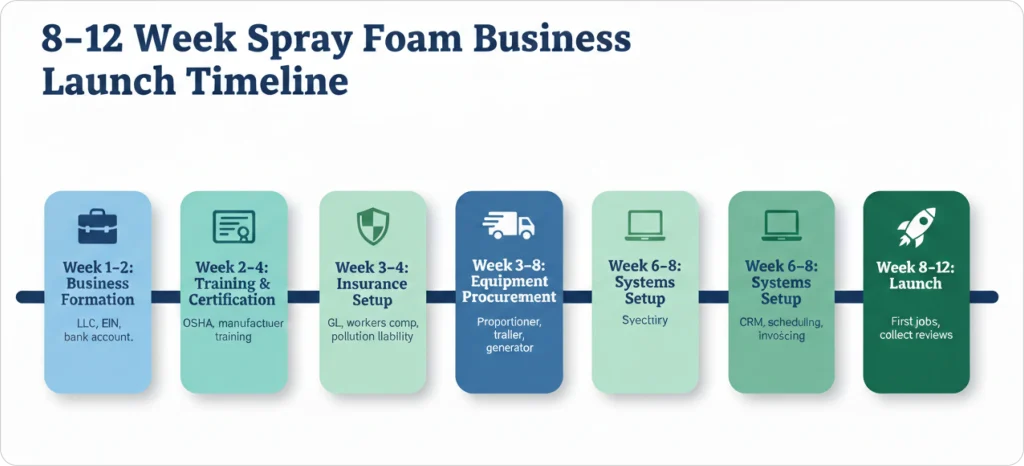
From decision to first paying job: 8–12 weeks typically. Training takes 2–4 weeks, equipment procurement 4–8 weeks (some overlap possible), and business setup runs concurrently. Rushing this process leads to costly mistakes. Building a sustainable, profitable business takes 6–12 months of consistent work.
Essential equipment includes: proportioner/reactor ($28,000–$55,000), enclosed trailer ($8,000–$35,000), generator ($3,500–$12,000), air compressor ($3,000–$10,000), spray guns and heated hoses ($3,000–$7,000), and full PPE including supplied-air respirator ($3,000–$8,000). Total equipment investment: $50,000–$130,000+, depending on quality level.
Required coverage includes: general liability ($1M/$2M), workers’ compensation (if you have employees), commercial auto, inland marine (equipment coverage), and critically, pollution liability coverage for overspray claims. Total annual cost: $12,000–$25,000, depending on coverage levels and business size.
Most new contractors start with open-cell residential work (attics, walls) because it’s higher volume, more forgiving of minor technique issues, and builds experience quickly. Open-cell jobs also have shorter cycle times, so you can complete more jobs per week while learning. Add closed-cell capabilities for crawl spaces, rim joists, and commercial work as you gain experience.
Yes. The Energy Efficient Home Improvement Credit (25C) allows homeowners to claim 30% of qualifying insulation material costs, up to $1,200 annually. This credit is available through December 31, 2025. Important: labor costs are NOT eligible; only material costs qualify. Homeowners should consult their tax professional for specific guidance.