
HVAC Markup vs Margin: What’s the Difference? (+ Conversion Chart)
April 3, 2026 - 11 min read

April 3, 2026 - 11 min read

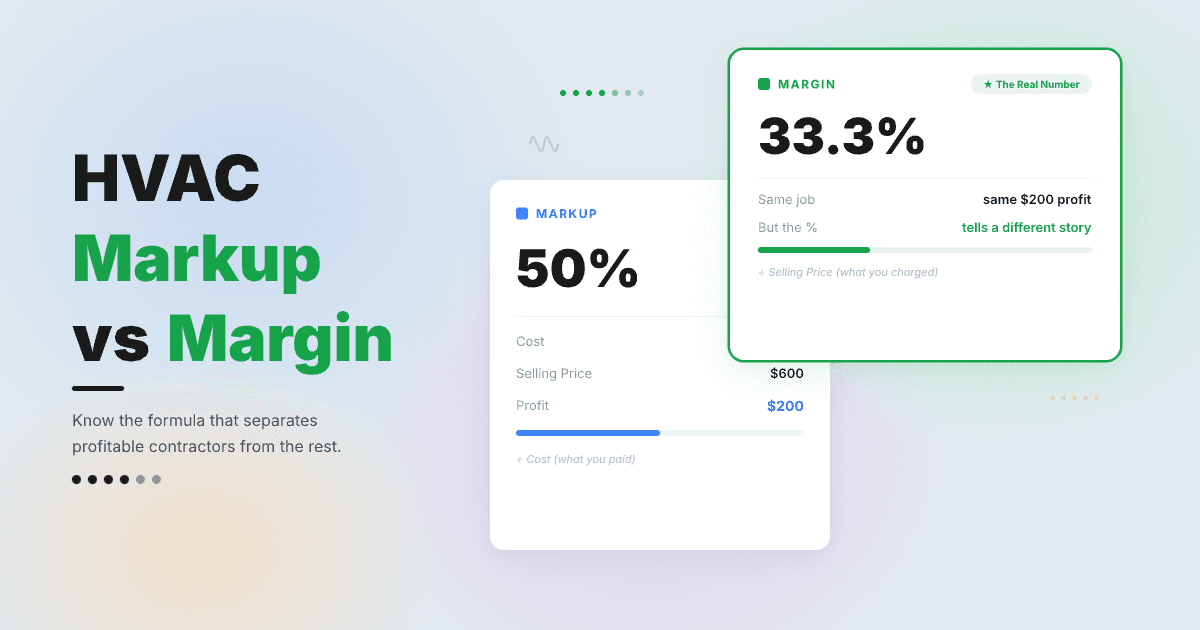
| TL;DR: Markup and margin measure the same dollar profit using different bases. Markup divides by cost; margin divides by selling price. Mix them up when pricing jobs, and you can lose thousands per year without ever knowing why. |
Pricing is one of the most common pressure points for HVAC businesses.
Most contractors know their costs, know what they want to charge for HVAC jobs, and still walk away with less than expected. Not because of poor workmanship or bad customers, but because markup and margin get used interchangeably when they’re not the same thing.
This post breaks down both formulas clearly, shows you how to convert between HVAC margin vs markup with a single calculation.
Let’s walk through the real dollar impact of mixing them up, so you can price jobs with confidence and actually hit the margins you’re targeting.
Summarize with AIKEY HIGHLIGHTS
HVAC Markup vs Margin
Markup in HVAC is profit expressed as a percentage of cost, which is what you paid before selling.
It answers one question: How much am I adding on top of my cost?
Markup % = (Selling Price – Cost) / Cost × 100
The denominator is Cost. Markup always divides by what you paid, not what you charged.
This is the calculation most contractors encounter first, because it starts from a known number. You know what you paid for a part, you decide how much to add, and you arrive at a selling price.
You purchase a compressor for $400 and apply a 50% markup.
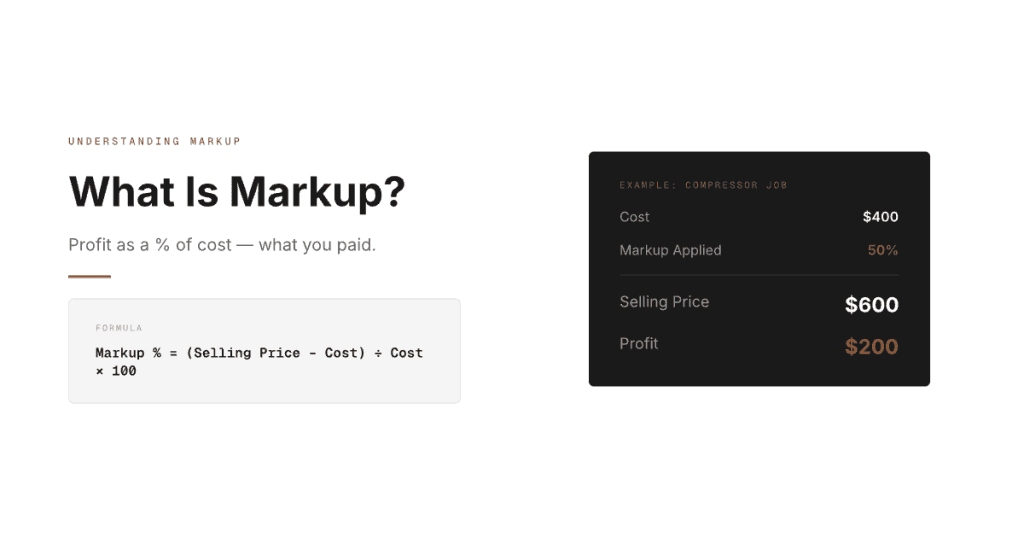
Clean and straightforward. The markup vs. margin difference doesn’t surface until you look at the same transaction through the margin lens.
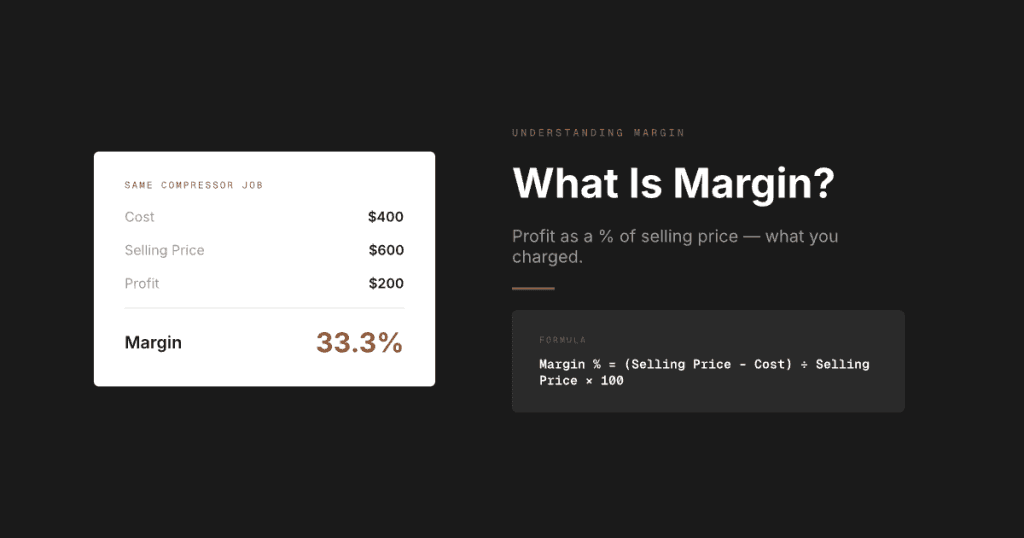
Margin in HVAC is profit expressed as a percentage of the selling price, which is what you charge the customer.
It answers a different question: What portion of my revenue is profit?
Margin % = (Selling Price – Cost) / Selling Price × 100
The denominator here is the Selling Price.
That one change, swapping cost for selling price at the bottom of the fraction, is what produces two completely different percentages from the same transaction.
Gross profit margin tells you what share of every dollar you bring in actually stays with you after covering direct costs. It’s one of the numbers your accountant tracks.
For a deeper look at healthy gross profit margin figures across different HVAC job types, see our HVAC profit margins guide.
Using the same compressor job from above: same cost, same selling price, and same dollar profit:
Not 50%. The job that looked like a 50% markup job is actually a 33.3% margin job. The dollar profit is identical, but the percentage looks completely different depending on which formula you use.
The confusion almost always comes down to one thing: the base number used in the calculation.
| Markup | Margin | |
| Formula | (Selling Price – Cost) / Cost | (Selling Price – Cost) / Selling Price |
| Base number | Cost | Selling Price |
| $200 profit example | $200 / $400 = 50% | $200 / $600 = 33.3% |

Key distinction: Markup tells you how much you added on top of the cost. Margin tells you what portion of revenue you kept. Neither number is wrong; they describe the same profit from two different angles.
Say you want to hit 40% profit on a larger HVAC install. The job has $6,000 in costs. You apply a 40% markup, assuming that produces a 40% profit.
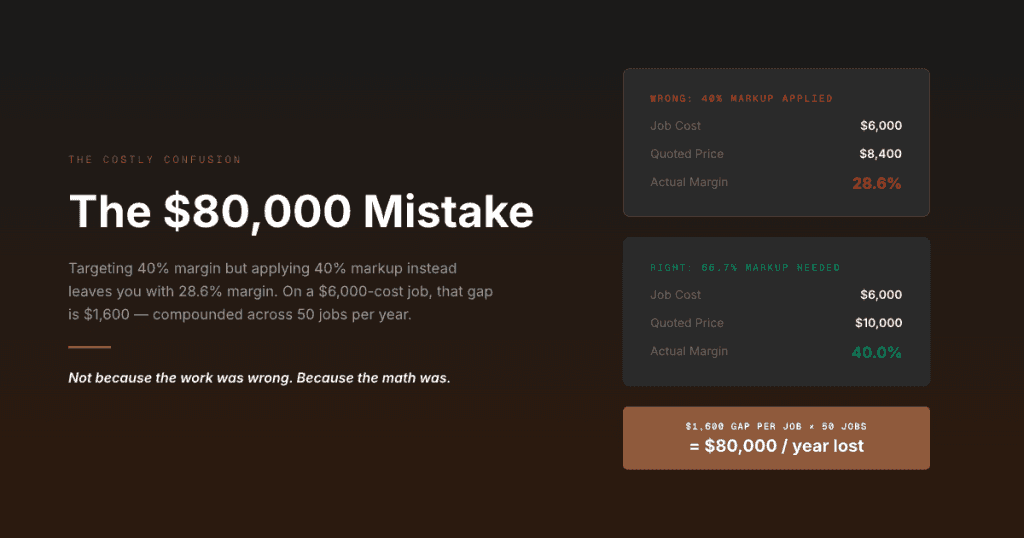
To actually hit a 40% gross margin on a $6,000-cost job, you’d need to charge closer to $10,000.
The gap between those two prices is $1,600 per job. Across 50 jobs in a year, that’s $80,000 in profit that never appeared, not because the work was done wrong, but because the percentages were being calculated against different bases.
That’s why markup vs. margin is a pricing issue, not a bookkeeping issue.
Find your markup percentage on the left. The corresponding margin percentage is on the right. Markup is always higher than the corresponding margin on the same transaction.
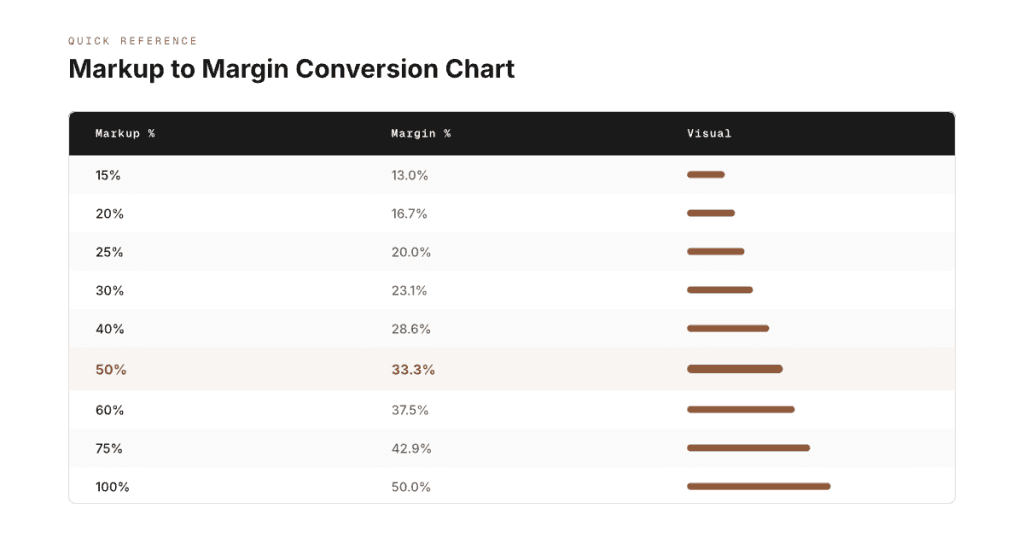
Rule: Markup % is always higher than Margin % for any given transaction. A 50% markup is a 33.3% margin.
A 100% markup is a 50% margin. If someone tells you they run a 50% margin, they’re either operating a highly profitable HVAC business or they’re thinking of markup.
Markup to Margin:
Margin = Markup / (1 + Markup)
Example: 50% markup → 0.50 / (1 + 0.50) = 0.50 / 1.50 = 33.3% margin
Margin to Markup:
Markup = Margin / (1 – Margin)
Example: 33.3% margin → 0.333 / (1 – 0.333) = 0.333 / 0.667 = 50% markup
These two formulas let you move between markup and margin without a chart, useful when reviewing a quote, talking with your accountant, or comparing notes with a contractor who thinks in different terms.
If you know the gross margin percentage you want to hit, you can work backward to find the required markup.
Required Markup % = Target Margin % / (1 – Target Margin %)
Important: This formula gives you a gross margin starting point only. It does not account for overhead, net profit requirements, taxes, warranty callbacks, or financing costs. Your actual required markup may need to be higher.
Note: 40% is used here as an illustration only. Your actual target depends on your overhead and business goals.
0.40 / (1 – 0.40) = 0.40 / 0.60 = 66.7% required markup
Applied to a job with $5,000 in direct costs:
$5,000 × 1.667 = $8,335 selling price
At $8,335, approximately $3,335 represents gross profit, 40% of the selling price.
Working backward from a margin target to a required markup gives you a floor for building out a full job estimate. Overhead coverage and net profit are built into the floor above.
A flat markup applied to every line item treats a $12 filter the same as a $4,000 air handler. Those two products have different economics: supplier relationships, holding costs, installation time, and competitive pricing all vary by category.
A uniform markup percentage across all categories can leave money on some jobs while making others harder to win.
The fix is to build category-level price floors before you quote. Our free Service Price Calculator lets you set target margins by job type, so your markup reflects the actual economics of each line item, not just a blanket percentage applied across the board.
This connects directly to the costly confusion example above. Prices get set using margin logic while being calculated using markup math, or vice versa, and that gap compounds across every job.
The easiest fix is removing the manual calculation entirely. Our free Profit Margin Calculator lets you input cost and selling price and instantly see both the markup and margin, so you always know exactly which number you’re working with before a quote goes out.
Gross margin calculations account only for direct costs: materials, equipment, and direct labor. They don’t include overhead, truck payments, insurance, office expenses, or warranty callbacks.
There are multiple valid approaches to overhead allocation: flat-rate pricing that bundles overhead into a standard rate, job-costing methods that allocate overhead based on hours or revenue, or a percentage-of-revenue model.
Whichever method you use, overhead must be accounted for somewhere in your pricing, not assumed away. Use our free Labor Cost Calculator to get a clear number for your true per-job labor cost before you set a markup floor, and make sure your invoices reflect that fully-loaded cost from the start, not just parts and time.
If your current invoicing process makes that difficult, it’s worth looking at how HVAC invoicing software can automate the calculation so nothing gets missed.
Stop Losing Profit to Pricing Errors
FieldCamp auto-generates estimates and invoices from job data, so your markup is applied consistently on every job, every time.
No. A 50% markup on a $100 item means you sell it for $150. Your profit is $50. Your margin on that transaction is $50 / $150 = 33.3%, not 50%. Markup percentage is always higher than margin percentage on the same transaction. Markup divides by cost (a smaller number); margin divides by selling price (a larger number). That difference in the denominator separates the two results.
66.7% markup. Formula: 0.40 / (1 – 0.40) = 0.40 / 0.60 = 66.7%. If direct costs on a job are $5,000, you’d need to charge approximately $8,335 to achieve a 40% gross margin. This is a gross margin calculation only; it does not account for overhead, net profit requirements, or other below-the-line costs.
Both are valid. The choice depends on which framing fits your workflow.
Markup works well during estimating because it starts from a known number, what you paid, and adds on from there. It’s easy to apply in the field. Margin works well when analyzing job performance because it aligns with how financial statements are structured and makes it easier to compare profitability across jobs of different sizes. One approach: price in markup during estimating, then review results in margin terms when analyzing performance. That way, both numbers work for you at different stages of the same job. For a full walkthrough of the pricing process, see our HVAC pricing guide.