HVAC Phone Scripts: 10 Proven Scripts That Turn Calls Into Booked Jobs in 2026
April 14, 2026 - 27 min read

April 14, 2026 - 27 min read

Table of Contents
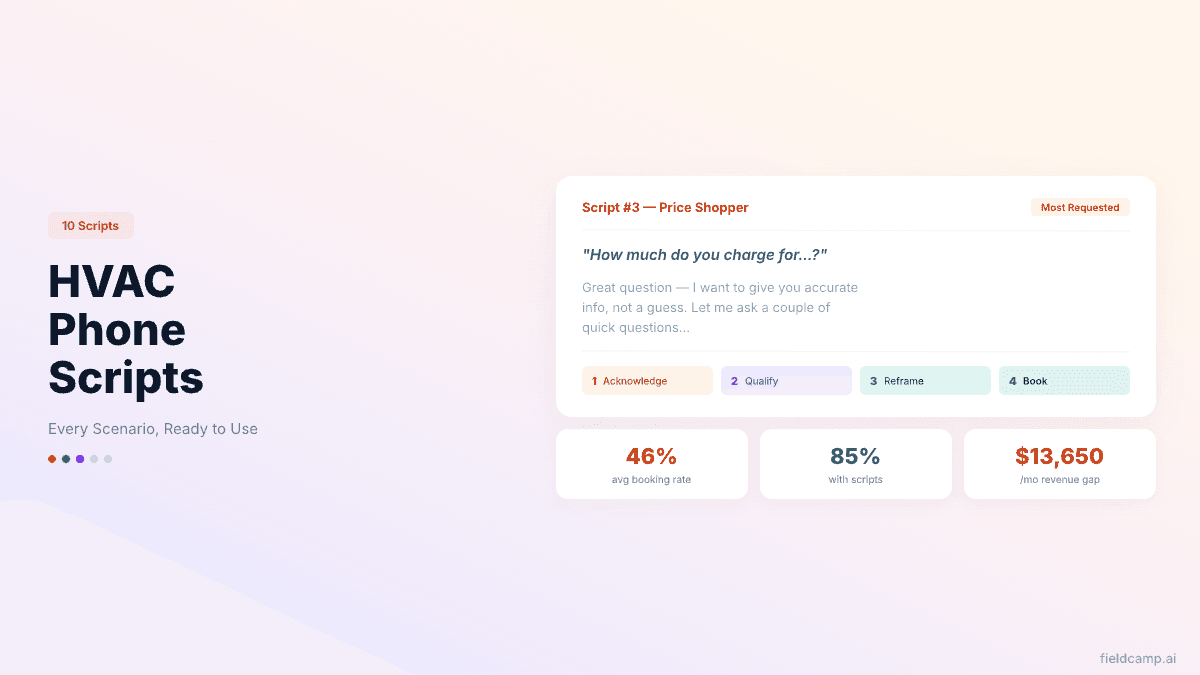
| TL;DR: The average HVAC company converts only 46% of incoming calls into booked appointments. Top performers hit 85%. That gap, on 100 calls per month at a $350 average ticket, is $13,650 in lost revenue every single month. The difference isn’t luck or charm. It’s having scripts: structured frameworks that guide your team through every type of call, from first-time callers to price shoppers to angry customers. This guide gives you 10 ready-to-use scripts. |
Your phone rings. A homeowner says, “Hi, my AC stopped working. How much to fix it?”
Your new hire panics. “Uh, it depends on what’s wrong. It could be anywhere from $150 to $1,200.” Silence on the other end. “Okay, let me call a few other places.” Click.
You just lost a $400 repair. Possibly a $9,000 replacement. Because nobody taught your front desk what to say.
This happens dozens of times a month at HVAC companies across the country. 27% of incoming calls go unanswered entirely. Of the calls that do get answered, nearly half fail to convert into booked appointments.
The industry average booking rate sits at 46%, meaning for every 100 calls, 54 potential customers hang up and call your competitor.
Here’s what makes this painful: you already paid for those calls. Whether through Google Ads, SEO, yard signs, or word-of-mouth, every call that doesn’t convert is marketing dollars wasted.
Phone scripts fix this. Not by turning your team into robots, by giving them a proven structure that captures information, builds trust, and books the appointment before the caller has a chance to “think about it and call back.”
And if your team can’t get to every call, an AI receptionist can capture leads 24/7, answering calls, gathering details, and booking jobs automatically, so no ring goes to waste.
This guide gives you 10 complete scripts covering every call scenario your HVAC company faces. Print them, train on them, customize them for your business. They work whether you have a dedicated CSR, an office manager handling phones between tasks, or a technician answering calls from the truck.
For the bigger picture on turning calls into revenue, our HVAC sales tips guide covers the full customer interaction from first contact through close.
And if you’re building a team and need to hire people who’ll actually use these scripts well, our HVAC interview questions guide helps you identify the right candidates.
Let’s get your booking rate above 80%.
That’s a lot of scripts. If you want a quick breakdown of which ones will make the biggest difference for your team size and call volume, let AI summarize it for you.
🤖 Get a quick script summary for my HVAC BusinessKEY HIGHLIGHTS
HVAC Phone Scripts
Before we get into scripts, let’s make the business case crystal clear.
Take a typical HVAC company receiving 100 inbound calls per month:
| Metric | Average Company (46% booking) | Top Performer (85% booking) | Difference |
|---|---|---|---|
| Calls received | 100 | 100 | — |
| Appointments booked | 46 | 85 | +39 |
| Jobs completed (80% show rate) | 37 | 68 | +31 |
| Revenue at $350 avg ticket | $12,950 | $23,800 | +$10,850/month |
| Annual revenue impact | $155,400 | $285,600 | +$130,200/year |
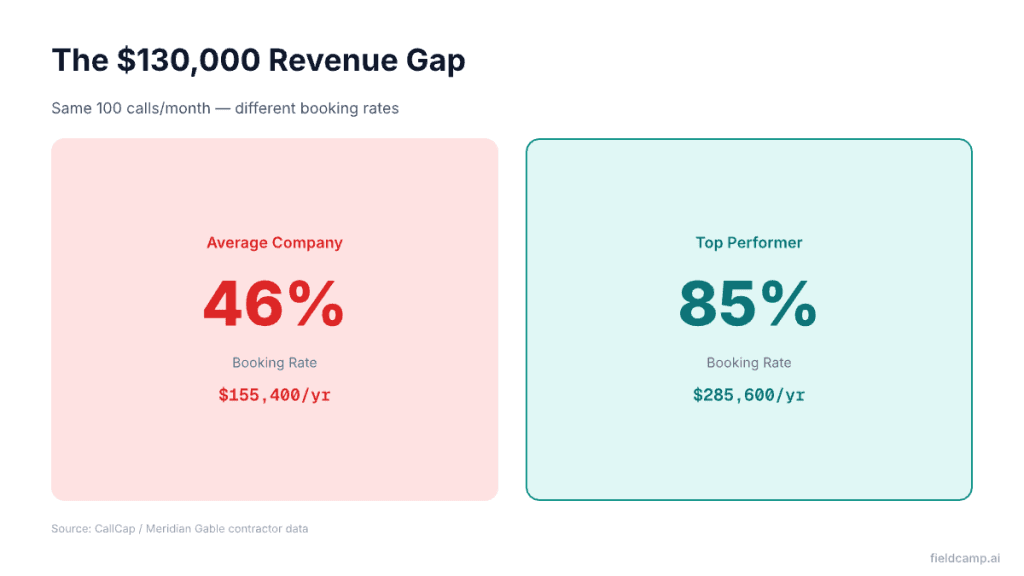
That’s $130,000 in annual revenue sitting inside your phone lines, with zero additional marketing spend. You’re already generating the calls. You just need to convert them.
HVAC contractors lose an estimated $45,000 to $120,000 per year from missed and mishandled calls (Source: ResultCalls, 2025).
Scripts alone won’t solve every problem, but companies that implement structured call protocols see a 27% increase in conversion rates within the first 90 days.
A quick note before we dive in. These scripts are frameworks with key phrases, not word-for-word readings. The structure ensures your team hits every important point. The key phrases are specific words and sentences proven to build trust and move toward booking. But the conversation should feel natural.
How to implement: pick the three scripts most relevant to your daily calls (for most companies, that’s Script #1, Script #3, and Script #6). Customize them with your company name, service area, pricing, and scheduling details.
Role-play them, have your CSR or office manager practice with another team member twice a week for two weeks. Post and laminate the core scripts at every workstation where phones are answered.
Then review and adjust monthly by listening to recorded calls and refining based on real customer language.
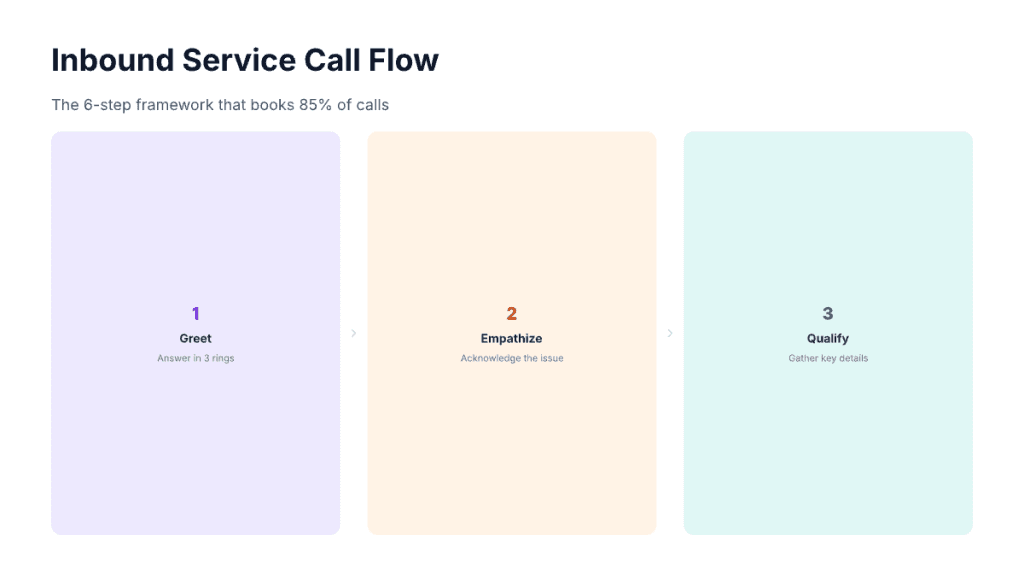
Use when: A homeowner calls needing HVAC repair or service. This is your bread-and-butter script; it handles 60–70% of all incoming calls.
[Phone rings — answer within 3 rings]
CSR: “Thanks for calling [Company Name], this is [your name]. How can I help you today?”
[Customer describes the problem]
CSR: “I’m sorry to hear that — I know how frustrating it is when your [AC/heating] isn’t working properly. Let me get some quick information so we can get a technician out to you as fast as possible.”
[Gather essential info:]
CSR: “Thank you, [customer name]. Based on what you’re describing, I’d like to get one of our technicians out to diagnose the issue and give you your options. We have availability [offer two specific time slots]. Which works better for you?”
[If they hesitate about cost:]
CSR: “Our diagnostic visit is [$X], and that covers a complete system assessment. If any repair is needed, our technician will explain exactly what’s going on, show you the issue, and give you the cost before doing any work. There are never any surprises.”
[Book the appointment:]
CSR: “Great, I have you down for [day] between [time window]. You’ll receive a confirmation text shortly, and our technician will call you about 30 minutes before arrival. Is there anything else I can help with?”
Key phrases that matter:
Use when: A call comes in outside business hours or involves a safety concern (no heat in winter, gas smell, carbon monoxide alarm).
[Answering service or after-hours recording picks up]
CSR/Recording: “Thank you for calling [Company Name]. We’re here for you 24/7. For emergency service, please stay on the line.”
[If live person or callback within 5 minutes:]
CSR: “This is [name] with [Company Name]. I understand you have an emergency. First, is everyone in the home safe right now?”
[If safety concern, gas smell, CO alarm:]
CSR: “If you smell gas or your carbon monoxide detector is going off, please leave the home immediately, move to fresh air, and call 911 if you haven’t already. Once you’re safe, I’ll stay on the line with you, and we’ll get a technician dispatched right away.”
[If no immediate safety concern:]
CSR: “Okay, I’m glad everyone is safe. Let me get your information and dispatch a technician. What’s the address?”
[Gather: address, phone, brief problem description]
CSR: “I’m dispatching a technician now. Our after-hours emergency rate is [$X] for the service call, which covers diagnosis. The technician will call you approximately [X] minutes before they arrive. They’ll assess the issue and walk you through all your options and costs before doing anything.”
[If they ask about cost before committing:]
CSR: “I completely understand. You want to know what you’re getting into. The [$X] emergency service fee covers the technician coming to your home and diagnosing the problem.
Any repair costs beyond that will be presented to you upfront before work begins. Our goal is to get your [heat/cooling] running tonight.”
If your team isn’t available after hours, an AI receptionist can capture emergency calls, gather the essential details, and trigger an automated dispatch notification, so no 2 AM call goes unanswered.
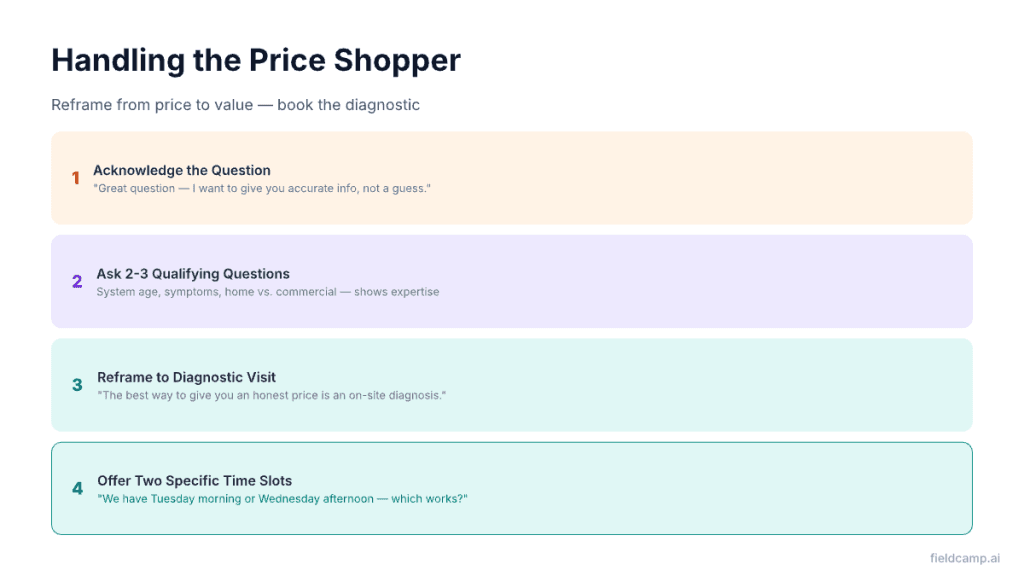
Use when: A caller leads with “How much do you charge for…?”
This is the call most HVAC companies dread and fumble. The caller wants a number. Your instinct is to give one. But quoting blind almost always loses: either your number is too high, and they hang up, or it’s too low, and you’re locked into a price before seeing the problem.
The goal: Shift the conversation from price to value, and book a diagnostic visit.
Caller: “Hi, how much do you charge to [fix a leaking AC / replace a furnace / do a tune-up]?”
CSR: “Great question. I want to make sure I give you accurate information and not just a guess. The cost depends on a few things specific to your system, so let me ask a couple of quick questions to point you in the right direction.”
[Ask 2–3 qualifying questions:]
CSR: “Thanks for that. Based on what you’re describing, the best way to give you an honest, accurate price is to have one of our technicians take a look. Our diagnosis is [$X], and it includes a full inspection of the system. Once our tech identifies the issue, he’ll show you exactly what’s going on and give you your options with pricing before any work starts. No pressure, no surprises.”
[If they push back — “I just need a ballpark”:]
CSR: “I totally get it, you want to make sure you’re in the right range before committing. For [general service type], our customers typically see [broad honest range, e.g., 150–$600 for AC repairs, depending on the issue]. But I’d hate to give you a number that’s off because I haven’t seen the system. Our diagnostic fee of [ X] gets you the real answer, and if you move forward with the repair, we [waive it / apply it toward the repair cost].”
[If they say they’re calling around for quotes:]
CSR: “That makes complete sense. Most smart homeowners get a couple of opinions. What I can tell you is that we’ve been serving [service area] for [X years], we have [X] five-star reviews, and our technicians are [NATE certified/licensed/bonded and insured]. We focus on diagnosing the real issue first, so you don’t pay for work you don’t need. Can I get you on the schedule for a diagnosis? We have openings [offer two slots].”
Why this works: You never refuse to give a price; you reframe the question. The customer feels heard, gets a range if they push, and understands why an on-site visit gives them a better answer. The key phrase “show you exactly what’s going on and give you your options” reassures them that they won’t be pressured.
For contractors wanting to build a complete pricing framework, our flat rate pricing guide covers how to structure your prices, so your team always has a confident answer.
Use when: A customer’s annual maintenance plan is expiring, and you need to renew it.
CSR: “Hi [customer name], this is [your name] from [Company Name]. How are you doing today?”
[Brief small talk, keep it to 15–20 seconds]
CSR: “I’m reaching out because your annual maintenance agreement is coming up for renewal on [date], and I wanted to make sure we get you taken care of before it lapses.”
[If they seem receptive:]
CSR: “Your plan covers [briefly list what’s included, two annual tune-ups, priority scheduling, 15% repair discount, no emergency service fees]. It’s been great having you on the plan. We serviced your system in [month], and everything looked good. Renewing keeps you covered for another year at [X],whichbreaksdowntoabout[X], which breaks down to about [ X],whichbreaksdowntoabout[X/month]. Should I go ahead and renew that for you?”
[If they hesitate:]
CSR: “I understand. I want to make sure it’s still a good fit. Here’s what I can share: customers on our maintenance plan save an average of $200–$400 per year on repairs because we catch small issues during tune-ups before they become big problems. Plus, your system is [X years old now], which means regular maintenance is more important than ever for keeping it running efficiently. Would you like to keep the coverage going?”
[If they say no:]
CSR: “Totally respect that. Can I ask, is there something about the plan that didn’t work for you, or is it more of a timing thing? I want to make sure we’re meeting your needs.”
Maintenance agreements are the backbone of recurring revenue for HVAC companies. Tracking renewal dates and automating outreach through your CRM ensures no customer slips through the cracks.
Never Miss a Maintenance Renewal Again
FieldCamp’s AI-powered CRM tracks every service agreement expiration date and surfaces renewal opportunities automatically, so your team reaches out at exactly the right time, every time
Use when: A customer calls upset about a recent service, billing issue, or unresolved problem.
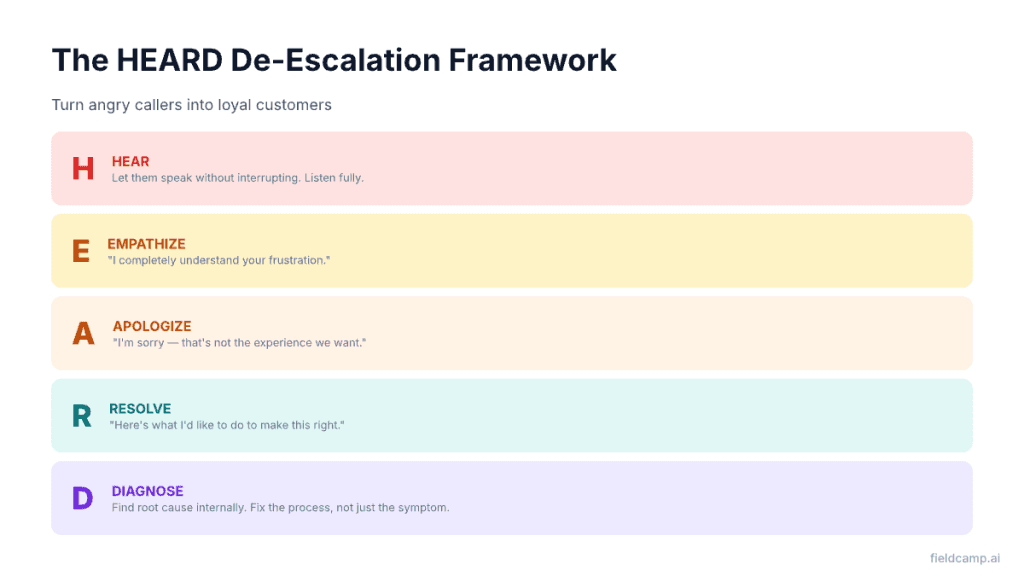
Use the HEARD technique: Hear, Empathize, Apologize, Resolve, Diagnose.
[Customer is upset/angry]
Step 1 – HEAR: Let them talk. Do not interrupt. Do not get defensive. Let them get the frustration out completely.
CSR: [Listen actively. Take notes. Wait for a natural pause.]
Step 2 – EMPATHIZE:
CSR: “I completely understand your frustration, [customer name]. If I were in your situation, I’d feel the same way.”
Step 3 – APOLOGIZE:
CSR: “I’m sorry this happened. That’s not the experience we want any of our customers to have.”
Step 4 – RESOLVE:
CSR: “Here’s what I’d like to do to make this right. [Offer a specific solution, send a senior tech back at no charge, issue a billing adjustment, prioritize a follow-up visit.] Does that work for you?”
Step 5 — DIAGNOSE (internal, after the call):
Find out what went wrong. Was it a technician issue, a communication gap, or a process failure? Fix the root cause so it doesn’t happen again.
Key phrases for de-escalation:
What NOT to say:
Use when: Your tech is 20–30 minutes from the customer’s location.
This is the most underrated customer touchpoint in HVAC. It sets the tone for the entire service visit.
Tech: “Hi [customer name], this is [tech name] from [Company Name]. I’m about [X] minutes from your home. Just wanted to let you know I’m on my way.”
[Brief pause for any questions]
Tech: “When I arrive, I’ll [explain what happens first, check the outdoor unit, take a look at the thermostat, inspect the system in the attic/basement]. Is there anything specific you want me to know before I get there, like a gate code, a dog in the yard, or where the equipment is located?”
[Customer responds]
Tech: “Perfect. I’ll see you shortly. And just so you know, I’ll walk you through everything I find and give you your options before we do anything. See you soon.”
Why this matters: The “on my way” call accomplishes four things — confirms the appointment (reduces no-shows by 25–30%), sets expectations for what happens during the visit, eliminates surprises (gate codes, pet situations, access issues), and builds trust before the tech walks in the door.
If your dispatch system sends automated ETA notifications, your tech can supplement, not replace, the automated message with a personal call. The personal touch makes a real difference.
Use when: You gave an estimate or proposal and haven’t heard back, or a customer missed their appointment.
For the estimate follow-up (24–48 hours after):
CSR: “Hi [customer name], this is [your name] from [Company Name]. I’m following up on the estimate [tech name] put together for you on [day]. I wanted to check in and see if you had any questions about the options we presented.”
[If they’re still deciding:]
CSR: “Totally understandable. It’s a big decision. Is there anything specific that’s holding you back? Sometimes I can clarify details or check on [financing options / current promotions/equipment availability] that might help.”
[If they went with another company:]
CSR: “I appreciate you letting me know. Can I ask, was it a pricing difference or something else? We’re always trying to improve, and your feedback genuinely helps.”
For the full proposal follow-up strategy, our HVAC proposal template guide includes a complete follow-up cadence.
For missed appointment:
CSR: “Hi [customer name], this is [your name] from [Company Name]. We had you on the schedule today for [service type], and it looks like we missed connecting. No worries at all, I just wanted to reach out and see if you’d like to reschedule. We have openings on [offer two dates].”
Keep it warm, zero guilt. Life happens. The goal is to rebook, not to make them feel bad.
Use when: A tech has just completed a successful job and the customer is happy.
Tech (at the end of the visit): “[Customer name], I’m glad we got everything taken care of today. If you felt good about the service, it would mean a lot to us if you left us a quick review on Google. It’s the number one way new customers find us.”
[Hand them a card with QR code linking to your Google review page, or text them the link]
Tech: “It only takes about 30 seconds, and you can do it whenever it’s convenient. We really appreciate it.”
Follow-up text (2–3 hours after service):
“Hi [customer name], thanks for choosing [Company Name] today. If you have a moment, we’d love a quick Google review — it helps us keep serving families in [city/neighborhood]. Here’s the link: [direct Google review URL]. Thank you!”
Why timing matters: Review requests at the moment of peak satisfaction, right after a successful repair, convert at 3–5x the rate of requests sent days later. The tech asking in person, followed by a text with the direct link, is the highest-converting combination.
Online reviews directly feed your lead generation pipeline. Every 5-star review makes your Google Business Profile, your advertising, and your social media more credible.
Use when: A technician identifies an additional issue or opportunity during a service call.
This is NOT about pressuring customers into unnecessary work. It’s about professional communication when you find something real.
Tech: “[Customer name], I finished up the [original repair/service]. Your [AC/furnace] is running well now. But I did notice something I want to show you.”
[Walk the customer to the issue — show, don’t just tell]
Tech: “See this here? [Describe the issue — corroded connections, a cracked drain pan, an aging capacitor, a dirty coil]. It’s not an emergency right now, but it’s the kind of thing that could cause a problem down the road — especially heading into [summer/winter].”
[Present the option — never pressure:]
Tech: “I can take care of it today while I’m here for [$X], which saves you a separate service call. Or if you’d rather wait, I’ll note it in your file so we can keep an eye on it at your next visit. Totally your call.”
Key principles:
Technicians who follow a structured upsell conversation convert at roughly 30%, adding an average of $180–$350 per service call. Over a month, that’s significant revenue from work the customer genuinely needed.
Your Team Can Only Follow Scripts If They Know Where They’re Going
FieldCamp’s smart dispatch and scheduling system ensures every call is matched with the right technician, at the right time, with the right customer history, so your team walks into every job prepared.
Your voicemail greeting is the last line of defense before a lead hangs up and calls your competitor. Make it count.
Standard Business Hours (when lines are unexpectedly busy):
“You’ve reached [Company Name], [city]’s trusted HVAC team. We’re helping other customers right now, but your call is important. Please leave your name, number, and a brief description of what you need — we’ll call you back within 30 minutes. For emergencies, press 1 to reach our on-call technician. Thanks for calling.”
After Hours:
“Thanks for calling [Company Name]. Our office is currently closed — our regular hours are [hours]. If this is a heating or cooling emergency, press 1 and our on-call team will be in touch within 15 minutes. For all other calls, leave your name, number, and a brief message, and we’ll get back to you first thing in the morning. Thank you.”
Seasonal — Summer:
“You’ve reached [Company Name]. AC troubles? You’re in the right place. We’re experiencing high call volume this season, but we’re working to get to everyone as quickly as possible. Leave your name, number, and a brief message — or press 1 for emergency cooling service. We’ll call you back within [timeframe].”
Seasonal — Winter:
“Thanks for calling [Company Name]. If your heat is out, press 1 for emergency service. Our on-call technician will reach you within 15 minutes. For all other calls, leave a message, and we’ll return your call during business hours. Stay warm.”
Critical detail: 85% of callers who reach voicemail never call back (Source: BrightLocal/InsideSales.com). Your voicemail needs to: (1) promise a specific callback time, (2) provide an emergency option, and (3) be under 30 seconds. Anything longer and they hang up.
The same call type needs a different language depending on the season. Your CSR’s opening acknowledgment should mirror what the customer is experiencing.
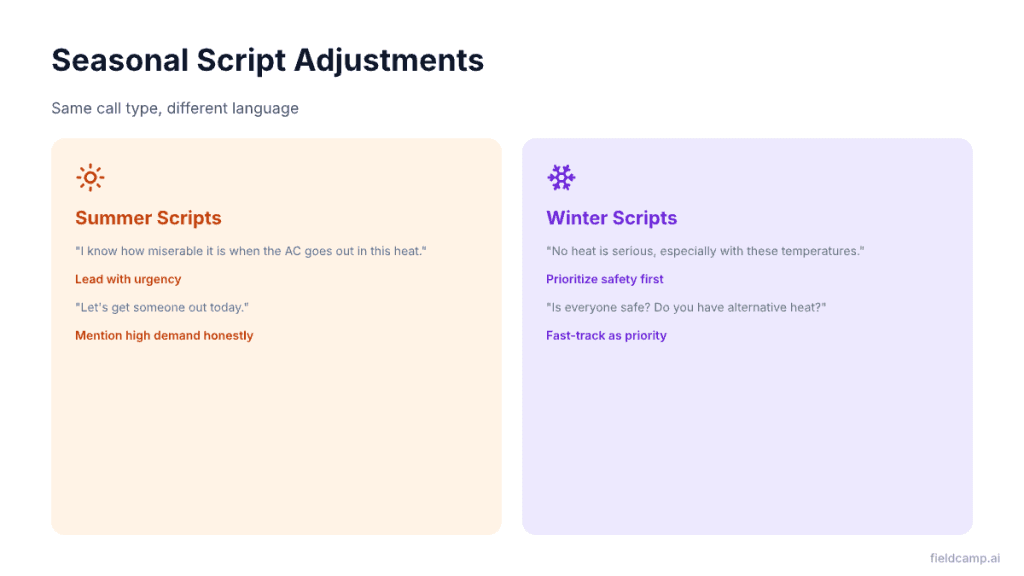
Summer (May–September): Acknowledge the discomfort (“I know how miserable it is when the AC goes out in this heat”), create urgency (“Let’s get someone out today to take a look”), and mention demand honestly (“We’re running at full capacity this week, but I can get you on the schedule for [earliest available]”).
Winter (November–March): Acknowledge the safety concern (“No heat is serious, especially with these temperatures. Let’s get this handled right away”), prioritize safety (“Is everyone in the home safe? Do you have an alternative heat source for tonight?”), and fast-track (“I’m marking this as priority and dispatching a technician”).
Shoulder Seasons (April, October): Use preventive framing (“This is the perfect time to get your system tuned up before [summer/winter] hits”) and lean into availability (“Our schedule is more flexible right now, so I can get you a convenient time slot”).
Matching your language to the season shows the customer you understand their situation, not just your service menu.
Scripts on paper are worthless if your team can’t deliver them naturally. Here are the training practices that make the difference.
Weekly role-play sessions (15–20 minutes): Pair up team members. One plays the customer, one plays the CSR. Rotate through scenarios: price shopper, angry caller, emergency dispatch, upsell objection. Record the role-plays (with consent) and review them as a team. This is how professional call centers train, and it works for two-person HVAC offices too.
The HEARD technique (for every difficult call): Hear, let them speak without interrupting. Empathize, acknowledge their feeling. Apologize, take responsibility even if it’s not “your fault.” Resolve, offer a specific next step. Diagnose and figure out the root cause after the call. Train every person who answers the phone on HEARD. It defuses 90% of escalation situations.
Call recording reviews (monthly): Listen to 5–10 recorded calls per month as a team. Celebrate what went well. Identify patterns in lost bookings. Adjust scripts based on real customer language, not what you think customers say, but what they actually say.
Three non-negotiable rules: Answer within three rings, every ring past three drops your booking rate. Use the customer’s name at least twice; it creates a personal connection and signals you’re paying attention. Always offer two specific time slots. “When works for you?” invites procrastination; “We have Tuesday morning or Wednesday afternoon, which works better?” invites a decision.
If you’re building your team and want to hire CSRs who’ll thrive with this system, our guide on becoming an HVAC technician covers the broader hiring landscape, and our HVAC interview questions help you screen for communication skills specifically.
Your phone is the front door of your HVAC business. Every call is a customer standing at that door deciding whether to walk in or walk away.
The 10 scripts in this guide cover the situations that make or break that decision, from the straightforward booking call to the uncomfortable price shopper to the angry customer who needs you to make things right. None of them is complicated. All of them work better than winging it.
Start with three: the inbound booking script, the price shopper script, and the tech “on my way” call. Print them. Practice them. Track your booking rate for 30 days and compare it to last month. The numbers will tell the story.
And before any script can work, someone has to answer the phone. If you’re losing calls to voicemail during peak hours or after business hours, an AI receptionist captures every lead automatically and routes it into your scheduling system.
The HVAC companies booking 85% of their calls aren’t doing anything magical. They’re just prepared. Now you are too.
Ready to connect your phone system to a platform that books, schedules, dispatches, and tracks every customer interaction? FieldCamp handles the workflow, so your team can focus on what they do best, talking to customers and fixing systems.
Every script should include a professional greeting with your company name, empathy for the customer’s situation, qualifying questions to understand the issue, a clear path to booking (offering two specific time slots), and reassurance about pricing transparency. The best scripts also include handling for common objections like price concerns.
Only if they read them word-for-word like a telemarketer. Effective scripts are frameworks — they give your team structure and key phrases while leaving room for natural conversation. After two weeks of practice, most CSRs internalize the structure and it becomes second nature.
Never refuse to discuss price — but reframe the conversation. Acknowledge their question, ask two to three qualifying questions about their system, then explain that an accurate price requires an on-site diagnosis. Offer a broad range if they push, and emphasize that your diagnostic fee covers a full assessment with no surprise charges.
HEARD stands for Hear, Empathize, Apologize, Resolve, Diagnose. It’s a de-escalation framework for handling upset customers. Let them speak fully, acknowledge their frustration, apologize sincerely, offer a specific resolution, and then investigate the root cause internally after the call.
Start with three changes: answer every call within three rings, use scripts that offer two specific appointment slots instead of open-ended scheduling, and follow up on every missed call within five minutes. These three actions alone can lift booking rates from 46% to 65–70%. Adding formal script training pushes it above 80%.
Yes. The “on my way” call, the “I found an additional issue” conversation, and the post-service review request are all technician-facing scripts that improve customer satisfaction, reduce no-shows, and generate more reviews. Technicians don’t need full scripts — bullet-point frameworks covering key phrases are enough.
Review scripts quarterly. Update them when you add new services, change pricing, introduce new technology (like online booking), or notice recurring call patterns that current scripts don’t address. Seasonal adjustments (summer vs. winter language) should happen in April and October.
Track three metrics monthly: booking rate (calls that become appointments), average handle time (shorter isn’t always better — but very long calls suggest confusion), and customer satisfaction scores from post-service surveys. Compare these metrics before and after script implementation to measure impact.