
HVAC SEO: The Complete Guide to Ranking Your HVAC Business on Google in 2026
March 13, 2026 - 28 min read


March 13, 2026 - 28 min read

Table of Contents
| TL;DR: Most HVAC contractors are invisible on Google, and it’s costing them thousands in leads every month. This guide covers the complete HVAC SEO playbook: optimizing your Google Business Profile, building service and location pages, earning local backlinks, and creating content that captures searches year-round. SEO costs a fraction of paid ads, compounds over time, and most HVAC markets are still wide open. The contractors investing now are the ones who’ll own their local search results for years. |
46% of all Google searches have local intent. For HVAC contractors, that means nearly half of every search – “AC repair near me,” “furnace installation [city],” “emergency HVAC service” is a potential customer looking for exactly what you offer, right now, in your service area.
The problem? Most HVAC businesses either don’t show up in those searches at all, or they’re buried on page two, where nobody looks. Meanwhile, the contractor who invested in HVAC SEO is collecting those calls, not because they’re better at HVAC work, but because Google found them first.
This guide covers everything you need to know about SEO for HVAC companies in 2026: from local SEO fundamentals and on-page optimization to technical fixes, content strategy, and AI-powered tools that are changing how contractors get found online.
Whether you’re doing SEO yourself or evaluating an HVAC SEO agency, this is the playbook.
Find out the podcast above that covers this blog so that you can listen while moving.
KEY HIGHLIGHTS
HVAC SEO Strategy
HVAC SEO (search engine optimization) is the process of improving your heating and cooling company’s visibility in Google search results, so when homeowners in your area search for HVAC services, your business appears at the top.
It covers three core areas:
The HVAC industry is projected to reach $367.5 billion globally by 2030, which means competition for local customers is intensifying every year. Here’s why SEO should be your top marketing priority:
If your HVAC company isn’t investing in SEO, you’re paying more for every lead while your competitors get them for free.
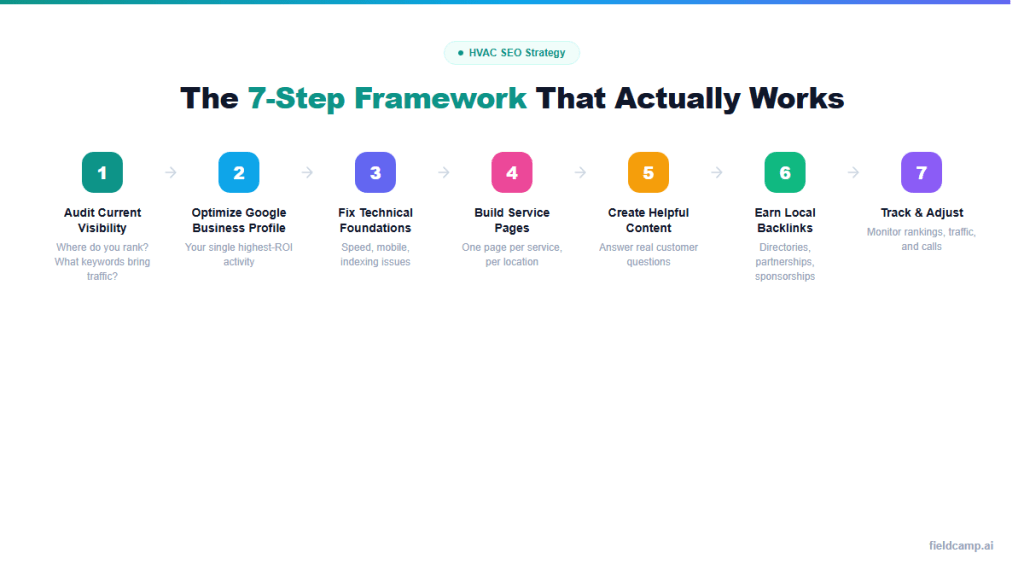
Before diving into tactics, here’s the high-level HVAC SEO strategy that actually works:
Local SEO is where HVAC contractors win or lose. When someone searches “AC repair near me” or “HVAC contractor [city],” Google serves three types of results:
The Map Pack gets 42% of clicks and costs you nothing per click. That’s where you want to be.
Your Google Business Profile (GBP) is the single most important ranking factor for local HVAC searches.
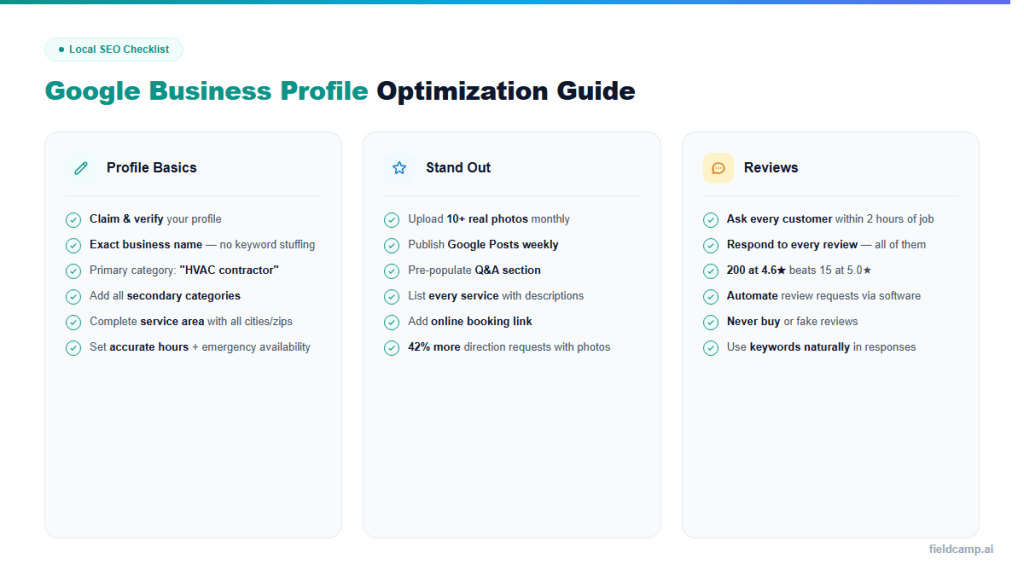
The basics (do these first):
What separates top-ranking profiles:
Reviews are the second most important local ranking factor. Here’s the system:
Pro tip: include relevant keywords naturally in your review responses. “We’re glad the furnace installation went smoothly,” signals relevance to Google without being spammy.
NAP stands for Name, Address, Phone number. Google cross-references your business information across hundreds of directories to verify legitimacy. Inconsistencies – different phone numbers, old addresses, variations in your business name – hurt rankings.
Priority citation sources for HVAC contractors:
How to fix citation issues:
Local backlinks tell Google your HVAC business is trusted within your community. Here are proven strategies:
On-page SEO means optimizing the content and HTML of your website pages so Google understands what you offer and ranks you for relevant searches.
Before optimizing anything, you need to know what your customers actually search for. Here are the highest-value HVAC keyword categories:
Emergency/urgent services (highest conversion intent):
Service-specific keywords:
Informational keywords (top-of-funnel):
Brand and comparison keywords:
How to find HVAC keywords:
Every service you offer should have its own dedicated page.
Title tag formula: [Service] in [City] | [Business Name]
Example: “AC Repair in Phoenix | ABC Heating and Cooling”
Meta description formula: [Benefit] + [Service] + [City] + [CTA]
Example: “Same-day AC repair in Phoenix. Licensed HVAC technicians, upfront pricing, 24/7 emergency service. Call (555) 123-4567.”
Page content checklist:
If you serve multiple cities, create individual pages for each location. Don’t just swap the city name — make each page genuinely unique:
Example: your “AC Repair in Scottsdale” page should mention Scottsdale’s extreme summer heat (115F+), common AC issues in desert climates (refrigerant leaks from heat stress, compressor failures), and any city-specific permit requirements.
Technical SEO ensures Google can crawl, index, and render your website properly. Most HVAC websites have fixable technical issues holding them back.
Google has confirmed that site speed is a ranking factor. For HVAC businesses, slow sites also kill conversions, and the data backs this up:
Quick wins:
Test your speed at PageSpeed Insights and aim for a score above 80 on mobile.
60%+ of HVAC searches happen on mobile devices. Your site must be:
Schema markup is code that helps Google understand your business information. For HVAC companies, add:
You don’t need to code this manually. Use Google’s Structured Data Markup Helper or a WordPress plugin like Rank Math or Yoast.
Google’s Core Web Vitals measure real user experience:
| Metric | What It Measures | Good Score |
| LCP (Largest Contentful Paint) | How fast does the main content loads | Under 2.5 seconds |
| INP (Interaction to Next Paint) | How responsive the page is to clicks | Under 200ms |
| CLS (Cumulative Layout Shift) | How much the page layout shifts during loading | Under 0.1 |
Check yours in Google Search Console under “Core Web Vitals” or at PageSpeed Insights.
Content marketing is how HVAC businesses capture informational searches and build authority over time. The goal: be the most helpful HVAC resource in your market.
Focus on the questions your customers actually ask. Here’s a seasonal content calendar.
Spring (March-May):
Summer (June-August):
Fall (September-November):
Winter (December-February):
Evergreen content (publish anytime):
Most HVAC blogs write generic tips. Stand out by creating:
Backlinks remain one of Google’s top 3 ranking factors. Here are the most effective strategies beyond local citations.
Google’s AI detection for unnatural links is better than ever. One penalty can undo months of work.
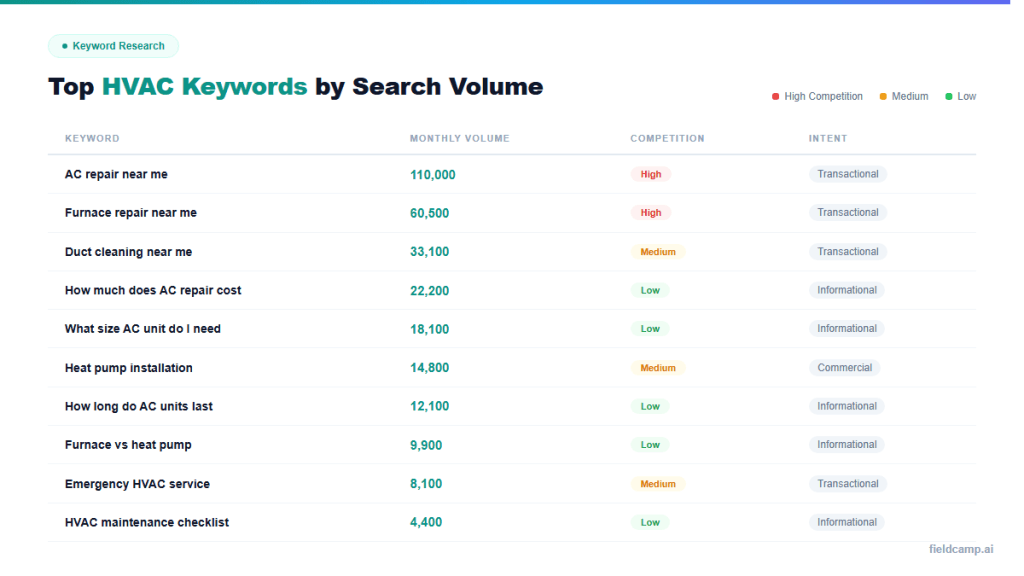
Here are the highest-value keyword categories for HVAC contractors, organized by search intent.
| Keyword Pattern | Monthly Searches (US) | Competition |
| AC repair near me | 110,000 | High |
| HVAC contractor [city] | 1,000-10,000 per city | Medium |
| Furnace repair near me | 60,500 | High |
| AC installation [city] | 500-5,000 per city | Medium |
| Emergency HVAC service | 8,100 | Medium |
| Duct cleaning near me | 33,100 | Medium |
| Heat pump installation | 14,800 | Medium |
| Keyword Pattern | Monthly Searches (US) | Competition |
| How much does AC repair cost | 22,200 | Low |
| When to replace furnace | 6,600 | Low |
| What size AC unit do I need | 18,100 | Low |
| HVAC maintenance checklist | 4,400 | Low |
| Furnace vs heat pump | 9,900 | Low |
| How long do AC units last | 12,100 | Low |
| Keyword Pattern | Search Behavior |
| “[service] near me” | Mobile, high urgency |
| “[service] in [city]” | Desktop and mobile, moderate urgency |
| “best HVAC company [city]” | Research phase, comparing options |
| “[brand] dealer [city]” | Brand-aware, ready to buy |
| “24 hour HVAC [city]” | Emergency, highest conversion |
Keyword mapping rule: assign one primary keyword per page. Don’t try to rank your homepage for everything. Your homepage targets your brand and city. Each service page targets one specific service and location.
AI is fundamentally changing how search works and how HVAC contractors can leverage it.
Google’s AI Overviews now appear in 30%+ of search results. For HVAC queries, they typically pull from:
How to optimize for AI Overviews:
Smart HVAC businesses are using AI to scale their SEO efforts:
The key principle: use AI to handle the repetitive work so you can focus on adding genuine HVAC expertise that no AI can replicate.
With smart speakers and voice assistants in 35%+ of US homes, voice search is growing for HVAC. Voice queries are conversational and tend to be longer (6-10 words vs 2-3 for typed searches), and they strongly favor local results.
Optimize for voice by:
SEO without measurement is a guessing game. Here’s what to track and how.
| Metric | Tool | Why It Matters |
| Organic traffic | Google Analytics | Total visitors from search |
| Keyword rankings | Ahrefs, SEMrush, or BrightLocal | Are you moving up for target keywords? |
| Map Pack visibility | BrightLocal or LocalFalcon | How often do you appear in the top 3 local results |
| Phone calls from organic | Google Analytics + call tracking | The metric that pays the bills |
| Form submissions | Google Analytics goals | Online bookings and estimate requests |
| Google Business Profile actions | GBP Insights | Calls, direction requests, and website clicks from your profile |
| Conversion rate | Google Analytics | What % of visitors become leads |
| Cost per lead | Manual calculation | Total SEO investment / total organic leads |
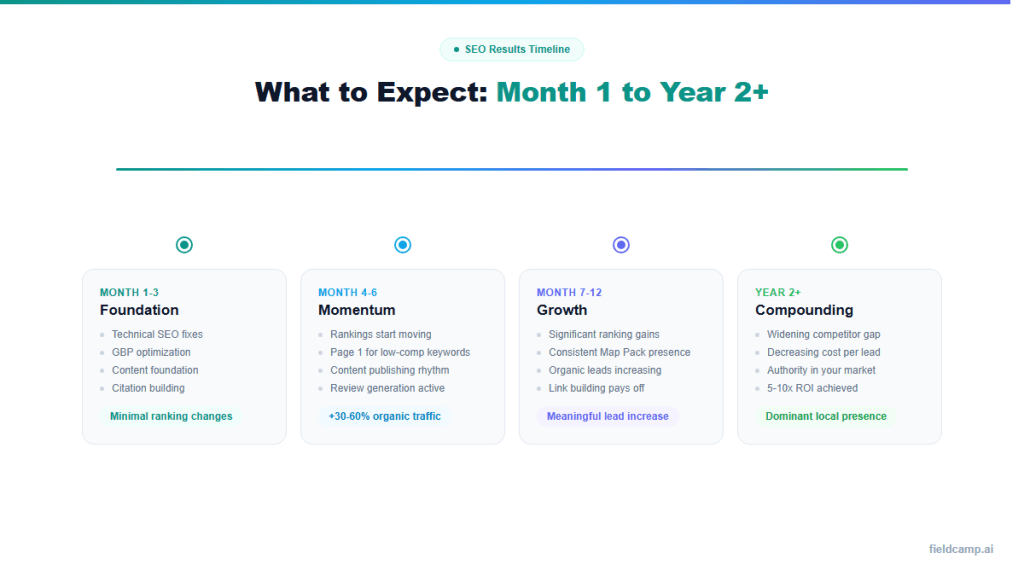
Month 1-3: Technical fixes, GBP optimization, content foundation. Expect minimal ranking changes.
Month 4-6: Rankings start moving. You may enter page 1 for lower-competition keywords. Organic traffic increases 30-60%.
Month 7-12: Significant ranking improvements. Map Pack appearances become consistent. Organic leads increase meaningfully.
Year 2+: Compounding returns. The gap between you and your competitors widens. Cost per lead decreases as volume increases.
Realistic ROI example:
Most HVAC companies see 5-10x ROI from SEO within 12 months.
| Item | Monthly Cost |
| Google Business Profile | Free |
| Google Search Console | Free |
| Google Analytics | Free |
| SEO tool (Ahrefs Lite or SEMrush) | $99-129/month |
| Content writing (if outsourced) | $200-500/month |
| Citation management tool | $30-50/month |
| Total DIY | $329-679/month + your time (5-10 hours/week) |
| Service Level | Monthly Cost | What You Get |
| Basic local SEO | $500-1,000 | GBP optimization, citations, basic reporting |
| Mid-tier | $1,000-2,500 | Full local SEO + on-page + content creation |
| Comprehensive | $2,500-5,000 | Everything above + link building + technical SEO |
| Enterprise | $5,000-10,000+ | Multi-location, aggressive content, dedicated strategist |
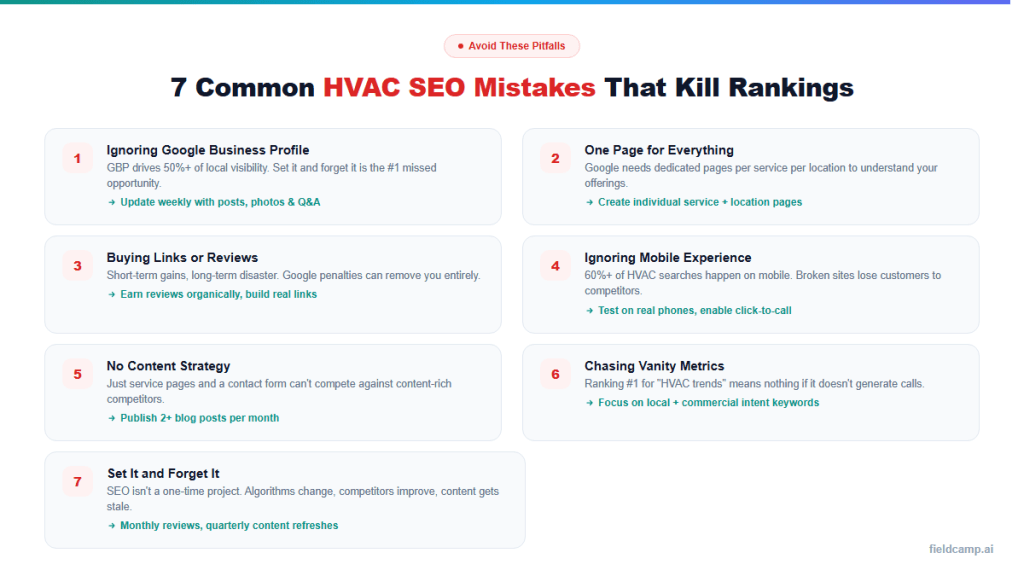
Mistake #1: Ignoring Google Business Profile
GBP is responsible for 50%+ of local visibility. Many HVAC businesses set it up once and never touch it again. Treat it like a social media profile – update it weekly.
Mistake #2: One Page for Everything
“We do AC repair, furnace installation, duct cleaning, and heat pump service” all on one page doesn’t work. Google needs dedicated pages per service per location to understand what you offer and where.
Mistake #3: Buying Links or Reviews
Short-term gains, long-term disaster. Google penalties can remove your business from search results entirely – and recovery takes 6-12 months.
Mistake #4: Ignoring Mobile Experience
Your potential customer’s AC just broke. They’re sweating, frustrated, and searching on their phone. If your site is slow, hard to navigate, or the phone number isn’t clickable, they’re calling your competitor.
Mistake #5: No Content Strategy
A website with just service pages and a contact form won’t compete against businesses publishing helpful content regularly. You don’t need to blog daily – one quality post per week is enough.
Mistake #6: Choosing Vanity Metrics Over Leads
Ranking #1 for “HVAC industry trends” means nothing if it doesn’t generate calls. Focus on keywords with local intent and commercial value. Rankings are a means to an end – the end is booked jobs.
Mistake #7: Setting and Forgetting
SEO isn’t a one-time project. Google’s algorithm changes constantly, competitors are improving, and your content needs refreshing. Budget for ongoing optimization, not a one-time fix.
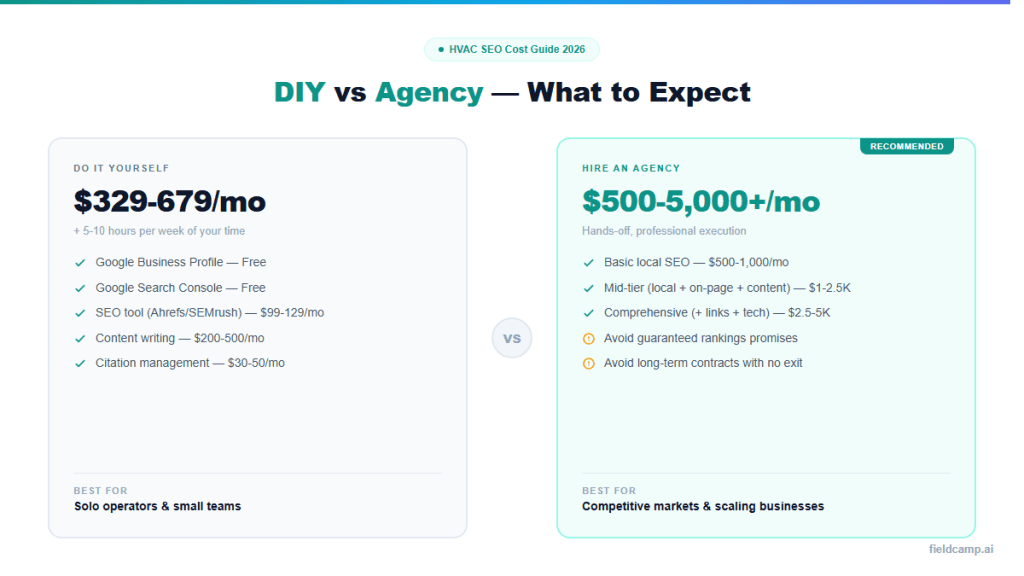
DIY makes sense if you’re a solo operator or small team with limited budget, you’re willing to invest 5-10 hours per week learning and executing, you have basic computer skills and can learn tools like Google Search Console, or your market isn’t extremely competitive (smaller cities, less saturated areas).
Best DIY approach:
Agency makes sense if you’re in a competitive market (major metro areas), you don’t have time to learn and execute SEO consistently, your budget supports $1,500+/month investment, you’re ready to scale and need multi-location optimization, or you need faster results and professional link building.
How to evaluate an HVAC SEO agency:
Free HVAC SEO Checklist for 2026
39 action items across GBP, technical SEO, on-page, content, and link building, organized so you can work through them one by one.
HVAC SEO isn’t optional anymore – it’s the difference between a business that has to chase customers and one that has customers chasing them. The contractors who invest in local SEO, create genuinely helpful content, and maintain their online presence are the ones booking jobs while competitors wonder where their leads went.
The good news: most of your competitors aren’t doing this well.
According to our keyword data, the top HVAC SEO keywords have difficulty scores of just 1-4 out of 100. The opportunity is wide open.
Start with the highest-impact activities: optimize your Google Business Profile, get reviews flowing, and build service pages that actually help people.
From there, layer in content marketing, link building, and technical improvements.
And if you want to streamline the operational side – scheduling, dispatching, invoicing, and automated customer follow-ups so you have more time to focus on growing your online presence – FieldCamp handles all of that.
HVAC SEO is the practice of optimizing your heating, ventilation, and air conditioning company’s online presence to rank higher in Google search results. It includes local SEO (Google Business Profile and Maps), on-page optimization (website content and structure), and technical SEO (site speed, mobile experience, schema markup). The goal is to appear when local homeowners search for HVAC services in your area.
Most HVAC businesses see meaningful results in 4-6 months, with significant improvement by month 8-12. Quick wins like Google Business Profile optimization can show results in weeks. Competitive keywords in major metro areas may take 12+ months. SEO compounds over time; the longer you invest, the wider the gap between you and your competitors.
DIY HVAC SEO costs $300-700/month for tools and outsourced content, plus 5-10 hours of your time weekly. HVAC SEO agencies charge $500-5,000+/month depending on scope. Mid-tier agencies ($1,500-2,500/month) typically provide the best ROI for single-location HVAC businesses.
Yes. Many HVAC business owners successfully handle their own SEO, especially in less competitive markets. Start with Google Business Profile optimization, create service and location pages, publish helpful blog content weekly, and systematically collect reviews. Tools like Google Search Console (free) and Ahrefs or SEMrush ($99-129/month) make DIY SEO manageable.
The highest-value HVAC keywords combine service type with location: “AC repair in [city],” “furnace installation [city],” “HVAC contractor near me.” Emergency keywords like “emergency AC repair” convert the highest. Informational keywords like “how much does AC repair cost” build authority and capture early-stage buyers.
Yes. Local SEO specifically targets map pack results, “near me” searches, and location-based queries – which is where 80%+ of HVAC leads come from. It focuses heavily on Google Business Profile optimization, reviews, local citations, and location-specific content. Regular SEO focuses more on website content and backlinks for organic rankings. HVAC businesses need both, but local SEO should be the priority.
The most effective approach: send an automated text message with your Google review link within 1-2 hours of completing a job, while the positive experience is fresh. Use your field service software to automate this as part of your job completion workflow. Also, train technicians to mention reviews in person: “If you were happy with the service, a Google review really helps our small business.”
The best HVAC SEO company depends on your budget, market, and goals. Look for agencies with verifiable HVAC client results, transparent reporting, month-to-month contracts, and a clear understanding of local SEO. Avoid agencies that guarantee specific rankings, won’t show their work, or lock you into long contracts. Ask for at least 3 HVAC client references before signing.
Social media doesn’t directly impact Google rankings, but it supports SEO indirectly. An active social presence builds brand awareness, drives traffic to your website, and can earn natural backlinks when content is shared. For HVAC companies, Facebook and YouTube tend to deliver the most value. Post before/after photos, maintenance tips, and behind-the-scenes content.
Very important. Google has confirmed page speed is a ranking factor, and for HVAC businesses specifically, most searches happen during emergencies on mobile devices. A 1-second delay in load time reduces conversions by 7%. Aim for under 3 seconds on mobile. Compress images, use a CDN, and choose fast hosting to improve speed.