
Plumber Salary Guide: How Much Do Plumbers Make in 2026?
April 11, 2026 - 11 min read


April 11, 2026 - 11 min read

Table of Contents
| TL; DR: The average plumber salary in 2026 is approximately $63,000 per year, or $30 per hour. Apprentice plumbers earn $42,000-$46,000, journeyman plumbers earn around $69,000, and master plumbers earn $80,000-$100,000+. Plumbing business owners can earn $100,000-$250,000+ depending on team size and efficiency. |
KEY HIGHLIGHTS
The national average plumber salary in 2026 is $62,970 per year, according to data compiled from the Bureau of Labor Statistics, Indeed, and Glassdoor. Here is how the numbers break down:
| Measure | Amount |
| Average annual salary | $62,970 |
| Average hourly rate | $30.27 |
| Entry-level annual | $40,670 |
| Top 10% annual | $105,150 |
| Median weekly | $1,211 |
These figures represent W-2 employee wages. Self-employed plumbers and business owners typically earn more but also carry overhead costs for insurance, vehicles, tools, and marketing.
Plumber earnings have risen steadily over the past five years, driven by a skilled labor shortage, aging infrastructure, and increased construction activity. The plumbing industry generates over $130 billion annually in the U.S. and demand continues to outpace the supply of licensed plumbers.
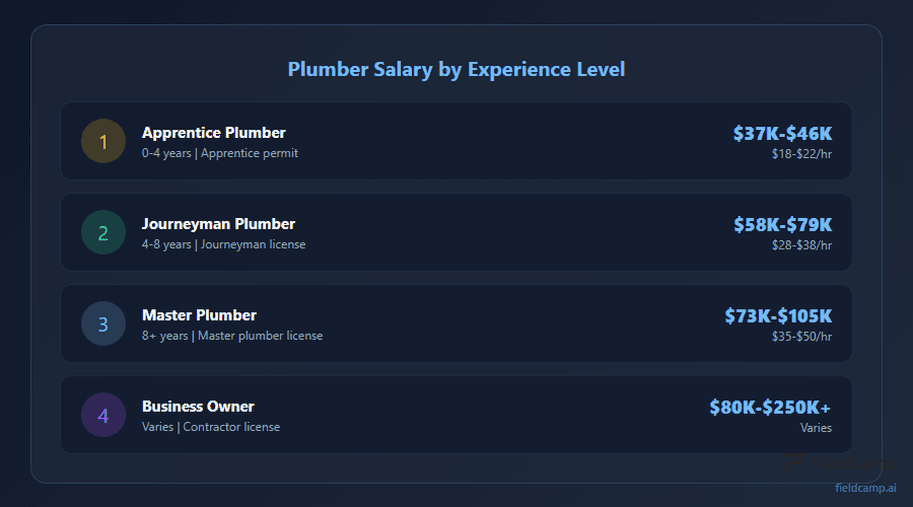
Your experience level and license type are the biggest factors in determining how much plumbers make. Here is the progression from apprentice to master:
| Level | Avg Hourly Rate | Avg Annual Salary | Years of Experience | License Required |
| Apprentice | $18-$22/hr | $37,000-$46,000 | 0-4 years | Apprentice permit |
| Journeyman | $28-$38/hr | $58,000-$79,000 | 4-8 years | Journeyman license |
| Master Plumber | $35-$50/hr | $73,000-$105,000 | 8+ years | Master plumber license |
| Plumbing Business Owner | Varies | $80,000-$250,000+ | Varies | Contractor license |
Apprentice plumbers start at the bottom of the pay scale but earn while they learn. Most apprenticeship programs last 4-5 years and combine on-the-job training with classroom instruction. Starting wages typically range from $15-$18 per hour, increasing each year as you gain experience.
By year 3-4 of an apprenticeship, most plumbers earn $20-$24 per hour. The apprenticeship investment pays off because you are earning a salary the entire time (unlike college graduates who accumulate debt).
After completing your apprenticeship and passing the journeyman exam, your earning potential jumps significantly. Journeyman plumbers earn an average of $69,273 per year ($34/hour). At this level, you can work independently on most residential and light commercial projects.
Journeyman plumbers with specialized skills (backflow testing, medical gas certification, tankless water heater expertise) command higher rates within this range.
Master plumbers sit at the top of the employee pay scale. The average master plumber salary is $80,053 per year ($38.49/hour), with the top earners making $92,500-$118,000+ annually. Reaching master plumber status typically requires 3-7 additional years beyond journeyman, plus passing a comprehensive licensing exam.
Master plumber certification also opens the door to starting your own business, which is where the real earning potential lies.
Plumber salary by state varies dramatically based on cost of living, union presence, construction activity, and licensing requirements. Here are the 10 states where plumbers earn the most:
| Rank | State | Average Annual Salary | Average Hourly Rate |
| 1 | Illinois | $86,200 | $41.44 |
| 2 | Alaska | $86,499 | $41.59 |
| 3 | Massachusetts | $82,500 | $39.66 |
| 4 | New York | $81,800 | $39.33 |
| 5 | Oregon | $80,200 | $38.56 |
| 6 | Minnesota | $79,800 | $38.37 |
| 7 | Washington | $79,500 | $38.22 |
| 8 | New Jersey | $78,900 | $37.93 |
| 9 | Hawaii | $78,500 | $37.74 |
| 10 | California | $77,800 | $37.40 |
Illinois leads the nation for plumber pay due to strong union presence in the Chicago metropolitan area, a large volume of commercial and industrial construction, and licensing requirements that reward experienced plumbers.
High-paying states often have higher costs of living. A plumber earning $86,000 in Illinois may have similar purchasing power to one earning $65,000 in a lower-cost state. Consider cost-of-living-adjusted salary when comparing opportunities across states.
| Rank | State | Average Annual Salary | Average Hourly Rate |
| 1 | West Virginia | $49,600 | $23.86 |
| 2 | Mississippi | $50,200 | $24.13 |
| 3 | Arkansas | $50,800 | $24.42 |
| 4 | Kentucky | $51,200 | $24.62 |
| 5 | South Carolina | $52,100 | $25.05 |
| 6 | Alabama | $52,500 | $25.24 |
| 7 | Louisiana | $53,200 | $25.58 |
| 8 | Oklahoma | $53,800 | $25.87 |
| 9 | Tennessee | $54,100 | $26.01 |
| 10 | Georgia | $54,500 | $26.20 |
Southern and rural states generally pay less due to lower cost of living, less union presence, and lower demand for commercial plumbing work. However, plumbing business owners in these states often enjoy lower operating costs, which can offset the salary gap.
Not all plumbing work pays the same. Specialized skills command premium rates:
| Specialty | Average Annual Salary | Why It Pays More |
| Plumbing Engineer | $85,000-$107,000 | Design work for commercial/industrial projects |
| Plumbing Designer | $75,500-$99,000 | Blueprint and system design for new construction |
| Pipefitter/Steamfitter | $72,000-$95,000 | Industrial pipe systems, high-pressure work |
| Medical Gas Installer | $75,000-$95,000 | Hospital and healthcare facility specialization |
| Backflow Prevention Specialist | $70,000-$90,000 | Certification required, consistent demand |
| Green Plumbing/Water Reclamation | $68,000-$88,000 | Growing demand for sustainable systems |
| Plumbing Inspector | $60,000-$85,000 | Government or private inspection work |
| Service Plumber (Residential) | $55,000-$80,000 | Most common, highest volume |
Adding even one specialty certification can increase your hourly rate by $5-$15. Backflow prevention certification, for example, takes 40 hours of training and opens up a consistent revenue stream that most plumbers cannot access.
Union membership significantly affects plumber compensation. Here is how they compare:
| Factor | Union | Non-Union |
| Average hourly rate | $35-$50/hr | $25-$38/hr |
| Benefits | Health insurance, pension, annuity | Varies widely |
| Overtime premium | 1.5x-2x standard rate | Often 1.5x |
| Training | Structured apprenticeship programs | Varies |
| Job security | Higher (collective bargaining) | Lower |
| Geographic flexibility | Lower (union halls local) | Higher |
Union plumbers typically earn 15-23% more than their non-union counterparts. Beyond hourly rates, union benefits packages (health insurance, pension, annuity contributions) add significant value. A union plumber earning $45/hour may have an effective compensation of $55-$65/hour when benefits are included.
However, union work is concentrated in major metropolitan areas and may involve periods between assignments. Non-union plumbers have more flexibility in choosing clients, hours, and service areas.
The biggest jump in plumber earnings comes from transitioning from employee to business owner. While an employed master plumber tops out around $80,000-$100,000, a plumbing business owner can earn significantly more by building a team and leveraging efficiency.
| Business Size | Revenue | Owner Salary | Key Requirement |
| Solo plumber | $100K-$200K | $60K-$120K | Efficient scheduling and pricing |
| Small team (2-5 techs) | $300K-$750K | $100K-$175K | Scheduling software, office help |
| Growing company (6-15 techs) | $750K-$2M | $150K-$250K | Full office staff, CRM, marketing |
| Established company (15+ techs) | $2M-$5M+ | $200K-$500K+ | Management team, multiple crews |
The critical shift happens when you stop trading your personal hours for dollars and start earning revenue from your team’s work. A plumber who works alone can only complete 4-6 jobs per day. A plumber who owns a 5-truck operation generates revenue from 20-30 jobs daily.
Technology makes this transition easier. AI-powered dispatch and scheduling handles job assignment so you do not spend your mornings on dispatch puzzles. Route optimization fits more jobs into each day. In-app invoicing speeds up payment collection. These tools let a small team operate like a much larger one.
The plumbing business owners who earn the most are not necessarily the best plumbers. They are the ones who build efficient systems for scheduling, dispatching, invoicing, and marketing. If you are considering starting a plumbing business, technology is the multiplier that separates $80K owners from $200K+ owners.
Earning six figures as a plumber is achievable through multiple paths. Here are the most common:
Tankless water heater installations, sewer line replacements, and commercial plumbing projects command premium rates. A plumber who specializes in sewer camera inspections and trenchless repair can charge $200-$500 per inspection plus repair fees.
After-hours and weekend emergency calls pay 1.5x-2x the standard rate. A plumber earning $35/hour standard makes $52-$70/hour on emergency calls. Four emergency calls per week at premium rates can add $20,000-$40,000 annually.
Union plumbers in top-paying states routinely earn $80,000-$100,000+ with benefits that add another 20-30% in effective compensation.
The highest-earning path. A well-run plumbing business with 3-5 technicians can generate $100,000-$200,000+ in owner compensation. Use field service management software to handle scheduling and dispatch efficiently so you can focus on growing instead of managing chaos.
Relocating from a $50K market to an $85K market is the fastest single raise most plumbers can give themselves. Factor in cost of living, but metropolitan areas with strong construction activity almost always offer better earning potential.
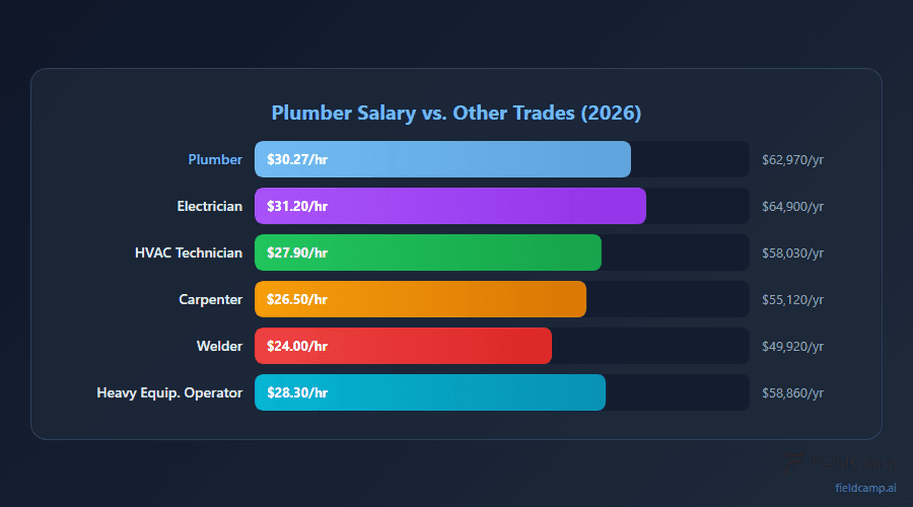
How does plumbing pay compare to other skilled trades? Here is a side-by-side comparison:
| Trade | Average Hourly Rate | Average Annual Salary | Job Growth (2024-2034) |
| Plumber | $30.27 | $62,970 | 4% |
| Electrician | $31.20 | $64,900 | 6% |
| HVAC Technician | $27.90 | $58,030 | 5% |
| Carpenter | $26.50 | $55,120 | 2% |
| Welder | $24.00 | $49,920 | 2% |
| Heavy Equipment Operator | $28.30 | $58,860 | 4% |
Plumbing ranks among the highest-paying trades with strong job security. The 4% growth rate combined with 44,000 annual openings (from retirements and industry expansion) means qualified plumbers will remain in high demand for the foreseeable future.
Plumbing also offers a clearer path to business ownership than many other trades. The recurring nature of plumbing emergencies (burst pipes, water heater failures, drain blockages) creates a steady stream of work that supports independent businesses.
The plumbing trade offers a clear path to strong earnings without a four-year degree. Starting at $40,000-$46,000 as an apprentice, progressing to $69,000 as a journeyman, and reaching $80,000-$100,000+ as a master plumber, the career trajectory is well-defined and achievable.
The biggest leap comes from business ownership. Plumbing business owners who build efficient teams and use technology to handle scheduling, dispatch, and invoicing consistently earn $150,000-$250,000+ annually. The plumbing industry is not slowing down: aging infrastructure, new construction, and a shrinking labor pool mean demand for skilled plumbers will remain strong for decades.
Whether you are considering a career in plumbing, negotiating a raise, or planning to start your own business, the data supports one conclusion: plumbing pays well, and the ceiling is as high as you are willing to build it.
The average plumber earns $30.27 per hour in the U.S. Entry-level plumbers start at $18-$22/hour, journeyman plumbers earn $28-$38/hour, and master plumbers earn $35-$50/hour. Emergency and after-hours work pays 1.5x-2x the standard hourly rate.
Plumbing engineers earn the most among employed plumbers, with salaries ranging from $85,000-$107,000 annually. Among field plumbers, medical gas installers ($75,000-$95,000) and pipefitters working on industrial projects ($72,000-$95,000) command the highest rates. Plumbing business owners can earn $150,000-$250,000+ by building efficient operations with multiple crews.
Yes. Plumbers can reach six figures through several paths: master plumber certification in a high-paying state, union membership with overtime, specialization in premium services (sewer repair, commercial plumbing), or starting their own business. The BLS reports that the top 10% of plumbers earn over $105,150 annually as employees alone.
Plumbing is one of the most stable and well-paying trades available. The BLS projects 44,000 annual job openings through 2034, the industry generates $130+ billion annually, and the skilled labor shortage means qualified plumbers are in high demand. Unlike many careers, plumbing cannot be outsourced or automated, providing long-term job security.
Becoming a licensed journeyman plumber typically takes 4-5 years through an apprenticeship program. Reaching master plumber status requires an additional 3-7 years of journeyman experience plus passing a comprehensive licensing exam. Total time from apprentice to master plumber: 7-12 years. However, you earn a salary throughout the entire process.
Electricians earn slightly more on average ($31.20/hour vs. $30.27/hour for plumbers). However, the gap narrows at higher experience levels, and plumbing business owners often out-earn electrical business owners due to the higher frequency of emergency calls and recurring maintenance work. Both trades offer excellent career prospects with strong demand.
Plumbing business owner income varies widely based on team size and efficiency. Solo plumbers typically earn $60,000-$120,000. Owners with 2-5 technicians earn $100,000-$175,000. Growing companies with 6-15 techs generate $150,000-$250,000+ for the owner. The key to higher earnings is building efficient operations with scheduling software and strong marketing rather than working more hours yourself. —