
Types of Cleaning Services: 15 Profitable Services to Offer in 2026
January 30, 2026 - 20 min read

January 30, 2026 - 20 min read

Table of Contents
| TL;DR: Not all cleaning services are created equal. Residential cleaning gets you started, but specialty services like post-construction (25-35% margins), Airbnb turnovers (20-30%), and pressure washing (25-35%) are where the real money is. The most successful cleaning businesses pick 2-3 services and dominate them rather than offering everything. Start with residential to build cash flow, add commercial contracts for recurring revenue, then specialize in premium margins. The cleaning industry is worth $442 billion globally; your slice depends on which services you choose. |
Here’s something nobody tells you when you start a cleaning business: the services you offer matter more than how hard you work.
I’ve seen cleaning business owners hustle 60-hour workweeks doing standard house cleans at $25/hour. Down the street, another owner does half the hours at twice the income, because they picked post-construction cleanup instead.
Same industry. Same city. Completely different results.
The difference isn’t talent or luck. It’s service selection.
The global cleaning business market reached $442 billion in 2025 and is projected to hit $617 billion by 2030. But that growth isn’t spread evenly. Some service types are stuck in price wars. Others have more demand than cleaners to fill it.
This guide breaks down 15 types of cleaning services, ranked by actual profitability, so you can build a business that pays you what you’re worth.
Before we dive deep, here’s the full picture at a glance.
| Service Type | Net Profit Margin | Startup Cost | Scalability | Best For |
| Post-Construction | 25-35% | $5K-15K | Medium | Experienced owners |
| Biohazard/Hoarding | 30-40% | $10K-25K | Low | Certified specialists |
| Pressure Washing | 25-35% | $3K-10K | High | Solo operators |
| Window Cleaning | 20-30% | $2K-8K | High | Route-based businesses |
| Airbnb/Vacation Rental | 20-30% | $1K-3K | High | Operators in tourist areas |
| Medical Facility | 20-28% | $8K-20K | Medium | Certified, compliance-focused |
| Carpet Cleaning | 20-28% | $5K-15K | Medium | Add-on service providers |
| Restaurant/Kitchen | 18-25% | $5K-12K | Medium | Commercial specialists |
| Move-In/Move-Out | 15-22% | $1K-3K | High | Real estate networkers |
| Deep Cleaning | 15-20% | $1K-3K | High | Residential upsellers |
| Foreclosure Cleaning | 15-22% | $2K-5K | Medium | Bank/REO contractors |
| Green/Eco Cleaning | 12-18% | $1.5K-4K | High | Premium residential |
| Office Cleaning | 12-18% | $2K-5K | High | Recurring revenue seekers |
| Janitorial Services | 10-15% | $3K-8K | Very High | Large team builders |
| Standard Residential | 10-15% | $500-2K | High | Beginners |
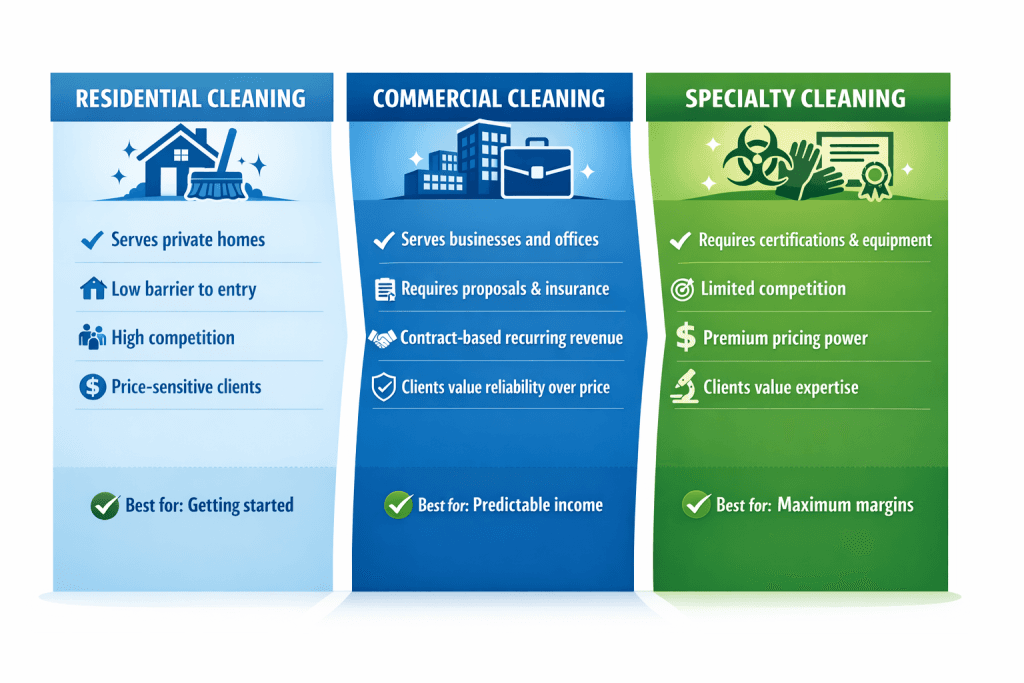
Every cleaning service falls into one of three buckets. Understanding these categories helps you see where the money actually flows.
What it covers: House cleaning, apartment cleaning, condo cleaning, anything in someone’s home.
Typical profit margins: 10-15% net
The honest reality: This is where 90% of cleaning businesses start. It’s also where most get stuck.
Residential cleaning has brutal competition. Homeowners compare prices constantly. They’ll switch cleaners for over $20 per visit. And when money gets tight, house cleaning is the first expense they cut.
But residential has one huge advantage: you can start tomorrow. Buy $500 in supplies, post on Nextdoor, and you’re in business. No certifications. No special equipment. No barrier.
Use residential cleaning as your launchpad, not your destination.
Residential cleaning includes:
What it covers: Offices, retail stores, warehouses, restaurants, medical facilities, and any business property.
Typical profit margins: 15-25% net
Why margins jump: Commercial clients sign contracts. Monthly recurring revenue. Predictable schedules. Larger spaces mean more revenue per stop.
A single office building can replace 15 residential clients. One contract instead of juggling 15 different schedules, personalities, and payment timelines.
The tradeoff: Getting commercial contracts takes longer. You need proposals, insurance certificates, and references. Sometimes you’re bidding against companies that have been around for decades.
But once you’re in, you’re in. Commercial clients don’t switch cleaners over small issues. The relationship stickiness is real.
Commercial cleaning includes:
What it covers: Services requiring specialized equipment, training, or certifications.
Typical profit margins: 20-35% net
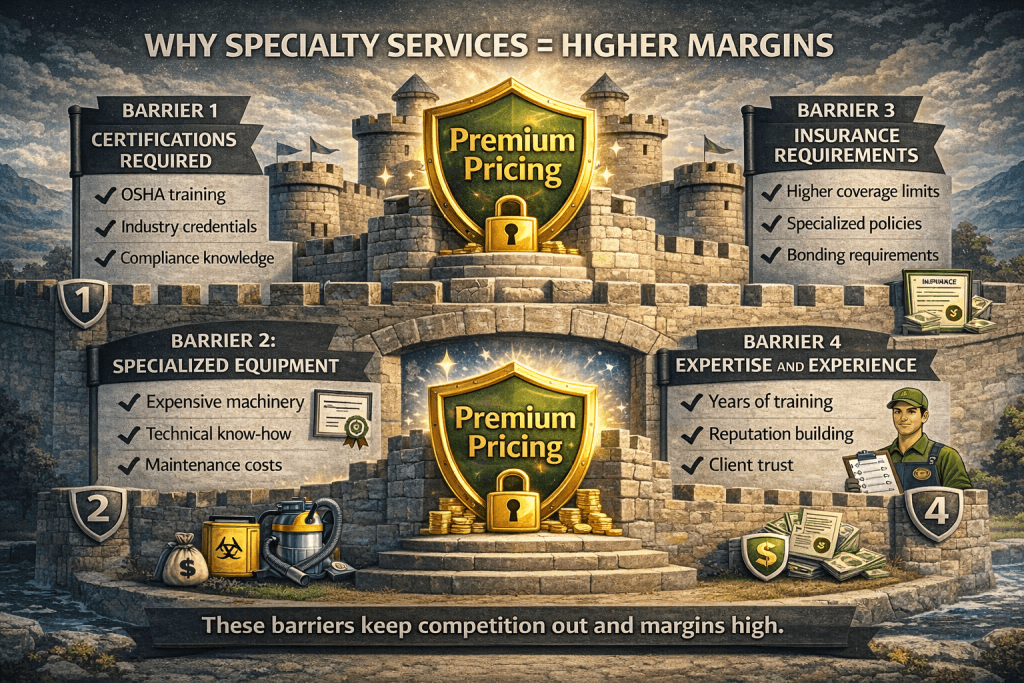
Why specialty cleaning wins: Barriers to entry protect your pricing. When you need OSHA certifications, $15,000 in equipment, or specific insurance, random competitors can’t undercut you.
Clients aren’t comparing you to the cheapest option; they’re comparing you to the few others who can actually do the work.
Specialty services also attract clients who value expertise over price. A property manager hiring post-construction cleanup cares about quality and speed. A hospital hiring medical cleaning staff cares about compliance. Price sensitivity drops dramatically.
Specialty cleaning includes:
Now let’s break down each service type. I’ve organized these into three tiers based on profit potential.
These services require more to get started, but pay significantly better.
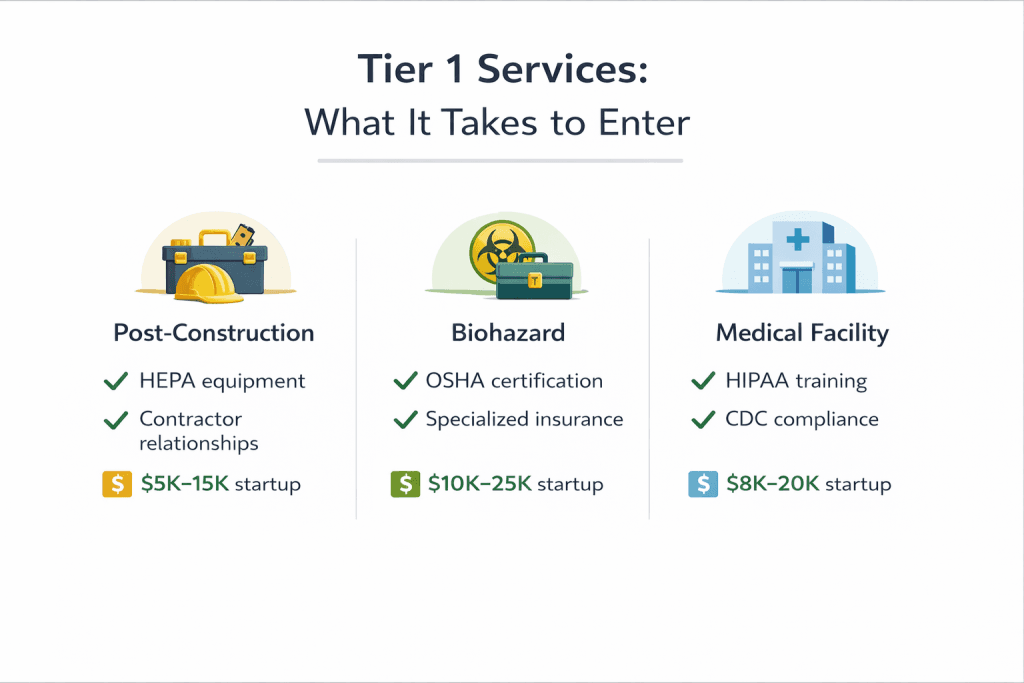
Profit margin: 25-35% Startup cost: $5,000-$15,000 Equipment needed: HEPA vacuums, industrial scrubbers, scaffolding, PPE, heavy-duty chemicals
Post-construction cleaning happens after builders finish but before owners move in. You’re removing construction dust from every surface, cleaning adhesive residue, polishing fixtures, and getting the space move-in ready.
Why it pays well:
General contractors work on tight deadlines. They need the space cleaned fast so they can hand over the keys and collect the final payment. When you deliver, you become their go-to cleaner for every project.
Most residential cleaners can’t do this work. They don’t have the right equipment or the experience to handle construction-level mess. That limited competition lets you charge $0.10-$0.50 per square foot. A 5,000 sq ft project pays $500-$2,500.
How to break in:
Start by connecting with 2-3 general contractors. Offer your first job at cost to prove you can deliver. Construction runs on relationships and referrals. Once you’re proven, work flows consistently.
Profit margin: 30-40% Startup cost: $10,000-$25,000 Equipment needed: Hazmat suits, respirators, biohazard containers, hospital-grade disinfectants, specialized disposal systems
This is the cleaning work most people won’t do. Crime scenes. Unattended deaths. Hoarding situations. Sewage backups. Mold infestations.
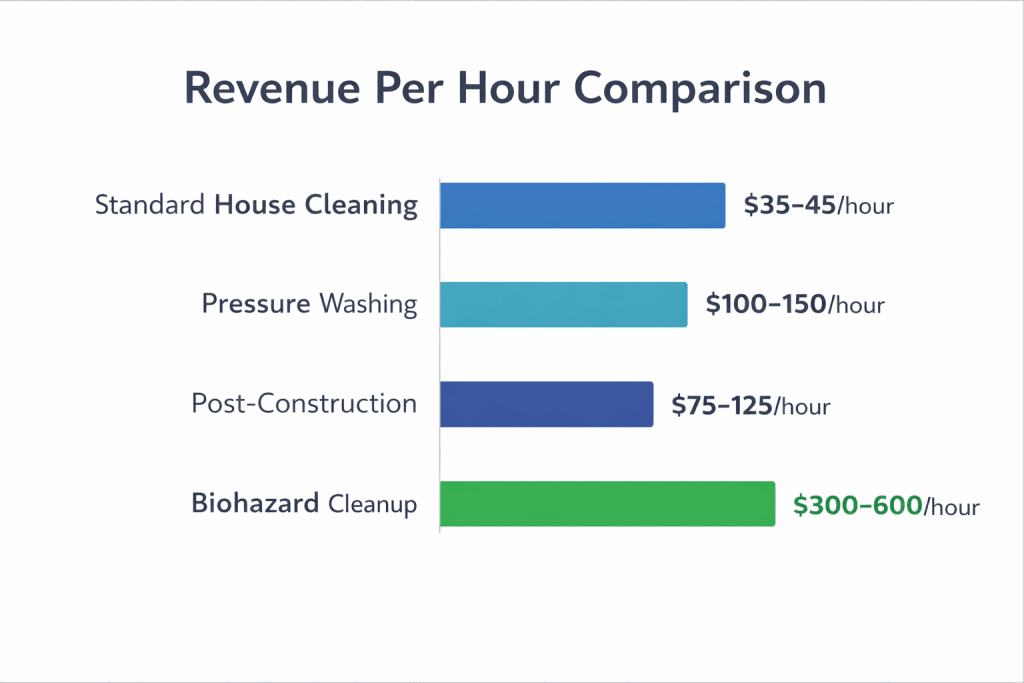
Why it pays $300-$600 per hour:
The barriers are enormous. You need OSHA bloodborne pathogen training. Proper disposal certifications. Specialized insurance. And honestly, the mental fortitude to handle difficult scenes.
Insurance companies often pay these bills, which means less price negotiation. Families dealing with tragedies aren’t shopping for the cheapest option; they want it handled professionally.
The reality check:
This isn’t a side hustle. Check your state’s cleaning business license requirements carefully; biohazard work has strict regulations. You’ll invest months in certifications before taking your first job.
But for the right person, it’s the most profitable niche in cleaning.
Profit margin: 25-35% Startup cost: $3,000-$10,000 Equipment needed: Commercial pressure washer (3,000+ PSI), surface cleaners, extension wands, chemical injectors, trailer or truck
Pressure washing cleans driveways, sidewalks, decks, siding, parking lots, and building exteriors. The market reached $3.2 billion in 2025 and continues growing at nearly 5% annually.
The math that makes it work:
Knowing how much to charge for pressure washing makes all the difference. Here’s what the market supports:
Compare that to a 4-hour house clean at $150. Pressure washing generates more revenue per hour with less physical strain.
Scaling potential:
Some pressure washing businesses clear $200,000+ in year one. It works as a standalone business or as a seasonal add-on to existing cleaning services. Spring and summer are peak seasons.
Profit margin: 20-30% Startup cost: $2,000-$8,000 Equipment needed: Squeegees, extension poles, water-fed poles, ladders, safety harnesses (for high-rise)
Don’t let the simplicity fool you. Window cleaning is quietly one of the most profitable cleaning niches.
Why it works:
The scaling path:
Start with residential clients to build skills and cash flow. Add commercial routes for predictable recurring revenue. Eventually, hire crews to handle residential while you focus on commercial accounts.
A cleaning schedule app becomes essential once you’re managing multiple routes and crews.
Profit margin: 20-30% Startup cost: $1,000-$3,000 Equipment needed: Standard cleaning supplies, laundry capacity (or laundromat partnership), reliable vehicle
There are over 1.7 million short-term rental properties in the US, according to AirDNA. Every single one needs turnover cleaning, often with just 3-4 hours between checkout and check-in.
The opportunity:
The secret advantage? Your competition is flaky. Hosts constantly complain about cleaners who cancel, show up late, or do subpar work. Reliability alone sets you apart.
Smart approach:
Contact property management companies, not individual hosts. One property manager relationship can hand you 10-50 properties. That’s instant scale without chasing individual clients.
The tight turnaround windows make multi-day scheduling critical. Missing a checkout time means an angry host and a bad review for their property.
Profit margin: 20-28% Startup cost: $8,000-$20,000 Equipment needed: Hospital-grade disinfectants, color-coded microfiber systems, ATP testing equipment, HEPA vacuums
Healthcare cleaning operates under strict regulations from the CDC, OSHA, and EPA. Those regulations are your competitive moat.
Why compliance creates profit:
Random cleaning companies can’t walk into a medical facility and compete. You need certifications, background checks for staff, HIPAA compliance training, and specialized equipment.
That barrier means:
Getting started:
Budget 3-6 months to get properly credentialed before pursuing healthcare contracts. The upfront investment pays off through stable, high-margin work.
These services balance good margins with reasonable startup requirements.
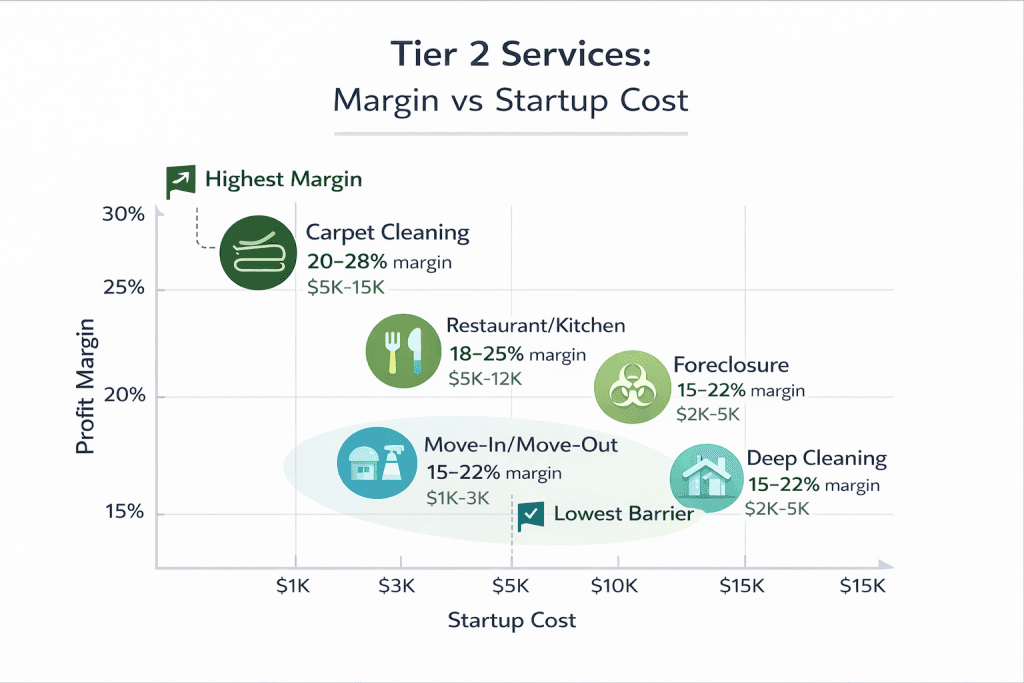
Profit margin: 20-28% Startup cost: $5,000-$15,000 Equipment needed: Truck-mounted or portable extractors, spot treatment chemicals, drying fans
Carpet cleaning commands premium pricing because homeowners can’t do it themselves. They don’t own extraction equipment.
Typical pricing:
Best use case:
Carpet cleaning works exceptionally well as an add-on for existing residential clients. “While we’re here, want us to do the carpets?” Instant upsell.
You can finance the equipment and pay it off within months if you’re adding carpet cleaning to an established client base.
Use a professional carpet cleaning invoice template to keep your billing organized as jobs stack up.
Profit margin: 18-25% Startup cost: $5,000-$12,000 Equipment needed: Commercial degreasers, steam cleaners, hood cleaning equipment, slip-resistant footwear
Health codes require commercial kitchens to meet specific cleanliness standards. Restaurants can handle daily cleaning internally, but deep cleaning often gets outsourced.
Two distinct revenue streams:
Why it’s recession-resistant:
Restaurants don’t choose whether to maintain health code compliance. They have to do it or risk getting shut down. That makes this work remarkably stable.
Profit margin: 15-22% Startup cost: $1,000-$3,000 Equipment needed: Standard supplies plus heavy-duty degreasers, oven cleaners, glass scrapers
Every rental property needs cleaning between tenants. Every home sale benefits from professional cleaning before showing or after closing.
Pricing range:
The range depends on the property condition and size.
The relationship play:
Partner with property managers and real estate agents. One solid relationship can deliver 10+ jobs per month on autopilot. Offer them a referral fee or priority scheduling when they call.
This is one of the fastest ways to get clients for your cleaning business without paid advertising.
Profit margin: 15-20% Startup cost: $1,000-$3,000 Equipment needed: Standard supplies plus steam cleaners, heavy-duty degreasers, extended-reach tools
Deep cleaning covers everything regular cleaning skips, inside appliances, behind furniture, baseboards, light fixtures, ceiling fans, and inside cabinets.
Pricing strategy:
Charge 2-3x your standard cleaning rate. If regular service is $150, deep cleaning is $350-$450. Clients expect the premium because they understand the scope.
Use a house cleaning cost calculator to quote accurately based on square footage and specific tasks.
When clients book deep cleaning:
Profit margin: 15-22% Startup cost: $2,000-$5,000 Equipment needed: Heavy-duty trash removal equipment, pressure washer, standard cleaning supplies
Banks need foreclosed properties cleaned before listing them for sale. The work ranges from basic cleaning to full “trash-out” services, removing everything the previous owners left behind.
Pricing:
Getting contracts:
Contact asset management companies and REO (Real Estate Owned) departments at banks. They maintain approved vendor lists. Getting on those lists means steady workflow.
Lower margins, but often easier to start and scale.
Profit margin: 10-15% Startup cost: $500-$2,000 Equipment needed: Vacuum, mop, bucket, microfiber cloths, all-purpose cleaners, bathroom and kitchen products
This is the starting point for most cleaning businesses. Low barriers, low startup costs, and you can land clients this week.
Typical pricing: $100-$200 per cleaning based on home size and frequency.
The honest trap:
Many owners get stuck here forever. They build a residential client list, max out their personal capacity, and plateau. Margins are thin. Competition is brutal. Clients are price-sensitive.
Residential cleaning should fund your growth into higher-margin services, not be your permanent business model.
Not sure what to charge? Our guide on how to charge for cleaning services breaks down pricing by service type.
Profit margin: 12-18% Startup cost: $2,000-$5,000 Equipment needed: Commercial vacuum, mop system, trash can liners, restroom supplies, basic floor care equipment
Small to mid-size offices under 10,000 square feet are the sweet spot. They’re large enough to be worth your time but small enough that enterprise cleaning companies ignore them.
Typical pricing: $0.05-$0.20 per square foot, billed monthly.
Schedule advantage:
Most office cleaning happens after 6 PM. You can run residential cleaning during the day and office routes at night. Or flip it, whatever fits your life.
Workload balancing becomes critical once you’re managing both segments.
Profit margin: 10-15% Startup cost: $3,000-$8,000 Equipment needed: Floor machines, commercial vacuums, restroom supplies, trash equipment, day porter supplies
Janitorial services go beyond basic cleaning. It’s ongoing facility maintenance, restrooms, common areas, supply restocking, and day-to-day upkeep. Think schools, gyms, corporate campuses.
The business model:
High volume. Thin margins. Maximum predictability.
A $5,000/month janitorial contract at 12% margin delivers $600/month profit. Not exciting per contract, but stack ten of those, and you’ve built a stable business.
Exit potential:
Janitorial companies sell for 2-4x annual profit. If your goal is building a business to sell eventually, janitorial’s predictable revenue makes it attractive to buyers.
Profit margin: 12-18% Startup cost: $1,500-$4,000 Equipment needed: Certified green cleaning products, HEPA vacuums, microfiber systems
Green cleaning isn’t a separate service category; it’s a positioning strategy. You offer residential or commercial cleaning using eco-certified products and methods.
The premium:
Clients pay 10-20% more for green cleaning. More importantly, it attracts clients who value quality over price. These clients don’t leave over a $10 price difference.
Certification options:
Green Seal certification, EPA Safer Choice products, or simply transparent ingredient lists can justify the premium positioning.
Choosing services isn’t just about chasing the highest margins. You need to match your current situation.
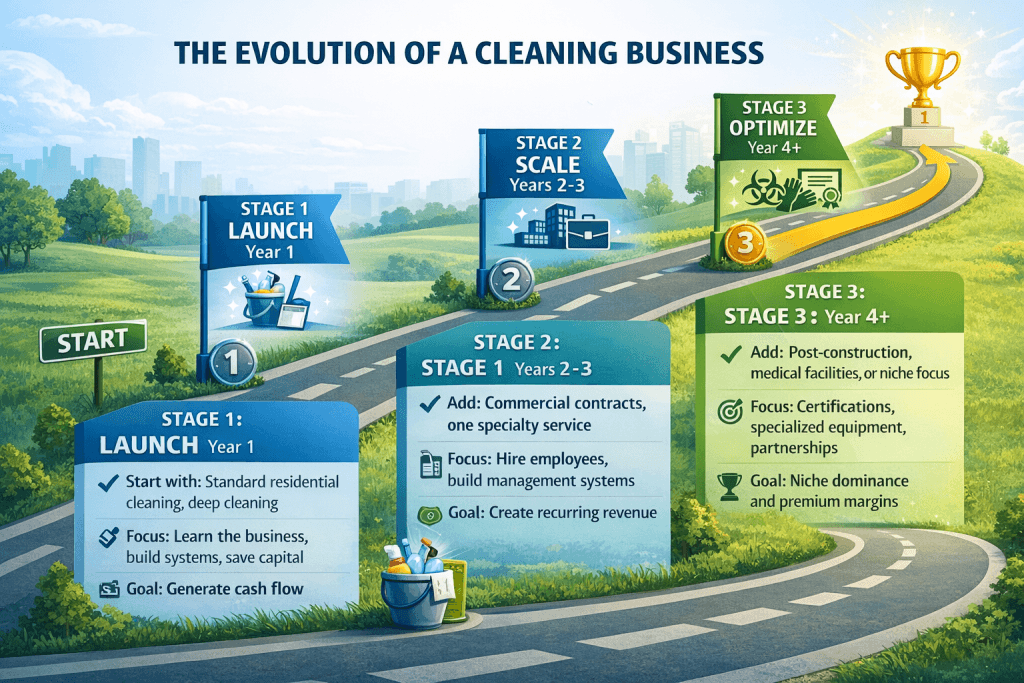
Start with: Standard residential + deep cleaning
Why: Lowest startup costs. Fastest path to first clients. Immediate cash flow to fund growth.
Add next: Move-in/move-out cleaning
Build relationships with property managers and real estate agents early. These partnerships compound over time.
Your focus: Learn the business. Build systems. Save capital for equipment upgrades.
New to the industry? Our complete guide on how to start a cleaning business covers everything from licensing to landing your first client.
Add: Commercial office contracts + one specialty service (window cleaning or carpet cleaning)
Why: Commercial contracts create recurring revenue stability. One specialty service adds margin without overwhelming complexity.
Target mix: 60% recurring revenue from commercial, 40% from residential, and specialty combined.
Your focus: Hire your first employees. Build management systems. Start marketing consistently.
At this stage, SEO for your cleaning business becomes critical. You need leads flowing in consistently, not just from referrals.
Consider: Post-construction, medical facilities, or Airbnb/vacation rental focus
Why: Maximum margins. Reduced competition. Premium market positioning.
Goal: Niche dominance over broad service offerings.
Your focus: Certifications and credentials. Specialized equipment. Strategic partnerships.
Established businesses should explore how AI is transforming cleaning services from automated scheduling to predictive staffing.
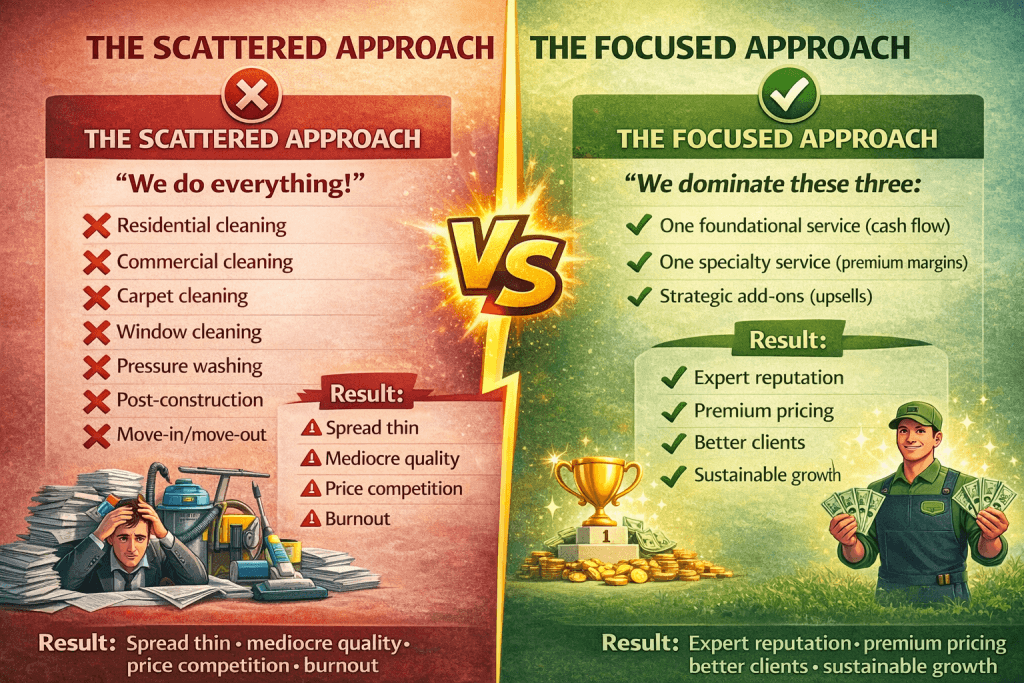
Most articles on this topic list 50 services like a restaurant menu. Here’s everything! Pick what sounds good!
That approach leads to scattered, struggling businesses.
The reality:
The cleaning businesses that thrive pick 2-3 services and dominate them.
Build your service mix intentionally:
Three categories. Maximum. Master them completely before considering expansion.
Manual Operations Are Becoming a Competitive Disadvantage.
Your clients compare you to every service they use: Uber, Amazon, DoorDash. They expect instant confirmations, easy rescheduling, and digital invoices. “That’s how we’ve always done it” is costing you jobs.
Commercial cleaning and specialty services typically have the highest profit margins at 15–28%. The most profitable niches include:
The key to profitability is specialization. Niche services face less competition and command higher rates than general residential cleaning.
Several options require minimal or no upfront investment:
You can also start by offering services, getting paid upfront (or a deposit), and using that income to purchase supplies.
Based on cleaning industry trends and statistics, the highest-demand services include:
Referrals and LSAs can generate leads within days. Google Business Profile improvements show results in 2-4 weeks. SEO typically takes 3-6 months for a significant impact. Consistency matters more than any single tactic.
The most affordable cleaning businesses to start:
All of these can realistically launch within a week with basic supplies.
Your pricing affects how you market. Too cheap and you’ll attract price-shoppers who churn. Too expensive without clear value, and you’ll lose quotes. Learn how to charge for cleaning services to find the right balance for your market.