

Free Concrete Contractor Invoice Template
About this template
Concrete work is precise; your invoicing should be too. FieldCamp’s free concrete contractor invoice template gives you a professional format built specifically for the concrete trade. Document every detail of the job: cubic yards poured, PSI mix specifications, reinforcement type, finishing method, and labor hours, all in a clear, itemized layout clients can actually follow.
Whether you’re billing for a residential driveway, a commercial foundation, a stamped patio, or a retaining wall, this template keeps your numbers organized and your payment terms clear. Pair it with FieldCamp’s free concrete estimate template to keep your bids and final invoices consistent from the first quote to the last pour.
Key Features
- Detailed project tracking with cubic yards & costs
- Professional layout designed for concrete projects
- Flexible cost structure for materials & labor fees
- Auto tax calculation for accurate billing
,
|
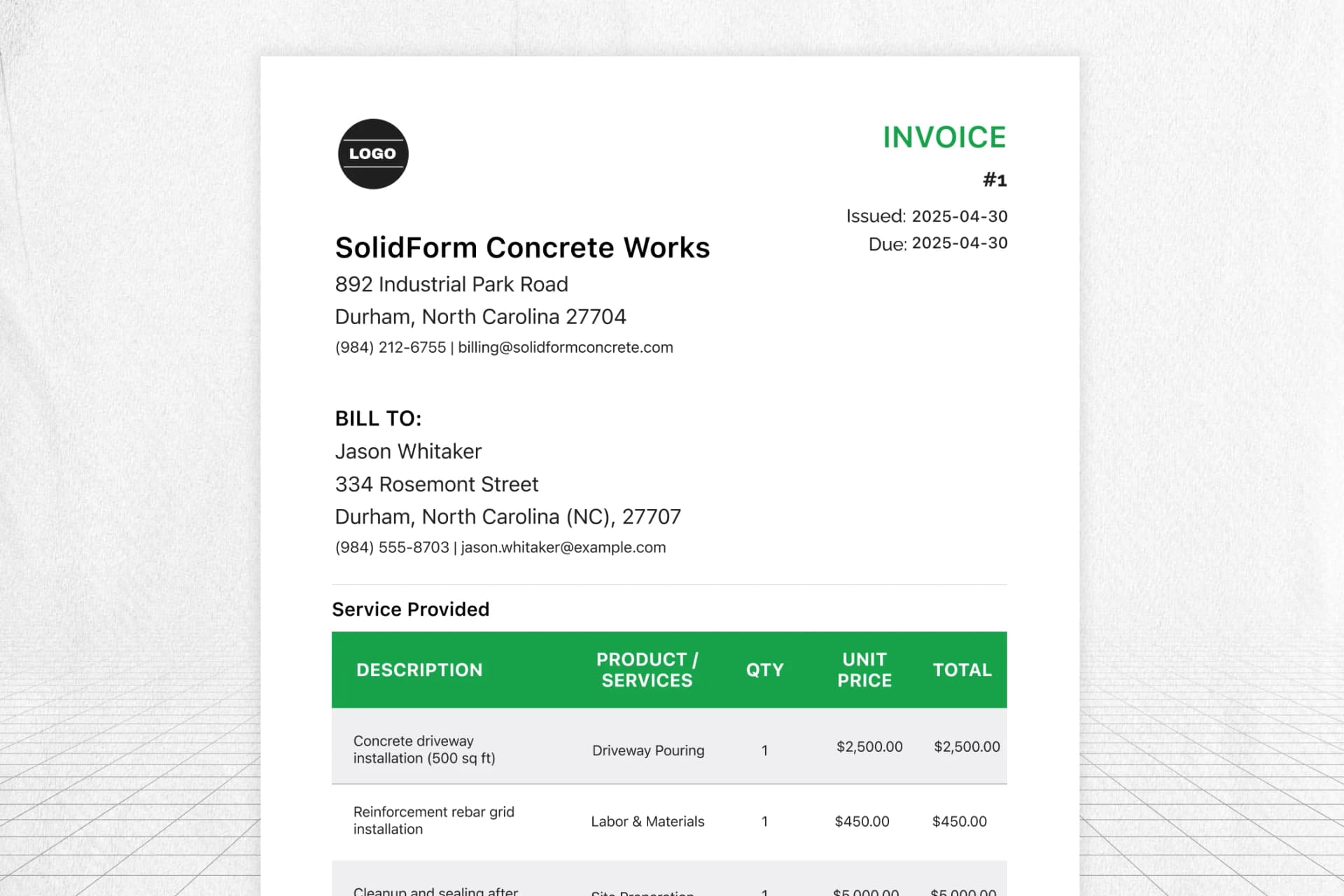
INVOICE
#1
Issued: 2026-03-30
Due: 2026-03-30
BILL TO:
Services Provided
| DESCRIPTION | PRODUCT / SERVICE | QTY | UNIT PRICE | TOTAL |
|---|---|---|---|---|
| Installing baseboard trim around the bedroom perimeter | Baseboard Trim Installation | 1 | $140.00 | $140.00 |
| Repairing damaged door frame and removal of rotted wood | Door Frame Repair | 1 | $120.00 | $120.00 |
| Design and installation of a wall-mounted custom bookshelf | Custom Bookshelf Installation | 1 | $450.00 | $450.00 |
How to Create a Concrete Contractor Invoice?
A concrete invoice should document the full scope of the job, not just a flat number. Here’s how to build one step by step:
- Add your business information: Company name, address, phone, email, and contractor license number. Concrete work almost always requires licensing, so include it on every invoice. Upload your logo for consistent branding across all your documents.
- Enter client and project details: Customer name, contact info, and the job site address. For concrete work, also note the project type (driveway, foundation, slab, patio, retaining wall) and any relevant permit numbers. If you’re working under a general contractor, include their information as well.
- Set the invoice number and dates: Unique invoice number for your records. Include the date the work was completed (or the current phase completion date for multi-phase jobs) and the payment due date. Standard terms for concrete contractors range from Net 15 to Net 30, with many residential jobs due on completion.
- Itemize all services performed: This is where a concrete invoice differs from other trades. Break it down by phase:
- Site preparation: excavation, grading, compaction, gravel sub-base installation
- Formwork: form installation, leveling, bracing
- Reinforcement: rebar placement (specify bar size – #3, #4, #5), wire mesh, fiber mesh, or post-tension cables
- Concrete placement: cubic yards poured, mix design (3000 PSI, 4000 PSI, etc.), pump truck usage if applicable
- Finishing: broom finish, smooth trowel, stamped pattern, exposed aggregate, colored concrete, decorative scoring
- Post-pour: control joint cutting, expansion joint installation, curing compound application, form stripping
- Each phase gets its own line with a description, quantity, and cost.
- List materials separately: Ready-mix concrete (price per cubic yard), rebar (by linear foot or weight), wire mesh (by sheet or roll), form lumber, gravel/base material, concrete sealer, curing compound, stamps/mats for decorative work. Clients in concrete understand that material costs fluctuate with commodity prices — showing the breakdown makes price changes easier to justify.
- Add equipment and rental costs: Concrete pump truck, bobcat/skid steer, compactor, concrete saw, power trowel. If you rented equipment for the job, list it separately rather than burying it in a flat labor rate.
- Apply taxes, note payment terms, and send: Add your local sales tax rate, verify the totals, and include clear payment terms: due date, accepted methods, deposit already collected (if any), and remaining balance. Download the PDF and email it or hand-deliver it on-site.
For contractors managing multiple active pours and projects, FieldCamp’s invoicing dashboard handles creation, sending, and tracking from one place. Here’s a walkthrough: Creating and Managing Invoices in FieldCamp.
What to Include in a Concrete Invoice?
A concrete job involves heavy materials, specialized equipment, and work that literally can’t be undone once it’s poured. Your invoice should reflect that level of detail. Here’s the full checklist:
- Your business details – Company name, address, phone, email, website, contractor license number, and insurance information. For concrete contractors, showing proof of insurance is often required by GCs and commercial clients before they release payment.
- Client and project information – Customer name, project site address, and project type. If you’re subcontracting under a GC, include the GC’s name and the overall project reference number.
- Invoice number and date – Unique identifier plus work completion date and payment due date.
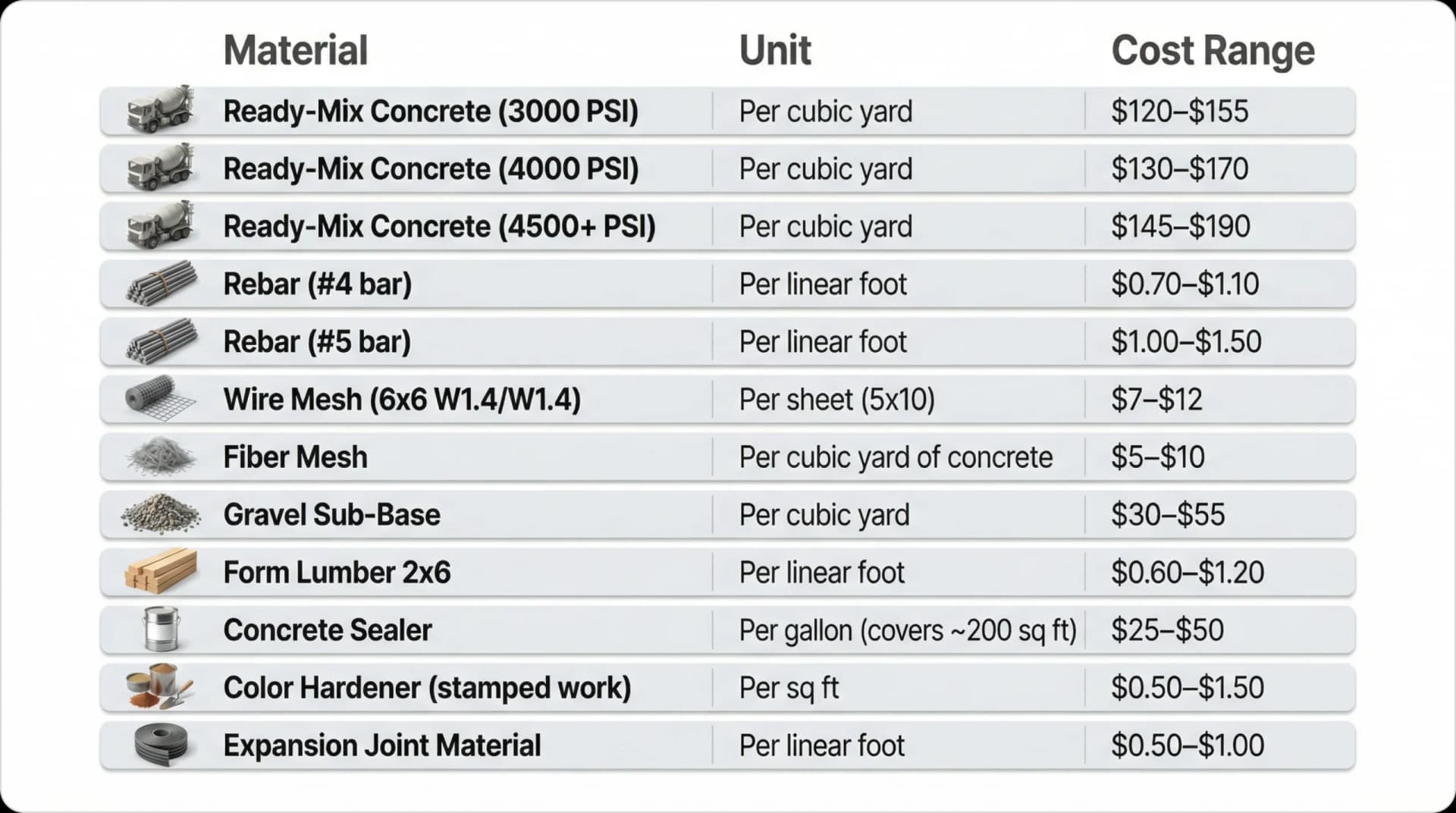
- Project specifications – This is concrete-specific and important: note the total area (square footage), concrete thickness (4″, 6″, 8″), total cubic yards placed, mix design (3000 PSI residential, 4000 PSI driveways, 4500+ PSI structural), and reinforcement type (rebar size and spacing, wire mesh gauge, fiber reinforcement). These specs protect you if questions arise about the scope of work delivered.
- Itemized services by phase – Excavation and grading, sub-base preparation and compaction, formwork installation, reinforcement placement, concrete pouring and placement, finishing (specify method: broom, trowel, stamped, exposed aggregate), control joint cutting, curing, and form removal.
- Materials with costs – Ready-mix concrete (cubic yards x price per yard), rebar, wire mesh, form lumber, gravel base, concrete sealer, expansion joint material, decorative color hardener, or acid stain. List quantities and unit prices for each.
- Labor charges – Crew size, hours worked, and your rate. Concrete work is labor-intensive; a typical residential driveway pour might require 4–6 crew members for a full day. If you need to calculate what your labor should actually cost per hour (including taxes, insurance, and overhead), FieldCamp’s labor cost calculator gives you the fully loaded number.
- Equipment costs – Concrete pump truck, delivery surcharges, power tools, finishing equipment, saw rental. List each separately.
- Taxes and fees – Sales tax, permit fees, disposal fees (for demolition/removal jobs).
- Total amount due – Clear, bold, and easy to find on the invoice.
- Payment terms – Due date, accepted payment methods (check, ACH, credit card), deposit details, and any retainage terms for commercial work. For large projects, note milestone payment schedules (e.g., 30% at form completion, 40% after pour, 30% at final inspection).
Concrete Job Pricing Reference
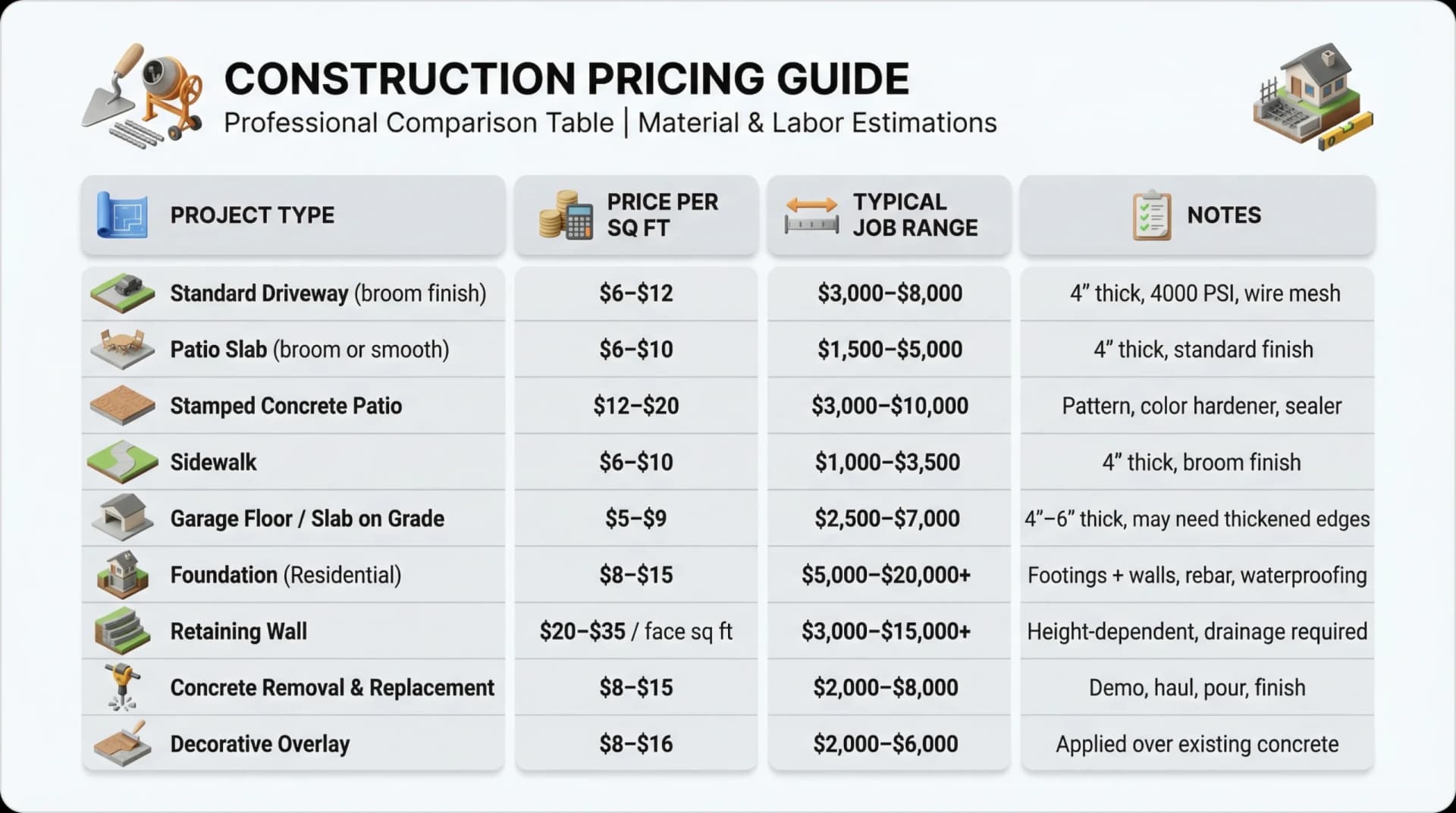
Whether you’re invoicing after the job or sanity-checking your numbers before you send, here’s what typical concrete work costs in 2026. Use these as a baseline and adjust for your local market, material supplier pricing, and job complexity.
Concrete Work Pricing by Project Type
Material Cost Breakdown
What Drives Concrete Pricing Up?
- Thickness and reinforcement – A 6″ slab with #4 rebar on 12″ centers costs significantly more in material and labor than a standard 4″ slab with wire mesh. Foundation work with grade beams and #5 rebar at close spacing pushes costs higher.
- Decorative finishes – Stamped concrete requires color hardener, release agent, stamps/mats, and a skilled finisher. Exposed aggregate adds washing and sealing steps. These finishes can add $4–$10 per square foot over a standard broom finish.
- Site conditions – Sloped lots require more excavation and grading. Poor soil may need additional compaction or geo-fabric. Tight access that prevents direct chute delivery means a concrete pump truck ($800–$1,500 for a half-day).
- Demolition and removal – Tearing out an existing driveway or patio before pouring new concrete adds $2–$6 per square foot for sawing, breaking, loading, and hauling.
- Winter conditions – Cold-weather pours require heated enclosures, insulated blankets, and hot water in the mix. This can add 15–25% to the overall job cost.
If you’re building your rate card or adjusting prices for the year, FieldCamp’s service price calculator helps you factor in labor, materials, equipment, overhead, and your target margin, so you’re pricing for profit on every pour.
To verify your margins are where they should be before sending the invoice, run the numbers through the profit margin calculator.
Built for Every Type of Concrete Project
Concrete contractors don’t do one type of job. Monday might be a residential driveway pour, Tuesday a commercial foundation, Wednesday a decorative stamped patio, and Thursday a retaining wall repair. Your invoicing needs to flex with the work.
FieldCamp’s concrete contractor invoice template handles:
- Residential flatwork – Driveways, patios, sidewalks, garage floors, and pool decks. Straightforward square-footage billing with material and labor split.
- Foundation and structural work – Footings, grade beams, stem walls, slab-on-grade for new construction. Multi-line invoices with reinforcement specs, mix designs, and milestone billing.
- Decorative and stamped concrete – Pattern selection, color hardener, acid stain, exposed aggregate, decorative scoring. These jobs command higher per-square-foot rates, and the invoice should reflect the premium finish.
- Demolition and replacement – Sawcutting, breaking, hauling old concrete, then prepping and pouring new. Document removal and new work as separate phases.
- Commercial and municipal work – Parking lots, loading docks, curb and gutter, ADA-compliant ramps. These jobs often require detailed invoicing with retainage terms, certified payroll references, and insurance documentation.
For residential jobs, a clean invoice with itemized phases and material specs keeps homeowners confident in the bill. For commercial work and GC relationships, the level of documentation on your invoice can directly affect how fast you get paid, or whether you get the next project.
This template handles the format. You fill in the job specifics.
When you’re running multiple crews across several active job sites, pouring one project while prepping another, managing invoices manually starts costing you more time than it’s worth. That’s when most concrete contractors move to dedicated software that ties estimating, scheduling, and invoicing together.
FieldCamp lets you generate invoices from completed jobs, auto-populate client and project details, and track payment status across all your active work from one dashboard.
For contractors with recurring maintenance accounts (annual sealing, crack repair contracts), you can set up automatic invoicing and payment collection: Auto-Deducting Payments for Invoices & Recurring Jobs.
Concrete Sets Fast. Your Payments Should Too.
Every invoice that goes out vague, late, or without proper documentation is a payment that sits in limbo, and in concrete terms, your material and labor costs don’t wait for anyone.
Frequently Asked Questions
How to make an invoice for concrete work?
Start with your business details and contractor license number at the top, then add the client’s name, contact info, and job site address. List every phase of the job as a separate line item: excavation and site prep, sub-base installation, formwork, reinforcement (rebar or wire mesh), concrete placement (note cubic yards and PSI), finishing (broom, trowel, stamped, or exposed aggregate), joint cutting, curing, and form removal. Add material costs and labor charges separately, apply your local tax rate, include payment terms, and send the invoice as a PDF.
What should a concrete contractor’s invoice include?
At minimum: your business name, license number, and insurance info; client name and job site address; unique invoice number and date; project specifications (area in square feet, slab thickness, concrete PSI, reinforcement type); itemized services by phase; materials list with quantities and unit costs (cubic yards of concrete, rebar, mesh, gravel, forms, sealer); labor charges with crew size and hours; equipment rental costs; taxes; total amount due; and payment terms including deposit details and due date.
How do I price concrete work on an invoice?
Price based on three factors: square footage (or cubic yardage for vertical/structural work), the complexity of the finish, and the amount of prep required. Standard residential flatwork runs $6–$12 per square foot for a broom-finished driveway or patio. Stamped and decorative concrete runs $12–$20 per square foot. Foundation work runs $8–$15 per square foot, depending on depth, reinforcement, and waterproofing requirements. List each component separately on the invoice so the client understands what drives the total.
Should I charge separately for demolition and removal?
Yes, always. Tearing out an existing driveway, patio, or sidewalk is a distinct operation — sawcutting, breaking, loading, hauling, and disposal. Pricing it as a separate line item (typically $2–$6 per square foot, depending on thickness and rebar presence) keeps the invoice transparent and prevents clients from thinking the removal is “included” in the new pour price. Some contractors list demo as a separate phase on the invoice with its own subtotal.
How do I handle progress payments on a concrete invoice?
For large projects: foundations, commercial pours, multi-phase work, break the total into milestone payments and document them on the invoice. A common structure: 30% deposit before work begins, 30% after formwork and reinforcement are set, and the remaining 40% after the pour and finishing are complete. List the full project total, then show each payment milestone with its amount and status (paid/pending). This keeps both sides clear on what’s been collected and what’s outstanding.
Can I include equipment rental costs on my invoice?
Absolutely. Concrete pump trucks, bobcats, compactors, concrete saws, and power trowels are legitimate job costs that should appear on the invoice. List them as separate line items with the rental duration and cost. A pump truck alone can run $800–$1,500 for a half-day, so burying it in a flat labor rate undersells the true cost of the job and compresses your margin.
What’s the difference between a concrete estimate and a concrete invoice?
An estimate is your proposed pricing sent before the work begins. An invoice is the final bill sent after the work is complete. The line items are usually similar, but the invoice reflects the actual work performed, which can differ from the estimate if the scope changed (e.g., a thicker slab is needed due to soil conditions, extra cubic yards are required, or additional finishing is requested). Keep both documents for your records and reference the original estimate number on the invoice. For consistent formatting between your quotes and bills, use FieldCamp’s concrete estimate template alongside this invoice template.
How do I handle retainage on commercial concrete invoices?
Retainage (typically 5–10% of the invoice total) is common on commercial and municipal concrete projects. List the full amount of work completed, then show the retainage hold as a separate line item that reduces the current amount due. For example: “Subtotal: $25,000 | Retainage (10%): -$2,500 | Amount Due This Period: $22,500.” Track cumulative retainage across invoices so you know exactly what’s being held and can invoice for its release upon project completion or final inspection.
Can I send concrete invoices directly through FieldCamp?
Yes. FieldCamp lets you create invoices from completed jobs, email them to the client or GC, and track whether they’ve been viewed, paid, or are overdue, all from one dashboard. For contractors managing multiple active projects and subcontractor relationships, this eliminates double-entry and keeps your invoicing tied directly to the work you’ve completed.
What are the most common concrete invoice mistakes?
The biggest one: not specifying the concrete mix design and reinforcement details. If you bill $8,000 for a driveway and the invoice just says “concrete driveway” with no mention of 4000 PSI, 4-inch thickness, wire mesh, or broom finish, you’re inviting disputes. Other common mistakes: not listing cubic yards poured, forgetting equipment rental costs, omitting the job site address (critical when you’re working on multiple properties), leaving out permit fees, and not documenting the deposit amount already collected. Every missing detail is a potential delay in getting paid.