

Free Junk Removal Invoice Template
About this template
FieldCamp’s free junk removal invoice template tidies up your billing just like you clear the clutter. Add client info, removal services, business name, and applicable taxes in a snap.
Customize with a unique invoice number, break down costs, and set clear payment terms. Brand it your way by adding company details and reuse it anytime, and send professional invoices that help you get paid faster. Clean, quick, and built for every junk job you haul.
Key Features
- Easy add & edit client information
- Professional, clean invoice layouts
- Custom invoice numbers for tracking
- Smart tax calculation for quick billing
,
|
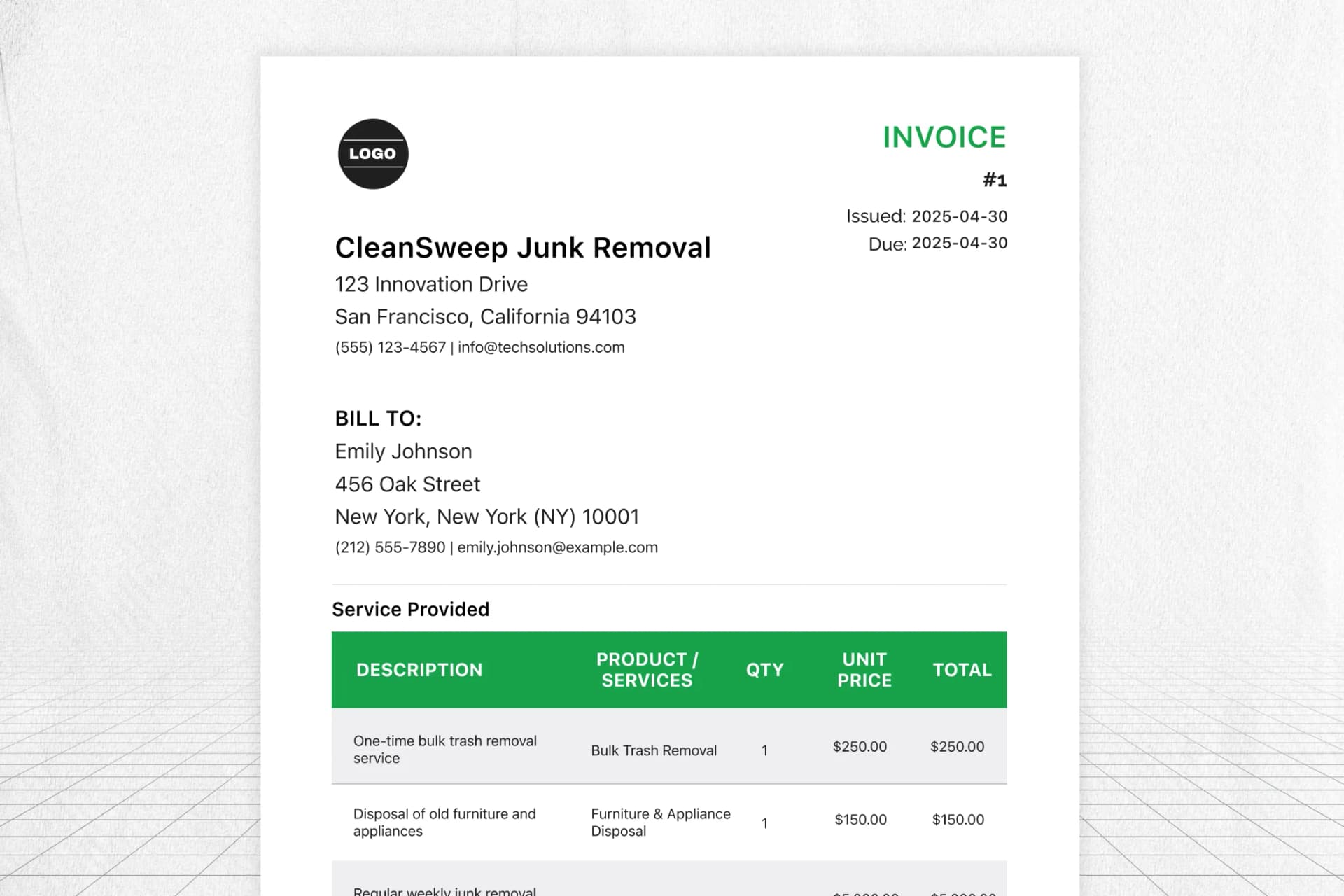
INVOICE
#1
Issued: 2026-03-05
Due: 2026-03-05
BILL TO:
Services Provided
| DESCRIPTION | PRODUCT / SERVICE | QTY | UNIT PRICE | TOTAL |
|---|---|---|---|---|
| Removal of old furniture from the living room and disposal | Furniture Removal | 1 | $100.00 | $100.00 |
| Yard debris removal and proper waste disposal | Yard Debris Removal | 1 | $150.00 | $150.00 |
| Hauling away broken appliances and recycling | Appliance Hauling | 1 | $75.00 | $75.00 |
How to Create a Junk Removal Invoice
Getting paid starts with a clear invoice. Here’s how to build one that leaves no room for confusion.
1. Add Your Business Details
Put your company name, phone number, email, and address at the top. If you’ve got a logo, add that too. It makes the invoice look professional and helps clients remember who hauled their stuff. Include your business license number if your state requires it.
2. Enter the Client’s Information
Add the customer’s full name, address, phone number, and email. For commercial jobs, include the company name and the on-site contact person. Always note the service address separately if it’s different from the billing address. This matters for multi-location clients and property managers.
3. Set Your Invoice Number and Dates
Give every invoice a unique number. Use a simple system like JR-001, JR-002, or tie it to the date (JR-20260305). Include the date the work was completed and the payment due date. Most junk removal pros give net 15 or net 30 terms, though same-day payment is common for residential jobs.
4. Itemize Every Service
Break down each service on its own line. Don’t lump everything into one total. Clients want to see exactly what they’re paying for.
Common line items for junk removal invoices:
- Furniture removal (sofas, mattresses, dressers)
- Appliance hauling (refrigerators, washers, dryers)
- Yard debris and green waste removal
- Construction debris (drywall, lumber, concrete)
- Estate cleanout or foreclosure cleanout
- Garage, attic, or basement cleanout
- Hot tub or shed demolition and removal
- E-waste disposal (TVs, monitors, computers)
- Minimum load charge or truck volume charge
- Labor hours (loading, sorting, hauling)
- Dumpster rental (if applicable)
5. Add Disposal and Environmental Fees
Junk removal has costs that other trades don’t: landfill tipping fees, recycling surcharges, and hazardous material handling charges. List these separately so the client understands they’re pass-through costs, not markups.
6. Apply Taxes and Discounts
Enter your local sales tax rate. If you offered a discount for bundled services or repeat clients, show it as its own line item so the client sees the value.
7. Review and Send
Double-check every line before sending. Verify the math, confirm the client’s name and address, and make sure payment terms are clear. Download as a PDF and email it, or print a copy for on-site delivery.
What to Include in a Junk Removal Invoice
A complete junk removal invoice covers everything the client needs to pay you without question. Miss a detail, and you’ll spend more time answering emails than hauling loads. Here’s your checklist:
| Invoice Element | What to Include | Why It Matters |
| Business info | Company name, address, phone, email, logo, license # | Builds trust and looks professional |
| Client details | Name, billing address, service address, phone, email | Ensures the invoice reaches the right person |
| Invoice number | Unique sequential number (e.g., JR-0047) | Simplifies tracking and bookkeeping |
| Service date | Date the work was performed | Confirms when the job happened |
| Issue date | Date the invoice was created | Sets the billing timeline |
| Due date | Payment deadline (Net 15, Net 30, or due on receipt) | Prevents late payments |
| Service descriptions | Each item on its own line with clear labels | Reduces disputes and confusion |
| Quantities | Number of items, loads, hours, or cubic yards | Justifies the total charge |
| Unit pricing | Rate per item, per load, per hour, or per cubic yard | Shows transparent pricing |
| Disposal fees | Landfill tipping fees, recycling charges, e-waste fees | Explains pass-through costs |
| Labor charges | Hours worked, number of crew members, hourly rate | Breaks down where the money goes |
| Subtotal | Sum before tax and discounts | Let the client review before the final total |
| Taxes | Applicable sales tax with rate shown | Keeps you compliant |
| Discounts | Multi-load discount, repeat customer discount | Shows value and encourages loyalty |
| Total due | Final amount in bold or highlighted | No ambiguity on what they owe |
| Payment methods | Cash, check, credit card, Venmo, Zelle, bank transfer | Makes it easy for the client to pay |
| Late payment terms | Late fee percentage or flat fee after due date | Discourages overdue payments |
| Notes | Special instructions, thank-you message, warranty info | Adds a personal touch |
Junk Removal Pricing Guide
Knowing what to charge keeps your invoices accurate and your margins healthy. Here’s what the industry looks like in 2026.
Average Junk Removal Costs by Load Size
| Load Size | Description | Average Price Range |
| Minimum load | A few small items (1-2 pieces of furniture) | $75 – $150 |
| Quarter truck | Small cleanout, a few bags + 1-2 large items | $150 – $250 |
| Half truck | Average residential job (bedroom or garage cleanout) | $250 – $400 |
| Three-quarter truck | Large cleanout (multiple rooms, estate partial) | $400 – $550 |
| Full truck load | Complete estate cleanout, foreclosure, or renovation debris | $500 – $800 |
| Multiple loads | Major commercial or construction cleanout | $800 – $1,500+ |
Common Add-On Charges
| Service | Typical Charge |
| Appliance removal (per unit) | $35 – $75 |
| Mattress removal (per unit) | $50 – $100 |
| Hot tub removal | $200 – $450 |
| Piano removal | $150 – $400 |
| Shed demolition + removal | $300 – $800 |
| Tire disposal (per tire) | $10 – $25 |
| E-waste disposal (per item) | $15 – $50 |
| Hazardous material handling | $50 – $200+ |
| Stairs or difficult access surcharge | $25 – $75 |
| Same-day or emergency service | 15% – 25% premium |
Disposal Cost Breakdown
Your actual profit depends on what it costs to get rid of what you pick up:
- Landfill tipping fees: $30 – $80 per ton (varies by county)
- Recycling center fees: $0 – $25 per load (some materials earn credit)
- Donation drop-off: Free, but factor in drive time
- Hazardous waste facility: $50 – $150 per load
- Fuel costs: $25 – $60 per job, depending on distance
Profit Margin Targets
- Residential cleanouts: 40% – 60%
- Commercial jobs: 30% – 45%
- Construction debris: 25% – 40%
- Same-day/emergency jobs: 50% – 70%
Want help calculating the right price for every job? Use FieldCamp’s guide on how to price a junk removal job for a step-by-step breakdown.
We Sort Your Invoices as You Sort the Junk
FieldCamp’s junk removal invoice template streamlines the invoicing process for junk removal businesses. Whether you’re tackling small cleanups or large-scale projects, create professional invoices with all the necessary details like client info, removal services, costs, and payment terms.
This template is perfect for both residential and commercial junk removal jobs. It helps manage taxes, itemizes material and labor costs, and sets clear payment expectations. Organize your invoices, speed up your paycheck, and get back to making everything shine!
Built for Every Type of Junk Removal Job
Whether you’re running a solo truck operation or managing a crew across multiple cities, this template handles every job type you’ll run into.
Residential jobs: Garage cleanouts, estate cleanups, hoarding situations, move-out junk removal, and seasonal decluttering. Itemize by room or by item type to give homeowners a clear picture of what they’re paying for.
Commercial jobs: Office furniture removal, warehouse cleanouts, retail store closings, and property management turnovers. Commercial clients expect detailed line items and often need invoices tied to purchase orders.
Construction debris: Post-renovation cleanup, demolition waste, drywall and lumber hauling, and concrete removal. Track disposal fees separately since construction waste often carries higher tipping fees.
Specialty removal: Hot tub and spa removal, shed demolition, above-ground pool teardown, and playground equipment. These jobs need custom line items because everyone is different.
FieldCamp’s junk removal software connects your invoices directly to scheduled jobs. Finish a haul, generate an invoice from the job details, and send it before you leave the driveway. No retyping addresses, no recalculating totals.
For a deeper look at managing your invoicing workflow inside FieldCamp, check out the step-by-step guide on creating and managing invoices.
Clear Junk, Clear Admin Too
Stop wasting hours on paperwork. FieldCamp automates CRM, scheduling, dispatch, reports, invoicing, estimates, and payments—so you focus on hauling, not typing. Automation and Efficiency means more pickups per day.
Frequently Asked Questions
Why should junk removal professionals send invoices?
Junk removal professionals should send well-crafted invoices to showcase their junk removal business in a professional light. A detailed and clear invoice ensures timely payments and maintains transparency with clients.
What should be included on an invoice for a junk removal professional?
A junk removal invoice should feature all relevant details such as client information, a clear breakdown of removal services, material costs, and applicable taxes. It should also contain a unique invoice number for easy tracking and business information such as your company name, address, and contact details. Setting clear payment terms and listing all services provided will make the invoice easy to understand, ensuring that your junk removal company stays organized and receives payments timely.
Can I send junk removal invoices directly through the software?
Yes, you can send junk removal invoices directly through FieldCamp’s AI-powered junk removal software. The software helps businesses create and send professional invoices in just a few clicks, keeping your billing process smooth and efficient. By managing client details and services directly within the platform, you ensure that your invoices are accurate, easily sent, and trackable.
How can I make my junk removal invoices stand out?
Most invoices just state the amount owed. Yours could stand out if it shows value, professionalism, and attention to detail. Here’s how:
An invoice like that isn’t just a payment request, it’s a subtle reminder of the hard work and professionalism you bring to every haul.
How can I track overdue payments for junk removal services?
Tracking overdue payments is easy with FieldCamp’s junk removal software. The platform allows you to monitor payment terms and set reminders for overdue payments. By storing invoice numbers and client information, you can quickly follow up on unpaid invoices, ensuring that your junk removal business stays on top of outstanding balances. Use the software’s features to send reminders and keep your payment process smooth and efficient.
Do I need to charge sales tax on junk removal services?
It depends on your state and local tax laws. In most U.S. states, junk removal is classified as a service and is subject to sales tax. However, some states exempt certain types of services or have different rates for hauling vs. disposal. Check with your state’s department of revenue or your accountant. When in doubt, add a tax line to your invoice. It’s easier to refund a small tax amount than to owe back taxes at the end of the year.