

Free Painting Invoice Template
About this template
Whether you just finished rolling the last coat on a living room accent wall or wrapped up a full exterior repaint on a two-story colonial, the invoice you send should reflect the same quality as the work you did.
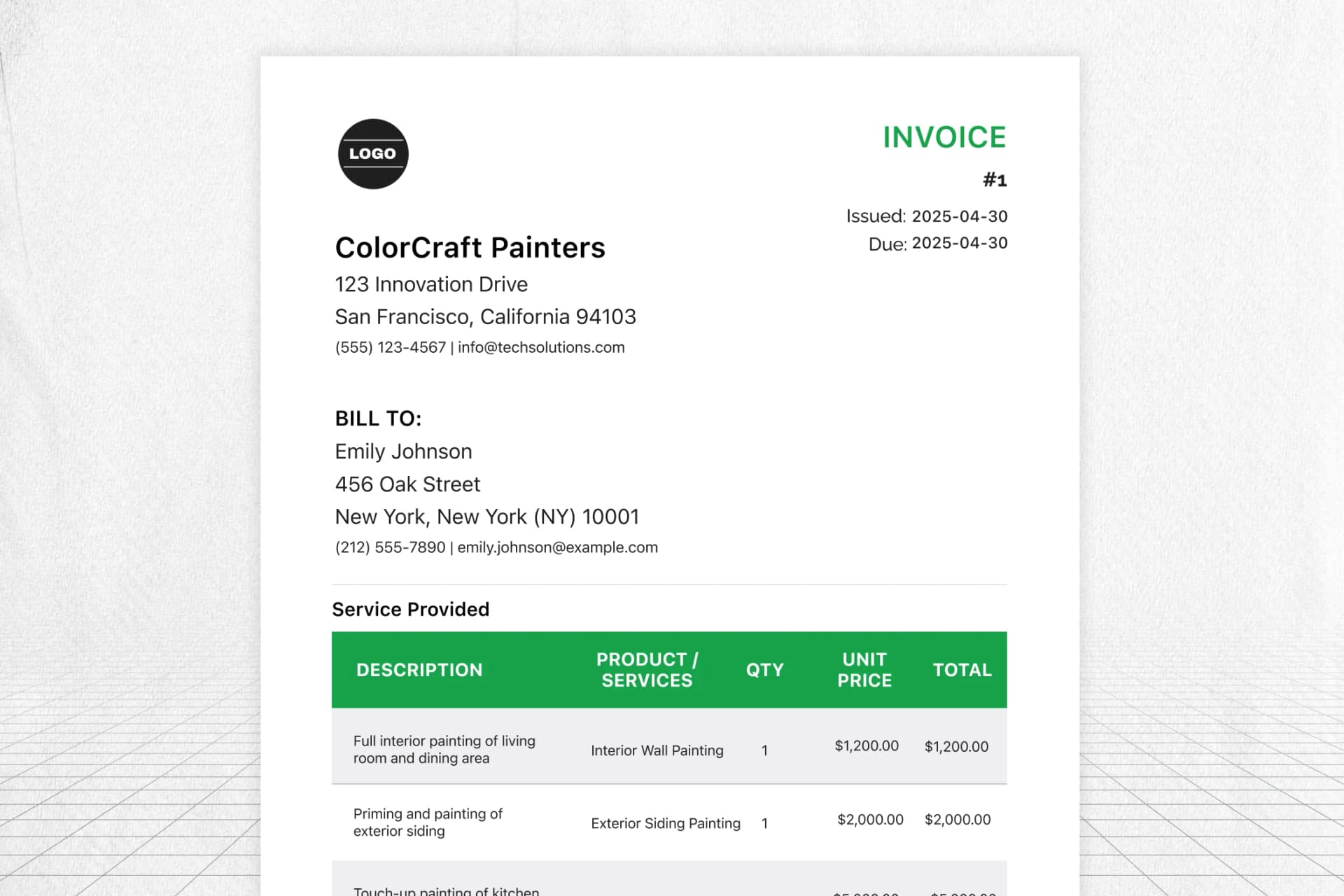
FieldCamp’s free painting invoice template gives painting contractors a clean, professional format to bill for interior painting, exterior house painting, trim and molding work, cabinet refinishing, deck staining, and everything in between. Break down each service line by line: surface preparation, primer application, finish coats, materials, so clients see exactly where their money went.
If you’re also putting together quotes before the job starts, pair this with our free painting estimate template to keep your estimates and invoices consistent.
Key Features
- Download & print free painting invoice templates
- Auto tax calculation based on the total cost
- Professional layout for painting invoices
- Customizable fields for painting services
,
|
INVOICE
#1
Issued: 2026-03-04
Due: 2026-03-04
BILL TO:
Services Provided
| DESCRIPTION | PRODUCT / SERVICE | QTY | UNIT PRICE | TOTAL |
|---|---|---|---|---|
| Painting walls using the client-selected color and finish | Interior Wall Painting | 1 | $200.00 | $200.00 |
| Full exterior paint job, including prep and cleanup | Exterior House Painting | 1 | $750.00 | $750.00 |
| Detailed work for window/door trims and baseboards | Trim & Molding Touch-Up | 1 | $50.00 | $50.00 |
How to Create a Painting Invoice?
A painting invoice should take you five minutes, not thirty. Here’s how to put one together step by step:
- Add your business information: Company name, address, phone number, email, and contractor license number if your state requires it. Upload your logo so every invoice carries your brand.
- Enter the client and property details: Customer name, phone, email, and the property address where the work was performed. For painting, including the property address matters — especially if you’re working on multiple properties for the same client (landlords, property managers, flippers).
- Set the invoice number and dates: Assign a unique invoice number for tracking. Include the date the work was completed and the payment due date. Standard terms in painting are Net 15 or Net 30, though plenty of residential jobs are due on completion.
- Itemize every service performed: This is where most painting invoices fall short. Don’t just write “painting – $3,000.” Break it down: surface preparation (patching holes, sanding rough spots, caulking trim gaps, taping off edges), primer application, wall painting (number of coats, paint type, sheen), ceiling painting, trim and baseboard work, door and window frame painting, cleanup, and debris removal. Each service gets its own line.
- List materials separately: Paint (brand, type, sheen, number of gallons), primer, caulk, wood filler, painter’s tape, plastic sheeting, drop cloths, sandpaper. Clients appreciate seeing that a $4,500 job includes $600 worth of Sherwin-Williams Duration or Benjamin Moore Regal Select, it justifies the total and shows you’re not cutting corners on product quality.
- Apply taxes, discounts, and finalize: Add your local sales tax rate and any project-specific discount. Review the totals, download the PDF, and send it to the client via email or hand-deliver a printed copy on-site.
For contractors handling multiple invoices across several active jobs, FieldCamp’s invoicing dashboard lets you create, send, and track everything in one place. Here’s a walkthrough: Creating and Managing Invoices in FieldCamp.
What to Include in a Painting Invoice?
A complete painting invoice leaves zero room for “I didn’t know that was extra.” Here’s everything that belongs on it:
- Your business details: Company name, address, phone, email, website, and license/insurance information. For painting contractors, showing proof of insurance on the invoice builds trust with homeowners and is often required for commercial work.
- Client information: Customer name, phone, email, and the property address where work was done.
- Invoice number and date: Unique identifier plus completion date and payment due date.
- Detailed service descriptions: Each task as its own line item. Surface prep (sanding, patching, caulking, taping), primer application (number of coats, type), wall painting (rooms, square footage, number of coats, paint sheen), ceiling work, trim and molding, baseboard painting, door and frame painting, accent walls, exterior siding, fascia, and soffit work. The more specific, the fewer disputes.
- Materials list with costs: Paint brand and product line, sheen type (flat, eggshell, satin, semi-gloss), number of gallons, primer, caulk, wood filler, spackling compound, sandpaper, tape, and plastic sheeting. If you’re using premium products, listing them by name reinforces the value.
- Labor charges: Hours worked, crew size, and your rate. For large projects, breaking labor into phases (prep day, prime day, paint days, detail/touch-up day) helps clients see the timeline behind the cost. If you’re figuring out what your labor should cost per hour, FieldCamp’s labor cost calculator gives you the fully loaded number.
- Taxes and fees: Sales tax, disposal fees (for lead paint abatement or large-scale scraping debris), and any permit-related charges.
- Total amount due: Clear, bold, no ambiguity.
- Payment terms: Due date, accepted payment methods, deposit details (if applicable), and late payment policy. Spell out whether the balance was partially covered by a deposit and what remains.
House Painting Invoice Examples
Here are two completed painting invoice examples you can use as a reference when billing your own jobs.
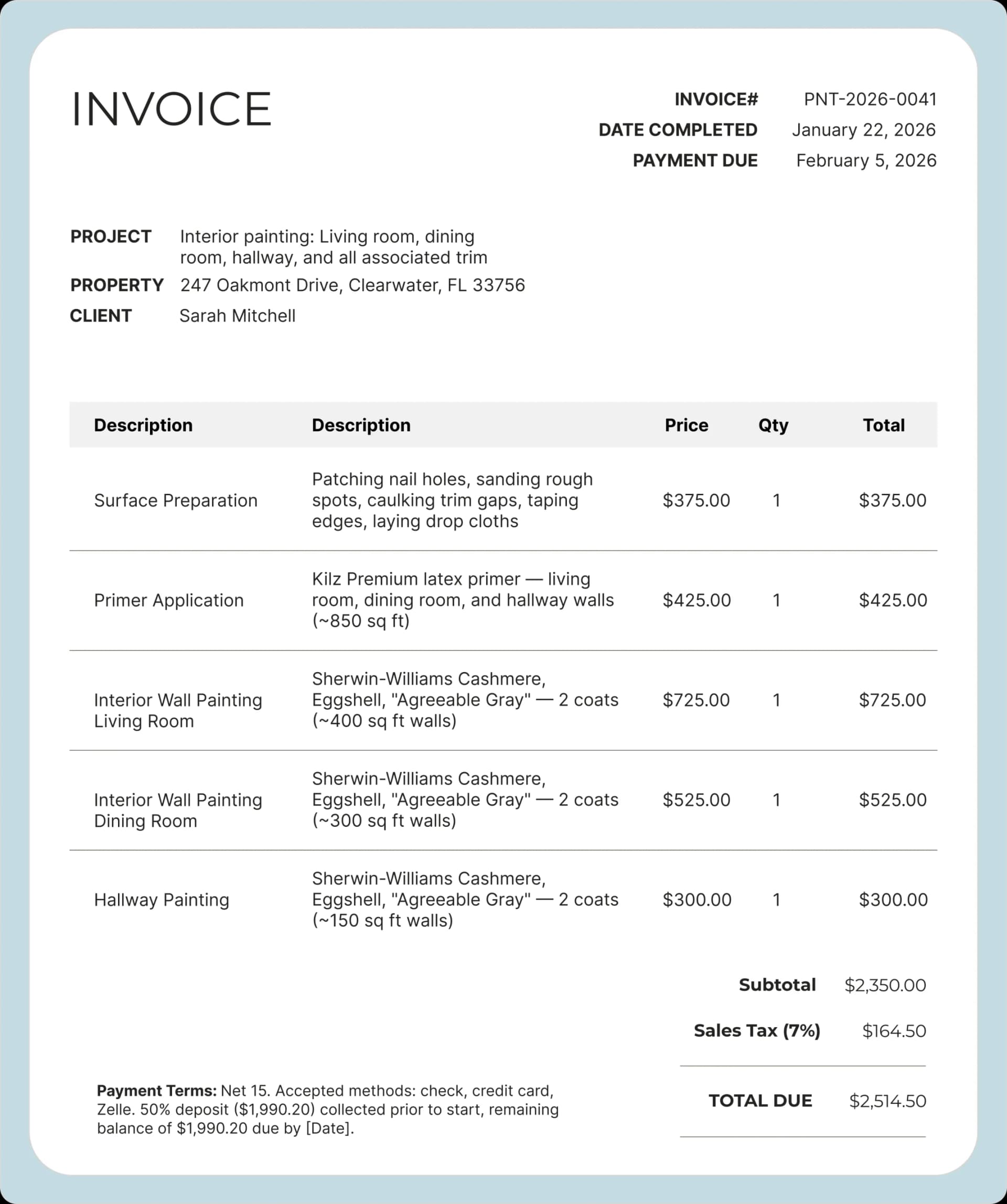
Example 1: Interior Painting Invoice
This example covers a typical residential interior repaint, three rooms plus hallway, including full surface preparation, priming, two coats of finish paint, and trim work.
Example 2: Exterior Painting Invoice
This example covers a full exterior repaint on a two-story home, including power washing, scraping, spot priming, two coats of exterior paint on siding, plus trim, shutters, and doors.
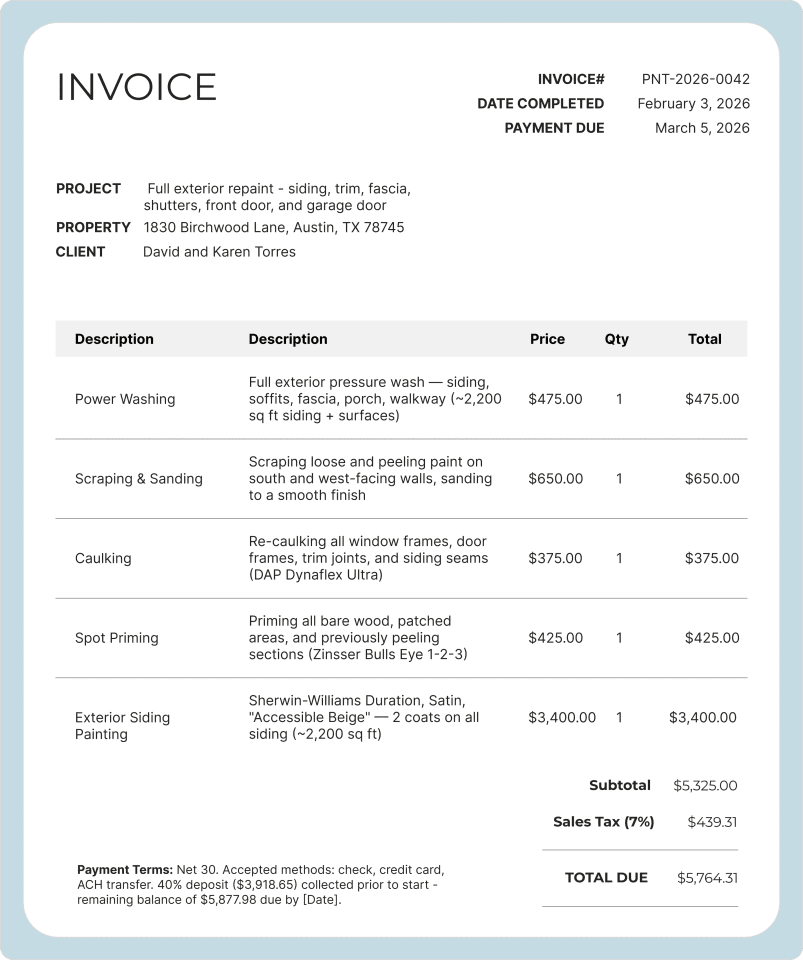
These examples cover the two most common house painting jobs: a multi-room interior repaint and a full exterior. Use them as a reference when building your own invoices. The key takeaway: break every phase of the job into its own line item and list materials with brand names and product types. That level of detail is what separates a painting invoice that gets paid on time from one that sits in someone’s email for three weeks.
Painting Job Pricing Reference
Whether you’re billing after the fact or putting together a quote, knowing the going rates for painting services keeps your invoices accurate and competitive.
Here’s a pricing reference for common residential painting work in 2026.
Interior Painting Rates
| Service | Per Square Foot | Per Room (Avg 12×12) | Notes |
| Wall Painting (2 coats) | $2.50 – $5.00 | $350 – $750 | Varies by ceiling height and wall condition |
| Ceiling Painting (1 coat) | $1.50 – $3.00 | $150 – $350 | Flat paint and textured ceilings cost more |
| Trim & Baseboard | $1.50 – $3.50 / linear ft | $150 – $400 / room | Semi-gloss or high-gloss finish |
| Door Painting (per door) | — | $75 – $200 | Includes light sanding and 2 coats |
| Cabinet Painting (per kitchen) | — | $2,500 – $6,000 | Includes removal, sanding, priming, and 2 coats |
| Accent Wall | $3.00 – $6.00 | $200 – $500 | Bold or dark colors need extra coats |
Exterior Painting Rates
| Service | Per Square Foot | Typical Range | Notes |
| Siding (2 coats) | $2.00 – $5.50 | $3,000 – $8,000 | Depends on stories, material, and condition |
| Trim, Fascia & Soffits | $2.00 – $4.00 / linear ft | $800 – $2,500 | Semi-gloss for durability |
| Shutters (per pair) | — | $75 – $175 | Remove, paint, rehang |
| Front Door | — | $150 – $350 | Sand, prime, 2 coats |
| Deck Staining | $2.50 – $5.00 | $500 – $2,500 | Pressure wash included or separate |
| Power Washing (pre-paint) | $0.15 – $0.40 | $200 – $600 | Required before any exterior repaint |
To see exactly where your margins land on each job type, run the numbers through the profit margin calculator before you finalize your rate card.
What Drives Painting Prices Up?
Not every job is average. Here’s what pushes pricing above standard rates:
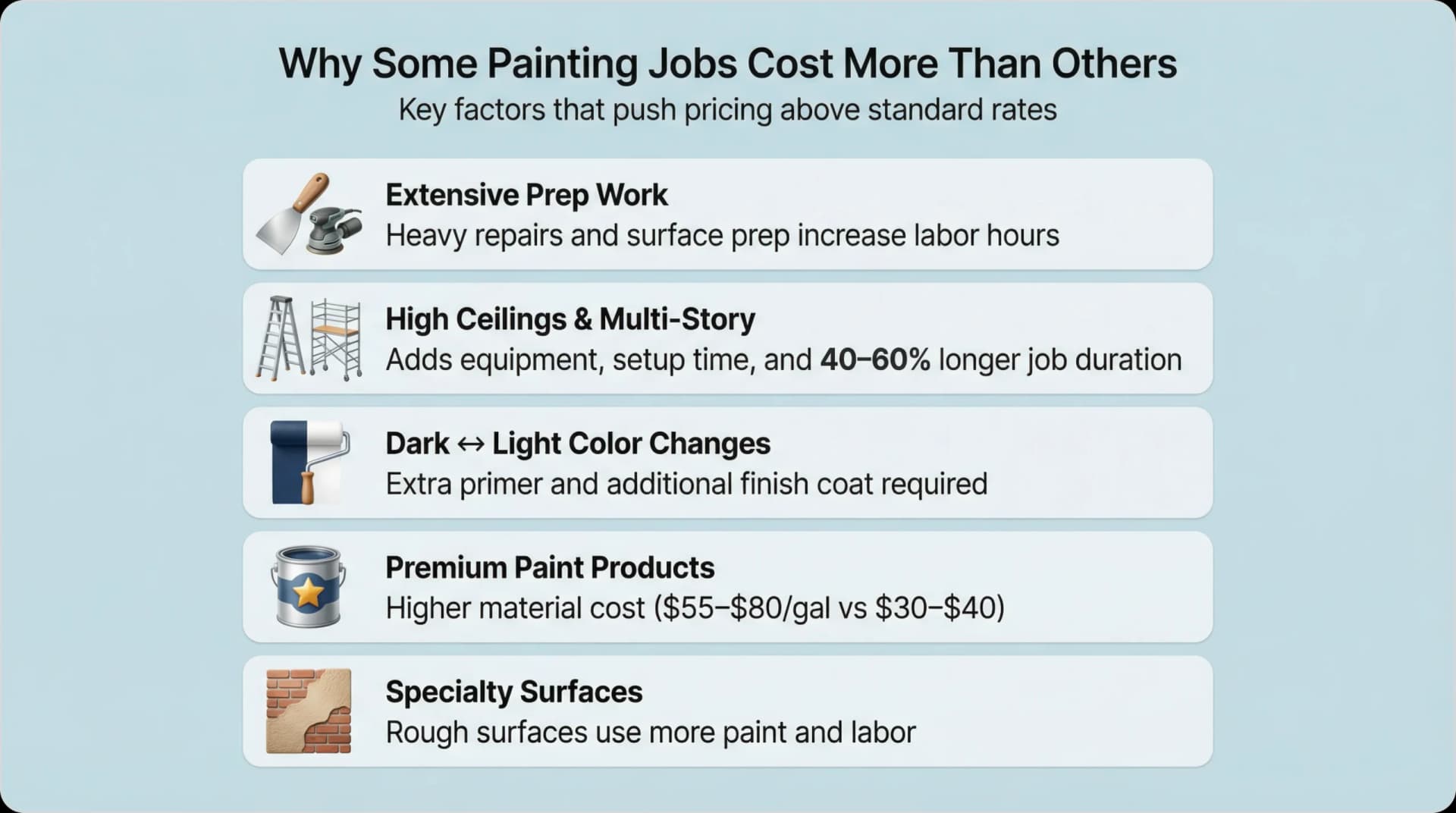
- Extensive prep work: Old homes with lead paint, heavy peeling, rotted trim, or multiple layers of old paint require significantly more sanding, scraping, and repair time before a single coat goes on.
- High ceilings and multi-story exteriors: Anything above 10 feet adds ladder and scaffolding time (and rental costs). A two-story exterior can take 40–60% longer than a single-story.
- Dark or bold color changes: Going from a dark color to light (or vice versa) often requires an additional coat of primer plus an extra finish coat to get even coverage.
- Premium paint products: A gallon of Sherwin-Williams Duration or Benjamin Moore Aura runs $55–$80 versus $30–$40 for builder-grade paint. The material cost difference on a full exterior can be $400–$800+.
- Specialty surfaces: Stucco, brick, cedar shakes, and textured surfaces consume more paint and take longer to cover evenly.
If you’re setting your painting prices for the first time or adjusting for the year, FieldCamp’s service price calculator walks you through the math: labor, materials, overhead, and your target margin, so you’re pricing for profit, not just covering costs.
Built for Every Type of Painting Business
It doesn’t matter if you’re a one-person operation taping off a kitchen on a Tuesday afternoon or running three crews across town on commercial repaints. The way you handle invoicing shapes how clients perceive your professionalism and how fast you get paid.
FieldCamp’s painting invoice template works for:
- Solo residential painters handling interior repaints and touch-up jobs
- Growing painting companies managing multiple crews and job sites
- Commercial painting contractors billing property management firms, GCs, and developers
- Specialty painters doing cabinet refinishing, decorative finishes, and epoxy floor coatings
- Maintenance painters on recurring contracts for apartment complexes, HOAs, and retail spaces
For residential jobs, a clean invoice with itemized prep, prime, and paint charges builds homeowner confidence. For commercial work, a detailed breakdown with square footage, material specs, and crew hours satisfies procurement departments and property managers who need line-item documentation before they cut a check.
This free template handles the formatting. You bring the job details.
But if you’re managing more than a handful of active projects – sending estimates, scheduling crews, tracking which invoices are paid and which are 30 days overdue, doing it all manually starts to cost you more time than it saves.
That’s where painting contractor software comes in. FieldCamp consolidates your estimates, scheduling, dispatching, invoicing, and payments into one platform.
If you’re curious how it works for painters specifically, the painting contractor playbook breaks down the full workflow.
And if you’re ready to set it up, here’s a step-by-step guide to getting started with FieldCamp for your painting business.
For contractors evaluating their options, this guide on how to implement painting contractor software covers the full process, from data migration to crew training, so the transition doesn’t disrupt your active jobs.
Managing Recurring Painting Contracts
If you’ve landed recurring work, apartment complex touch-ups every quarter, annual HOA repaints, and commercial maintenance contracts, you don’t want to rebuild the same invoice every cycle.
FieldCamp lets you set up recurring invoices and automatic payment collection for repeat clients.
The invoice goes out on schedule, payment processes automatically, and you don’t have to chase anyone down. Here’s how to set it up: Auto-Deducting Payments for Invoices & Recurring Jobs.
This is especially useful for painting contractors with maintenance agreements — seasonal touch-ups, quarterly common-area repaints, and annual exterior wash-and-paint cycles. Set it once, and it runs in the background while you focus on the actual painting.
Your Paint Dries Faster Than Your Clients Pay. Let’s Fix That.
Stop losing time on admin. Start running your painting business like the contractors who are already a step ahead.
Frequently Asked Questions
What should a house painting invoice include?
At minimum: your business name and contact information, client name and property address, a unique invoice number, date of completion, itemized service descriptions (surface preparation, primer, wall painting with number of coats and paint type, trim work, ceiling work), materials used with brand names, labor charges, applicable taxes, total amount due, and payment terms including due date and accepted methods.
How do I price painting services on my invoice?
Calculate pricing based on three variables: square footage (or number of rooms), the amount of prep work required, and the quality of paint being used. Most residential interior painting runs $2.50–$5.00 per square foot, including labor and materials. Exterior work runs $2.00–$5.50 per square foot, depending on the number of stories, surface condition, and paint quality. List each service as a separate line item so the client can see what drives the total.
Do I need different invoice templates for interior and exterior painting?
No. One template works for both; you just adjust the line items. For interior jobs, your services will include wall prep, primer, wall painting by room, ceiling work, and trim. For exterior jobs, you’ll list power washing, scraping, caulking, spot priming, siding painting, trim and fascia, shutters, and doors. The structure stays the same; the specifics change based on the project.
How do I handle deposits and partial payments on a painting invoice?
List the total project cost with all line items, then add a line showing the deposit already collected and the remaining balance due. For example: “Subtotal: $5,200 | Deposit Received: $2,080 | Balance Due: $3,120.” This makes it clear to the client what’s been paid and what’s left. Standard deposit structures for painting work are 30–50% upfront, with the balance due on completion or Net 15.
Can I include material costs as separate line items?
Absolutely, and you should. Listing paint brand, product line, sheen type, and number of gallons — plus primer, caulk, wood filler, tape, and supplies — shows clients the quality of products going onto their property. A line item that says “Sherwin-Williams Duration, Satin, 8 gallons — $480” carries more weight than “Materials — $480.”
How do I calculate painting cost per square foot?
Measure the total paintable wall area (wall height x wall width for each wall, minus windows and doors). Multiply by your per-square-foot rate, which should account for labor, materials, prep time, and your profit margin. For a typical residential interior with standard 8-foot ceilings and walls in decent condition, most contractors land between $2.50 and $4.50 per square foot for a two-coat job with separate primer.
Should I charge differently for prep-heavy jobs?
Yes. A house with clean, smooth walls that just needs a color change is a fundamentally different job than one with peeling paint, patched drywall, wallpaper removal, or lead paint requiring abatement. Price prep work as its own line item rather than absorbing it into the per-square-foot rate. This way, clients with well-maintained homes aren’t subsidizing the extra hours that problem walls require, and your margins stay consistent regardless of job condition.
Can I send painting invoices directly through FieldCamp?
Yes. FieldCamp lets you create an invoice from a completed job, email it to the client, and track whether it’s been viewed, paid, or overdue, all from one dashboard. You can also convert accepted estimates directly into invoices so you’re not re-entering line items you already quoted. For painters managing several active projects, this eliminates the double-entry problem and keeps your invoicing tied directly to the work.
What are the most common painting invoice mistakes?
The biggest one: vague service descriptions. Writing “interior painting — $3,500” instead of breaking down prep, prime, paint by room, trim, and materials invites questions and payment delays. Other common mistakes include forgetting to list the property address (critical when you’re working on multiple homes), not specifying the number of coats, leaving out paint product details, skipping the payment due date, and not documenting the deposit amount already collected. Small details, but each one can turn a quick payment into a drawn-out back-and-forth.
What’s the difference between a painting estimate and a painting invoice?
An estimate is what you send before the job to propose pricing. An invoice is what you send after the job to collect payment. The line items are often similar, but the invoice should reflect the actual work performed, which sometimes differs from the original estimate if the scope changed mid-project. Keep both documents for your records. If you need an estimate format, FieldCamp’s painting estimate template follows the same structure, so your documents stay consistent from quote to final bill.