

Free Remodeling Invoice Template
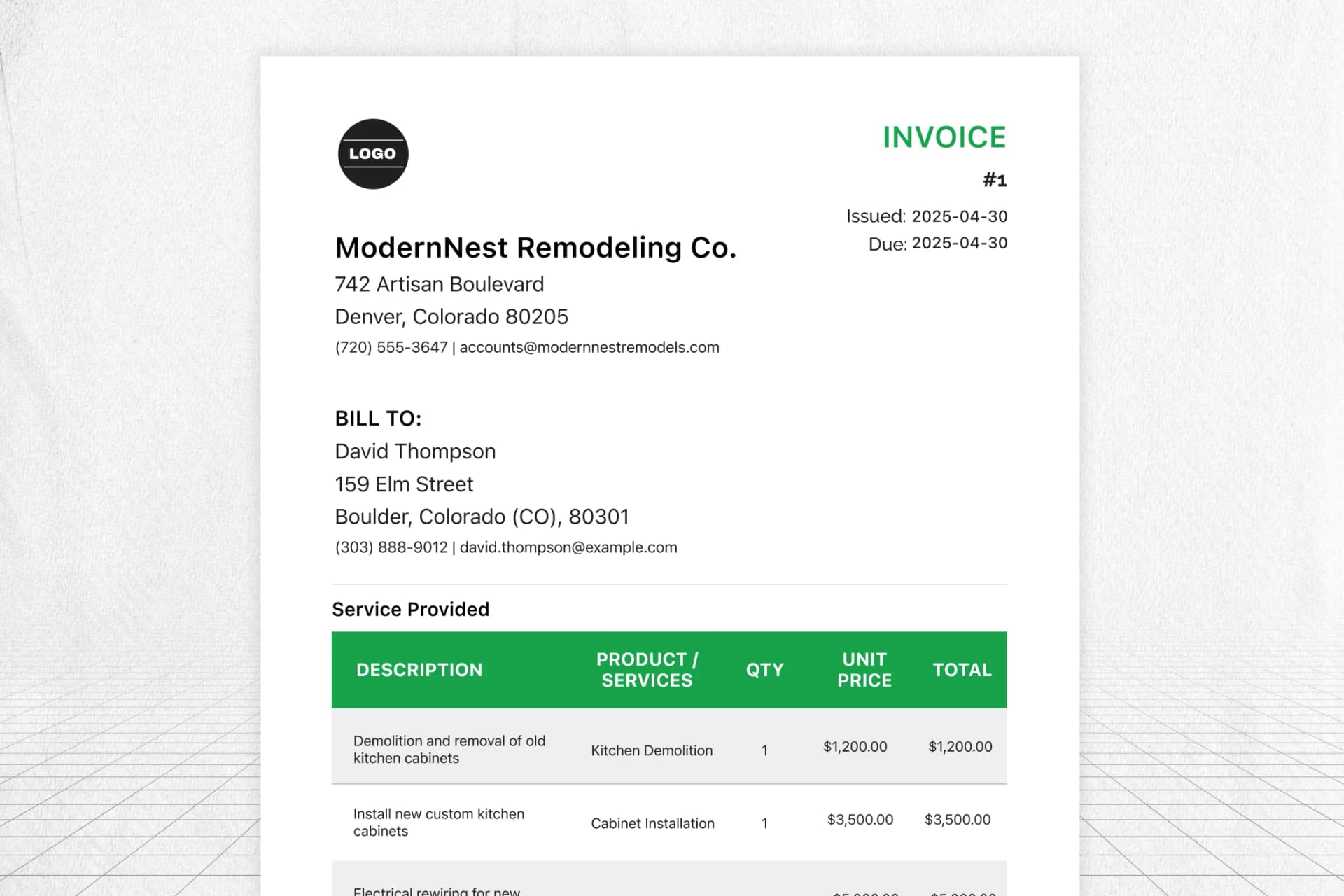
About this template
FieldCamp’s free remodeling invoice template simplifies billing for kitchen, bathroom, and full-home renovations. Easily track labor costs, material expenses, and project milestones with a professional layout that helps you get paid faster and maintain organized records.
Download it instantly and customize it with your business details. Keep your invoicing process organized and your cash flow healthy with just a few clicks.
Key Features
- Professional remodeling invoice PDF layout
- Auto-calc labor & materials in contractor format
- Free invoice template for contractors, printable
- Customizable fields for any project size
,
|
INVOICE
#1
Issued: 2026-04-11
Due: 2026-04-11
BILL TO:
Services Provided
| DESCRIPTION | PRODUCT / SERVICE | QTY | UNIT PRICE | TOTAL |
|---|---|---|---|---|
| Complete cabinet setup with custom fitting | Kitchen Cabinet Installation | 1 | $2.00 | $2.00 |
| Professional tile installation & floor finishing | Bathroom Tile & Flooring | 1 | $1.00 | $1.00 |
| Safe wiring updates and fixture installation | Electrical Work & Fixtures | 1 | $680.00 | $680.00 |
Professional Invoices for Remodeling Teams
FieldCamp’s remodeling invoice template serves independent contractors, small business owners, and construction teams handling home renovation projects. Whether you’re managing kitchen remodels, bathroom renovations, or complete home makeovers, this construction invoice template helps you detail labor professionally.
Perfect for contractors who need to track payments, organize construction invoices, and maintain clear client communication throughout complex remodeling projects. Send professional invoices that reflect the quality of your construction work from the job site to the final billing.
How to Use FieldCamp’s Remodeling Invoice Template
1. Download and Customize
Get your free remodeling invoice template and add your company name, address, phone number, email, and contractor license number. Upload your logo so every invoice carries your brand. If you specialize in a particular type of renovation (kitchens, bathrooms, basements) you can save different versions of the template for each.
2. Add Client Information
Include the client’s full name, billing address, and contact details. For remodeling jobs, always list the project address separately if it’s different from the billing address. Add the project name or description (e.g., “Master Bathroom Renovation — 123 Oak Street”) so the client can immediately identify which project the invoice covers. This matters when homeowners are running multiple renovations or when you’re billing a property management company.
3. Itemize Services and Materials
This is where remodeling invoices differ from simple service invoices. Renovation projects involve multiple trades, phases, and material categories. Break everything down clearly.
Labor by trade:
- Demolition crew hours
- Framing and carpentry
- Electrical rough-in and finish
- Plumbing rough-in and finish
- Drywall installation and finishing
- Tile and flooring installation
- Painting (prep, prime, and finish coats)
- Cabinet and countertop installation
- Trim and finish carpentry
Materials by category:
- Lumber and framing materials
- Electrical supplies (wire, outlets, panels, fixtures)
- Plumbing supplies (pipes, fittings, fixtures)
- Drywall, tape, and mud
- Tile, grout, and backer board
- Flooring materials
- Cabinets and hardware
- Countertops
- Paint and finishing supplies
Other charges:
- Permit fees (pass-through)
- Inspection fees
- Dumpster rental and debris hauling
- Subcontractor invoices (with markup if applicable)
- Equipment rental (scaffolding, lifts, specialty tools)
4. Set Payment Terms
Remodeling projects run weeks or months, so payment terms matter more than on a one-day job. Specify the due date, accepted payment methods (check, credit card, bank transfer, online payment), and your late payment policy. For larger projects, define your draw schedule: what percentage is due at each milestone (see the Progress Billing section below).
5. Send Invoices Promptly
Send the invoice within 24 hours of completing a phase or reaching a milestone. The longer you wait, the longer you wait to get paid. Email a PDF directly to the client, or use FieldCamp to send, track, and follow up automatically. Learn how to create and manage invoices inside FieldCamp.
What to Include in a Remodeling Invoice
Remodeling invoices are more complex than a standard service invoice because renovation projects involve multiple phases, trades, and material categories. Here’s everything that belongs on a complete remodeling invoice:
| Invoice Element | What to Include | Why It Matters |
| Business info | Company name, address, phone, email, logo, contractor license # | Establishes credibility and legal identity |
| Client details | Name, billing address, project address, phone, email | Ensures correct billing and project identification |
| Project name | Descriptive title (“Kitchen Renovation — 456 Elm St”) | Identifies which project when clients have multiple |
| Invoice number | Sequential number (e.g., REM-0034) | Tracks payments and simplifies bookkeeping |
| Invoice date | Date the invoice was issued | Sets the billing timeline |
| Due date | Specific payment deadline | Prevents ambiguity about when to pay |
| Project phase | Which milestone does this invoice cover (e.g., “Phase 2: Rough-In”) | Ties payment to completed work |
| Labor breakdown | Hours per trade, hourly rates, or flat rates per phase | Shows where labor costs are going |
| Materials list | Each material with quantity, unit price, and total | Prevents disputes over material costs |
| Subcontractor charges | Specialty work (electrical, plumbing, HVAC) with costs | Documents third-party work included in the project |
| Permit and inspection fees | Building permits, inspection costs (pass-through) | Shows these are required costs, not markups |
| Change orders | Any approved scope changes with associated costs | Documents agreed-upon additions to the original scope |
| Subtotal | Sum of all charges before tax | Let the client review before the final total |
| Taxes | Applicable sales tax with rate displayed | Keeps you legally compliant |
| Retainage (if applicable) | Percentage held until completion (typically 5-10%) | Common on larger renovation contracts |
| Total due on this invoice | Amount owed for this billing period | Clear, bold, unmistakable |
| Cumulative project total | Running total of all invoices to date | Helps client track overall project spending |
| Payment methods | Cash, check, credit card, bank transfer, online | Makes it easy for the client to pay |
| Late payment terms | Fee amount and when it applies | Discourages overdue payments |
| Notes | Warranty info, next phase timeline, punch list items | Keeps communication clear and documented |
Remodeling Invoice Pricing Guide
Accurate pricing is the foundation of every remodeling invoice. Here’s what the numbers look like in 2026.
Average Remodeling Costs by Project Type
| Project Type | Average Cost Range | Typical Duration |
| Kitchen remodel (mid-range) | $25,000 – $55,000 | 6 – 10 weeks |
| Kitchen remodel (upscale) | $60,000 – $130,000+ | 10 – 16 weeks |
| Bathroom remodel (mid-range) | $12,000 – $28,000 | 3 – 6 weeks |
| Bathroom remodel (upscale) | $30,000 – $65,000+ | 5 – 10 weeks |
| Basement finishing | $20,000 – $50,000 | 4 – 8 weeks |
| Whole-home renovation | $100,000 – $300,000+ | 3 – 8 months |
| Room addition | $40,000 – $100,000+ | 6 – 14 weeks |
| Deck or patio build | $8,000 – $25,000 | 1 – 3 weeks |
| Garage conversion | $15,000 – $40,000 | 4 – 8 weeks |
Labor Cost Breakdown by Trade
| Trade | Hourly Rate Range | Typical % of Project Cost |
| General labor/demolition | $20 – $35/hr | 5 – 10% |
| Framing/carpentry | $35 – $60/hr | 10 – 15% |
| Electrical | $50 – $100/hr | 8 – 12% |
| Plumbing | $50 – $100/hr | 8 – 12% |
| HVAC | $55 – $95/hr | 5 – 10% |
| Drywall | $30 – $50/hr | 5 – 8% |
| Tile installation | $40 – $70/hr | 5 – 10% |
| Painting | $30 – $55/hr | 5 – 8% |
| Cabinet installation | $40 – $65/hr | 3 – 5% |
| Finish carpentry/trim | $40 – $70/hr | 3 – 5% |
Markup and Profit Margins
- Material markup: 15 – 25% on materials you source and supply
- Subcontractor markup: 10 – 20% on subcontracted work you manage
- Overhead allocation: 10 – 15% to cover insurance, vehicle, office, and admin costs
- Target net profit: 8 – 15% on mid-range projects, 12 – 20% on upscale/custom work
- Change order markup: 15 – 30% (change orders disrupt the workflow, so higher margins are justified)
Progress Billing / Draw Schedule
Most remodeling contractors don’t wait until the end of a project to invoice. Instead, they bill at milestones. Here’s a standard draw schedule:
| Milestone | % of Contract | What It Covers |
| Deposit/mobilization | 10 – 15% | Permits, material ordering, project setup |
| Demolition complete | 10 – 15% | Tear-out, debris removal, site prep |
| Rough-in complete | 20 – 25% | Framing, electrical, plumbing, HVAC rough-in |
| Drywall and insulation | 15 – 20% | Insulation, drywall hang, tape, and mud |
| Finish work | 20 – 25% | Cabinets, countertops, tile, flooring, paint, trim |
| Final walkthrough/punch list | 5 – 10% | Touch-ups, corrections, final inspection, and cleanup |
This schedule protects both you and the client. You get paid as work is completed, and the client doesn’t pay for work that hasn’t been done. Use FieldCamp’s service price calculator to build accurate quotes before starting any project.
Create Remodeling Invoices That Get You Paid Faster
Transform your basic remodeling invoice template into a powerful billing tool that matches your exact workflow. These customization options help you create professional invoices that reflect your brand and streamline your payment process.
Automate business information – Pre-fill your company details, logo, and contact information to match your business needs across every invoice.
Set unique invoice numbers – Generate sequential invoice numbers to organize your billing and maintain professional records for work completed.
Configure multiple payment methods – Accept credit cards, checks, bank transfers, and online payments to make it easier for clients to pay quickly.
Schedule automatic reminders – Send payment reminders for unpaid invoices without manual follow-up, improving your collection process.
Track project details – Document work completed with detailed descriptions, photos, and milestone updates that match your invoicing features.
Send invoices instantly – Email professional invoices directly from the template or print for on-site delivery to maintain consistent communication.
Built for Every Type of Remodeling Project
Remodeling covers everything from a weekend bathroom refresh to a year-long whole-home gut renovation. Your invoicing needs to be flexible enough to handle all of it.
Kitchen remodels: The most invoice-intensive renovation type. Track cabinets, countertops, appliances, backsplash tile, lighting fixtures, plumbing fixtures, and flooring as separate material line items. Labor includes demolition, rough-in for multiple trades, installation, and finish work. Most kitchen remodels require 4-6 progress invoices over the life of the project.
Bathroom renovations: Smaller scope but detail-heavy. Itemize tile (floor and wall separately), fixtures (vanity, toilet, shower/tub), plumbing modifications, electrical (GFCI outlets, exhaust fan, lighting), and waterproofing. Bathrooms are where change orders happen most. Clients upgrade fixtures mid-project, so document every change on the invoice.
Basement finishing: Unique cost categories: moisture mitigation, egress windows, sump pump installation, and code-required fire separation. These aren’t standard line items on a generic invoice template, which is why a remodeling-specific template matters.
Whole-home renovations: Multiple phases, multiple subcontractors, and running project totals that can exceed six figures. Use progress billing with clear milestones, and include a cumulative total on every invoice so the client can track spending against the contract amount.
FieldCamp’s remodeling software connects your invoices directly to job schedules, client records, and team dispatching. Finish a phase, generate an invoice from the job details, and send it while you’re still on site.
Remodel Your Billing Process
Stop relying on handwritten notes. Use FieldCamp’s remodeling invoice template to organize costs, apply taxes, and set professional payment terms.
Frequently Asked Questions
How to create a construction invoice vs a remodeling invoice?
While general construction invoices focus on new builds and large-scale projects, remodeling invoices require specific details for renovation work. Use FieldCamp’s remodeling invoice template to include renovation-specific elements like existing structure modifications, permit requirements, and phased completion milestones that standard construction templates miss.
How can I customize a free remodeling invoice template for different projects?
Customize your template by creating project-specific sections for kitchen renovations, bathroom remodels, or whole-home updates. Adjust line items for specialty work, modify payment schedules for project phases, and include relevant permits or inspections. Save customized versions for different project types to streamline future billing.
What are the best practices for listing costs and labor in my invoice?
Break down labor costs by trade (plumbing, electrical, carpentry), list material costs separately with quantities, and include detailed descriptions for each service. Add labor hours worked, hourly rates, and total costs. Use clear categories and avoid bundling different types of work, and maintain transparency with clients by offering straightforward payment options.
How can I ensure my remodeling invoice template includes all the details?
Use a comprehensive checklist covering client information, project address, detailed work descriptions, material specifications, labor breakdown, permit costs, cleanup fees, and warranty information. Include invoice date, payment terms, accepted payment methods, and your business license information to create complete, professional billing documents.
Can I track payments using this invoice template?
While our free template helps you organize invoices and add payment status manually, FieldCamp’s AI-powered remodeling software takes payment tracking to the next level. Get real-time payment notifications, automated follow-ups for overdue invoices, and complete financial dashboards that show your cash flow at a glance. Plus, your clients can pay instantly through secure online portals, and you’ll never lose track of who owes what. Upgrade from basic templates to smart automation that grows your remodeling business.
How often should I send invoices for remodeling projects?
Send invoices promptly upon completing work phases or project milestones. For larger projects, consider progress billing to maintain steady cash flow throughout the construction project timeline.
How can I create invoices faster for my remodeling business?
Use FieldCamp’s invoice software to streamline the invoicing process. Templates with automatic calculations, client information storage, and professional layouts help small business owners create invoices faster and focus on construction work rather than paperwork.