
AI Dispatcher ROI Calculator for Cost Clarity
Invalid Date - 12 min read

Invalid Date - 12 min read

Table of Contents
It’s 8:47 AM on a Tuesday, and your dispatcher is already juggling six phone calls while trying to reroute three technicians because an emergency HVAC call just came in.
Meanwhile, your best tech is sitting in traffic for 35 minutes between jobs, burning fuel and daylight.
Sound familiar?
Most field service owners are unaware that inefficient dispatching is quietly draining $15,000 to $50,000 from their bottom line every year. That’s money lost to wasted fuel, excessive drive time, missed appointments, and dispatchers too overwhelmed to focus on actual field service automation or business growth.
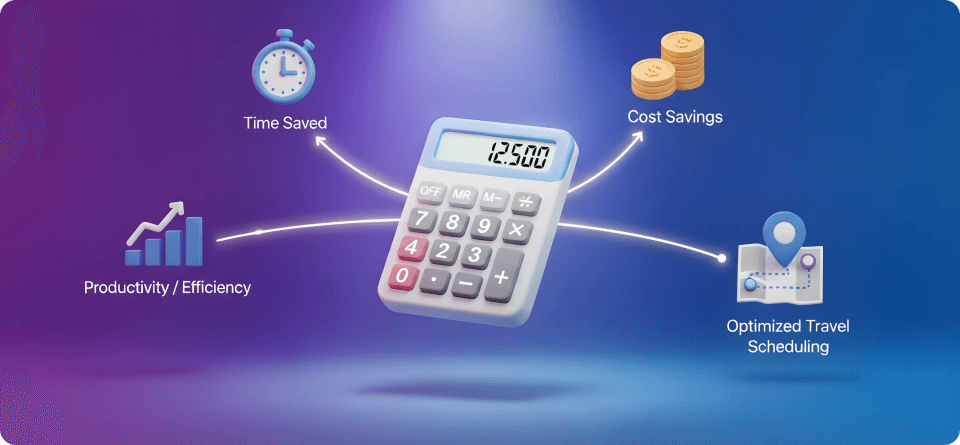
But what if you could see exactly where every dollar is going and calculate precisely how much you could save with smarter dispatching? The AI Dispatcher ROI Calculator can help you to do so.
In this guide, we will show you exactly how to calculate your AI dispatcher ROI calculator across four critical areas: drive time cost savings, revenue optimization, dispatcher productivity gains, and customer satisfaction improvements.
AI dispatcher ROI measures how much financial value your field service business gains by switching from manual to automated technician scheduling, AI-powered dispatch decisions.
Traditional dispatching depends on:
AI dispatching uses machine learning to optimize job assignment automatically.
Industry research shows that AI dispatching delivers an average ROI of 340% in the first year, with many companies seeing payback within 3–6 months.What is AI Dispatcher ROI and Why It Matters for Field Service Businesses?
Drive time represents one of the most significant hidden costs in field service operations. Every minute your technicians spend behind the wheel is time they are not generating revenue, yet you are still paying for labor, fuel, and vehicle depreciation. Manual dispatching often results in inefficient routing, backtracking, and poorly sequenced job assignments, wasting hours daily.
Let’s break down the real costs of excessive drive time for a typical field service business:
| Cost Category | Manual Dispatching | AI Dispatching |
| Daily drive time per tech | 2.5 hours | 1.9 hours |
| Monthly fuel cost (5 techs) | $3,200 | $2,400 |
| Annual labor cost (drive time) | $78,000 | $59,280 |
| Annual savings | — | $28,320 |
Curious how AI dispatching actually outperforms traditional software in real operations? Check out our detailed comparison here → AI Dispatching vs Traditional Dispatch Software.
FieldCamp’s AI dispatching software uses trained machine learning models and algorithms to continuously optimize routes based on real-time traffic conditions, technician locations, job priorities, and historical service duration data. The system considers multiple variables simultaneously that would be impossible for human dispatchers to process:
Contact us, and FieldCamp will help you decrease the drive time by up to 25%, helping you to attend more jobs.
While cost reduction is essential, the real financial impact of AI dispatching comes from revenue optimization. Manual dispatching often treats all jobs equally or prioritizes them based on simple rules, such as a first-come, first-served approach. This approach leaves significant revenue on the table by failing to consider job profitability, customer lifetime value, and resource utilization.
FieldCamp’s AI dispatcher analyzes multiple revenue factors to maximize your daily earning potential:
The revenue optimization benefits vary by service industry and job type. Emergency services, scheduled maintenance, and project work each respond differently to AI dispatching:
| Service Type | Avg Job Value | Extra Jobs/Day | Revenue Gain (/mo) |
| HVAC Emergency | $485 | 2.1 | $21,435 |
| Plumbing Repair | $325 | 1.8 | $12,285 |
| Electrical Service | $295 | 1.6 | $9,912 |
| IT Support | $185 | 2.4 | $9,324 |
Note: These calculations assume a team of 5 technicians working 21 days per month. Your specific results will vary based on your service area, job mix, pricing structure, and the efficiency of your technicians.
Manual dispatching is extraordinarily time-consuming. Dispatchers spend hours daily on repetitive tasks, such as checking technician availability, calling customers to confirm appointments, adjusting schedules when emergencies arise, and fielding calls from technicians regarding their subsequent assignments. This constant reactive work prevents dispatchers from focusing on strategic activities that actually drive business growth.
FieldCamp’s AI dispatcher automates the majority of manual dispatching work by eliminating the need for manual decision-making. When a new job arrives, the system instantly:
What previously required 8 to 12 minutes of dispatcher time per job now happens in milliseconds. For a field service business handling 50 jobs daily, this represents 7 to 10 hours of dispatcher time saved daily, 35 to 50 hours saved weekly, and 1820 to 2600 hours saved annually.
When dispatchers are freed from constant schedule management, they can focus on high-value activities that directly impact your bottom line:
The productivity gains from AI dispatching extend beyond just time savings. Dispatcher stress and burnout decrease significantly when they are no longer juggling constant schedule changes and emergency calls.
This leads to better retention, higher job satisfaction, and improved decision-making quality. Businesses using FieldCamp reporting and analysis have found that dispatcher turnover decreases by an average of 40% after implementation, resulting in substantial savings on recruitment and training costs.
For a field service company with 2 full-time dispatchers earning $45,000 annually plus benefits, the productivity gains translate to measurable cost savings or capacity expansion:
Option 1: Maintain current staff, expand service capacity by 40-60%
Option 2: Reduce staffing by 1 position, save $58,500 annually (salary + benefits)
Option 3: Reallocate dispatcher time to customer success roles, increase retention revenue by $125,000+ annually
The financial benefits of AI dispatching extend far beyond immediate cost savings and efficiency gains. The most significant long-term impact comes from improved customer satisfaction, which drives repeat business, referrals, and premium pricing power. Field service businesses using FieldCamp’s AI dispatcher report substantial improvements across all major customer satisfaction metrics.
AI dispatching directly addresses the top customer complaints in field service:
Research in the field service industry consistently demonstrates that customer satisfaction has a direct and measurable impact on revenue. Here’s how the improvements from AI dispatching translate to financial gains:
A 5% improvement in customer retention typically increases profits by 25-95% according to Harvard Business Review research. For a field service company with 500 active customers generating $2,500 annually per customer, improving retention from 85% to 90% results in additional customers retained (25 customers), additional annual revenue ($62500), and cumulative 5-year value: ($343,750, accounting for customer lifetime value)
Satisfied customers refer others. FieldCamp users report that improving satisfaction scores from 3.8 to 4.6 stars increases referral rates from 12% to 23% among customers, resulting in a 10% increase in new customer acquisition for a business that typically acquires 100 new customers annually. Additional referral-based customers are 11 per year, and the marketing cost saved $440 per referred customer.
Companies with superior customer satisfaction can command premium pricing. Field service businesses using FieldCamp report being able to charge 8-12% more than competitors due to their reputation for reliability and responsiveness. At $1 million in annual revenue, this represents an additional margin of $80,000 to $120,000 per year.
The financial case for implementing FieldCamp’s AI dispatcher is compelling across every dimension of field service operations. From immediate cost savings in fuel and labor to long-term revenue growth from improved customer satisfaction, the return on investment typically exceeds 300% in the first year alone.
What makes FieldCamp particularly valuable is the speed of implementation and time to value. Unlike traditional field service management software that requires months of configuration and training, FieldCamp’s AI learns your business patterns within the first few weeks and begins optimizing automatically. Most customers see measurable improvements in efficiency within 30 days.
Whether you’re a small operation with 3-5 technicians or a regional service company with 50+ field employees, the FieldCamp AI Dispatcher ROI Calculator will show you exactly what’s possible for your business.
ranked by importance, and tags provide granular control for specific situations. If a commercial client needs same-day service, FieldCamp adjusts accordingly without disrupting other commitments.
Most FieldCamp customers experience measurable improvements within 30 days of implementation, with full ROI typically achieved within 3 to 6 months. Drive time reductions and additional job capacity are immediately visible, while customer satisfaction improvements compound over quarters.
Traditional field service management software requires manual scheduling decisions—you’re still doing the work, just with better tools. FieldCamp’s AI dispatcher actually makes the decisions for you, using machine learning to automatically assign jobs, optimize routes, and adjust schedules in real-time based on 50+ variables simultaneously.
No. FieldCamp integrates with most existing CRM, accounting, and business systems. Many customers start with just AI dispatching and expand to other FieldCamp features as they see results. Implementation typically takes 2-3 weeks, not months.
FieldCamp’s AI dispatcher is proven across HVAC, plumbing, electrical, appliance repair, IT support, pest control, and dozens of other field service industries. The system learns your specific business patterns—whether you handle mostly emergencies, scheduled maintenance, or project work—and optimizes accordingly.
FieldCamp moves beyond digitization and brings true AI-driven decision-making. It automatically matches technicians to jobs based on skills, zones, tools, history, and availability. It also offers real-time rescheduling, priority-based assignments, and a Command Center where managers run operations through simple natural-language instructions.
FieldCamp pricing starts at $99/month for small teams (3-5 technicians) and scales based on team size. For most businesses, the monthly subscription is recovered in saved fuel costs alone within the first week. The calculator will provide you with exact pricing and ROI projections tailored to your specific operation.
This is one of the most common concerns we hear—and it’s rarely an issue in practice. Dispatchers quickly embrace FieldCamp because it eliminates the stressful, repetitive aspects of their job (constant schedule juggling, emergency rerouting) while allowing them to focus on customer relationships and strategic work. Most tell us they wouldn’t go back to manual dispatching for any amount of money.
Yes! FieldCamp offers a 14-day free trial with full AI dispatching capabilities. You can also book a personalized demo where we’ll use your actual business data to show you exactly how much time and money you could save. There’s zero risk—and you’ll have concrete ROI numbers before making any decision.