


Certifications & Qualifications in AI Dispatch: A Complete Guide
At 9:47 AM, a gas furnace repair request hits your dispatch board. Your closest technician is 8 minutes away. Your most experienced HVAC tech is 25 minutes out.
That’s an easy call, right? Send the closer tech.
Except he doesn’t have an EPA 608 certification or a gas line permit. Now you’re looking at a compliance violation, a failed inspection, and a potential safety incident.
Certification-based dispatching is the process of treating technician certifications as hard constraints, non-negotiable requirements that AI validates before any job assignment happens. Instead of relying on dispatcher memory, the system checks credentials, expiration dates, and job-specific requirements in 50–100 milliseconds. Unqualified technicians are eliminated instantly.
This is fundamentally different from how traditional dispatch software works.
A manual dispatching system prioritizes proximity.
AI dispatching system prioritizes compliance first, always.
This guide explains how AI validates certifications, the difference between certifications and skills, what happens when no qualified tech exists, and how expiry tracking prevents violations automatically.
Prefer listening? Hear this guide in podcast form:
Certification vs. Skill: Understanding the Taxonomy
Before diving into how AI handles certifications, you need to understand the critical distinction between certifications and skills in dispatching logic.
This distinction determines whether AI eliminates a technician from consideration (certification) or ranks them lower (skill).
What Makes Certifications Different
Certifications are legally required, time-limited, and regulatory. They represent credentials issued by government agencies, industry bodies, or regulatory organizations. Without them, a technician cannot legally perform certain work.
Common examples include:
- EPA 608 certification (refrigerant handling)
- State electrical licenses
- Backflow prevention certification
- Gas line permits
- Medical gas installer certification
Skills are experience-based preferences. They represent what a technician is good at, not what they’re legally authorized to do.
Examples include:
- “Good with Carrier units.”
- “Fast diagnostic ability”
- “Customer-friendly demeanor”
- “Experienced with commercial systems.”
How AI Treats Each Differently
| Attribute | Certification | Skill |
| Constraint Type | Hard (pass/fail) | Soft (scoring factor) |
| Validation | Binary, has it or doesn’t | Weighted preference |
| Expiration | Time-limited, must be current | No expiration |
| Legal Requirement | Often mandated by law | Business preference |
| AI Treatment | Eliminates ineligible techs instantly | Ranks qualified techs |
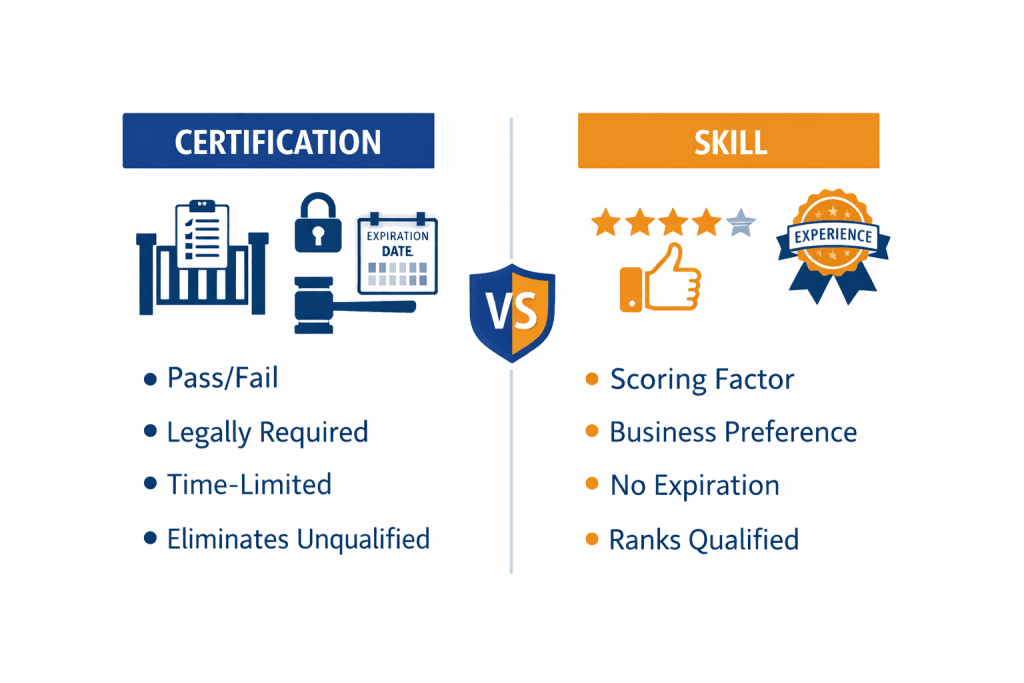
AI treats certifications as pass/fail gates in the feasibility check. If a technician lacks the required certification, they’re eliminated from consideration, period. Skills, on the other hand, are used to rank technicians who have already passed the certification check.
Real-World Example: HVAC Scenario
Consider a job requiring EPA 608 Universal certification:
- Tech A has EPA 608 Type I (not sufficient for this job type) → Eliminated
- Tech B has EPA 608 Universal, but it expired 3 months ago → Eliminated
- Tech C has valid EPA 608 Universal + 15 years experience → Qualified
Only Tech C enters the optimization pool. From there, the AI considers skills, proximity, workload, and other soft constraints to determine if Tech C is the best match.
For a deeper look at how AI weighs hard vs. soft constraints, see our guide to how AI dispatching thinks.
The Feasibility Check Layer: How AI Validates Certifications
The certification validation process runs in five distinct steps, each of which completes in milliseconds.
The 5-Step Validation Process
When a job arrives in FieldCamp’s AI dispatching system, certification validation happens in a specific sequence:
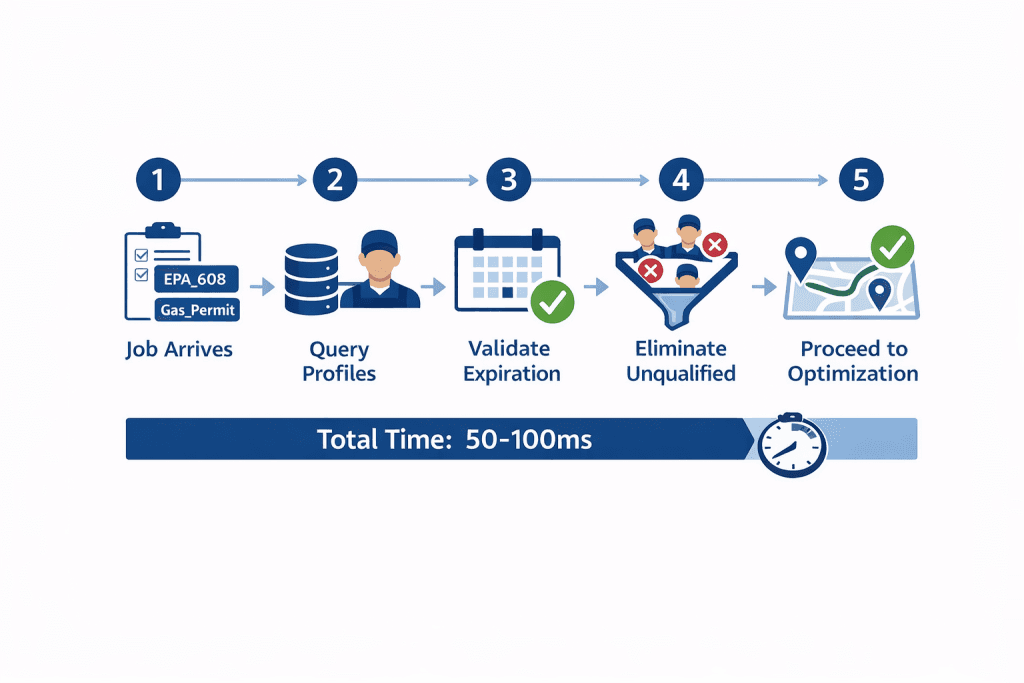
1. Job arrives with required certification tags (e.g., EPA_608, Gas_Line_Permit, Backflow_Cert)
2. AI queries technician profiles for matching certification IDs
3. System validates expiration dates against the current timestamp
4. Technicians without valid certifications are instantly excluded
5. Only qualified technicians proceed to constraint programming and route optimization
This entire process completes in 50–100ms, faster than a human dispatcher can even read the job requirements.
Why Speed Matters
The sub-100-ms validation window eliminates impossible matches before route optimization begins. The system reduces computation time and ensures dispatchers only see viable options.
Expiry Tracking Is Automatic
The system doesn’t just check if a technician “has” a certification. It validates the expiration date against the job date. This means:
- A certification expiring tomorrow is still valid for today’s job
- A certification that expired yesterday makes the technician ineligible
- Upcoming expirations can trigger proactive alerts
Plumbing Scenario: Backflow Testing
Here’s how the feasibility check works for a backflow testing job:
Job Requirement: Backflow certification
Technician Pool: 5 plumbers
| Technician | Certification Status | Result |
| Plumber 1 | No backflow cert | Eliminated |
| Plumber 2 | Backflow cert expired 2024-11-15 | Eliminated |
| Plumber 3 | Backflow cert valid through 2025-12-31 | Qualified |
| Plumber 4 | Backflow cert valid through 2026-03-15 | Qualified |
| Plumber 5 | No backflow cert | Eliminated |
Result: Only Plumbers 3 and 4 enter route optimization. The AI then chooses between them based on proximity, workload, time windows, and other factors.
For the complete technical breakdown of FieldCamp’s optimization pipeline, see how AI dispatcher algorithms work.
Trade-Specific Certification Requirements
A) HVAC Certifications
HVAC work involves some of the most stringent certification requirements because refrigerant handling carries both environmental and safety risks. The three certifications that most commonly affect dispatching are:
- EPA 608 Universal – Required for handling any refrigerant. This is legally mandated by the EPA.
- Gas line permit – Required for gas furnace work in most jurisdictions
- NATE certification – Industry standard, not legally required but often customer-preferred
B) Plumbing Certifications
Plumbing certifications vary significantly by state and municipality. The most common dispatch-affecting credentials are:
- Backflow prevention certification – Required for testing and installation of backflow preventers
- Gas line permit – Required for gas appliance connections
- Medical gas installer certification – Required for healthcare facility work
C) Electrical Certifications
Electrical work carries serious safety implications. Key certifications include:
- Master Electrician license – Can pull permits, supervise journeymen
- High-voltage certification – Required for commercial/industrial panels
- Low-voltage certification – Data, telecom, security systems
D) Multi-Certification Scenario: Medical Facility Plumbing
A medical facility plumbing job typically requires multiple certifications:
- Plumbing license (general authorization)
- Backflow prevention certification (water safety)
- Medical gas installer certification (healthcare-specific work)
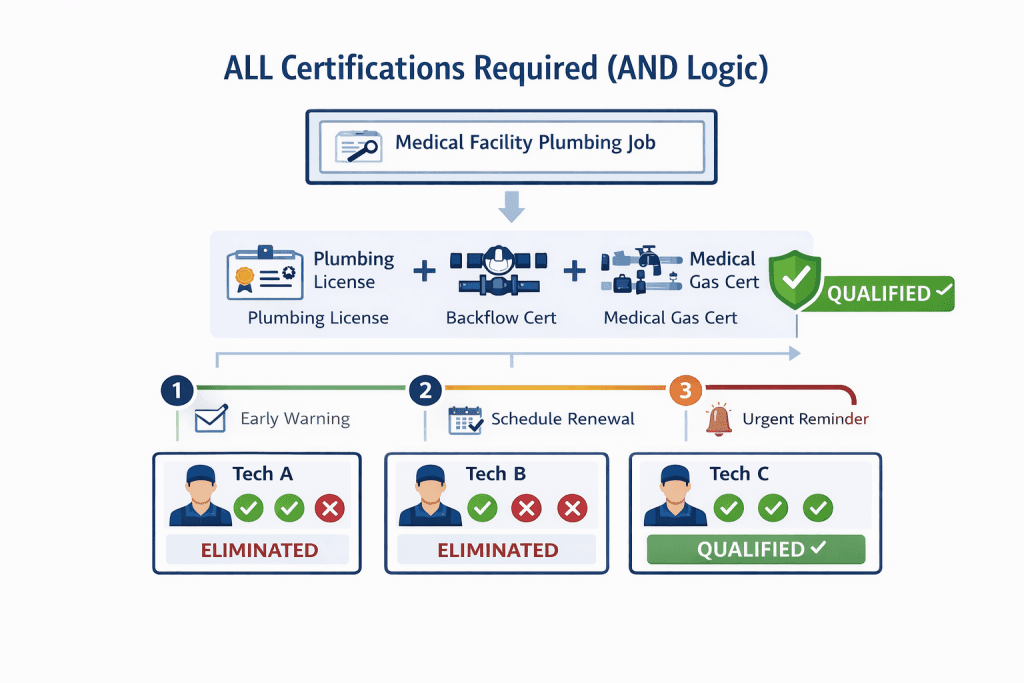
The AI checks all three. If a technician has a plumbing license + backflow cert but no medical gas certification → Eliminated from assignment pool.
The “No Qualified Tech” Scenario
When no technician in your pool has the required certification, FieldCamp’s AI doesn’t just assign the closest available person.
Instead, the job is flagged as unassigned with a “No Qualified Technician” status. It remains in the queue, visible to dispatchers, but won’t be automatically assigned.
The dispatcher receives an alert explaining exactly why the job couldn’t be assigned. This isn’t a vague “scheduling conflict” message; it specifically identifies the missing certification.
Suggested Actions
When a certification gap occurs, the system provides actionable options:
- Reschedule the job to a later date when a certified tech is available
- Identify training gaps across the team (which certifications are bottlenecks?)
- Consider subcontracting to a certified partner
- Manual override with compliance risk acknowledgment (if the business accepts the risk)
You can configure how these alerts and overrides work through admin settings.
Training Gap Analysis
Over time, AI can generate reports showing which certifications are creating bottlenecks. For example:
40% of unassigned jobs in the past month required backflow certification, but only 2 of 8 plumbers are certified.
This data helps operations managers make informed decisions about training investments.
Electrical Scenario: High-Voltage Work
A high-voltage commercial panel upgrade arrives. All 6 electricians have journeyman licenses, but none have high-voltage certification.
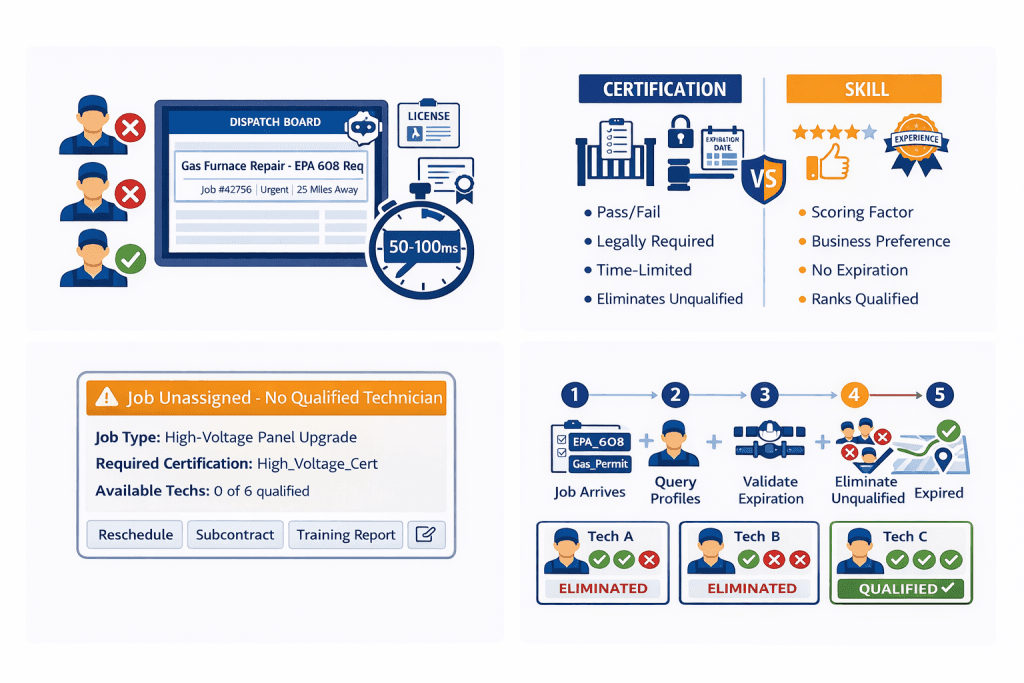
AI Response:
- Job flagged as unassigned
- Dispatcher sees alert: “0 qualified technicians available. Required: High_Voltage_Cert. Suggestion: Schedule for next week when a certified contractor is available or send for certification training.”
Certification Expiry Tracking & Compliance Protection
Expired certifications are just as problematic as missing ones. Certification expiry automation is the process by which AI dispatching systems continuously monitor certification expiration dates and prevent job assignments to technicians with expired credentials.
How Expiration Validation Works?
Every certification in FieldCamp has an expiration date field that’s checked during the feasibility layer. The system:
- Compares the certification expiration date against the job date
- Treats expired certifications as “not present” in assignment logic
- Automatically excludes technicians from relevant jobs until credentials are renewed
Technician credentials are managed through CRM profiles, where you can set expiration dates and renewal reminders.
Proactive Renewal Alerts
FieldCamp doesn’t wait until a certification expires to notify you. The system sends alerts at configurable intervals:
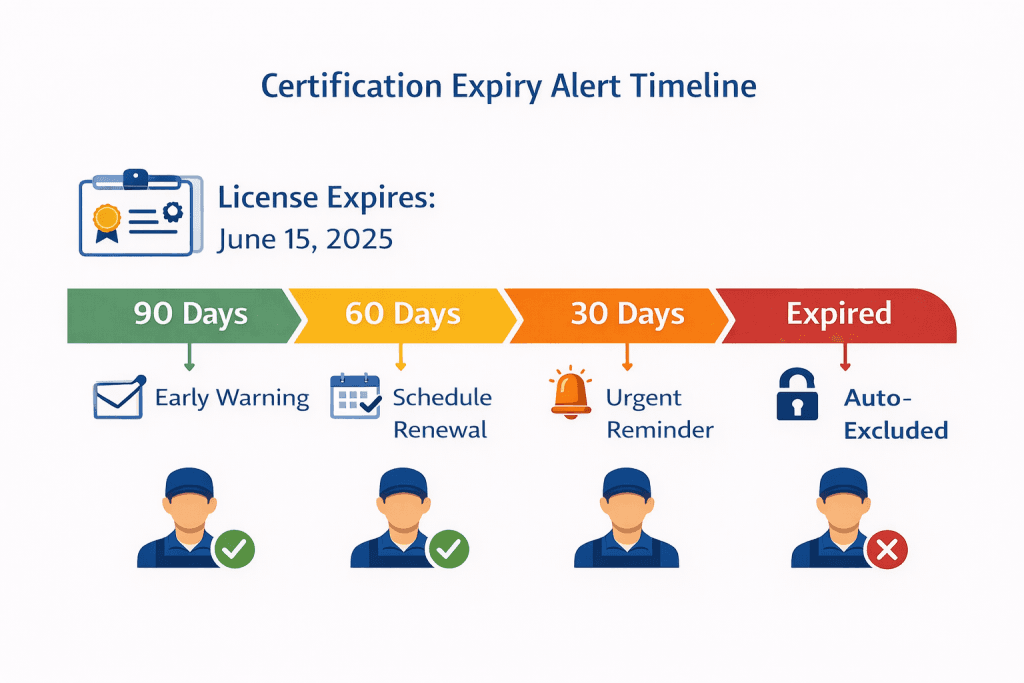
- 90 days before expiration: Early warning for certifications requiring testing
- 60 days before expiration: Time to schedule renewal courses
- 30 days before expiration: Urgent reminder
These alerts go to both the technician and operations management, ensuring nothing falls through the cracks.
Automatic Exclusion in Action
Electrical Scenario:
Tech has an electrical license expiring 2025-06-15.
- On 2025-06-14: Tech is eligible for electrical jobs
- On 2025-06-16: AI automatically excludes them from electrical jobs
- Dispatcher receives alert: “Tech #3 no longer eligible for electrical work. License expired yesterday. Renewal required.”
No manual intervention needed. No risk of accidental assignment.
Compliance Audit Trail
For regulated industries, documentation matters. FieldCamp logs all certification checks, creating an audit trail that shows:
- Which certifications were validated for each job
- The timestamp of each validation
- Any certification gaps that prevented the assignment
This documentation can be invaluable during regulatory audits or in the event of a compliance dispute.
Multi-Certification Job Logic
AI handles multi-certification requirements through AND logic; the technician must have ALL required certifications, not just one.
How AND Logic Works
When a job is tagged with multiple certification requirements, the feasibility check validates each one independently. A technician is only considered qualified if they pass ALL certification checks.
Common Multi-Certification Combinations
| Job Type | Required Certifications |
| Gas furnace repair | HVAC + EPA 608 + Gas Line Permit |
| Commercial electrical panel | Electrical License + High Voltage Cert |
| Medical facility plumbing | Plumbing License + Backflow Cert + Medical Gas Cert |
| Rooftop AC installation | HVAC + EPA 608 + Fall Protection Cert |
Commercial Electrical Panel Example
Job: Commercial panel upgrade requiring 2 certifications
| Technician | Electrical License | High Voltage Cert | Result |
| Tech A | ✓ | ✗ | Eliminated |
| Tech B | ✗ | ✓ | Eliminated |
| Tech C | ✓ | ✓ | Qualified |
Only Tech C, who has both valid certifications, enters the optimization pool.
Why This Matters for Complex Jobs
Multi-certification requirements are common in:
- Commercial HVAC: Often requires EPA certification + specific equipment certifications
- Healthcare facilities: Medical gas, backflow, and specialized plumbing certifications
- Industrial electrical: Multiple voltage-level certifications
- New construction: Combination of trade licenses and specialty certifications
Compliance-First Assignment Examples
The real value of certification-based dispatching becomes clear in scenarios where AI chooses compliance over convenience.
Scenario 1: Proximity vs. Certification
Situation:
Emergency no-heat call on gas furnace. Closest tech is 8 minutes away, but lacks a gas line permit. The next closest tech with a gas permit is 25 minutes away.
AI Decision:
Assigns to the distant tech with proper certification.
Result:
Compliant repair, no regulatory violation, customer satisfied despite longer wait.
Scenario 2: Leaving a Job Unassigned
Before: Manual dispatcher sends available plumber to backflow testing job
Problem: Plumber lacks backflow certification
Outcome: Failed inspection, customer complaint, regulatory fine
After: AI flags jothe b as unassigned
Action: Dispatcher schedules certified contractor for the next day
Outcome: Compliant service, certification gap identified for training
Scenario 3: Rerouting for Rare Certifications
Consider a medical gas leak at a hospital. Only one technician has medical gas installer certification, and they’re currently 45 minutes into a 2-hour maintenance job across town.
The AI evaluates three factors:
1. Certification requirement (medical gas cert) Hard constraint
2. Emergency priority (hospital leak) High urgency
3. Current workload (maintenance job) Lower priority
Decision: Reroute the certified technician to the emergency, reschedule their current job, and adjust the entire day’s schedule using dynamic rerouting.
Result: Critical compliance requirement met, hospital emergency addressed by qualified personnel, minimal disruption to other customers.
How FieldCamp Handles Certifications?
As explained in the feasibility check layer, FieldCamp’s certification validation occurs in the first 50–100ms of the dispatch algorithm, before route optimization begins.
This means impossible assignments are eliminated before route optimization begins, and compliance violations cannot occur.
The Validation Process
When a job enters the system:
1. Required certifications are identified from the job type configuration
2. Each technician’s certification profile is queried
3. Expiration dates are validated against the job date
4. Technicians missing any required certification are eliminated
5. Only fully qualified technicians proceed to optimization
For step-by-step setup instructions, see the dispatch documentation.
What Makes FieldCamp Different?
Unlike generic dispatching tools that treat certifications as optional “tags,” FieldCamp enforces them as hard constraints.
FieldCamp’s feasibility check runs in parallel with route optimization, while other systems check certifications sequentially (adding 200-400ms per assignment).
FieldCamp validates all certifications simultaneously, maintaining sub-100ms total processing time even for complex multi-certification jobs.
Configuration Flexibility
FieldCamp allows businesses to configure certifications with:
- Expiration dates for automatic exclusion
- Renewal alert thresholds (30/60/90 days)
- Job type mappings linking certifications to specific work
- Override permissions for emergencies (with audit logging)
The system doesn’t just prevent bad assignments; it helps operations managers identify certification gaps, plan training investments, and maintain audit-ready documentation.
Conclusion
When that 9:47 AM emergency call comes in, FieldCamp’s feasibility check ensures the assigned technician has every required certification, no dispatcher memory required, and no compliance risk. AI dispatching treats certifications as hard constraints, not optional preferences.
The system validates certification presence, expiration status, and multi-certification requirements before any technician enters the optimization pool. When no qualified technician exists, the system flags the job and alerts dispatchers rather than risking compliance violations.
Certifications are one component of a complete technician profile. Learn how to configure technician skills, certifications, and availability in our team management guide.
Every Missed Certification Check Is a Liability
Failed inspections. Fines. Lost customers. FieldCamp eliminates the risk before it starts.
Frequently Asked Questions
What’s the difference between a certification and a skill in AI dispatching?
A certification is a legally required, time-limited credential (like EPA 608 or an electrical license) that AI treats as a hard constraint; technicians without valid certifications are instantly eliminated from assignment consideration. A skill is an experience-based preference (like “good with Carrier units”) that AI uses to rank qualified technicians, but doesn’t eliminate anyone.
What happens if no technician has the required certification?
FieldCamp flags the job as unassigned and alerts the dispatcher with a “No Qualified Technician” message. The system suggests rescheduling, identifying training gaps, or manually overriding with compliance risk acknowledgment. The job won’t be automatically assigned to an unqualified technician.
How does AI prevent assigning jobs to technicians with expired certifications?
FieldCamp’s feasibility check validates certification expiration dates in 50–100ms during assignment. Expired certifications are treated as “not present,” and technicians are automatically excluded from relevant jobs until credentials are renewed. The system also sends proactive alerts 30, 60, and 90 days before expiration.
Can AI handle jobs requiring multiple certifications?
Yes. FieldCamp uses AND logic; technicians must have ALL required certifications. For example, a gas furnace repair requiring HVAC + EPA 608 + Gas Permit will only match technicians with all three valid certifications. If any certification is missing or expired, the technician is eliminated from consideration.
What happens if a technician’s certification expires mid-day while they’re already assigned to jobs?
FieldCamp’s real-time validation prevents this scenario. If a certification expires at midnight, any jobs scheduled for the following day are automatically flagged during the overnight schedule optimization. The system alerts dispatchers and suggests reassignments before the technician’s shift begins.