
Customer Preferences as Constraints: How AI Dispatching Balances Relationship Continuity with Operational Efficiency
Invalid Date - 13 min read


Invalid Date - 13 min read

Table of Contents
Your dispatcher knows Mike’s schedule is packed. What happens next?
This scenario plays out dozens of times daily in field service operations. Customers ask for specific technicians, and dispatchers have to figure out how to honor those requests without throwing the whole day’s schedule into chaos.
That’s where AI dispatch software comes in.
AI dispatching honors customer technician preferences when it’s efficient, overrides them when it’s disruptive, and always prioritizes safety, timing, and skills.
Customer preferences are treated as flexible rules, not strict requirements. AI dispatching tries to honor them whenever possible, but can override them if doing so would cause delays, overtime, or missed commitments.
This article explains how AI dispatch systems find the right balance between keeping customers happy with familiar faces and keeping your schedule efficient.
You’ll learn when preferences get honored, when they get overridden, and how to set things up so your team respects relationships without creating bottlenecks.
Rather listen? We’ve got you covered 👇
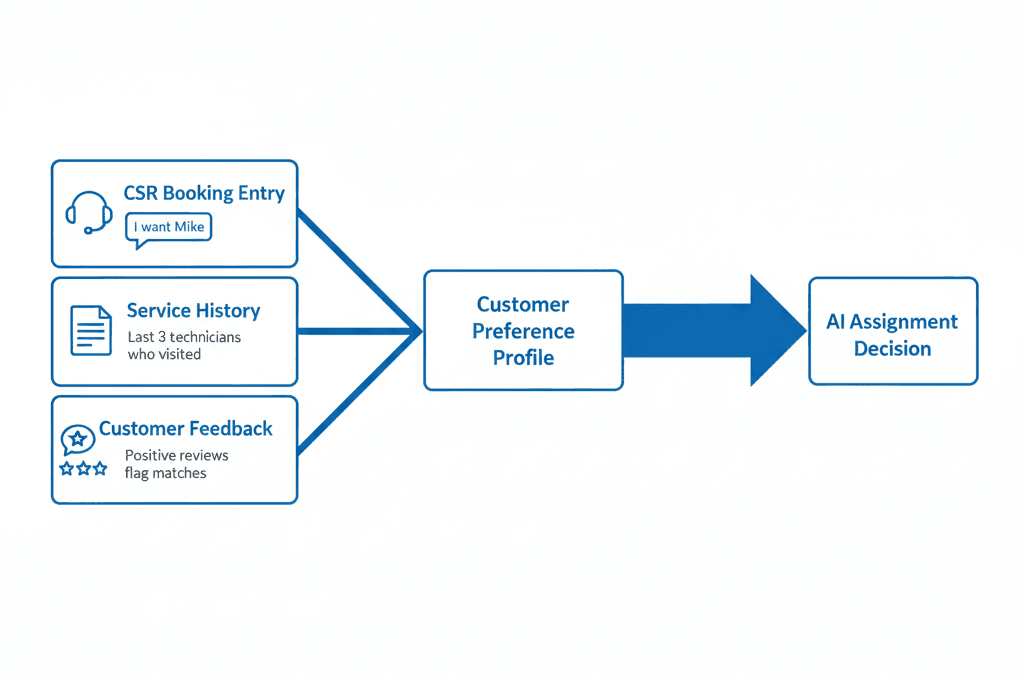
Customer preferences flow into your dispatch system through several natural channels, each one creating data that influences future assignments.
When a customer calls to schedule service, they’ll often say something like “send the same tech as last time.” This explicit request gets captured during booking and immediately flags the job for preference matching. The CSR enters this information, and the system stores it alongside the job details.
Sometimes customers are more specific: “I want Mike” or “anyone but the new guy.” These requests get documented in service notes and carry significant weight in the assignment process.
The dispatcher or CSR records these preferences, and the AI factors them into every future scheduling decision for that customer.
Positive reviews and successful callbacks automatically flag technician-customer matches as preferred. When a customer rates a technician highly or specifically mentions them in feedback, the system learns that this pairing works well.
This creates preferences naturally, without requiring the customer to explicitly ask for someone.
The system automatically pulls the last three technicians who serviced each customer as potential preferences. Even without an explicit request, the AI recognizes that familiarity matters. A customer who has seen the same tech for their last four visits likely expects to see them again.
Different trades create different preference patterns. HVAC customers often request “the tech who installed my system” because that technician understands the specific equipment configuration.
Plumbing customers want “someone who knows my old pipes” because experienced techs navigate aging infrastructure faster. Electrical customers prefer “the licensed electrician who did my panel” because complex electrical work benefits from continuity.
HVAC Annual Maintenance: A customer calls to schedule their annual furnace tune-up. The CSR sees in the service history that Sarah performed the original installation and the last two maintenance visits.
Even without the customer asking, the system automatically flags Sarah as the first preference. The AI will strongly favor this assignment unless something makes it impractical.
Plumbing Emergency: A customer calls during an emergency and explicitly requests “the tech who fixed my sewer line last month.”
The dispatcher enters Carlos as the preferred technician. The system will work hard to make this assignment happen.
For the business impact of honoring preferences, see our guide to preferred technician assignment.
Instead of forcing or ignoring preferences, the system assigns a “cost” when a preferred technician can’t be used. A small cost means the preference is easy to honor.
A higher cost means that honoring it would disrupt the schedule.
Some rules can never be broken. Others can, if there’s a good reason. Skills and safety requirements are never flexible. Customer preferences are flexible when needed.
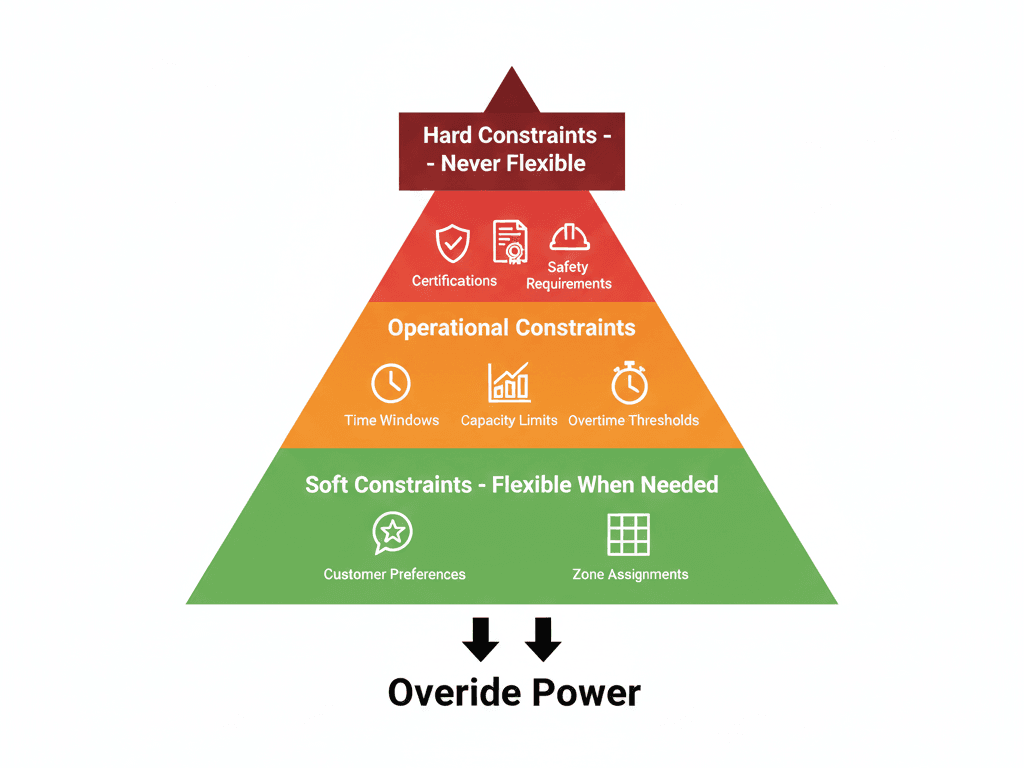
The system weighs two things: how much the customer values seeing the same technician, and how much disruption honoring that request would cause. If the relationship benefit outweighs the disruption, the preference is honored.
When a customer has multiple preferred technicians stored in the system, their position in the list determines how much weight they carry.
| Preference Order | Impact Level | What It Means |
| First choice | None | Ideal match |
| Second choice | Low | Acceptable alternative |
| Third choice | Medium | Works, but not ideal |
| No preference match | High | Relationship may be affected |
Preferences get honored when the operational cost is low:
Example: A customer requests Sarah for a furnace repair. Sarah is already scheduled in the same neighborhood, has a 90-minute gap at 2 PM, and the customer’s window is 1–4 PM. The AI assigns Sarah.
The preference costs nothing operationally, so it gets honored automatically.
Preferences get overridden when the operational cost is too high:
Example: A customer requests Sarah for an AC repair. Sarah is fully booked on the opposite side of the service area, but Mike is 10 minutes away with immediate availability. The AI assigns Mike.
The total schedule still runs better than forcing Sarah into the job and creating overtime for multiple technicians.
For more on how customer preferences fit into the broader constraint hierarchy, see our guide to how AI dispatching thinks.
Situation: Customer requests Sarah. Sarah is already scheduled for two jobs in the same neighborhood that morning.
What happens: Preference honored. Adding this job to Sarah’s route costs almost nothing in extra drive time, and the customer gets their preferred technician. Geographic clustering makes the preference essentially free to honor.
Situation: Customer requests Sarah. Sarah is fully booked with eight jobs already scheduled, all confirmed.
What happens: Preference overridden. Mike is assigned instead—same skills, available capacity, reasonable proximity. Honoring the preference would require bumping a confirmed appointment or creating significant overtime.
Situation: Customer requests Tech A for a panel upgrade. Tech A lacks the high-voltage certification required for this job. Only Tech B has the necessary license.
What happens: Skill requirement wins. Tech B is assigned regardless of customer preference. The AI simply cannot assign an unqualified technician, even if the customer specifically requests them. This is non-negotiable for safety and compliance.
For more on how skill requirements interact with other constraints, see our guide to skills-based technician assignment.
Situation: Customer requests Tech C and has a 9 AM–11 AM time window. Tech C’s earliest availability is 2 PM due to existing commitments.
What happens: Time window wins. Tech D is assigned because they can arrive at 10 AM, within the customer’s window. Missing a promised time window damages customer trust more than sending a different technician.
For more on time window trade-offs, see our guide to time window optimization.
Situation: A VIP customer with a service contract requests Carlos for an urgent furnace issue. Carlos is available but 45 minutes away. Maria is 10 minutes away.
What happens: This depends on your configuration. For VIP customers, the preference carries more weight, making the system more willing to accept the extra drive time. The system might assign Carlos despite the distance because maintaining VIP relationships is worth the operational cost.
For more on how customer preferences interact with job priority levels, see our guide to how AI prioritizes competing jobs.
| Scenario | Preferred Tech Status | Decision | Why |
| Same neighborhood | Available nearby | Honored | Low operational cost |
| Fully booked | At capacity | Overridden | Capacity constraint |
| Lacks certification | Missing required skill | Overridden | Safety requirement |
| Would miss window | Available but too late | Overridden | Time window priority |
| VIP customer | Available but far | Often honored | Relationship value |
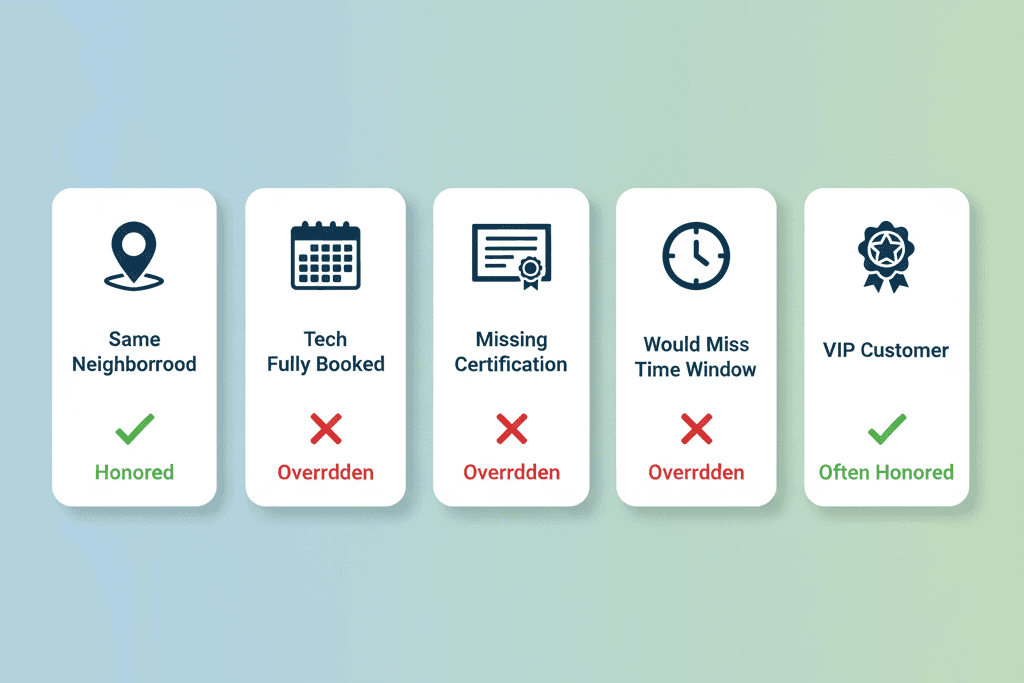
In most cases where the preferred technician is available and qualified, FieldCamp honors the preference, but intelligently overrides when operational costs are too high.
When 15 customers request the same technician on the same day, you’ve got a problem. Here’s how to handle it.
FieldCamp alerts dispatchers when preference requests exceed capacity. When more than 60% of daily jobs request the same technician, the system flags the overload and suggests alternative assignments.
This prevents bottlenecks before they disrupt the schedule.
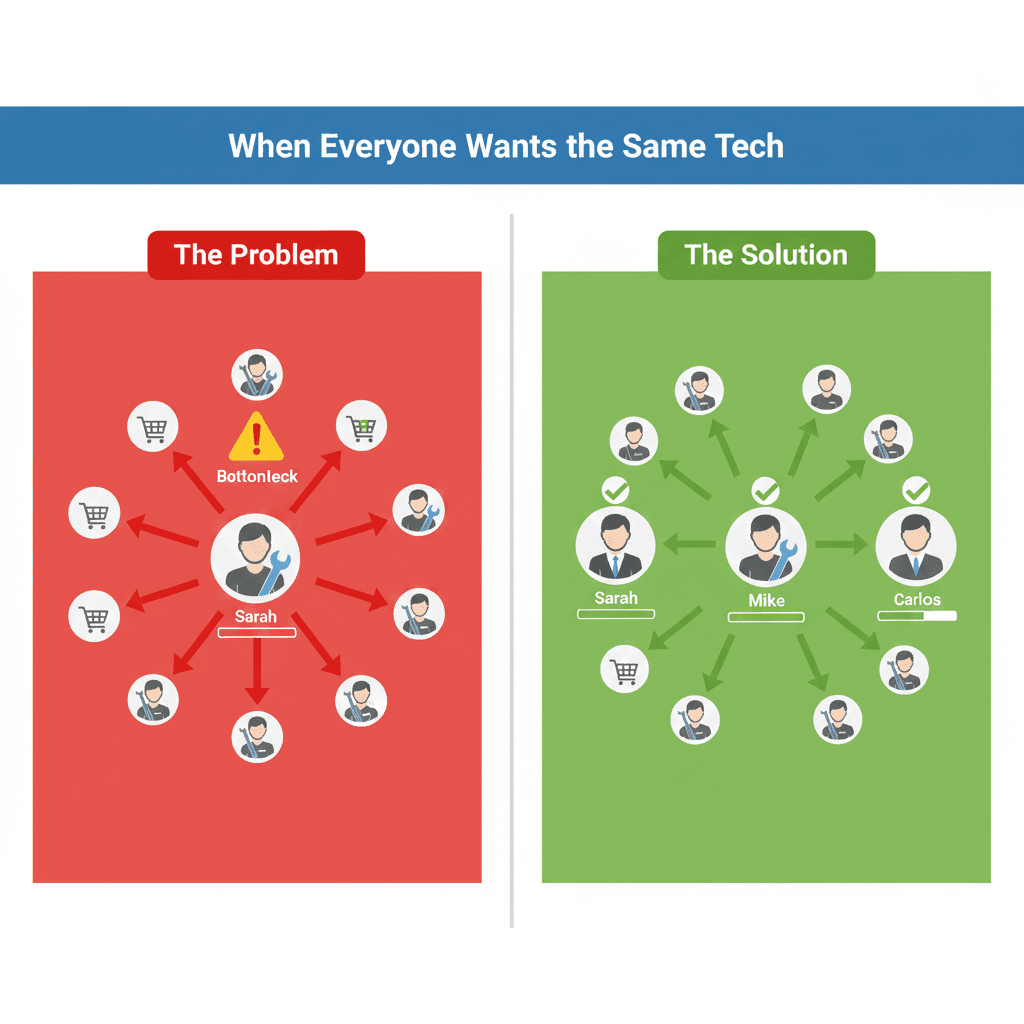
Example: Fifteen customers all prefer Sarah for same-day service. The system flags this to the dispatcher: “Sarah preference overload, 12 requests exceed capacity. Recommend distributing to Mike and Carlos with customer notification.”
The dispatcher can then proactively contact customers to explain the situation and offer alternatives, rather than scrambling at the last minute.
Reach out to customers when they explicitly requested a specific technician by name, when they’re a VIP or service contract customer, or when it’s a complex job where technician familiarity significantly impacts the outcome.
You can skip the call when it’s a system-generated preference based on service history, routine maintenance where any qualified tech can perform equally well, or the customer indicated flexibility during booking.
Preference data needs maintenance. When a technician leaves the company, the system automatically removes all preference entries for them and promotes any second-choice preferences to first choice where applicable.
This prevents scheduling errors and ensures preferences remain current without manual cleanup.
It’s also worth distinguishing between two types of preferences.
System-driven preferences, “This tech usually covers this zone,” are softer, based on efficiency patterns.
Customer-driven preferences, “I specifically want this person,” carry more weight because the customer explicitly asked. Configure different weights for each type.
Train your CSRs to set appropriate expectations when customers request specific technicians.
Good: “We’ll do our best to send Mike, but if he’s unavailable, we’ll send another certified tech who can handle your furnace.”
Not good: “We’ll definitely send Mike.”
This simple communication shift prevents disappointment when preferences can’t be honored and gives dispatchers flexibility to optimize the schedule.
For those who want to understand the technical implementation: FieldCamp stores customer-driven preferences in a prioritized list, applying escalating cost values based on match position.
The system automatically captures preferences from three sources: explicit requests entered by CSRs during booking, service history showing the last three technicians who serviced this customer, and positive feedback or callbacks that flag successful technician-customer matches.
This data populates the preference list automatically, reducing manual work while ensuring preferences are captured consistently.
When Mrs. Johnson calls requesting Mike for her boiler service, FieldCamp’s AI evaluates Mike’s schedule, proximity, and workload, then either assigns him (if operationally feasible) or flags an alternative for your dispatcher to communicate proactively.
Most of the time, customers get the technician they know. When that’s not possible, the system makes sure the alternative is qualified, on time, and explained clearly, so trust isn’t lost.
To understand how customer preferences interact with other scheduling priorities like emergencies and VIP customers, read How AI Prioritizes Competing Jobs.
FieldCamp makes sure that’s not you.
The AI assigns the next available technician with matching skills and notifies the dispatcher. You can then contact the customer to explain and offer the preferred tech for a future appointment.
Yes, by configuring the preference weight to a very high value, you can effectively force the system to honor preferences. However, this often results in longer wait times and increased overtime. FieldCamp’s default approach balances preference honoring with schedule efficiency.
FieldCamp pulls preference data from three sources: explicit requests entered by CSRs during booking, service history showing the last three technicians who serviced this customer, and positive feedback or callbacks that flag successful technician-customer matches.
The system automatically removes all preference entries for that technician and promotes any second-choice preferences to first choice. This prevents scheduling errors and ensures preferences remain current without manual cleanup.
FieldCamp flags assignments where the preferred technician wasn’t available. Your dispatcher can then proactively call or text the customer: “Mike is fully booked today, but Sarah is EPA-certified and available at 2 PM. Does that work?” This maintains transparency and trust.