
How AI Matches Jobs to Technicians (And Why It Picks the “Wrong” One)
Invalid Date - 9 min read

Invalid Date - 9 min read

Table of Contents
Tech #1 is 8 minutes away. Tech #3 is 22 minutes away. Your AI dispatcher assigns Tech #3. Is it broken?
No, it just knows something you don’t.
AI job-technician matching evaluates every possible pairing between available technicians and incoming jobs, scoring each combination across multiple dimensions: skills, location, workload, customer history, and equipment availability, to determine the optimal assignment. The system evaluates hundreds of variables in seconds to assign the right technician, even when that choice appears counterintuitive at first glance.
A manual dispatching system relies on simple rules: closest tech, first available, whoever’s free. AI dispatching evaluates 50+ variables simultaneously to find the truly optimal match, which often isn’t the obvious choice.
This guide explains what factors AI weighs, how it calculates trade-offs, and why the technician 22 minutes away might be your best option.
This concept is easier to understand when you hear it explained. Tune into the podcast below.
This section explains why proximity-based dispatching breaks under compliance and SLA pressure.
You send the closest tech to an emergency heating call. They arrive in 8 minutes, but they’re not gas-line certified. They diagnose the problem, can’t legally touch the furnace, and call it in. Another tech gets dispatched.
Your customer waited 45 minutes instead of 22. Worse, they watched someone show up, poke around, and leave without fixing anything.
The consequence: One “efficient” decision created a compliance risk, a failed visit, and an angry customer.
The business impact: That callback costs you a second truck roll, overtime risk, and a customer who now questions your competence.
This is the gap AI fills. Not by being faster, but by seeing constraints you can’t track in real time.
This section lists every factor AI weighs when matching a job to a technician.
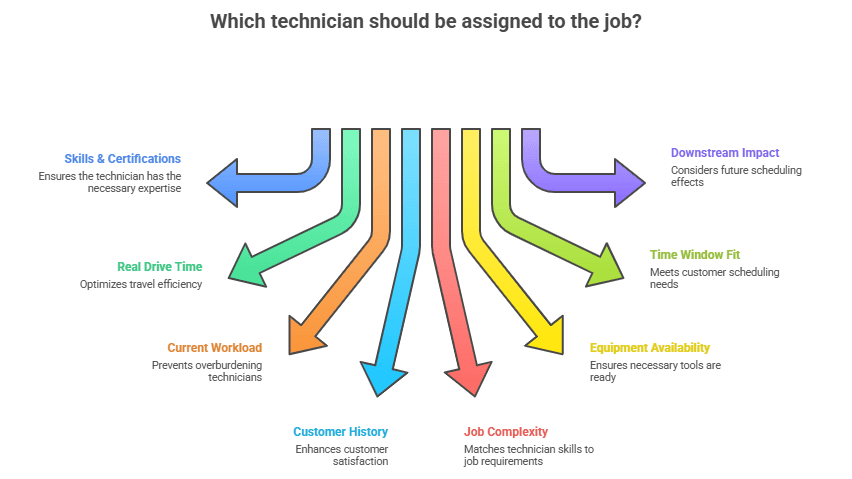
| Dimension | What AI Checks |
| Skills & Certifications | Does this tech have credentials to legally do this work? |
| Real Drive Time | Actual travel time based on GPS and live traffic—not map distance |
| Current Workload | How many jobs today? Overtime risk? |
| Customer History | Previous service? Explicit request for this tech? |
| Job Complexity | Estimated duration and first-time fix probability |
| Equipment Availability | Right tools in the truck, or depot run needed? |
| Time Window Fit | Can they arrive within the promised window? |
| Downstream Impact | Does this assignment break other commitments? |
You track maybe 10-20 of these mentally. AI evaluates all of them, every time, in seconds. For more on how AI processes these variables, see what an AI dispatcher is.
This section explains how AI distinguishes between non-negotiable requirements and trade-off factors.
Hard constraints are pass/fail. If a job requires gas certification and a tech doesn’t have it, they’re eliminated. Distance doesn’t matter. Availability doesn’t matter. They’re out.
Soft constraints can be traded off. Drive time matters, but it competes against customer history, workload balance, and first-time fix probability. AI finds the best combination, not the best single metric.
The trade-off principle: AI sacrifices something on every assignment. The question is what it sacrifices and why.
For a deeper explanation, see how AI dispatching thinks.
This section shows how AI scored five technicians for an emergency HVAC call, no heat, 20°F outside.
| Technician | Distance | Skills | Workload | Customer History | Score |
| Tech A | 8 min | Basic HVAC | 5 jobs | None | 67/100 |
| Tech B | 15 min | EPA Certified | 6 jobs | None | 74/100 |
| Tech C | 22 min | EPA + Gas Line | 4 jobs | Serviced 3x | 89/100 |
| Tech D | 12 min | EPA Certified | 7 jobs (OT risk) | None | 62/100 |
| Tech E | 6 min | Wrong zone | 3 jobs | None | 58/100 |
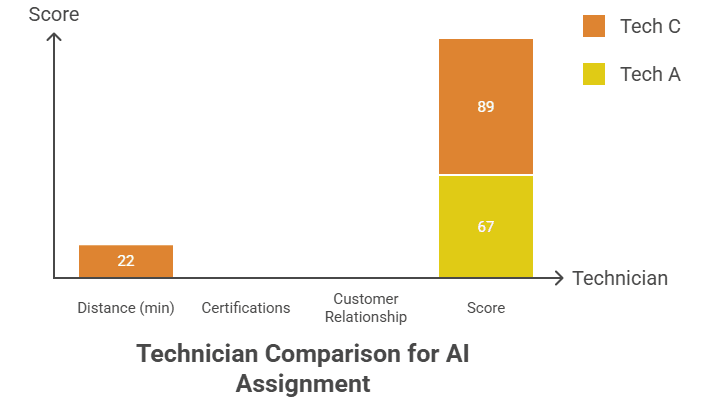
Tech C wins. Here’s what AI sacrificed: 14 minutes of drive time.
Here’s what AI protected: compliance (full certification), workload balance (no overtime), and customer relationship (three previous visits).
The trade-off was worth it.
This section shows four common situations where AI picks the “wrong” tech, and what it sacrifices each time.
Job: Gas furnace repair
| Tech A | 8 min | Missing certification | Eliminated |
| Tech C | 22 min | Certified | Assigned |
Trade-off: AI sacrificed 14 minutes to avoid a compliance violation.
Job: Repeat customer requested the same tech
| Tech B | 10 min | No history | 72/100 |
| Tech D | 18 min | 4 previous visits | 91/100 |
Trade-off: AI sacrificed 8 minutes to preserve customer loyalty.
Job: Standard plumbing repair
| Tech A | 5 min | 7 jobs, overtime risk | 68/100 |
| Tech E | 14 min | 4 jobs, balanced | 87/100 |
Trade-off: AI sacrificed 9 minutes to prevent burnout and overtime costs.
Job: Complex electrical panel upgrade
| Tech B | 12 min | 60% first-time fix rate | 71/100 |
| Tech F | 19 min | 94% first-time fix rate | 93/100 |
Trade-off: AI sacrificed 7 minutes to avoid a likely callback.
This section explains re-matching, the system behavior that separates AI from basic dispatch tools.
Schedules don’t stay static. Jobs run long. Traffic spikes. Emergencies arrive. Basic dispatch software sets a schedule and hopes it holds. AI watches for changes and adapts.
| Trigger | What Happens |
| Job runs 30+ minutes over | Downstream appointments get reassigned |
| Traffic delay exceeds 15 minutes | Affected routes recalculate |
| Tech finishes early | New capacity absorbs overflow |
| Emergency arrives | Lower-priority jobs shift |
| Customer cancels | Freed capacity redistributes |
If Job 2 runs 45 minutes over, AI moves Job 3 to a different tech while keeping Job 4 in place. It recalculates only what’s affected.
Confirmed appointments stay pinned. A customer who is locked in at 2 PM doesn’t get moved to 4 PM because of upstream delays.
This is where trust gets built. Not in the initial assignment, in how the system handles disruption.
For the technical process, see how AI dispatcher algorithms work.
This section explains the non-negotiable rules that govern every assignment.
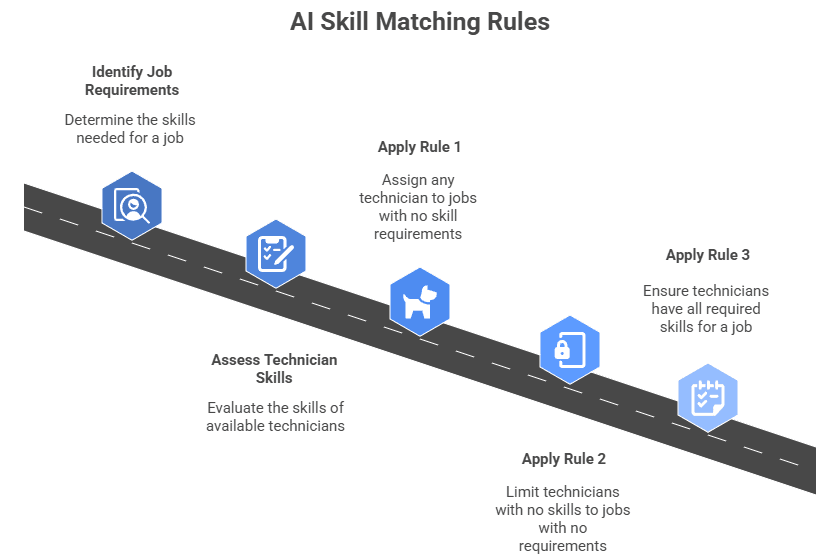
Rule 1: Jobs without skill requirements can go to any technician.
Rule 2: Technicians without certifications can only do jobs with no requirements.
Rule 3: Technicians must have ALL required skills. Partial matches don’t count.
These rules never bend. A tech with 2 of 3 required certifications doesn’t get assigned. The job waits for someone fully qualified.
This isn’t theoretical. HVAC techs need gas line and EPA certifications; send the wrong person, and you’re liable. Electrical panel upgrades require specific licensing that varies by state. Plumbing backflow testing needs a separate certification, which most general plumbers don’t have.
The 3-rule system exists because “close enough” creates callbacks, compliance issues, and customers who don’t call back.
This section explains how AI handles “send the same tech” requests.
When a customer requests a specific technician, AI adds weight to that tech’s score. But it won’t violate time windows or trigger overtime to honor the preference.
The trade-off: Customer preference competes with operational feasibility. AI finds the best balance, not the perfect outcome.
Every assignment is a trade-off. AI makes that trade-off visible.
When you understand why the system picked Tech C over Tech A, you stop second-guessing and start trusting. Dispatchers spend less time overriding recommendations. Techs get jobs that match their skills. Customers see the right person the first time.
The math was always there. Now it’s working for you instead of against you.
AI evaluates 8 dimensions for every match: skills, location, workload, customer history, job complexity, equipment, time windows, and downstream impact.
Hard constraints are eliminated. Missing certification = out, regardless of distance.
Soft constraints compete. Drive time vs. relationship vs. first-time fix probability.
Every assignment sacrifices something. Understanding what, and why, is how you learn to trust the system.
Re-matching is where AI earns trust. Not in the morning schedule, but in how it handles mid-day disruption.
AI doesn’t replace judgment. It replaces invisible math.
The technician 22 minutes away isn’t the “wrong” choice. It’s the choice that accounts for certification, workload, customer history, and downstream impact, factors you can’t calculate in real time.
Trust comes from understanding trade-offs. Now you do.
Watch FieldCamp evaluate skills, workload, and customer history, and see exactly what it sacrifices on each assignment.
Distance is one factor among many. AI weighs skills, workload, customer history, and first-time fix probability. A tech 15 minutes farther might have the right certifications, an established relationship, or a 95% success rate on that job type. The trade-off is often worth it.
AI monitors continuously. If a job runs over, traffic spikes, or an emergency arrives, the system recalculates, but surgically. Only affected routes adjust. Confirmed appointments stay locked.
Yes. AI recommends, it doesn’t mandate. Most dispatchers find that once they understand the trade-off, they agree with the assignment.
It adds weight to that tech’s score. But it won’t break time windows or trigger overtime to honor the preference. Preference competes with feasibility.
Yes. Even 3-5 technician teams see improvements in time window stability and workload balance. The gains scale with complexity.