
The AI Dispatching Manifesto: An AI-First Approach for Field Pros
Invalid Date - 17 min read

Invalid Date - 17 min read

Table of Contents
Every field service business faces a moment when they must decide: Do we trust the algorithm, or do we trust our dispatcher’s gut feeling?
However, the reality is what worked with 5 technicians breaks with 50. Human judgment remains critical, but under real-time pressure it cannot continuously balance skills, availability, travel time, downstream impact, and customer expectations at scale.
This manifesto exists to draw a clear line. It answers; When should you trust AI? When should you override it? And how do you build a culture where both coexist?
Let’s understand it in detail.
An AI Dispatching Manifesto is a foundational document that establishes the philosophical principles, ethical guidelines, and operational philosophy governing how AI-powered dispatching systems should function within field service organizations.
A manifesto defines the “why” behind AI dispatching—not the technical “how.” It articulates core beliefs about the relationship between human dispatchers and intelligent systems, when algorithmic recommendations should be trusted versus overridden, and how to maintain fairness, transparency, and accountability in automated scheduling.
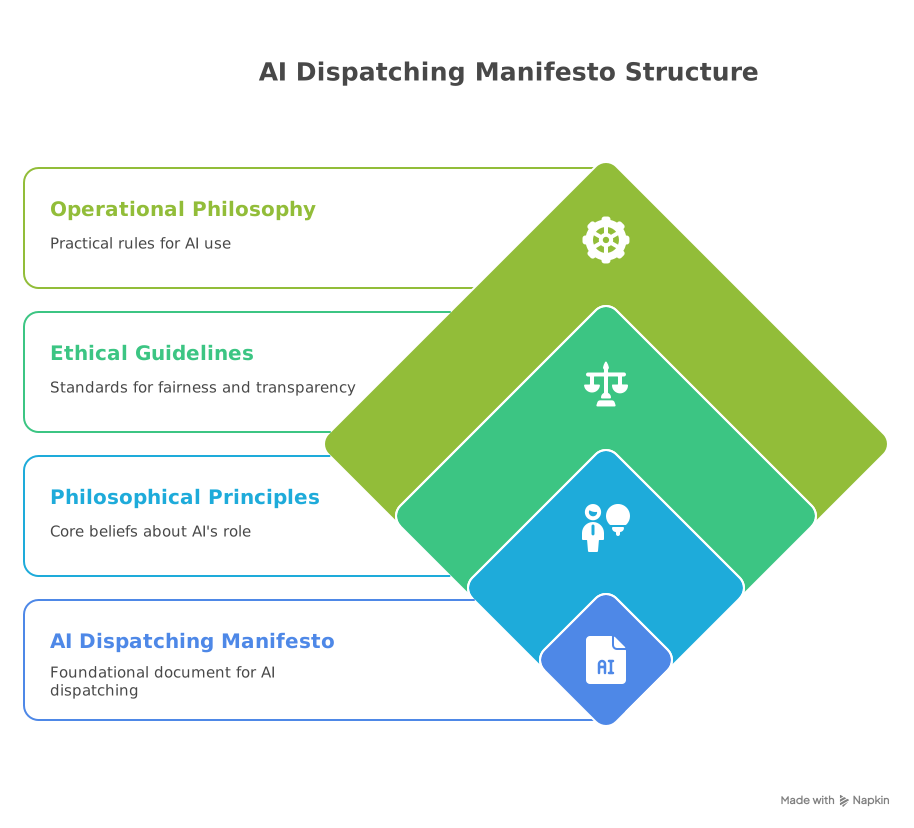
This manifesto explains why dispatching must evolve. If you want a closer look at what an AI dispatcher does and how it operates day to day, see what an AI dispatcher actually is.
Traditional field service dispatching was built on four assumptions that break at scale: proximity equals best choice, manual control ensures accountability, today’s schedule is all that matters, and experience compensates for complexity.
Modern AI dispatching software addresses each limitation.
For decades, dispatching was built on assumptions that made sense in smaller, simpler operations. Those assumptions quietly shaped how schedules were created, how technicians were assigned, and how success was measured.
At scale, those assumptions break.
However, these assumptions didn’t break overnight. They failed gradually as operations scaled. This shift is explored in detail in our breakdown of the evolution of AI dispatching.
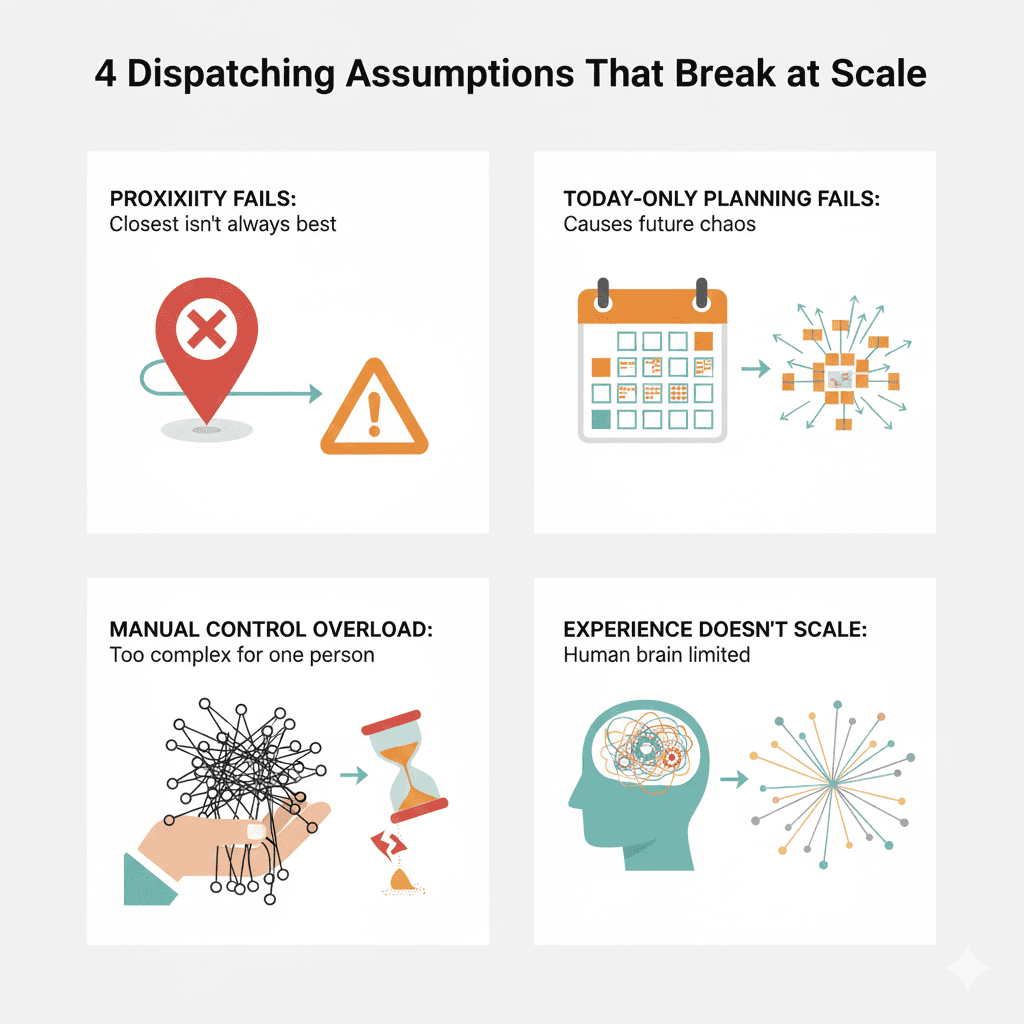
Proximity was once a reliable shortcut. Fewer variables existed. Fewer skills were required. Fewer jobs overlapped.
Today, distance alone ignores certifications, job complexity, first-time fix probability, workload balance, and downstream impact on the rest of the schedule. Optimizing for minutes instead of outcomes leads to rework, delays, and customer frustration.
Speed without context is not efficiency.
Manual control was once synonymous with accountability. If a dispatcher touched every decision, they owned the outcome.
At scale, this model collapses. Human attention becomes the bottleneck. Decision quality degrades under volume, interruptions, and time pressure. What once felt like control becomes constant firefighting.
Control does not require manual execution. It requires visibility and intent.
Traditional dispatching optimizes for the current day. When capacity is exceeded, the response is reactive: push jobs, reschedule later, call customers.
This mindset creates backlogs, missed commitments, and unpredictable service windows. Modern operations require schedules that extend beyond today and adapt automatically when capacity limits are reached.
Dispatching that cannot plan ahead is not planning. It is deferral.
Experience remains valuable—but it no longer scales.
As job types diversify, service areas expand, and constraints multiply, even the most experienced dispatcher cannot evaluate thousands of trade-offs simultaneously. Relying on memory and intuition to manage exponential complexity is not sustainable.
Experience should guide systems, not replace them.
This is why modern dispatching systems rely on machine learning models to handle complexity humans cannot scale.
See how Fieldcamp’s AI dispatching software reduces scheduling time by 70% while improving technician utilization and customer satisfaction scores.
AI dispatching is defined by six foundational beliefs: dispatching is a system not a task, transparency is mandatory, efficiency without trust fails, humans set intent while AI executes, overrides are signals not errors, and fairness is operational not optional.
Before principles come beliefs.
AI dispatching is not defined by algorithms alone. It is defined by the values that govern how those algorithms are used, trusted, and overridden.
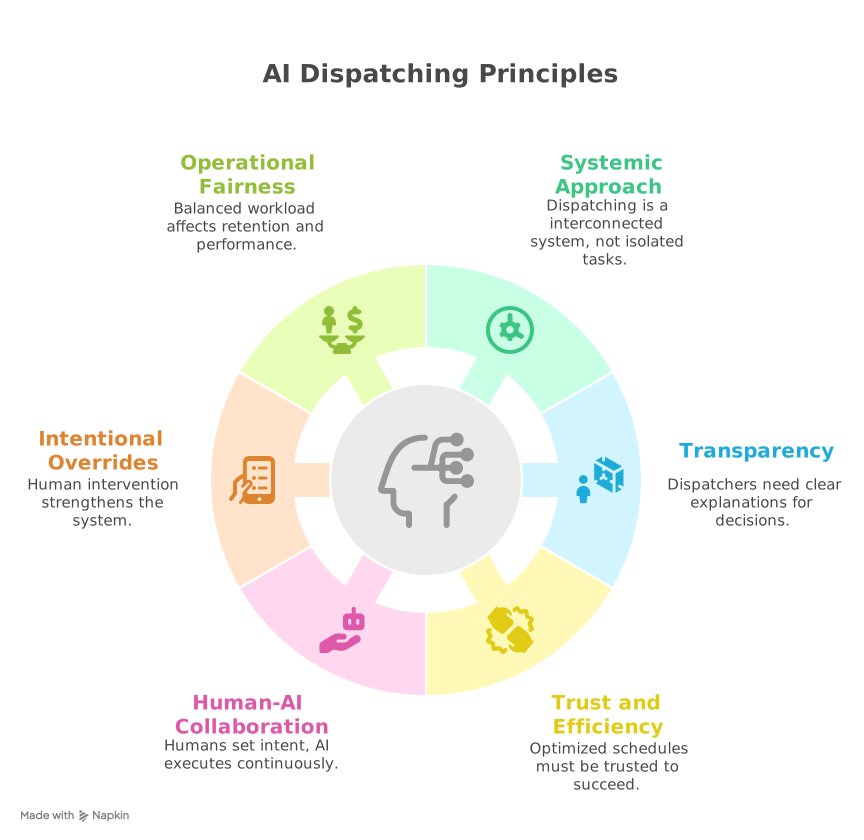
These beliefs form the foundation of modern dispatching:
These beliefs anchor every responsible AI dispatching system. Without them, automation becomes brittle, opaque, and resisted.
The seven non-negotiable principles of AI dispatching are: (1) AI amplifies human judgment, (2) every decision must be explainable, (3) skill alignment outweighs proximity, (4) schedules must extend beyond today, (5) relationships override marginal efficiency, (6) learning must correct bias, and (7) trust is the operating system.
The following principles define the minimum standard for AI dispatching.
They are not best practices. They are non-negotiables.
AI evaluates constraints at scale. Humans retain authority.
Dispatchers define priorities, handle exceptions, and make final decisions when context matters. Any system that removes human override undermines accountability and trust.
AI executes decisions. Humans own them.
An assignment without explanation is a liability.
Dispatchers must be able to understand why one technician was chosen over another, which factors mattered most, and what trade-offs were considered. Explainability is a prerequisite for adoption, not a nice-to-have feature.
Opaque optimization erodes confidence.
To know how AI chose the assignment, how it works, read our guide on how AI dispatching algorithms works to know the technicalities of the decision taken by AI.
The right technician arriving later is better than the wrong technician arriving early.
AI dispatching prioritizes qualifications, certifications, and job success probability over simplistic distance calculations. First-time fix rates—not arrival times alone—define effective service.
Evaluating skill alignment requires considering experience, workload, and job complexity together. The reasoning behind this matching logic is explored in how AI matches jobs to technicians.
Dispatching is not complete when today’s calendar is full.
When capacity is exceeded, the system must automatically plan future days, rebalance workloads, and protect service commitments. Long-range scheduling is a requirement for sustainable growth.
Long-range scheduling depends on route efficiency across multiple jobs, not single assignments.
Customer trust and technician morale carry long-term value.
When optimization conflicts with established relationships, service expectations, or team well-being, human judgment must take precedence. Efficiency that damages retention is not optimization.
AI learns from historical patterns—but history often contains imbalance.
Dispatching intelligence must actively monitor and correct unfair workload distribution, favoritism, and opportunity gaps. Automating past inequities is operational negligence.
Without trust, no system scales.
Dispatchers must trust recommendations. Technicians must trust assignments. Trust is earned through consistency, transparency, and fairness—not promises or performance claims.
A system that fails to earn trust will be bypassed, regardless of technical sophistication.
Watch how field service companies using Fieldcamp assign 100+ jobs daily with 95% first-time fix rates. Real results, real ROI, real transformation.
Traditional dispatching means the dispatcher controls every variable manually. Six hours of manual scheduling, constant phone calls, reactive firefighting, and little time for strategic thinking. AI dispatching changes this to one hour of strategic oversight—reviewing AI recommendations, handling exceptions, and focusing on customer relationships.
Dispatchers retain control while shifting from manual execution to strategic direction. The dispatcher sets strategic priorities while AI handles computational execution.
This requires organizational mindset change, not just software adoption. Leaders must communicate that AI dispatching isn’t about replacing dispatchers—it’s about freeing them to do higher-value work that algorithms simply cannot perform.
The Human-AI Partnership Model in dispatching defines the collaborative relationship where AI handles computational complexity (evaluating thousands of scheduling variables in seconds) while human dispatchers provide strategic judgment, relationship management, and exception handling. This model positions AI as an augmentation tool that elevates dispatcher capabilities rather than a replacement that eliminates human decision-making.
AI handles computational complexity—evaluating millions of scheduling combinations, recognizing patterns across thousands of jobs, and adjusting to real-time changes. Humans provide strategic judgment—relationship management, ethical considerations, and exception handling.
When a commercial HVAC emergency arrives at 2 PM, AI evaluates 8 available techs in 0.3 seconds based on EPA certification, proximity, and current workload. The dispatcher reviews the recommendation, sees Tech A is recommended despite being 15 minutes farther because Tech B is already handling a complex job, and approves. Total decision time: 12 seconds instead of 8 minutes of manual evaluation.
| Responsibility | AI Role | Human Role |
| Routine job assignment | Primary decision-maker | Oversight and validation |
| Emergency situations | Recommendation provider | Final decision-maker |
| Customer relationship calls | Data provider | Strategic decision-maker |
| New technician onboarding | Pattern learning | Training and judgment setting |
FieldCamp’s approach reflects this partnership: AI handles 90% of routine assignments while the dispatcher focuses on the 10% that require judgment.
Some overrides strengthen the system while others undermine it. The goal is calibrated trust—not blind trust or constant second-guessing.
When facing an AI recommendation you’re unsure about, work through this hierarchy:
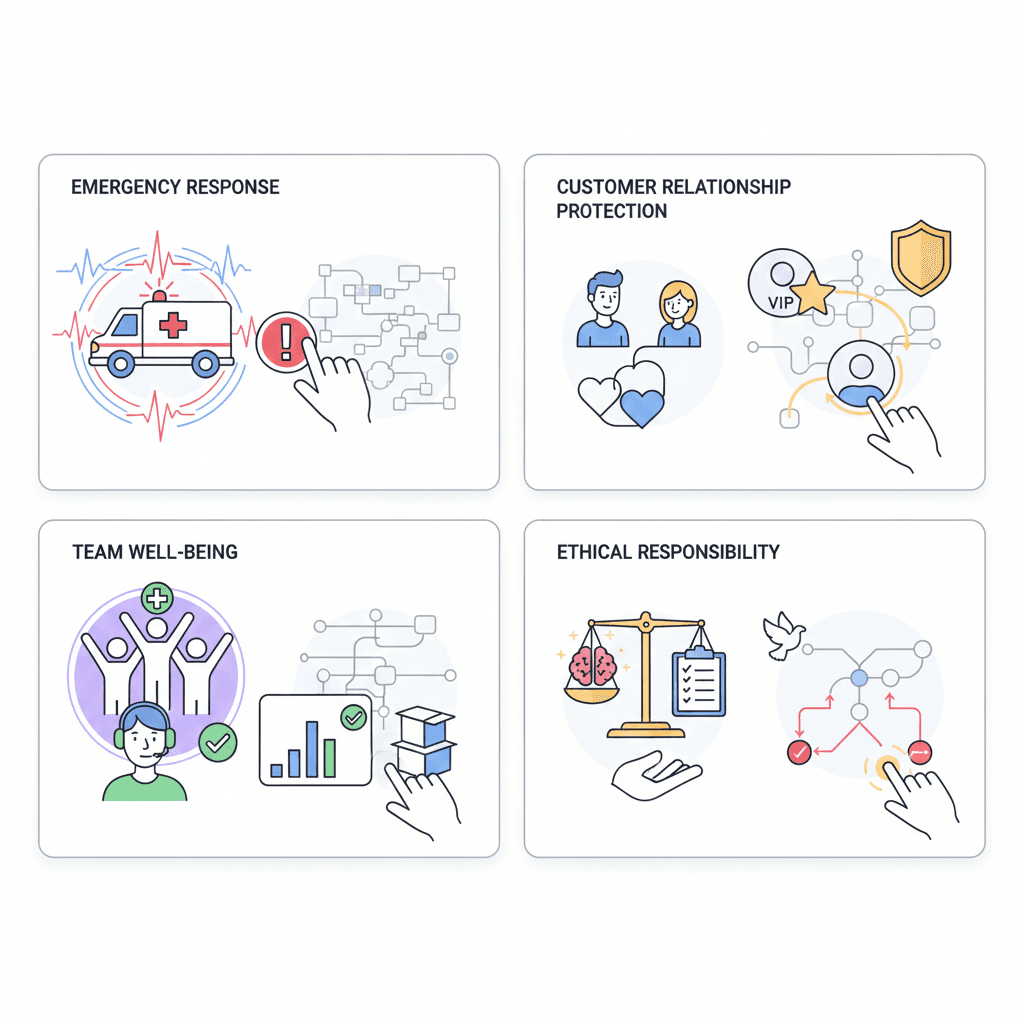
| Priority Level | Scenario | Override Recommended? | Reasoning |
| 2 | AI assigns job to technician who had conflict with customer | YES | Relationship preservation trumps efficiency |
| 4 | AI suggests longer route to balance workload | EVALUATE | Check if workload balance is strategic priority today |
| 3 | AI schedules emergency during technician’s planned break | YES | Team morale and labor compliance matter |
| 4 | AI assigns complex job to less experienced tech with right skills | EVALUATE | Consider training opportunity vs. first-time fix rate |
| 2 | AI optimizes route that violates customer’s preferred time window | YES | Customer promise must be kept |
Algorithmic Transparency in AI dispatching means the system can explain why specific assignments were made, which constraints were prioritized, and what trade-offs were considered. Transparent AI dispatching allows dispatchers to understand, validate, and confidently communicate scheduling decisions rather than treating the algorithm as a “black box” that produces unexplainable results.
Three ethical commitments are non-negotiable in AI dispatching: Transparency (dispatchers understand why decisions are made), Fairness (workload distributed intentionally, not historically), and Accountability (final responsibility remains human). Ethical AI dispatching is about building systems worthy of trust.
Dispatchers must understand why decisions are made, which constraints were prioritized, and what trade-offs were considered. Explainability is the foundation of trust.
Workload, opportunity, and job complexity must be distributed intentionally. AI must detect and correct imbalance, not reinforce historical bias or favoritism.
Final responsibility remains human. Algorithms recommend; people decide. Automation does not absolve organizations of ownership over outcomes.
Ethical AI dispatching is not about restriction. It is about building systems worthy of trust.
Successful AI adoption depends more on culture change than technology deployment.
The most sophisticated AI dispatcher in the world will fail if your team doesn’t trust it, understand it, or feel empowered to work alongside it.
Leaders must demonstrate trust in AI while showing appropriate override judgment. If management constantly second-guesses the algorithm, the team will too. If management blindly accepts every recommendation, the team won’t feel empowered to exercise judgment.
Technicians need to know that AI is not evaluating them—it’s optimizing operations. The algorithm isn’t watching to see who works fastest or slowest. It’s trying to reduce drive time, balance workloads, and get the right person to the right job.
Dispatchers must be trained to work alongside AI, not compete with it. This means understanding what the AI can see (patterns across thousands of data points) and what it can’t see (relationship nuances, morale issues, context the data doesn’t capture).
Before implementing AI dispatching, evaluate:
Current AI dispatching capabilities will expand in three specific directions:
As AI handles more routine decisions, dispatchers will become strategic planners, relationship managers, and exception handlers. The tedious work disappears. The meaningful work expands.
Join 10,000+ field service teams using Fieldcamp to automate scheduling, optimize routes, and boost technician productivity by 40%. Setup takes 15 minutes.
The AI Dispatching Manifesto is not a prediction. It is a response to reality already unfolding across field service operations worldwide.
Organizations that adopt AI dispatching principles today—human-AI partnership, transparent decision-making, skill-based matching, and earned trust—will build sustainable competitive advantages.
Those that continue relying solely on manual scheduling, proximity-based assignments, and heroic dispatcher effort will find their operations increasingly unable to scale, their technicians increasingly frustrated, and their customers increasingly dissatisfied.
The question is no longer whether to adopt AI dispatching. The question is whether you can afford not to.
AI dispatching is an intelligent scheduling system that uses machine learning algorithms to automatically assign field technicians to service jobs. Unlike manual dispatching, AI dispatching evaluates thousands of variables—including technician skills, location, availability, traffic conditions, and job requirements—to optimize assignments in real-time. This results in 30-40% faster response times and 85%+ first-time fix rates.
AI dispatching software improves field service operations by: (1) reducing scheduling time by 70%, (2) increasing technician utilization by 25-35%, (3) improving first-time fix rates from 60% to 90%+, (4) cutting fuel costs through optimized routing, and (5) enhancing customer satisfaction through accurate ETAs and skilled technician matching. The software continuously learns from outcomes to improve future assignments.
No, AI dispatching does not replace human dispatchers—it augments them. AI handles computational tasks (evaluating thousands of variables simultaneously), while humans retain strategic control (setting priorities, handling exceptions, protecting relationships). The best AI dispatching systems maintain human override capabilities and learn from dispatcher decisions to improve over time.
Manual dispatching relies on dispatcher experience to make one assignment at a time, typically using proximity as the main factor. AI dispatching evaluates all available technicians and jobs simultaneously, considering skills, certifications, workload balance, travel time, job complexity, and success probability. AI dispatching scales automatically while manual dispatching becomes a bottleneck as operations grow.
AI dispatching software typically costs $20-100 per user per month for cloud-based solutions. Enterprise solutions may have custom pricing. However, the ROI is significant: companies report 20-35% reduction in operational costs, 70% decrease in scheduling time, and 15-25% improvement in technician productivity. Most field service companies see positive ROI within 3-6 months of implementation.
Essential AI dispatching features include: (1) real-time schedule optimization, (2) skill-based technician matching, (3) route optimization with traffic integration, (4) automated workload balancing, (5) predictive scheduling for capacity planning, (6) mobile app for technicians, (7) customer communication tools, (8) explainable AI with transparent recommendations, and (9) easy human override capabilities.