


What is an AI Dispatcher? Full 2026 Guide
Dispatching used to be manageable when schedules were predictable and teams were small. That reality no longer exists.
Today’s field service operations deal with emergency calls, traffic disruptions, tight SLA windows, skill-based assignments, and customer technician preferences—all happening at once. Even experienced dispatchers struggle to keep schedules stable under constant change.
This is not a human failure. It’s a scale problem.
That’s why AI dispatchers are becoming essential for modern field teams. This guide explains what an AI dispatcher is, why traditional dispatching is breaking down, how AI-driven dispatching works, and how FieldCamp’s AI dispatcher helps teams run smoother, faster, and more profitably in 2026.
What Is an AI Dispatcher?
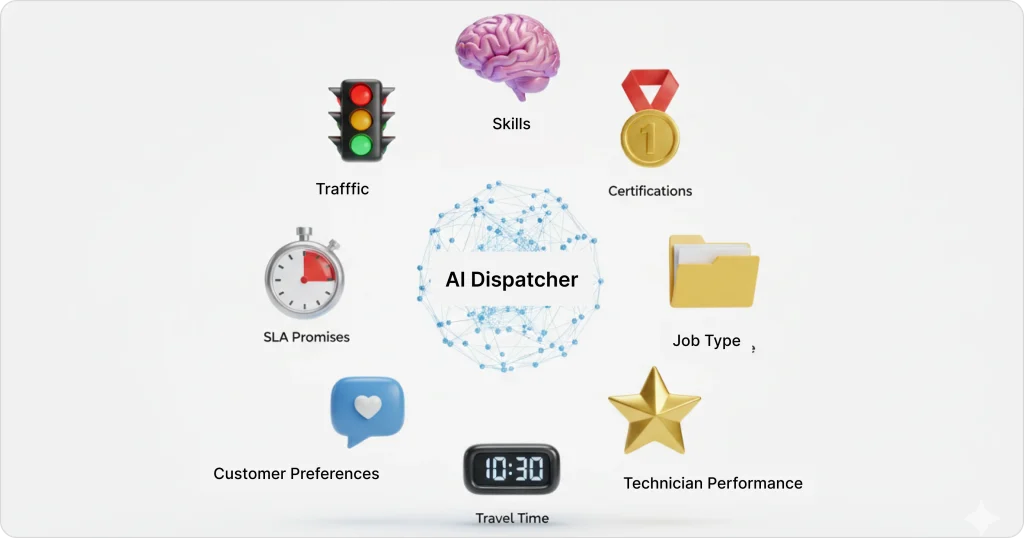
An AI dispatcher is intelligent field dispatch system that automatically assigns the right technician to the right job using real-time data, machine learning, and optimization algorithms. It evaluates skills, certifications, location, traffic, job urgency, historical performance, and SLAs to create schedules that are realistic, efficient, and continuously adaptable.
To understand how AI dispatching evolved and why it outperforms manual scheduling, see our detailed breakdown in how AI dispatching algorithms actually works behind the scenes.
Why Is Traditional Dispatching Breaking Down?
Traditional dispatching breaks down because humans cannot consistently process the volume, speed, and variability of modern field service operations in real time.
Traditional dispatching has served the industry for decades, but the speed and complexity of modern service operations have surpassed what humans can keep up with.
Picture this:
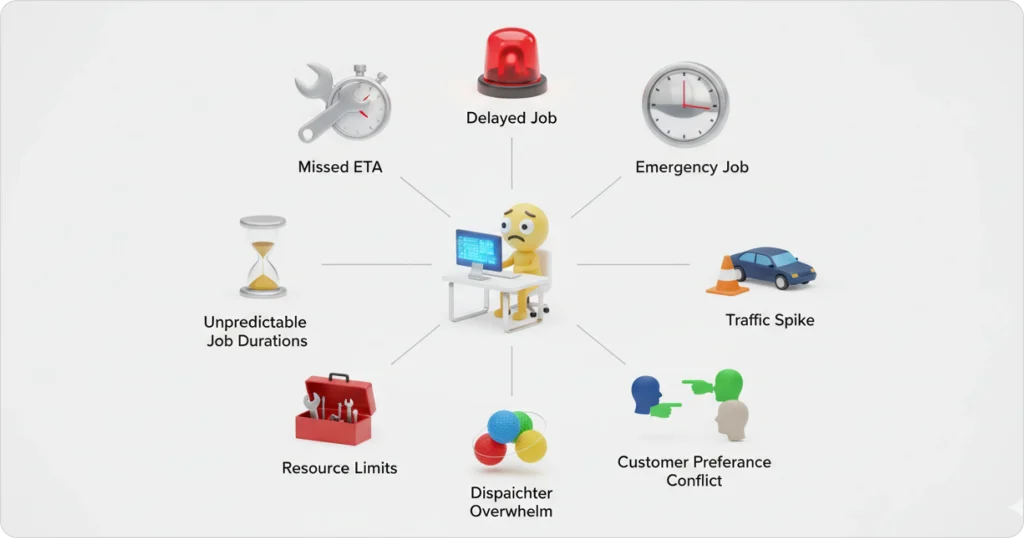
1. A technician is stuck on a job that ran two hours longer than expected.
2. Another job across town is escalating into a same-day emergency.
3. Traffic suddenly spikes because of an accident.
Meanwhile, two customers want the same technician who serviced them last time. A dispatcher now has to reorganize half the day’s schedule—while the phones keep ringing.
Even the best dispatchers can only juggle around 20–30 variables at once. But real field operations involve far more: technician performance history, job duration predictions, overlapping routes, customer SLAs, zone restrictions, equipment availability, and real-time GPS data.
- This is why dispatchers burn out.
- This is why missed ETAs happen.
- This is why revenue gets lost in transition.
This growing complexity is exactly why many teams are shifting away from manual workflows toward AI-driven field service automation.
AI Dispatcher vs Traditional Dispatching: What’s the Difference?
Traditional dispatching relies on human judgment and manual adjustments, while AI dispatching uses data, prediction, and real-time optimization to make faster, more accurate decisions at scale.
An AI dispatcher adds a layer of intelligence that manual scheduling simply cannot reproduce.
FieldCamp’s AI dispatcher eliminates these limitations through data-driven precision. Where traditional dispatchers might remember 20-30 technician preferences, the AI tracks unlimited attributes: EPA certification expiry dates, ladder comfort levels, and territory knowledge ratings. The system maintains perfect recall of 10,000+ historical jobs, identifying patterns humans never notice.
AI dispatching isn’t “faster manual dispatching.”
It’s a fundamentally different system built for complexity, not for isimple rule execution.
For a deeper, side-by-side breakdown of how AI dispatching differs from manual and rule-based scheduling in real operations, read our detailed guide on AI dispatching vs traditional dispatch software.
| Feature | Traditional Dispatching | AI Dispatching |
| Decision Speed | Minutes per assignment | Seconds per assignment |
| Error Rate | High, prone to human error | Low, minimizes human error |
| Variables Considered | 10–20 (limited by memory) | 50–500+ (data-driven) |
| Scalability | Limited | Easily scales to hundreds of jobs |
| Adaptability | Manual/reactive | Learns & improves continuously |
| Route Optimization | Basic/manual | Real-time, traffic-aware |
How an AI Dispatcher Works?
An AI dispatcher evaluates each job, analyzes all available technicians, simulates thousands of scheduling outcomes, selects the optimal assignment, and recalculates instantly when conditions change.
1. It understands the job.
As soon as a new job arrives, the system identifies skills required, predicted duration, urgency level, location, equipment needs, and customer preferences.
2. It evaluates all technicians.
It checks real-time GPS location, availability, skill level, certifications, past job performance, travel time to site, work-in-progress, and daily workload balance.
3. It tests thousands of scheduling combinations.
Machine learning models and optimization engines simulate hundreds or thousands of potential scenarios and score each one for efficiency, first-time fix success, ETA accuracy, and SLA compliance.
4. It selects the optimal assignment.
The system chooses the technician with the highest overall success probability—not just the closest tech.
5. It adapts the moment things change.
If a job cancels, traffic slows, or a technician falls behind, the AI recalculates instantly. When changes require manual intervention, dispatchers can follow the documented steps in how to reschedule a job in FieldCamp.
AI dispatching isn’t “faster manual dispatching.” It’s a fundamentally different system built for complexity, not for simple rule execution. This intelligence is powered by advanced optimization models like capacitated vehicle routing, which ensure technician workloads remain executable—not just efficient on paper.
Check How FieldCamp’s AI Dispatcher Works
Most AI dispatching systems claim to be “smart,” but FieldCamp’s AI dispatcher is built specifically for real-world field teams — not enterprise setups that require heavy configuration, IT support, or rigid workflows.
FieldCamp’s AI dispatcher works like a digital co-dispatcher that thinks ahead, corrects issues before they become problems, and adapts to your team’s natural way of working. Here’s how FieldCamp’s system actually operates behind the scenes.
1. It Understands Each Job With Context (Not Just Data)
FieldCamp doesn’t just read job details. It intelligently interprets them. For every new job created, imported, or booked online, the system automatically identifies:
- Required skills (HVAC, electrical, plumbing, appliance repair, etc.)
- Certifications or license requirements
- Estimated duration based on your historical data
- Tools or materials or equipments needed
- Risk level or urgency
- Customer preferences (like “Send the same technician as last time”)
- SLA windows or promised time slots
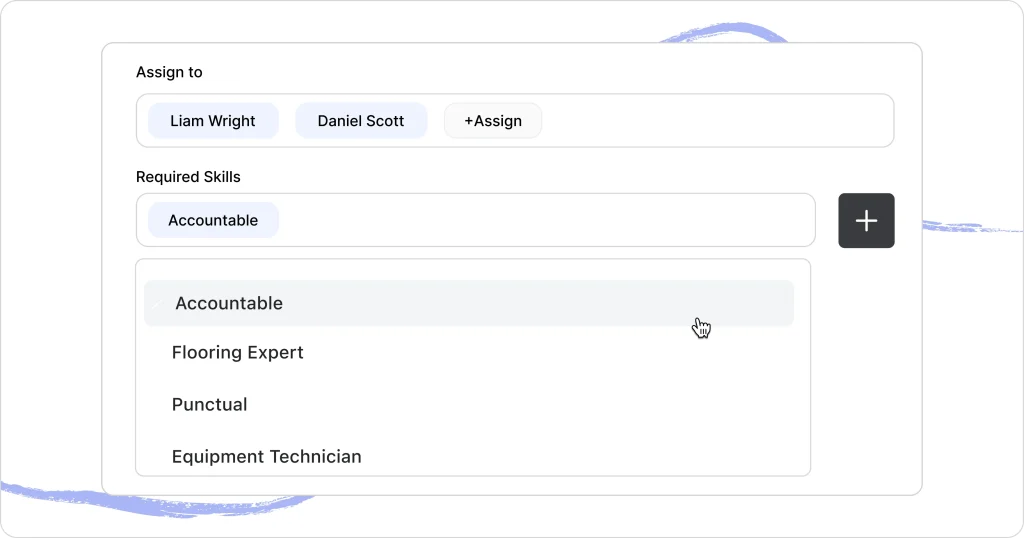
This context becomes the “job profile,” which the AI later uses to match the right technician.
Job-specific context such as customer preferences and history is often captured through structured client notes, which are explained in how to create notes for clients in FieldCamp.
2. It Evaluates All Technicians in Real Time (Not Static Rules)
FieldCamp continuously compares and updates technician profiles based on:
- Real-time GPS location
- Current job progress + remaining duration
- Skill match accuracy
- Certification validity
- Territory or zone restrictions
- Past performance with similar job types
- Technician rapport score with repeat customers
- Daily workload distribution
- Overtime thresholds
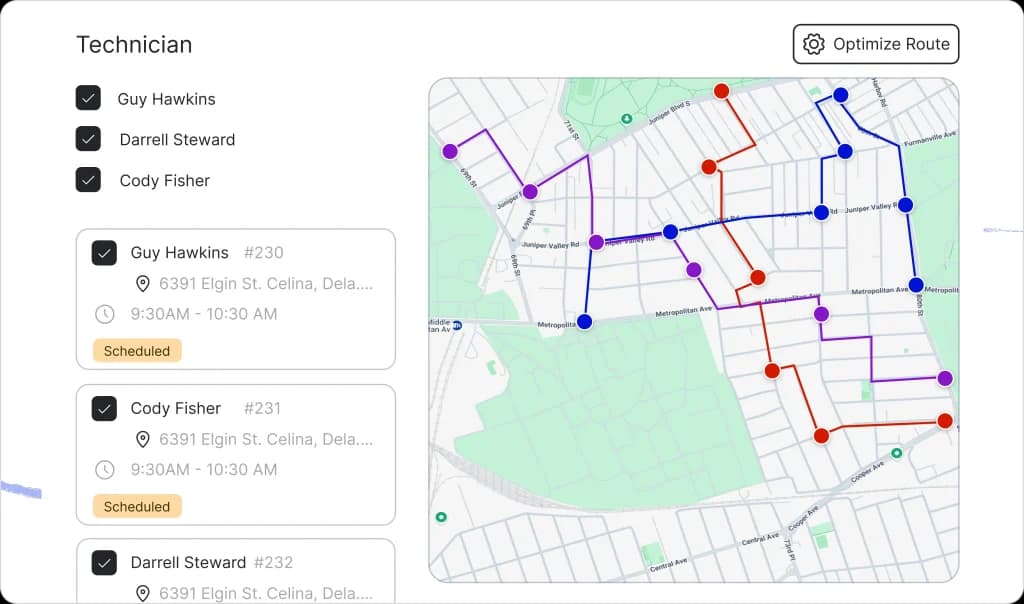
This gives the AI a complete, always-updated picture of your entire field team — something manual dispatching can never do consistently.
Technician availability, skills, and certifications are maintained through team profiles, as outlined in how to add and manage team members in FieldCamp.
3. It Simulates Thousands of Possibilities Before Choosing One
This is where FieldCamp’s AI feels different.
Instead of assigning the “closest tech” or the “first available tech,” FieldCamp’s optimization engine runs rapid-fire calculations:
- Which assignment will minimize route disruption?
- Which technician has the highest success probability?
- Which sequence reduces travel cost the most?
- Which assignment avoids overtime fees?
- Which option protects today’s SLA windows?
- Which combination creates the most efficient day overall?
The AI tests scenarios that a human dispatcher simply doesn’t have the bandwidth to evaluate.
Within 0.5 seconds, it chooses the assignment with the highest combined score across efficiency, cost, customer satisfaction, and technician fit.
Watch AI Build a Real Schedule in Seconds
Traffic, delays, emergencies… AI handles all of it without slowing you down.
See how FieldCamp keeps the day stable even when things change.
4. It Adapts Automatically When Something Changes
Real field operations are messy. Your jobs get delayed, technicians call in sick, traffic hits unexpectedly, customers cancel or request rescheduling, and what not.
FieldCamp’s AI dispatcher re-evaluates the entire day when scenario changes and automatically:
- Reassigns jobs
- Adjusts technician routes
- Protects SLA windows
- Prevents technician overload
- Minimizes disruption to other jobs
Instead of the dispatcher juggling 20 moving pieces, FieldCamp recalculates everything instantly and recommends the next best move.
5. It Learns From Every Job (Continuous Intelligence)
FieldCamp’s AI doesn’t stay static — it gets better every week.
It learns from:
- Technician actual job duration
- Dispatcher overrides (to understand your preferences)
- Customer satisfaction signals
- Technician success rate by job type
- Real-world traffic patterns
- Seasonal patterns (ex: HVAC jobs take longer in winter)
This means your scheduling grows more accurate every month without any manual configuration.
FieldCamp’s AI dispatcher: What Makes It Different?
1. Built for small & mid-sized teams (5–50 technicians)
Most AI dispatch systems are built for enterprise and require months of onboarding. FieldCamp’s Dispatcher works out of the box with minimal setup.
2. Bias-free, data-backed technician recommendations
No more “We always send John for HVAC jobs.”
FieldCamp analyzes actual performance patterns — not assumptions.
3. Human override-friendly (the AI learns from your decisions)
Dispatchers remain in control. Every override is feedback to the AI. This is powerful because it blends human intuition with machine precision.
4. Multi-objective balancing (not just “nearest technician”)
FieldCamp’s AI considers:
- Route cost
- Job priority
- Technician skill strength
- SLA deadlines
- Customer lifetime value
- Travel impact on rest of day
Enterprise systems often push revenue-first optimization.
FieldCamp prioritizes your operational reality.
5. Designed for real field use — not academic models
The AI is trained on real field service patterns like:
- Late-running jobs
- Traffic bottlenecks
- Repeat customer preferences
- Seasonal workload swings
- Technician reliability patterns
It’s realistic — not theoretical.
The Complete Flow of FieldCamp’s AI dispatcher
Here’s the simplest way to visualize how FieldCamp creates your daily schedule:
Job enters system →
AI enriches job →
Technician profiles updated →
AI simulates outcomes →
AI assigns optimal technician →
Real-time changes recalculated →
AI improves from results →
And things go on…….
Every part is automated. Every part is intelligent. Every part reduces dispatcher workload.
Make Your Schedule Run Itself
Fewer delays. Less travel. Better technician match.
Here’s what teams gain when they switch to AI.
Is an AI Dispatcher the Same as Automated Scheduling? Not Even Close.
Automated scheduling follows fixed rules, while AI dispatching learns from data, predicts outcomes, and adapts dynamically to real-world conditions
Let’s have a detailed look;
Automated scheduling follows rigid if-then rules: “If the customer is VIP, assign senior tech.” It cannot adapt, learn, or optimize beyond programmed parameters. Think of it as a sophisticated alarm clock—reliable but inflexible.
AI Dispatching employs machine learning models that discover optimal patterns from data. FieldCamp’s system doesn’t just follow rules—it creates them. After analyzing 1,000 HVAC emergency calls, it might discover ServiceTitan’s Dispatch Pro that Tech A performs 23% better on heat pump issues between 2-5 PM, while Tech B excels at gas furnace problems before noon. No human would program these granular rules, but AI identifies and acts on them.
Key Differentiators:
- Adaptation: Automated systems require manual updates | AI systems self-improve
- Complexity Handling: Rules break with edge cases | AI handles exceptions gracefully
- Prediction Capability: Rules react to known patterns | AI predicts unknown scenarios
- Revenue Impact: Rules optimize for single metrics | AI balances multiple objectives
What an AI dispatcher Actually Considers (50+ Real Variables)
AI dispatchers evaluate dozens—sometimes hundreds—of real-world variables that influence job success.
Some of the most important include:
• Technician skills and certifications
• Zone and territory restrictions
• Travel time predictions
• Real-time GPS location
• Traffic patterns
• Job complexity and historical job duration
• Equipment availability
• Technician fatigue and workload
• Customer preferences and past tech match
• SLA time windows
• Emergency status
• Weather impact
• Previous job success rate
• Customer lifetime value
• Equipment in technician’s vehicle
• Day-of-week performance trends
• First-time fix probability
This is why AI-generated schedules consistently outperform human-generated ones.
Who Should Use an AI Dispatcher? (And When It Becomes Critical)
AI dispatching becomes essential when:
• You manage 5–50 technicians
• You offer emergency or same-day service
• Technician skill sets vary significantly
• Travel time is eating into profit margins
• Your dispatcher is overwhelmed
• You miss ETAs more often than you’d like
• Your jobs span multiple zones or cities
• You want predictable job capacity
• You want to scale without adding more office staff
Industries that gain the most immediate ROI include HVAC, plumbing, electrical, appliance repair, pest control, solar, roofing, cleaning, and IT services.
If your scheduling feels chaotic, unpredictable, or overly dependent on one dispatcher’s memory—an AI dispatcher is no longer optional.
If you’re still unsure whether your operation has reached that point, this guide walks through the practical signals, team size thresholds, and operational warning signs to help you decide should you use an AI dispatcher.
Final Thoughts: Dispatching Has Changed
Field service dispatching is no longer about filling a schedule once and hoping the day goes as planned. With emergency calls, traffic disruptions, skill-based assignments, and strict SLAs all happening simultaneously, manual decision-making simply doesn’t scale. The complexity of modern field operations has outgrown what human memory and intuition can reliably manage.
An AI dispatcher brings structure to that chaos. By continuously analyzing real-time conditions, technician capabilities, and job requirements, it helps teams stay on schedule, reduce wasted travel, and deliver consistent service without burning out dispatchers. For growing field service businesses, AI dispatching isn’t a future upgrade—it’s a practical foundation for running predictable, efficient operations today.
Frequently Asked Questions
What is an AI dispatcher?
An AI dispatcher is an automated dispatching system that uses algorithms to assign jobs, plan routes, and update schedules automatically based on technician skills, locations, traffic, and priority, instead of relying on manual decisions.
How does an AI dispatcher work?
It pulls data like job details, technician availability, maps, and past performance, then calculates the best technician‑job matches and route sequences in real time, continuously adjusting when cancellations, delays, or emergencies happen.
What is the difference between a human dispatcher and an AI dispatcher?
A human dispatcher relies on experience and manual tools to plan each job, while an AI dispatcher automates repetitive scheduling and routing tasks, leaving humans to focus on exceptions, customer issues, and strategic decisions.
What problems does an AI dispatcher solve?
AI dispatchers reduce drive time and fuel, cut scheduling errors, improve on‑time arrivals, and minimize idle gaps in technicians’ days, helping field service teams complete more jobs with the same headcount.
Do small businesses need an AI dispatcher?
Yes, even small teams benefit because AI dispatching cuts manual scheduling time, reduces wasted driving, and helps a few technicians handle more jobs without adding extra staff.
Is an AI dispatcher hard to set up?
Most modern AI dispatch tools connect to existing customer and job data, then start with simple rules and improve over time, so setup is usually a guided, step‑by‑step process rather than a big IT project.