
Why AI Dispatching Matters: The Real Cost of Getting It Wrong
Invalid Date - 13 min read

Invalid Date - 13 min read

Table of Contents
You started because you’re good at the work: fixing HVAC units, clearing drains, keeping buildings running. The dispatching part? That was supposed to be simple. A whiteboard, a phone, and someone who could keep it all straight in their head.
Then your team grew. Ten technicians became fifteen. Service areas multiplied. Emergency calls started colliding with scheduled appointments. And suddenly, the person holding it all together was buried in sticky notes, half-finished spreadsheets, and a phone that wouldn’t stop ringing.
That’s the moment most field service owners realize something uncomfortable: dispatching isn’t a side task. It’s the engine that drives revenue, customer satisfaction, and whether your best techs stick around or burn out.
When that engine runs on guesswork, everything downstream breaks.
AI dispatching is software that automatically assigns the right technician to the right job at the right time by evaluating dozens of variables simultaneously. Skills, certifications, real-time traffic, job priority, customer history, parts availability, and route efficiency are all weighed in seconds. Unlike manual scheduling, which relies on a dispatcher juggling 4–5 factors in their head, AI dispatching processes 30–50+ constraints to find the optimal assignment. It doesn’t replace human judgment; it gives dispatchers an optimized starting point they’d never reach on their own.
If you prefer listening over reading, we unpack this exact topic with real examples in the podcast below.
An AI dispatcher is software that automatically figures out which technician should go to which job, and in what order, by weighing dozens of factors at once. Skill sets, certifications, live traffic, job urgency, customer history, parts on the truck, and who’s already nearby.
A human dispatcher juggles maybe four or five of those variables before their brain starts dropping things. The AI handles all of them in seconds.
It doesn’t replace your dispatcher. It gives them a head start they’d never have otherwise.
Most owners never calculate this because the losses don’t show up on one line item. They’re spread across the whole operation.
It’s the fuel burned when a tech drives 40 minutes to a job they’re not certified for. The second appointment was pushed back because the first one ran long, and nobody adjusted. The overtime you paid was because the afternoon schedule collapsed after a cancellation at 10 AM.
The callback that wouldn’t have happened if you’d sent your most experienced person in the first place.
Stack those up across a full year, and a growing team, and the number gets uncomfortable fast.
One industry survey by Field Technologies Online found that poor scheduling and routing can eat up 20–30% of a field team’s productive capacity. That’s not a rounding error — that’s revenue walking out the door.
This is fundamentally a math problem. Your dispatcher might be brilliant, but nobody can optimize 20+ moving variables in real time while answering the phone. That’s what algorithms are built for.
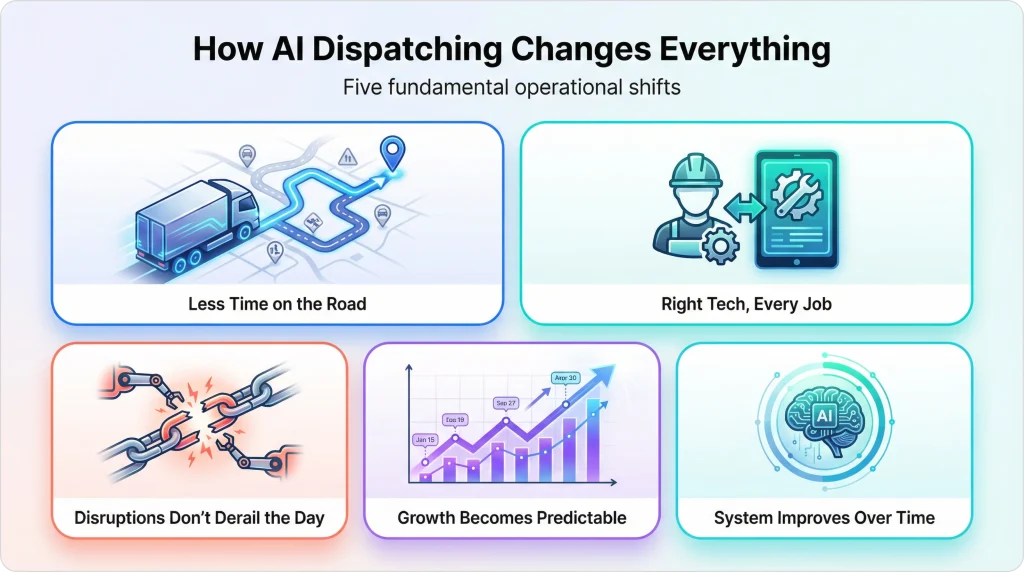
AI dispatches clusters of observations geographically and sequences them based on real-time traffic and technician location. The result is tighter routes with fewer wasted miles.
Companies that adopt AI-powered routing often report noticeably shorter drive times across their fleet, in some cases, enough to fit an extra job or two into each tech’s day without extending their hours.
Here’s how to configure it: Route Optimization in FieldCamp.
A junior HVAC tech shouldn’t be dispatched to a commercial chiller repair when someone qualified is 10 minutes away. AI dispatching matches jobs to technicians based on skills, certifications, past performance, and even which tech the customer prefers.
Fewer mismatches means fewer callbacks, higher first-time fix rates, and customers who stop wondering if you know what you’re doing.
Two emergency calls come in. Someone calls in sick. A 90-minute job turns into a three-hour one.
With manual dispatch, that’s 45 minutes of frantic reshuffling and apologetic phone calls. With AI, the schedule re-optimizes on its own. The nearest qualified tech gets rerouted, ETAs update automatically, and the day keeps moving. This is where AI dispatching proves its value, not on smooth days, but on the messy ones.
Capacity planning without data is just guessing with more trucks. AI dispatching shows you exactly how much capacity your team has, where the bottlenecks sit, and whether you need to hire or just dispatch smarter.
Can you absorb that new commercial contract? What happens to response times if volume jumps 15%? These become answerable questions, not gut calls. Build the view yourself: Getting Started with FieldCamp Analytics.
Unlike a static rulebook, AI dispatching learns from outcomes. Which assignments led to first-time fixes? Which routes actually saved time? Which job types consistently run overestimate?
Over months, the system sharpens its decisions. Your dispatching doesn’t just stay efficient, it compounds. That’s an advantage manual dispatch can never replicate.
“We used to lose an hour every morning just figuring out who goes where. Now the schedule’s ready before I finish my coffee. Our techs are doing two more jobs a day on average, and we stopped hearing complaints about late arrivals.” — Operations manager, 30-person HVAC and plumbing company using FieldCamp
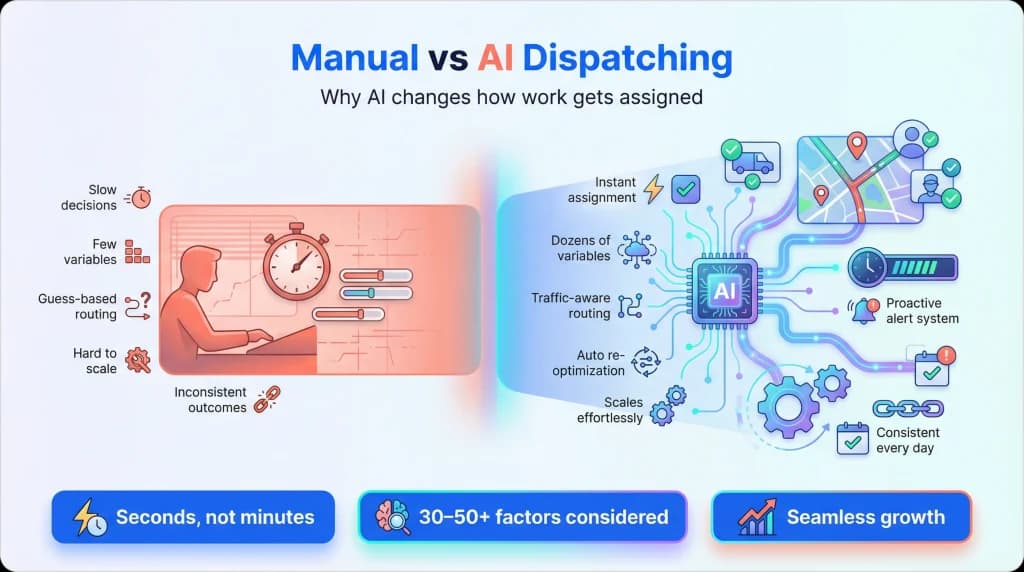
| Manual | AI | |
| Assignment speed | 5–10 min per decision | Seconds |
| Variables weighed | 3–5 | 30–50+ |
| Routing | Best guess or basic maps | Real-time, traffic-aware optimization |
| Handling disruptions | 30–60 min of reshuffling | Automatic re-optimization |
| Scaling past 15–20 techs | Painful | Seamless |
| Consistency | Depends on the dispatcher’s day | Data-driven, every time |
With FieldCamp, AI dispatching isn’t a bolt-on; it’s woven into how every job gets scheduled and assigned.
A job comes in – from a call, an online booking, or a recurring visit. The system captures service type, location, priority, and skill requirements.
AI evaluates your team – checking each tech’s current location, certifications, workload, and remaining capacity. It accounts for multi-day jobs if the work spans more than one visit.
The best-fit tech gets assigned – with their route optimized to fold in the new stop cleanly.
Everyone stays informed – the tech gets a mobile notification, the customer gets an ETA, and your dispatcher sees it all on the dispatch calendar with full override capability.
The system learns – job duration, travel time, customer feedback, and completion data all feed back into the next round of decisions.
You can also manage the whole thing through natural language in the FieldCamp Command Centre, just tell it what you need.
Industries seeing the biggest impact: HVAC, plumbing, electrical, pest control, landscaping, cleaning, and general contracting.
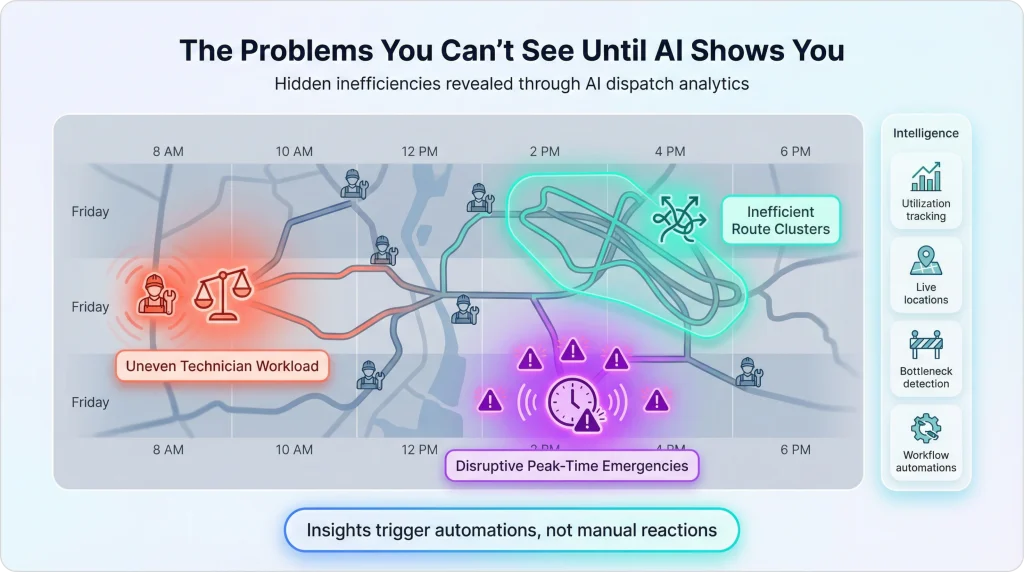
When dispatch runs manually, you’re blind to patterns hiding in your own data. You don’t notice that one technician gets overloaded every Friday. Or that your south-side routes run significantly less efficiently than your north-side ones. Or that emergency calls between 2–4 PM are quietly wrecking the next morning’s schedule.
AI dispatching surfaces all of this through analytics and custom dashboards. Track utilization, watch live team locations, and spot bottlenecks before they become problems.
You can also set up workflow automations triggered by dispatch events, customer notifications, tech check-ins, and follow-up scheduling. Browse the template library to get started fast.
“My dispatcher knows our territory better than any algorithm.” They probably do. But they also take sick days, have off mornings, and max out at juggling a handful of variables. AI doesn’t replace that knowledge; it scales it and makes it available every day, not just on good ones.
“We’re too small for this.” If you’re running five or more techs and scheduling 20+ jobs a day, you’re already complex enough to see a difference.
“What if the AI gets it wrong?” It will, sometimes. That’s why your dispatcher can override any decision. The difference is that they’re starting from an optimized suggestion instead of a blank screen.
“We tried dispatch software before.” Traditional dispatch software digitizes the old process. AI dispatching rethinks it. There’s a real difference between a digital calendar and a system that actively solves your routing and scheduling problems for you.
The smartest rollouts happen in phases:
1. Start with visibility. Connect your job data and let the AI analyze your current patterns. You’ll see where time and money leak immediately.
2. Try AI-assisted scheduling. Let the system suggest assignments while your dispatcher makes the final call.
3. Turn on auto-dispatching. Once trust is built, automate routine jobs. Keep manual control for the complex stuff.
4. Keep optimizing. Use analytics to refine territories, rebalance workloads, and tune the system to your business.
FieldCamp’s job management system supports every stage, from your first AI-suggested dispatch to full automation across the operation.
AI dispatching matters because dispatching itself matters. It touches your techs’ daily experience, your customers’ satisfaction, your fuel bill, your revenue per truck, and your ability to grow without proportionally growing your headcount.
The businesses that get this right don’t just operate more smoothly. They win more bids because they commit to tighter service windows. They keep more technicians because workloads are fair. They scale because their operations can handle it.
Manual dispatching got you here. AI dispatching is how you keep going.
AI dispatching isn’t an upgrade; it’s the new baseline. The companies that get this are pulling away. The ones that don’t are already behind.
No. AI removes the repetitive scheduling work so dispatchers can focus on decisions that need human judgment: customer handling, exceptions, and real-time problem-solving. Most teams report dispatchers are happier because they’re solving problems instead of playing calendar Tetris all day. Dispatchers stay in control, AI handles the heavy calculations.
Dispatch AI is software that uses advanced optimization algorithms to assign jobs, plan routes, balance workloads, and handle real-time schedule changes. It analyzes skills, locations, time windows, and priorities to build the most efficient schedule automatically.
No. Smaller teams (8-15 technicians) often see the biggest improvements first because they have enough complexity to benefit but not so much that implementation is overwhelming. The threshold isn’t company size, it’s operational complexity.
Setup typically takes 1-2 weeks (data migration, job type configuration, skill mapping). Most companies start seeing results within days once basic data is ready. Teams usually see measurable improvements within 30 days. Full adoption, where the team trusts the system and stops constantly overriding, takes 60-90 days.
Dispatchers can override any AI assignment with a single click. The system respects your decision immediately and adjusts the schedule around your change. To prevent similar situations in the future, you can update technician preferences, skill requirements, or zone assignments in your configuration, ensuring the AI follows your business rules from the start.
The opposite. AI adapts in real time when jobs run long or customers reschedule. That’s the entire point: traditional systems are rigid because humans can’t recalculate everything instantly. AI can.
Per-seat cost is often similar, but ROI comes from reduced dispatcher time, lower fuel costs (optimized routes), less overtime, and higher job capacity. Most teams break even within 3-6 months and see significant cost reductions through reduced dispatcher time, fuel savings, and overtime elimination.
Yes. AI dispatching reoptimizes in real time when new jobs arrive. The system evaluates which technician can respond fastest without disrupting other commitments, reassigns if needed, and updates all affected ETAs automatically.
AI uses skills, zones, time windows, priority levels, and configured preferences to make accurate decisions. It evaluates all your business rules simultaneously, something impossible to do manually at scale. The more precisely you configure job categories, technician skills, and customer preferences, the better your schedules become.