
Workload Balancing with AI: The Complete Guide
Invalid Date - 14 min read


Invalid Date - 14 min read

Table of Contents
How AI distributes work fairly, without dispatcher intervention.
Prefer listening? Catch the full episode.
Your best HVAC tech just quit. When you asked why, they said: “I was doing 9 jobs a day while everyone else did 5. I’m exhausted.”
You didn’t mean for this to happen. But it did, because manual dispatching creates invisible workload imbalances that burn out top performers and leave others underutilized.
Workload balancing with AI is the process of distributing job assignments evenly across a field service team to prevent overload, maximize capacity, and ensure fair allocation. The system automatically evaluates job count, total hours, complexity, and revenue distribution across all technicians, then adjusts assignments in real-time to keep the team balanced without requiring dispatcher intervention.
This is one of the hardest problems in field service operations. Dispatchers naturally favor reliable technicians, creating patterns where the same people get overloaded while others sit idle.
This kills morale, increases turnover, and wastes capacity.
This guide explains how AI balances workload across your team, why job count alone misses the real picture, and how to prevent burnout before it costs you your best people.
Workload imbalance isn’t about fairness. It’s about hidden risk concentration.
When the same technicians absorb the most work, the business becomes fragile. One resignation, one injury, one burnout, and capacity collapses overnight.
This problem didn’t appear because technicians suddenly became less capable; it appeared because traditional dispatch systems were never designed to see workload as a team-wide risk. That limitation is exactly why dispatching evolved from manual boards to rule-based systems and, eventually, to AI dispatchers.
(Learn more about the evolution of AI dispatching.)
AI workload balancing spreads risk before it turns into burnout, attrition, or capacity collapse. The goal isn’t equal distribution for its own sake. The goal is operational resilience.
Manual dispatching creates specific patterns of imbalance that often go unnoticed until it’s too late.
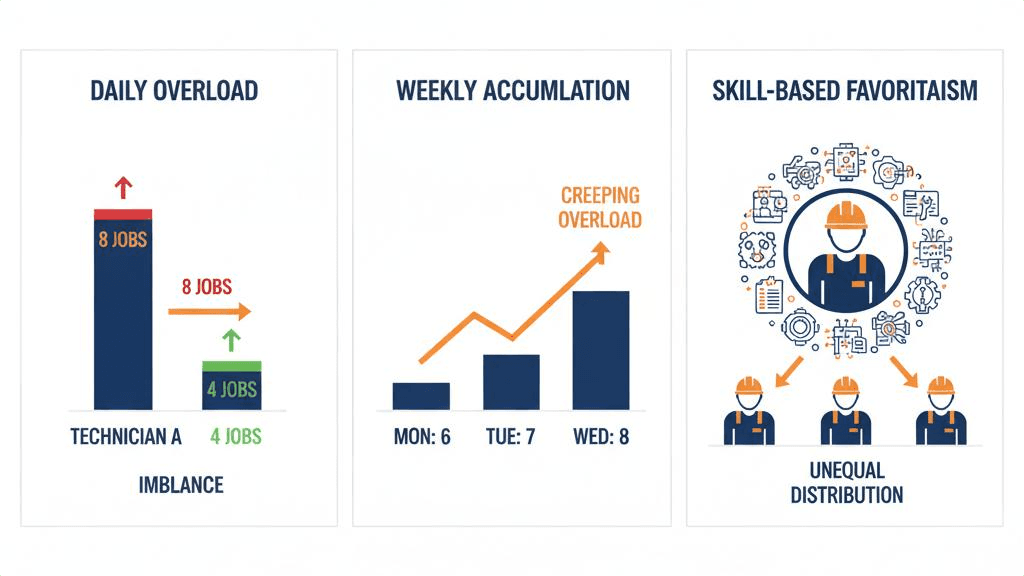
The most visible form. One technician gets 8 jobs while another gets 4. Same day, same shift length.
The dispatcher didn’t intend to create this gap. But it happened because they assigned jobs one at a time without tracking the running total. They defaulted to “send whoever is closest” or “give it to the tech who always says yes.”
This results in your most reliable technicians ending up buried while others wait for their next assignment.
This pattern is nearly impossible to spot manually.
Monday: 6 jobs. Tuesday: 7 jobs. Wednesday: 8 jobs.
No single day looks problematic. But by Thursday, they’re exhausted. By Friday, they’re making mistakes. Within months, they’re updating their resume.
AI detects this multi-day trend before it breaks and redistributes work proactively.
This kind of multi-day fatigue is exactly why modern AI dispatching treats scheduling as a continuous, multi-day problem rather than a series of isolated daily decisions, something multi-day scheduling with AI is designed to handle.
Your “best HVAC tech” gets every complex job and burns out while qualified peers sit underutilized.
This happens because dispatchers naturally assign high-stakes work to people they trust. But trust creates dependency, and dependency creates burnout.
Example: HVAC company with 5 techs. Tech A (senior) consistently gets 7–9 jobs/day because the dispatcher trusts them.
Tech B and C (qualified but newer) average 4–5 jobs/day. Tech A quits after 6 months. Capacity drops overnight because the company never developed its other technicians.
For more on how AI evaluates multiple dimensions when making assignments, see How AI Dispatching Thinks.
A technician with 5 complex installs is more overloaded than one with 7 routine maintenance calls.
AI uses four dimensions to calculate true workload balance.
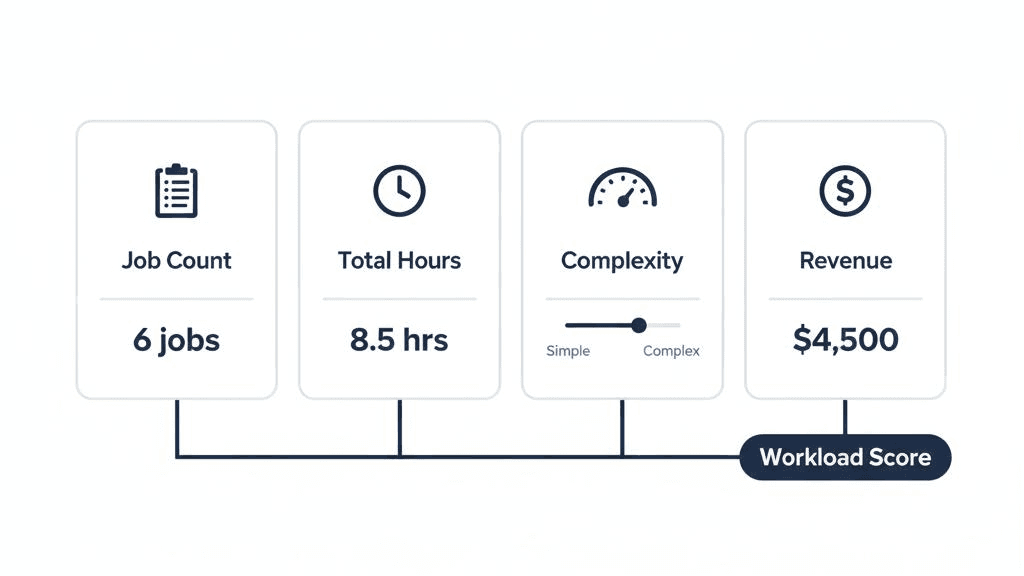
1) Job Count is the baseline metric – easy to track, but incomplete. A tech with 6 jobs might be less busy than one with 4 if durations differ significantly.
2) Total Scheduled Hours accounts for duration. A 3-hour furnace install counts differently than a 45-minute filter replacement. Tech A with 5 jobs (8 hours total) is more overloaded than Tech B with 7 jobs (6 hours total).
3) Complexity Weighting recognizes that not all hours are equal. A complex diagnostic requires more mental energy than routine maintenance. Tech A with 3 complex HVAC installs carries more load than Tech B with 7 routine calls, despite fewer jobs.
4) Revenue Distribution ensures high-value work is spread fairly. If one technician consistently handles $4,500 jobs while another gets $1,200 jobs, the gap creates resentment and missed development opportunities.
| Dimension | What It Measures |
| Job Count | Number of assignments (baseline) |
| Total Hours | Cumulative scheduled time |
| Complexity | Difficulty and cognitive load |
| Revenue | Value of assigned work |
Want to dig deeper? Here’s our easy and non-technical guide to understanding how AI dispatcher algorithms work.
Static morning schedules break the moment reality intervenes. A technician finishes early, another runs late, and an emergency arrives at 2 PM.
AI doesn’t just create balanced schedules; it maintains balance throughout the day.
Let’s understand the concept with an example:
A trigger event occurs: a tech finishes early, runs late, or a new emergency arrives. AI recalculates workload balance for all techs in real time. Then it redistributes, pulling from overloaded tech’s queue or adding to underutilized tech’s route.
Tech A is scheduled for 7 jobs (8.5 hours). Tech B is scheduled for 5 jobs (6 hours). At 11 AM, Tech B finishes 2 jobs faster than expected.
Without AI: Tech B sits idle while Tech A continues toward a 9+ hour day.
With AI: The system automatically assigns the next available job to Tech B, preventing Tech A from hitting overtime while Tech B waits.
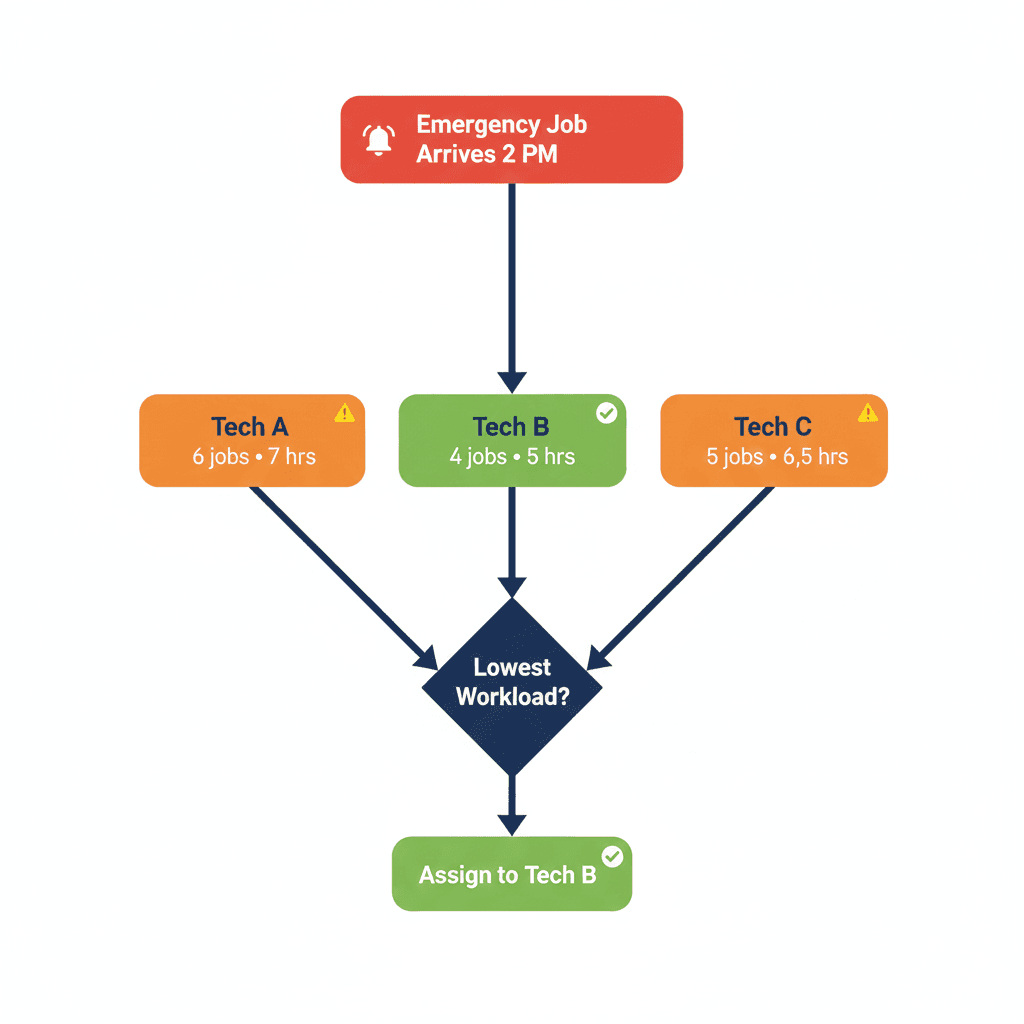
A VIP customer calls at 2 PM with an urgent HVAC issue. Three technicians are available:
| Technician | Current Jobs | Hours Scheduled |
| Tech A | 6 jobs | 7 hours |
| Tech B | 4 jobs | 5 hours |
| Tech C | 5 jobs | 6.5 hours |
AI assigns Tech B to maintain balance, even if Tech A is geographically closer. The system weighs workload balance against drive time and makes the optimal trade-off.
Drive time is often the hidden factor that turns a “balanced” schedule into an overloaded day, which is why AI continuously optimizes routes alongside workload decisions, especially when conditions change mid-day. See how AI reduces drive time without breaking schedule balance.
Perfect workload balance and minimum drive time don’t always align. Sometimes the most efficient route creates the most unfair distribution.
Perfect geographic clustering, where each tech handles all jobs in their zone, often creates an imbalance. If the North zone has 12 jobs and the South zone has 6, pure route optimization would overload the North zone tech.
The system weighs both factors. When balance is prioritized, it accepts slightly longer total drive time to prevent overload.
Real-World Scenario: 3 jobs in the North zone, 2 in the South. Tech A lives in the North (already has 6 jobs, 7.5 hours). Tech B lives in the South (3 jobs, 4 hours).
Pure efficiency: Assign all North jobs to Tech A. Minimum drive time.
AI decision: Assign 2 North jobs to Tech A, 1 North job to Tech B. Accepts extra drive time to prevent Tech A from hitting 9 hours while Tech B sits at 5.5.
This results in total drive time increasing slightly, but workload imbalance drops significantly. Team morale improves. Turnover drops.
The skill trap is one of the most damaging patterns in field service. It happens when dispatchers assign all complex jobs to the “best tech” creating burnout while qualified peers never get a chance.
The dispatcher identifies a “go-to” technician for complex jobs. That tech builds experience and becomes even more trusted. Other qualified techs never get complex work, never develop skills.
The “hero” tech burns out or leaves. The company loses significant complex job capacity overnight.
AI identifies all qualified technicians for each job type, then distributes complex work across the qualified pool, not just to the most trusted person.
Before AI: The HVAC company has 1 “senior tech” who gets all furnace installs (8–10/month).
The other 3 techs (all EPA-certified, qualified for installs) only do maintenance. Senior tech burns out, quits. The company loses installation capacity overnight.
After AI: System distributes monthly installs across all 4 qualified techs. Senior tech still gets complex diagnostics but isn’t overloaded. Team capacity increases. Turnover drops.
The skill trap doesn’t just burn out top performers; it wastes capacity. Junior and mid-level techs who could handle complex work never get the chance.
AI identifies all technicians with required skills and certifications, then distributes based on current workload, not dispatcher preference. This unlocks hidden capacity in your existing team.
Dispatchers can’t see balance without visual tools. Manual tracking requires mental math across job count, hours, complexity, and revenue, impossible in real time.
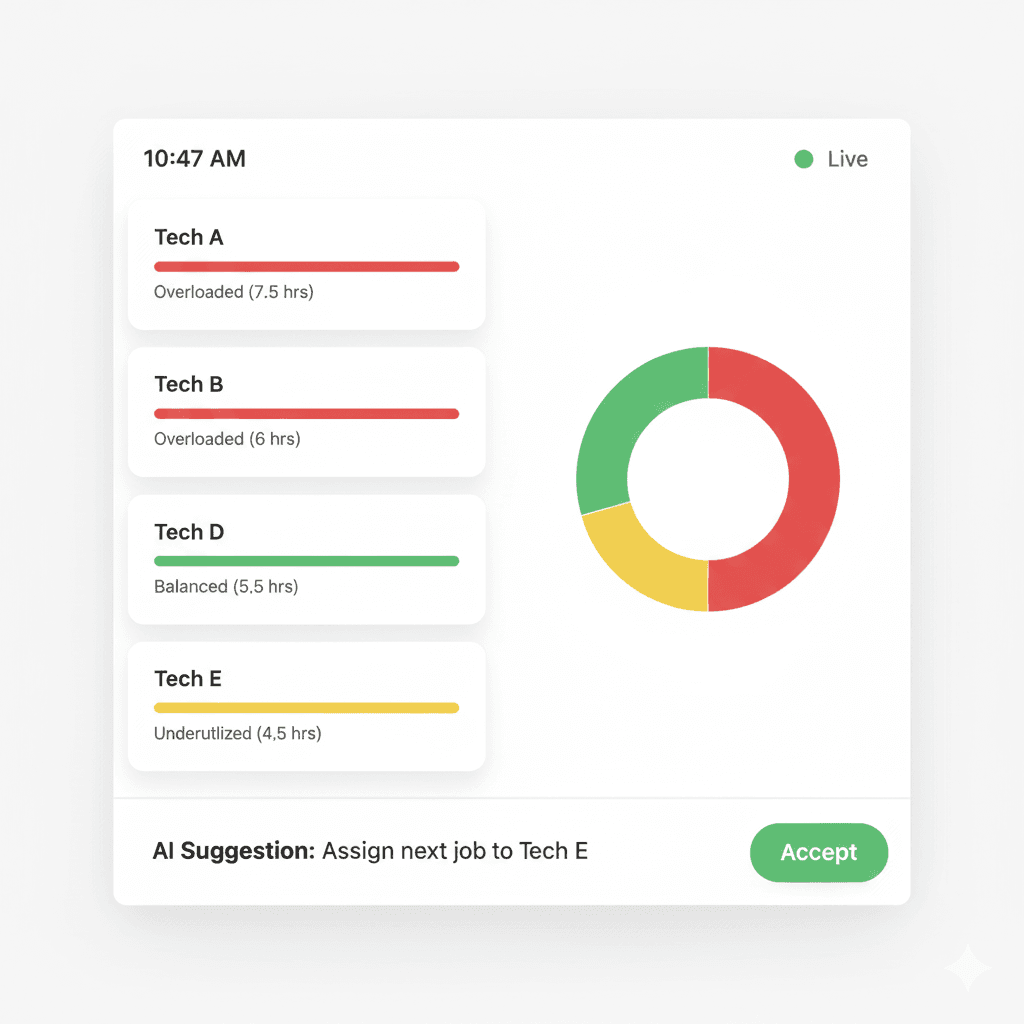
Color-coded view at a glance: Red means overloaded. Green means balanced. Yellow means underutilized.
At 10 AM, a dispatcher opens the dashboard:
| Technician | Status | Hours |
| Tech A | Red | 7.5 hrs |
| Tech B | Red | 6 hrs |
| Tech D | Green | 5.5 hrs |
| Tech E | Yellow | 4.5 hrs |
A new job arrives. AI suggests Tech C. Dispatcher confirms. By 2 PM, all three are green.
Sometimes dispatchers need to override AI. Personal requests mean Tech D needs an early finish for a family event. Customer preferences mean a customer specifically requested this tech. Training situations mean a new tech needs supervision. Equipment constraints mean only one tech has the specialized tool.
The dashboard also shows accumulation patterns before they become critical. If Tech A has run 8+ hours for three consecutive days, the trend view flags this before burnout hits.
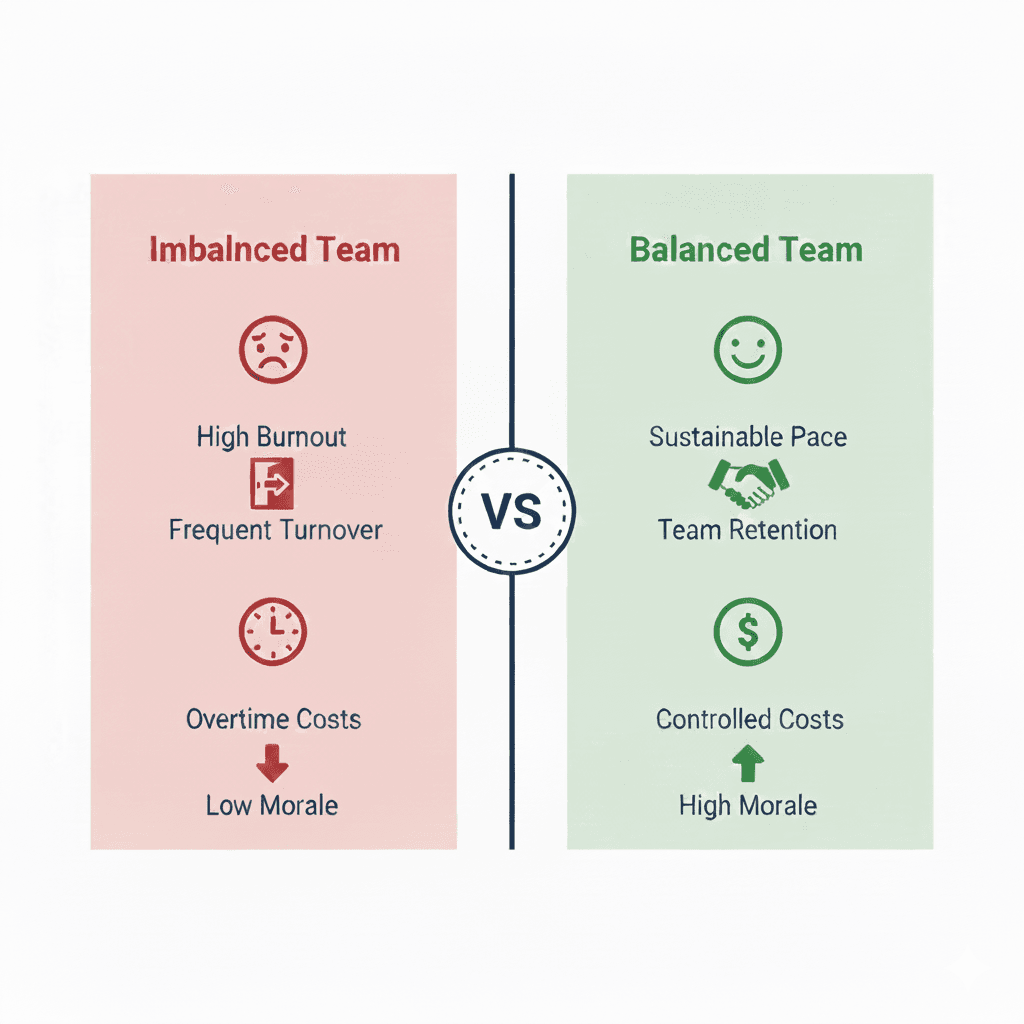
The difference between imbalanced and balanced teams shows up in four areas and compounds over time.
Lower Turnover. When work is distributed fairly, top performers don’t burn out and leave. The cost of replacing a skilled technician: recruiting, training, and lost productivity is high. Preventing even one departure pays for workload balancing many times over.
Higher Morale. Technicians feel valued when work is distributed fairly. They see that the system doesn’t play favorites, that everyone gets opportunities for high-value work, and that no one is consistently overloaded. This translates to better customer interactions, fewer mistakes, and stronger team cohesion.
Predictable Capacity. Balanced workloads enable accurate forecasting. When you don’t depend on single “hero” technicians, you can predict capacity reliably. If one tech calls in sick, the impact is manageable, not catastrophic.
Increased Utilization. Underutilized techs become productive, unlocking more capacity from your existing team. More jobs are completed without hiring, or delayed hiring decisions until you’ve maximized current resources.
FieldCamp’s AI dispatching software applies workload balance scoring in real time, factoring in scheduled hours, skill requirements, and configurable business priorities.
When a new job arrives, FieldCamp doesn’t just ask “who’s closest?” It asks, “Who can take this job while maintaining the best team balance?”
Workload Balance Scoring uses a configurable weight (adjustable from “allow imbalance” to “perfect balance”) that the system evaluates before every assignment.
Real-Time Rebalancing continuously monitors and adjusts throughout the day. Every few minutes, the dispatch system reshuffles unconfirmed jobs to find the best possible route and technician match.
Configurable Weights let businesses set their own priority between fairness and efficiency using routing modes: Balanced, Minimize Driving, or Maximize Revenue.
Skill-Based Distribution ensures jobs only go to qualified technicians and spreads complex work across all who qualify, not just the dispatcher’s favorite.
Set it up once, and FieldCamp Automation handles workload balancing on its own. New jobs are evaluated, assigned, and rebalanced automatically. Dispatchers see the results; they don’t have to calculate them.
Your best tech said: “I was doing 9 jobs while everyone else did 5.”
That’s not a staffing problem. That’s a visibility problem. Manual dispatching can’t see the imbalance building until it’s too late.
AI workload balancing makes the invisible visible. It measures what dispatchers can’t track, distributes what dispatchers can’t fairly allocate, and prevents what dispatchers can’t predict.
The question isn’t whether to balance workload. The question is whether you’ll do it before or after your best technician quits.
See how FieldCamp’s automation balances workload across your team, without manual intervention.
Workload balancing with AI distributes job assignments evenly across a team to prevent overload, maximize capacity, and ensure fair allocation. AI automates this by evaluating job count, hours worked, complexity, and revenue, then adjusting assignments in real time without dispatcher intervention.
AI calculates a workload balance score for each technician based on multiple dimensions. When a new job arrives, the system assigns it to the technician with the lowest balance score, preventing any single tech from accumulating disproportionate work.
Yes, but there’s a trade-off. AI uses configurable weights to balance fairness vs. efficiency. When workload balance is prioritized, the system may accept slightly longer total drive time to prevent overload. Businesses can adjust these weights based on their priorities.
The skill trap occurs when dispatchers assign all complex jobs to the “best tech,” creating burnout while qualified peers sit underutilized. AI breaks this by distributing complex work across all qualified technicians, unlocking capacity and reducing dependency on single performers.
AI tracks workload trends over multiple days. If a technician receives 6 jobs on Monday, 7 on Tuesday, and 8 on Wednesday, the system detects this pattern and redistributes work on Thursday, before burnout occurs. Manual dispatching typically misses these trends until it’s too late.