
How to Price Commercial Lawn Care Jobs in 2026
February 26, 2026 - 30 min read


February 26, 2026 - 30 min read

Table of Contents
| TL;DR Pricing commercial lawn care jobs requires strategic planning beyond residential work—this comprehensive guide reveals how to calculate costs per acre, master competitive bidding, and secure profitable contracts worth $5,000-$75,000+ annually. Use proven formulas, advanced strategies, and FieldCamp’s tools to transform your lawn care business into a commercial powerhouse. |
KEY HIGHLIGHTS
Master Commercial Pricing Strategy
Breaking into commercial lawn care represents a quantum leap for any lawn care business. Unlike residential jobs that might net $50-$150 per visit, commercial contracts can generate $5,000 to $75,000+ annually per client. However, how to price commercial lawn care jobs demands a completely different approach than your typical lawn mowing jobs.
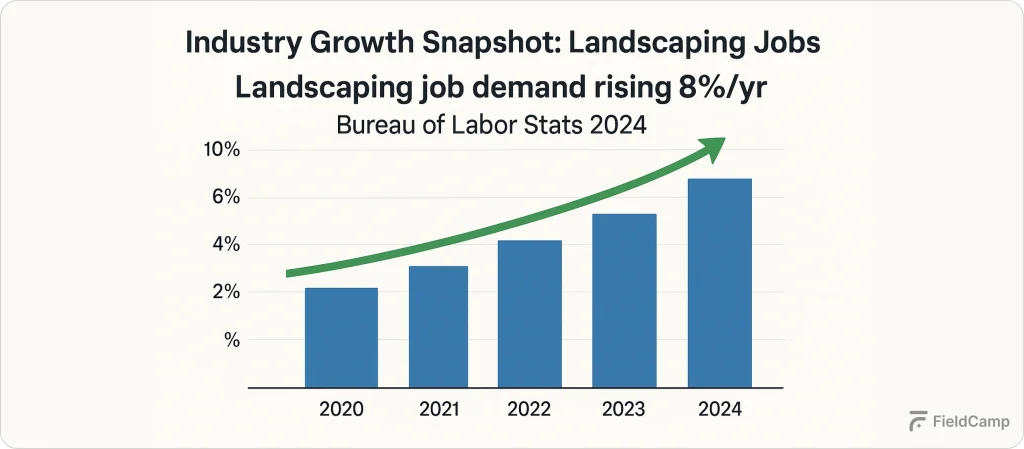
The commercial lawn care industry is experiencing unprecedented growth, with a market size sitting at $159 billion, representing a 3% increase over 2023. If this continues, we’re looking at a $163.8 billion industry in 2025, and landscaping jobs increasing 8% annually (IBIS World, April 2025).
Commercial clients are seeking lawn care companies that can deliver consistent results at scale, making proper pricing strategy the difference between profitable contracts and costly mistakes. Having access to a comprehensive service pricing guide and reliable service pricing calculator tools becomes essential for accurate bid preparation and maintaining competitive advantage.
This definitive guide covers everything from basic lawn care service pricing to advanced bidding strategies for commercial landscaping contracts. You’ll learn to calculate labor costs, factor overhead costs, and present winning proposals that commercial clients can’t refuse.
Let’s get started.
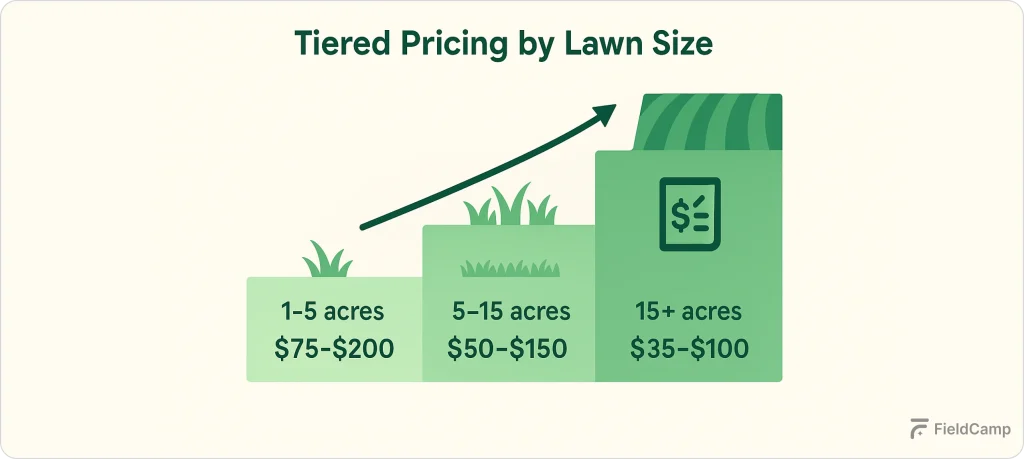
Commercial mowing rates range from $35 to $200 per acre in 2026, depending on property size, terrain, and service frequency.
Most commercial lawn care contracts range from $29,000–$41,000 annually for a standard 6-acre property.
Commercial mowing rates depend on three main things: how big the property is, how often you’re cutting, and where the property is located.
Here’s what contractors are charging across the US right now:
| Property Size | Per Visit Rate | Weekly Contract | Monthly Estimate | Annual Value |
|---|---|---|---|---|
| Under 1 acre | $150–$300 | $125–$250 | $500–$1,000 | $6,000–$12,000 |
| 1–5 acres | $75–$200 | $65–$175 | $260–$700 | $3,120–$8,400 |
| 5–10 acres | $50–$150 | $45–$130 | $180–$520 | $2,160–$6,240 |
| 10–15 acres | $40–$100 | $35–$90 | $140–$360 | $1,680–$4,320 |
| 15+ acres | $35–$80 | $30–$70 | $120–$280 | $1,440–$3,360 |
Rates assume flat, accessible terrain with standard grass. Add 20–30% for slopes, obstacles, or overgrown conditions.
A few things worth noting. Weekly contract rates are typically 10–15% lower than one-time per-visit pricing, and property managers expect a volume discount when they’re committing to a full season.
And larger properties have a lower per-acre cost because your setup and travel time stay the same whether you’re mowing 5 acres or 20.
Commercial mowing rates vary from one location to another. A 5-acre office park in New Jersey costs significantly more to maintain than the same property in Alabama. Labor costs, cost of living, and the length of the growing season all play a role.
| State | Per Acre Rate | Hourly Rate | Growing Season | Regional Factor |
|---|---|---|---|---|
| California | $90–$225 | $55–$85 | Year-round | +30% above national avg |
| Texas | $60–$150 | $45–$70 | Mar–Nov (9 mo) | Near national avg |
| Florida | $75–$175 | $50–$75 | Year-round | +15% above national avg |
| New York | $95–$230 | $60–$90 | Apr–Oct (7 mo) | +35% above national avg |
| Illinois | $70–$165 | $50–$75 | Apr–Oct (7 mo) | +10% above national avg |
| Ohio | $60–$140 | $45–$65 | Apr–Oct (7 mo) | Near national avg |
| Georgia | $65–$155 | $45–$70 | Mar–Nov (9 mo) | Near national avg |
| Pennsylvania | $75–$175 | $50–$80 | Apr–Oct (7 mo) | +15% above national avg |
| North Carolina | $60–$150 | $45–$70 | Mar–Nov (9 mo) | Near national avg |
| Arizona | $80–$190 | $50–$80 | Year-round | +20% above national avg |
Rates based on average commercial properties (5–10 acres). Actual pricing varies by property condition, terrain, and contract terms.
The pattern is simple: states with higher cost of living and shorter growing seasons tend to have higher per-visit rates. But don’t overlook year-round states like Florida and Arizona.
The per-visit rate might be slightly lower, but annual revenue is higher because you’re mowing 12 months instead of 7.
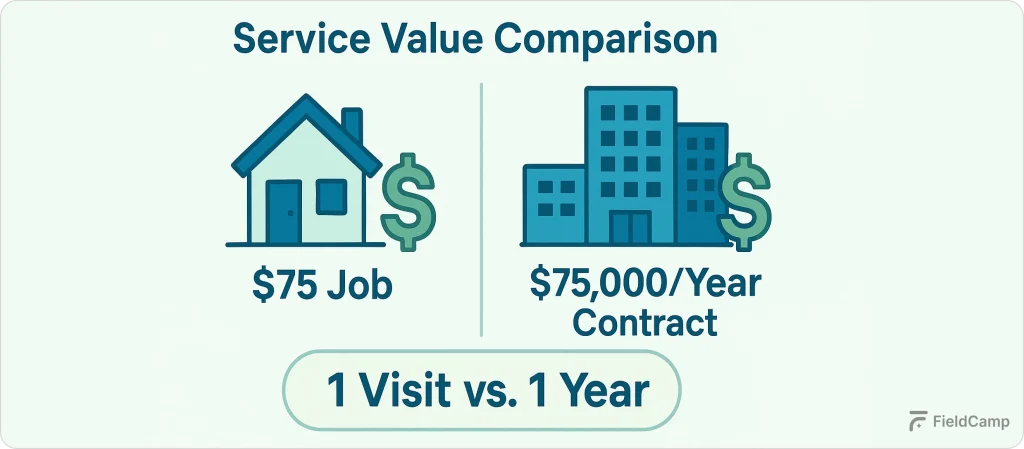
The leap from residential lawn care to commercial contracts isn’t just about bigger properties—it’s a fundamental shift in how your lawn care business operates. Commercial lawn care services demand different equipment, crew management, and pricing strategies that can make or break your profitability.
| Aspect | Residential | Commercial |
| Equipment Cost | ~$5,000 mower | $15,000–$50,000+ zero-turn mowers & specialized equipment |
| Equipment Type | Light-duty | Heavy-duty, high-performance |
| Crew Size | 1–2 workers | 3–6 workers |
| Job Duration | 30–60 minutes | Several hours |
| Labor Complexity | Low | High (due to scale and coordination) |
| Scheduling Impact | Minimal | Significant (due to crew allocation and time blocks) |
| Aspect | Residential Clients | Commercial Clients |
| Billing Preference | Per-service / pay-per-visit | Predictable monthly billing via annual contracts |
| Cash Flow Impact | More flexible, pay-as-you-go | Requires accurate annual cost projections and cash flow planning |
| Margin Strategy | Higher margins (typically 30–40%) | Lower margins (typically 15–25%) |
| Volume Strategy | Lower volume, smaller jobs | Higher volume, larger jobs |
| Example Profit Comparison | $200 job × 40% = $80 profit | $2,000 job × 20% = $400 profit |
| Aspect | Residential Clients | Commercial Clients |
| Stakeholders | Deal directly with homeowners | Involve property managers, facilities directors, and budget committees |
| Decision Process | Simple, fast approvals | Complex approval workflows with multiple layers of authorization |
| Relationship Focus | Personal relationship with homeowner | Ongoing relationship management across several stakeholders |
| Service Expectations | Flexible, based on homeowner preferences | High-performance standards tied to business image and operations |
| Impact of Poor Service | Inconvenience or complaints | Affects customer traffic, employee satisfaction, and overall business reputation |
Successful lawn care companies use different pricing models depending on client preferences, property characteristics, and competitive positioning. Understanding when to apply each model maximizes your chances of winning profitable contracts.
How It Works: Charge a fixed rate per acre of maintained area, with pricing tiers based on total property size and service complexity.
Pricing Structure:
Formula: Total Price = (Acres × Rate per Acre) + Additional Services
Example Calculation:
8-acre office complex with monthly mowing:
PROS
CONS
Easy to explain to potential clients
Scales logically with property size
Industry-standard for commercial bids
May not reflect actual labor time on complex properties
Doesn’t account for terrain variations
Best For: Standard office parks, retail centers, industrial facilities with relatively uniform terrain and maintenance requirements.
How It Works: Charge based on actual labor time invested, typically ranging from $45-$85 per man hour depending on your local market and service complexity.
Formula: Total Cost = (Workers × Hours × Hourly Rate) + Equipment Costs + Materials
Market Rate Analysis:
Example Calculation:
Property requiring 3 workers for 6 hours:
PROS
CONS
Accurately reflects actual work performed
Fair compensation for complex or unpredictable jobs
Easy to adjust for scope changes
Protects against underestimating difficult properties
Clients may question efficiency
Requires detailed time tracking
Less predictable for client budgeting
Best For: Complex properties with varying terrain, specialized lawn maintenance services, new client relationships where work scope is uncertain.
How It Works: Annual or seasonal contracts with fixed monthly payments covering all specified lawn services regardless of actual time spent.
Seasonal Adjustment Strategy:
Formula: Annual Contract = (Peak Season Cost × 7 months) + (Off-Season Cost × 5 months)
Example Calculation:
Large commercial property:
PROS
CONS
Predictable revenue for both parties
Simplifies client budgeting
Encourages long-term relationships
Protects against underestimating difficult properties
Risk if costs exceed projections
Requires accurate annual planning
Weather variations can impact profitability
Difficult to adjust for scope changes
Best For: Established commercial clients, full-service maintenance contracts, properties with predictable seasonal requirements.
Accurate cost calculation forms the foundation of profitable commercial pricing. Many lawn care companies fail because they underestimate true costs, leading to contracts that generate revenue but destroy profitability.
Base Labor Calculation: Labor costs extend far beyond basic hourly wages. Use this comprehensive formula:
Labor Cost = (Base Wage × Labor Burden Multiplier) × Hours × Workers
Labor Burden Components:
Example Labor Burden Calculation:
Try FieldCamp’s free labor cost calculator now. It’s fast, free, and built for field pros like you. Whether you’re pricing a small residential job or a large commercial contract, knowing your true labor cost is non-negotiable.
Equipment Cost Categories:
Equipment Rate Calculation:
Annual Equipment Costs:
Expected annual hours: 1,200
Equipment rate: $15,900 ÷ 1,200 = $13.25/hour
Not sure how much lawn care should cost? Use our free lawn care cost calculator to get an instant estimate based on your property size, services, and location. No guesswork — just a clear price range to help you plan better.
Fixed Overhead Categories:
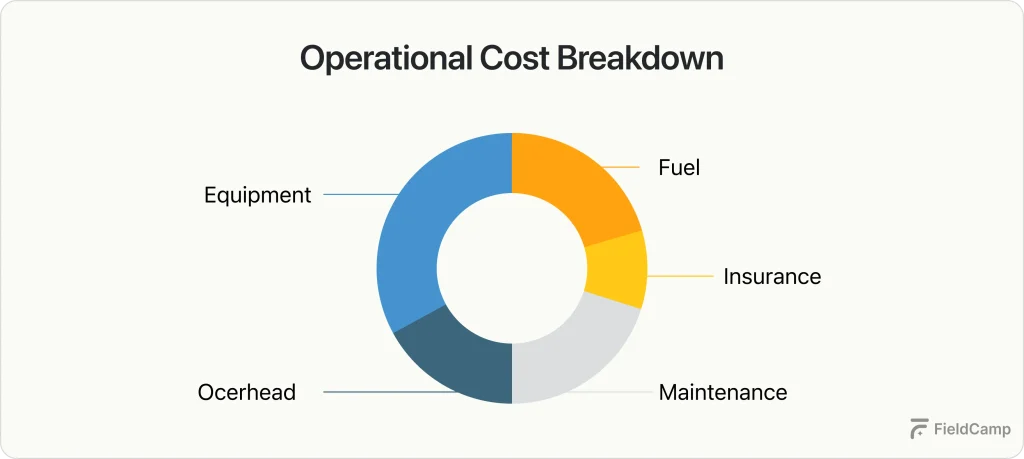
Variable Overhead:
Overhead Allocation Formula:
Direct Materials:
Material Markup Strategy:
Target Profit Margins by Service Type:
Complete Pricing Example:
Weekly mowing for 5-acre commercial property:
Let’s put all five steps together. Say you’re bidding on a weekly mowing contract for a 5-acre office park with flat terrain, standard grass, and easy equipment access.
Step 1 – Labor:
Step 2 – Equipment:
Step 3 – Overhead:
Step 4 – Materials:
Step 5 – Profit margin:
| Line Item | Cost |
|---|---|
| Labor (6 man-hours) | $138.24 |
| Equipment (3 hours) | $39.75 |
| Overhead (3 hours) | $49.05 |
| Materials | $15.00 |
| Subtotal | $242.04 |
| + 25% profit margin | $80.68 |
| Price per visit | $322.72 |
| Per acre rate | $64.54 |
| Weekly contract (42 weeks) | $13,554 |
| Annual value | $13,554 |
That $64.54 per acre lands right in the middle of our 5–10 acre pricing range ($50–$150/acre). If the property is straightforward, you’re competitive. If it has slopes or obstacles, bump it up 20–30%.
Stop guessing at your profit margins and start making data-driven pricing decisions. Our free profit margin calculator helps lawn care professionals instantly determine their actual profitability on every job, ensuring you never undercharge for your services again.
Different commercial lawn services require distinct pricing approaches based on complexity, frequency, and market demand. Understanding service-specific pricing helps you create comprehensive proposals that maximize revenue.
Here’s a quick reference for what commercial properties typically pay per acre across different service types in 2026:
| Service | Per Acre Rate | Frequency | Annual Cost (5-acre property) |
|---|---|---|---|
| Basic mowing & edging | $50–$150 | Weekly | $10,400–$31,200 |
| Fertilization | $45–$90 | 4–6x/year | $900–$2,700 |
| Aeration | $30–$60 | 1–2x/year | $150–$600 |
| Overseeding | $35–$85 | 1–2x/year | $175–$850 |
| Weed control / herbicide | $15–$50 | 4–6x/year | $300–$1,500 |
| Dethatching | $90–$260 | 1x/year | $450–$1,300 |
| Leaf removal | $90–$200 | 3–6x/fall | $1,350–$6,000 |
| Hedge & shrub trimming | $50–$120 | Monthly | $3,000–$7,200 |
| Irrigation management | $30–$75 | Monthly | $1,800–$4,500 |
| Snow removal | $75–$175 | Per event | Varies by region |
| Full-service maintenance package | $160–$320/month | Monthly | $9,600–$19,200 |
Sources: HomeAdvisor, Angi, LawnStarter
Most commercial property managers prefer bundled packages over individual services. A full-service maintenance contract that includes mowing, fertilization, weed control, and seasonal cleanup typically runs $160–$320 per acre per month, which works out cheaper than booking each service separately.
If you’re bidding on a commercial contract, lead with the package price and break out individual services as add-ons.
Frequency-Based Pricing:
Pricing by Property Size:
| Property Size | Weekly Rate | Bi-Weekly Rate | Monthly Rate |
| 1-3 acres | $150-$400 | $190-$500 | $250-$650 |
| 3-8 acres | $300-$750 | $380-$950 | $500-$1,200 |
| 8-15 acres | $600-$1,200 | $760-$1,500 | $1,000-$1,950 |
| 15+ acres | $45-$75 per acre | $55-$95 per acre | $75-$120 per acre |
Additional Mowing Considerations:
Fertilization and Soil Management:
Weed Control Programs:
Pest Control Integration:
Spring Startup Services:
Fall Preparation Services:
Landscape Enhancement Services:
Seasonal Contract Pricing:
Service Level Options:
Successful commercial bidding requires a systematic approach that balances competitive pricing with profitable margins. Understanding the bidding process gives your lawn care business a significant advantage over competitors who rely on guesswork.
Comprehensive Site Evaluation: Never submit a commercial bid without conducting a thorough on-site evaluation. Effective commercial job management ensures every detail is tracked from initial bid through project completion.
Essential Assessment Components:
Competitive Intelligence Gathering:
Professional Presentation Standards: Commercial clients expect detailed, professional proposals that demonstrate your lawn care company’s capabilities and attention to detail.

Proposal Structure:
Transparent Cost Breakdown – Monthly Commercial Lawn Care Package
Client: Acme Office Complex – 6 Acres
| Category | Service | Cost |
| Core Maintenance | Weekly mowing and edging | $1,800/month |
| Bi-weekly trimming and cleanup | $400/month | |
| Monthly fertilization (growing season) | $300/month | |
| Quarterly weed control | $200/month | |
| Seasonal Services | Spring cleanup and preparation | $1,200 (one-time) |
| Fall leaf removal program | $800 (one-time) | |
| Winter maintenance | $400/month (Dec–Feb) | |
| Optional Enhancements | Irrigation system maintenance | $300/month |
| Seasonal flower program | $600/month | |
| Emergency response | $150/month | |
| Total Monthly Investment (Peak Season) | $2,700 | |
| Annual Contract Value | $29,400 | |
Monthly Subscription Model Benefits: 27.5% of lawn care companies use monthly billing to create predictable cash flow for both parties (GreenPal, 2024).
Subscription Pricing Strategies:
12-Month Averaging:
Seasonal Billing:
Hybrid Approach:
Payment Collection Strategies:
Automated Payment Systems:
Collection Policy Development:
Service Documentation and Accountability:
Digital Work Orders:
Client Communication Protocols:
Performance Monitoring Systems:
Tracking the right metrics isn’t just about accountability — it’s about growth, profitability, and delivering consistent value to your commercial clients.
Here are some essential KPIs you should be monitoring:
Check out our full guide: 51 Field Service Metrics That Matter Most — it’s packed with actionable insights for tracking performance, boosting efficiency, and scaling smarter.
Client Satisfaction Management:
At some point, you’re going to need to raise your rates. Fuel costs go up, labor gets more expensive, and equipment wears out. The contractors who lose clients over price increases are the ones who spring it on people at the last minute with no explanation.
Here’s how to do it right:
Give 60–90 days’ notice. Never surprise a property manager with a rate increase at renewal time. Send a professional letter or email 2–3 months before the contract renews, explaining the adjustment.
Lead with the numbers, not the apology. Don’t say “unfortunately, we need to raise prices.” Instead, say “due to a 12% increase in fuel costs and a 15% increase in labor rates since your contract started, we’re adjusting our rate from $X to $Y effective [date].” Property managers deal with vendor price increases all the time, and they respect transparency.
Keep it between 5–10% annually. Anything above 10% in a single year feels aggressive, even if it’s justified. If you’re behind on pricing, spread the catch-up over 2 years. A 5% annual increase on a $30,000 contract is $1,500; most property managers won’t blink. A 20% jump is $6,000, which triggers a rebid.
Bundle the increase with added value. “We’re adjusting our rate by 7%, and we’re also adding a free spring aeration to your contract,” makes the increase feel like an upgrade rather than a cost hike.
Have a retention plan ready. If a client pushes back, have a middle ground prepared. Maybe hold the old rate for 3 more months, or offer a 2-year lock at a smaller increase. Losing a $30,000 commercial account over a $1,500 price increase makes no financial sense.
Maximizing profitability in commercial lawn care requires sophisticated strategies that go beyond basic pricing. Successful lawn care companies implement systems that optimize every aspect of their operations while creating additional revenue opportunities.
Route Optimization and Crew Productivity
Geographic Clustering Strategy:
Crew Specialization Benefits:
Technology Integration for Efficiency: Using field service automation can reduce administrative costs by 25-40% while improving service quality.
Automated Scheduling Benefits:
Fuel costs, wasted time, and inefficient crew movement can quietly drain your profits.
FieldCamp fixes that.
Our smart AI-powered scheduling and route optimization engine helps you:
Modern commercial lawn care success depends heavily on technology integration that streamlines operations, improves client communication, and maximizes profitability. Leading lawn care companies leverage comprehensive field service management solutions to gain competitive advantages.
Comprehensive Operational Control:
Integrated Job Scheduling and Dispatch:
Advanced Client Management:
Mobile Workforce Empowerment:
Field Team Capabilities:
Client Self-Service Portal Benefits:
Empower Your Mobile Crew On the Go
Give field teams access to digital work orders, time tracking, and photo logs.
Save admin time and capture job data in real time.
Ready to transform your commercial pricing strategy? FieldCamp’s comprehensive field service optimization platform helps lawn care businesses streamline operations, optimize crew efficiency, and win more profitable contracts through professional proposal generation and automated client management.
Start your FieldCamp free trial today and discover how the right technology transforms commercial lawn care pricing from guesswork into strategic advantage—helping you build a profitable, scalable business that commercial clients trust and recommend.
Commercial mowing rates typically range from $35-$100 per acre for large properties (15+ acres) and $75-$200 per acre for smaller commercial sites (1-5 acres). Pricing depends on terrain complexity, service frequency, and regional market rates. Properties with obstacles, slopes, or high-maintenance requirements command premium pricing.
Commercial pricing operates on lower profit margins (15-25%) but higher total contract values, while residential jobs typically have higher margins (25-40%) but smaller individual invoices. Commercial contracts require competitive bidding, longer-term commitments, and more complex service agreements compared to residential jobs.
Calculate loaded labor costs by multiplying base wages by 1.25-1.5 to account for payroll taxes, workers’ compensation, benefits, and training costs. For example: $18/hour base wage × 1.3 multiplier = $23.40 loaded rate. Multiply by crew size and estimated hours for total labor cost per visit.
Include all indirect business expenses: office rent, insurance, vehicle maintenance, business management software, marketing, licensing, and administrative costs. Calculate overhead rate by dividing monthly overhead by billable hours. Typical overhead rates range from $12-$25 per hour depending on business size and efficiency.
Focus on accurate cost calculation including all labor costs, equipment expenses, overhead costs, and desired profit margin. Research competitor pricing but avoid underbidding below profitable levels. Emphasize value, reliability, and service quality rather than competing solely on price. Target 15-25% profit margins for sustainable growth.
Monthly billing provides predictable cash flow for both parties, with 27.5% of lawn care providers using this model (GreenPal, 2024). Consider seasonal adjustments where peak season (April-October) rates are higher than dormant season rates, or spread annual costs evenly across 12 months for client budget consistency.
Invest in comprehensive field service management software that includes scheduling, mobile work orders, client communication, and billing integration. Essential features include GPS tracking, photo documentation, automated invoicing, and client portal access for self-service and communication.
For a typical 5-acre commercial property, expect to pay somewhere between $800 and $1,600 per month for full-service maintenance. That usually covers weekly mowing, edging, fertilization, weed control, and seasonal cleanup. Basic mowing-only contracts run significantly less, around $120 to $280 per month per acre depending on your region and service frequency.
Most contractors charge between $35 and $200 per acre per visit in 2026. The range is wide because property size makes a huge difference. A small 2-acre office park might command $150 per acre, while a 20-acre industrial campus might go for $40 per acre. The key is calculating your actual labor, equipment, and overhead costs per acre — then adding your target profit margin on top. Our cost calculation section above walks through that math step by step.
It depends on the service. Basic mowing jobs typically bring in 15–25% net profit. Full maintenance contracts with fertilization and weed control bump that up to 20–30%. Specialty work like seasonal landscaping or irrigation management can hit 25–40%. If you’re consistently below 15% on commercial accounts, you’re either underpricing or your overhead is eating your margins.
Start with Google Earth or satellite imagery to estimate the acreage and spot any obstacles: slopes, islands, fences, water features. Then do a site visit to check grass condition, terrain difficulty, and access points for equipment. Multiply your per-acre rate by the total mowable area, add time estimates for edging and trimming, and factor in travel time. Always build in a 10–15% buffer for your first visit, properties are almost always more work than they look on screen.
Generally, yes, but not always. Commercial contracts are larger ($10,000–$40,000+ annually vs $1,500–$4,000 for residential), more predictable, and come with multi-year renewal potential. The trade-off is tighter margins per visit and slower payment cycles — some commercial clients take 30–60 days to pay. Most successful lawn care companies run a mix of both. Residential fills the weekly schedule and pays fast. Commercial builds a long-term revenue base.