
Automated Dispatching: How AI Algorithms Assign Jobs
April 8, 2026 - 15 min read


April 8, 2026 - 15 min read

Table of Contents
AI dispatching algorithms are automated systems that assign jobs to technicians by evaluating skills, location, constraints, and real-time conditions, replacing manual dispatch boards with math that adapts as your day changes.
But “algorithms” is a vague word. What’s actually happening under the hood? How does the system decide who gets which job, and why does it sometimes pick the farther technician over the closer one?
This guide breaks down the exact logic, from constraint validation to machine learning scoring, so you understand what your AI dispatcher is doing and why.
What you’ll learn:
AI dispatching algorithms are automated systems that evaluate jobs, technicians, constraints, and real-time conditions to generate optimal schedules. They replace manual dispatching with mathematical models that continuously adapt as circumstances change.
Modern field service operations involve too many variables for human dispatchers to manage at scale: skills, locations, traffic, SLAs, and workload balance all shift constantly throughout the day.
Human dispatchers typically handle 10–20 variables simultaneously, while field service operations generate 200+ variables hourly. Manual dispatchers violate constraints 15–20% of the time when processing this volume. Algorithms manage:
For a broader look at why this matters operationally, see why AI dispatching matters and the evolution of AI dispatching.
VRP determines the most efficient way for technicians to complete jobs while respecting constraints. As job counts increase, route combinations grow exponentially; 50+ jobs create more possibilities than could be explored in a lifetime.
VRP Variants in Field Service:
Constraint programming ensures schedules are operationally valid, legally compliant, and aligned with business priorities. Every scheduling rule falls into one of two categories:
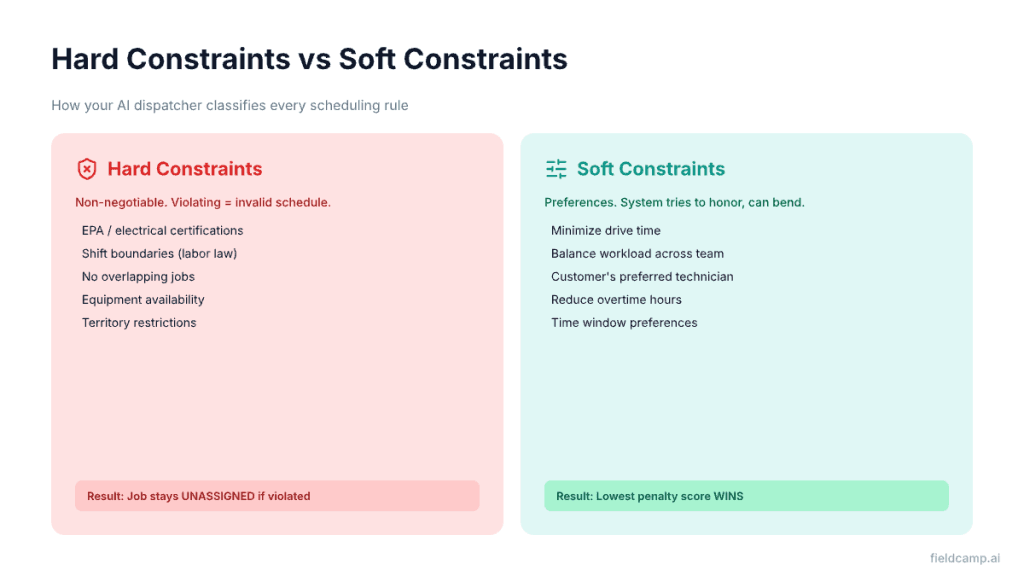
Hard Constraints (non-negotiable – violating them makes the schedule invalid):
Soft Constraints (preferences the system tries to honor but can bend):
The critical distinction: hard constraints are binary (pass or fail), while soft constraints use penalty scoring to weigh trade-offs.
A very high-penalty soft constraint still differs fundamentally from a hard constraint; soft constraints can be violated if necessary, hard constraints cannot.
ML improves scheduling accuracy by learning from historical patterns:
The system becomes measurably smarter with usage; teams see 70–80% prediction accuracy in the first 60 days, increasing to 90%+ as the model adapts.
Real-time optimization continuously recalculates when disruptions occur:
Rather than rebuilding the entire schedule, the system adjusts only affected routes, protecting the rest of the day. See real-time schedule adjustments for a deeper breakdown.
When AI skips the closest technician for someone farther away, it’s not malfunctioning; it’s optimizing the entire day simultaneously rather than one job at a time.
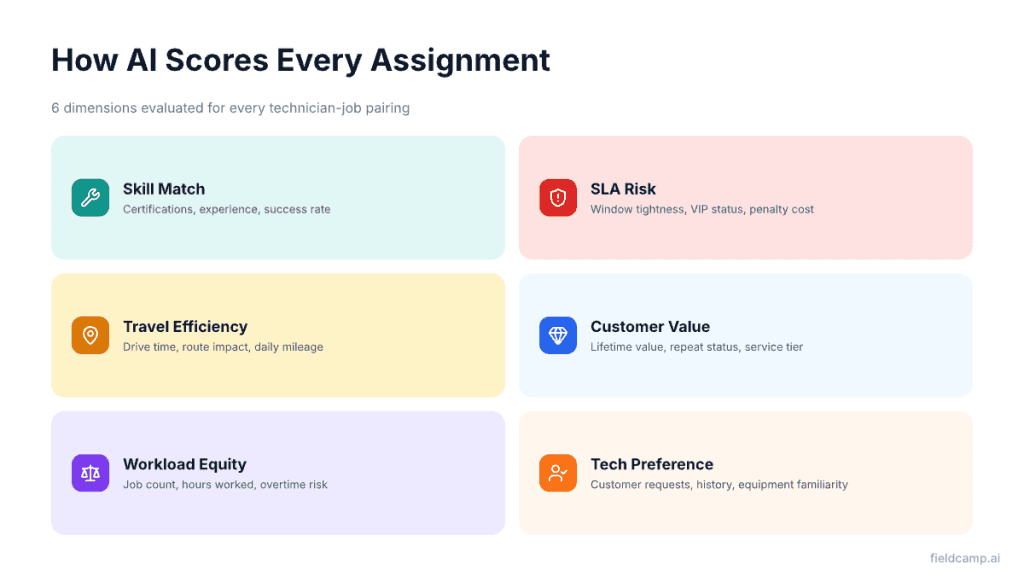
The system evaluates every technician-job pairing across six dimensions. See how AI matches jobs to technicians for the full matching logic.
Skill Match vs. Proximity: AI assigns the experienced tech 18 minutes away over the closer novice because expertise reduces callback probability, offsetting the extra drive time across the whole day.
Workload Balance vs. Speed: AI routes to the less-loaded tech even if farther away, because overtime costs from overloading one person exceed the fuel expense of a longer drive. See fair distribution algorithms for how equity is scored.
SLA Protection vs. Route Efficiency: When a tight SLA window exists, AI prioritizes the tech with the most reliable schedule over the one with the shorter route. See how AI prioritizes competing jobs.
Running Late – Reassign or Protect? When a tech runs 40 minutes late, AI reassigns only the next appointment to protect the time window, then lets the original tech resume the rest of their route. See dynamic rerouting for how this plays out in practice.
Perfect optimization is computationally impossible with hundreds of variables. AI commits when incremental improvements drop below 2%, delivering 96% optimal schedules in seconds rather than mathematically perfect solutions that take minutes.
Every business rule your AI dispatcher enforces falls into one of four categories:
Protect your business from legal liability. EPA 608 certification for refrigerant handling, labor laws on maximum hours, and OSHA safety regulations. These cannot be softened.
Physical realities and core business policies shift boundaries, territory restrictions, and technician capacity limits. Most are hard, though some can be softened based on your flexibility needs. See zone and territory constraints in AI dispatching.
Requests for specific technicians, preferred time windows, and same-day service. These rarely justify making a schedule impossible. See alternative time windows for how to handle customer flexibility.
Minimizing drive time, balancing workload, and reducing overtime. These optimize operations but never block a valid assignment. See AI route optimization explained for how efficiency constraints translate into route decisions.
When multiple constraints clash, this priority ranking determines which rules override:
No efficiency gain justifies a compliance violation. No cost saving justifies breaking a customer commitment.
The system processes every assignment through six validation steps:
See what is continuous planning for how this loop runs across a full dispatch day.
Getting this classification right determines whether your AI dispatcher helps or frustrates your team.
Make a rule HARD if: Breaking it would be illegal, unsafe, physically impossible, or contractually required.
Make a rule SOFT if: It represents a preference, efficiency goal, fairness target, or informal expectation.
Not sure whether your operation needs AI dispatching at all? Use the AI dispatch decision tree to find out.
Treating “same-day service” as a hard constraint often causes excessive unscheduled jobs. Converting it to a soft constraint with high penalty weight (5,000–10,000) allows next-day scheduling with customer confirmation when same-day is genuinely impossible — reducing your unschedulable rate significantly.
| Weight Range | Meaning |
|---|---|
| 1–100 | Minor preference (nice to have) |
| 100–1,000 | Moderate preference (try hard) |
| 1,000–10,000 | Strong preference (only violate if necessary) |
| 10,000+ | Near-hard constraint (almost never violated) |
Start with industry defaults, run test schedules, review assignments that feel wrong, adjust by 50–100%, and re-test. Quarterly reviews help adapt to seasonal business changes. The AI dispatcher ROI calculator can help you quantify the impact of constraint tuning on your bottom line.
The algorithms above handle the logic. Machine learning makes that logic increasingly accurate over time. For context on how this compares to traditional tools, see AI dispatching vs. traditional dispatch software.
Static time estimates fail because a routine maintenance visit at a well-maintained facility takes 45 minutes — the same service at a neglected property takes 4 hours. ML duration models process:
Result: 40% reduction in schedule disruption compared to static estimates.
Field service businesses lose 15–20% of scheduled appointments to no-shows and late cancellations. ML flags high-risk appointments based on:
Countermeasure: For high-risk slots, strategically double-book with a lower-priority job from the same area. If the primary appointment confirms, the backup moves. If they no-show, the tech proceeds to the backup — zero wasted time. FieldCamp’s no-show prevention automation handles this automatically.
ML analyzes 50+ variables to create holistic technician profiles across four dimensions:
This feeds back into the scoring system — AI routes complex commercial jobs to techs with proven success rates, not just the closest available person. Track these metrics using field service reporting software.
Every completed job generates training data. The system tracks actual vs. predicted duration, parts used vs. estimated, customer satisfaction, and schedule disruption incidents.
For teams planning seasonal demand in advance, see long-range scheduling and priority-based AI dispatching.
When jobs pile up unassigned, the issue is usually capacity — not a software bug. Check:
For surge scenarios, see emergency job handling and mid-day job insertions.
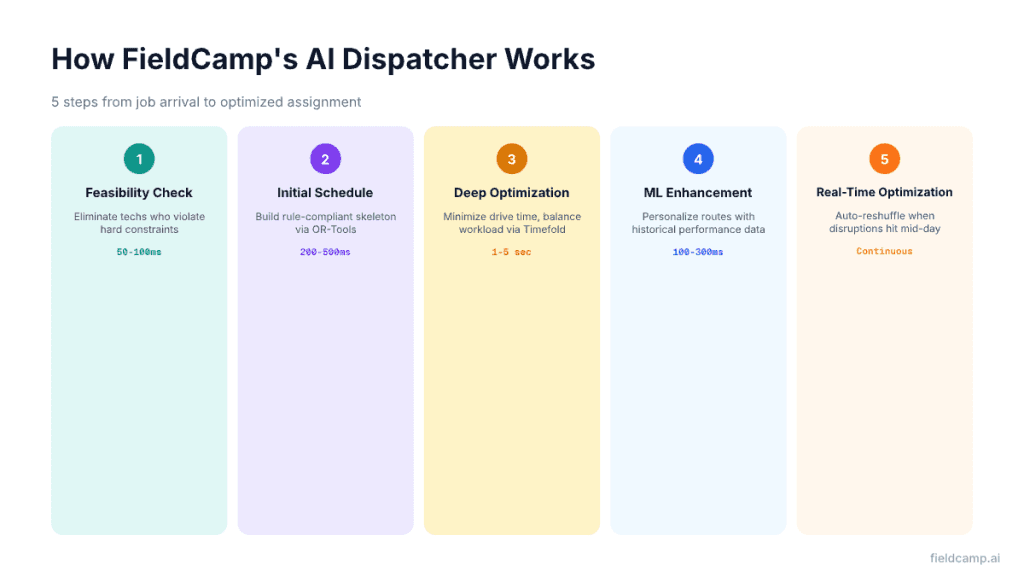
Step 1: Feasibility Check (50–100ms) Eliminates impossible matches based on hard constraints — skills, certifications, time windows, equipment, territories.
Step 2: Initial Schedule (200–500ms) Google OR-Tools builds a rule-compliant skeleton schedule respecting all time windows and shift limits. See AI-powered scheduling for how the initial schedule is constructed.
Step 3: Deep Optimization (1–5 seconds) Timefold improves the schedule — minimizing drive time, balancing workload, satisfying soft constraints with lowest total penalty score. See multi-stop route planning with AI.
Step 4: Machine Learning Enhancement (100–300ms) ML personalizes routes based on historical team performance, adjusts duration estimates, flags no-show risks.
Step 5: Real-Time Optimization (Continuous) Automatically reshuffles affected portions when disruptions occur — late jobs, cancellations, emergency insertions.
Step 6: Output Delivery Technicians receive updated routes, ETAs, and sequence changes across all apps. Dispatchers see the reasoning behind every assignment with score breakdowns and alternative options. Learn more about what this looks like day-to-day in what is an AI dispatcher.
Trust the AI when the reasoning is sound even if counterintuitive — a higher-rated tech 18 minutes away often beats the closer novice when you factor in callbacks and completion time.
Override when you have context the system lacks — undocumented customer preferences, a tech having a bad day, equipment issues not yet logged, or relationship dynamics the data can’t capture.
FieldCamp’s AI dispatch software shows you the top 3 factors behind every assignment, the score breakdown, and alternative options — so overrides are informed, not guesses. See how this compares to older tools in AI dispatching vs. traditional dispatch software.
Let FieldCamp’s dispatcher algorithms do the heavy lifting — smart assignments, instant reshuffling, and accurate ETAs even when your day gets unpredictable.
Algorithms score every available technician across skills, certifications, location, workload, SLA risk, and customer value. The highest-scoring match that satisfies all hard constraints wins, balancing response speed, first-time fix likelihood, and minimal travel distance. See how AI matches jobs to technicians for the full breakdown.
Hard constraints are rules that cannot be violated; breaking them makes the schedule invalid (certifications, shift limits, equipment availability). Soft constraints are preferences the system tries to honor but can bend when necessary (drive time, workload balance, customer tech preferences). Hard constraints filter; soft constraints score.
AI evaluates the entire day, not just one job. The farther tech might have better skills, lower workload, higher success rates, or a schedule that makes the rest of the day more efficient. Distance is one factor among six scoring dimensions.
Most teams see 70–80% accuracy in the first 60 days, increasing to 90%+ after the model adapts to your specific job patterns, technician performance, and seasonal variations.