

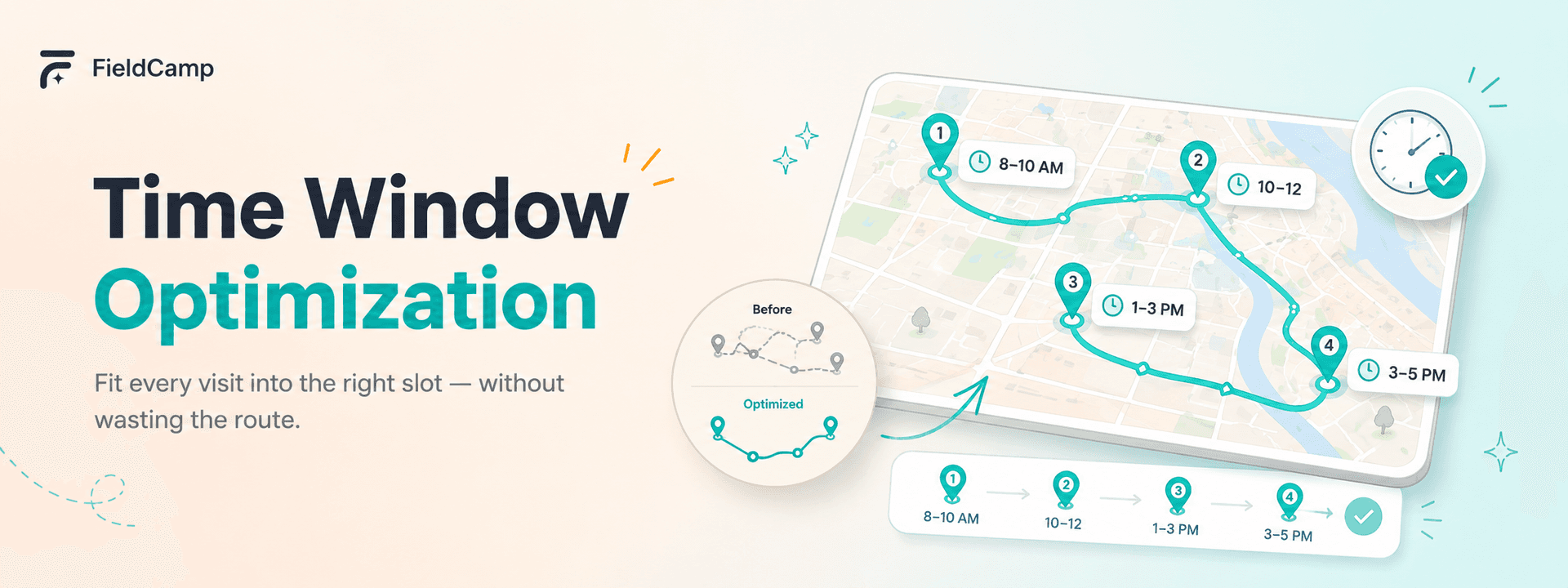
TL;DR
- Time window optimization field service treats customer arrival windows as soft constraints with penalty weights, not as rigid pass/fail rules.
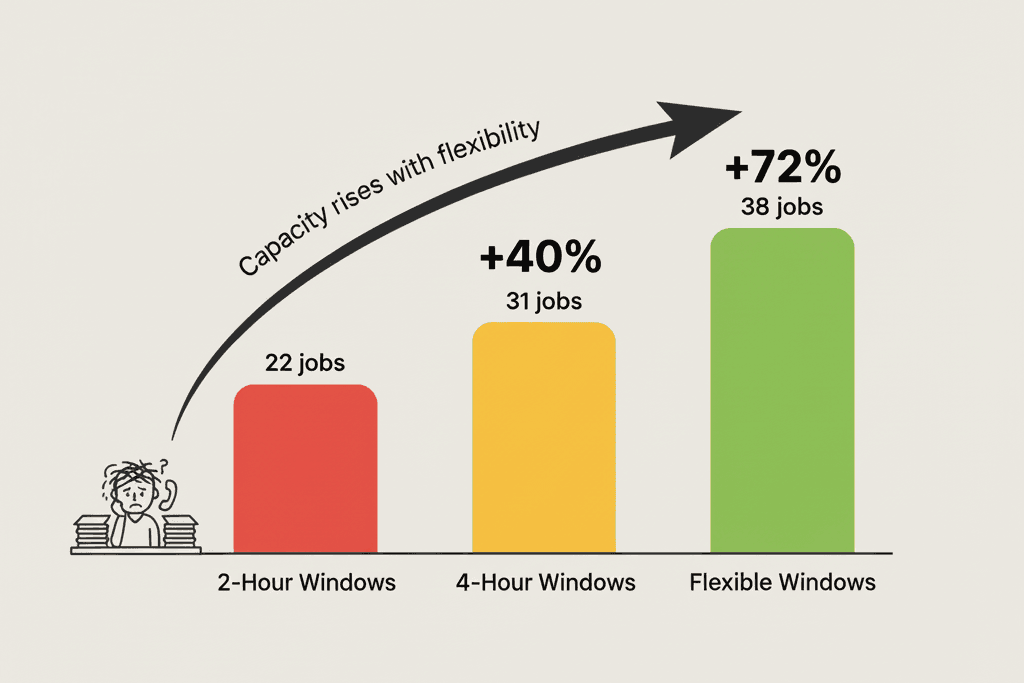
- Capacity impact is exponential. 2-hour windows fit ~22 jobs on a 5-tech day; 4-hour windows fit ~31 (+40%); 8-hour anytime windows fit ~38 (+72%).
- Multi-alternative windows let customers offer 2–3 ranked time slots — the AI picks the best fit and turns “we can’t fit you in” calls into scheduled jobs.
- CONFIRMED appointments are immovable. PLANNED appointments can shuffle. Most emergency insertions resolve without breaking any confirmed window.
- Segmenting by customer tier (VIP strict 2-hour, standard 4-hour, commercial day-specific) maximizes both satisfaction and capacity in the same schedule.
The hardest question in field service scheduling isn’t “which tech goes where.” It’s “how strict are the arrival windows you promised?” Promise every customer a 2-hour window and hit it 100% of the time, and you’re either overstaffed or leaving revenue on the table. Promise nothing and customers churn. Time window optimization field service is the math that lets you do both — strict windows for VIPs, flexible windows for routine work, and protected windows for emergencies — inside one schedule.
This guide explains the three time-window types and their exponential capacity impact, the soft-versus-hard constraint logic that powers modern AI dispatch, how multi-alternative windows kill the “we can’t fit you in” call, and how the AI protects CONFIRMED appointments during emergency insertions. Every mechanic below runs inside the live field service management software from FieldCamp.
Three Window Types and Exponential Capacity Impact
A time window represents a constraint that routing algorithms must satisfy while minimizing drive time, balancing workloads, and respecting technician capacity. Not all windows constrain the schedule equally — they fall into three types with very different effects on capacity. The choice of window strategy is one of the largest revenue levers most field service operations never touch.
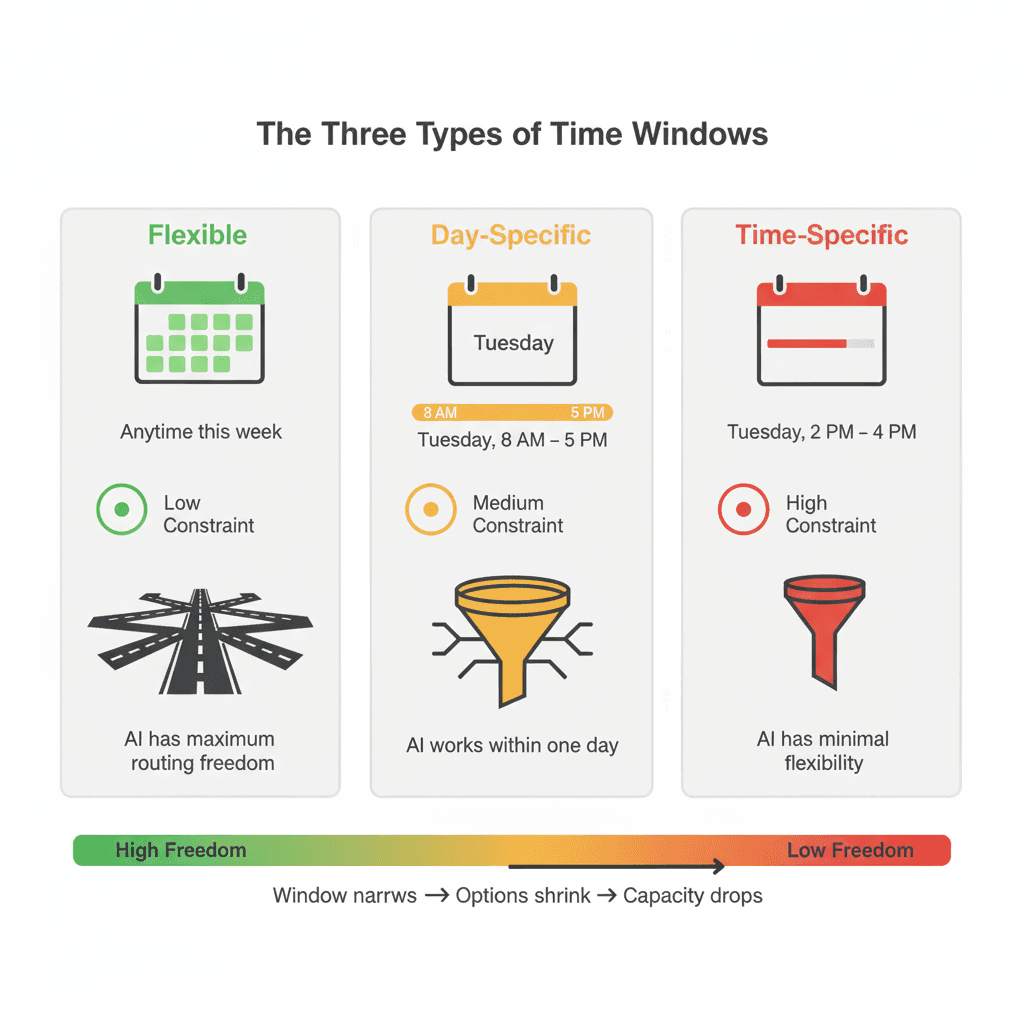
- Flexible windows. Multi-day or open-ended availability (“anytime this week,” “today, ASAP”). Lowest scheduling difficulty — the AI has maximum routing freedom. Example: an HVAC emergency (“no heat, 20°F outside”) = 8-hour window.
- Day-specific windows. Service is constrained to a day but flexible within it (“Tuesday anytime between 8 AM–5 PM”). Medium difficulty — the AI must fit within that day but retains routing flexibility across nine hours.
- Time-specific windows. The most restrictive form (“Tuesday 2–4 PM”). Highest difficulty because every time-specific window dramatically shrinks available scheduling options.
Capacity impact is exponential, not linear. With 5 technicians × 8-hour shifts (40 tech-hours), 2-hour windows accommodate ~22 jobs, 4-hour windows ~31 jobs (+40%), and 8-hour “anytime” windows ~38 jobs (+72%). Each new job with a narrow window must fit into shrinking gaps without disrupting existing commitments. The constraint isn’t just “does the window fit” — it’s “does the window fit AND does the route still make sense AND does it not break other commitments.”
For a plumbing company on a Tuesday, half-flex bookings can carry +44% more jobs than all-2-hour bookings using the same techs on the same day. Day-level totals roll up through capacity planning with AI, so window strategy directly affects hiring math. The way windows interact with stop ordering is owned by AI route optimization — windows constrain when a stop can happen; sequencing decides the order that respects every window simultaneously.
KEY TAKEAWAY
Cutting your default window from 2 hours to 4 hours is the closest thing to a free 40% capacity increase you’ll find in field service operations. It costs you only the willingness to call customers proactively when you’re trending toward the end of the window.
Soft vs. Hard Constraint Handling
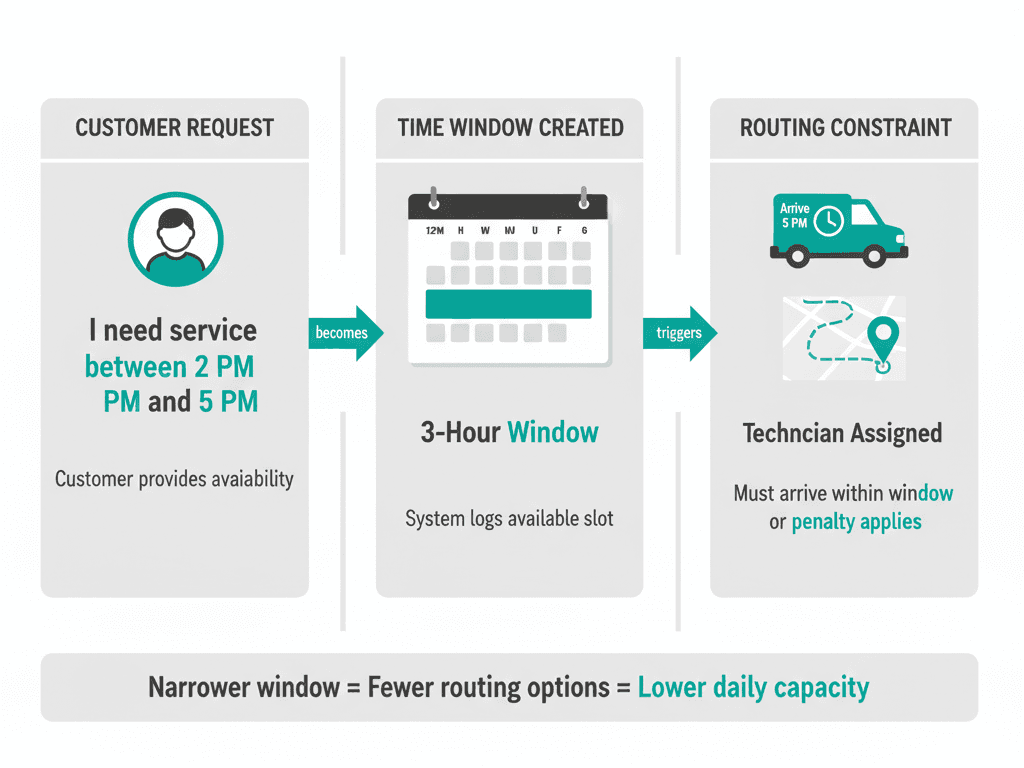
Most modern AI dispatching treats time windows as soft constraints with configurable weights — a fundamental departure from manual or rule-based scheduling that treats them as binary pass/fail. The same penalty math underwrites SLA-aware scheduling, so a confirmed window and a contractual SLA share one cost function.
| Constraint type | Behavior | Result if violated |
|---|---|---|
| Hard | Cannot be violated under any circumstances | Job stays unscheduled |
| Soft | Penalty applied to the schedule’s total cost | Job schedules with a cost the optimizer accepts |
The AI calculates total schedule cost as the sum of all penalties — time-window violations + drive time + overtime + workload imbalance — and a window violation may be accepted if it prevents a worse outcome. Worse outcomes include forcing overtime, leaving a high-priority job unscheduled, or creating a 2-hour backtrack across town. The job ships; the cost shows up in the schedule’s total score.
Early vs. late arrivals. The vast majority of time-window violations are early arrivals within a grace period. Customers rarely complain about technicians arriving 15 minutes early. Late arrivals carry heavier penalties because they directly impact customer satisfaction — the AI weights them roughly 3–5× higher than early arrivals.
Configurable strictness. Stricter settings (“customer satisfaction is paramount, stay in windows”) and flexible settings (“some flexibility is OK, we’ll confirm with the customer if needed”) tune how strictly the system adheres to windows. This treats the window as a customer preference with weight rather than a binary constraint.
The biggest advantage AI brings to window handling is consistency. Human dispatchers negotiate windows unpredictably — some push for flexibility, others don’t. AI follows weighted rules that scale across every booking, every customer, every shift. That consistency is also what powers reliable AI job scheduling across multi-tech operations where window-handling drift would otherwise produce uneven service quality.
See Window Strategy in Action
Bring your busiest day. We’ll run it through 2-hour, 4-hour, and multi-alternative windows so you can see capacity impact side-by-side.
Multi-Alternative Time Windows Kill the Callback
Alternative time windows let customers provide 2–3 ranked options instead of a single take-it-or-leave-it slot. The AI evaluates all alternatives simultaneously, picking the one that best balances customer preference + technician availability + route efficiency.
Traditional dispatch forces a binary approach: the customer gives one window, the dispatcher tries to fit it, the job goes to “unscheduled” if it fails — creating callback negotiations, frustrated customers, and wasted dispatcher time.
How preference ranking works. Window 1 (rank 1): Thursday 5–7 PM (first choice). Window 2 (rank 2): Friday 8–11 AM (second choice). Window 3 (rank 3): Monday 2–5 PM (third choice). Tiered penalties scale with rank: rank 1 = minimal penalty, rank 2 = small penalty, rank 3 = medium penalty. This gives the AI 3× the “target area” to fit the job while still honoring customer preferences.
Worked example. A customer says “I’m available Thursday evening, Friday morning, or Monday afternoon — Thursday is best.” The AI finds that Friday 9 AM works perfectly (rank 2, small penalty), schedules it immediately, and avoids disrupting Thursday’s already-tight schedule. The customer gets their second choice, but the job is scheduled. Better than “we can’t fit you in this week.”
This approach increases first-call scheduling success significantly for jobs that would otherwise require callback negotiation. It’s also a quiet revenue lever — every “we’ll call you back” turns into a “scheduled” with no extra dispatcher minutes spent.
Emergency Insertion Without Breaking Confirmed Windows
When an emergency arrives mid-day and the schedule is already full, the AI must insert the job without violating confirmed time windows. The system distinguishes between two appointment statuses:
- CONFIRMED appointments are immovable anchors. They literally cannot be moved because customers have been promised those times.
- PLANNED appointments can be reshuffled because they haven’t been promised to the customer yet.
Worked example. A 10 AM schedule shows: 9:00 AM Job A (CONFIRMED), 11:30 AM Job B (PLANNED), 1:30 PM Job C (CONFIRMED), 3:30 PM Job D (PLANNED). An emergency arrives at 10:15 AM — high-priority, 90-minute, customer needs ASAP. After AI re-optimization at 10:16 AM: 9:00 AM Job A unchanged, 11:30 AM EMERGENCY inserted into the gap, 1:30 PM Job C unchanged, 3:30 PM Job B inserted into the freed gap, 5:00 PM Job D moved later. Both confirmed appointments protected, unconfirmed jobs reshuffled within their windows.
Most mid-day emergency insertions resolve without violating any confirmed time windows, and the vast majority don’t require customer callbacks to reschedule. The mechanics live in emergency job handling, with downstream re-flow handled by dynamic rerouting.
PRO TIP
Confirm appointments aggressively. Every booking you flip from PLANNED to CONFIRMED becomes a hard constraint the AI must protect, which gives the algorithm a tighter problem and a more stable schedule. Confirmed customers also get fewer reschedule texts.
Industry Windows and Customer Segmentation Strategy
Different industries have different time-window norms based on service type, urgency, and customer expectations. There is no universal “right” window policy — strict adherence yields higher satisfaction and lower capacity; flexible windows yield higher capacity and require proactive customer communication.
| Industry | Emergency window | Routine window | Strategy |
|---|---|---|---|
| HVAC | 8-hr (“today, ASAP”) | 4-hr | Reserve 20% capacity for same-day emergencies |
| Plumbing | 4-hr | 9-hr (2-day flex) | Use alternative windows for routine |
| Electrical | 8-hr | 4-hr | Batch permit-dependent jobs on specific days |
| Appliance Repair | 5-day flex | 4-hr weekend | Premium pricing for weekend time-specific |
The best operators don’t pick one extreme — they segment by job type, customer tier, and urgency. The window penalty weight changes per segment, not per job, so the system enforces different service contracts within the same schedule without dispatcher discretion.
| Customer type | Window strategy |
|---|---|
| VIP customers (top 20% revenue) | Strict 2-hour windows, guaranteed |
| Standard customers | 4-hour windows as default |
| Emergency calls | Flexible “next 4 hours” (speed over precision) |
| Commercial accounts | Day-specific (businesses care about day, not hour) |
The honest trade-off: if you promise every customer a 2-hour window and hit it 100% of the time, you’re either overstaffed or leaving revenue on the table. A practical target is 95%+ within-window for confirmed appointments and strategic flexibility for the rest. To model the labor cost of stricter VIP windows, run the math through the labor cost calculator first. For category-level benchmarks across the major scheduling tools, the best lawn care apps roundup compares arrival-window UX across platforms.
WARNING
Don’t extend windows quietly. If you move standard customers from 2-hour to 4-hour windows, communicate the change — and pair it with proactive ETA texts. Customers tolerate wider windows when they get a 30-minutes-out notification; they don’t tolerate “between 8 and 5.”
How FieldCamp Handles Time Windows
FieldCamp’s AI Dispatcher treats time windows as soft constraints with configurable penalty weights, evaluates multi-alternative options simultaneously, and protects CONFIRMED appointments while reshuffling PLANNED jobs. Penalty weights can be tuned per customer tier — stricter for VIPs, flexible for routine — so the same engine enforces different service contracts in the same schedule.
The system surfaces real-time violation tracking before dispatch, showing which jobs are scheduled outside windows. Most violations are early arrivals within grace periods, which customers rarely complain about, so the dispatcher can confirm those without intervention and focus attention only on late-risk jobs. Window handling integrates with skill matching and drive-time minimization so windows are weighed against the rest of the constraint stack rather than applied in isolation. The runtime engine lives inside the AI Command Center.
Set this up in the docs:
- Defining job types and priorities
- Arrival windows with manual capacity
- Arrival windows with provider-based capacity
Watch Window Math Save Hours
FieldCamp evaluates multi-alternative windows simultaneously and protects every confirmed appointment. See it on your real schedule.
Frequently Asked Questions
What is a time window in route optimization?
A time window is a specific period during which a customer is available to receive service; it defines the acceptable arrival range for a technician. Windows can be flexible (anytime this week), day-specific (Tuesday 8 AM to 5 PM), or time-specific (Tuesday 2 to 4 PM). Narrower windows constrain routing options more severely.
How do time windows affect daily capacity?
The impact is non-linear. Moving from 2-hour to 4-hour windows typically increases capacity by about 40 percent, and moving to 8-hour anytime windows can add 72 percent over a 2-hour baseline. Wider windows give algorithms exponentially more options to optimize sequences and cut wasted drive time.
What’s the difference between hard and soft time-window constraints?
Hard constraints cannot be violated; jobs will not schedule outside the window. Soft constraints are preferences the AI tries to honor but can bend, applying a penalty instead of leaving the job unscheduled. Most AI dispatching uses soft constraints with configurable weights for flexibility.
How do multi-alternative time windows work?
Customers provide 2 to 3 time options with preference ranking. The AI evaluates all alternatives simultaneously and picks the one that best balances customer preference with technician availability and route efficiency. This increases first-call scheduling success significantly compared to single-window requests.
What happens when emergencies arrive mid-day?
The AI distinguishes between CONFIRMED appointments (immovable) and PLANNED appointments (can shuffle). It inserts the emergency into available gaps, reshuffles unconfirmed jobs if needed, and protects all confirmed time windows. Most emergencies resolve without violating any confirmed appointments.
Can I make time windows stricter for VIP customers?
Yes. Most AI dispatching systems allow configurable penalty weights per customer tier. You can set stricter adherence for VIP customers while allowing more flexibility for standard jobs, maximizing both satisfaction and capacity in the same schedule.
Continue reading
- SLA-aware scheduling — turning windows into weighted SLA constraints with penalty escalation.
- Multi-stop route planning with AI — how stops sequence inside the windows.
- Emergency job handling — protected vs. flexible logic during P0 insertions.
- What is an AI dispatcher? — the foundational guide every dispatch operator should start with.