
Pest control dispatch software
Dispatch software that won’t send an uncertified tech to a termite job.
AI pest control dispatch software that enforces chemical applicator cert tier as a hard rule, packs quarterly recurring routes for density, and re-sequences the day the moment a termite emergency lands at 11 am.
Definition
What is pest control dispatch software?
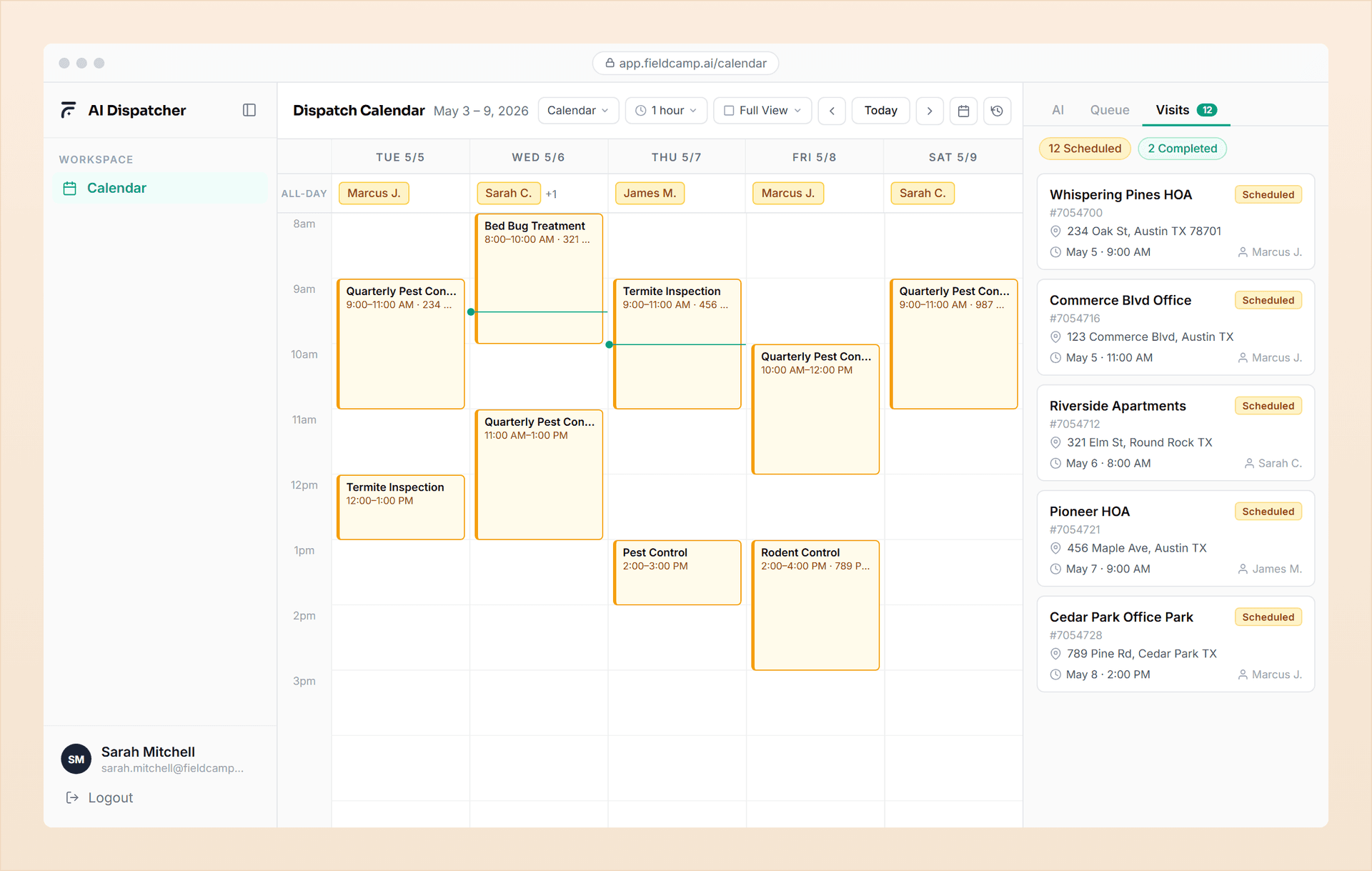
Pest control dispatch software automatically matches each job to the right applicator — based on chemical license tier, state and county jurisdiction, route density, and equipment on the truck — without a human dispatcher pulling up a calendar. Modern pest control scheduling software does this for an entire 30-day plan at once, not one day at a time.
The AI dispatcher treats cert tier as a hard constraint. An applicator without the termite tier is never matched to a termite job, even if they’re closer or the day is open. Quarterly recurring routes stay tight in their geographic clusters.
FieldCamp’s AI dispatcher for pest control is included in every plan. Human dispatchers still own exceptions: customer escalations, late jobs, and edge-case scope changes.
Trusted by pest control contractors across North America
PestPro Group
TermShield Co.
SafeGuard Pest
CleanLine Exterminator
Sentry Pest Control
What’s broken in pest control dispatch
Six reasons your quarterly route slips every emergency call.
If you’ve ever bumped four quarterly stops to tomorrow because a termite emergency landed at 11am, you already know the pain.
01
Termite emergency bumps 4 quarterlies.
11am callout, dispatcher’s only move is to move the afternoon stops to tomorrow. Tomorrow’s already full. Four customers slip and the cadence breaks.
02
General-pest applicator sent to termite work.
Calendar tools don’t enforce cert tier. Whoever’s free gets dispatched. The job gets refused on-site, or worse — gets done outside cert scope.
03
15-stop day sprawls into 22.
Quarterly stops get added by calendar order, not geography. A tight residential block becomes a zigzag with 30 minutes of backtracking per route.
04
Cross-state dispatch with no reciprocity.
Applicator licensed in TX shows up in OK’s job pool. Reciprocity isn’t configured. Job done, complaint filed, license at risk.
05
One applicator on 18 stops, another on 7.
Workload uneven across the team. One ends the day exhausted, another sits on filler. By Friday, burnout shows up.
06
Wrong equipment on the truck.
Dust applicator-only truck rolls to a sprayer job. Tech gets there, can’t complete. Truck swap or reschedule, and the cadence drifts again.
The 11am termite emergency
When the emergency lands mid-route, the day re-sequences.
Pest control runs on quarterly recurring contracts. A residential customer signs up for four visits a year, and missing one is a churn risk every time. Calendar-only pest control scheduling software can’t replan the day mid-route. When a termite emergency lands at 11am, the dispatcher’s only move is to bump the afternoon’s quarterly stops.
Without cert-aware re-dispatch
every pest control operation
With FieldCamp’s AI Dispatcher
same emergency, replanned in one pass
Built for pest control operations
One AI engine for every pest control dispatch challenge.
Cert tier, state jurisdiction, recurring density, emergency response — all priced into the same routing decision, every minute.
Cert-tier matching
General pest, termite, fumigation, structural — all stored as hierarchical skills. An applicator without the right tier is never matched, even if they’re closer or the day is open.
State-jurisdiction zones
License rules and reciprocity vary by state and county. An applicator licensed in one state doesn’t appear in another state’s job pool unless reciprocity is configured.
Recurring-route density
Quarterly routes stay tight. Right applicator AND best stop sequence in one pass — a 15-stop residential day stays a 15-stop day instead of sprawling into 22 with backtracking.
Emergency-call insertion
Termite or hornet emergency mid-route — dispatcher inserts into the cert-matched applicator’s day and shifts recurring stops forward. The afternoon doesn’t collapse to tomorrow.
Workload balancing
No applicator ends up with 18 stops while another has 7. The optimizer balances the day across the team, weighted by cert tier and route geography.
Equipment-aware dispatch
Sprayers, dust applicators, baits, traps don’t all live on the same truck. The optimizer matches equipment loaded on each truck to the jobs assigned to that route.
How it works
Four steps every pest control dispatch decision goes through.
From quarterly intake to emergency callout — every dispatch decision runs through these four layers, fast enough that applicators feel it as a single experience.
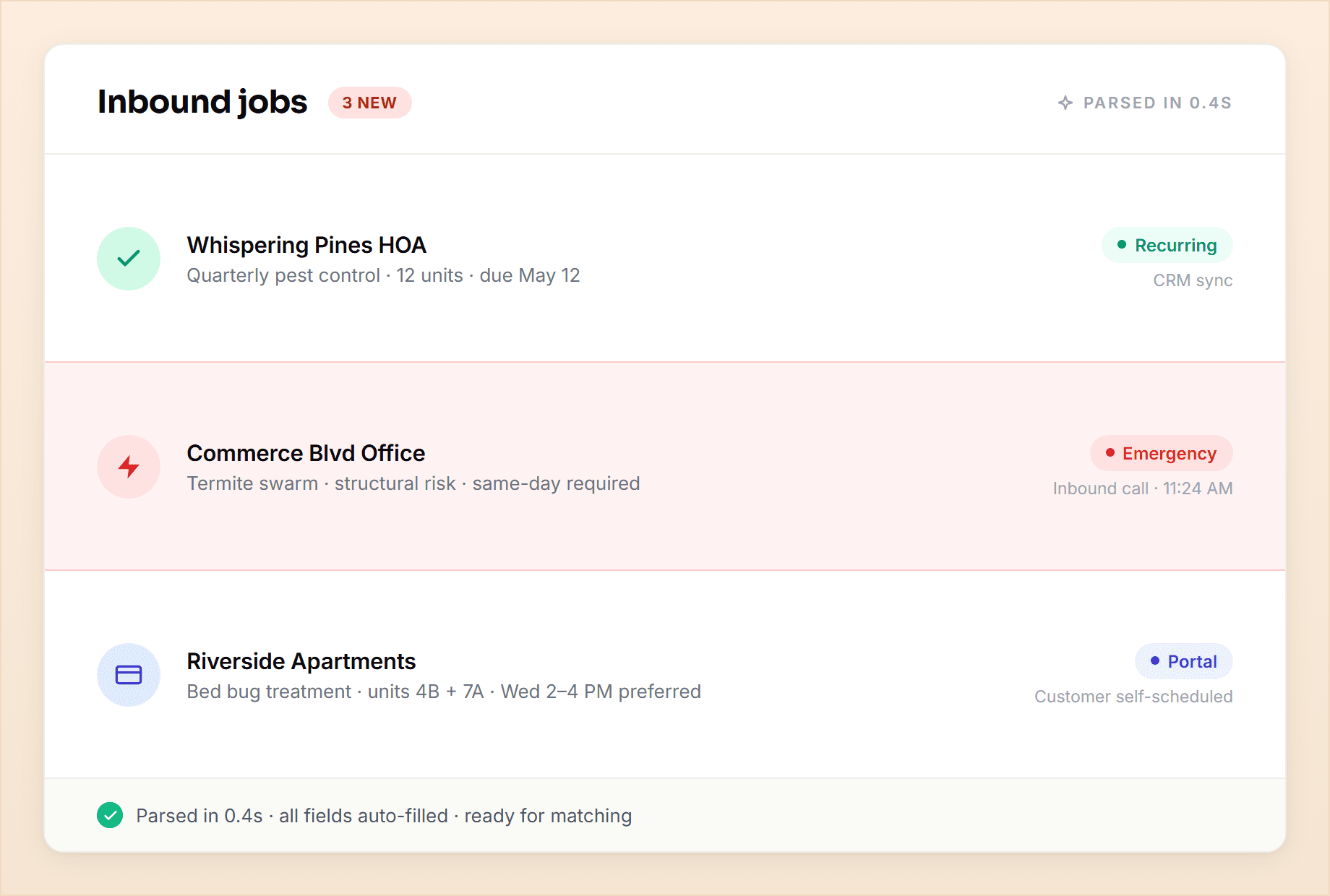
Jobs arrive from your CRM, customer portal, or inbound call. The dispatcher parses each one: job type, location, customer cadence, required cert tier, equipment needed.
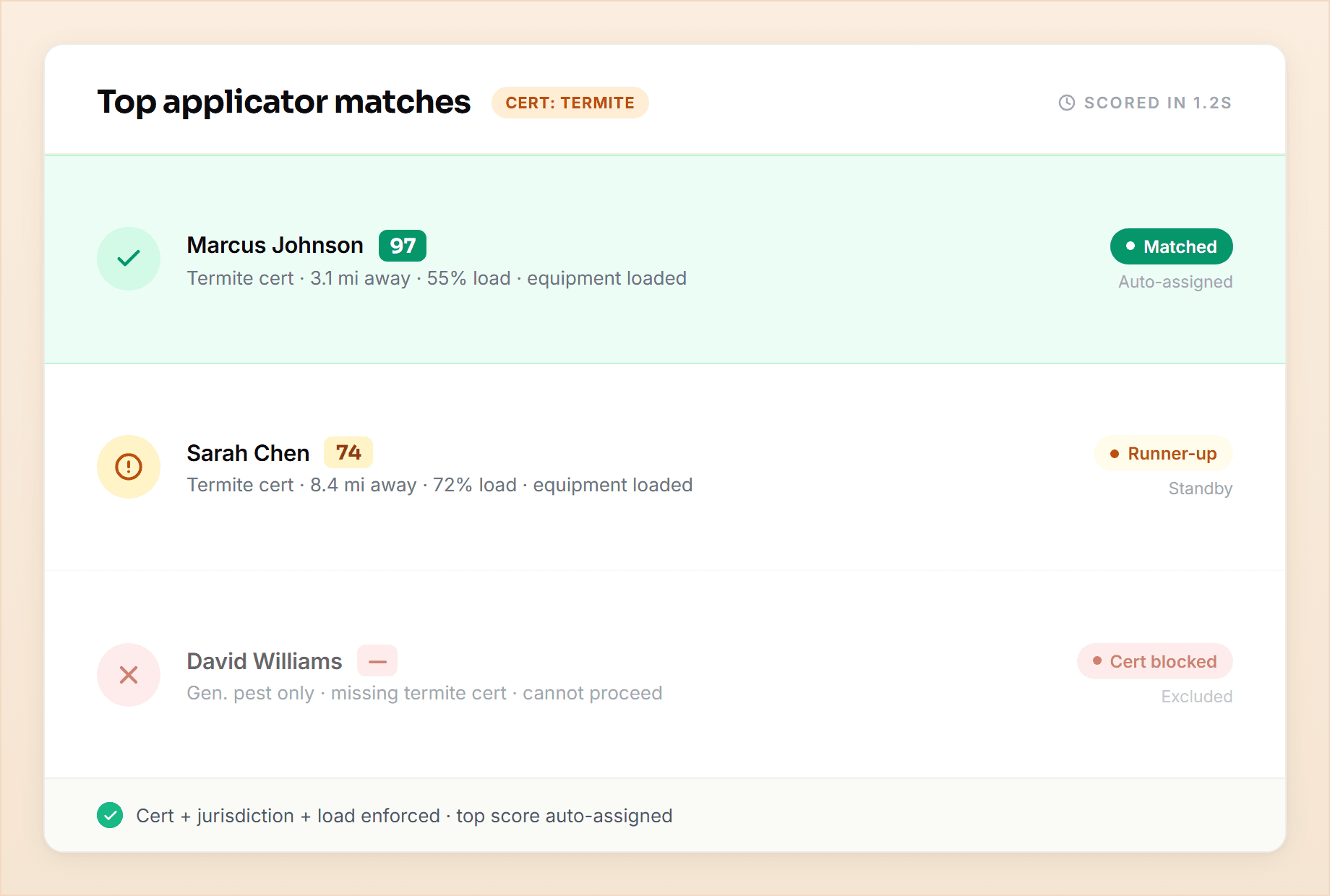
The optimizer scores every applicator against the next 30 days of jobs at once. Cert tier, state and county jurisdiction, current route density, and equipment on the truck all weigh in. Powered by skill-based dispatching and route dispatching.
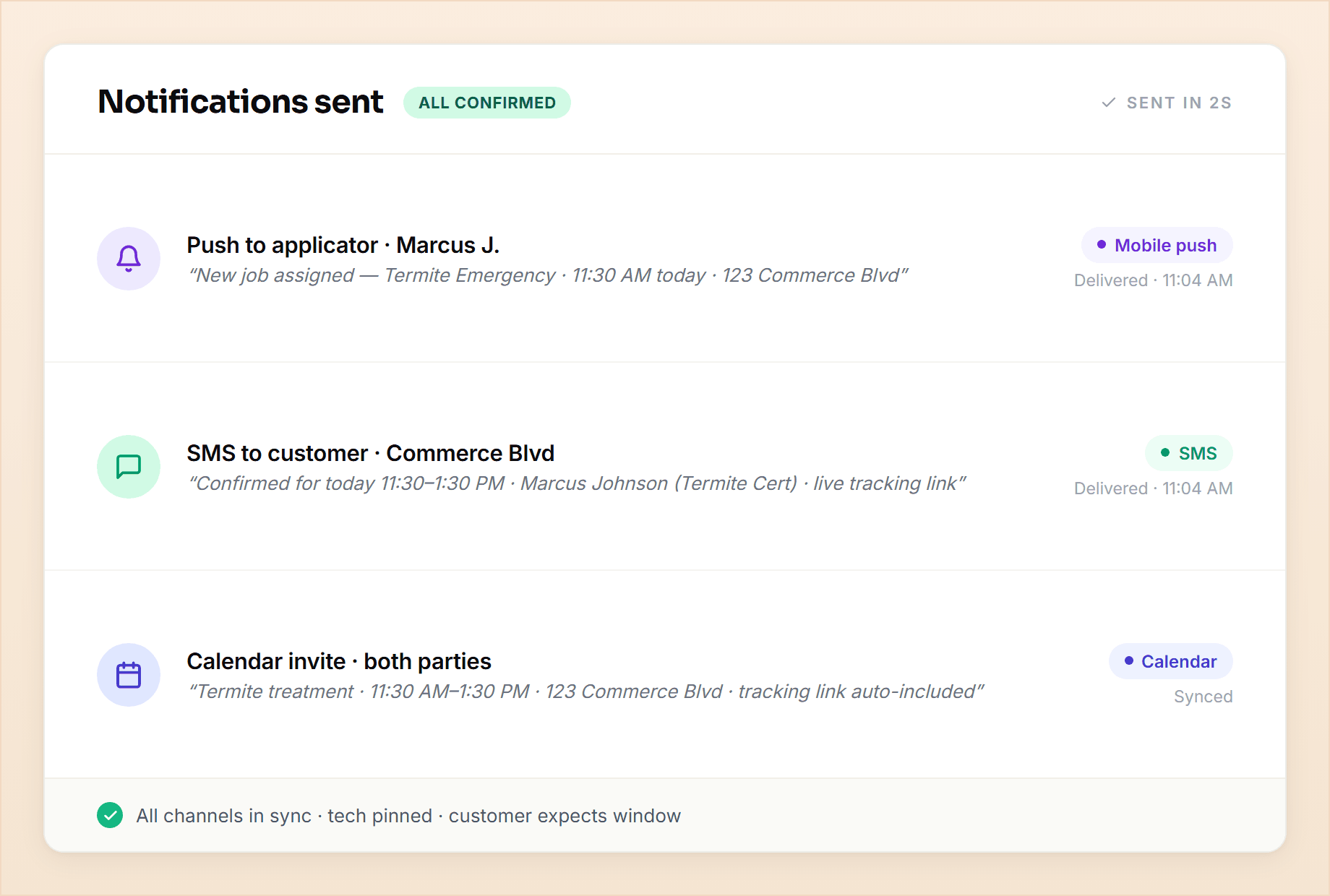
The matched applicator gets the job pinned to a specific day and slot. The customer gets a confirmed window — and an automatic update if a quarterly visit needs to shift.
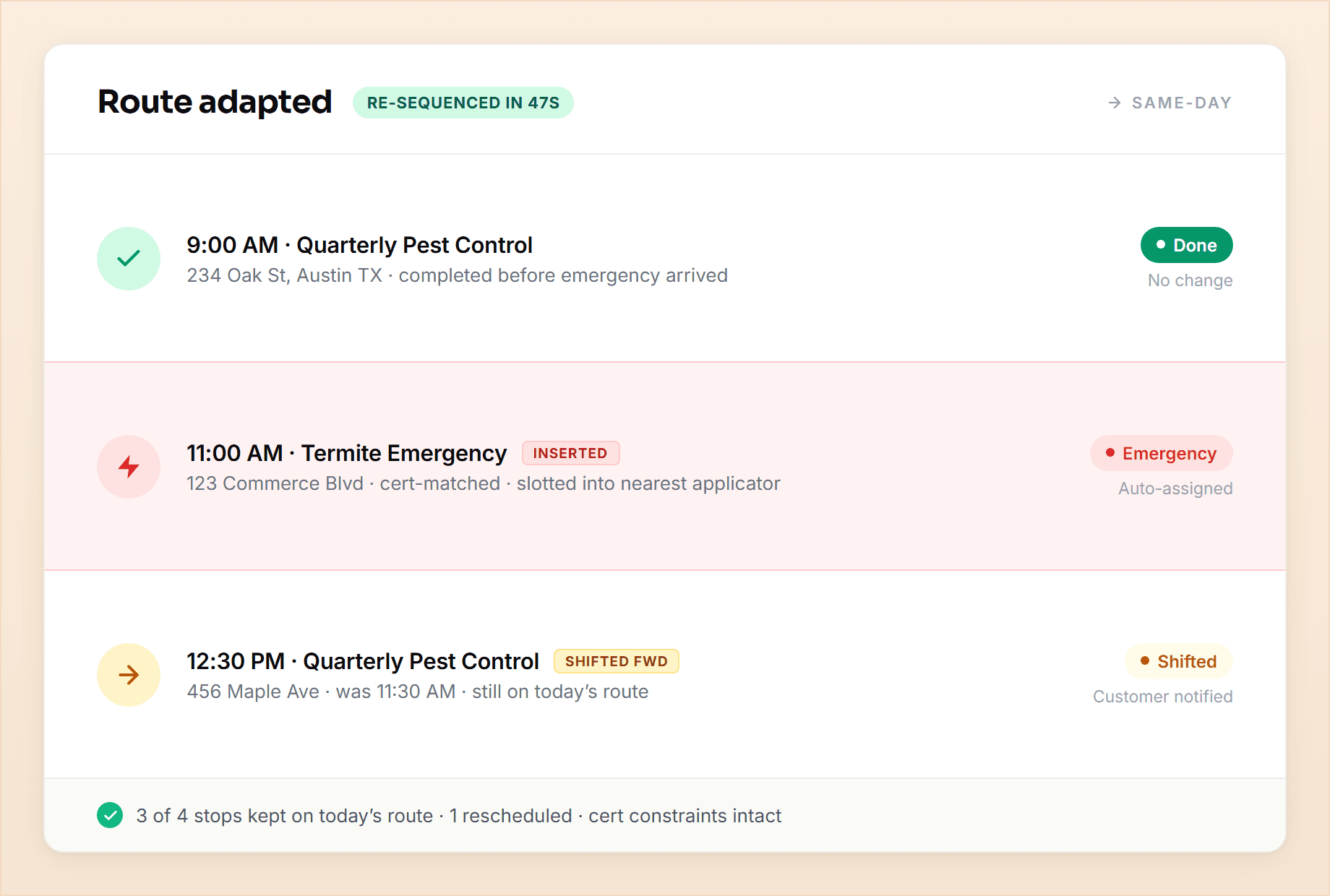
When an emergency call lands or a stop runs long, dynamic rerouting re-sequences the rest of the day. Recurring stops shift forward, cert constraints stay intact, and the dispatcher approves drift instead of rebuilding the day.
Manual vs FieldCamp AI
Why your dispatcher’s spreadsheet isn’t built for chemical cert tiers.
“It looks like it does everything that I want it to do throughout the pipeline. And that’s really important. If you’re trying to find one platform that talks to itself without having multiple systems, this is it.“
Frequently Asked Questions
Does pest control dispatch software track applicator cert tier?
Yes. FieldCamp’s pest control dispatch software stores chemical applicator license tiers as hierarchical skills per technician — general pest, termite, fumigation, structural, or whatever tier set your state requires. The optimizer treats cert tier as a hard constraint, so an applicator without the right tier is never matched to that job, regardless of proximity or schedule openness.
How does AI pest control dispatch software handle recurring routes?
AI pest control dispatch software plans up to 30 days of recurring quarterly visits in a single pass. The optimizer sequences stops by geographic density rather than calendar order, so a 15-stop residential route stays a 15-stop day instead of sprawling into 22 stops with backtracking.
Can pest control scheduling software handle 50+ recurring contracts on a daily route?
Yes. Pest control scheduling software in FieldCamp plans recurring routes for density, sequencing the stops in geographic order rather than calendar order. A 15-stop residential day stays a 15-stop day instead of sprawling into 22 stops with backtracking.
What happens when a termite emergency comes in mid-route?
The Dispatch Recovery agent inserts the emergency into a cert-matched applicator’s day and re-sequences the rest of the route. Recurring stops shift forward instead of bumping to tomorrow.
Does pest control dispatch software work for residential, commercial, or both?
Both. The dispatch board treats residential quarterly routes and commercial accounts as the same set of jobs, with cert tier and equipment requirements applied per job. A mixed fleet runs on one dispatch board.
Does the exterminator scheduling software auto-rebook a missed quarterly visit?
Recurring jobs are tracked in your CRM and pushed to the dispatcher. FieldCamp doesn’t auto-create a new appointment when a quarterly visit is missed, but the dispatcher will route the rebook the moment your team schedules it. The optimizer treats the rebooked stop as part of the next route’s plan, so it slots into geographic order.
Does pest control management software work without an existing CRM?
Yes. The AI Dispatcher runs as a standalone pest control management software product or layered on top of an existing system of record. It connects via REST API, two-way sync with major field-service CRMs, and direct CSV import.
How long until the pest control dispatch software is running our real schedule?
Typical pest control migrations are running production dispatch within 2-3 weeks. Time depends on data hygiene — applicator cert records, recurring contract cadence, and equipment-per-truck inventory — more than software setup.
Ready?
Stop bumping quarterlies for every emergency. Smarter pest control dispatch, redesigned by AI.
Plug AI Dispatcher into your existing CRM, or run it with the full FieldCamp suite. Either way, your applicators stay cert-matched and your quarterly cadence stays intact.