
Plumbing dispatch software
Emergency, scheduled, commercial — dispatched by license, not by calendar.
Plumbing dispatch software from FieldCamp matches each call to a licensed, equipped, available plumber — and re-sequences the day the moment a flooding callout comes in. The AI Dispatcher replaces the manual board-building that plumbing scheduling software typically forces on operators.
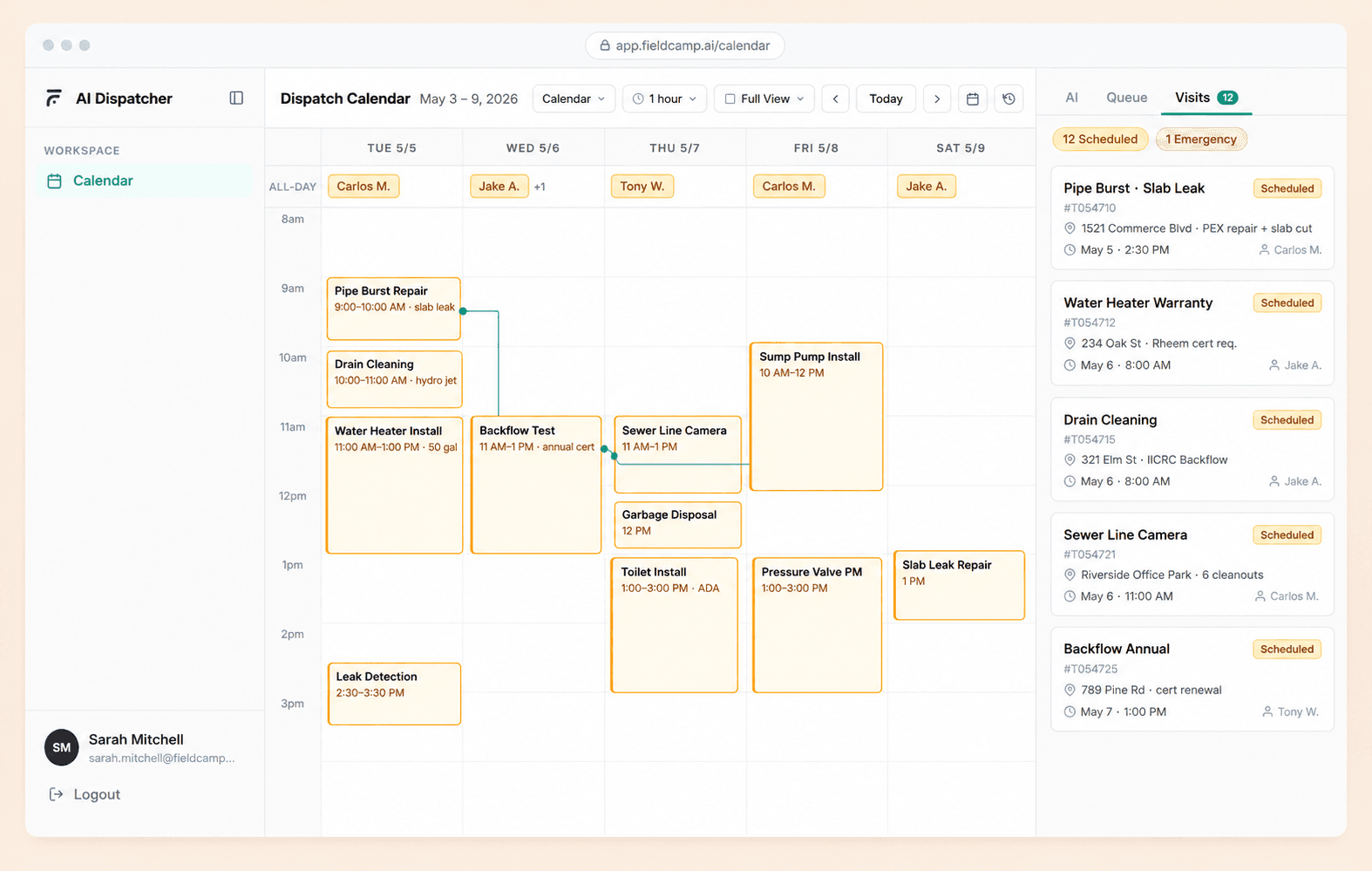
Definition
What is plumbing dispatch software?
Plumbing dispatch software is software that automatically matches each service, commercial, or emergency call to the best available plumber — based on jurisdictional license, equipment loaded on the truck, certification requirements, and customer windows — without a human dispatcher cross-referencing a license chart while a flooded basement waits on the phone.
The AI dispatcher treats plumbing licensing as a hard constraint, not a hopeful assumption. Plumbing scheduling software like FieldCamp’s only matches plumbers whose license is valid in the job’s jurisdiction — a Texas-licensed plumber is never offered to a Louisiana service area, regardless of proximity.
FieldCamp’s AI dispatcher for plumbing contractors is included in every plan. Human dispatchers still own exceptions: customer escalations, scope changes, and after-hours coordination.
Trusted by service + commercial plumbing contractors across North America
Cascade Plumbing
Riverside Pipefitters
Ironwood Plumbing
Reliant Plumbing Co.
Highland Pipe & Drain
What’s broken in plumbing dispatch
Six reasons your plumbing board breaks before lunch.
If you’ve ever sent a journeyman to a backflow job that needed a master, you already know the pain. Here’s what AI Dispatcher fixes.
01
License-by-jurisdiction violations.
City A requires master licenses for new construction. City B doesn’t. Calendar tools don’t know — the wrong tech rolls and the permit inspector turns the truck around.
02
6am burst pipe — manual re-juggle.
Burst pipe call lands at 6:04am. Dispatcher pulls every plumber’s day apart by hand. By 7am the rest of the morning is collateral damage.
03
Drain call without the snake on the truck.
Tech arrives at a 60-foot main line clog with a 25-foot snake. Drive back to the shop, swap rigs, lose an hour of revenue and one customer’s trust.
04
Backflow test sent to uncertified tech.
Backflow testing requires a state-certified BPAT. The board doesn’t track cert dates. The water utility rejects the test and the customer’s water is shut off.
05
Gas-line emergency to a non-gas plumber.
Gas-leak call routed to a plumber without a gas endorsement. They legally can’t touch it. Another hour lost while a qualified tech is found.
06
Service vs new-construction crossover.
Service plumbers stuck on rough-ins. New-construction crew stuck on service calls. No tool is keeping each lane on the right side of the board.
The 6am burst-pipe problem
When a flooding callout lands mid-route.
Plumbing contractors run service techs, commercial techs, and emergency techs on overlapping schedules. When a flooding-basement call lands at 6:04am, calendar-only plumbing dispatch software can’t enforce license, equipment, and gas-endorsement constraints across a board that’s already in motion — by 7am the rest of the morning is in tatters.
Without license-aware dispatch
what most plumbing scheduling software does today
With FieldCamp’s AI Dispatcher
same morning, planned with license + equipment as hard constraints
Built for plumbing operations
One AI engine for every plumbing dispatch challenge.
License, jurisdiction, equipment, customer windows — all priced into the same routing decision, every minute.
License-aware dispatching
Master, journeyman, apprentice — every plumber’s license is mapped to every job before it’s offered. Wrong-license assignments stop at the dispatch level.
Jurisdiction zone rules
City and county licensing rules are configured once. The optimizer routes only plumbers licensed in the job’s jurisdiction — no permit-inspector surprises.
Emergency-call insertion
Burst-pipe and flooding callouts insert into the closest qualifying truck’s day in seconds. The agent flags downstream impacts, dispatcher approves with one click.
Workload caps per plumber
Service and commercial techs have different daily caps. The optimizer respects each plumber’s caseload limit so the rookie isn’t carrying the senior’s afternoon.
Equipment-aware dispatch
Camera lines, hydro-jetters, 100-foot snakes — equipment loadout per truck is a hard constraint per stop. No camera on the truck, no sewer-camera job.
Drive-time-optimized routing
Service routes are clustered for density, not first-come-first-served. The optimizer keeps each plumber’s day inside one zone — windshield time falls per truck.
How it works
Four steps every dispatch decision goes through.
From inbound call to confirmed plumber window — every dispatch decision runs through these four layers, fast enough that customers feel it as a single experience.
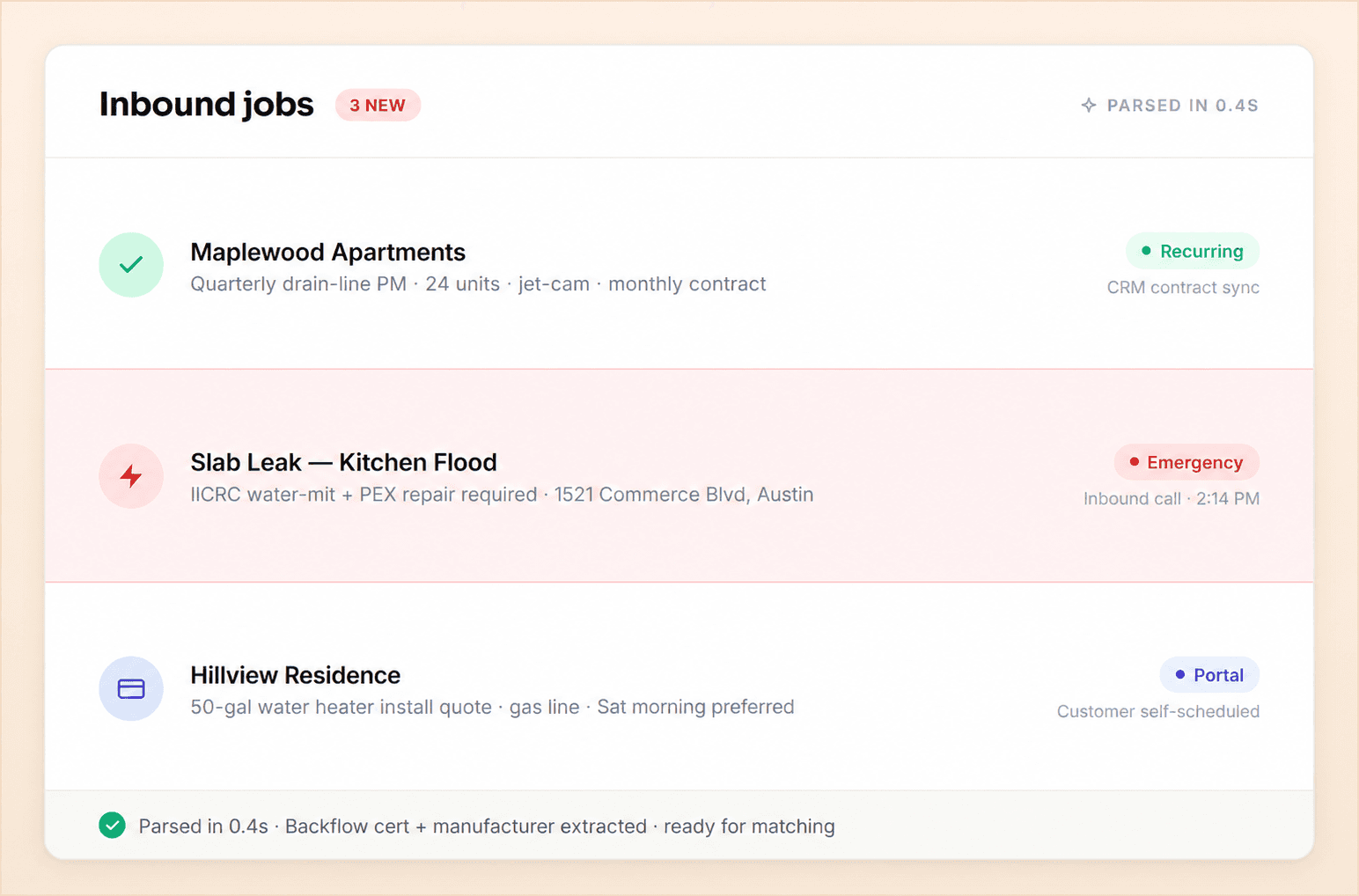
Service, commercial, and emergency calls land from your CRM, customer portal, or phone integration. The dispatcher parses each call: jurisdiction, license requirement, equipment needed, customer window.
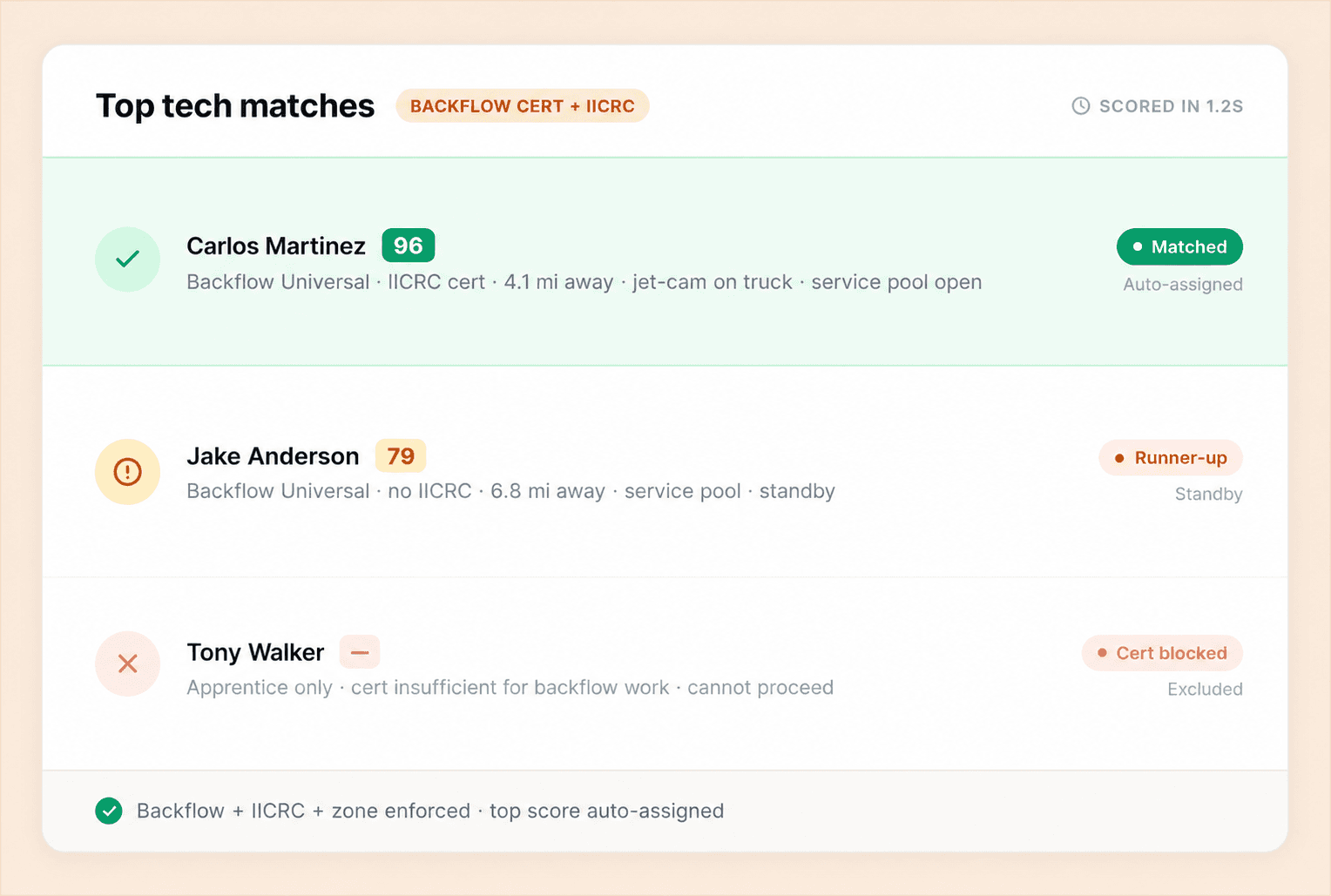
The optimizer scores every plumber across the next 7 days. License tier, jurisdiction, equipment on the truck, and workload all weigh in. Powered by skill-based dispatching and zone dispatching.
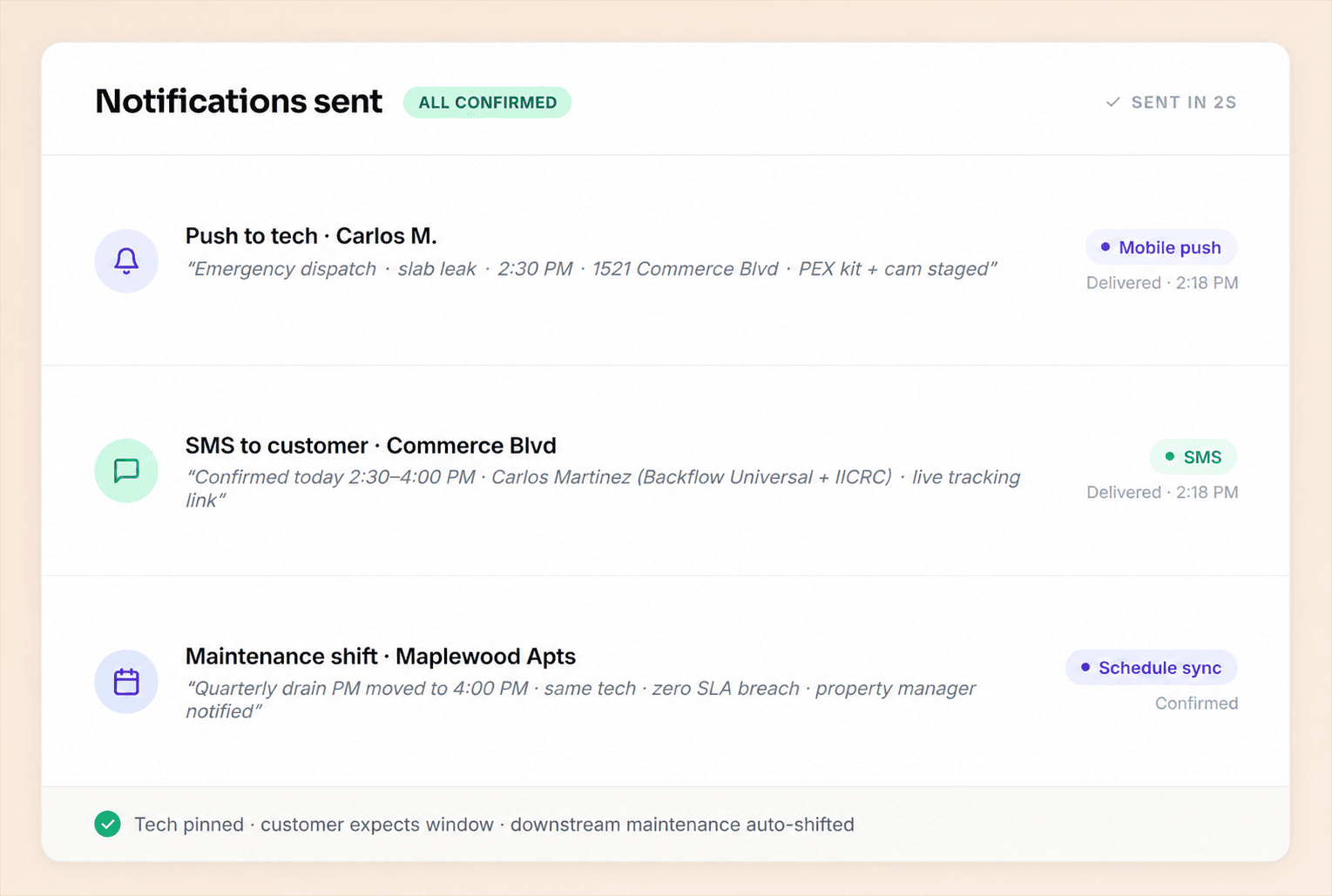
The matched plumber gets the day’s route with license and equipment requirements confirmed. The customer gets a confirmed window with the tech’s name and license tier.
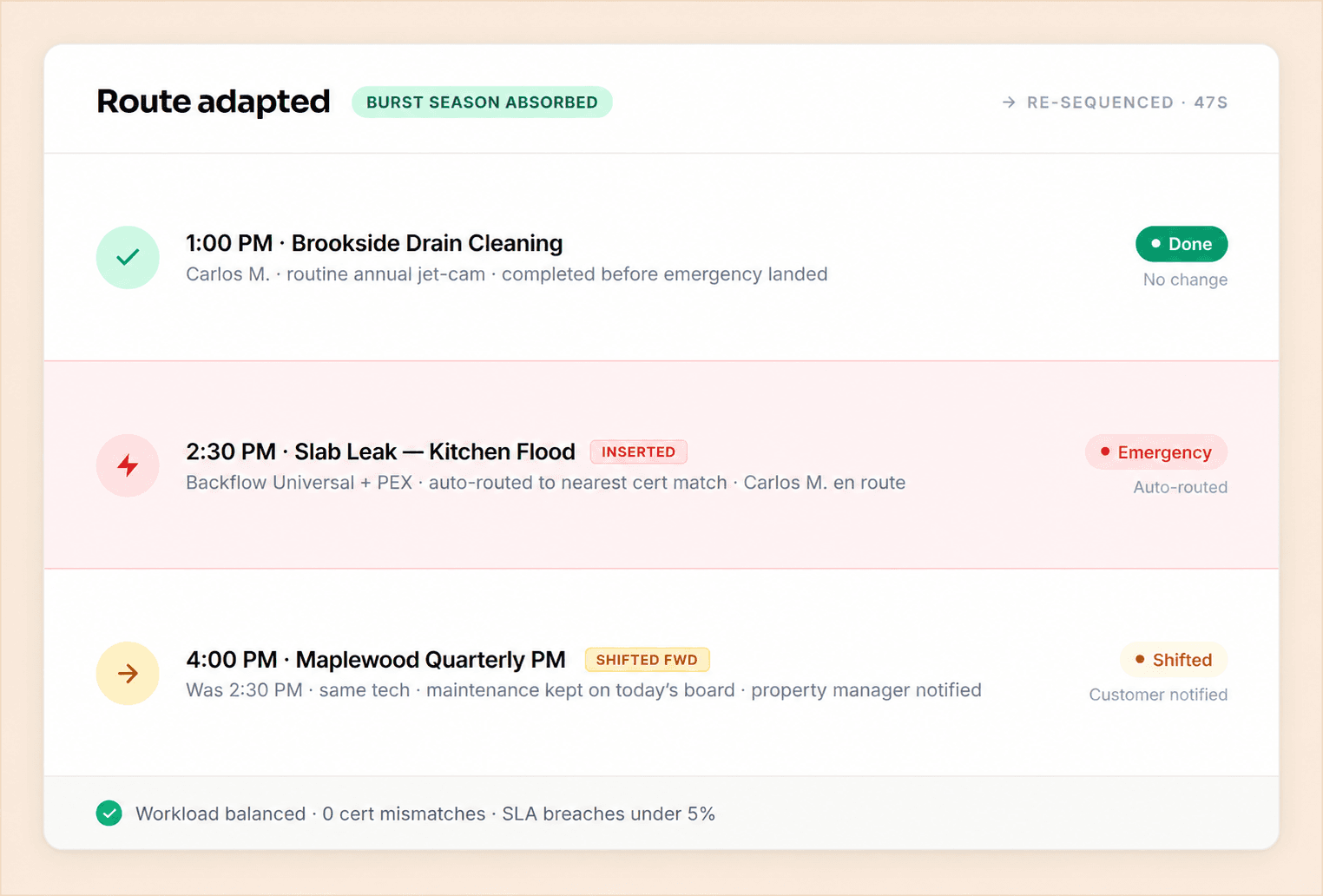
When a flooding call lands at 6:04am, dynamic rerouting inserts the emergency into the closest licensed, equipped plumber’s day. License and gas-endorsement stay enforced. The dispatcher approves the recovered morning with one click.
Manual vs FieldCamp AI
Why your dispatcher’s whiteboard isn’t built for plumbing dispatch.
“It looks like it does everything that I want it to do throughout the pipeline. And that’s really important. If you’re trying to find one platform that talks to itself without having multiple systems, this is it.“
Frequently Asked Questions
Does plumbing dispatch software enforce license by jurisdiction?
Yes. Each plumber’s license tier (master, journeyman, apprentice) and jurisdictional registrations are stored as hard constraints on the technician record. The optimizer never offers a master-only job to a journeyman, or a Texas-only plumber to a Louisiana service area — regardless of proximity or current workload.
How does plumbing dispatch software handle a 6am burst-pipe callout?
Plumbing dispatch software re-sequences the day’s stops in seconds when a flooding callout lands. License tier, gas endorsement, equipment loadout, and customer windows stay enforced through the re-dispatch. The dispatcher approves the recovered morning with one click instead of paging plumbers down the line. Powered by dynamic rerouting.
Can plumbing scheduling software track equipment per truck?
Yes. Camera lines, hydro-jetters, 100-foot snakes, water-meter pulls — every shared piece of equipment lives on the truck record. The optimizer enforces equipment availability as a hard constraint per stop. A plumber without a camera on the truck is never matched to a sewer-camera job.
Does the AI dispatcher handle backflow and gas-line certifications?
Yes. Backflow Prevention Assembly Tester (BPAT) certifications, gas-line endorsements, and any state-level cert renewals are tracked per plumber with expiration dates. Expired or missing certs disqualify the plumber from cert-gated jobs at dispatch time, no matter the proximity.
How does plumbing dispatch software keep service and new-construction lanes separate?
Service plumbers and new-construction crews have different daily caps, equipment, and skill sets. Each lane is configured separately on the dispatch board. The optimizer never pulls a new-construction crew into a service call mid-rough-in unless the dispatcher explicitly approves the override.
Does plumbing dispatch software integrate with my parts ordering?
Equipment-aware dispatch tracks what’s loaded on each truck. Parts ordering integration is via REST API or two-way sync with your CRM — once a part is consumed on a job, the inventory record reflects it before the next dispatch.
Does the AI dispatcher for plumbing work without an existing CRM?
Yes. The AI Dispatcher runs as a standalone product or layered on top of an existing system of record. It connects via REST API, two-way sync with major field-service CRMs (ServiceTitan, Housecall Pro, Jobber), and direct CSV import for recurring contract lists.
How long until plumbing dispatch software is running our real schedule?
Typical plumbing-contractor migrations are running production license-aware dispatch within 2-3 weeks. Time depends on data hygiene — clean license records, accurate truck loadouts, and cert expiration dates — more than software setup.
Ready?
Ditch the dispatch grind. Smarter plumbing routes, redesigned by AI.
Plug AI Dispatcher into your existing FSM, or run it with the full FieldCamp suite. Either way, the right plumber rolls first time.