
Cleaning Business Startup Plan: Free Template
February 24, 2026 - 26 min read


February 24, 2026 - 26 min read

Table of Contents
| TL;DR A solid cleaning business plan covers seven core sections: executive summary, company overview, market analysis, services and pricing, operations, marketing strategy, and financial projections. The U.S. Cleaning services market generates nearly $100 billion annually and is growing at roughly 5% per year. Follow this step-by-step guide to build a plan that attracts funding, wins clients, and sets your cleaning company up for long-term growth. |
KEY HIGHLIGHTS
Your Cleaning Business Plan Roadmap
A cleaning business plan is a structured document that maps out your company’s goals, target market, services, pricing, operations, and financial projections. It serves two purposes simultaneously: it acts as a roadmap for your daily operations and as a persuasion tool for lenders, investors, or partners who need to understand your business before writing a check.
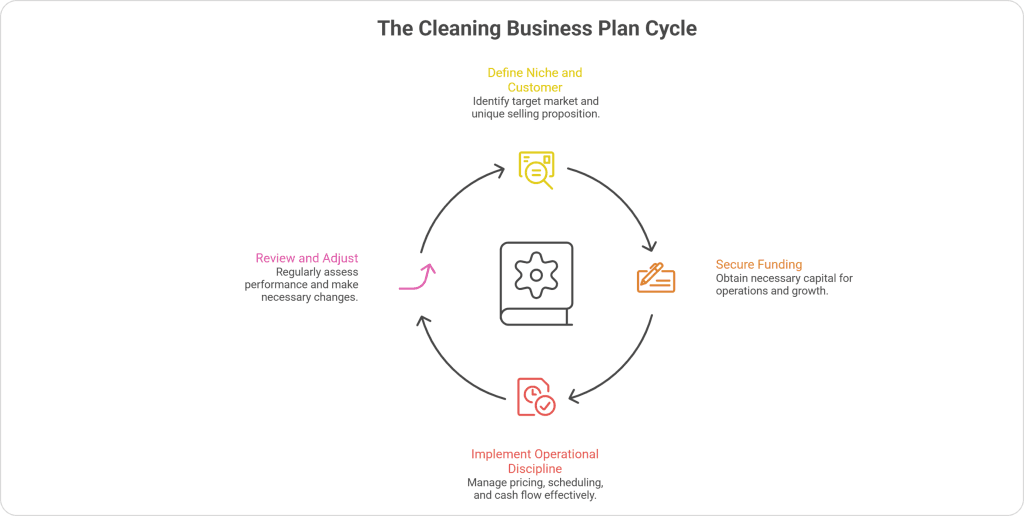
Whether you’re launching a residential house cleaning service or a commercial janitorial operation, your cleaning business plan answers three foundational questions: Who do you serve? How do you make money? And how will you grow?
Banks and lenders almost always require a business plan before approving a loan. The U.S. Small Business Administration (SBA), which backs many of the loans cleaning businesses use to launch, requires a formal plan as part of every application. But even if you’re self-funding, the process of writing one forces you to confront real numbers instead of guessing.
Write your cleaning business plan before you buy equipment or print business cards. The research you do during planning often changes your niche, pricing, or target market, and you want those decisions locked in before spending money.
A cleaning business plan isn’t just paperwork. It’s the difference between guessing with every dollar you invest and following a tested roadmap for growth. Here’s what a solid plan actually does for you:
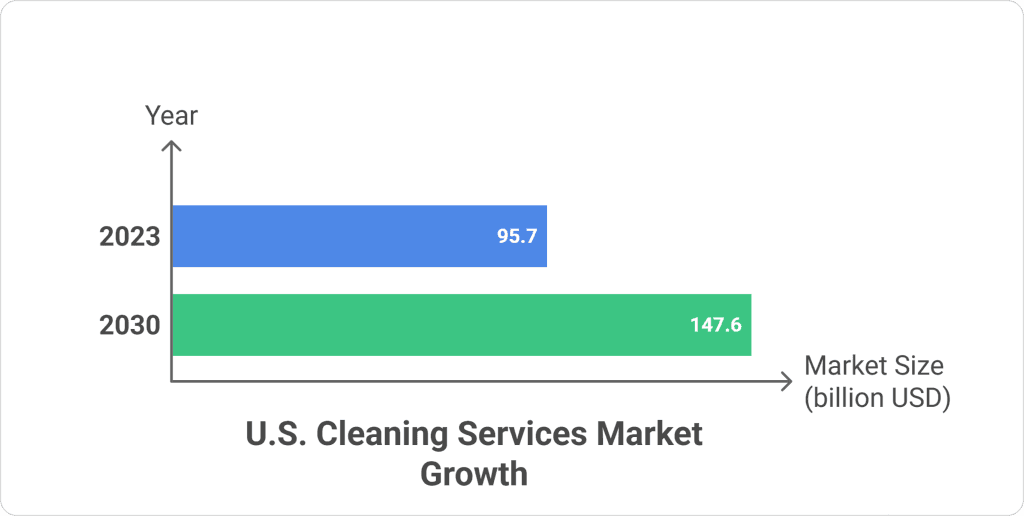
The U.S. cleaning services market is projected to reach roughly $147.6 billion by 2030, according to industry research from Grand View Research. With over 60,000 janitorial firms already operating, your plan needs to show exactly who you serve, how you price, and why clients should choose you.
For a complete walkthrough on launching your company, check out our guide on how to start a cleaning business.
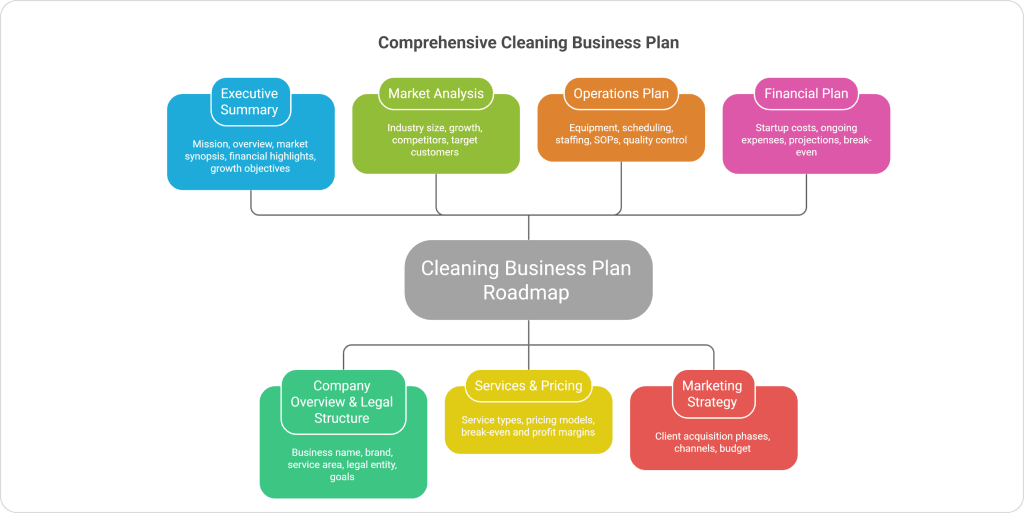
The seven sections below form the standard structure for a cleaning business plan. Each section builds on the one before it, so work through them in order. Write your executive summary last, even though it appears first in the finished document.
The executive summary is a one-to-two-page snapshot of your entire cleaning business plan. It’s the first section readers see, but you should write it last after completing every other section. A strong executive summary lets a lender, investor, or partner understand your entire business model in 90 seconds or less.
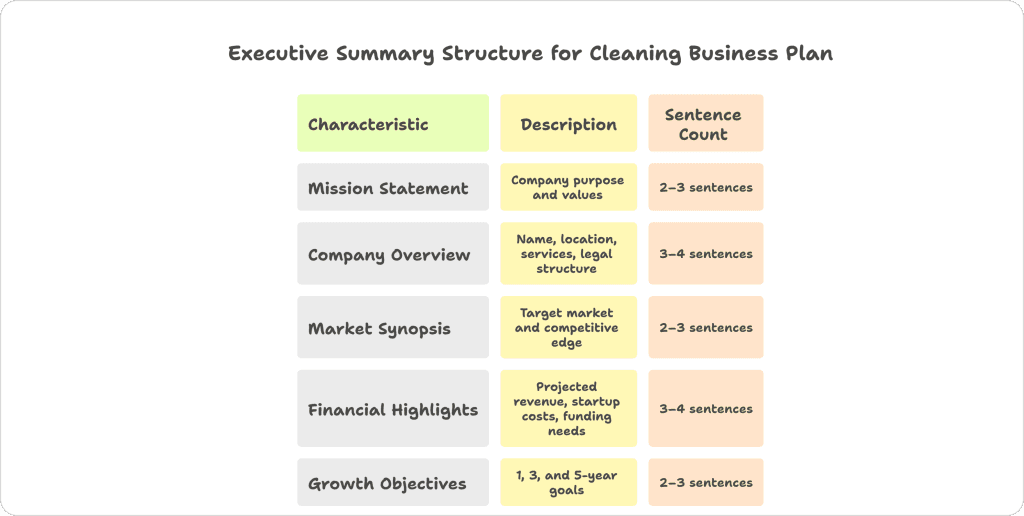
Your executive summary should include:
| Section | What to Include | Length |
| Mission statement | Company purpose and core values | 2-3 sentences |
| Company overview | Business name, location, services, legal structure | 3-4 sentences |
| Market synopsis | Target market and competitive advantage | 2-3 sentences |
| Financial highlights | Projected revenue, startup costs, funding needs | 3-4 sentences |
| Growth objectives | Where you plan to be in 1, 3, and 5 years | 2-3 sentences |
Example mission statement: “CleanPath Services provides reliable, eco-friendly residential cleaning to busy professionals in the Austin metro area. Our mission is to deliver consistent, trustworthy service that gives clients their weekends back.”
Keep your executive summary under two pages. If a lender can’t understand your business model in 90 seconds, your summary is too long. Lead with the most compelling number, like your market size or projected first-year revenue.
Your company overview explains who you are, what you do, and how your business is organized. This section gives readers a clear picture of your cleaning company’s identity and legal foundation.
Business structure options for a cleaning company
| Structure | Best For | Liability Protection | Tax Treatment |
| Sole Proprietorship | Solo operators just starting | None | Personal income |
| LLC | Most small cleaning businesses | Yes | Pass-through (flexible) |
| S-Corp | Established businesses with profits | Yes | Salary + distributions |
| Partnership | Two or more co-founders | Varies | Pass-through |
An LLC, or Limited Liability Company, is the most common legal structure for cleaning businesses. It creates a legal separation between your personal assets and your business debts, meaning a lawsuit against your company cannot touch your personal savings, home, or car. Most states allow you to form an LLC for $50-$500.
An S-Corp is a tax election (not a separate business type) that established cleaning businesses use to reduce self-employment taxes. Once your cleaning business earns consistent profits above $40,000-$50,000, an S-Corp election lets you split income between a reasonable salary and distributions, reducing the portion subject to self-employment tax.
What to include in your company overview
You’ll also want to research your state’s cleaning business license requirements. Most states require a general business license, and some require a specific cleaning or janitorial license.
Warning: Don’t skip insurance. General liability insurance ($500-$1,500/year) and a surety bond protect you when something breaks or goes missing in a client’s home. A surety bond is a three-party agreement where an insurance company guarantees your client will be compensated if you or your employees cause damage or commit theft. Many commercial contracts require proof of both insurance and bonding before you can even bid.
A market analysis is the section of your cleaning business plan that proves demand exists for your services and demonstrates you understand the competitive landscape. This is where lenders and investors look to see if your business idea holds up against reality.
Your market analysis should cover three areas: industry overview, competitor analysis, and target customer profiles.
Industry overview
The U.S. cleaning services industry is large and growing steadily. Here are the key data points to include in your plan:
| Metric | Value | Source |
| U.S. contract cleaning market size (2023) | $95.7 billion | Grand View Research |
| Projected annual growth rate | 4.8% CAGR through 2030 | Grand View Research |
| Number of U.S. janitorial firms | ~60,000+ | SBDCNet |
| Households expected to use pro cleaning (next 2 years) | ~80% of dual-income | Amra & Elma |
CAGR stands for compound annual growth rate, which measures the average yearly growth of a market over a multi-year period. A 4.8% CAGR means the cleaning industry is adding roughly $4.6 billion in new market value every year through 2030.
Competitor analysis
Identify three to five competitors in your service area. For each one, document:
Target customer profiles
Define who you’re selling to. Common segments for cleaning businesses:
| Customer Segment | Demographics | Key Needs | Willingness to Pay |
| Busy professionals | Ages 30-55, dual-income | Convenience, reliability | High |
| Property managers | Commercial, multi-unit | Consistent, recurring service | Medium-High |
| Airbnb hosts | Short-term rental owners | Fast turnovers, same-day | High |
| Small offices | 1,000-5,000 sq ft businesses | After-hours cleaning | Medium |
| Elderly homeowners | 65+, fixed income | Regular maintenance help | Medium |
Don’t try to serve everyone. Pick one to two customer segments to start. A residential cleaning business plan targeting busy professionals in a specific metro area is far stronger than a vague plan targeting “anyone who needs cleaning.
Learn how other cleaning businesses attract their first clients in our guide on how to get clients for a cleaning business and strengthen your cleaning business plan.
Your services and pricing section defines what you sell and how much you charge. This section directly determines your revenue potential and profit margins. Get it wrong, and you’ll either undercharge yourself into burnout or overprice yourself out of the market.
Common cleaning services to offer
| Service Type | Target Customer | Average Price Range | Frequency |
| Standard residential cleaning | Homeowners | $120-$250/visit | Weekly or bi-weekly |
| Deep cleaning | All residential | $200-$400+ | One-time or quarterly |
| Move-in/move-out cleaning | Renters, property managers | $250-$500 | One-time |
| Airbnb turnover cleaning | Short-term rental hosts | $80-$200 | Per checkout |
| Commercial/office cleaning | Small businesses | $0.05-$0.15/sq ft | Weekly or daily |
| Post-construction cleaning | Contractors, homeowners | $0.10-$0.50/sq ft | One-time |
| Specialty services (carpet, windows) | All segments | $50-$300+ | As needed |
Which pricing model works best for a cleaning business?
| Model | How It Works | Pros | Cons |
| Hourly rate | $25-$50/hour per cleaner | Simple to calculate | Harder to scale, unpredictable revenue |
| Flat rate per visit | Based on home size or rooms | Clients prefer it, predictable | Requires accurate estimating |
| Recurring subscription | Discounted rate for weekly/bi-weekly | Predictable revenue, client retention | Lower per-visit margin |
| Per square foot | Common for commercial | Scalable, easy to quote | Requires accurate measurements |
Flat-rate pricing is the most popular model for residential cleaning businesses because clients want to know the total cost upfront. Hourly pricing creates uncertainty for clients and can actually penalize faster, more efficient cleaners. Per-square-foot pricing is standard for commercial cleaning contracts because office buildings and retail spaces vary dramatically in size.
Start your cleaning business plan pricing by calculating your break-even point. Add up all monthly costs (supplies, insurance, gas, software, marketing), then divide by the number of jobs you can realistically complete. That’s your minimum price per job. Anything below that, and you’re losing money.
Calculate Your Cleaning Service Pricing
Use our free house cleaning cost calculator to model different pricing scenarios based on:
For a complete pricing strategy, check our full guide on how to charge for cleaning services.
Manage Your Cleaning Jobs Without the Chaos
You’re building a plan to run a real business, not just clean houses. FieldCamp helps you manage scheduling, dispatching, invoicing, and client communication from one platform, so you spend less time on admin and more time growing
Your operations plan explains how your cleaning business actually runs day to day. This is where you move from theory to execution, covering everything from staff scheduling to quality control. Lenders pay close attention to this section because it reveals whether you’ve thought through the logistics of actually delivering your services.
Key operations elements
How does a cleaning job flow from booking to completion?
Step 1: Client books online or calls in –> Step 2: Job assigned to crew based on location, skills, and availability –> Step 3: Crew completes job using standardized checklist –> Step 4: Quality check and client feedback –> Step 5: Invoice sent automatically –> Result: Recurring client relationship built
Document your standard operating procedures (SOPs) before hiring your first employee. An SOP is a written, step-by-step guide that describes exactly how to complete a specific task. A written checklist for “standard clean” and “deep clean” eliminates guesswork, reduces callbacks, and makes training new staff three times faster.
For this you can use our digital checklists and forms to standardize every job and track completion in real time.
Your marketing plan outlines how you’ll find clients, build your reputation, and generate consistent bookings. For a cleaning business, marketing breaks into two distinct phases: getting your first 20 clients and building a sustainable growth engine that generates leads without your constant attention.
Phase 1: Getting your first 20 clients
| Channel | Cost | Expected Results | Best For |
| Google Business Profile | Free | High-intent local leads | All cleaning businesses |
| Nextdoor and local Facebook groups | Free | Community trust, referrals | Residential cleaning |
| Door-to-door flyers | $50-$200 | 1-3% response rate | Targeted neighborhoods |
| Referral program (give $25, get $25) | Variable | Highest conversion rate | After first 10 clients |
| Google Ads (local) | $500-$1,500/month | 5-15 leads/month | Faster client acquisition |
A Google Business Profile is a free listing that appears in Google Search and Google Maps when people search for cleaning services in your area. It’s the single most important free marketing tool for a local cleaning business because it puts you directly in front of people actively looking for a cleaner right now.
Phase 2: Building a growth engine
Local SEO: Optimize your Google Business Profile, collect reviews, and build citations on Yelp, Thumbtack, and Angi. Citations are mentions of your business name, address, and phone number on other websites, and they help Google verify your business is legitimate. Read our guide on SEO for cleaning businesses.
Website with online booking: Let clients book and get instant quotes without calling you. Learn how to set up an online booking system to capture leads 24/7.
Review strategy: Ask every satisfied client for a Google review. Businesses with 20+ reviews at 4.5+ stars dominate local search results. The most effective time to ask is immediately after completing a job when client satisfaction is highest.
Email marketing: Monthly newsletters with cleaning tips keep you top of mind for recurring clients and generate referrals from people who forward your emails.
How much should a cleaning business spend on marketing?
| Business Stage | Revenue Target | Marketing Budget (5-10%) |
| Year 1 | $75,000 | $3,750-$7,500 |
| Year 2 | $150,000 | $7,500-$15,000 |
| Year 3 | $300,000 | $15,000-$30,000 |
Your best marketing channel as a new cleaning business is referrals from happy clients. Every other channel supports that. Deliver exceptional service, ask for reviews, and offer a referral bonus. Word of mouth built most of the successful cleaning companies operating today.
Your financial plan is where your cleaning business plan proves it can make money. This is the section lenders scrutinize most carefully. It includes startup costs, ongoing expenses, revenue projections, and your break-even analysis.
Revenue projections (sample residential cleaning business)
| Metric | Year 1 | Year 2 | Year 3 |
| Active recurring clients | 25-40 | 50-80 | 80-120 |
| Average revenue per client/month | $300 | $320 | $340 |
| Gross revenue | $72,000-$108,000 | $144,000-$230,000 | $245,000-$367,000 |
| Operating expenses | $50,000-$75,000 | $100,000-$160,000 | $170,000-$250,000 |
| Net profit (est.) | $22,000-$33,000 | $44,000-$70,000 | $75,000-$117,000 |
| Net profit margin | ~30% | ~30% | ~30-32% |
What financial statements does a cleaning business plan need?
| Statement | Purpose | Frequency |
| Profit and Loss (P&L) | Shows revenue minus expenses | Monthly (Year 1), Quarterly (Years 2-3) |
| Cash flow statement | Projects incoming revenue and outgoing expenses | Monthly |
| Balance sheet | Lists assets, liabilities, and owner’s equity | Quarterly |
| Break-even analysis | Number of jobs needed to cover all costs | One-time, update annually |
A profit and loss statement (also called an income statement) tracks your total revenue, subtracts all expenses, and shows your net profit or loss for a given period. A cash flow statement is different because it tracks when money actually enters and leaves your bank account, which matters because you can be “profitable” on paper while still running out of cash if clients pay late.
How to calculate your break-even point
Monthly fixed costs / (Average revenue per job – Variable cost per job) = Jobs needed to break even
Example: $3,000 fixed costs / ($175 average job – $45 variable cost) = 24 jobs per month to break even.
Fixed costs are expenses that stay the same regardless of how many jobs you complete, like insurance, software subscriptions, and vehicle payments. Variable costs change with each job, like cleaning supplies, gas, and labor.
Be conservative with revenue projections and generous with expense estimates. Lenders see through inflated numbers immediately. If your projections show you’re profitable by month four, add a buffer. Most cleaning businesses take six to 12 months to break even consistently.
Use our labor cost calculator to accurately estimate your biggest expense: labor. For professional invoicing, grab our cleaning invoice templates and cleaning estimate templates.
A fill-in-the-blank template with all 7 sections, pricing worksheets, and startup cost calculator.Includes a 90-day launch checklist to keep you on track.
Download PDF TemplateHere’s a realistic breakdown of what it costs to start a cleaning business, organized by business model:
| Category | Solo Operator | Small Crew (2-3 People) |
| Business registration and LLC | $100-$500 | $100-$500 |
| Insurance (general liability + bonding) | $500-$1,500 | $1,000-$3,000 |
| Cleaning equipment and supplies | $300-$1,000 | $1,000-$3,000 |
| Marketing (website, cards, flyers, ads) | $500-$2,000 | $1,500-$5,000 |
| Software (scheduling, invoicing, CRM) | $0-$50/month | $50-$200/month |
| Vehicle expenses (gas, insurance) | $200-$500/month | $500-$1,500/month |
| Uniforms and branding | $100-$300 | $300-$800 |
| Total startup | $1,700-$5,800 | $4,400-$13,800 |
The average cleaning service spends roughly $3,500 on initial startup costs. That’s one of the lowest barriers to entry of any service business. For a full cost breakdown with equipment lists and sample budgets, see our complete guide on cleaning business startup costs.
Which Cleaning Business Model Fits Your Situation?`| If this describes you… | Consider this model |
| Starting part-time with limited budget, under $2,000 | Solo residential cleaning, start with 5-10 recurring clients |
| Have $5,000-$15,000 and want to go full-time | Solo-to-small crew residential, target 20-30 recurring clients in year one |
| Want higher revenue per contract | Commercial/office cleaning, target small offices and medical facilities |
| Want predictable, subscription-style income | Recurring residential + Airbnb turnovers |
| Interested in scaling quickly with multiple crews | Mixed residential + commercial, invest in AI-powered scheduling early |
The business model you choose in your cleaning business plan directly affects every other section. Residential cleaning requires less startup capital but generates lower revenue per client. Commercial cleaning requires more equipment and insurance but delivers higher contract values and more predictable monthly income. Many successful cleaning companies start with one model and expand into the other within two to three years.
Running a cleaning business means juggling schedules, client requests, crew assignments, invoicing, and route planning every single day. As you grow past your first 10-15 clients, manual processes break down fast. Missed appointments, double-bookings, and lost invoices become recurring problems that cost you both money and reputation.
Modern cleaning businesses use field service management software to handle the operational complexity that comes with growth. Field service management (FSM) software is a category of business tools that combines scheduling, dispatching, invoicing, CRM, and route optimization into a single platform. The right FSM platform turns hours of admin work into minutes.
With FieldCamp’s AI dispatch management, you can:
Sam, the founder of HeyMaid, a residential cleaning company launched in 2025, put it this way: “I’ve been looking at tons of field service software, and it was so refreshing to see FieldCamp. It looks clean, it feels modern. You can tell it was built on top of AI, not the other way around.”
The businesses that succeed aren’t just good at cleaning. They’re good at running the business behind the cleaning. Learn more about what is field service management and how it applies to cleaning businesses.
Building a cleaning business plan is the single most important step between having a cleaning business idea and running a profitable cleaning company. The U.S. cleaning market is a $95.7 billion industry growing at 4.8% annually, with strong demand across both residential and commercial segments. There is room for well-run businesses that differentiate through quality, reliability, and smart operations.
Your plan doesn’t need to be 50 pages. Focus on the seven core sections: executive summary, company overview, market analysis, services and pricing, operations, marketing, and financials. Back your projections with real data, price your services based on actual costs, and choose the right tools to run your operations from day one.
Whether you’re a solo cleaner starting part-time or an entrepreneur building a crew from scratch, a written cleaning service business plan keeps you focused, funded, and growing. The businesses that succeed in this industry aren’t the ones with the most expensive equipment. They’re the ones that plan their pricing, marketing, and operations before they spend their first dollar.
Start writing your plan today. Your future cleaning business depends on the decisions you make now.
For more guidance, explore field service management strategies (https://fieldcamp.ai/blog/field-service-management) to optimize your operations as you grow.
Ready to Streamline Your Cleaning Business?
See how FieldCamp can help you schedule jobs, dispatch crews, send invoices, and manage clients, all from one AI-powered platform. Join cleaning businesses saving hours every week on scheduling and dispatching.
Most cleaning businesses launch for $1,700-$5,800 as a solo operator. The average startup cost is about $3,500, covering equipment, supplies, insurance, marketing materials, and business registration. If you’re starting with a small crew, expect $4,400-$13,800 in initial investment. You can start lean by using your own vehicle and purchasing supplies gradually. The four largest cost categories are insurance ($500-$1,500), equipment ($300-$1,000), marketing ($500-$2,000), and legal registration ($100-$500).
Yes. Even a one-page cleaning business plan helps you set pricing that actually covers costs, choose the right target market, and avoid common startup mistakes. If you need any outside funding, whether a bank loan, SBA loan, or investor capital, a formal plan is required. The process of writing one often reveals blind spots in your pricing, marketing, or operations strategy that would otherwise cost you thousands in the first year.
Residential cleaning businesses typically achieve 25-35% net profit margins once established. A solo cleaner doing four to five jobs per day at $150-$200 each can generate $60,000-$100,000 annually. Commercial cleaning contracts offer higher revenue per client ($500-$5,000+ per month) but require larger teams and more equipment. Profitability depends heavily on pricing (charging above your break-even point), operational efficiency (minimizing drive time and callbacks), and client retention (recurring clients are far more profitable than one-time jobs). Learn more about cleaning industry trends and statistics (https://fieldcamp.ai/blog/cleaning-industry-trends-statistics).
Requirements vary by state and city. Most areas require a general business license ($50-$400). Some states require a specific cleaning or janitorial license. You’ll also need an EIN (Employer Identification Number) from the IRS, which is free. An EIN is a federal tax identification number that functions like a Social Security number for your business. You need it to open a business bank account, hire employees, and file business taxes. General liability insurance ($500-$1,500/year) isn’t legally required everywhere but is practically essential because most clients won’t hire an uninsured cleaner. Check our detailed cleaning business license guide (https://fieldcamp.ai/blog/cleaning-business-license).
Residential cleaning has lower startup costs ($1,500-$5,000), a shorter sales cycle (clients book within days), and is easier to start solo. Commercial cleaning offers higher revenue per contract ($500-$5,000+ per month) and more predictable scheduling, but typically requires a crew, industrial equipment, and higher insurance coverage upfront. Many successful cleaning businesses start residential to build cash flow and operational systems, then add commercial services in year two or three once they’ve hired staff and can handle the larger scope.
Calculate your break-even cost per job first: add up all monthly expenses and divide by the number of jobs you can complete. Then add your desired profit margin (25-35% minimum). Research competitor pricing in your area for benchmarking. Standard residential cleaning averages $120-$250 per visit, while commercial cleaning runs $0.05-$0.15 per square foot. Avoid pricing below your break-even just to win jobs, because underpricing is the fastest path to burnout and business failure. Use FieldCamp’s house cleaning cost calculator (https://fieldcamp.ai/free-tools/house-cleaning-cost-calculator) to model different scenarios.
A comprehensive cleaning business plan includes seven sections: executive summary, company overview and legal structure, market analysis, services and pricing, operations plan, marketing strategy, and financial projections with startup costs. Include real data on your local market, competitor pricing, and realistic revenue projections for years one through three. Lenders specifically look for a break-even analysis, a cash flow statement, and evidence that you understand your competitive landscape.
Yes. Many successful cleaning companies started as part-time side businesses. Schedule weekend and evening jobs to build your client base without quitting your day job. A realistic part-time schedule of two to three jobs per evening or five to eight jobs per weekend can generate $1,500-$3,000 per month. Once you have 15-20 recurring clients generating enough revenue to replace your salary, you can transition to full-time. A good cleaning business plan should include a specific timeline and revenue milestone for this transition.