
How to Advertise Your Plumbing Business: 12 Marketing Strategies That Work in 2026
March 30, 2026 - 20 min read


March 30, 2026 - 20 min read

Table of Contents
| TL; DR: The most effective plumber advertising strategies combine Google Local Services Ads ($20-60 per lead), Google Business Profile optimization (free), and targeted direct mail (1-3% response rate) to build a steady pipeline of high-value residential and commercial jobs. |
KEY HIGHLIGHTS
The plumbing industry generates over $130 billion in annual revenue across the United States, according to IBISWorld industry reports. Yet most plumbing businesses rely almost entirely on word-of-mouth and emergency calls for new customers. That leaves money on the table.
Here is the reality. The Bureau of Labor Statistics projects strong demand for plumbers through 2033, but competition is increasing too. More plumbing companies are investing in plumbing advertising to capture customers before they call a competitor.
Track every advertising lead by source. Knowing whether a call came from Google Ads, a yard sign, or a referral lets you double down on what works and stop wasting money on what does not.
If your phone only rings for emergencies, you are leaving your schedule to chance. A consistent advertising strategy fills your calendar with scheduled jobs at predictable margins instead of scrambling for last-minute calls.
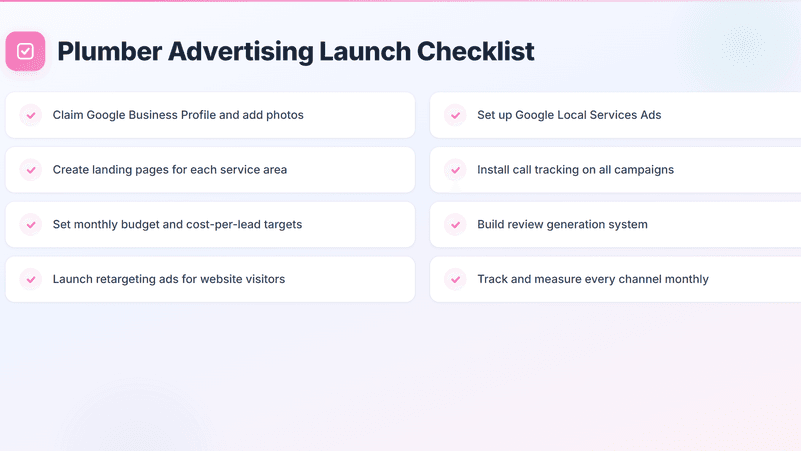
A realistic plumbing advertising budget is 5-10% of your gross annual revenue. The exact amount depends on your business size, growth goals, and local competition.
| Business Size | Annual Revenue | Monthly Ad Budget | Focus Areas |
| Solo operator (1-3 techs) | $150K-$400K | $200-$500 | Google Business Profile, reviews, referrals |
| Small company (4-15 techs) | $400K-$2M | $1,000-$3,000 | Google Ads + LSAs + SEO + direct mail |
| Growing business (15+ techs) | $2M+ | $5,000-$15,000+ | Full-funnel: PPC + LSAs + SEO + content + fleet branding |
The average plumbing service call generates $250-$500 in revenue. If your cost per lead is $30-50 and your close rate is 40-60%, each advertising dollar generates $3-8 in return. That math works for any size plumbing business.
Start small, measure everything, and scale what works. A solo plumber spending $300/month on Google Business Profile optimization and reviews can generate 5-10 qualified leads monthly with zero ad spend.
Every strategy below includes real cost estimates and expected ROI based on industry benchmarks. Pick the ones that match your budget and growth stage.
Google Local Services Ads put your business at the very top of search results with a “Google Guaranteed” badge. You pay per lead, not per click, which makes budgeting straightforward for plumbing businesses.
How it works: When someone searches “plumber near me” or “emergency plumber,” your ad appears above regular Google Ads with your business name, reviews, and a call button. You only pay when a customer contacts you directly.
Cost breakdown:
Why this matters for plumber advertising: LSAs are the fastest path to new plumbing leads. Unlike SEO, which takes months, LSAs can generate calls within 24-48 hours of setup. The Google Guaranteed badge builds instant trust.
Getting started:
1. Pass Google’s background check and verification
2. Set your weekly budget and service area
3. List your specific plumbing services (drain cleaning, water heater, etc.)
4. Collect at least 5 Google reviews to compete effectively
Dispute invalid leads through the LSA dashboard. Google credits you for spam calls, wrong-number calls, and leads outside your service area. Most plumbers miss this and overpay by 10-20%.
Your Google Business Profile is the single most important free advertising tool for any plumbing business. It controls what customers see when they search your name, your services, or “plumber near me.”
How it works: An optimized profile appears in Google’s Local Pack (the map results), which gets 42% of all clicks for local service searches. This is free traffic that converts at a high rate because these searchers need a plumber now.
Cost breakdown:
Optimization checklist:
Your Google Business Profile is not a “set it and forget it” listing. Active profiles with fresh photos and regular posts outrank stale ones. Treat it like a social media channel that you update weekly.
Google Ads (PPC) places your plumbing business above organic search results for specific keywords. You bid on terms like “plumber in [city]” or “water heater repair near me” and pay each time someone clicks.
How it works: You create targeted ads, set geographic boundaries, and bid on keywords your customers search. When someone clicks, they land on your website or booking page. You pay per click regardless of whether they book.
Cost breakdown:
Best keywords to target:
PPC mistakes plumbers make:
1. Bidding on broad keywords without location targeting (wastes budget)
2. No call tracking (cannot measure which ads generate revenue)
3. Sending traffic to the homepage instead of service-specific landing pages
4. Not using negative keywords to block irrelevant searches (“plumber salary,” “plumbing school”)
SEO builds long-term organic visibility so your plumbing business shows up in search results without paying per click. It takes 3-6 months to see results, but the leads are essentially free once you rank.
How it works: By optimizing your website for plumbing keywords, building local citations, and creating helpful content, Google ranks your site higher for relevant searches. Unlike ads, organic rankings keep generating leads 24/7 without ongoing ad spend.
Cost breakdown:
SEO priorities for plumbers:
1. Create service pages for each plumbing service you offer
2. Build location pages for each city and neighborhood you serve
3. Earn backlinks from local business directories and trade associations
4. Publish helpful content (e.g., “when to replace a water heater“)
5. Maintain consistent NAP across 40+ business directories
For a deeper dive, check our complete guide to plumbing industry SEO strategies.
Reviews are the most powerful form of plumbing advertising because they combine social proof with local SEO benefits. A plumbing business with 50+ reviews and a 4.5+ star rating generates significantly more calls than competitors with fewer reviews.
How it works: After each job, you ask satisfied customers to leave a Google review. These reviews improve your Google Business Profile ranking, build trust with new customers, and influence the Local Pack algorithm.
Cost breakdown:
Review generation tactics:
1. Send a text with a direct Google review link after completing each job
2. Include a QR code on your invoice that links to your review page
3. Follow up 24 hours after service with a friendly review request
4. Respond to every review, positive and negative, within 48 hours
5. Never offer incentives for reviews (violates Google’s terms)
Using a field service CRM that tracks customer interactions makes review follow-ups consistent. When every job has a customer record, no review opportunity slips through the cracks.
Warning: Never buy fake reviews or use review generation services that create fake profiles. Google’s algorithm detects these patterns and can permanently suspend your business listing.
Social media is not where most plumbers get direct leads. But it builds brand awareness, credibility, and trust in your local market. The best plumbing companies use social media to stay top-of-mind so that when someone needs a plumber, they think of you first.
How it works: Share job photos, plumbing tips, team spotlights, and customer testimonials on platforms where your customers spend time. Facebook and Instagram are the highest-value platforms for local plumbing businesses.
Cost breakdown:
What to post:
Best platforms for plumbers:
Direct mail is underrated in the digital age, but it remains one of the most effective plumbing advertising methods for reaching homeowners in specific neighborhoods.
How it works: You mail postcards, flyers, or doorhangers to targeted addresses in your service area. The physical format stands out because most marketing is digital now. Homeowners who receive your mailer keep it on the fridge or counter until they need a plumber.
Cost breakdown:
Direct mail best practices:
1. Target neighborhoods with homes 15+ years old (more plumbing needs)
2. Include a specific offer with an expiration date (“$50 off drain cleaning, expires March 31”)
3. Mail consistently (monthly or quarterly) to the same areas for recognition
4. Include your Google review rating and count on the mailer
5. Use Every Door Direct Mail (EDDM) to save on postage
Track direct mail leads with a unique phone number or promo code. This tells you exactly which neighborhoods and offers generate the best return.
Your plumbing trucks drive through your service area every day. A professional vehicle wrap turns every truck into a rolling billboard that generates 30,000-70,000 impressions daily, according to the Outdoor Advertising Association of America.
How it works: A full or partial wrap covers your work vehicles with your business name, phone number, services, and branding. Every drive between jobs becomes free advertising.
Cost breakdown:
Vehicle wrap tips:
1. Make your phone number the largest element (readable from 50+ feet)
2. Include your website URL and Google review count
3. List your top 3 services (not everything you do)
4. Use professional design and installation
5. Keep the design clean with high contrast colors
Referrals are the highest-converting lead source for plumbing businesses. Customers referred by a friend have a 60-70% close rate compared to 20-30% for cold advertising leads.
How it works: You create a structured program that rewards existing customers for sending new business your way. This turns your satisfied customer base into an active sales force.
Cost breakdown:
Referral program ideas:
1. “$50 credit for every referral that books a job”
2. “Refer 3 friends, get a free drain cleaning“
3. “Leave a review + refer a neighbor = $75 off your next service”
4. Partner with local real estate agents (they always need reliable plumbers)
5. Partner with HVAC, electrical, and general contractors for cross-referrals
Track referral sources in your customer management system so you know which customers and partners send the most business.
Email marketing nurtures past customers and keeps your plumbing business top-of-mind between service calls. It costs almost nothing and generates $36 for every $1 spent, according to industry benchmarks.
How it works: Collect email addresses from every customer and send regular, helpful content. When they need a plumber again (or their neighbor asks for a recommendation), your business is the first one they think of.
Cost breakdown:
Email campaign ideas:
1. Seasonal reminders: “Winterize your pipes before the first freeze” (November)
2. Maintenance tips: “3 warning signs your water heater is failing” (monthly)
3. Special offers: “Spring plumbing inspection: $99” (seasonal)
4. New service announcements: “We now offer tankless water heater installation”
5. Review requests: “How did we do? Leave a quick review” (post-service)
Email is the cheapest advertising channel for plumbers. Even a small list of 200 past customers, emailed monthly, generates repeat business and referrals that no other channel matches.
Local visibility builds trust and brand recognition in ways that digital advertising cannot replicate. When homeowners see your plumbing company supporting their kids’ sports team or sponsoring the neighborhood festival, they remember you when a pipe bursts.
How it works: Sponsor local sports teams, community events, charity functions, or school programs. Your business name and logo appear on jerseys, banners, event programs, and social media.
Cost breakdown:
Community involvement ideas:
1. Sponsor a Little League team (jersey logo + banner at games)
2. Donate plumbing services to Habitat for Humanity builds
3. Set up a booth at the local home show or county fair
4. Offer free plumbing inspections at community safety events
5. Partner with a local charity for a “percentage of revenue” campaign
The best plumbing advertising strategy is worthless if you cannot convert leads into booked jobs. Modern AI-first field service platforms bridge the gap between advertising and revenue by automating lead capture, scheduling, and follow-up.
How it works: When advertising generates a lead (phone call, form submission, or online booking), AI tools automatically schedule the job, assign the right technician, and send confirmation to the customer. No manual data entry. No leads falling through the cracks.
The lead conversion problem:
AI-powered conversion tools:
1. Online booking: Let customers book directly from your Google ad or website, 24/7
2. AI dispatch scheduling: Automatically assign the nearest available technician with the right skills
3. Automated follow-up: Send confirmation texts, appointment reminders, and post-service review requests without lifting a finger
4. Lead tracking: Know which advertising channel generated each customer for ROI measurement
FieldCamp’s AI Dispatcher considers five factors when assigning jobs: technician skills, location proximity, equipment availability, customer time windows, and job priority. That means advertising leads get booked faster, with the right technician, every time.
Plumbing businesses using AI-first scheduling report 96% reduction in scheduling time and 30-40% more jobs completed with the same team.
Use this table to compare all 12 strategies and decide which ones match your business size and budget.
| Strategy | Monthly Cost | Cost Per Lead | Time to Results | Best For |
| Google Local Services Ads | $500-2,000 | $20-60 | Days | All sizes, immediate leads |
| Google Business Profile | Free | $0 | 2-4 weeks | Solo operators, budget-conscious |
| Google Ads (PPC) | $1,000-5,000 | $50-150 | Days | Growing businesses, high volume |
| SEO | $500-2,000 | $10-30 (long-term) | 3-6 months | Long-term growth |
| Online Reviews | Free-$150 | $0 | 2-4 weeks | All sizes |
| Social Media | Free-$500 | $30-80 (paid) | 1-3 months | Brand awareness |
| Direct Mail | $450-800/batch | $15-80 | 1-2 weeks | Neighborhood targeting |
| Vehicle Wraps | $2,500-5,000 (one-time) | $5-20 (annualized) | Ongoing | Brand visibility |
| Referral Programs | $25-100/referral | $25-100 | 1-2 weeks | Highest close rate |
| Email Marketing | Free-$50 | $2-10 | 1 week | Past customer retention |
| Community Sponsorships | $200-2,000 | N/A | Long-term | Local trust building |
| AI Lead Conversion | Included in FSM software | Improves all channels | Immediate | Converting existing leads |
Here is how to allocate your plumbing advertising budget based on your business size and growth goals.
| Channel | Solo ($300/mo) | Small ($2,000/mo) | Growing ($8,000/mo) |
| Google LSAs | $100 | $500 | $2,000 |
| Google Business Profile | $0 (DIY) | $0 (DIY) | $200 (managed) |
| Google Ads (PPC) | $0 | $500 | $2,500 |
| SEO | $0 (DIY) | $500 | $1,500 |
| Reviews/Reputation | $0 (DIY) | $50 | $150 |
| Direct Mail | $0 | $200 | $500 |
| Social Media | $0 (DIY) | $100 | $300 |
| Email Marketing | $0 (free tier) | $0 (free tier) | $50 |
| Referrals | $50 | $100 | $300 |
| Vehicle Wraps | $50 (lettering) | $50 (amortized) | $200 (amortized) |
| Community | $0 | $0 | $300 |
| Total | $200 | $2,000 | $8,000 |
Start with the top 3 channels for your budget. Add more channels as you prove ROI on your initial investment. Growing too fast across too many channels dilutes your ability to measure what works.
Advertising without tracking is guessing. Here is how to measure which strategies generate actual revenue for your plumbing business.
Essential tracking metrics:
1. Cost per lead: Total ad spend / number of leads generated
2. Cost per acquisition: Total ad spend / number of booked jobs
3. Revenue per channel: Total revenue from customers acquired through each channel
4. Return on ad spend (ROAS): Revenue generated / advertising cost
5. Lifetime customer value: Average revenue per customer over their lifetime (includes repeat jobs + referrals)
Tracking tools:
Set a monthly review cadence. Look at which channels generate the lowest cost per acquisition and highest lifetime value, then shift budget accordingly.
Effective plumber advertising does not require a massive budget or a marketing degree. It requires picking the right channels for your business size, tracking what works, and consistently showing up where your customers are searching.
Start with the fundamentals: Google Local Services Ads for immediate leads, a fully optimized Google Business Profile for free visibility, and a review generation system to build trust. As those channels prove their ROI, layer in Google Ads, SEO, direct mail, and community involvement.
The plumbing businesses that grow fastest are not the ones with the biggest advertising budgets. They are the ones that convert advertising leads into booked jobs efficiently, follow up consistently, and measure everything. That is what separates a plumbing company that survives from one that thrives.
Most plumbing businesses should allocate 5-10% of gross revenue to advertising. Solo operators typically spend $200-500 per month, small companies $1,000-3,000, and growing businesses $5,000-15,000+. Start with Google Local Services Ads and Google Business Profile optimization because they offer the fastest return per dollar spent.
Google Local Services Ads and Google Business Profile optimization deliver the highest ROI for most plumbing businesses. LSAs generate immediate leads at $20-60 per contact, while an optimized Google Business Profile generates free calls from local searches. Combine both with a consistent review generation strategy for maximum impact.
Yes, Google Ads works well for plumbers targeting specific services and locations. The average cost per click for plumbing keywords ranges from $15-50, with conversion rates of 5-10%. To maximize ROI, create service-specific landing pages, use geographic targeting, and add negative keywords to block irrelevant searches.
Focus on three free strategies: optimize your Google Business Profile completely, ask every satisfied customer for a Google review, and build a referral program. These three tactics alone can generate 10-20 qualified leads per month for a plumbing business without any advertising spend.
Facebook delivers the best results for most plumbing businesses because of its local targeting capabilities and large user base of homeowners. Post before-and-after photos, plumbing tips, and customer testimonials. NextDoor is also valuable because it reaches homeowners in specific neighborhoods who actively seek service recommendations.
Local SEO for plumbing businesses typically takes 3-6 months to generate measurable results. You should see improvements in Google Business Profile visibility within 4-8 weeks, but ranking on page one for competitive plumbing keywords usually takes 4-6 months of consistent optimization.
Yes. Direct mail generates a 1-3% response rate for plumbing services, which translates to 10-30 leads per 1,000 mailers at a cost of $15-80 per lead. Target neighborhoods with older homes (15+ years) for the highest response rates. Include a specific offer with an expiration date to drive urgency.
Track four metrics: cost per lead (total spend divided by leads), cost per acquisition (spend divided by booked jobs), revenue per channel (revenue from each source), and return on ad spend (revenue divided by cost). Use call tracking numbers, UTM parameters, and your CRM system to attribute every lead to its source.