
How to Bid HVAC Jobs in 2026 (Commercial & Residential Guide)
April 1, 2026 - 23 min read

April 1, 2026 - 23 min read

Table of Contents
| TL;DR: Bidding HVAC jobs profitably requires calculating your burdened labor rate (not just hourly wage), applying the right equipment markup (25-50% on major equipment, 100-400% on small parts), knowing your overhead per billable hour ($84.40/hr is the ACCA benchmark), and setting profit margin targets by job type (55-65% gross on service, 45-55% on replacements, 35-50% on new construction). This guide walks through every formula with real numbers, a complete bid sheet template, and the follow-up strategy that actually wins work. |
A $45,000 commercial rooftop unit replacement bid goes sideways because the contractor forgot to calculate overhead per billable hour. The materials were right. Labor was right. But overhead was a flat guess, $3,000 tacked on and called a day.
When the real math came out six months later, the actual overhead rate was $87.50/hr. On a job that size, that’s $6,200 underwater before a single dollar of profit.
That one mistake is more common than most contractors want to admit. And if you’re reading this, you’re probably tired of guessing too, tired of losing bids you should’ve won, or worse, winning bids that lose you money.
This guide covers everything needed to bid HVAC jobs profitably. Real formulas, real dollar figures, real markup strategies, for both residential and commercial work. No vague advice about “knowing your numbers.” We’re going to calculate them right here.
Want a quick AI-powered breakdown of HVAC bidding formulas from this guide? Click below.
Summarize with AIKEY HIGHLIGHTS
How to Bid HVAC Jobs
An estimate is your internal calculation of what a job will cost you to complete. It’s the sum of materials, labor hours, equipment, subcontractors, permits, and overhead. The estimate is for your eyes only.
A bid is the price you present to the customer. It includes your estimate plus your profit margin, contingency, and any strategic pricing adjustments based on the competitive landscape. The bid is your offer to perform the scope of work at a specific price.
Here’s why this matters: if you’re “estimating” jobs and handing that number to customers, you’re selling at cost. Plenty of contractors do this for years, busy as hell, always broke. They have an estimating problem disguised as a cash flow problem.
The process should always be: estimate first, then bid. Your estimate is the floor. Your bid is the floor plus profit, overhead recovery, risk premium, and market positioning.
If you want to sharpen your estimating skills before you start bidding, here is the full breakdown on how to estimate HVAC jobs that covers quantity takeoffs, material pricing, and labor hour calculations.
Labor is the single biggest line item on most HVAC bids, 40-60% of total job cost (BLS).
And the number one mistake we see? Contractors use the wage they pay their tech as their labor cost.
Your tech makes $28.75/hr? Great. That’s not what that tech costs you.
Your burdened labor rate is the true cost of putting a technician on a job. Here’s the formula:
Burdened Labor Rate = Base Wage + Payroll Taxes + Workers’ Comp + Benefits + Paid Time Off
Let’s work a real example with the median HVAC technician wage:
| Component | Rate/Cost | Calculation |
| Base wage | $28.75/hr | Starting point |
| Payroll taxes (FICA, FUTA, SUTA) | ~10.5% | $3.02/hr |
| Workers compensation | ~8-12% | $2.88/hr (at 10%) |
| Health insurance | ~$500/mo | $2.88/hr (÷ 174 billable hrs/mo) |
| Paid time off (2 weeks) | ~3.8% | $1.09/hr |
| Tool allowance/uniforms | ~$150/mo | $0.86/hr |
Total burdened labor rate: $39.48/hr
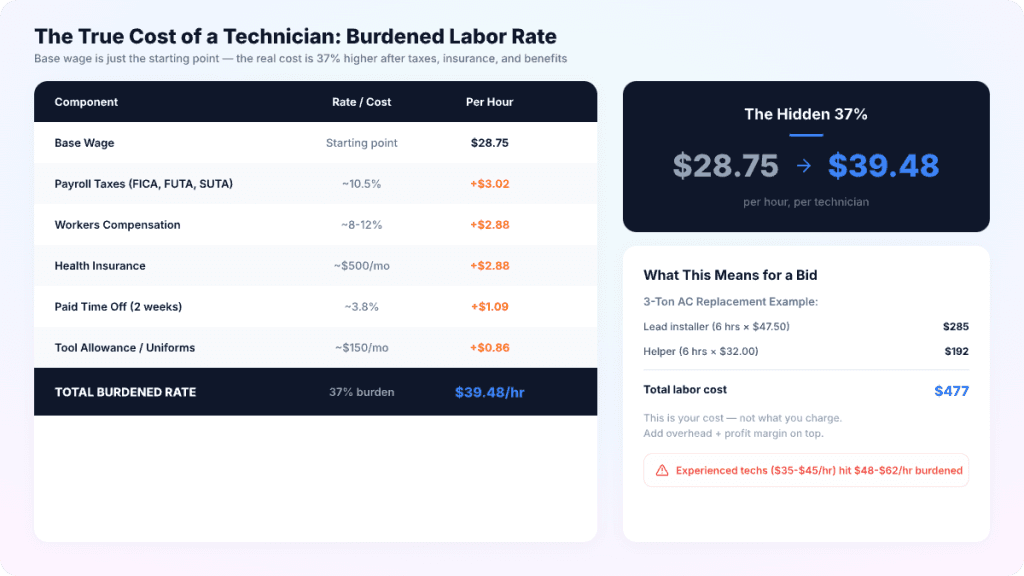
That’s a 37% burden on top of the base wage. For experienced techs making $35-$45/hr, your burdened rate can easily hit $48-$62/hr.
Once you have your burden rate, multiply it by the estimated hours for the job:
Example — 3-Ton Residential AC Replacement:
That $477 is your cost. It’s not what you charge. The charge comes later when you add overhead and profit.
If you’re bidding on public or government HVAC projects, prevailing wage requirements can bump your labor costs 30-60% above your normal rates. Always check your state’s prevailing wage schedule before pricing government work. A $45/hr burdened rate can become $65-$72/hr on a prevailing wage job, and if you miss that in your bid, you’re eating the difference.
Your markup on equipment and materials is where you recover purchasing costs, warranty risk, warehousing, and the time spent sourcing and managing the supply chain. Here’s what healthy markups look like across different item categories:
| Item Category | Typical Markup | Target Gross Margin | Example |
| Major equipment (condensers, air handlers, furnaces) | 25-40% | 20-30% | $2,800 cost → $3,500-$3,920 sell |
| Ductwork & sheet metal | 35-50% | 25-35% | $1,200 cost → $1,620-$1,800 sell |
| Refrigerant & specialty materials | 40-60% | 30-40% | $350 cost → $490-$560 sell |
| Small parts (capacitors, contactors, thermostats) | 100-400% | 50-80% | $12 cost → $24-$60 sell |
| Filters & consumables | 200-500% | 65-85% | $4 cost → $12-$24 sell |
(Sources: EstimateKit)
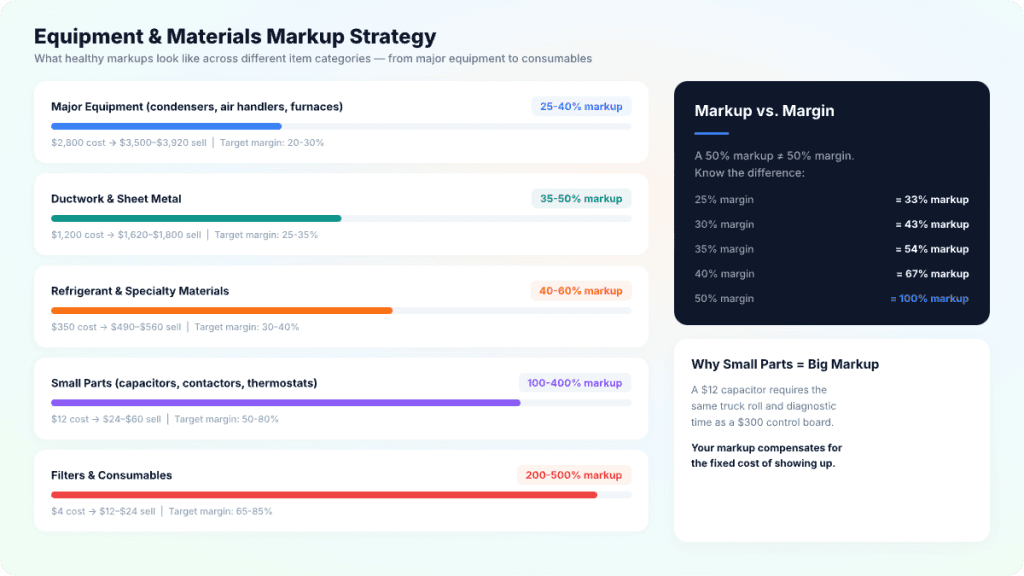
Why the wide range on small parts? Because a $12 capacitor requires the same truck roll, diagnostic time, and expertise as a $300 control board. Your markup on small parts compensates for the fixed costs of showing up. Nobody’s going to bid a service call at cost just because the part is cheap.
This trips people up constantly:
A 50% markup gives you a 33% margin. A 100% markup gives you a 50% margin. If your target gross margin on equipment is 30%, you need a markup of about 43%, not 30%.
Quick reference:
| Target Gross Margin | Required Markup |
| 25% | 33% |
| 30% | 43% |
| 35% | 54% |
| 40% | 67% |
| 50% | 100% |
For a deeper dive on pricing structures and how to set your rates, check out the detailed HVAC pricing guide.
This is where my $45K bid fell apart, and it’s where most contractors leak profit without realizing it. Overhead includes everything you pay, whether or not a single tech is on a job:
Overhead Per Billable Hour = Total Annual Overhead / Total Annual Billable Hours
Let’s say you’re a 5-truck shop:
| Overhead Category | Annual Cost |
| Facility (rent, utilities) | $48,000 |
| Office staff (2 people) | $95,000 |
| Vehicle costs (5 trucks) | $72,000 |
| Insurance (GL + WC + auto) | $38,000 |
| Marketing | $36,000 |
| Software & technology | $12,000 |
| Licensing, training, misc | $15,000 |
| Total overhead | $316,000 |
Now divide by billable hours. If each of your 5 techs bills 1,400 hours/year (accounting for drive time, callbacks, training, PTO):
$316,000 / 7,000 billable hours = $45.14/hr overhead
The ACCA 2025 benchmark for the total cost of rolling a truck (overhead + labor) is $84.40/hr. If your overhead per hour plus your burdened labor rate doesn’t add up to at least that, double-check your numbers — you might be forgetting costs.
A healthy HVAC operation generates $300,000-$500,000 in revenue per truck per year (industry benchmark). If you’re significantly below $300K per truck, either you’re not billing enough hours, your prices are too low, or both. This is a sanity check you should run quarterly.
For more on keeping your margins healthy as you scale, read HVAC profit margins.
Not all HVAC work carries the same margin, and your bids should reflect that. Here’s what healthy operations target:
| Job Type | Target Gross Margin | Target Net Margin | Notes |
| Service / Repair | 55-65% | 20-25% | Highest margin — small parts markup + diagnostic fees |
| Replacement (residential) | 45-55% | 10-12% | Equipment-heavy, but volume makes up for it |
| New Construction (residential) | 35-50% | 3-5% | Competitive, spec-driven, tight margins |
| Commercial Service | 50-60% | 15-20% | Higher ticket, longer contracts |
| Commercial New Construction | 35-45% | 5-15% | Bid bonds, retention, and slow payment |
| Maintenance Agreements | 55-65% | 25-30% | Recurring revenue, planned labor |
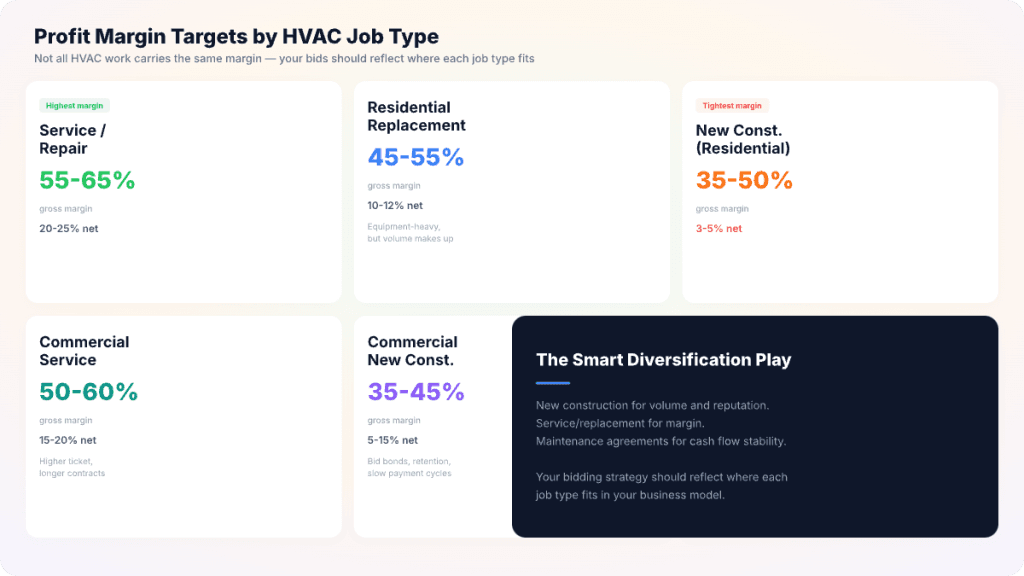
A critical note on net margins in new construction: That 3-5% net margin is not a typo. New construction is a volume game. You’re competing against every contractor in your market on plan-and-spec jobs, and the general contractor is squeezing every sub.
If your overhead isn’t dialed in, new construction will bankrupt you while keeping your trucks busy.
This is why experienced contractors diversify. They use new construction for volume and reputation, service/replacement for margin, and maintenance agreements for cash flow stability. Your bidding strategy should reflect where each job type fits in your business model.
For a breakdown on flat rate vs. time-and-materials pricing, and how to present each option to close more deals, see our HVAC sales tips.
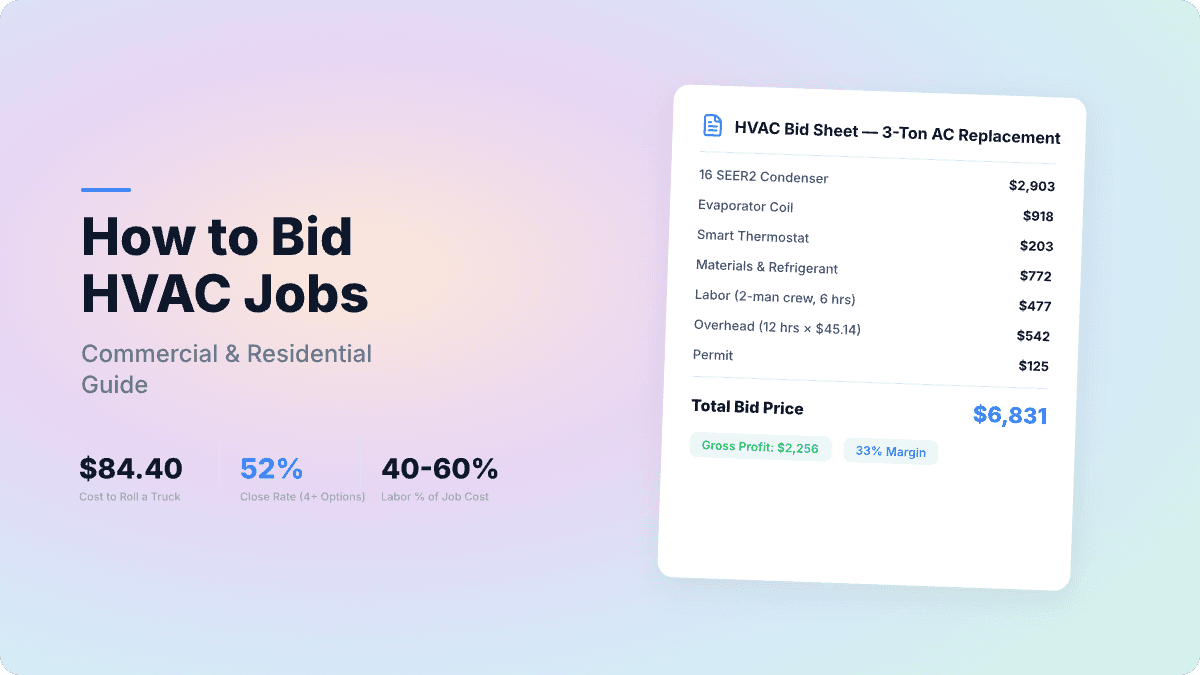
Let me walk through a complete bid for a 3-ton residential air conditioning replacement. This is a bread-and-butter job for most HVAC companies, and it’s a perfect template for building your bid sheets.
| Line Item | Cost | Markup | Sell Price |
| Equipment | |||
| 3-ton 16 SEER2 condenser | $2,150 | 35% | $2,903 |
| Matching evaporator coil | $680 | 35% | $918 |
| Smart thermostat | $135 | 50% | $203 |
| Materials | |||
| Refrigerant line set (30ft) | $185 | 45% | $268 |
| Disconnect + whip | $65 | 100% | $130 |
| Electrical wire, fittings | $45 | 100% | $90 |
| Refrigerant (R-410A, 8 lbs) | $96 | 50% | $144 |
| Misc (tape, mastic, hangers, screws) | $35 | 100% | $70 |
| Pad / mounting hardware | $40 | 75% | $70 |
| Labor | |||
| Lead installer — 6 hrs @ $47.50 burdened | $285 | — | $285 |
| Helper — 6 hrs @ $32.00 burdened | $192 | — | $192 |
| Overhead allocation | |||
| 12 billable hours @ $45.14/hr | $542 | — | $542 |
| Permit | $125 | 0% | $125 |
| Subtotal (Cost) | $4,575 | ||
| Subtotal (Sell before profit) | $5,940 | ||
| Profit margin (15%) | $891 | ||
| Total Bid Price | $6,831 |
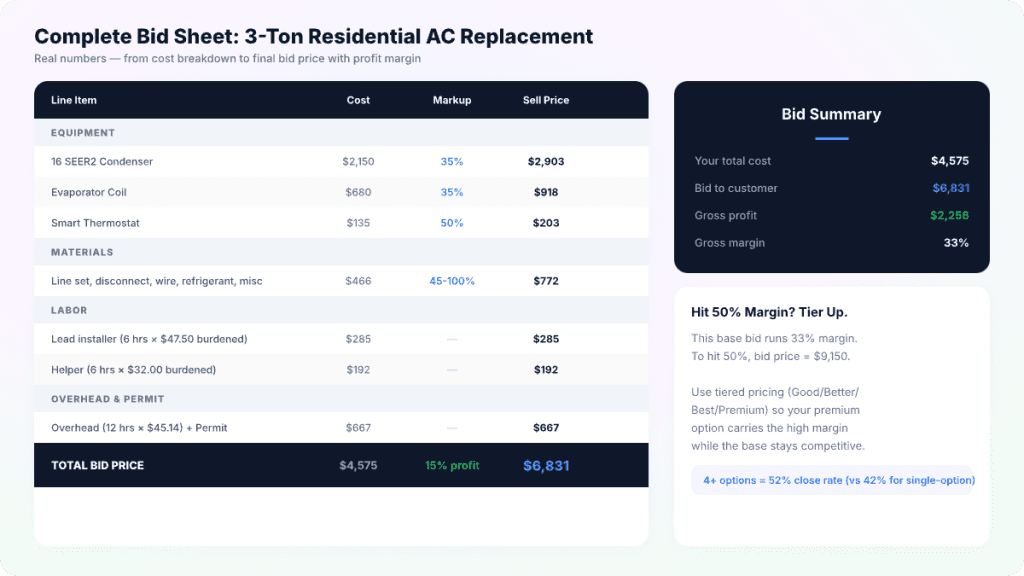
“Wait – 33% gross margin on a replacement? You said the target is 45-55%.”
You’re right. This bid is on the lean side. To hit 50% gross margin on this job, the bid price would need to be about $9,150. Whether your market supports that depends on your area, your reputation, and how you present the proposal.
This is exactly why tiered pricing matters (more on that below). Your base option might be at a 33-40% margin, but your premium option, with a variable speed system, extended warranty, and IAQ add-ons, might carry a 55% margin.
The blend across options is what gets your average to the target.
Commercial HVAC bidding is a different animal from residential. The money is bigger, the timelines are longer, and the paperwork can bury you. There are three main commercial bidding structures:
The mechanical engineer designs the system. You get drawings and specifications. You price exactly what’s on the plans without substitutions unless you submit a formal request. The lowest responsible bidder typically wins.
Pros:
Cons:
The customer hires you to both design and install the HVAC system. You’re responsible for load calculations, equipment selection, duct design, and installation. More risk, but much more margin.
Pros:
Cons:
You’re invited to bid based on an existing relationship or prequalification. The scope may be somewhat flexible, and there’s room for back-and-forth on pricing and approach. Common in repeat commercial accounts and preferred vendor arrangements.
Pros:
Cons:
Before you submit any commercial bid, make sure you’ve accounted for:
For a look at what’s shaping commercial HVAC in 2026, including technology shifts and regulatory changes, see HVAC industry trends.
Residential bidding is faster, more relationship-driven, and involves a completely different sales dynamic than commercial. The homeowner is standing right there. Your presentation matters as much as your price.
Replacements are your bread and butter. The homeowner’s system has died or is on its last legs, and they need a solution, usually within days, not months.
What makes a winning residential replacement bid:
New construction residential is spec-driven and builder-controlled. You’re bidding against other subs, and the builder cares about three things: price, schedule, and reliability.
Key differences from replacement bidding:
“I keep losing bids to the cheap guy.” We hear this constantly. And the answer is never to match the cheap guy’s price, because the cheap guy is either going broke slowly or cutting corners.
Here’s how to compete on value instead of price:
We covered this above, but it deserves emphasis. Tiered pricing does three things:
Every line item that adds perceived value without proportional cost is a value stack. Examples:
If you’re not offering financing in 2026, you’re leaving 20-30% of potential jobs on the table. Partner with a lender (GreenSky, Synchrony, Hearth, or your local credit union) and present monthly payments alongside the total price on every proposal.
The math: A $9,500 system at 7.99% for 84 months = $148/month. Most homeowners can stomach $148/month. Many of them can’t stomach writing a $9,500 check. Same job, same price, completely different psychology.
Here’s the section no other HVAC bidding guide covers, and it might be the most valuable thing on this page.
Most HVAC contractors submit a bid and then… wait.
Maybe they call once. Maybe they don’t. And they wonder why their close rate is stuck at 30%.
Data from sales research consistently shows that 80% of deals require 5+ touchpoints, but most salespeople give up after 1-2. In HVAC, the follow-up gap is enormous, and it’s a competitive advantage hiding in plain sight.
48 Hours After Proposal:
Call (don’t text). The script is simple:
“Hi [Name], this is [You] from [Company]. I’m just calling to see if you had a chance to look over the proposal I left and if you have any questions about the options. No pressure at all — I just want to make sure everything makes sense.”
This call is about answering questions and removing objections, not closing. 70% of the time, the customer hasn’t even looked at the proposal yet. That’s fine. You’re now the contractor who followed up, which puts you ahead of the two guys who didn’t.
1 Week After Proposal:
Text or email. Keep it brief:
“Hey [Name], just checking in on the AC proposal. I’ve got my schedule filling up for [month], so I wanted to make sure we can lock in your preferred installation date if you’re ready to move forward. Happy to adjust anything on the proposal if needed.”
This creates gentle urgency without being pushy. It also opens the door for negotiation — some customers want to say yes but need a small concession to feel good about it.
2 Weeks After Proposal:
Final follow-up. Call or text:
“Hi [Name], I know things get busy, so I just wanted to touch base one more time on the HVAC proposal. If you’ve decided to go a different direction, totally understand — but if you’re still considering it, I’d love to help. I’m offering [small incentive — free thermostat upgrade, free first-year maintenance, etc.] for installations booked this month.”
This is your last outreach. If they don’t respond, move on. But you’d be surprised — I’ve won jobs on this third follow-up that I would’ve never gotten if I stopped after the first call.
You can’t improve your follow-up if you don’t track it. Every bid should be logged with: date sent, follow-up dates, customer responses, and outcome (won/lost/no response).
This data tells you your close rate, your average sales cycle, and where deals are falling off.
This is where a field service management platform like FieldCamp becomes essential. You can create and manage estimates in the field and use FieldCamp’s estimating tools to build proposals with your pre-set price book bundle, so every bid is consistent, accurate, and sent before the competition.
Your bid-to-win ratio (also called close rate or win rate) tells you how many bids you submit for every job you win. It’s one of the most important KPIs in your business, and most contractors have no idea what theirs is.
| Bid Type | Target Win Rate | What It Means |
| Residential replacement | 35-50% | You’re in a strong position if you hit 40%+ |
| Residential new construction | 20-30% | Builder-driven, more competition |
| Commercial plan-and-spec | 10-20% | Large bid pools, lowest price wins |
| Commercial design-build | 25-35% | Fewer competitors, relationship-driven |
| Commercial negotiated | 50-70% | You’re the preferred vendor |
| Overall healthy benchmark | 15-25% | Across all job types combined |
If your win rate is below 15%:
If your win rate is above 40%:
The 4+ Options Effect: Contractors who present 4 or more options on proposals close at a 52% rate, compared to 42% for single-option proposals (ACHR News).
That’s a 24% improvement in close rate just from restructuring how you present the same information. This is the single highest-ROI change you can make to your bidding process.
Speed to quote matters too. The first contractor to present a professional proposal wins the job more often than not. If it takes you 3 days to get a bid out after a site visit, you’re losing to the company that sends theirs the same day.
FieldCamp lets you build and send proposals right from the job site, so you never lose a bid to a slow turnaround.
For more strategies on getting in front of the right customers in the first place, read HVAC lead generation.
Build Proposals That Win More Jobs
Present tiered options, send same-day estimates, and follow up automatically, all from one platform built for HVAC contractors.
The median annual salary for HVAC technicians in 2026 is $59,810, according to the Bureau of Labor Statistics. Depending on experience, location, and specialization, HVAC techs earn between $39,130 (entry-level/rural areas) and $91,020+ (top 10%/major metros). Union technicians and commercial specialists often exceed $70,000–$80,000 annually.
HVAC engineers earn $77,666–$90,684/year, industrial refrigeration specialists earn $70,000–$150,000/year, and HVAC sales engineers earn $80,000–$120,000+ with commissions. HVAC supervisors earn a median of $90,800. The highest earners are business owners with established multi-crew operations, who can earn $200,000–$500,000+ annually.
Yes, though it requires strategic career planning. Proven paths to $100K include: (1) specializing in commercial/industrial refrigeration, (2) moving into supervisory roles, (3) working significant overtime during peak seasons, (4) becoming a selling tech with commission income, (5) union work in high-cost cities, (6) starting a successful HVAC business, or (7) becoming an HVAC sales engineer. Realistic timeline: 5–10 years of experience.
Yes. HVAC offers 8% projected job growth (2024–2034), median pay approaching $60,000, and an industry-wide shortage of 110,000+ technicians, creating exceptional job security. The field requires only 6 months to 2 years of training versus 4+ years for a bachelor’s degree, offers multiple career paths (residential, commercial, supervisory, business ownership), and provides essential services that can’t be automated or outsourced.
Alaska pays HVAC technicians the highest average salary at $80,940–$83,660/year, followed by New Hampshire ($77,445), Washington ($76,796), Washington, D.C. ($75,050), and Massachusetts ($72,680). However, cost-of-living adjusted rankings differ; states like Washington (no income tax) and New Hampshire (no income tax) offer better purchasing power than similarly-paid states with high taxes.
HVAC apprentices and helpers earn $34,073–$41,187/year ($16–$20/hour) on average. Union apprenticeships typically start at $15–$18/hour and progress to $42+/hour after 4–5 years of training. Higher-cost states like California, New York, and Massachusetts pay apprentices $18–$22/hour, while lower-cost states may start at $14–$16/hour.
At the entry level, electricians earn slightly more ($60,600 vs. $54,100 for HVAC). Through mid-career, earnings are comparable. However, HVAC supervisors ($90,800 median) significantly out-earn senior electricians ($76,600). Both trades offer similar long-term earning potential, with top performers and business owners in both fields exceeding $100K. Training time is slightly shorter for HVAC (2–3 years vs. 4–5 years for electricians).
Yes. Union HVAC technicians earn approximately 23% more than non-union workers ($72,210 vs. $58,782 average) according to ZipRecruiter. Union members also receive superior benefits, including pensions (worth 20–30% of lifetime earnings), comprehensive health insurance with minimal employee cost, guaranteed wage increases, and paid apprenticeship training. Trade-offs include union dues (~$30–$100/month) and less flexibility in work arrangements.
Certificate programs take 6–12 months, associate degrees take 2 years, and apprenticeships take 2–5 years (paid on-the-job training). EPA Section 608 certification is required to handle refrigerants and can be obtained in a few weeks of study. Most HVAC technicians enter the workforce within 2–3 years of starting their training, significantly faster than 4-year college degrees, and many earn competitive wages while learning through paid apprenticeship programs.