
How to Calculate CFM for HVAC: The Complete Guide With Formulas, and Examples
March 23, 2026 - 22 min read


March 23, 2026 - 22 min read

Table of Contents
You can install the most expensive HVAC system on the market. If the airflow is wrong, it won’t matter.
CFM, cubic feet per minute, is the number that determines whether conditioned air actually reaches every room in the building. Get it right, and the system runs efficiently, every room stays comfortable, and the equipment lasts its full lifespan. Get it wrong, and you’re chasing hot spots, frozen coils, humidity problems, and callbacks that eat your margins.
The problem? Most HVAC guides either give you one oversimplified formula or dump engineering math with no context.
This guide gives you everything in between: four calculation methods explained step by step, the CFM per square foot charts everyone searches for, but nobody publishes properly, and real examples you can apply to your next job.
If you’re a homeowner, here’s the quick version:
CFM stands for cubic feet per minute, the volume of air flowing through your HVAC system every 60 seconds. It’s measured at the system level (total airflow through the air handler) and at the room level (airflow through individual supply registers).
Think of it this way: BTUs tell you how much heating or cooling capacity your system has. CFM tells you how much of that capacity actually reaches the rooms.
A 3-ton air conditioner produces 36,000 BTU/h of cooling. But if the ductwork only delivers 900 CFM instead of the required 1,200 CFM, roughly 25% of that capacity never makes it where it’s needed. The system works harder, the compressor strains, the homeowner complains, and you get a callback.
These two metrics are related but measure different things:
| Metric | What It Measures | Unit | Used For |
| CFM | Volume of air flowing per minute | Cubic feet/minute | System and duct sizing, register selection |
| ACH | How many times is the room’s air fully replaced per hour | Changes/hour | Ventilation requirements, air quality standards |
The connection: CFM = (Room Volume × ACH) ÷ 60
If you know a room’s ACH requirement (from building codes or ASHRAE standards), you can convert it directly to CFM. Use our air changes per hour calculator to quickly find recommended ACH values by room type and convert them to CFM.
There isn’t one CFM formula — there are four, and each one serves a different purpose. The right method depends on what you’re trying to do.
Which method should most people start with? Method 1 (Room Volume/ACH) is the recommended primary method for most residential sizing. Methods 2–4 below are best used as cross-checks or for specific advanced scenarios.

Best for: Sizing airflow for individual rooms using air change rates. This is the most common and recommended method for residential HVAC sizing.
Formula:
CFM = (Length × Width × Ceiling Height × ACH) ÷ 60
Example: A 12 ft × 15 ft bedroom with 8 ft ceilings needs 6 air changes per hour (ACH — the number of times the room’s entire air volume gets replaced per hour).
CFM = (12 × 15 × 8 × 6) ÷ 60 = 8,640 ÷ 60 = 144 CFM
That bedroom needs a supply register delivering 144 CFM — which a 6-inch round duct can typically handle.
When to use this method: When you know the room dimensions and the recommended ACH for that room type. This is the go-to method for room-by-room HVAC sizing.
Best for: Quick system-level airflow calculation based on equipment size. Use this as a cross-check, not as your primary sizing method.
Formula:
CFM = Tons of cooling × 400
Example: A 3-ton AC system.
CFM = 3 × 400 = 1,200 CFM total
That’s the total airflow the blower needs to move through the entire duct system. Individual rooms get a portion of that total based on their individual loads.
The 400 CFM/ton rule isn’t universal. Climate affects the ideal CFM per ton:
| Climate Type | CFM per Ton | Why |
| Hot and humid (Florida, Gulf Coast) | 350 | Lower airflow = longer run time = better dehumidification |
| Standard/moderate (most of the U.S.) | 400 | Industry baseline |
| Hot and dry (Arizona, Nevada) | 450 | Higher airflow = more sensible (temperature) cooling, less latent (moisture) removal needed |
| Heat pump systems | 450 | Heat pump design requires higher airflow across the coil |
Quick reference — System CFM by equipment size:
| System Size | BTU/h | Required CFM (at 400/ton) |
| 1.5 ton | 18,000 | 600 |
| 2 ton | 24,000 | 800 |
| 2.5 ton | 30,000 | 1,000 |
| 3 ton | 36,000 | 1,200 |
| 3.5 ton | 42,000 | 1,400 |
| 4 ton | 48,000 | 1,600 |
| 5 ton | 60,000 | 2,000 |
When to use this method: When you know the system tonnage and need a quick check on total system airflow. This does NOT tell you how much CFM each room needs — use Method 1 or Method 3 for that.
Best for: Precision room-level sizing when you know the BTU load from a Manual J calculation.
Formula:
CFM = BTU/h ÷ (1.08 × ΔT)
Where ΔT (delta T) = the temperature difference between supply air and return air. Standard cooling ΔT is 20°F. Standard heating ΔT is 40–70°F.
Example: A room with a 6,000 BTU/h cooling load and a standard 20°F ΔT.
CFM = 6,000 ÷ (1.08 × 20) = 6,000 ÷ 21.6 = 278 CFM
Simplified shortcut for cooling: CFM = BTU load ÷ 21.6 (assumes standard 20°F ΔT)
When to use this method: When you have Manual J load calculation data for individual rooms. This is the most accurate method for room-by-room sizing because it’s based on actual heat gain/loss, not estimates.
Best for: Measuring actual airflow in existing ductwork or verifying duct sizing. This is a field measurement method, not a design method.
Formula:
CFM = Duct Cross-Section Area (sq ft) × Air Velocity (FPM)
For round ducts: Area = π × (diameter in inches / 2)² ÷ 144
Example: An 8-inch round duct with air moving at 700 feet per minute (FPM).
Area = 3.14159 × 4² ÷ 144 = 0.349 sq ft CFM = 0.349 × 700 = 244 CFM
When to use this method: When you’re measuring existing airflow with an anemometer, verifying duct performance, or diagnosing airflow problems in the field.
| Your Situation | Best Method | What You Need |
| Sizing rooms for a new install or replacement | Method 1 (ACH) or Method 3 (BTU) | Room dimensions or Manual J data |
| Quick check on total system airflow | Method 2 (Per-Ton) | Equipment tonnage |
| Verifying airflow at a register or duct | Method 4 (Velocity) | Anemometer + duct size |
| Diagnosing comfort complaints | Methods 1 + 4 | Calculate what’s needed, measure what’s delivered |
This is the chart everyone searches for. These values assume standard 8-foot ceilings, moderate climate, and average insulation. Adjust for ceiling height, poor insulation, or extreme climates using the correction factors below.
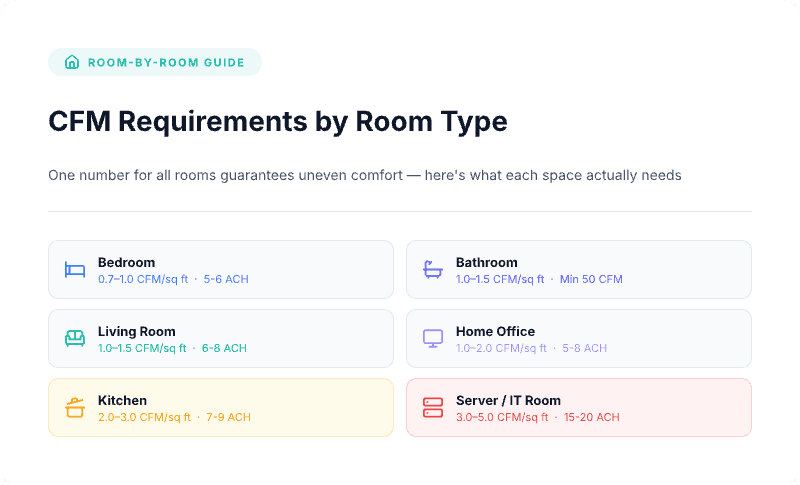
Important: These are guidelines, not exact specifications. Every room has unique characteristics. For accurate sizing, always calculate based on actual room conditions or use our free CFM calculator, which factors in window type, sun exposure, insulation quality, and occupancy.
A kitchen at 2–3 CFM/sq ft and a bedroom at 0.7–1.0 CFM/sq ft aren’t arbitrary — they reflect the actual heat loads in each space:
The contractor who calculates room-by-room CFM delivers better comfort than the one who divides total system CFM evenly across all registers. This is one of the biggest differentiators in quality HVAC work, and part of what separates contractors who price confidently from those still guessing.
Our HVAC pricing guide covers how room-level data strengthens your estimates and justifies higher ticket prices.
The charts above are baseline numbers. Real-world conditions shift them up or down.
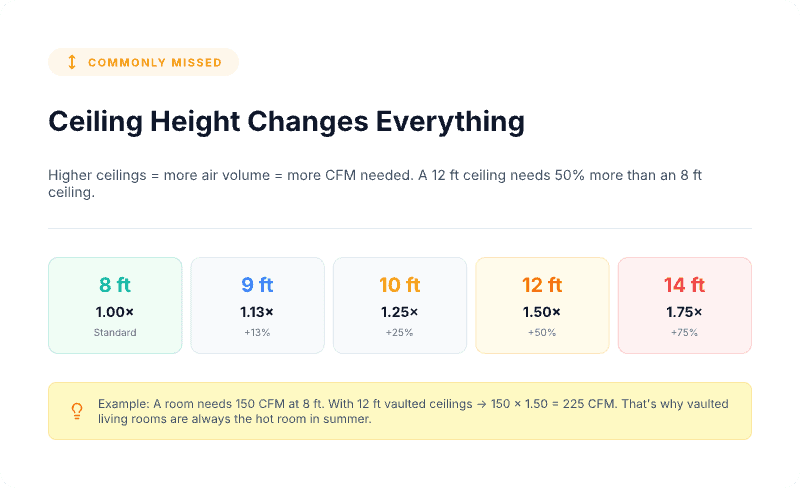
Standard calculations assume 8-foot ceilings. Higher ceilings = more air volume = more CFM needed.
| Ceiling Height | Multiplier vs. 8 ft |
| 8 ft (standard) | 1.00× |
| 9 ft | 1.13× |
| 10 ft | 1.25× |
| 12 ft | 1.50× |
| 14 ft (vaulted) | 1.75× |
| 16 ft | 2.00× |
Example: A room needs 150 CFM at 8 ft ceilings. With 12 ft ceilings, it needs 150 × 1.50 = 225 CFM.
This is one of the most commonly missed adjustments, and it’s the reason vaulted-ceiling living rooms are almost always the hot room in summer.
| Factor | CFM Impact |
| Poor insulation (older home) | +20–30% |
| South/west-facing windows (unshaded) | +20–30% |
| Each additional occupant beyond baseline | +50–100 CFM per person |
| High-heat appliances (commercial kitchen, server equipment) | +200–400+ CFM |
| Altitude above 3,000 ft | +3% per 1,000 ft above sea level |
| Flex duct instead of rigid metal | Delivers ~15% less CFM at the same duct size |
Altitude matters more than people think. Denver (5,280 ft elevation) needs roughly 16% more CFM than a sea-level city because the air is less dense; it takes more volume to move the same amount of energy.
This is one of the most misunderstood topics in HVAC, and most guides skip it entirely.
Cooling: 400 CFM per ton (20°F ΔT – the temperature difference between supply and return air)
Heating: 300–350 CFM per ton equivalent (because the ΔT is much larger — 60–100°F)
Here’s why: When your AC is running, it supplies air at roughly 55°F into a 75°F room. That’s a 20°F difference. To move enough cooling energy, you need relatively HIGH airflow.
When your furnace is running, it supplies air at 130–170°F into a 70°F room. That’s a 60–100°F ΔT. Because each cubic foot of air carries WAY more energy (due to the larger temperature differential), you need LESS airflow to deliver the same BTUs.
This is why multi-speed and variable-speed blowers exist. The blower runs at a higher speed during cooling (more CFM) and a lower speed during heating (less CFM). The system automatically adjusts.
For contractors: When sizing ductwork, size for the COOLING CFM requirement (the higher number). The duct system that handles 1,200 CFM for cooling will work perfectly at 900 CFM for heating; the air just moves a bit slower through the same ducts.
There are two completely different types of CFM in HVAC, and mixing them up causes major sizing errors.
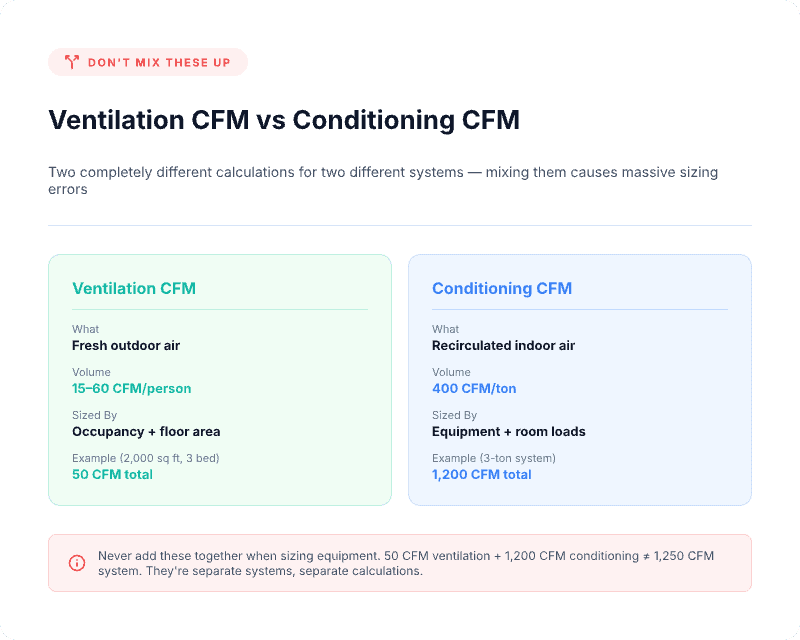
This is the air circulated through your HVAC system for heating and cooling. It’s the same indoor air, pulled through the return, conditioned by the coil or heat exchanger, and pushed back out through supply registers.
This is fresh air brought in from outside to maintain indoor air quality. It replaces stale indoor air with fresh outdoor air.
ASHRAE 62.2 (Residential):
Total required ventilation = (Square footage ÷ 100) + ((Number of bedrooms + 1) × 7.5) CFM
Example: 2,000 sq ft home, 3 bedrooms Ventilation CFM = (2,000 ÷ 100) + ((3 + 1) × 7.5) = 20 + 30 = 50 CFM of fresh outdoor air
Plus local exhaust:
ASHRAE 62.1 (Commercial):
| Space Type | CFM per Person | CFM per Sq Ft | Example: 2,000 sq ft, 20 people |
| Office | 5 | 0.06 | (20×5) + (2,000×0.06) = 220 CFM |
| Retail | 7.5 | 0.12 | (20×7.5) + (2,000×0.12) = 390 CFM |
| Restaurant (dining) | 7.5 | 0.18 | (20×7.5) + (2,000×0.18) = 510 CFM |
| Classroom | 10 | 0.12 | (20×10) + (2,000×0.12) = 440 CFM |
| Gym/Fitness | 20 | 0.06 | (20×20) + (2,000×0.06) = 520 CFM |
The takeaway: Don’t add ventilation CFM to conditioning CFM when sizing equipment. They’re separate calculations for separate systems. Conditioning CFM determines your equipment size and ductwork. Ventilation CFM determines your fresh air intake and exhaust fans.
The ductwork is the delivery system. If the ducts are too small, they restrict airflow, no matter how powerful the blower. If they’re too large, air velocity drops, and you get poor distribution.
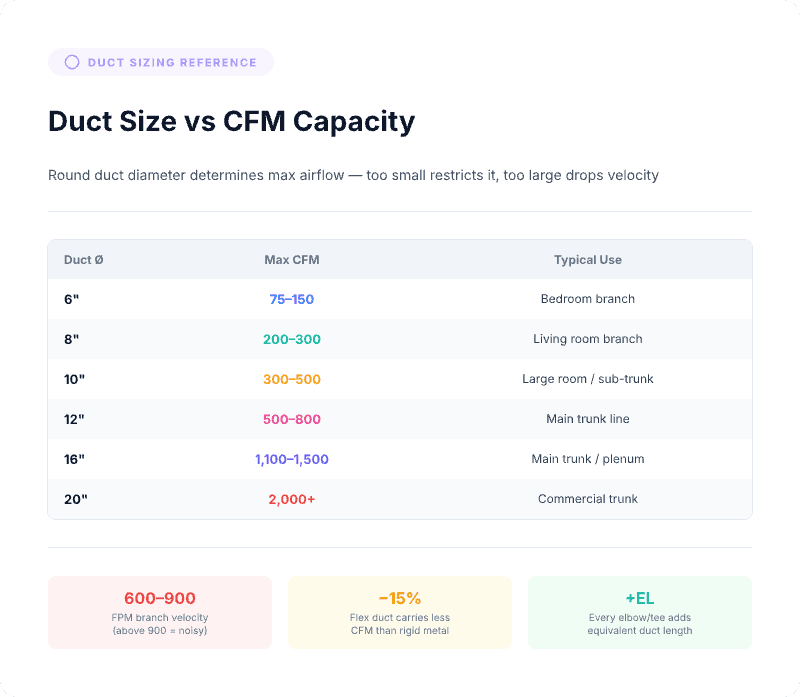
| Duct Diameter | Max CFM (Residential) | Typical Use |
| 4 inch | 30–50 | Bathroom exhaust |
| 5 inch | 50–75 | Small register run |
| 6 inch | 75–150 | Bedroom branch |
| 7 inch | 150–200 | Medium room branch |
| 8 inch | 200–300 | Living room branch |
| 10 inch | 300–500 | Large room or sub-trunk |
| 12 inch | 500–800 | Main trunk line |
| 14 inch | 800–1,100 | Large trunk |
| 16 inch | 1,100–1,500 | Main trunk or plenum |
| 18 inch | 1,500–2,000 | Large system trunk |
| 20 inch | 2,000+ | Commercial trunk |
Key guidelines:
For detailed duct sizing based on your CFM needs, use our duct sizing calculator. Once your duct layout is set, turn it into a professional quote with our HVAC estimate template.
Let’s calculate CFM for an entire home to show how individual room numbers add up to system requirements.
Sample home: 2,000 sq ft, single-story, 3 bed/2 bath, 8 ft ceilings, moderate climate, average insulation.
| Room | Dimensions | Sq Ft | ACH | CFM Calculation | Required CFM |
| Master Bedroom | 14×16 | 224 | 6 | (224×8×6)÷60 | 179 |
| Bedroom 2 | 12×12 | 144 | 6 | (144×8×6)÷60 | 115 |
| Bedroom 3 | 11×12 | 132 | 6 | (132×8×6)÷60 | 106 |
| Living Room | 18×16 | 288 | 7 | (288×8×7)÷60 | 269 |
| Kitchen | 12×14 | 168 | 8 | (168×8×8)÷60 | 179 |
| Dining Area | 10×12 | 120 | 6 | (120×8×6)÷60 | 96 |
| Master Bath | 8×10 | 80 | 9 | (80×8×9)÷60 | 96 |
| Bathroom 2 | 6×8 | 48 | 9 | Min 50 CFM | 50 |
| Hallway | 4×20 | 80 | 4 | (80×8×4)÷60 | 43 |
| Laundry | 6×8 | 48 | 8 | (48×8×8)÷60 | 51 |
| TOTAL | 1,332 (conditioned) | 1,184 CFM |
Verification against the per-ton method: 1,184 CFM ÷ 400 CFM/ton = 2.96 tons → 3-ton system
Cross-check: 2,000 sq ft ÷ 600 sq ft per ton (conservative rule of thumb) = 3.33 tons
The room-by-room calculation and the per-ton method agree: a 3-ton system at 1,200 CFM is the right fit. The room-by-room data tells us exactly how to distribute that airflow through the ductwork, something the per-ton method alone can’t do.
For more precise load-based sizing, run a full Manual J calculation. Our free HVAC load calculator gives you BTU loads that feed directly into Method 3 (the heat load CFM formula). For a deep dive on Manual J and why it matters, see our complete Manual J calculation guide.
That’s a rough average for a whole house, not a sizing method. A kitchen needs 2–3× that. A basement needs half. One number for all rooms guarantees some are over-conditioned and others aren’t.
A 3-ton system needs 1,200 CFM total. But HOW that 1,200 is distributed matters enormously. Without room-by-room calculations, the master bedroom gets 250 CFM (too much) while the kitchen gets 100 (not nearly enough).
Static pressure (the resistance your ductwork creates against airflow, measured in inches of water column) is critical. 400 CFM per ton only works if the blower can actually deliver it. If total external static pressure exceeds the manufacturer’s spec (usually 0.5″ water column), actual airflow drops dramatically.
A system rated for 1,200 CFM might only deliver 900 with restrictive ductwork, dirty filters, or undersized returns. The best HVAC apps include diagnostic tools that help techs catch static pressure problems on-site before they become callbacks.
Supply CFM can never effectively exceed return CFM. If the return grille or duct is undersized, it chokes the entire system. Many older homes have only ONE return vent — often undersized — creating a major restriction.
A 5-ton system in a house that needs 3 tons will short-cycle: running 5–8 minutes instead of 15–20, never dehumidifying properly, wearing out the compressor faster, and creating hot and cold spots throughout the home.
Good HVAC dispatch software can flag callback patterns by equipment size, often the first signal that oversizing is happening across multiple installs.
Calculations assume 100% of CFM reaches the room. Reality: duct leaks lose 20–30% of airflow in typical homes. Every fitting (elbow, tee, reducer) adds equivalent length. And flex duct carries about 15% less than rigid metal at the same diameter.
ASHRAE says “15 CFM per person” for ventilation. That’s FRESH outdoor air — totally separate from the 400 CFM/ton of RECIRCULATED conditioning air. Mixing these two numbers causes massive sizing errors.
A 200 sq ft room with 8 ft ceilings (1,600 cubic feet) needs very different CFM than the same room with 12 ft ceilings (2,400 cubic feet). That’s 50% more volume — and 50% more CFM needed. Use the ceiling height multiplier table above.
Same-size rooms can have wildly different CFM needs depending on conditions:
Heating uses 300–350 CFM per ton (higher ΔT = less airflow needed). Cooling uses 400 CFM per ton (lower ΔT = more airflow needed). Size ducts for the cooling requirement (higher CFM). Multi-speed blowers handle the difference automatically.
For contractors and advanced DIY: Sometimes you need to measure what’s actually being delivered, not just what the calculations say should be delivered. Here are three methods, from simplest to most accurate.
This uses the furnace nameplate data and a thermometer:
Example: 80,000 BTU furnace at 95% efficiency, 50°F temperature rise CFM = (80,000 × 0.95) ÷ (1.08 × 50) = 76,000 ÷ 54 = 1,407 CFM
Accuracy: ±10–15%. Good for quick field checks.
A handheld anemometer (~$30–$100 for a basic model) measures air velocity at registers:
Accuracy: ±10–20% depending on technique and register type. Better than the temperature rise for individual registers.
A calibrated flow hood ($1,500–$4,000) fits over the register and directly measures CFM:
Accuracy: ±3–5%. The gold standard for commissioning, diagnostics, and balancing.
Pro tip for contractors: If you’re troubleshooting a comfort complaint, compare calculated CFM (what each room should get) against measured CFM (what each room actually gets). The gap tells you where the problem is: an undersized duct, a disconnected flex, excessive leakage, or a blower that can’t overcome static pressure.
Track these diagnostics alongside your job records using work order management software, so you build a data trail that improves future installs.
It depends on the room type. Bedrooms need 0.7–1.0 CFM per square foot, living rooms need 1.0–1.5, kitchens need 2.0–3.0, and bathrooms need 1.0–1.5 (with a minimum of 50 CFM for exhaust). These assume standard 8-foot ceilings and moderate climate. Adjust upward for higher ceilings, poor insulation, or south/west-facing windows.
The most common formula is: CFM = (Room Length × Width × Ceiling Height × ACH) ÷ 60, where ACH is air changes per hour (typically 5–8 for residential rooms). For system-level calculation, use CFM = Tons × 400. For precision room sizing with load data, use CFM = BTU/h ÷ (1.08 × ΔT).
A 12×12 room with 8-foot ceilings (1,152 cubic feet) needs approximately: 115 CFM as a bedroom (6 ACH), 154 CFM as a living space (8 ACH), or 173 CFM as a home office with equipment (9 ACH). Use our free CFM calculator for a more precise number based on your specific room conditions.
A 3-ton air conditioner (36,000 BTU/h) requires approximately 1,200 CFM at the standard 400 CFM per ton rate. In humid climates, this may be reduced to 1,050 CFM (350/ton) for better dehumidification. In dry climates, it may be increased to 1,350 CFM (450/ton) for more sensible cooling.
CFM (cubic feet per minute) measures the volume of air flowing through a system per minute — it’s a rate. ACH (air changes per hour) measures how many times the entire volume of air in a room is replaced per hour — it’s a frequency. They’re related by the formula: CFM = (Room Volume × ACH) ÷ 60. CFM is used for equipment and duct sizing. ACH is used for ventilation standards and building codes.
For a 1,000 sq ft space with 8-foot ceilings: at 6 ACH (typical residential), you need approximately 800 CFM. Using the per-ton method: 1,000 sq ft typically requires a 2–2.5 ton system, which needs 800–1,000 CFM. The exact number depends on ceiling height, insulation, windows, and room composition.
A 2,000 sq ft home typically needs 1,000–1,400 CFM total, corresponding to a 2.5–3.5 ton system. The actual requirement depends on climate, insulation quality, window area, and how the space is divided. Our room-by-room walkthrough above shows a 2,000 sq ft home calculating to 1,184 CFM (3-ton system).
Insufficient airflow causes: the system can’t deliver enough heating or cooling to the room (comfort complaints), the evaporator coil can freeze in cooling mode (leading to no cooling and potential compressor damage), humidity removal suffers, and the system runs longer trying to compensate — increasing energy costs and wear. Static pressure increases, further straining the blower motor.
Excessive airflow causes: the air moves across the coil too quickly to effectively dehumidify (in cooling mode), creating a cold but clammy feeling. Supply air temperature is closer to room temperature (smaller ΔT), reducing the system’s effective capacity. Noise from high-velocity air through ducts and registers increases. Energy waste from running the blower harder than necessary.
Yes, significantly. CFM is based on room volume, not just floor area. A room with 12-foot ceilings has 50% more volume than the same room with 8-foot ceilings — and needs 50% more CFM. Use the ceiling height multiplier: 9 ft = 1.13×, 10 ft = 1.25×, 12 ft = 1.50×, 14 ft = 1.75×.
A 7-inch round duct handles 150–200 CFM, and an 8-inch round duct handles 200–300 CFM. For exactly 200 CFM, either size works — use 7-inch for shorter runs and 8-inch for longer runs or where additional fittings add friction. Check our duct sizing calculator for recommendations based on your specific run length and configuration.
Divide CFM by 400: Tons = CFM ÷ 400. A system moving 1,600 CFM requires a 4-ton unit (1,600 ÷ 400 = 4). This assumes standard conditions; adjust to ÷350 in humid climates or ÷450 in dry climates.
The 400 CFM/ton rule states that every ton of air conditioning capacity (12,000 BTU/h) requires 400 cubic feet per minute of airflow across the evaporator coil. It’s the industry standard for moderate climates. Reduce to 350 CFM/ton in humid regions (for better dehumidification) or increase to 450 CFM/ton in dry/arid regions.