
How to Manage a Field Service Team in 2026
February 20, 2026 - 33 min read


February 20, 2026 - 33 min read

Table of Contents
| TL;DR: Half your technicians are considering leaving. Seventy-three percent of their time goes to paperwork instead of billable work. And most field service managers are still running their teams on processes designed for 2018. This guide covers the 12 practices that actually move the needle, from onboarding to AI-powered scheduling to the financial habits that keep growing teams profitable. |
Running a field service team is nothing like managing an office team. Your people work alone, miles from headquarters. You can’t walk over to check progress. Problems that would take five minutes to catch in person take five days to surface in the field, usually when a customer calls to complain.
The operational stakes are higher than most managers realize. A tech who shows up without the right part, gets stuck in traffic, or loses a paper invoice doesn’t just waste time; you risk a lost job, a bad review, and a customer who quietly moves to a competitor.
This guide covers the 12 practices explore how to manage a field service team in 2026.
Not the generic “communicate more, train better” advice you’ll find everywhere else, the specific, actionable moves that separate high-performing field operations from ones that are always on the back foot.
KEY HIGHLIGHTS
AI Transforming Field Service Team Management
Running a field service team is nothing like managing an office team. Your people work alone, miles from headquarters. You can’t walk over to check progress. Problems that would take five minutes to catch in person take five days to surface in the field, usually when a customer calls to complain.
The operational stakes are higher than most managers realize. A tech who shows up without the right part, gets stuck in traffic, or loses a paper invoice doesn’t just waste time; you risk a lost job, a bad review, and a customer who quietly moves to a competitor.
This guide covers the 12 practices that actually help you manage a field service team in 2026.
Not the generic “communicate more, train better” advice you’ll find everywhere else, the specific, actionable moves that separate high-performing field operations from ones that are always on the back foot.
Field service team management is the practice of organizing, scheduling, dispatching, and developing a workforce that performs services at customer locations rather than from a fixed office. It encompasses everything from assigning the right technician to each job and optimizing travel routes to tracking performance metrics, maintaining customer relationships, and developing technicians’ skills over time.
The “field” distinction is what makes it uniquely complex. Unlike office teams, field service workers operate in dispersed locations with limited direct supervision, variable job conditions, and real-time constraints that require fast decision-making without a manager in the room.
If you’re new to the concept, our guide on what is field service management covers the foundations in depth.
Key functions of field service team management include:
Modern field service team management is increasingly powered by AI-enabled FSM platforms that automate scheduling, dispatching, routing, and billing: reducing manual coordination and improving accuracy across all of the above.
The global FSM market reflects this shift: valued at $6.21 billion in 2026 and projected to reach $23.61 billion by 2035.
Before diving into solutions, it helps to name the problems clearly. The same operational pain points appear across field service businesses of every size and trade.
If you want a deeper look, we’ve broken down the most common field service management challenges and their solutions separately.
Finding and keeping good technicians. The field service industry is in a real talent crunch. Replacing a single experienced technician can easily run into tens of thousands of dollars once you factor in recruiting, onboarding, overtime, and lost revenue during the gap.
On top of that, broader workforce research shows that nearly half of professionals are actively considering leaving their jobs in the next year, a clear warning sign for any manager who treats technician retention as an afterthought.
Scheduling that falls apart mid-day. Manual scheduling fails when reality changes: a tech calls in sick, a job runs long, an emergency comes in at 2 p.m. Without a system that adapts in real time, the dispatcher is constantly rebuilding the day from scratch.
No visibility into what’s happening in the field. Problems surface when customers call, not when they happen. By the time a manager learns about a delayed job or a frustrated customer, the window for recovering the relationship has usually already closed.
Paperwork absorbing billable time. Field technicians spend 73% of their time on non-billable activity. Job notes, forms, and administrative tasks eat into the hours that should be generating revenue.
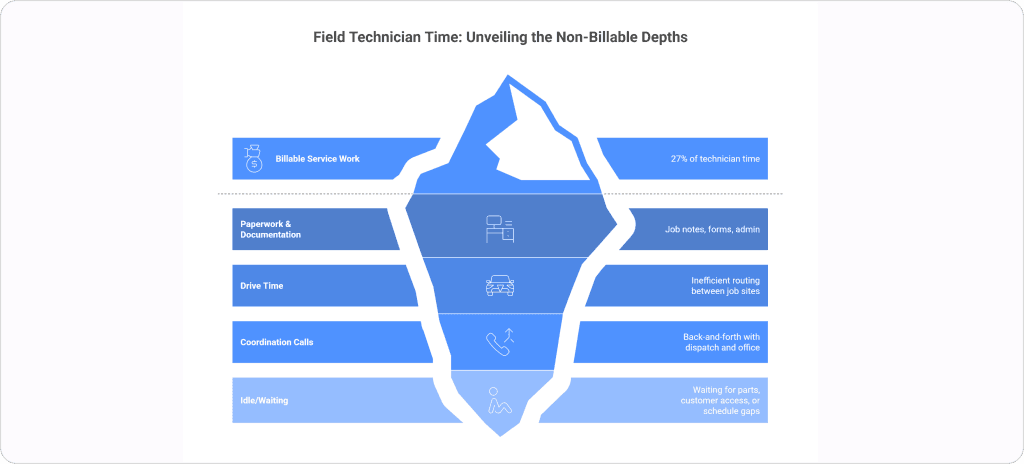
Communication breakdowns between the office and the field. Teams often operate on different information. Messages sent via text or phone calls don’t reliably reach the right person at the right time, and rarely get recorded anywhere useful.
Rising customer expectations. Recent customer experience research shows that roughly two-thirds to three-quarters of customers say their standards for a good service experience are higher than ever. They expect real-time ETAs, same-day follow-ups, and the kind of experience they get from companies with far bigger operational budgets.
And when they don’t get it, 72% switch to a competitor after just one bad experience.
These aren’t new problems. But in 2026, there will be better tools for solving them than there were three years ago.
The 12 practices below address each of these directly.
Most field service businesses don’t have an onboarding program. They have a training period, which usually means riding along with an experienced tech for a few weeks until someone decides the new hire is “ready.”
Replacing a skilled field technician often costs tens of thousands of dollars, frequently 50% or more of their annual salary, once you factor in recruiting, onboarding, and lost productivity.
And because it takes around 3–6 months for a new hire in a technical role to reach full productivity, early attrition becomes one of the most expensive losses a service business can absorb.
Onboarding is different from training. Training covers technical skills. Onboarding covers everything else: how jobs are assigned, how to communicate with dispatch, how to handle an angry customer, what to do when a part isn’t on the truck, how to log job notes properly, and what a good day looks like in your operation.
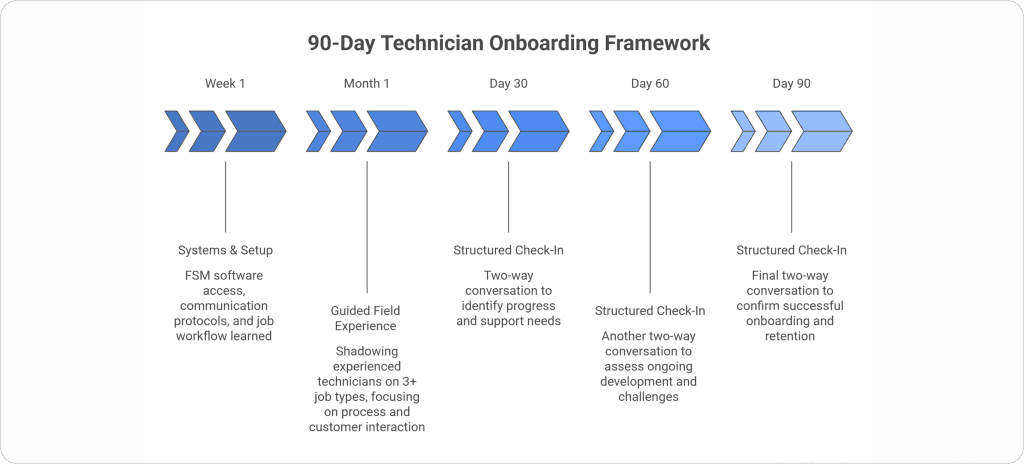
A practical onboarding framework:
The technicians who make it past 90 days almost always stick around for years. The ones who don’t usually leave because nobody explained how the operation actually works.
Scheduling problems create every other problem downstream. Bad scheduling means technicians start the day frustrated, customers wait longer than they should, and your best people burn out while less-efficient ones cruise through underloaded days.
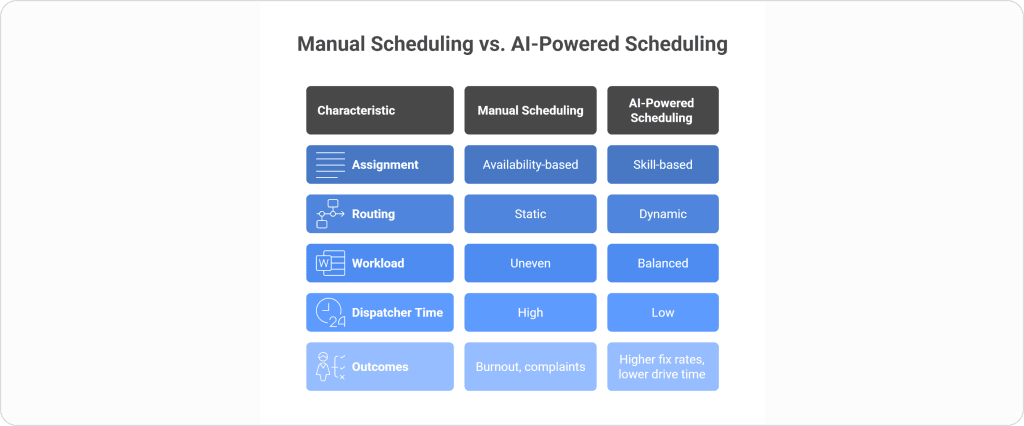
The most common scheduling failures:
AI job scheduling software solves all three: automatically assign technicians to jobs based on skills, current location, and real-time availability, not just who’s geographically closest.
FieldCamp customers consistently report cutting dispatch planning from a 30-minute daily task to a single-click confirmation. The right technician, the right skills, the right parts, on the first visit. That’s not just an efficiency gain. It’s a direct customer satisfaction driver.
If your team is still on spreadsheets, these are the signs you need crew scheduling software.
The most common thing field service managers say when they discover a problem: “I had no idea that was happening.”
That’s a visibility problem. And it’s one of the most expensive problems a field operation can have, because every problem you can’t see becomes a customer complaint, a return trip, or a lost relationship before you get the chance to fix it.
Real-time visibility means knowing, at any point in the day:
Modern FSM platforms give managers a live dispatch board through work order management software that surfaces all of this without phone calls or manual check-ins. The field team logs job status updates in real time; the office sees changes as they happen.
The teams still running on phone check-ins and end-of-day reports are discovering problems 12 to 24 hours after they occur. That’s 12 to 24 hours of a customer waiting for a callback that never comes.
Broken communication between the office and the field is the most commonly cited problem in field service, and it’s rarely fixed by telling people to communicate better.
The issue isn’t intention. It’s infrastructure. When dispatch sends updates via text, the technician logs notes on a paper form, the office enters those notes hours later, and the customer gets a callback based on information from that morning: communication is broken by design, not by attitude.
What a working communication infrastructure looks like:
One of the biggest time sinks in field communication is the back-and-forth involved in simple coordination questions: who’s available, who’s closest, who has the right certifications for this job.
Dispatchers spend hours cross-referencing schedules, calling technicians, and mentally assembling answers that a connected system could surface in seconds. That’s the biggest drawback, especially if you’re using a traditional FSM instead of an AI-backed FSM.
Modern FSM platforms with conversational AI solve this by letting dispatchers ask plain-language questions (“Which techs are available between 2 and 4 p.m. tomorrow?”) and get instant answers pulled from live scheduling data. No calls. No spreadsheet cross-referencing. FieldCamp’s AI Command Center is one example of this, built specifically so small and mid-size teams can access this capability without enterprise overhead.
Training investment in field service is usually reactive: a tech makes a mistake, everyone goes through a refresher. The businesses that run the best operations treat training as a continuous, structural part of the job, not a response to failure.
One angle almost no one addresses: knowledge capture. Experienced technicians are retiring, and the institutional knowledge they carry about specific equipment, specific customer sites, sand pecific failure patterns is walking out with them.
Most businesses have no plan for this.
Practical investments that work:
Building digital checklists and forms for each job type also gives new technicians a structured process to follow rather than relying on memory or guesswork during their first solo visits.
Every field service management article tells you to track KPIs. Almost none of them tell you what good actually looks like. Here are the six metrics that matter most, with the benchmark numbers your competitors don’t give you:
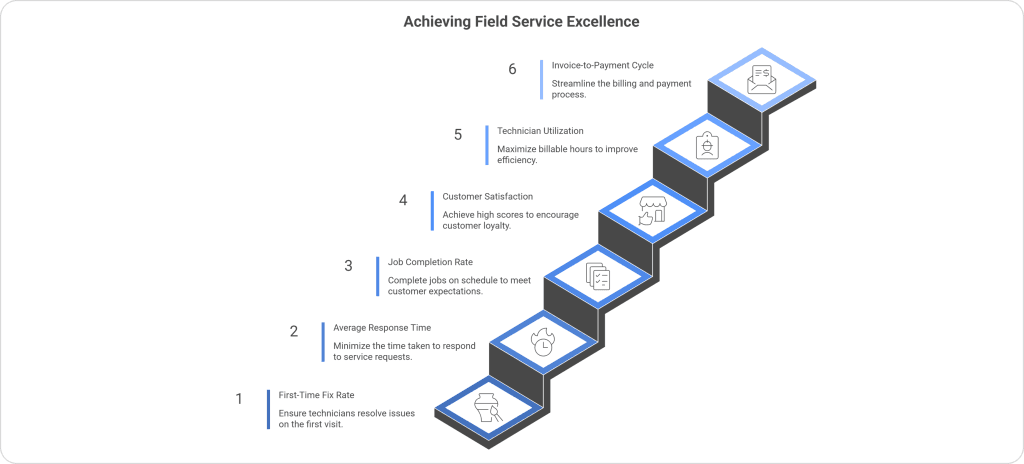
| KPI | Approx. Target Range |
| First-Time Fix Rate (FTFR) | 75–85% standard; 88%+ is world-class |
| Average Response Time | Under 4 hours for priority; under 24 hours for standard |
| Job Completion Rate | 90%+ on the scheduled date |
| Customer Satisfaction Score | 4.5+ out of 5 for renewal likelihood |
| Technician Utilization Rate | 75–85% billable vs. total available hours |
| Invoice-to-Payment Cycle | Under 7 days with a collections process in place |
The businesses tracking these numbers, not just logging them, but reviewing them weekly and acting on what they see, consistently outperform competitors on customer retention. 94% of customers who have a great service experience will buy again. 48% who have a bad one will switch. The KPIs are how you know which side of that line you’re standing on.
For a deeper dive into what to measure and how, our guide on 51 field service metrics and KPIs covers every metric worth tracking. And if you want to tie those numbers directly to technician development, start with these field service technician goals.
Field service reporting software with AI-powered dashboards makes weekly review painless, auto-generated charts, filterable by team member or time period, refreshed in real time without anyone pulling data manually.
You Can’t Improve What You Can’t See in Real Time
The best field service teams don’t just track KPIs; they act on them before small problems become expensive ones. FieldCamp gives you live dashboards, AI-powered scheduling, and automated dispatch in one platform built for teams your size.
Technician turnover is the most expensive operational problem in field service, and it’s mostly preventable.
The math: replacing one field technician costs approximately $35,000 when you factor in recruiting, hiring, training, lost productivity during the gap, and the overhead of teammates absorbing the extra load. In a 10-tech team running 5% annual turnover, that’s $175,000 walking out the door with zero revenue attached.
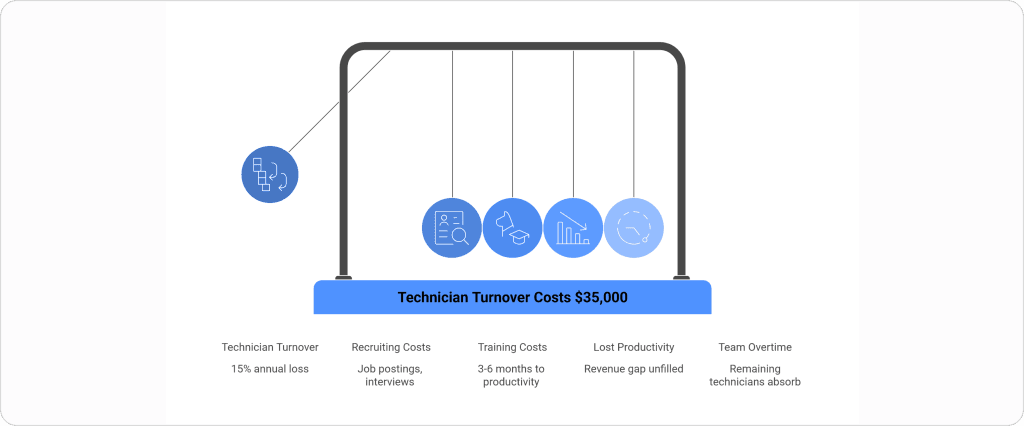
The reasons technicians leave are consistently the same:
What actually works:
One of the trickiest parts of workload balance is that it’s hard to do manually without bias creeping in. Dispatchers naturally lean toward their most reliable techs for tough jobs, which means your best people quietly absorb a heavier load while others coast.
Over time, that imbalance is exactly what pushes top performers out. FieldCamp’s fair distribution algorithms are built around this problem, automatically balancing assignments based on skills, availability, and capacity instead of gut feel. It doesn’t fix culture on its own, but it removes the invisible friction that makes good technicians start browsing job listings.
Burnout precedes turnover by months. By the time a technician is actively looking for other jobs, you’ve already lost them operationally. They’re going through the motions, not going the extra mile.
The burnout triggers in field service are predictable: consistently overloaded schedules, starting every day without knowing what the day holds, constant emergency calls without warning, and recovery. This leaves the feeling that the office has no idea what conditions actually look like in the field.
Prevention is operational, not motivational:
This isn’t soft management. It’s operational. A burned-out technician has a lower first-time fix rate, higher rework rate, and measurably higher likelihood of customer-facing conflict.
Preventing burnout protects your service quality scores, and it’s much cheaper than replacing someone.
Technicians in many field service operations lose around 30–40% of their day to non‑value‑adding work like unnecessary travel, idle time, and manual admin, according to productivity studies on field forces.
AI in field service has matured well beyond smart scheduling. The highest-impact applications right now:
AI dispatching handles mid-day disruptions automatically. A tech calls in sick, a customer cancels, and an emergency arrives at 2 p.m. A traditional dispatcher rebuilds the day manually. An AI dispatch scheduling system recalculates the optimal schedule across the entire team in real time, notifies affected customers automatically, and surfaces the revised plan for the dispatcher to confirm.
Route optimization reduces drive time for teams using it consistently. For a 10-tech team each driving 50+ miles a day, that’s thousands in annual fuel savings and additional billable hours per technician per week.
Voice-to-text job notes eliminate the biggest field productivity killer: documentation. Technicians speak their notes, photos are captured, timestamps logged, all hands-free, all in real time. Data quality improves. End-of-day admin time drops. And 82% of technicians report that mobile-first tools create upselling and cross-selling opportunities that paper-based workflows miss entirely.
Predictive maintenance, for teams serving commercial or industrial customers, uses IoT sensor data to detect developing equipment failures before they happen. Work orders are automatically created and scheduled. The technician arrives with the right parts before the customer’s system fails. Data shows 25% lower maintenance costs and 50% fewer unplanned downtime incidents for teams running predictive models.
For a broader look at what’s possible, our guide on field service automation covers the full spectrum from basic workflow triggers to AI-driven operations.
FieldCamp’s AI scheduling and dispatching features are built for small and mid-size service businesses, not enterprise accounts with dedicated IT departments. Setup takes an afternoon, not a multi-month implementation.
Field service managers often track operational metrics in one place and financial metrics in another. That disconnect is a profit leak.
The three financial connections that matter most:
Invoice speed. Every day between job completion and invoice delivery is a day closer to a cash flow problem. Teams using mobile field service invoicing software, where the technician generates and sends the invoice on-site at job close, collect faster than teams sending invoices from the office the next morning.
First-time fix rate and revenue. A return trip isn’t free. The parts, the drive time, the technician hours, the rescheduling overhead, every rework job has a hard cost. Tracking FTFR as a financial metric, not just a service quality metric, changes how teams invest in parts stocking and pre-job preparation.
Utilization and margin. Below 70% utilization, you’re paying for idle hours. Above 90% consistently, you’re burning toward burnout and turnover. The 75–85% band is where field service margin is healthiest, and AI Job scheduling is what makes that band maintainable across a growing team.
Need to tighten up your billing workflow end-to-end? The estimate-to-cash automation workflow template shows how to connect quoting, job completion, invoicing, and payment collection into a single automated pipeline.
Most field service teams hit a wall somewhere between 5 and 15 technicians — not because demand dries up, but because the informal systems that worked with a small team break when the team grows.
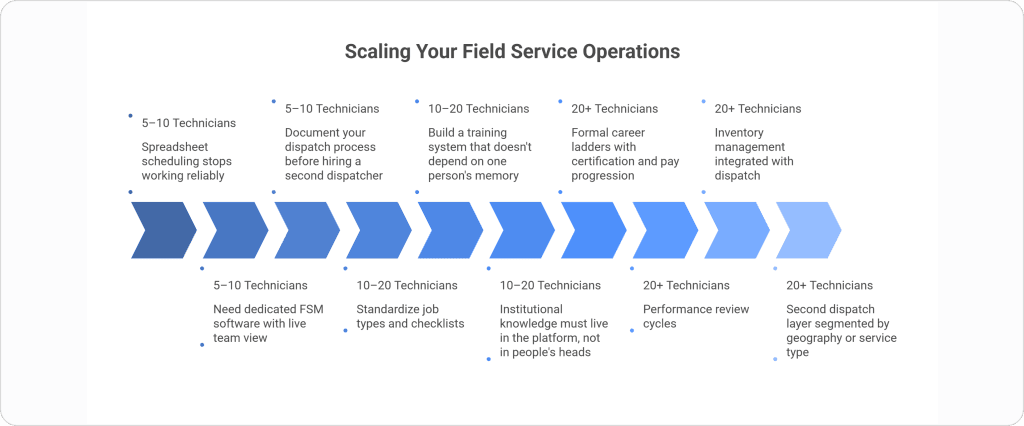
The critical inflection points:
The businesses that scale without breaking build these systems one stage early, before they’re needed, not after they’re failing. That means documenting your dispatch process before you hire your second dispatcher. Building your onboarding checklist before you’re onboarding three people at once.
The best source of operational intelligence in a field service business is the people doing the work. Technicians know which customers are high-maintenance and why. They know which parts fail most often. They know which job types consistently run longer than estimated. They know which office processes make their lives harder without adding any value.
Most of that knowledge never reaches management because there’s no structured channel for it and because experience has taught technicians that raising problems doesn’t lead anywhere productive.
What a real feedback culture looks like:
The teams that build this loop don’t just have higher morale. They have better operational data than teams that don’t, because the people with the most relevant information are actually sharing it.
A field service CRM that tracks customer history, technician notes, and job outcomes in one place makes this feedback loop much easier to maintain. Every conversation and every data point is already captured and searchable.
Most field service management advice is written for a generic “service business.”
But HVAC, plumbing, electrical, cleaning, landscaping, and pest control teams face distinct operational realities that generic advice misses. Here’s what changes by trade.
HVAC businesses deal with extreme seasonal demand swings, swamped in summer and winter, slow in spring and fall. Management priorities shift with the season.
During peak season, the focus is on maximizing schedule density, protecting maintenance contract commitments, and building a clear emergency job handling process. During off-peak, the priority shifts to preventive maintenance agreements, technician training, and equipment prep for the next surge.
Year-round, predictive maintenance and IoT monitoring deliver the highest return in HVAC because equipment failures are highly predictable from sensor data. A compressor that’s running hot or drawing unusual current gives weeks of warning before it fails.
Teams with the right monitoring in place dispatch a technician proactively, before the customer’s system goes down in a heat wave.
First-time fix rates matter more in HVAC than almost any other trade. A return trip during peak season costs more than just parts and drive time; it costs the customer relationship at exactly the moment when they need you most.
Plumbing is among the most emergency-driven trades. A significant portion of daily revenue comes from jobs that weren’t on the schedule that morning. Managing a plumbing team means building infrastructure around unpredictability rather than fighting it.
Key priorities:
AI dispatch handles emergency insertion better than any manual process, identifying the lowest-disruption slot across the live schedule and notifying affected customers automatically. FieldCamp for plumbing teams is designed around exactly this workflow.
Electrical work is certification-intensive, which makes skill-based technician assignment more important here than in most other trades. Sending a technician to a job that requires a license they don’t hold creates liability, not just inefficiency.
Key management priorities:
FieldCamp for electricians includes credential-aware scheduling that prevents unqualified assignments before they happen.
Cleaning businesses often manage larger headcounts across more locations than any other field service trade, usually at lower per-job margins where efficiency is everything.
Specific challenges:
FieldCamp for cleaning businesses provides the route optimization and checklist tools that make high-volume, low-margin operations consistently profitable.
Landscaping teams face a unique combination of weather dependency, seasonal labor, and route-heavy scheduling that requires a different management approach than most trades.
Key priorities:
FieldCamp for landscaping handles crew scheduling, recurring route optimization, and seasonal scaling in one platform.
Pest control operates on scheduled recurring service routes, which makes it one of the most schedulable, and therefore most AI-optimizable, of all field service trades.
Key priorities:
FieldCamp for pest control is designed around recurring route management and compliance documentation built into the technician’s mobile workflow.
Managing a field service team in 2026 comes down to one question: are you building systems that make your people’s jobs easier, or are you still expecting them to work harder inside broken ones?
The 12 practices in this guide aren’t theoretical. They’re the patterns that separate the field service operations growing profitably from the ones stuck in a cycle of hiring, losing, and re-hiring technicians while customers quietly move to competitors.
Here’s the short version:
The field service businesses that will win in 2026 and beyond aren’t necessarily the biggest. They’re the ones that run the tightest operations, where every technician has the right job, the right parts, and the right information before they pull into the driveway.
That’s what FieldCamp is built to help you do. Not as an enterprise platform that takes months to deploy, but as an AI-powered FSM tool that a 5-person team can set up in an afternoon and a 50-person team can scale without outgrowing.
Build the Field Service Operation Your Best Technicians Don’t Want to Leave
Balanced workloads, smart scheduling, zero paperwork, that’s what keeps your top performers from browsing job listings. FieldCamp’s AI handles the operations, so your team can focus on the work that actually matters.
Field service team management covers scheduling and dispatching jobs, tracking technician performance, maintaining customer relationships, handling parts and inventory, coordinating between the office and the field, and developing the team over time. The core challenge is doing all of this across dispersed locations, in real time, without direct oversight.
Technician turnover and scheduling inefficiency are consistently the top two. Turnover costs approximately $35,000 per departure; poor scheduling creates cascading problems across customer satisfaction, productivity, and morale. Both are significantly improved with modern FSM software.
Three levers: better pre-job preparation (right parts and information before arrival), accurate skill-to-job matching (the certified technician, not just the closest one), and job history access (techs who can review previous service records arrive better prepared). AI scheduling handles the matching; your FSM platform surfaces the history.
A manual dispatcher with good tools can typically handle 8–12 technicians effectively. Above that, quality degrades: missed updates, scheduling conflicts, and slower response times. AI dispatch software extends this meaningfully, letting one dispatcher manage 20+ technicians without sacrificing schedule quality.
First-Time Fix Rate (target: 75–85%), average response time, job completion rate, technician utilization (target: 75–85%), customer satisfaction score, and invoice-to-payment cycle time. Track these weekly. The monthly review is too slow to catch problems before they become expensive.
Start with workload balance; uneven distribution is a leading driver of resentment. Add a visible career ladder with certification and pay progression. Build a feedback channel technicians actually trust. And review schedule density weekly to catch burnout signals before they become resignation letters.
Build a protocol before you need one: define which job types qualify as emergencies, who has authority to displace existing appointments, and how affected customers are notified. AI dispatch software handles the recalculation automatically. It identifies the lowest-disruption insertion point across the live schedule and notifies customers in real time.
All job updates, changes, and notes should flow through one system, not a mix of calls, texts, and app notifications. FSM platforms with mobile technician apps give field teams real-time updates without requiring dispatcher phone calls. When the mobile app is the source of truth, nothing gets lost between channels.
AI optimizes scheduling (skill and location matching), handles mid-day dispatch disruptions automatically, reduces drive time through route optimization, captures job notes via voice-to-text, and generates invoices at job close. Net result: more billable jobs per technician per week, less manual admin, and faster billing cycles.
Video walkthroughs of common repairs (shot on a phone), detailed job notes in your FSM platform that new technicians can search, and structured knowledge transfer sessions before senior techs transition. The platform is the library, but it only works if job notes and resolution logs are consistently captured.
Scale systems before you scale headcount. Document your dispatch process before hiring a second dispatcher. Build a standard onboarding checklist before you’re onboarding multiple people at once. Implement FSM software before your team outgrows spreadsheets, not after things are already breaking.
Consistently overloaded schedules, unpredictable emergency-driven days with no advance notice, feeling invisible to management, and inadequate tools that make routine work harder than it needs to be. Prevention is operational: monitor workload trends, give 24-hour advance schedule visibility, and build defined emergency rotation protocols.
Use a 90-day structured framework: Week 1 covers systems, tools, and communication protocols. Month 1 includes job shadowing across at least three job types. Days 30, 60, and 90 include honest two-way check-ins, not performance reviews, but genuine conversations about what’s working and what support is needed. Technicians who get this framework stay. Technicians dropped into the field without it often don’t.
Management is the operational layer: scheduling, dispatching, KPI tracking, process compliance. Leadership is the human layer: team culture, career development, retention strategy, and the direction the operation is moving. High-performing field service businesses invest deliberately in both; the best field service managers are also effective leaders, not just logistics coordinators.