How to Start a Landscaping Business in 2026: The Complete 12-Step Guide
February 28, 2026 - 44 min read


February 28, 2026 - 44 min read

Table of Contents
| TL;DR: Start a landscaping business with $5K–$10K by forming an LLC, getting insured, and offering basic services like mowing to generate recurring revenue. Price for profit ($50–$100/hour), track every expense, and use simple software to manage scheduling, invoicing, and routing from day one. Avoid underpricing and overspending on equipment early, build steady clients first, then scale into higher-margin services. |
Starting a landscaping business can be incredibly rewarding, both financially and personally. You get to work outdoors, be your own boss, and build something from the ground up.
But here’s the reality: 70% of landscaping businesses fail within their first 18 months.
Why? Most new landscaping business owners skip critical planning steps, underestimate startup costs, or fail to build sustainable systems early on.
This guide will walk you through exactly how to start a landscaping business the right way, from zero experience to your first paying clients (and beyond). Whether you’re starting with $5,000 or $50,000, this step-by-step roadmap will help you avoid the most common mistakes and set yourself up for long-term success.
What you’ll learn:
Let’s get started.
Prefer listening over reading? Check out the podcast above!
KEY HIGHLIGHTS
What Is an Insulation Business?
Before you invest time and money, let’s talk about whether starting a landscaping business makes sense right now.
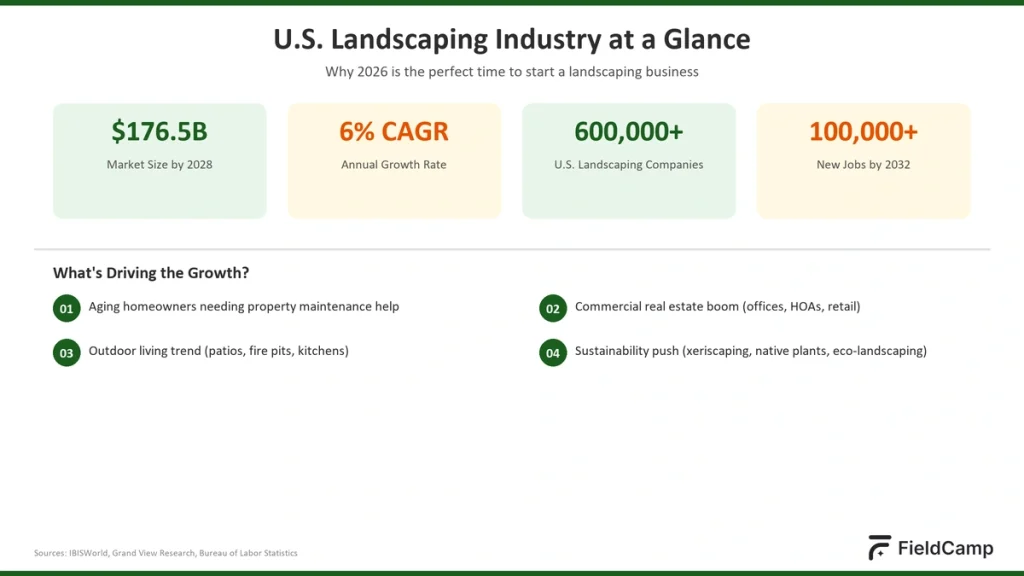
The landscaping industry is booming, and it’s not slowing down anytime soon. For a deeper dive into the numbers, check out our landscaping industry statistics roundup.
Key Industry Stats:
Why the growth? A few big trends:
Bottom line: The demand for landscaping services isn’t going anywhere. If you can deliver quality work and run a tight operation, there’s plenty of room to build a profitable business.
This is the million-dollar question (literally, for some landscapers).
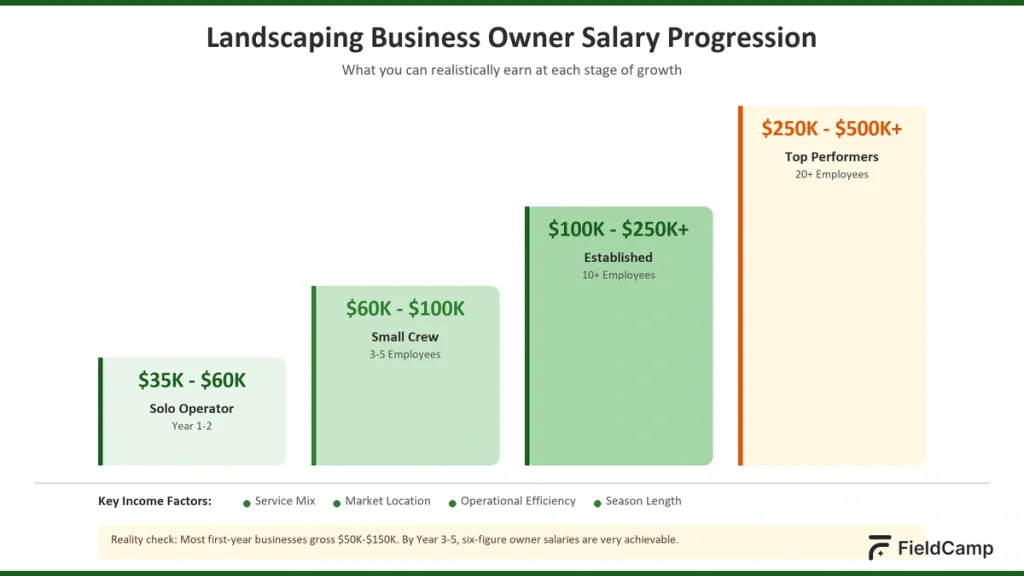
Owner Salary Ranges:
Your income depends on:
Reality check: Most first-year landscaping businesses gross $50,000-$150,000 in revenue. After expenses (labor, equipment, insurance, fuel), you might take home $30,000-$50,000. But by year 3-5, six-figure owner salaries are very achievable.
Let’s be honest about what you’re signing up for.
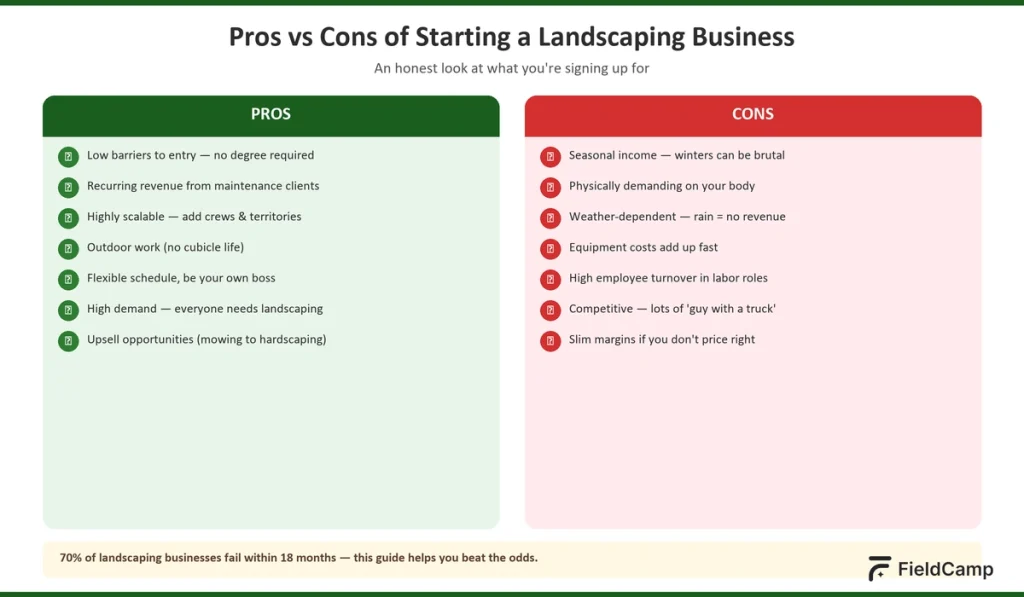
Pros:
Cons:
Here’s the stat nobody talks about: 70% of landscaping businesses fail before reaching 18 months.
Why?
The good news? You can avoid every one of these mistakes if you follow this guide.
The honest answer: it depends on how you start.
You can launch a landscaping business for as little as $5,000 (ultra-lean, mowing-only) or invest $50,000-$100,000+ for a full-service operation with employees and commercial equipment.
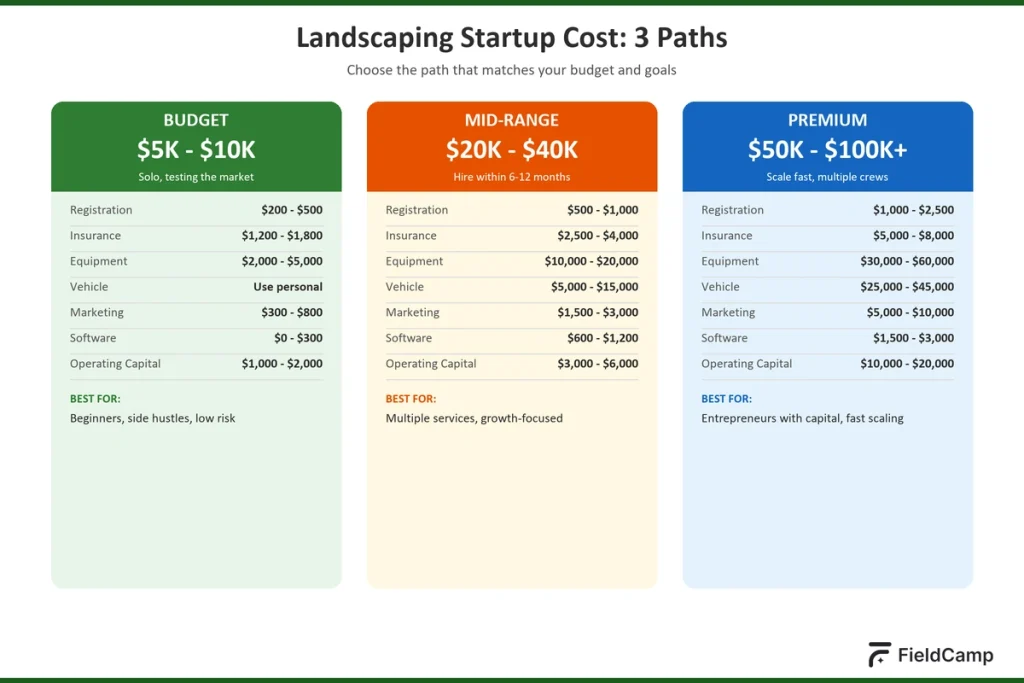
Here’s what you’ll actually need to spend:
| Expense Category | Budget Startup | Mid-Range | Premium | Notes |
| Business Registration & Licensing | $200-$500 | $500-$1,000 | $1,000-$2,500 | Basic LLC / LLC + trade name / LLC + multiple DBAs |
| Insurance (Year 1) | $1,200-$1,800 | $2,500-$4,000 | $5,000-$8,000 | General liability, vehicle / Add workers’ comp / Full coverage package |
| Equipment | $2,000-$5,000 | $10,000-$20,000 | $30,000-$60,000 | Used mower, basic hand tools / Commercial mower, trailer / Multi-crew equipment |
| Vehicle | $0 (use personal) | $5,000-$15,000 | $25,000-$45,000 | Existing truck/van / Used truck + trailer / New truck + lettering |
| Marketing | $300-$800 | $1,500-$3,000 | $5,000-$10,000 | Yard signs, flyers, Google profile / Website, local ads / Full branding, SEO, PPC |
| Software & Tools | $0-$300 | $600-$1,200 | $1,500-$3,000 | Free or basic plan / Pro software, CRM / Advanced FSM software |
| Operating Capital (3 months) | $1,000-$2,000 | $3,000-$6,000 | $10,000-$20,000 | Gas, supplies, emergencies / Payroll buffer / Full runway |
| TOTAL STARTUP COST | $5,000-$10,000 | $20,000-$40,000 | $50,000-$100,000+ |
Which path is right for you?
Stop losing money on disorganized jobs. FieldCamp’s free plan helps you track every dollar from day one.
“But I don’t have $5,000-$10,000 sitting around.”
I hear you. Here’s how to launch on a shoestring budget:
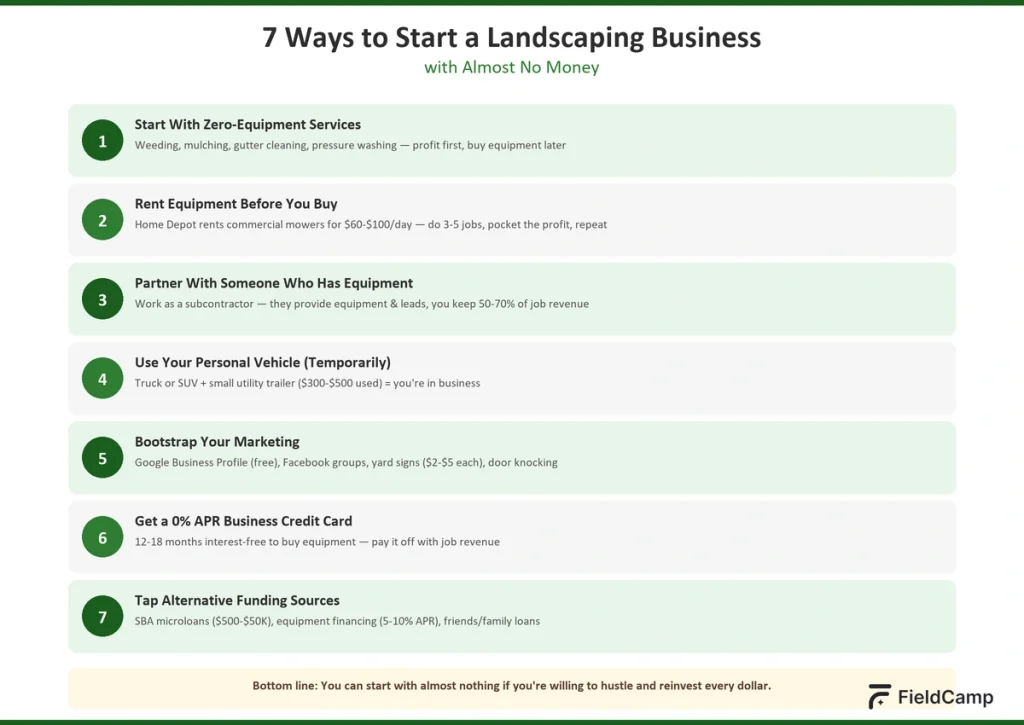
1. Start with Services That Require Zero Equipment
Before you buy a single mower, offer:
Use the profits from these jobs to buy your first mower.
2. Rent Equipment Before You Buy
Home Depot and Lowe’s rent commercial mowers for $60-$100/day. Do 3-5 mowing jobs, cover the rental cost, pocket the profit, repeat. Once you’re booked 15-20 hours/week, buy your own equipment.
3. Partner with Someone Who Has Equipment
Know someone with a landscaping business? Offer to work for them as a subcontractor. They provide equipment and leads; you provide labor and keep 50-70% of the job revenue.
4. Use a Personal Vehicle (Temporarily)
If you have a truck or SUV, use it. Attach a small utility trailer ($300-$500 used) and you’re in business. Yes, it looks less professional, but it’s temporary.
5. Bootstrap Marketing
6. Get a 0% APR Business Credit Card
If you have decent personal credit (680+), apply for a business credit card with 0% APR for 12-18 months. Use it to buy equipment, and pay it off with job revenue before the promo period ends.
7. Tap These Funding Sources
Bottom line: You can start with almost nothing if you’re willing to hustle, rent equipment, and reinvest every dollar you make.
Here’s the truth: You don’t need a degree or certification to start a landscaping business. But you DO need to know what you’re doing.
If you’ve never operated a commercial mower, installed irrigation, or built a retaining wall, you’re going to struggle. Hard.
1. Work for a Landscaping Company (6-12 Months)
The fastest way to learn:
Where to find jobs:
Pro tip: Work for a company that does the type of work you want to do. Want to focus on high-end hardscaping? Don’t work for a mow-and-blow crew.
2. Volunteer or Work for Free (Temporarily)
Approach a landscaping business owner and say:
“I want to start my own landscaping business, and I need to learn the ropes. I’ll work for you for free (or cheap) for 4-6 weeks if you’ll teach me how to estimate jobs, run equipment safely, and deal with customers.”
Most owners will say yes because free labor is free labor. You get priceless hands-on training, and they get help.
3. Take a Short Course or Certification
While not required, these can boost your credibility:
Do you NEED certifications to start? No. But they help when bidding on commercial contracts or high-end residential jobs.
4. Start Small and Learn on the Job
If you’re confident with basic mowing and trimming, start with residential maintenance clients and learn as you go. YouTube is full of tutorials on:
Just be honest with clients: “I’m a newer business owner, but I’ll treat your property like it’s my own, and if you’re not happy, I’ll make it right.”
Yes, but ONLY if you:
Trying to sell landscape design or hardscaping with zero experience? That’s a recipe for disaster (and lawsuits).
Not all landscaping businesses are the same. You need to decide what type of landscaping business you want to run.
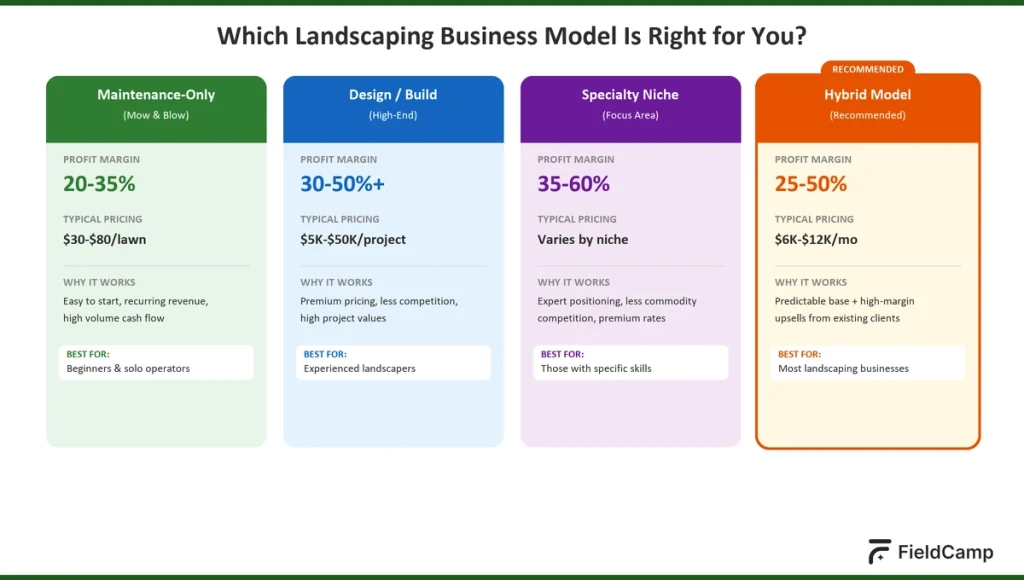
1. Maintenance-Only (Mow & Blow)
What it is: Recurring lawn mowing, edging, trimming, and blowing. Weekly or bi-weekly contracts.
Pros:
Cons:
Best for: Beginners, solo operators, those who want a predictable income
Typical pricing: $30-$80 per lawn (residential), $150-$500 per property (commercial)
2. Design/Build (High-End Landscaping)
What it is: Landscape design, hardscaping (patios, retaining walls, outdoor kitchens), irrigation installation, sod, plantings.
Pros:
Cons:
Best for: Experienced landscapers, those with a design/horticulture background
Typical pricing: $5,000-$50,000+ per project
3. Specialty Services
Focus on ONE niche and become the go-to expert:
Eco-Friendly and Sustainable Landscaping
This is one of the fastest-growing niches in the industry and deserves special attention. There’s surging demand for native plants, organic lawn care, and xeriscaping as homeowners and commercial property managers look for environmentally responsible options.
More landscapers are also switching to electric equipment (battery-powered mowers, trimmers, and blowers), which cuts fuel costs significantly and reduces noise complaints (a huge selling point for residential neighborhoods). Water-efficient irrigation systems like drip irrigation and smart controllers are another high-demand add-on.
The best part? Eco-conscious clients are willing to pay a premium for sustainable services, with many landscapers reporting 20-30% higher margins on green services compared to traditional offerings.
Best for: Those with specialized skills or who want to avoid commodity pricing
4. Hybrid Model (Maintenance + Upsells)
What it is: Start with maintenance contracts, upsell design/build projects, and add-ons.
Example:
Pros:
Cons:
Best for: Most landscaping businesses. This is the sweet spot.
Not all services are created equal. Here’s what makes the most money:
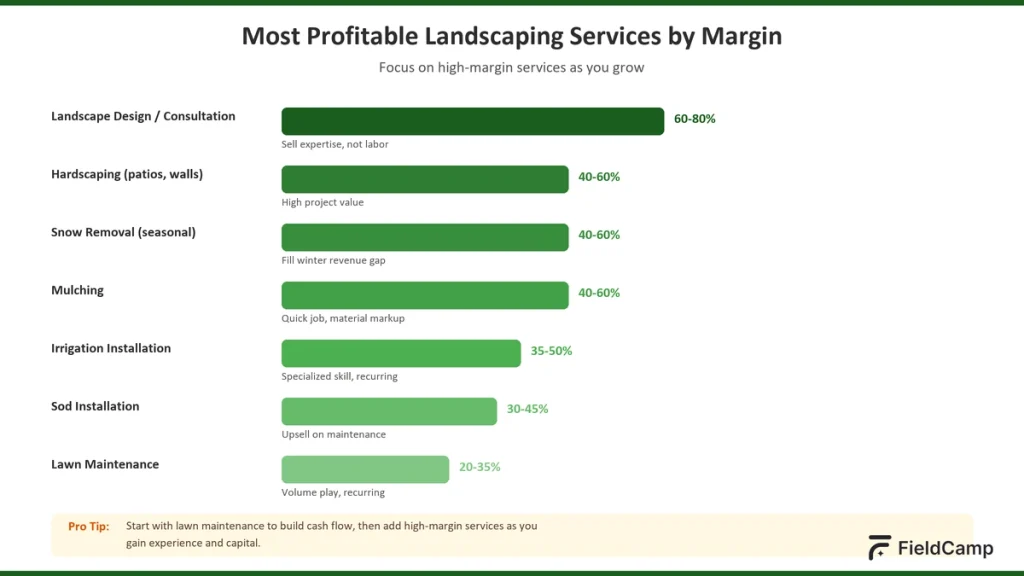
| Service | Avg Profit Margin | Why It’s Profitable |
| Landscape Design/Consultation | 60-80% | Sell expertise, not labor |
| Hardscaping (patios, walls, etc.) | 40-60% | High project value, premium pricing |
| Irrigation Installation | 35-50% | Specialized skill, recurring repairs |
| Mulching | 40-60% | Quick job, high markup on materials |
| Sod Installation | 30-45% | Upsell on maintenance contracts |
| Snow Removal (seasonal) | 40-60% | Fill the winter revenue gap |
| Lawn Maintenance | 20-35% | Volume play, recurring income |
Pro tip: Start with maintenance to build cash flow, then add high-margin services as you gain experience and capital.
“Do I really need a business plan?”
If you want to:
Then yes, you need a business plan.
But don’t overthink it. Your landscaping business plan doesn’t have to be 40 pages. A simple 5-10 page document is enough.
1. Executive Summary
2. Market Analysis
3. Services and Pricing
4. Marketing Plan
5. Operations Plan
6. Financial Projections
7. Funding Request (If Applicable)
Want a plug-and-play template?
Download our free landscaping estimate template – it includes pre-filled sections you can customize, financial projection spreadsheets, sample pricing tables, and a startup checklist.
(Note: This template is part of FieldCamp’s free resource library for service business owners.)
If you’re starting solo with personal savings and don’t need a loan, you can skip this step.
But I strongly recommend at least creating a simple financial forecast:
Use Google Sheets or Excel. Takes 2 hours. Will save you from going broke.
Time to make it legal.
You have four main options for structuring your landscaping business:
What it is: You and your business are legally the same entity. No formal registration required (beyond local business licenses).
Pros:
Cons:
Best for: Testing the waters, side hustles, ultra-low budget starts
Cost: $0-$100 (local permits only)
What it is: A legal entity separate from you personally. Protects your personal assets if the business gets sued.
Pros:
Cons:
Best for: 95% of landscaping businesses. This is the standard choice.
Cost: $100-$500 (formation) + $50-$800/year (varies by state)
What it is: A tax designation that allows you to split income between salary and distributions (potentially saving on self-employment taxes).
Pros:
Cons:
Best for: Established landscaping businesses grossing $150K+ per year
Cost: $500-$1,500/year (accountant, payroll service)
What it is: A fully separate legal entity with its own tax return.
Pros:
Cons:
Best for: Multi-state landscaping franchises or businesses planning to sell to a larger company
For most people reading this guide, form an LLC.
Here’s why:
How to Form an LLC:
DIY vs. Service:
Once you’ve formed your LLC (or chosen another structure), you need to make your business 100% legal.
1. Get an EIN (Employer Identification Number)
Think of this as a Social Security number for your business. You need it to:
How to get it: Free at IRS.gov (takes 5 minutes)
1. Business License
Most cities and counties require a general business license to operate.
The short answer: It depends on your state and what services you offer.
16 states require a contractor license for landscaping work above a certain dollar amount:
| State | License Required? | Threshold | Notes |
| Arizona | Yes | $1,000+ | Requires 4 years of experience or trade school |
| California | Yes | $500+ | Separate license for landscape construction |
| Connecticut | Yes | $500+ | Home Improvement Contractor License |
| Florida | Yes | Varies by county | Some counties require license, some don’t |
| Georgia | Yes | $2,500+ | Landscape contractor license |
| Hawaii | Yes | $1,000+ | Specialty Contractor (C-27) |
| Louisiana | Yes | $50,000+ | Horticulture license for irrigation |
| Maryland | Yes | Varies | Home Improvement License |
| Michigan | Yes | $600+ | Residential Builder or Maintenance & Alteration |
| Nevada | Yes | $1,000+ | C-10 Landscape Contractor |
| New Mexico | Yes | $7,000+ | GB-98 Landscape Contractor |
| North Carolina | Yes | $30,000+ | Landscape Contractor License |
| Oregon | Yes | $500+ | Landscape Contractor License |
| Tennessee | Yes | Varies by county | HVAC and Plumbing are separate |
| Utah | Yes | $1,000+ | Landscaping Contractor |
| Virginia | Yes | $1,000+ | Tradesman or Contractor License |
What this means:
How to get a landscaping license:
Check your state: Search “[Your State] landscaping contractor license requirements”
Depending on your services and location, you may also need:
Pro Tip: Don’t skip licensing requirements. Operating without proper licenses can result in:
This is NOT optional.
One injury, one damaged sprinkler line, one tree that falls on a client’s car, and your business is done without insurance.
1. General Liability Insurance
What it covers:
Cost: $500-$1,500/year for $1M coverage
Required by: Most commercial clients and HOAs
2. Workers’ Compensation Insurance
What it covers:
Cost: $1,500-$5,000+/year (depends on number of employees and state)
Required by Law in most states if you have employees
What if you’re solo? You typically don’t need workers’ comp for yourself (but check your state, as some require it even for sole proprietors).
3. Commercial Auto Insurance
What it covers:
Cost: $1,200-$2,400/year per vehicle
Required by: Legally required if you use a vehicle for business (personal auto insurance won’t cover business use)
4. Inland Marine / Tools & Equipment Insurance
What it covers:
Cost: $300-$800/year
Why you need it: Equipment theft is RAMPANT in the landscaping industry. A $10,000 zero-turn mower stolen from your truck = out of business without this coverage.
5. Professional Liability (Errors & Omissions)
What it covers:
Cost: $400-$1,200/year
Who needs it: Landscape designers, consultants, irrigation installers
Total Annual Insurance Cost:
| Scenario | Coverage | Annual Cost |
| Solo Operator (No Employees) | GL + Commercial Auto + Equipment | $2,000-$3,500 |
| 1-2 Employees | GL + WC + Auto + Equipment | $4,000-$7,000 |
| 3-5 Employees | Full package | $7,000-$12,000 |
| 6-10 Employees | Full package + umbrella | $12,000-$20,000+ |
How to Save on Insurance:
Where to Buy Insurance:
Now for the fun part: buying your tools.
But here’s the mistake most new landscaping business owners make: they buy too much, too fast, and on credit.
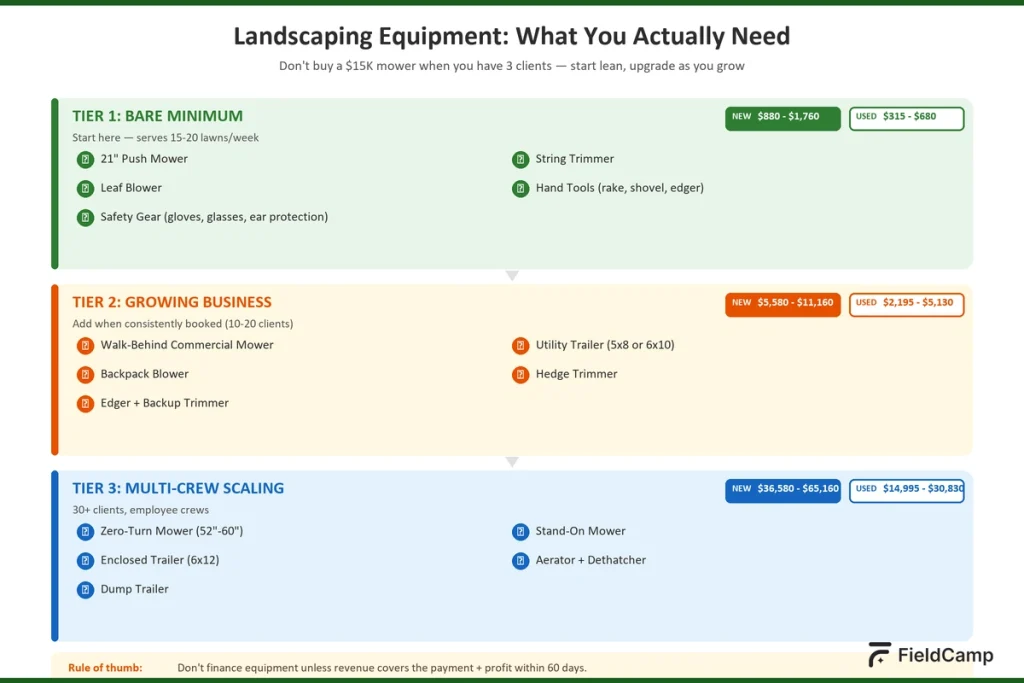
Don’t finance a $15,000 zero-turn mower when you have 3 clients. Start lean. Add equipment as you add revenue.
Here’s what you ACTUALLY need to get started:
Tier 1: Bare Minimum (Mowing-Only Business)
| Equipment | New Price | Used Price | Priority |
| 21″ Push Mower | $300-$600 | $100-$250 | MUST HAVE |
| String Trimmer (Weed Eater) | $200-$400 | $75-$150 | MUST HAVE |
| Leaf Blower | $150-$300 | $50-$100 | MUST HAVE |
| Safety Gear (gloves, glasses, ear protection) | $50-$100 | N/A | MUST HAVE |
| Hand Tools (rake, shovel, edger) | $100-$200 | $40-$80 | MUST HAVE |
| Gas Cans (2-5 gallon) | $30-$60 | N/A | MUST HAVE |
| Trimmer Line, Oil, Maintenance Supplies | $50-$100 | N/A | MUST HAVE |
| TOTAL | $880-$1,760 | $315-$680 | — |
Start here. You can mow 15-20 residential lawns per week with this setup and gross $3,000-$5,000/month.
Tier 2: Growing Business (10-20 Clients)
Add these once you’re consistently booked:
| Equipment | New Price | Used Price | Notes |
| 36″-48″ Walk-Behind Mower | $2,500-$5,000 | $1,000-$2,500 | Faster than a push mower |
| Utility Trailer (5×8 or 6×10) | $1,200-$2,500 | $500-$1,200 | Haul equipment |
| Backpack Blower | $400-$700 | $150-$300 | More powerful |
| Hedge Trimmer | $200-$400 | $80-$150 | For shrubs |
| Edger | $200-$400 | $75-$150 | Clean edges |
| Extra Trimmer (Backup) | $200-$400 | $75-$150 | Don’t lose a day to breakdown |
| TOTAL (Added to Tier 1) | +$4,700-$9,400 | +$1,880-$4,450 | — |
Total Investment: $5,580-$11,160 (new) or $2,195-$5,130 (used)
Tier 3: Scaling to Multi-Crew (30+ Clients or Employees)
| Equipment | New Price | Used Price | Notes |
| Zero-Turn Mower (52″-60″) | $8,000-$15,000 | $3,000-$7,000 | Cut large properties fast |
| Stand-On Mower | $10,000-$14,000 | $4,000-$7,000 | Crew favorite |
| Enclosed Trailer (6×12) | $4,000-$8,000 | $2,000-$4,000 | Secure equipment storage |
| Aerator | $2,500-$4,000 | $800-$1,500 | Upsell service |
| Dethatcher | $1,500-$3,000 | $500-$1,200 | Upsell service |
| Dump Trailer | $5,000-$10,000 | $2,500-$5,000 | Haul mulch, debris |
| TOTAL (Added to Tiers 1+2) | +$31,000-$54,000 | +$12,800-$25,700 | — |
Total Investment for Full Setup: $36,580-$65,160 (new) or $14,995-$30,830 (used)
1. Buy Used Equipment (Smartly)
2. Rent Before You Buy
Offer services like aeration, dethatching, or sod cutting BEFORE buying the equipment:
3. Finance Equipment (Carefully)
Rule of thumb: Don’t finance equipment unless the revenue it generates will cover the monthly payment + profit within 60 days.
4. Trade In or Sell Old Equipment
When you upgrade from a 21″ push mower to a commercial walk-behind, sell the push mower on Facebook for $150-$300. Put that toward your next purchase.
This is where most new landscaping business owners mess up.
They either:
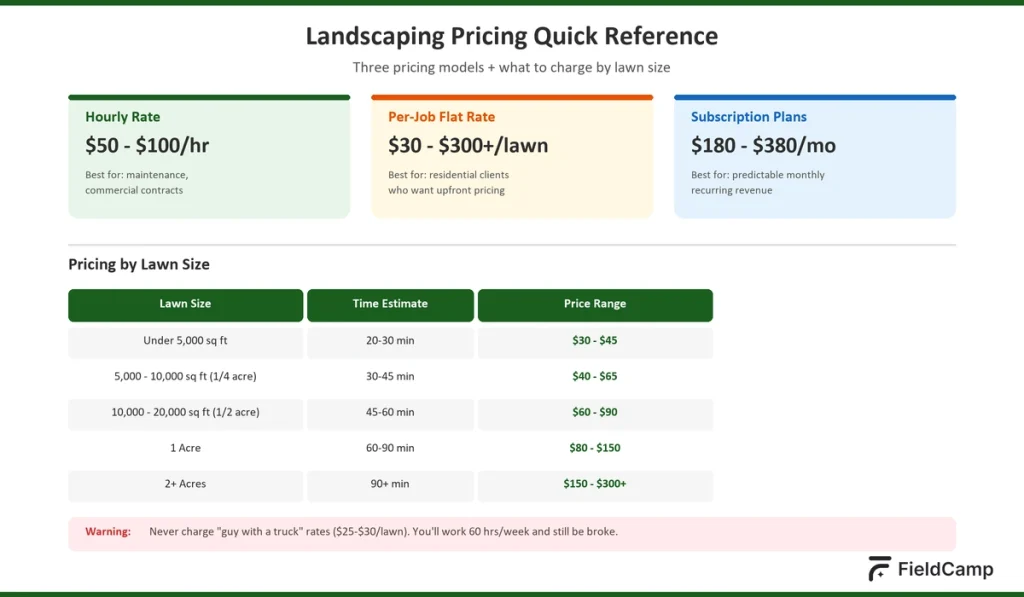
The goal: charge enough to be profitable while staying competitive. For a detailed breakdown, read our complete landscaping pricing guide.
Pricing Model #1: Hourly Rate
Calculate your hourly cost:
Formula: Your Hourly Rate = (Labor Cost + Equipment Cost + Overhead + Profit Margin) / Billable Hours
Example:
Industry averages:
If you’re specifically focused on mowing, check out our guide on lawn mowing pricing for more granular numbers.
Pricing Model #2: Per-Job Pricing
Most clients prefer flat-rate pricing. They want to know the total cost upfront.
How to calculate:
Residential Lawn Mowing Pricing Guide:
| Lot Size | Time | Price Range |
| Under 5,000 sq ft | 20-30 min | $30-$45 |
| 5,000-10,000 sq ft (1/4 acre) | 30-45 min | $40-$65 |
| 10,000-20,000 sq ft (1/2 acre) | 45-60 min | $60-$90 |
| 1 Acre | 60-90 min | $80-$150 |
| 2+ Acres | 90+ min | $150-$300+ |
Add-on services:
Pricing Model #3: Subscription/Recurring Plans
Offer clients weekly or bi-weekly lawn care packages:
Example:
Why this works:
Overwhelmed by pricing math? Use our free lawn care cost calculator to estimate your rates based on your costs, desired profit margin, and job type and size.
You can’t manage what you don’t measure.
From day one, set up simple systems to:
What you need:
Best practices:
Use FieldCamp’s free landscaping invoice template to get started. We also have a dedicated lawn care invoice template if you’re focused on mowing and maintenance.
For estimates and proposals, grab our free landscaping estimate template to send professional quotes to clients in minutes.
You need to track:
Tools:
Tax Tips:
Don’t mess with the IRS. Pay your taxes on time. Hire help if you need it.
You can be the best landscaper in town, but if nobody knows you exist, you’ll starve.
Here’s how to get your first 10-20 clients without spending a fortune.
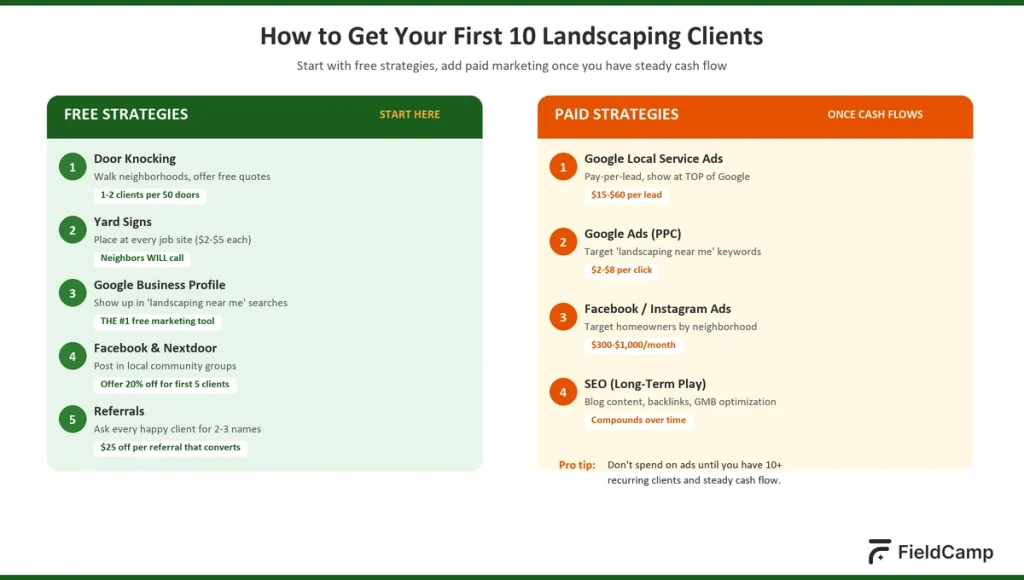
Free/Low-Cost Strategies:
1. Door Knocking (Yes, Really)
This sounds old-school, but it WORKS. Walk through neighborhoods on a Saturday afternoon:
“Hi, I’m [Name] with [Company]. I just started a landscaping business, and I’m looking for a few clients in this neighborhood. I noticed your lawn could use [specific observation]. I’d love to give you a free quote, no pressure. Here’s my card.”
Hit rate: 1-2 clients per 50 doors knocked.
2. Yard Signs
Buy 25-50 yard signs ($2-$5 each) that say:
“This Lawn Maintained by [Your Company] Call/Text: [Phone Number]”
Place them in every client’s yard (with permission). Neighbors WILL call.
3. Facebook & Nextdoor Posts
Post in local community groups:
“New landscaping business offering [service] in [neighborhood]. First 5 clients get 20% off. Free quotes. Call/text [number].”
4. Google Business Profile (Formerly Google My Business)
This is THE most important free marketing tool for local businesses.
Set it up:
Why it matters: When someone searches “landscaping near me,” you show up in the map results.
5. Referrals
Ask every happy client:
“Do you know 2-3 neighbors who might need landscaping? I’ll give you $25 off your next service for every referral that becomes a client.”
Referrals are the #1 way landscaping businesses grow.
You don’t need a $5,000 custom website. A simple 5-page site is enough:
Pages:
DIY Options:
Must-haves:
Once you have 5-10 clients and a steady cash flow, invest in paid marketing:
1. Google Local Service Ads (LSAs)
2. Google Ads (PPC)
3. Facebook/Instagram Ads
4. SEO (Search Engine Optimization)
Want more leads? Check out our detailed guide: How to Grow a Landscaping Business
Here’s what kills most landscaping businesses: disorganization.
The solution? Software. If you’re not sure where to start, check out our roundup of the best lawn care apps and our guide to the top lawn care business management software on the market.
Essential Features:
FieldCamp is built specifically for service businesses like landscaping companies. Explore our full landscaping business software page or check out the dedicated lawn care software solution.
What makes it different:
Why landscapers choose FieldCamp:
“I save 8-10 hours per week on admin work. That’s 2 extra days I can spend in the field.” – Mike S., Texas
“We grew from 12 clients to 47 clients in 9 months without hiring admin help. FieldCamp handles all the back-office stuff.” – Jenna L., Florida
The best part is that FieldCamp’s pricing is custom. You pay only for the features you need.
You’ve made it through the startup phase. Now it’s time to grow.
Signals it’s time:
What to pay:
Where to find help:
Pro tip: Start with part-time or seasonal help before committing to full-time.
Once you’ve mastered lawn maintenance, expand into higher-margin services:
Strategy: Upsell existing clients first. They already trust you.
Why go commercial:
For a detailed look at commercial pricing, read our guide on commercial lawn care pricing.
How to land commercial clients:
Requirements:
Learn from others’ failures:
1. Underpricing Services You work 60 hours/week, barely break even. Charge what you’re worth.
2. Buying Equipment on Credit Too Early: Financing a $15K mower with 2 clients = cash flow disaster. Buy used or rent first.
3. No Business Plan or Financial Forecast: You have no idea if you’re profitable. Track every dollar.
4. Ignoring Cash Flow in Winter, Summer profits disappear by December. Save 30-40% for off-season.
5. Not Getting Proper Insurance: One lawsuit = bankruptcy. Get GL and workers’ comp.
6. Skipping Contracts: Clients ghost you or refuse to pay. Use written agreements.
7. Hiring Too Fast (or Too Slow) Hire when you have steady revenue to support payroll, not before.
8. Manual Processes (Paper Schedules, No Software) Missed appointments, lost invoices, chaos. Invest in software early.
9. Not Marketing Consistently: You’re busy in spring, dead in fall. Market year-round.
10. Trying to Do Everything Yourself: You can’t scale if you’re the only one mowing lawns. Hire, delegate, automate.
This is the hidden killer of landscaping businesses, and almost nobody talks about it.
If you’re in a northern state, winter months (November through March) can mean zero income. Five straight months with no revenue coming in, but expenses like truck payments, insurance, and equipment loans don’t stop.
Here’s how to survive, and even thrive, during the off-season:
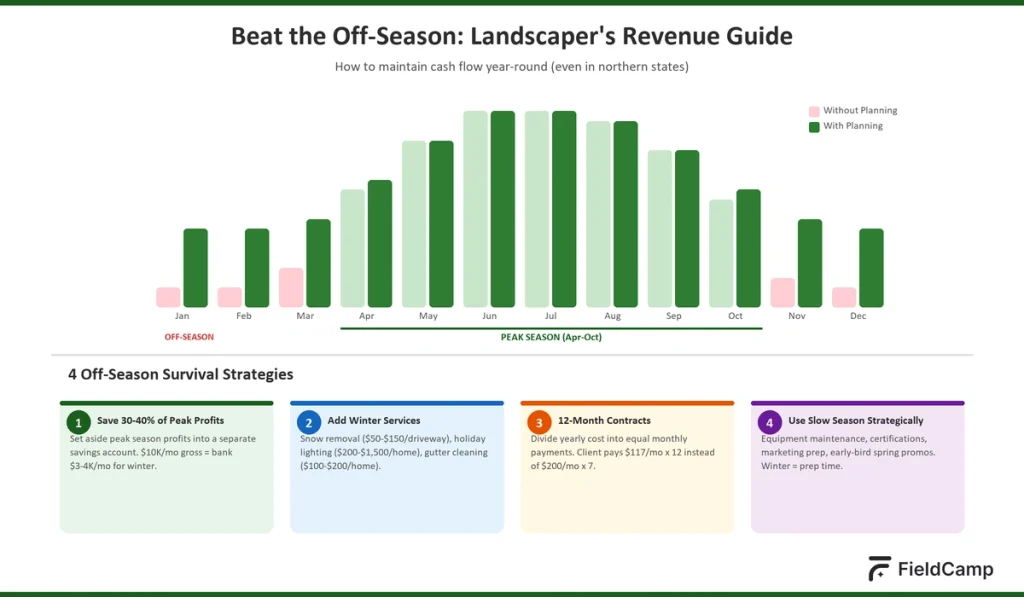
This is non-negotiable. Set aside 30-40% of your peak season profits (April-October) into a separate savings account that you don’t touch until winter. If you gross $10,000/month during the busy season, that means banking $3,000-$4,000/month for the slow months.
Don’t let your equipment and crew sit idle. These services keep cash flowing through the cold months:
Instead of billing monthly during the mowing season only, offer clients annual contracts where the total yearly cost is divided into 12 equal monthly payments. A client who pays $200/month for 7 months of mowing ($1,400 total) could instead pay $117/month for 12 months. You get the same revenue, but it’s spread evenly across the year, including winter.
The smartest landscaping business owners treat winter as prep time, not downtime:
Your business name matters more than you think.
Good Landscaping Business Names:
Avoid:
Name Brainstorming Formula:
Check availability:
Knowing the steps is one thing. Knowing when to take them is another. Here’s a realistic month-by-month timeline for your first year:
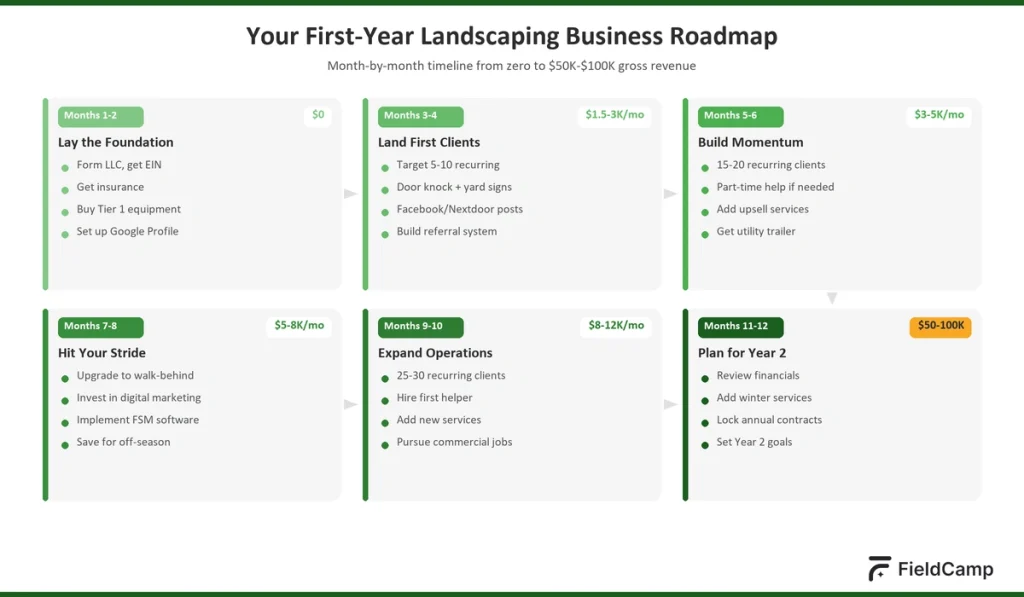
Download the PDF to get the roadmap
Year 1 Revenue Target: $50,000-$100,000 gross revenue is realistic if you follow this roadmap and stay consistent. Your take-home after expenses will likely be $25,000-$50,000. Not glamorous, but it’s building the foundation for a six-figure business by Year 2-3.
You just read 6,000+ words on how to start a landscaping business, but here’s the truth: reading won’t make you money. Action will.
The difference between the landscapers who make it and the 70% who don’t comes down to three things:
1. They start before they feel “ready.” You don’t need a $15,000 zero-turn mower and a wrapped truck. You need a push mower, a trimmer, and five clients willing to give you a shot.
2. They treat it like a business, not a side hustle. That means tracking every dollar, pricing for profit (not just to stay busy), and setting up systems from day one, not when things get messy.
3. They build systems early. The landscapers who scale past $100K aren’t working harder. They’re working smarter. Software handles their scheduling, invoicing, and routing so they can focus on the work and the growth.
Don’t try to do all 12 steps at once. Here’s what to focus on this week:
That’s it. One week from now, you could have a legal business entity, insurance, and your first leads coming in.
Stop Running Your Landscaping Business on Pape
Most new landscapers lose hours every week juggling phone calls, scribbling schedules on notepads, chasing late invoices, and driving inefficient routes. By the time you realize the chaos is costing you money, you’ve already lost clients.
You can start a basic lawn care business for $5,000-$10,000 (used equipment, solo operation). A full-service landscaping business with employees and commercial equipment costs $20,000-$50,000+.
It depends on your state and services. 16 states require a contractor license for landscaping work above a certain dollar threshold ($500-$30,000, depending on state). Lawn maintenance (mowing, trimming) typically does NOT require a license, but landscape construction (hardscaping, irrigation) often does.
Yes. Well-run landscaping businesses average 15-35% net profit margins. Solo operators can make $35,000-$60,000/year. Businesses with 3-5 employees can generate $100,000-$250,000+ in owner income.
Year 1 (solo): $30,000-$60,000
Year 2-3 (1-2 employees): $60,000-$100,000
Year 5+ (multiple crews): $100,000-$300,000+
Established businesses (10+ employees): $300,000-$1M+
Required:
Recommended:
Minimum:
Total cost: $880-$1,760 (new) or $315-$680 (used)
Free strategies:
Paid strategies:
Use our free lawn care cost calculator to estimate your rates.
Approximately 70% of landscaping businesses fail within 18 months. The most common reasons are underpricing, poor cash flow management, lack of business planning, and disorganized operations.
Yes, but start with basic services (mowing, edging, leaf cleanup) and learn as you go. For complex services (design, hardscaping, irrigation), you NEED experience or training first. Consider working for another landscaping company for 6-12 months before starting your own.
A simple landscaping business plan includes:
Download our free landscaping estimate template to get started with professional proposals and financial planning.
LLC (Limited Liability Company) is the best choice for 95% of landscaping businesses. It protects your personal assets, is simple to set up, and offers pass-through taxation.
Choose a name that:
Check availability at your Secretary of State website and domain registrars.