
HVAC Business Plan: Step-by-Step Guide With Free Template 2026
March 28, 2026 - 22 min read


March 28, 2026 - 22 min read

Table of Contents
| TL;DR: A business plan is required for SBA and bank funding; without one, no lender will talk to you. A one-truck HVAC startup costs $31,600–$84,400 to launch properly. Most startups hit break-even between months 4 and 7 if they price correctly and market from day one. This guide covers all 9 sections of a complete HVAC business plan, with real startup costs, 12-month revenue projections, and a free downloadable template. |
The HVAC industry is worth over $150 billion in the US alone. More than 3 million heating and cooling systems get replaced every year. New construction, retrofit projects, and the heat pump boom driven by federal incentives keep pushing demand higher.
So why do most HVAC businesses fail within five years?
Not because the work dried up. Because they launched without a plan. They bought a van, printed some business cards, got their first few referrals, and then hit a wall when they needed to hire their second technician, survive a slow shoulder season, or figure out why they were busy but not profitable.
A written business plan fixes that. It forces you to think through the math before you drain your savings. It gives you a roadmap for the first 12 months when everything feels chaotic. And if you need a bank loan or SBA financing, you literally cannot get funded without one.
This guide walks you through all 9 sections of a complete HVAC business plan, with real financial projections, startup cost breakdowns, and practical advice from the field. Whether you’re starting from scratch or formalizing an existing operation that’s been running on gut instinct, every section applies.
KEY HIGHLIGHTS
HVAC Business Plan Roadmap
The US HVAC market is projected to grow at 5–6% annually through 2026 and beyond. Heat pump installations alone surged over 30% in recent years, fueled by IRA tax credits and state-level electrification mandates.
The R-454B refrigerant transition is creating new training and equipment requirements that will reshape the competitive landscape.
There’s a massive opportunity, but also a massive complexity.
An HVAC business plan helps you navigate both.
Banks and SBA lenders require it. If you want an SBA 7(a) loan or a line of credit, your lender will ask for a business plan with financial projections. No plan, no funding.
It forces clear thinking about operations. Writing down your pricing strategy, staffing timeline, and marketing budget exposes the gaps you haven’t thought through. Better to find those gaps on paper than in month three when you can’t make payroll.
It creates accountability through seasonal swings. HVAC is one of the most seasonal trades. You’ll have months where you’re turning away work and months where the phone barely rings. A plan with quarterly revenue targets and a maintenance-push strategy for slow months keeps you from panicking every November.
For a deeper look at where the industry is headed, check out our breakdown of HVAC industry trends; it’ll help you ground your market analysis in real data.
Every solid HVAC business plan follows the same structure. Some sections take an afternoon to write. Others (financial projections) might take a week. But all nine matter.
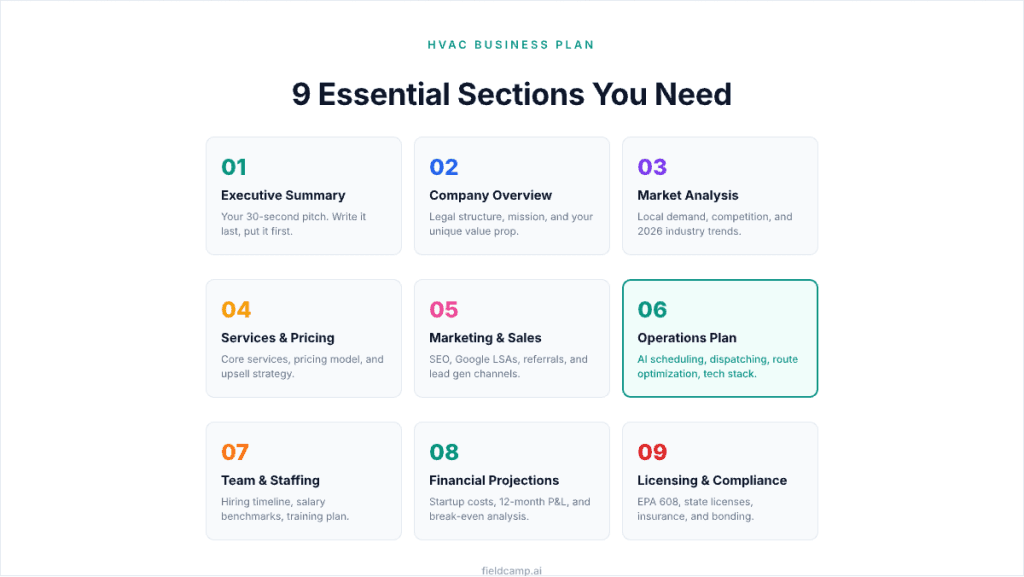
Write this section last. Put it first in the document.
Your executive summary is the 30-second pitch for your entire business. Lenders read it to decide whether they’ll bother reading the rest. Keep it to 1–2 pages and include your business name and location, services offered, target market, financial snapshot (projected Year 1 revenue, startup costs, and funding request if applicable), and your edge, what makes you different from the other HVAC companies in your market.
If you haven’t nailed down your company name yet, our guide on HVAC company names covers naming strategies that work for local search and brand recognition.
This section tells the reader who you are and how your business is structured.
Legal structure. Most HVAC startups choose LLC for the liability protection and tax flexibility. Some grow into S-Corp election once they’re clearing $70K+ in profit, since it can reduce self-employment tax. Talk to an accountant before deciding.
Mission statement. Skip the corporate fluff. A good HVAC mission statement is one sentence: “We provide fast, fairly-priced heating and cooling services to homeowners in [metro area], with transparent pricing and same-day response.”
Business history or founding story. If you’ve been running jobs under your own name for two years and you’re now formalizing into an LLC, say that. Lenders want to know you have field experience, not just a business idea.
Unique value proposition. “Quality work at fair prices” is what everyone says. Dig deeper. Maybe it’s your 2-hour response guarantee. Maybe you’re the only company in your area certified for VRF systems. Maybe you focus exclusively on maintenance agreements.
Our guide on how to start an HVAC business covers the legal setup process step by step if you’re still in the formation phase.
This is where you prove there’s actual demand for your business in your specific location.
A business plan that says “HVAC is a big industry” without local data won’t convince anyone.
Local market research. Pull real numbers for your service area: population and household count (Census Bureau data is free), housing stock age, climate zone, number of licensed HVAC contractors already operating in your area, and new construction permits filed in the last 12 months.
National trends that affect your local market:
The heat pump surge means federal tax credits of up to $2,000 per heat pump installation are driving massive consumer interest; if you’re not offering heat pump services, you’re leaving money on the table.
The R-454B refrigerant transition means R-410A is being phased down, requiring technician training and equipment updates. Smart home and IoT integration is making connected thermostats, zoning systems, and remote diagnostics standard in higher-end installs.
Post-pandemic awareness of indoor air quality created a permanent new revenue stream for HVAC companies that offer filtration, UV treatment, and humidity control.
TAM/SAM/SOM framework. Lenders and investors understand this format: Total Addressable Market (all HVAC spending in your state or region), Serviceable Addressable Market (HVAC spending in your specific service radius), and Serviceable Obtainable Market (the realistic slice you can capture in Year 1–3).
For example, if your metro area has 200,000 households and the average annual HVAC spend per household is $350, your SAM is $70 million. Capturing just 0.3% of that in Year 1 puts you at $210,000 in revenue, which is a realistic target for a one-truck operation.
Check our HVAC industry trends analysis for current national data points you can reference in this section.
Spell out exactly what you’ll offer and how you’ll price it. This isn’t just a menu; it’s a revenue architecture.
Core services to consider:
Installation covers new systems, replacements, and heat pump conversions. It has the highest ticket size ($4,000–$15,000+ per job) but requires more capital and longer sales cycles. Repair and diagnostics are bread-and-butter revenue, especially in summer and winter peaks, with average tickets of $150–$500.
Preventive maintenance has a lower per-job ticket but generates recurring revenue; maintenance agreements are the single best thing you can add to your business model. Indoor air quality covers filtration systems, UV lights, humidity control, and duct cleaning, with high margins and growing demand. Ductwork covering fabrication, installation, sealing, and insulation is often overlooked but profitable, especially on retrofit projects.
Pricing model: We recommend a flat rate for standard residential jobs. Customers know the price before you start, your techs don’t feel pressured to rush, and you can build your margin into the flat rate rather than hoping your hourly rate covers overhead.
Time-and-materials still makes sense for complex commercial work or unusual situations. A hybrid, flat rate for your top 50 services and T\&M for everything else works well for most companies.
For detailed pricing benchmarks, see our HVAC pricing guide. For job-level profitability math, see our guide on how to estimate HVAC jobs.
You can be the best technician in your city, but if nobody knows you exist, it doesn’t matter. Your marketing plan needs to address how you’ll get found, get chosen, and get referrals.
Google Business Profile (GBP) optimization. About 42% of local search clicks go to the Map Pack. Claim your profile, add photos of your work, collect reviews aggressively, and post updates weekly.
Website and SEO. You need a professional website that loads fast, looks credible on mobile, and ranks for “[your city] HVAC repair” and similar local searches. Our HVAC SEO guide covers exactly what to prioritize.
Google Local Services Ads (LSAs). These are the “Google Guaranteed” ads that appear above regular search results. You pay per lead, not per click, and the barrier to entry (background check, license verification) keeps lower-quality competitors out.
PPC (Pay-Per-Click) ads. Google Ads for high-intent keywords like “AC repair near me” or “furnace replacement [city].” See our HVAC advertising breakdown for budget benchmarks.
Referral programs. Offer existing customers $50–$100 for every referral that converts. It’s the cheapest customer acquisition channel you’ll ever find. Some companies also partner with realtors, property managers, and home inspectors for a steady stream of referrals.
Service agreement upselling. Every completed job should include a maintenance agreement pitch. Companies that push service agreements consistently hit 30–40% attach rates and build predictable recurring revenue.
For more strategies, explore our guides on HVAC marketing and HVAC lead generation.
This section describes how work actually gets done, from the moment a customer calls to the moment the invoice gets paid.
Daily workflow: Customer calls or books online; job gets created and scheduled; technician gets dispatched with job details, customer history, and route; tech completes the work and captures notes and photos; invoice gets generated and sent (ideally on-site, before the tech leaves); payment collected; follow-up scheduled if needed.
The AI-powered operations difference. AI-powered scheduling automatically slots jobs based on technician availability, skill match, and travel time between appointments. Smart dispatching assigns the closest qualified tech to urgent calls without someone manually shuffling the board. Route optimization cuts drive time between jobs, which means more jobs per day with the same crew. Automated invoicing means the customer gets their bill before the tech drives away, not three days later. That alone can cut your average collection time from 14 days to same-day.
Technology stack. Your operations plan should specify the software you’ll use.
At a minimum, you need field service management (FSM) software that handles scheduling, dispatching, invoicing, and customer management in one platform.
For software options, check out our reviews of the best HVAC scheduling software, best HVAC dispatch software, best HVAC apps, best HVAC CRM software, and HVAC ERP software.
Your staffing plan directly determines your capacity and your cost structure. Hire too fast, and you’ll bleed money. Hire too slowly, and you’ll burn out your existing techs and start losing customers.
The benchmark: Plan for roughly 1.5 technicians per $250,000 in annual revenue.
Hiring timeline for a one-truck startup: Months 1–6, the owner-operator handles everything. Months 6–9, hire your first technician or apprentice when you’re consistently turning away work or booking out 5+ days.
Months 9–12, consider part-time office help for phones, scheduling, and invoicing, or invest in FSM software that automates most of this. Year 2: Add a second technician and a dedicated dispatcher/office manager.
Compensation benchmarks: Entry-level techs start around $18–$24/hour. Experienced journeymen earn $28–$40/hour. Lead technicians and installers with NATE certification can command $45/hour or more in competitive markets.
Check our HVAC technician salary guide for current data by region and experience level.
Training and certifications to budget for: EPA 608 certification (mandatory for anyone handling refrigerants), NATE certification (not required but a strong differentiator), manufacturer-specific training (required for warranty work), R-454B handling training (becoming essential as the industry transitions), and OSHA safety training.
This is the section that makes or breaks your business plan. Vague projections won’t cut it. Lenders want specific numbers, and you need them too.
Startup Costs
| Category | One-Truck Startup | Multi-Truck Operation |
| Tools & Equipment | $6,000–$18,000 | $25,000–$50,000 |
| Vehicle(s) | $15,000–$35,000 | $60,000–$120,000 |
| Licensing & Permits | $500–$2,000 | $1,000–$5,000 |
| Insurance | $2,500–$7,000/yr | $8,000–$20,000/yr |
| Marketing (initial) | $2,000–$5,000 | $10,000–$25,000 |
| FSM Software | $600–$2,400/yr | $2,400–$6,000/yr |
| Working Capital | $5,000–$15,000 | $20,000–$50,000 |
| Office/Warehouse | $0 (home-based) | $12,000–$36,000/yr |
| Total | $31,600–$84,400 | $138,400–$312,000 |
12-Month Revenue Projection (One-Truck Startup)
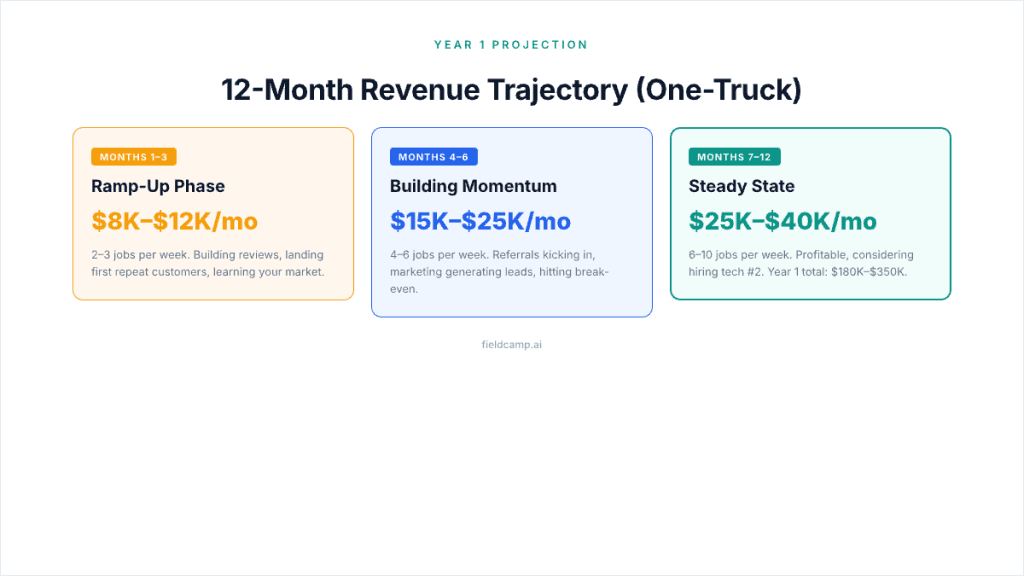
Months 1–3 (Ramp-up): 2–3 jobs per week, mostly repairs and diagnostics. Revenue: ~$8,000–$12,000/month.
Months 4–6 (Building momentum): 4–6 jobs per week as reviews accumulate and referrals start coming in. Revenue: ~$15,000–$25,000/month.
Months 7–12 (Steady state): 6–10 jobs per week with a mix of repairs, installations, and maintenance agreements. Revenue: ~$25,000–$40,000/month. Year 1 Total: $180,000–$350,000.
These numbers assume you’re in a metro area with 100,000+ households. Rural markets will have lower volume but often have less competition and higher per-job margins.
Break-Even Analysis
Every HVAC owner needs to know their break-even number:
Break-Even Revenue = Fixed Costs (1 – Variable Costs Revenue)
A simpler approach: divide your monthly fixed costs by your gross margin percentage. If your monthly fixed costs are $8,000 and your gross margin is 55%, you need $14,545 in monthly revenue to break even. Most one-truck HVAC startups hit break-even between months 4 and 7.
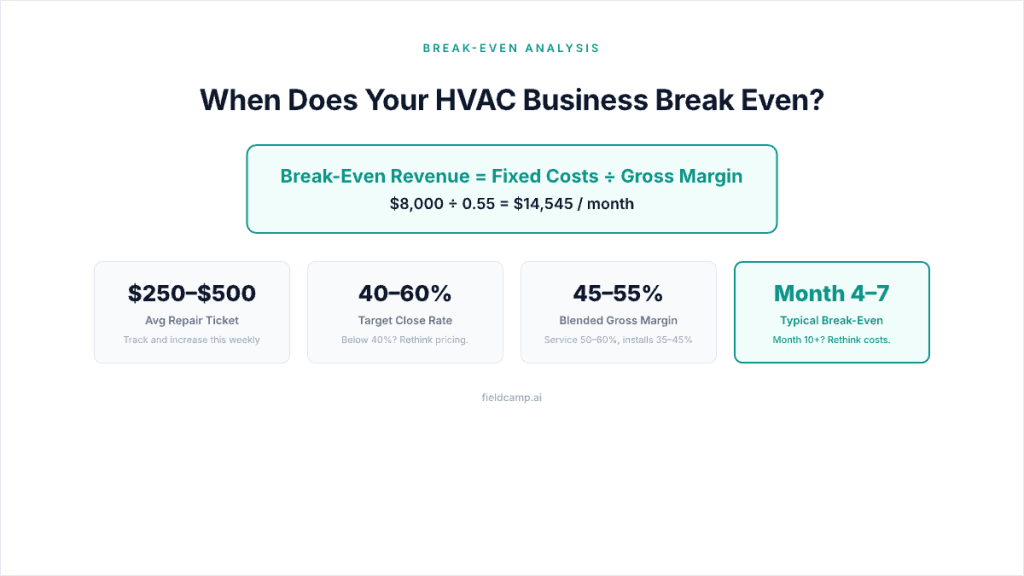
Key metrics to track from Day 1: average ticket size (residential repair: $250–$500; installations: $4,000–$12,000), close rate (industry average for residential: 40–60%), gross profit margin (target 50–60% for service/repair and 35–45% for installations), and customer acquisition cost (under $150 is good; over $300 means your marketing channels need optimising).
For deeper financial guidance, see our resources on HVAC profit margins, AI-powered HVAC job costing, and our free profit margin calculator.
Skipping this section can shut down your business before it starts. Operating without proper licensing in most states is a misdemeanor, and some states will fine you $10,000+ per violation.
EPA 608 Certification. Mandatory for anyone handling refrigerants. Get at least Type II (for high-pressure refrigerants) or Universal (covers everything). The exam costs about $150–$200.
State contractor licenses. Requirements vary dramatically by state. Some states, like California and Florida, require thousands of hours of documented experience plus a proctored exam. Others have no state-level requirement but defer to local municipalities.
Insurance minimums: General liability ($1 million per occurrence is standard; most commercial customers require proof before you set foot on their property), workers compensation (required in almost every state once you hire your first employee), commercial auto (your personal auto policy does NOT cover a vehicle used for business), and tools and equipment coverage (optional but smart).
Bonding. Some states and municipalities require HVAC contractors to carry a surety bond, typically $10,000–$25,000.
We’ve written a comprehensive guide on HVAC license requirements that breaks down the specifics by state.
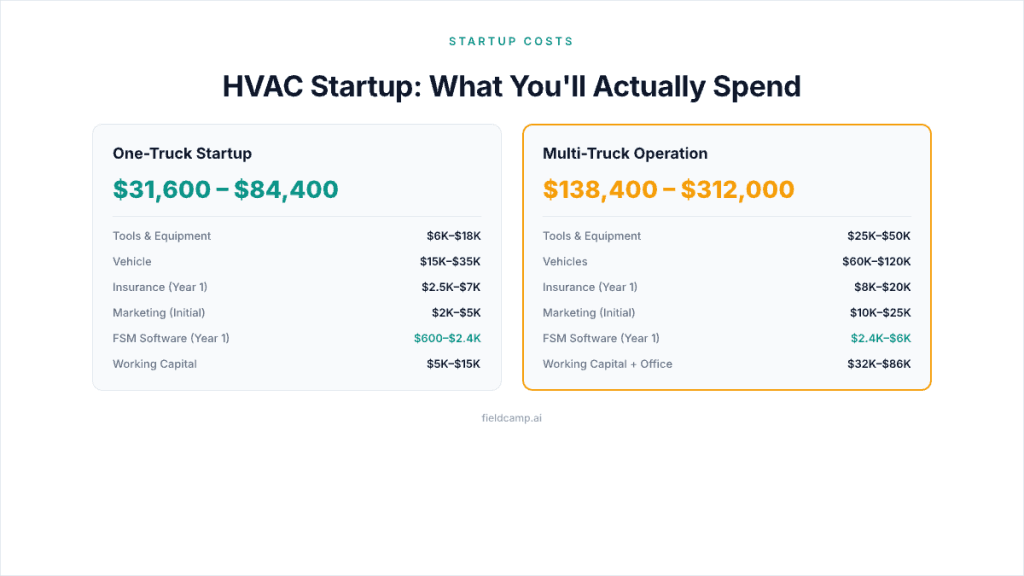
Tools and equipment ($6,000–$18,000 for one truck). Don’t buy everything new on day one. Your core toolkit, including gauges, a multimeter, a vacuum pump, a recovery machine, and hand tools, will run $4,000–$8,000 new. Buy quality recovery and vacuum equipment since these take a beating daily.
Vehicle ($15,000–$35,000). A reliable used cargo van or service body truck is fine for your first vehicle. A 2–3 year old Ford Transit or Chevy Express with under 60,000 miles typically runs $20,000–$28,000. Don’t lease; you need to be able to customise the interior for tool storage and parts bins.
Licensing and permits ($500–$2,000). Budget for your state contractor license, EPA 608 exam, business registration, and any municipal permits.
Insurance ($2,500–$7,000/year). Don’t skimp. Get proper general liability, commercial auto, and workers’ comp once you hire. Shop quotes from at least three providers.
Marketing, initial push ($2,000–$5,000). This covers website development, Google Business Profile setup, initial Google Ads spend, and vehicle wrap ($2,000–$3,500 once, works 24/7). Do not plan to rely only on word-of-mouth.
FSM software ($600–$2,400/year). This should be in your Day 1 budget. At $50–$200/month, FSM software saves $15,000–$30,000/year in missed appointments, double-bookings, manual invoicing errors, and lost follow-ups. If FSM software prevents just two missed appointments per month (conservatively worth $300–$500 each), that’s $7,200–$12,000 in saved revenue per year. The software pays for itself in the first month.
Working capital ($5,000–$15,000). This is the money that keeps the lights on while you’re ramping up. Equipment suppliers don’t extend credit to new businesses, and your marketing spend doesn’t generate revenue for 30–60 days. Three months of operating expenses as working capital is the minimum; six months is better.
Office/warehouse ($0 for home-based startup). Start from home. You don’t need an office or warehouse until you have 3+ trucks and enough parts inventory to justify the overhead. Spend the money on marketing and tools instead.
For job-level financial tools, check out our free HVAC estimate template and HVAC invoice template.
We’re building a downloadable PDF template that follows the exact 9-section structure outlined in this guide. It’ll include fill-in prompts for each section, the startup costs table pre-formatted for your numbers, and a 12-month financial projection worksheet.
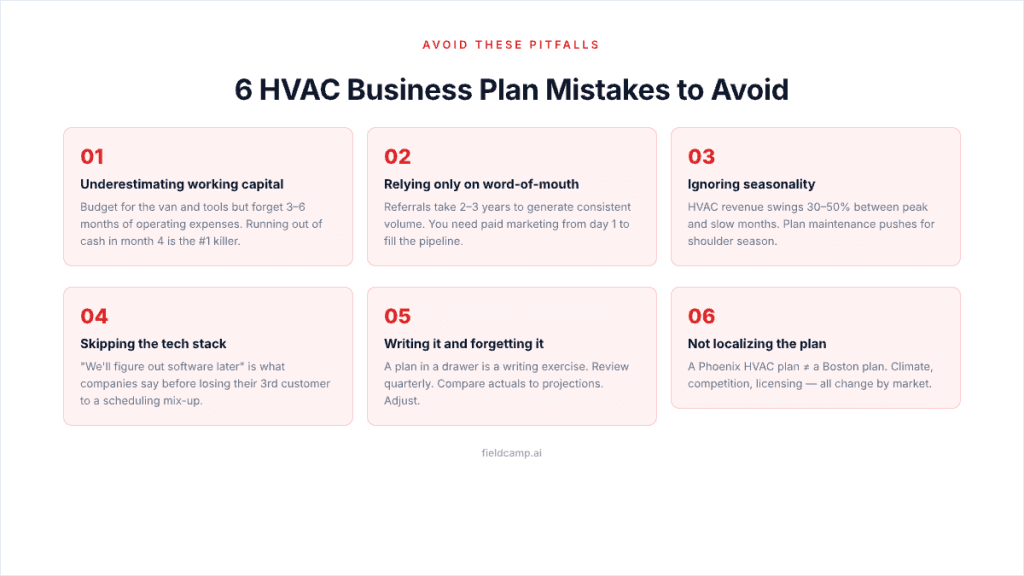
Underestimating startup costs, especially working capital. New HVAC owners budget for the van and the tools, but forget they need 3–6 months of operating expenses in the bank while they build a customer base.
No marketing budget, or planning to rely only on word-of-mouth. “I’ll just do great work, and the referrals will come,” takes 2–3 years to generate consistent volume. You need paid marketing from Day 1.
Ignoring seasonality. If your plan shows flat monthly revenue projections, it’s wrong. HVAC revenue swings 30–50% between peak and shoulder seasons. Your plan needs a strategy for slow months centered on maintenance agreement pushes, tune-up specials, and IAQ upsells.
Skipping the technology stack. “We’ll figure out the software later” is what companies say before they lose their third customer to a scheduling mix-up. Your operations plan needs FSM software, accounting software, and customer communication tools from the start.
Writing the plan and never looking at it again. Review it quarterly. Compare your actual numbers to projections. Adjust your strategy based on what’s working and what isn’t.
Using a generic template without localising it. A business plan for an HVAC company in Phoenix is completely different from one in Boston. Climate, competition, housing stock, licensing requirements, and seasonal patterns all change by market.
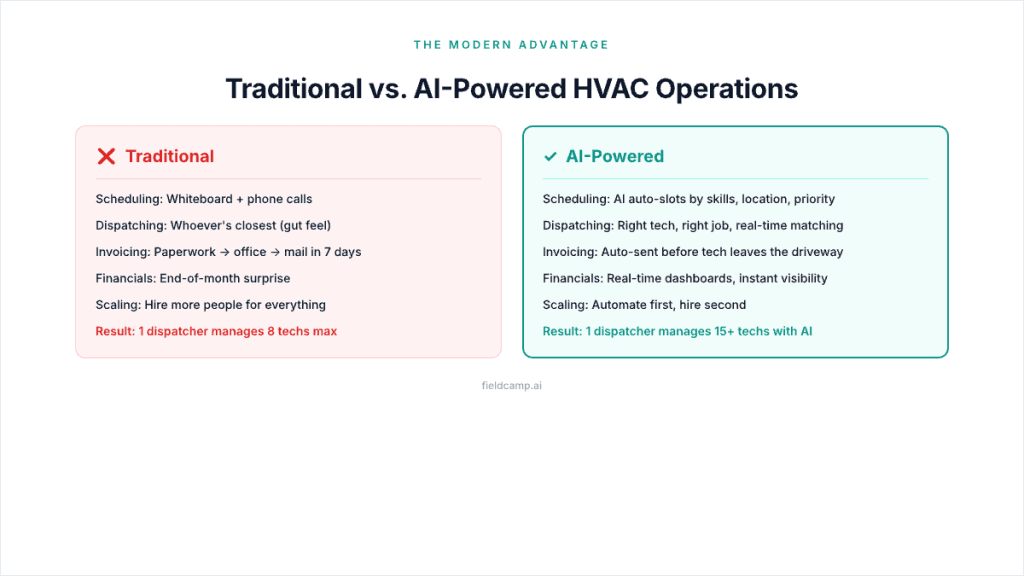
The HVAC companies that are growing fastest right now have all made the same operational shift: they’ve replaced manual processes with AI-powered software that handles the repetitive, error-prone parts of running a service business.
AI scheduling eliminates double-bookings and optimises tech utilisation. Intelligent scheduling considers technician skills, travel time, job duration, and customer preferences, then slots everything optimally. The result is more jobs per day with fewer gaps and zero conflicts.
AI dispatching matches the right technician to the right job. A senior tech with NATE certification shouldn’t be running diagnostic calls that a junior tech can handle. AI dispatching looks at job type, required skills, parts availability, and real-time location to assign the best technician automatically.
Automated invoicing reduces your billing cycle from days to minutes. When your tech completes a job, the invoice gets generated and sent before they pull out of the driveway.
Real-time dashboards replace gut-feel financial planning. Instead of waiting until the end of the month to see if you hit your numbers, you can see revenue, job completion rates, technician utilisation, and customer satisfaction metrics in real time.
Your business plan needs to account for the $50–$200/month you’ll spend on FSM software, because the companies competing against you are already spending it. The return on that investment consistently runs 10–20× the cost.
If you’re planning an HVAC operation, see how FieldCamp’s HVAC solution fits into a modern tech stack.
Still Running Your HVAC Business on Gut Feelings and Spreadsheets?
Your competitors are already using AI to schedule smarter, dispatch faster, and close more jobs. FieldCamp gives you the operational edge that turns your business plan into actual results, starting at $0 to try.
Start with the 9 essential sections: executive summary, company overview, market analysis, services and pricing, marketing plan, operations plan, staffing plan, financial projections, and licensing/compliance. Write the financial projections and market analysis first since they’re the most research-intensive, then write the executive summary last. Use real numbers from your local market, not generic industry averages.
A one-truck HVAC startup typically requires $31,600–$84,400, covering tools, a vehicle, licensing, insurance, marketing, software, and working capital. A multi-truck operation runs $138,400–$312,000. The biggest variable is whether you buy new or used equipment and vehicles. See our guide on starting an HVAC business for a detailed cost breakdown.
Yes. HVAC companies that are well-managed typically achieve 45–55% gross profit margins on service work and 35–45% on installations. Net profit margins for established companies range from 8–20%, depending on overhead structure and service mix. The key to profitability is maintenance agreements (recurring revenue) and controlling labor costs. Our HVAC profit margins guide breaks down the numbers in detail.
Yes, virtually all SBA lenders, banks, and credit unions require a written business plan with financial projections before approving a small business loan. The financial projections section, particularly your break-even analysis and 12-month revenue forecast, is what lenders scrutinise most closely.
The average gross profit margin for HVAC service work is 50–55%, and for installations it’s 35–45%. Net profit margins typically range from 8–15% for most companies, with top-performing operations hitting 15–22%. Companies that focus heavily on maintenance agreements and optimise their pricing tend to be at the higher end.
Over 3 million HVAC systems are replaced annually in the United States. This number is increasing due to aging housing stock (the average US home is now 40+ years old), efficiency upgrade incentives from the Inflation Reduction Act, and the ongoing transition away from R-410A refrigerant systems.