Free HVAC Service Contract Template 2026: Download + Complete Pricing Guide
March 30, 2026 - 25 min read


March 30, 2026 - 25 min read

Table of Contents
| TL; DR: Download a free 3-tier HVAC service contract template (Basic/Standard/Premium) with all 14 essential legal clauses. Includes real pricing benchmarks ($149–$449/year residential), word-for-word sales scripts, 6 objection responses, a 90-60-30 renewal cadence, and recurring revenue math showing how 500 agreements = $373,500 in total annual impact. |
If you’re running an HVAC service business without a structured maintenance agreement program, you’re leaving thousands in predictable monthly revenue on the table and handing it to competitors who do have one.
The biggest difference between HVAC companies that survive seasonal dips and those that thrive year-round almost always comes down to recurring service contracts.
This guide gives you everything you need to fix that today. A ready-to-use template with three pricing tiers that actually make money, all 14 essential legal clauses, the exact scripts your techs can use to sell agreements on every call, and the renewal system that keeps customers locked in year after year.
Download the free 3-tier HVAC service contract template below. Click “Make a copy” to save it to your Google Drive, then customize it with your company name, pricing, and terms.
Download the Free HVAC Service Contract Template →Customize as you go, and start pitching this week.
KEY HIGHLIGHTS
HVAC Service Contracts in 2026
The template includes everything you need to launch a professional agreement program this week. Here’s what you’re getting:
The template is a starting point. You need to have your attorney review it before you use it. Every state has different requirements, and I’ll cover the big ones later in this article. But the structure is solid, and it’ll save you 20+ hours of drafting from scratch.
We’ve seen HVAC companies make two common mistakes with pricing: they either offer one plan (which leaves money on the table) or five plans (which overwhelms customers and slows down the sale).
Three tiers hit the sweet spot. Most customers pick the middle option, and your premium tier makes the standard look like a bargain.
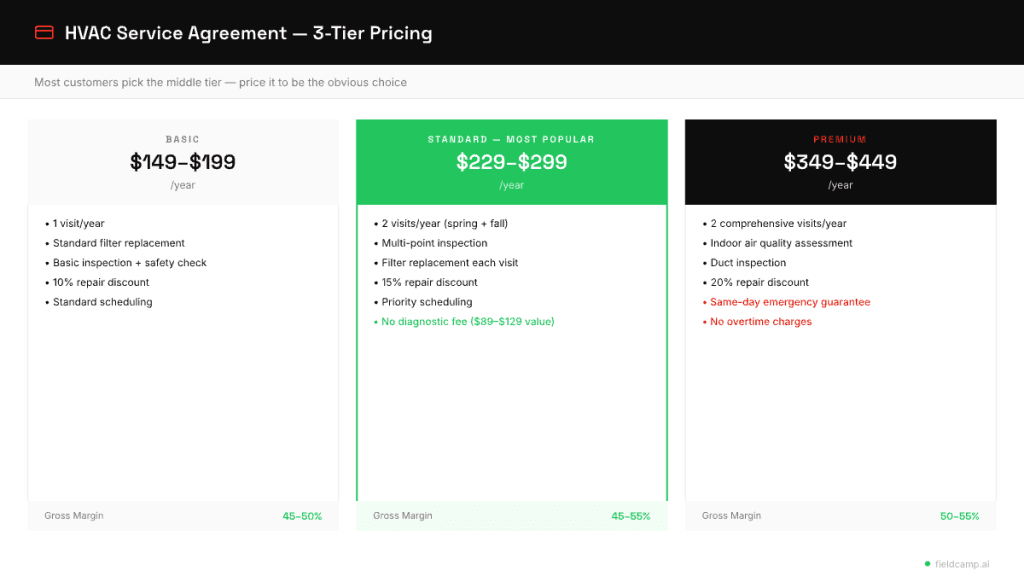
What’s included:
Your cost to deliver: $75–$100 per contract
Gross margin: 45–50%
Who buys this: Budget-conscious homeowners, landlords with rental properties, customers with newer systems that don’t need much attention yet.
This is your entry-level offer. The goal is to get them in the door and upgrade them to Standard within 12 months.
This is your money maker. Price it right, and most customers land here.
What’s included:
Your cost to deliver: $120–$160 per contract
Gross margin: 45–55%
Who buys this: The majority of residential customers. Homeowners who understand the value of twice-yearly maintenance and want the peace of mind that comes with priority service.
When you present all three tiers side by side, this option feels like the obvious choice.
What’s included:
Your cost to deliver: $175–$225 per contract
Gross margin: 50–55%
Who buys this: Homeowners with high-end systems, allergy sufferers, families with health concerns, customers with older equipment who want maximum protection.
The same-day guarantee and no-overtime clause are the real selling points here.
Your local market, cost structure, and competition all matter. Here’s the framework:
1. Calculate your fully loaded cost for each visit (tech time, drive time, materials, overhead)
2. Add your target margin (aim for 50% gross minimum on Standard and Premium)
3. Research your market, check what competitors charge, but don’t race to the bottom
4. Factor in pull-through revenue; remember, every $1 in contract value generates $2 in additional work
For a detailed breakdown of how to calculate your costs and set prices that protect your margins, check out our HVAC pricing guide.
Commercial agreements are priced per unit, per quarter. The service requirements are more intensive because commercial systems run harder, fail more expensively, and building owners expect faster response times.
| Tier | Price Per Unit/Quarter | Annual Per Unit | Approx. $/sqft |
| Basic | $150 | $600 | $0.12–$0.25 |
| Standard | $250 | $1,000 | $0.25–$0.45 |
| Premium | $400 | $1,600 | $0.45–$0.65 |
A 10-unit commercial building on your Standard plan is $10,000 per year in guaranteed revenue, plus the pull-through repair and replacement work that comes with it.
Important: Commercial contracts should reference ACCA/ASHRAE Standard 180-2018 for minimum maintenance task requirements. This protects you legally and gives your scope of work credibility with building managers and property owners who know what they’re looking at.
For estimating commercial job costs accurately, see our guide on how to estimate HVAC jobs.
Skip any of these, and you’re asking for trouble. Your contract template includes all 14, but here’s why each one matters:
Full legal names, addresses, and contact information for both your company and the customer. Sounds obvious, but I’ve seen contracts with just a first name and a phone number.
This is the most important clause in the entire document. Be painfully specific about what your maintenance visit covers.
But equally important: list what’s NOT included. Ductwork replacement, refrigerant recharging beyond a certain amount, equipment replacement, code upgrades, spell it out. Scope creep kills agreement profitability.
Standard is 12 months. Specify the exact start and end dates, not just “one year from signing.” Include whether the contract auto-renews and under what conditions.
Define when maintenance visits occur. “Spring and Fall” isn’t specific enough. Use “between March 1–May 31 and September 1–November 30” so customers have clear expectations and you have scheduling flexibility.
Offer multiple options: annual (full payment upfront, best for your cash flow), semi-annual, or monthly. Specify due dates, accepted payment methods, and what happens if payment is late. If you’re using automated payment collection through FieldCamp, mention auto-pay authorization here.
Industry standard: 30 days’ written notice. Pro-rate any refund based on services already performed. Be fair here, heavy-handed cancellation penalties drive bad reviews and complaints to your state attorney general.
Clarify what warranty covers maintenance work performed under the contract. This is separate from the manufacturer’s equipment warranty. State explicitly that your maintenance agreement does not extend or replace the manufacturer’s warranty.
Cap your liability at the total contract value. This is standard practice and something your attorney will insist on. Without this clause, a $299 maintenance agreement could expose you to an unlimited liability claim.
Both parties agree to hold each other harmless for claims arising from the other party’s negligence. This is boilerplate, but it needs to be there.
State your insurance coverage (general liability, workers’ comp) and that you maintain it throughout the contract term. Commercial customers will often request a certificate of insurance, this clause sets the expectation.
Specify how disagreements are handled. Mediation first, then arbitration or litigation. Name the jurisdiction. This prevents expensive out-of-state legal battles.
Which state’s laws govern the contract? Usually, the state where the work is performed.
Neither party is liable for failures caused by events outside their control, natural disasters, pandemics, or supply chain disruptions. COVID taught every service business why this clause exists.
Protects both parties’ business information. More relevant for commercial contracts, where you may access building systems data, but include it in residential contracts, too.
HVAC contracting regulations vary wildly by state, and your service contract needs to comply with local law.
Licensing and bonding: Roughly 80% of states require HVAC contractor licensing and/or bonding. Bond requirements range from $3,000 to $25,000, depending on the state. Your contract should reference your license number.
States without state-level HVAC licensing: Vermont, Wisconsin, Wyoming, Montana, Ohio, New York, New Hampshire, South Dakota, and Pennsylvania don’t require state-level licensing, but many have city or county requirements. Check your local jurisdiction.
Auto-renewal disclosure rules: Multiple states have specific requirements for how you notify customers about auto-renewal terms. Some require bold or conspicuous language, specific font sizes, or advance written notice 30–60 days before renewal. Get this wrong, and your auto-renewal clause is unenforceable.
Cooling-off periods: Some states give consumers a 3-day right to cancel certain service contracts. Your cancellation policy should accommodate this.
Bottom line: Use the template as a framework, but have a local attorney review your final version before you put it in front of customers. A $500 legal review prevents a $50,000 problem.
For more information regarding HVAC licensing requirements, check out our blog that covers it all.
Knowing when to present the agreement matters more than the pitch itself. Here are the five highest-conversion moments, ranked by effectiveness:
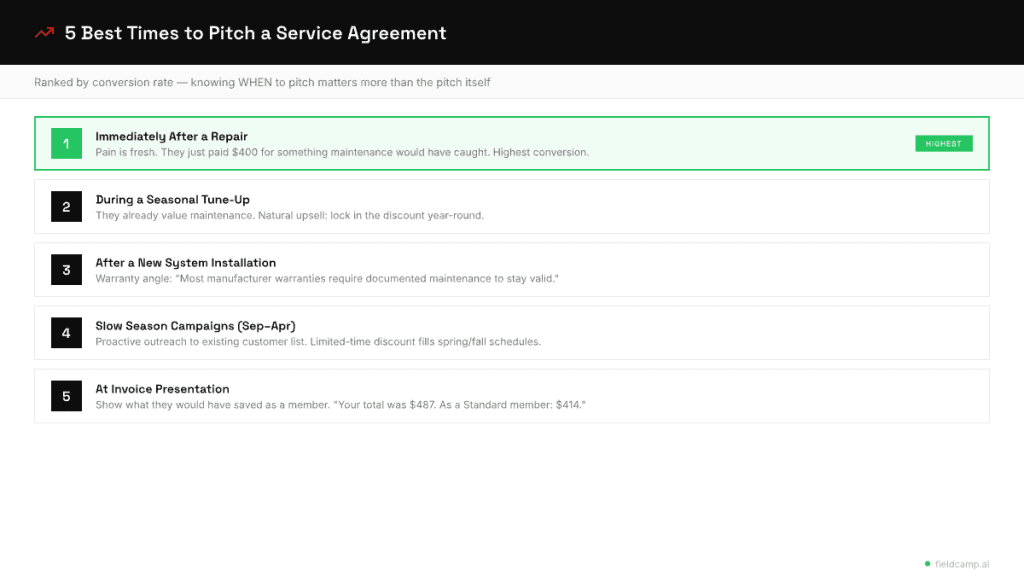
The customer just paid $400 to fix something that preventive maintenance would have caught. The pain is fresh. They’re emotionally receptive to anything that prevents it from happening again.
Use this script:
“Mr./Mrs. [Name], I’m glad we got everything fixed today. This kind of issue is actually preventable with regular maintenance. We offer a maintenance agreement that includes 2 tune-ups per year, priority scheduling, and 15% off future repairs. Most customers save more than the plan costs in repair discounts alone. Would you like me to go over the options?”
This script works because it doesn’t pressure. It connects the repair they just experienced to prevention, mentions concrete benefits, and ends with a low-pressure question.
The customer already values maintenance; they booked a tune-up. The conversation is natural: “You’re clearly someone who takes care of your equipment. Here’s how to lock in this service at a discount and get priority scheduling year-round.”
This is where the warranty angle becomes powerful. Tell the customer: “Most manufacturer warranties require documented professional maintenance to stay valid.” This is true for many manufacturers, and it reframes the agreement as protecting their $8,000–$15,000 investment, not as an additional expense.
When the phone slows down, proactive outreach picks up the slack. Run targeted campaigns to your existing customer list, offering a limited-time discount on annual agreements. This fills your spring and fall maintenance schedules in advance and stabilizes revenue during your slowest months.
For more strategies on keeping your pipeline full year-round, read our HVAC lead generation guide.
The customer is already in payment mode. Include agreement information with every invoice — a one-page flyer or a line item showing what they would have saved as a member. “Your total today was $487. As a Standard Plan member, this would have been $414 with your 15% discount, plus you’d have no diagnostic fee.”
Every objection is a buying signal; the customer is engaged enough to push back. Here’s how to respond to each one without sounding like you’re reading a script.
Break the annual cost into a daily rate. “Our Standard plan is $299 a year, that’s 82 cents a day. A single emergency repair averages $300–$500, plus you’d wait 3–5 days for service in peak season. Members get same-day scheduling and 15% off the repair.”
Don’t discount. Reframe value.
“That’s actually the best time to start. Think of it like oil changes on a new car; you don’t wait until something breaks. Regular professional maintenance adds 5–7 years to system lifespan, and most manufacturer warranties require documented maintenance to remain valid. Starting now protects your investment from day one.”
“You absolutely can, and we’ll be happy to help. Just know that reactive service calls typically cost 2–3 times what preventive maintenance catches early. And during peak season, July heat waves, and January cold snaps, our non-member wait time runs 3–5 days.
Members get same-day service. It’s the difference between sweating it out for a week and having someone there that afternoon.”
Never insult a handy homeowner. Acknowledge what they can do, then explain what they can’t.
“Absolutely, changing filters regularly is great, and you should keep doing that. The things our techs handle during a maintenance visit are the stuff that requires specialized equipment: checking refrigerant levels and pressures, testing electrical connections with a multimeter, cleaning evaporator and condenser coils properly, and verifying safety controls. Those are the things that prevent the expensive breakdowns.”
“Of course, take your time. I’ll leave this information with you. I should mention that we’re offering a 10% discount on first-year agreements through the end of this month.
If you’d like, I can schedule a follow-up call for next week to answer any questions that come up.”
Give them space, but create a reason to decide sooner rather than later, and schedule the follow-up before you leave.
Don’t defend the other company. Get curious.
“I’m sorry to hear that. Do you mind sharing what happened? Was it the service quality, the value, or something else?” Then listen. Address their specific concern, explain how your program is different, and emphasize your cancellation flexibility: “We do 30-day cancellation with a pro-rated refund. If we don’t deliver, you’re not locked in.”
Your technicians are in the customer’s home. They have trust and credibility that no marketing campaign can replicate. But most techs became technicians, not salespeople, and most hate selling.
Here’s how to make it work:
Pay a $25–$50 spiff per agreement sold. On top of their base salary, a tech who sells one agreement per day at $35 earns an extra $700–$1,400 per month. That gets attention.
Create a monthly leaderboard, but keep it friendly, not punitive. Celebrate top performers publicly. Consider monthly bonuses for the top seller: a gift card, an extra day off, and first pick on overtime shifts.
Track your attach rate, the percentage of service calls that result in an agreement sale.
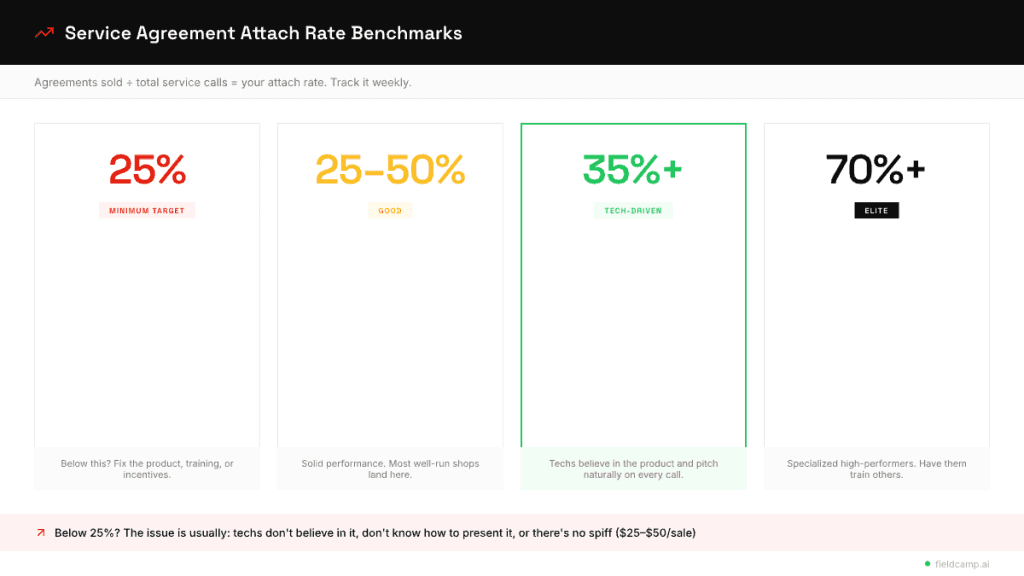
If your attach rate is below 25%, the issue is usually one of three things: your techs don’t believe in the product (fix the product), they don’t know how to present it (fix the training, HVAC sales tips can help here), or there’s no incentive (fix the compensation).
Don’t have techs memorize a pitch. Give them a laminated one-page comparison card showing all three tiers side by side. The customer can see the options while the tech walks through each one. Visual comparison drives decision-making; people almost always pick the middle option, which is exactly what you want.
Selling a new agreement is five times harder than renewing an existing one. Your renewal process determines whether your agreement program compounds into a business-transforming revenue stream or slowly bleeds out.
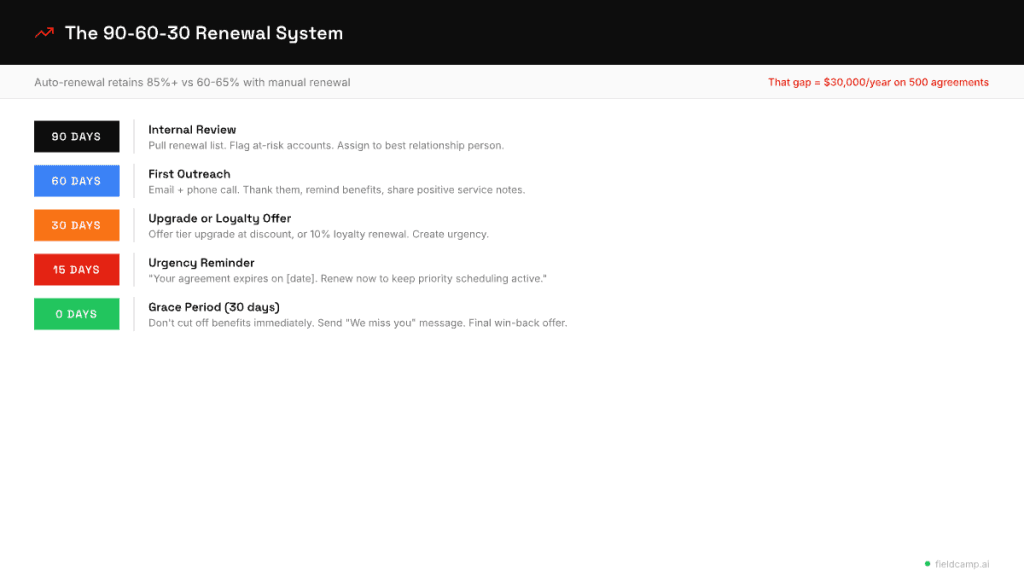
This is the system. Don’t skip steps.
90 days before expiration – Internal review. Pull your renewal list. Flag at-risk accounts: customers who skipped their second visit, had a complaint, or haven’t engaged in 6+ months. Assign these to your best relationship person for personal outreach.
60 days before expiration – First outreach. Email plus phone call. Thank them for being a member, remind them what’s included in their renewal, and mention any program improvements for the new term. If they had a great experience, share it with them. “Your tech noted your system is running at peak efficiency after both visits this year.”
30 days before expiration – Upgrade offer or loyalty incentive. Offer an upgrade to the next tier at a discounted rate, or a loyalty discount on renewal. “As a returning member, here’s 10% off your Standard plan renewal, or you can upgrade to Premium for just $50 more than last year.”
15 days before expiration – Urgency reminder. “Your agreement expires on [date]. Renew now to keep your priority scheduling and repair discounts active. Once it lapses, re-enrollment is at the current rate.”
Expiration date – Start a 30-day grace period. Don’t cut off benefits immediately. Send a “We miss you” message. Give them a window.
30 days post-expiration – Win-back campaign. Final attempt with a special offer. If they don’t bite, move them to your general marketing list.
Here’s the stat that should stop you in your tracks: auto-renewal programs retain 85%+ of customers. Manual renewal programs retain 60–65%.
That’s not a marginal difference. On 500 agreements at $300 average, dropping from 80% to 60% renewal means $30,000 in lost annual recurring revenue. Every single year.
Set up auto-renewal as the default. Get the payment method on file at initial signup. Send the required advance notice per your state’s disclosure rules. Make cancellation easy and fair; this builds trust and actually reduces cancellation rates.
For managing recurring billing and auto-payments, FieldCamp handles this automatically, charges are processed on schedule, customers get receipts, and you never chase a renewal payment manually.
Stop thinking about agreements as a side offering. Run these numbers for your own business.
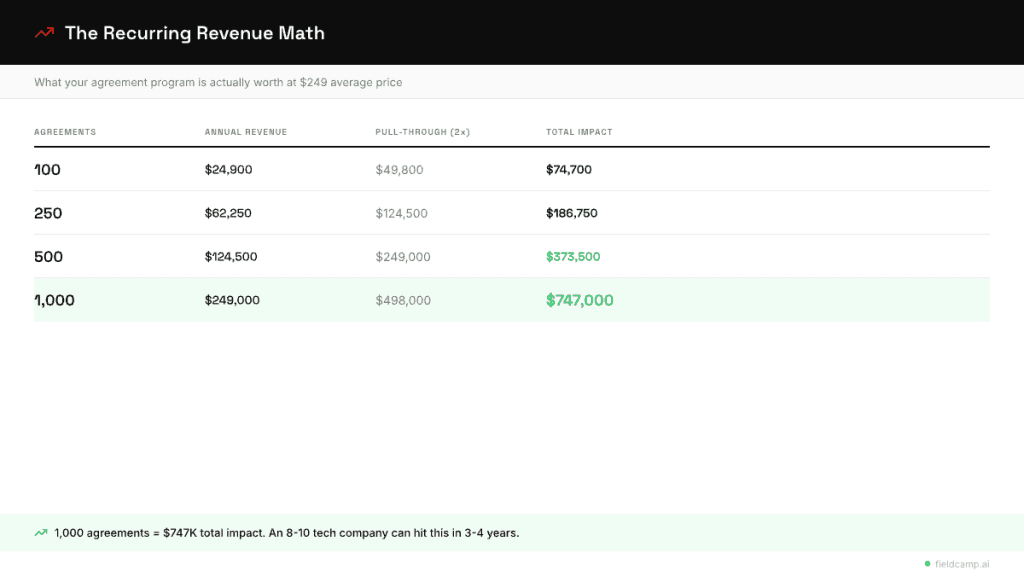
Read that last line again. One thousand agreements, which a single-location company with 8–10 techs can absolutely achieve in 3–4 years, generate nearly three-quarters of a million dollars in total revenue impact.
And that’s before you factor in the reduced marketing cost (contract customers refer more), the scheduling efficiency (planned visits vs. reactive chaos), and the company valuation multiple recurring revenue businesses sell for 3–5x higher multiples.
Explore our HVAC business growth guide to build these projections into your HVAC business plan from day one.
Understanding your margins on this work is critical. Our HVAC profit margins guide breaks down exactly how to calculate and protect your profitability as you scale.
Stop planning and start selling. Here’s your week-by-week launch plan.
For optimizing your scheduling as maintenance visits scale, our guide on the best HVAC scheduling software compares the options.
Once your program is running, track these HVAC business KPIs monthly:
Attach rate: Agreements sold / total service calls. Target: 25–50%.
Renewal rate: Agreements renewed / agreements up for renewal. Target: 70–80% manual, 85%+ with auto-renewal. Industry average is 60–65%, beat it.
Average revenue per agreement: Total agreement revenue/number of agreements. Track this over time to see if upgrades and price increases are moving the needle.
Pull-through ratio: Additional revenue from agreement customers/agreement revenue. Target: 2:1 minimum.
Customer lifetime value: Track how long agreement customers stay and how much they spend over their entire relationship. Industry average is $15,340 — your goal is to exceed that.
Churn by tier: Which tier has the highest cancellation rate? This tells you where your value proposition is weakest.
Tech performance: Agreements sold per tech per month. Identify top performers and have them train others.
Every month you operate without a service agreement program, you’re leaving $8,000–$15,000 in recurring revenue on the table. Your competitors are signing up the customers you serviced last summer.
Those customers aren’t calling you back; they’re on someone else’s maintenance plan, getting someone else’s priority scheduling, and buying someone else’s replacement systems.
The template is free. The pricing framework is proven. The scripts work. The only thing standing between you and a predictable, profitable revenue stream is the decision to start.
Download the template. Customize it tonight. Train your team tomorrow. Start selling this week.
Residential pricing in 2026 typically falls into three tiers. Basic plans (1 visit/year) run $149–$199. Standard plans (2 visits/year with priority service) run $229–$299. Premium plans (2 visits with same-day guarantee and no overtime charges) run $349–$449. Your exact pricing depends on your local market and cost structure, but target a 45–55% gross margin minimum across all tiers.
A realistic target for a company with 4–6 techs is 15–25 new agreements per month. At 20 agreements per month with a $35 monthly price point, you’ll add $8,400 in new monthly recurring revenue, reaching $100,800 in annual recurring revenue by month 12. Start with a goal of 10 per month and increase as your team gets comfortable with the pitch.
The industry average is 60–65%, which is mediocre. You should target 70–80% with manual renewal processes and 85%+ with auto-renewal enabled. The difference between 60% and 85% renewal on 500 agreements at $300 average is $37,500 in annual revenue — every year, compounding.
Offer both, but incentivize annually. Customers who pay annually have higher retention rates and better cash flow impact for your business. A common approach: offer a 10% discount for annual prepayment. Monthly billing works well for customers who can’t afford the lump sum and for increasing your total sign-up rate.
Yes. Approximately 80% of states require HVAC contractor licensing and bonding (bonds range from $3,000–$25,000). Auto-renewal contracts have state-specific disclosure requirements — some states require advance written notice 30–60 days before renewal. Several states also mandate a 3-day cooling-off period where consumers can cancel without penalty. Have a local attorney review your contract.
Make it easy. A 30-day written notice policy with a pro-rated refund is industry standard. Don’t penalize cancellation harshly; it creates bad reviews and legal exposure. Instead, use the cancellation conversation as a save opportunity: ask why they’re canceling, address the concern, and offer a tier change or discount before processing the cancellation. Fair cancellation policies actually reduce cancellation rates because customers feel less trapped.
Three things make the difference: belief, training, and incentives. First, make sure your agreement genuinely delivers value so techs can recommend it honestly. Second, give them a simple script and a visual comparison card, not a complicated pitch. Third, pay $25–$50 per agreement sold and recognize top performers publicly. When a tech earns an extra $1,000 per month from spiffs, the resistance disappears.
Most successful programs include minor parts (filters, basic capacitors) but exclude major components (compressors, motors, coils). Be explicit in your scope of work about what parts are and aren’t covered. Including filters in your plan removes a common reason customers skip maintenance, and the cost is negligible relative to the agreement price. —