
Insulation Contractor License Requirements by State (2026 Guide)
January 16, 2026 - 26 min read

January 16, 2026 - 26 min read

Table of Contents
| TL;DR: Most states don’t require a specific “insulation contractor license” but that doesn’t mean you can work without one. Depending on your state, project value, and insulation type (especially spray foam), you may need a general contractor license, home improvement contractor license, or specialty certification. About 30 states have some licensing requirements, and working unlicensed can void your contracts and kill your right to collect payment. |
You’re ready to bid your first insulation job, or maybe your fiftieth, and a customer asks: “Are you licensed?”
It’s a fair question. And the answer isn’t as simple as yes or no.
Insulation contractor licensing varies widely by state. Some states require specific licenses. Others don’t regulate insulation work at all. And spray foam? That’s a different set of rules entirely.
This guide breaks down exactly what you need, state by state, so you can stay compliant, win more bids, and avoid costly penalties.
KEY HIGHLIGHTS
Insulation Contractor License Requirements
We reviewed contractor licensing requirements directly from state licensing boards, including CSLB, ROC, DBPR, and 40+ other state authorities. Information was cross-referenced with OSHA guidelines and current building code requirements.
The short answer is that it depends entirely on where you work.
Some states issue a specific insulation contractor license, a dedicated classification just for insulation work. Others fold insulation under a general contractor license or home improvement contractor registration.
And roughly a third of U.S. states don’t require any state-level license at all, though local permits and business registration still apply.
Here’s what makes this confusing: licensing rules change. The threshold that applied two years ago might be different today. And the consequences of getting it wrong aren’t just fines; you could lose your legal right to collect payment for work you’ve already completed.
This guide breaks down insulation contractor licensing requirements for all 50 states, the certifications that actually matter in the insulation industry, the insurance you’ll need to operate legally, and a clear path to getting licensed in your state.
Whether you’re starting a spray foam insulation business or expanding an existing operation into new territories, understanding your licensing obligations protects both your business and your customers.
Before diving into state-by-state requirements, it helps to understand the three ways states typically regulate insulation contractors.
A handful of states recognize insulation as a distinct trade with its own license classification. If you’re working in Arizona, California, Hawaii, Nevada, or North Carolina, you’ll apply for a specialty license that specifically covers insulation and acoustical work.
These licenses require passing a trade-specific exam that tests your knowledge of insulation materials, installation techniques, thermal performance, building codes, and job site safety.
The advantage? Your license clearly signals your expertise to homeowners, general contractors, and commercial clients.
Most states don’t carve out insulation as a separate category. Instead, insulation work falls under broader classifications:
The requirements for these licenses vary dramatically. Some states demand years of verified experience and multiple exams. Others simply require registration and proof of insurance.
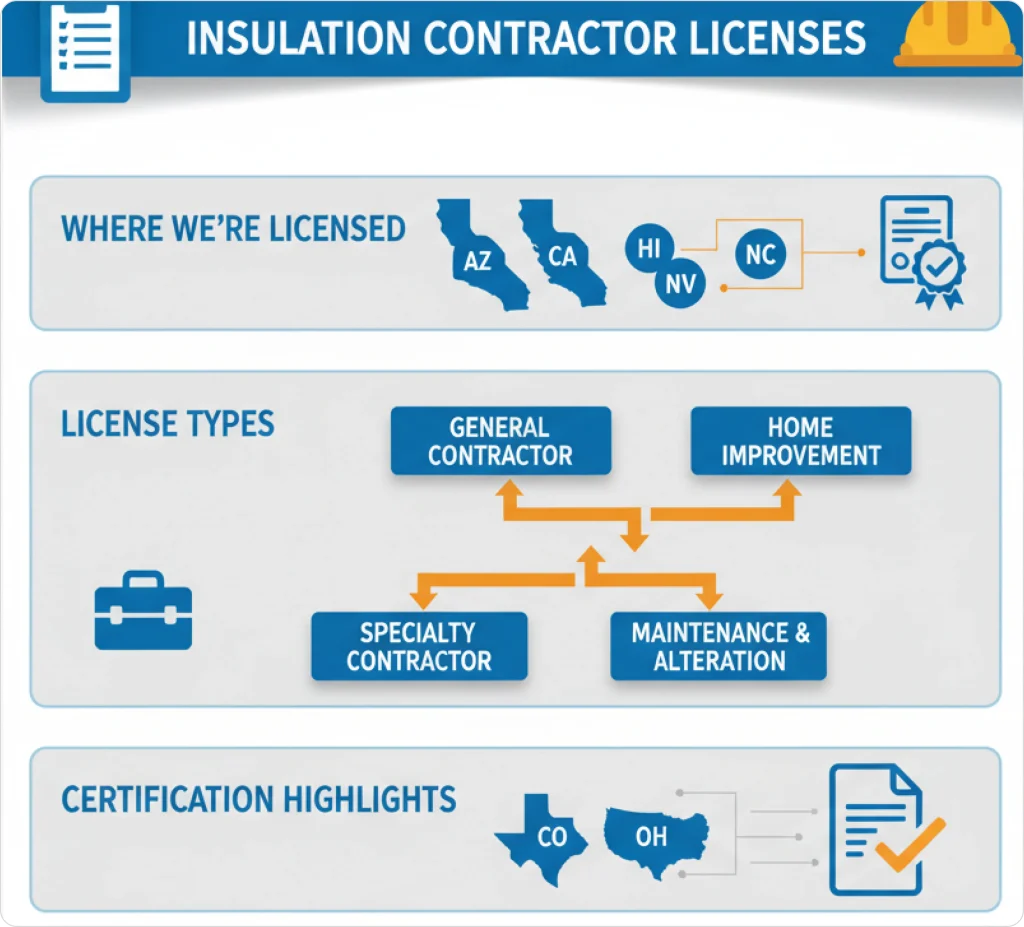
Approximately 15-20 states don’t mandate any state-level contractor license for insulation work. But “no state license” is misleading; it doesn’t mean “no requirements.”
In states like Texas, Colorado, and Ohio, you’ll still typically need:
Cities within these states often have their own contractor registration requirements. Never assume you can skip the paperwork just because your state doesn’t issue a statewide license.
Find your state below. This table shows whether you need a license, what type, the project threshold that triggers the requirement, and where to verify your status.
| State | License Required? | License Type | Project Threshold | Licensing Authority |
| Alabama | Yes | General Contractor | $50,000+ | Alabama Licensing Board for General Contractors |
| Alaska | Yes | General Contractor | $10,000+ | Alaska Division of Corporations, Business and Professional Licensing |
| Arizona | Yes | C-40 Insulation (Specialty) | All insulation work | Arizona Registrar of Contractors |
| Arkansas | Yes | Residential/Commercial Contractor | $2,000+ | Arkansas Contractors Licensing Board |
| California | Yes | C-2 Insulation and Acoustical | $1,000+ | Contractors State License Board (CSLB) |
| Colorado | No state license | Local requirements vary | Check city/county | Local building departments |
| Connecticut | Yes | Home Improvement Contractor (HIC) | Residential work | Connecticut Department of Consumer Protection |
| Delaware | Yes | General Contractor | All construction work | Delaware Division of Professional Regulation |
| Florida | Yes | Certified/Registered Specialty Contractor or General Contractor | Varies by county | Florida Department of Business and Professional Regulation |
| Georgia | Yes | Residential or General Contractor | $2,500+ | Georgia Secretary of State |
| Hawaii | Yes | C-38 Insulation and Acoustical | All insulation work | Hawaii Department of Commerce and Consumer Affairs |
| Idaho | No state license | Local requirements vary | Check city/county | Local building departments |
| Illinois | No state license | Local requirements vary | Check city/county (Chicago requires registration) | Local building departments |
| Indiana | No state license | Local requirements vary | Check city/county | Local building departments |
| Iowa | No state license | Local requirements vary | Check city/county | Local building departments |
| Kansas | No state license | Local requirements vary | Check city/county | Local building departments |
| Kentucky | No state license | Local requirements vary | Check city/county | Local building departments |
| Louisiana | Yes | Residential or Commercial Contractor | $75,000+ | Louisiana State Licensing Board for Contractors |
| Maine | No state license | Local requirements vary | Check city/county | Local building departments |
| Maryland | Yes | Home Improvement Contractor | Residential projects | Maryland Department of Labor |
| Massachusetts | Yes | Home Improvement Contractor (HIC) | Residential work | Massachusetts Office of Consumer Affairs |
| Michigan | Yes | Maintenance and Alteration Contractor | $600+ | Michigan LARA (Licensing and Regulatory Affairs) |
| Minnesota | Yes | Residential Contractor | Residential work | Minnesota Department of Labor and Industry |
| Mississippi | Yes | Residential Builder | $50,000+ | Mississippi State Board of Contractors |
| Missouri | No state license | Local requirements vary | Check city/county | Local building departments |
| Montana | No state license | Local requirements vary | Check city/county | Local building departments |
| State | License Required? | License Type | Project Threshold | Licensing Authority |
| Nebraska | No state license | Local requirements vary | Check city/county | Local building departments |
| Nevada | Yes | C-3 Insulation and Acoustical | All insulation work | Nevada State Contractors Board |
| New Hampshire | No state license | Local requirements vary | Check city/county | Local building departments |
| New Jersey | Yes | Home Improvement Contractor | Residential projects | New Jersey Division of Consumer Affairs |
| New Mexico | Yes | General Contractor (GB-98 or specialty) | $100+ | New Mexico Regulation and Licensing Department |
| New York | No state license | Local requirements vary | NYC requires Home Improvement Contractor license | Local jurisdictions (NYC Department of Consumer Affairs) |
| North Carolina | Yes | Insulation Contractor | $30,000+ | North Carolina Licensing Board for General Contractors |
| North Dakota | Yes | General Contractor | $4,000+ | North Dakota Secretary of State |
| Ohio | No state license | Local requirements vary | Check city/county | Local building departments |
| Oklahoma | No state license | Local requirements vary | Check city/county | Local building departments |
| Oregon | Yes | General Contractor | All construction work | Oregon Construction Contractors Board |
| Pennsylvania | Partial (local only) | Home Improvement Contractor | Philadelphia and Allegheny County only | Pennsylvania Attorney General |
| Rhode Island | Yes | Contractor Registration | All construction work | Rhode Island Contractors Registration Board |
| South Carolina | Yes | General or Mechanical Contractor | $5,000+ | South Carolina Department of Labor, Licensing and Regulation |
| South Dakota | No state license | Local requirements vary | Check city/county | Local building departments |
| Tennessee | Yes | Home Improvement Contractor or General Contractor | $25,000+ | Tennessee Board for Licensing Contractors |
| Texas | No state license | Local requirements vary | Check city (Austin, Dallas, San Antonio require registration; Houston does not) | Local jurisdictions |
| Utah | Yes | General Contractor (S350 Insulation specialty) | $3,000+ | Utah Division of Professional Licensing |
| Vermont | No state license | Local requirements vary | Check city/county | Local building departments |
| Virginia | Yes | Class A, B, or C Contractor | Based on project value | Virginia Department of Professional and Occupational Regulation |
| Washington | Yes | Contractor Registration | All construction work | Washington State Department of Labor and Industries |
| West Virginia | Yes | Contractor License | $2,500+ | West Virginia Division of Labor |
| Wisconsin | No state license | Local requirements vary | Check city/county | Local building departments |
| Wyoming | No state license | Local requirements vary | Check city/county | Local building departments |
Some states have nuances that don’t fit neatly into a table. Here’s additional context for the most commonly searched states.
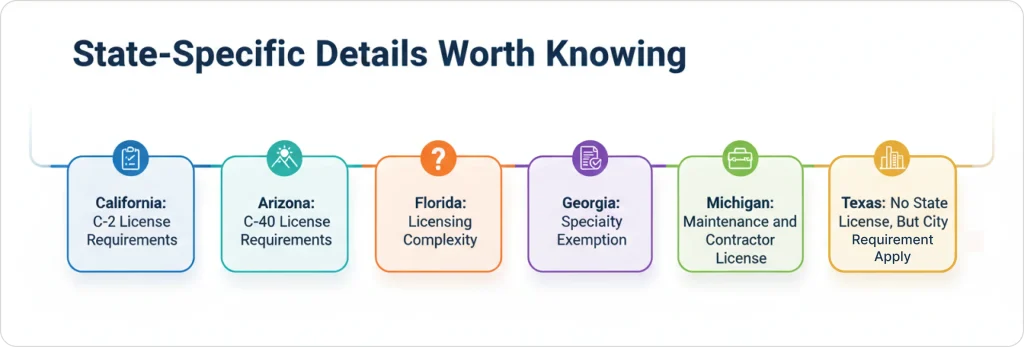
California’s Contractors State License Board issues the C-2 Insulation and Acoustical license for contractors specializing in insulation work.
As of January 1, 2025, projects valued at $1,000 or more (combined labor and materials) require a license; this threshold increased from the previous $500 limit under Assembly Bill 2622.
Requirements:
Timeline: Expect 4-9 months from application to license issuance, depending on exam scheduling and application processing times.
Arizona’s Registrar of Contractors issues the C-40 Insulation license as a specialty classification. Unlike many states, Arizona requires licensing for all insulation work regardless of project value.
Requirements:
Reciprocity note: Arizona offers expedited licensing for contractors who have held an equivalent license in another state for 12 or more months. If you’re expanding from another state, this can significantly reduce your timeline.
Florida doesn’t issue a standalone insulation contractor license. Instead, insulation work typically falls under:
Complicating matters, Florida has both state certification and local registration paths. Miami-Dade, Broward, and Palm Beach counties have additional local requirements beyond state licensing.
If you’re working exclusively in one county, local registration may suffice. If you’re working across Florida, state certification gives you broader authority.
Georgia requires contractor licensing for projects exceeding $2,500, but there’s an important exception many insulation contractors miss.
Under O.C.G.A. § 43-41-17, specialty contractors performing limited trade work may qualify as “Limited Service Specialty Contractors” including those in the “Drywall, Insulation, Studs & Acoustical” category.
This exemption may allow you to work without a general contractor license if you’re operating strictly within the insulation specialty scope.
Check with the Georgia Secretary of State to confirm whether this exemption applies to your specific business model.
Michigan specifically lists “insulation work” as a covered trade under the Maintenance and Alteration Contractor license. Projects valued at $600 or more require licensing.
Unique requirement: Michigan mandates 60 hours of prelicensure education before you can take the licensing exam. This includes coursework in business management, estimating, job costing, and trade-specific topics. Budget 4-8 weeks just for education requirements.
Licenses renew every three years, with continuing education attestation required.
Texas has no statewide contractor licensing, but major cities have their own rules:
| City | Registration Required? | Notes |
| Austin | Yes | City contractor registration required |
| Dallas | Yes | City contractor registration required |
| San Antonio | Yes | City contractor registration required |
| Houston | No | Only project permits required, no contractor registration |
| Fort Worth | Yes | City registration required |
Important: There’s no reciprocity between Texas cities. If you register in Dallas and want to work in Austin, you’ll need a separate Austin registration.
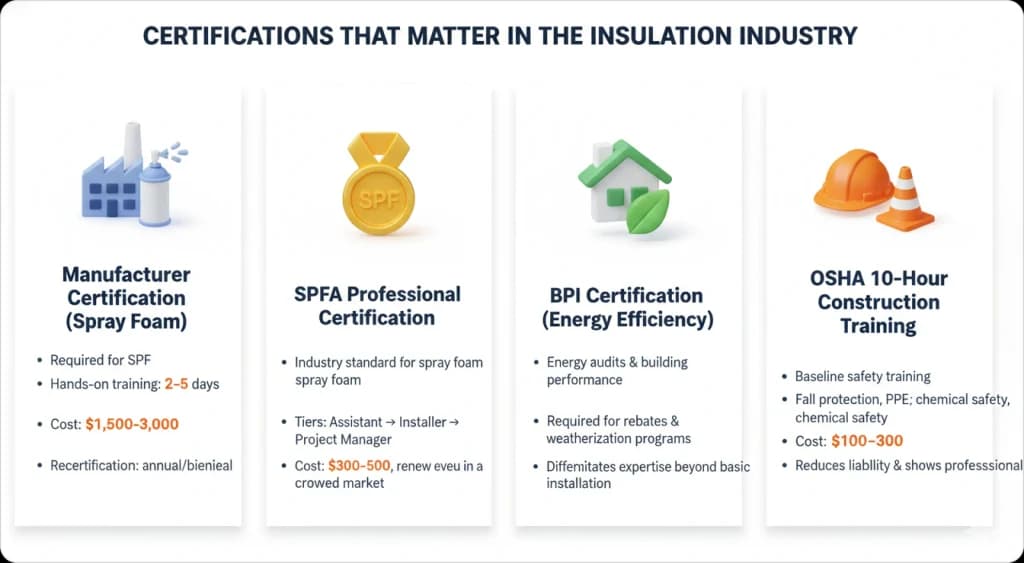
Beyond state licensing, certain certifications are either required or strongly recommended for insulation contractors. Here’s what actually moves the needle.
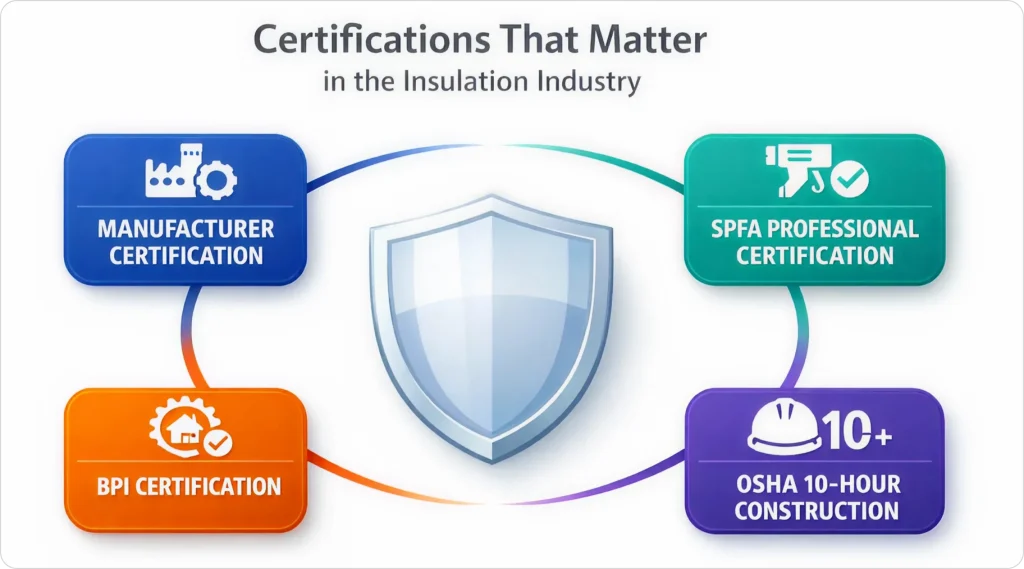
If you’re doing spray polyurethane foam (SPF) insulation, manufacturer certification isn’t optional; it’s mandatory.
Major spray foam manufacturers, including Demilec, BASF, Huntsman, Icynene, Gaco, and Lapolla, require contractors to complete their proprietary training programs before they’ll sell you materials.
This certification is also required to honor product warranties.
What to expect:
No manufacturer certification means no access to professional-grade spray foam materials. There’s no workaround.
The Spray Polyurethane Foam Alliance (SPFA) offers the insulation industry’s most widely recognized professional certification program for spray foam contractors.
Why it matters:
Certification tiers:
1. SPF Assistant: Entry-level for helpers and new technicians
2. SPF Installer: For experienced spray foam applicators
3. SPF Master Installer: Advanced certification for senior technicians
4. SPF Project Manager: For those managing crews and projects
Certification costs $300-$500 with renewal every three years. If you’re serious about spray foam, SPFA certification is worth the investment.
The Building Performance Institute (BPI) certification matters if you’re positioning yourself as an energy efficiency contractor rather than just an insulation installer.
BPI certification validates your ability to:
Why it matters for insulation contractors:
If your business model includes energy audits, weatherization work, or utility rebate programs, BPI certification is effectively required.
The OSHA 10-Hour Construction Safety course is a baseline requirement across much of the construction industry. Many states, general contractors, and commercial job sites require it for all workers.
For insulation contractors specifically, this training covers:
Cost runs $100-$300 for the course. Even where it’s not legally required, completing OSHA training demonstrates professionalism and reduces your liability exposure.
Licensing gets you legal permission to work. Insurance protects your business when things go wrong, and in insulation work, things can go wrong in expensive ways.
General liability insurance protects against third-party claims for bodily injury or property damage arising from your work. If insulation installation causes moisture problems, fire hazards, or structural issues, general liability responds.
Standard coverage: $1,000,000 per occurrence / $2,000,000 aggregate. Read more details about insulation general liability insurance here.
Most states require proof of general liability coverage to obtain or maintain a contractor license. Beyond legal requirements, general contractors and commercial clients typically require certificates of insurance before they will hire subcontractors.
Workers’ compensation coverage is required in nearly every state if you have employees. It covers medical expenses, rehabilitation costs, and lost wages when workers are injured on the job.
Insulation work involves chemical exposure (especially spray foam), confined space entry, ladder and scaffold use, and physical labor in extreme temperatures. The injury risk is real, and workers’ comp isn’t just a legal requirement; it’s essential protection.
Note: Requirements for sole proprietors and business owners vary by state. Some states allow exemptions; others require coverage regardless of employment status.
If you’re using vehicles to haul equipment, transport materials, or drive between job sites, your personal auto policy won’t cover accidents that occur during business activities. Commercial auto insurance fills that gap.
Your spray foam rig, proportioner, compressor, hoses, and tools represent a significant capital investment, often $50,000 to $150,000 for a fully equipped operation. Standard property insurance typically covers equipment only at your business location.
Inland marine insurance (also called equipment floater coverage) protects tools and equipment while they’re in transit, on job sites, or stored at temporary locations. For mobile insulation contractors, this coverage is essential.
The penalties for unlicensed contracting go far beyond fines. Here’s what’s actually at stake.
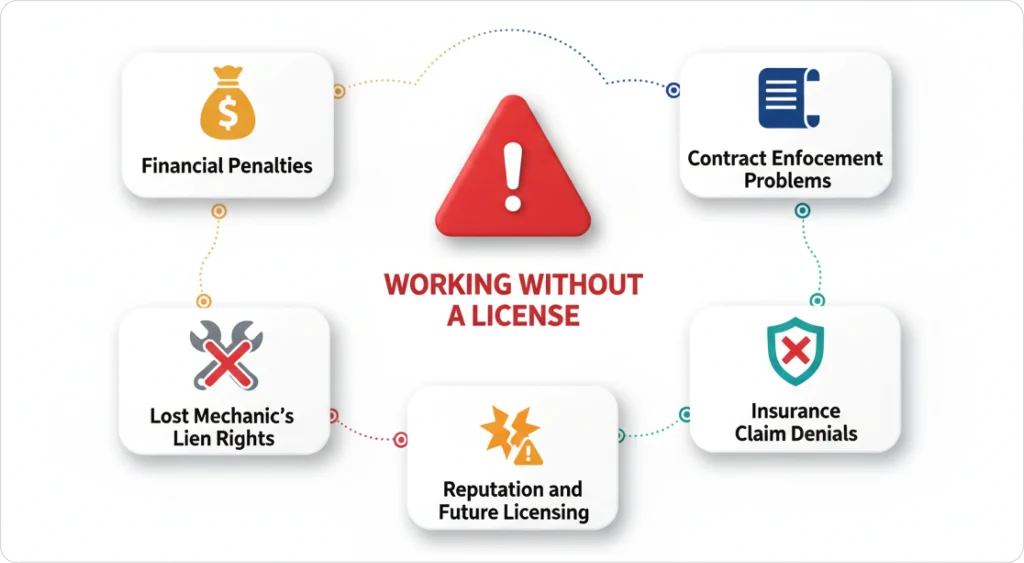
Depending on the state and circumstances, working without a required license can result in:
Some states calculate fines based on project value, meaning a single large job could trigger substantial penalties.
In most states, contracts with unlicensed contractors are unenforceable. This means:
Even if you complete a job perfectly, operating without proper licensing means you have no legal recourse if the customer doesn’t pay.
Mechanic’s liens are a contractor’s most powerful tool for securing payment. They allow you to place a claim against a property when you’re not paid for work performed.
Unlicensed contractors cannot file mechanic’s liens in most states. Without lien rights, your only option for collecting unpaid debts is small claims court, where you’ll face the contract enforcement problems described above.
Insurance policies typically include provisions requiring compliance with applicable laws. If you’re working without required licensing and a claim arises, your insurance carrier may:
This leaves you personally exposed to claims that insurance would otherwise cover.
License lookup databases are public. Customers, general contractors, and competitors can verify whether you’re properly licensed with a quick search.
Getting caught working unlicensed can also complicate future licensing applications. Many state applications ask about prior violations, and dishonesty on applications can result in permanent denial.
The specific process varies by state, but here’s the general path from unlicensed to fully legal.
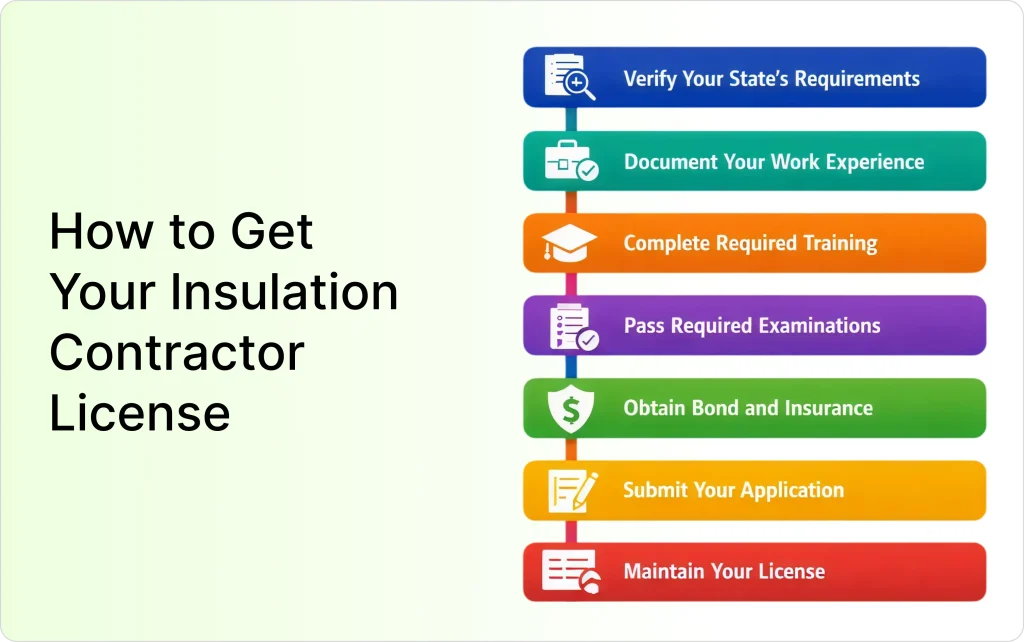
Requirements change. Before doing anything else, visit your state licensing board’s website and confirm:
Don’t rely on third-party websites or outdated information. Go directly to the source.
Most states require verified journey-level experience in the trade. Start gathering documentation now:
Experience typically must fall within the last 10 years. Older work history may not count toward your requirement.
Pro tip: If you’ve been working informally or for cash, you may face challenges documenting your experience. Some states accept affidavits from other licensed contractors who can verify your work. Check your state’s specific documentation requirements.
Depending on your state:
Build training time into your timeline. Education requirements alone can add 4-8 weeks before you’re eligible to sit for exams.
Most states require one or both of:
Exams are typically multiple choice with 70-75% passing scores required. Some states allow open-book exams; others don’t.
Preparation resources:
Before submitting your application, you’ll need:
Have certificates of insurance and bond documentation ready to submit with your application.
Complete your application with:
Processing timeline: 4-12 weeks, depending on your state, application completeness, and current processing backlogs.
Licenses aren’t permanent. Stay compliant with:
Set calendar reminders well before renewal deadlines. Letting a license lapse can mean restarting the application process from scratch.
Whether you’re a homeowner checking on a contractor or a contractor verifying your own status, here are the official lookup tools for states with specific requirements:
| State | License Verification Portal |
| Arizona | roc.az.gov |
| California | cslb.ca.gov |
| Florida | myfloridalicense.com |
| Georgia | sos.ga.gov |
| Hawaii | cca.hawaii.gov |
| Michigan | michigan.gov/lara |
| Nevada | nvcontractorsboard.com |
| North Carolina | nclbgc.org |
| Oregon | ccb.oregon.gov |
| Virginia | dpor.virginia.gov |
| Washington | lni.wa.gov |
For states without state-level licensing, check with local city or county building departments for contractor registration verification.
Getting licensed is just the first step.
Running a profitable insulation contracting business requires efficient operations, from scheduling crews for multi-day jobs to managing estimates and invoicing.
Insulation projects often span multiple days with different crew requirements, fiber installation on day one, and spray foam application on day two. Managing these complexities manually leads to scheduling conflicts, wasted drive time, and frustrated customers.
Modern field service management tools help insulation contractors:
Whether you’re a solo operator just starting or managing a growing business with multiple crews, the right systems make the difference between chaos and profitability.
Licensing requires upfront effort, but it protects your business, your customers, and your right to get paid for your work. The contractors who skip this step eventually learn the hard way that the cost of operating illegally far exceeds the cost of doing it right.
The License Was the Easy Part
Managing a growing insulation business without systems? That’s the hard part. FieldCamp is here for you to fix it.
Last updated: January 2026. Licensing requirements change; always verify current rules with your state licensing board before making business decisions.
It depends on your state and insulation type. About 30 states license insulation contractors as a distinct trade. Others may require general contractor or home improvement licenses above certain dollar amounts, typically $500 to $30,000, depending on the state. Spray foam usually requires manufacturer certification regardless of state law. Check your state’s contractor licensing board before bidding on work.
A specific insulation license (like California’s C-2 or Arizona’s C-40) is a specialty classification exclusively for insulation and acoustical work. You’ll take a trade-specific exam, and your license clearly demonstrates expertise in insulation. A general contractor license is broader; it authorizes you to perform or supervise multiple types of construction work, including insulation. Some states only offer the general contractor path; others give you the specialty option.
Total first-year costs typically range from $1,500 to $5,000, including application fees ($200-$500), exam fees ($50-$150), pre-license education if required ($200-$800), surety bond premium ($100-$500 annually based on bond amount and your credit), and insurance. California’s $25,000 bond requirement makes it one of the more expensive states. States with minimal exam or bond requirements cost significantly less.
Plan for 3-6 months from start to finish. Gathering experience documentation takes 1-2 weeks. Completing required training (if applicable) takes 1-4 weeks. Studying for and passing exams typically takes 2-8 weeks. Application processing runs 4-12 weeks, depending on your state. If you already have documented experience and just need to pass exams, you can sometimes complete the process faster.
Generally, no. Each state maintains its own licensing requirements, and most don’t offer reciprocity. Arizona is an exception, they offer expedited licensing for contractors who have held an equivalent license in another state for 12 or more months. But in most cases, you’ll need a separate license for each state where you perform insulation work.
Even without state licensing requirements, you typically still need business registration with your Secretary of State, local city or county contractor registration or permits, general liability insurance, workers’ compensation insurance (if you have employees), and manufacturer certifications (if doing spray foam work). “No state license” doesn’t mean “no requirements.”
For licensing purposes, usually not, spray foam falls under the same insulation contractor classification as fiberglass batts, blown-in cellulose, or rigid foam board. However, spray foam has additional practical requirements, including manufacturer certification to purchase materials, OSHA respiratory protection training due to chemical exposure risks, and specialized equipment knowledge. Insurance requirements may also be higher due to the technical nature of spray foam installation.
Penalties vary by state but can include fines from $500 to $15,000+ per violation, criminal charges (misdemeanor or felony for repeat offenses), inability to collect payment for work performed, contracts voided at the customer’s request, loss of mechanic’s lien rights, and insurance claim denials. The financial exposure from a single unlicensed project can far exceed the cost of proper licensing.
If you already hold a general contractor license in your state, it typically authorizes you to perform or supervise insulation work. However, some states have separate specialty classifications, and some general contractor licenses have scope limitations. Check your specific license classification and state regulations to confirm insulation work is covered.
The most valuable certifications include manufacturer certification (required for spray foam material purchases and warranties), SPFA Professional Certification (industry-recognized credential for spray foam contractors), BPI Certification (important for energy efficiency and weatherization work), and OSHA 10-Hour Construction Training (baseline safety certification). Manufacturer certification is effectively mandatory for spray foam; the others are recommended based on your business focus.