
What Is an Insulation Business? The Complete Industry Guide
February 25, 2026 - 36 min read

February 25, 2026 - 36 min read

Table of Contents
| TL;DR: An insulation business is a field service company that installs, removes, and upgrades thermal insulation in homes, commercial buildings, and industrial properties. The U.S. market is worth $13.6 billion and growing at 8.58% CAGR, with 89% of single-family homes still under-insulated. Gross margins run 45 to 55%, net margins sit around 25%, and a single spray foam rig with a 2-person crew can generate $1M+ annually. This guide breaks down the business model, types of insulation companies, startup costs, day-to-day operations, and exactly how contractors are making money in 2026. |
An insulation business is a field service management company that installs, removes, and upgrades thermal and acoustic insulation in residential, commercial, and industrial buildings. These businesses help property owners reduce energy costs, improve comfort, and meet building code requirements by applying materials like spray foam, fiberglass, cellulose, and mineral wool to walls, attics, crawl spaces, and other areas of the building envelope.
It’s one of the fastest-growing trades in construction, and for good reason. With 89% of U.S. single-family homes under-insulated and energy costs climbing, demand for insulation services has never been higher.
But what does running an insulation business actually look like? How do these companies operate day-to-day? What types of insulation businesses exist, and how much money do they really make?
Prefer listening over reading? Check out the podcast below!
This guide covers all of it, from the business model and revenue potential to the daily grind of managing crews, materials, and customer schedules.
KEY HIGHLIGHTS
What Is an Insulation Business?
At its core, an insulation business helps buildings retain heat in winter and stay cool in summer. That simple mission translates into a surprisingly wide range of services.
Insulation contractors are classified under NAICS Code 238310 (Drywall and Insulation Contractors), which helps define the scope and regulatory framework for the industry.
Most insulation businesses offer some combination of these services:
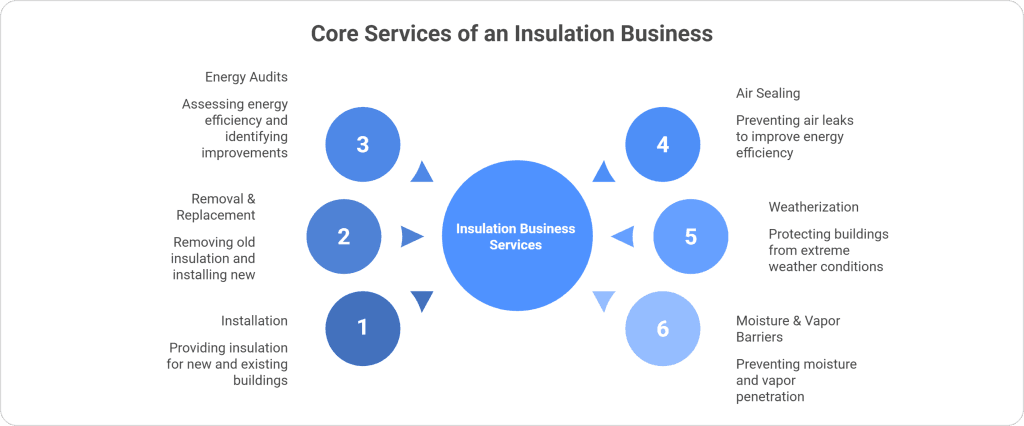
This is the bread and butter. It includes insulating new homes during construction, upgrading existing buildings through deep energy retrofit projects, and filling gaps in attics, walls, crawl spaces, basements, and ductwork.
Older insulation can become contaminated from rodent damage, mold, or water damage, or it can simply lose effectiveness over time. Removal businesses safely extract old materials and replace them with modern, energy-efficient alternatives.
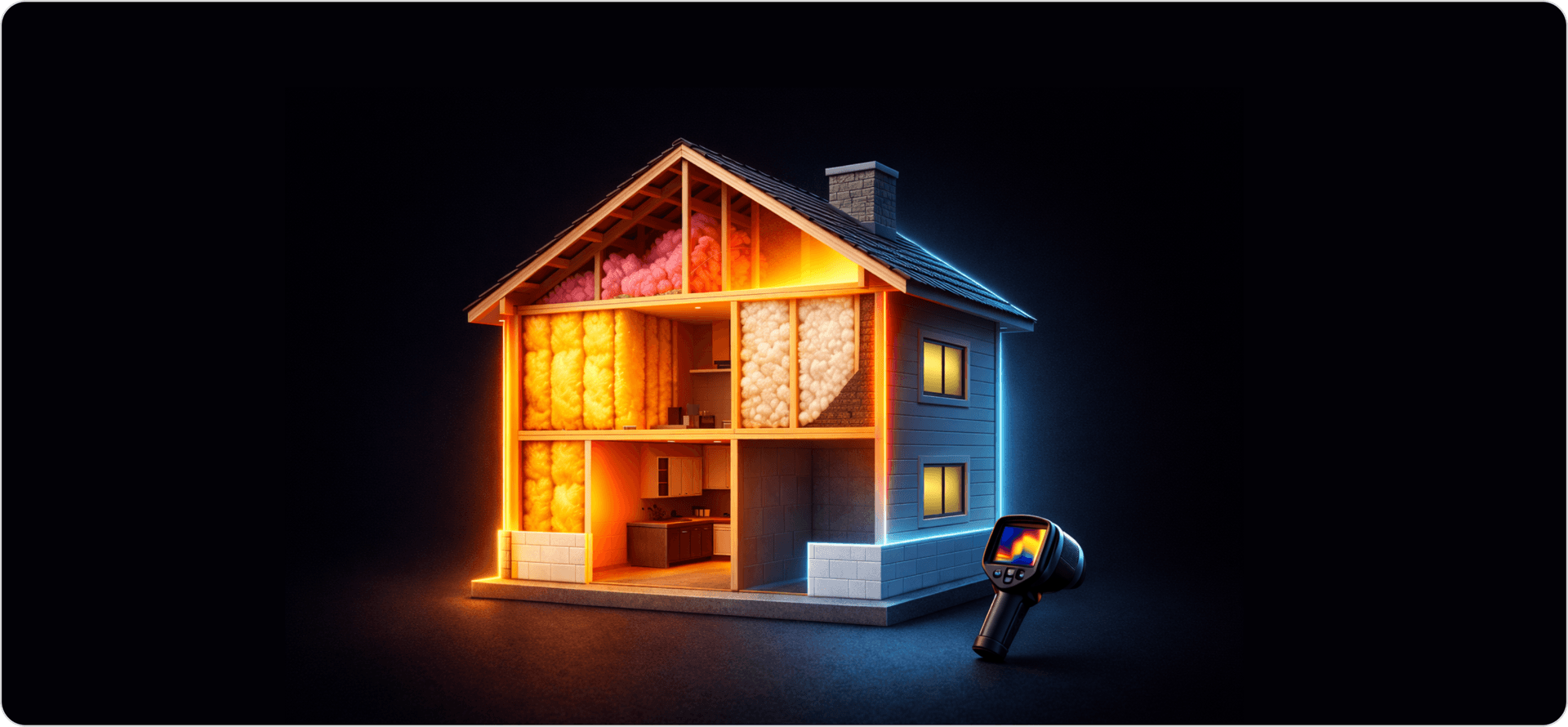
Many insulation contractors also offer blower door tests, thermal imaging inspections, and whole-home energy audits. Blower door testing measures air leakage and pinpoints where the building envelope is compromised. These services show homeowners exactly where heat is escaping and help them prioritize upgrades to improve indoor air quality and energy efficiency.
Insulation works best when paired with proper air sealing. Many contractors seal gaps around windows, doors, rim joists, and electrical penetrations as part of a comprehensive weatherization package. Proper air sealing reduces thermal bridging (heat transfer through structural elements like studs and joists) and improves overall building performance.
Some businesses participate in government-funded weatherization programs, providing low-income homeowners with free or subsidized insulation, air sealing, and energy upgrades.
In humid climates or damp crawl spaces, contractors install vapor barriers and vapor retarders to prevent condensation, mold growth, and structural damage.
Insulation businesses work with a variety of materials, each suited to different applications:
| Material | R-Value per Inch | Best For | Cost Range |
| Fiberglass batts | R-3.0 to R-4.3 | DIY-friendly; new construction walls | $ (lowest) |
| Blown-in cellulose | R-3.2 to R-3.8 | Attics; retrofit applications | $ |
| Open-cell spray foam | R-3.5 to R-3.6 | Walls; sound dampening; air sealing | $$ |
| Closed-cell spray foam | R-6.0 to R-6.5 | High performance; vapor barrier; structural strength | $$$ (highest) |
| Mineral wool / Rock wool | R-3.0 to R-3.3 | Fire resistance; soundproofing | $$ |
| Rigid foam board (EPS) | R-3.8 to R-4.4 | Basement walls; exterior sheathing | $$ |
| Rigid foam board (XPS) | R-5.0 | Moisture-prone areas | $$ |
| Rigid foam board (Polyiso) | R-5.6 to R-8.0 | Highest R-value rigid boards | $$$ |
R-value measures thermal resistance, so higher numbers mean better insulation performance. R-value claims are regulated by the FTC R-value Rule, which requires manufacturers to provide accurate thermal performance data.
Most insulation businesses specialize in one or two materials but offer multiple options based on customer needs and budget. For a detailed head-to-head comparison of the three most popular options, see our guide to spray foam vs blown-in vs batt insulation.
Insulation businesses serve four main customer segments:
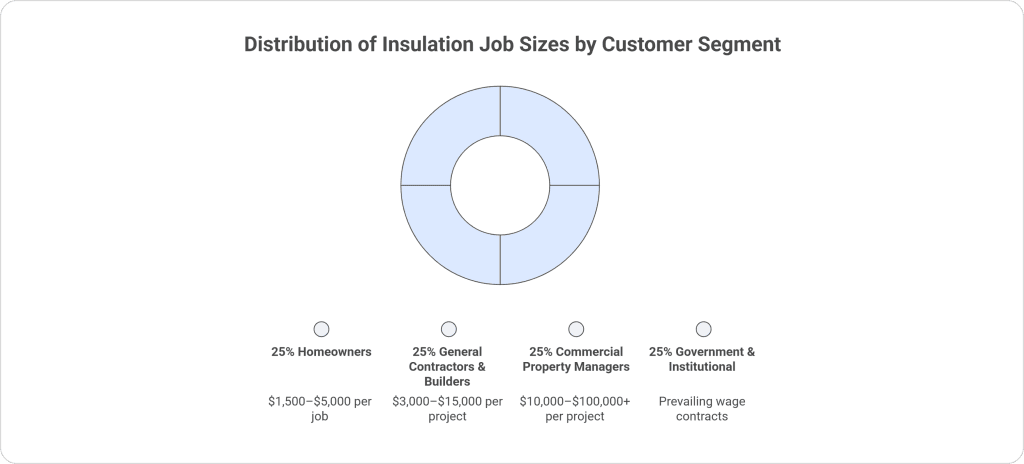
Homeowners (Largest Segment)
Residential customers hire insulation contractors for attic upgrades, crawl space encapsulation, wall cavity filling, and whole-home weatherization projects. Jobs typically range from $2,000 to $10,000.
Commercial Property Owners and Managers
Office buildings, retail spaces, warehouses, and apartment complexes all need insulation for energy efficiency and code compliance. Commercial jobs are larger, often $15,000 to $50,000+, but come with longer sales cycles.
General Contractors and Builders (New Construction)
This is a massive segment. Insulation contractors work as subcontractors on new home builds, completing installations before the drywall repair cost goes up. These are high-volume, lower-margin jobs with predictable workflows.
Government and Municipal Projects
Some contractors participate in weatherization assistance programs (WAP) or contract with utilities for energy efficiency rebate programs. The work is stable but involves more paperwork and compliance requirements.
Not all insulation businesses look the same. The industry includes a wide variety of business models, each with different startup costs, target markets, and revenue potential.
These contractors focus exclusively on spray polyurethane foam (SPF), both open-cell and closed-cell. Spray foam commands the highest margins (50%+ gross profit) but requires the most expensive equipment ($55,000 to $125,000 for a spray rig). This niche is growing fast due to demand for high-performance insulation.
If you’re considering this route, our guide on how to start a spray foam insulation business covers everything you need to know.
Cellulose insulation (made from recycled paper treated with fire retardants) is cost-effective and environmentally friendly. Blown-in contractors typically focus on attic upgrades and retrofit applications. Equipment costs are lower ($3,000 to $15,000 for blowing machines), making this one of the most accessible entry points into the trade.
These businesses offer multiple materials (fiberglass batts, blown-in cellulose, spray foam, mineral wool) and serve both residential and commercial markets. They can match the right material to each job, which increases close rates but requires more inventory and training.
This niche focuses on safely removing contaminated or damaged insulation, often from rodent infestation, mold, or water damage. It’s a less competitive niche with strong demand in older housing markets.
Some contractors combine energy audits, thermal imaging, and blower door testing with insulation installation. This model builds trust, commands higher prices, and generates longer-term customer relationships. It’s one of the fastest-growing niches as homeowners look for comprehensive energy solutions.
The largest segment. Residential contractors work directly with homeowners on attic upgrades, crawl space encapsulation, wall cavity insulation, and whole-home weatherization. Jobs are smaller but more frequent.
Commercial contractors insulate office buildings, retail spaces, warehouses, hotels, and multi-family housing. Jobs are larger and involve bidding processes, project management, and coordination with general contractors.
This niche insulates pipes, ductwork, boilers, tanks, and HVAC systems in factories, refineries, hospitals, and data centers. It requires specialized training and certifications but offers excellent margins and long-term contracts.
Many insulation businesses start as solo operations or single-crew setups. The owner runs jobs, manages scheduling, and handles sales. Startup costs are lower ($20,000 to $80,000), but revenue is capped by the owner’s capacity.
Established businesses run 2 to 10 crews simultaneously, with the owner transitioning into a management and sales role. Revenue scales significantly (often $1M to $3M+), but the complexity ramps up fast. Crew scheduling, training, quality control, and fleet management all become daily concerns.
Franchises provide brand recognition, proven systems, training, and marketing support in exchange for franchise fees ($189,000 to $410,000) and ongoing royalties (typically 6 to 8%). Franchisees benefit from established credibility but sacrifice some independence.
Some insulation contractors work exclusively as subcontractors for general contractors and builders on new construction projects. Volume is high, margins are lower, but workflows are predictable, and sales cycles are shorter.
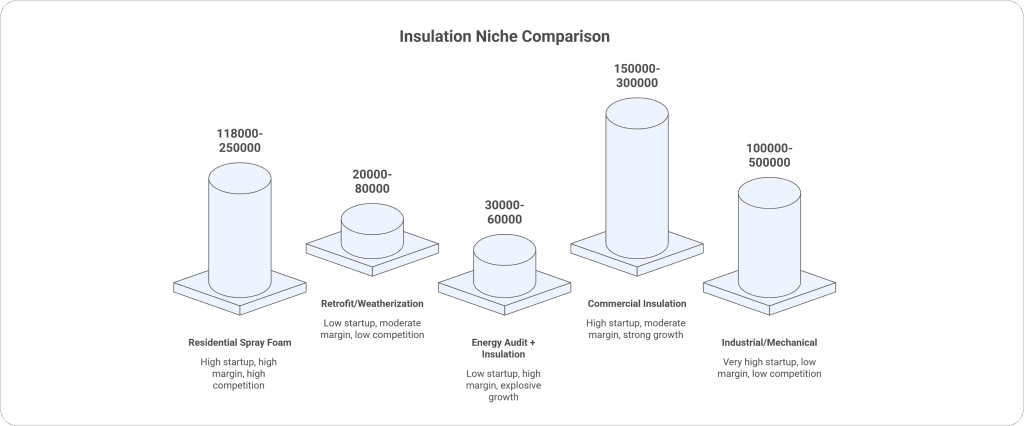
Here’s how the major niches compare side-by-side:
| Niche | Startup Cost | Avg Job Size | Margin | Competition | Growth Outlook |
| Residential spray foam | $118K to $250K | $5,500 | 50% | High | Strong |
| Retrofit/weatherization | $20K to $80K | $2K to $8K | 40 to 55% | Low-Moderate | Very Strong |
| Energy audit + insulation | $30K to $60K | $3K to $10K | 45 to 60% | Low | Explosive |
| Commercial insulation | $150K to $300K | $15K to $50K+ | 35 to 45% | Moderate | Strong |
| Industrial/mechanical | $100K to $500K | $50K to $500K+ | 30 to 40% | Low | Moderate |
Energy audit and insulation combo, as well as retrofit/weatherization businesses, offer the best combination of low startup costs, strong margins, and explosive growth. Residential spray foam is lucrative but highly competitive.
The insulation industry is experiencing a boom, driven by rising energy costs, stricter building codes, and unprecedented government incentives.
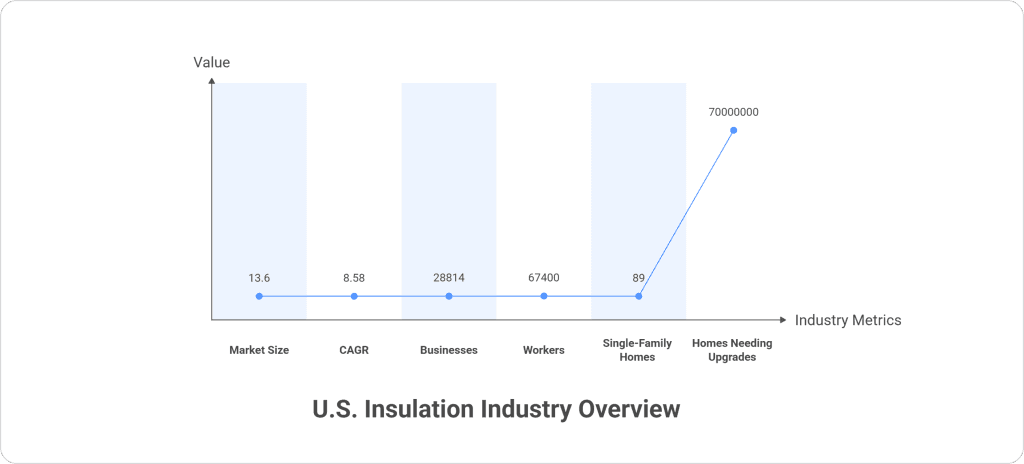
The U.S. insulation contractor market is valued at $13.6 billion in 2025, growing at a compound annual growth rate (CAGR) of 8.58%. By 2033, the market is projected to reach $24.94 billion.
There are currently 28,814 insulation contractor businesses operating in the U.S., employing approximately 67,400 insulation workers.
Globally, the insulation market was valued at $65 to $75 billion in 2025 and is expected to exceed $128 billion by 2034, with a CAGR of 7.7%. Asia Pacific leads with the largest share of global revenue.
Here’s the stat that should get your attention: 89% of U.S. single-family homes are under-insulated. That’s roughly 70 million homes that need insulation upgrades.
Heating and cooling account for 50 to 70% of energy use in the average American home. Homeowners who air seal and add insulation can save 15% on heating and cooling costs, a compelling ROI that keeps driving demand.
With over 1.3 million new homes forecast for 2025, the pipeline for insulation work remains strong.
The 2024 International Energy Conservation Code (IECC) made significant changes to building performance requirements. While prescriptive attic insulation requirements were actually reduced by R-11 across all climate zones (returning to 2018 levels), the code tightened air leakage requirements dramatically, down to 0.25 cfm/ft² (homes must be approximately 20% tighter than the 2021 code).
This means insulation contractors need to focus equally on air sealing and insulation performance, which is driving demand for blower door testing and comprehensive weatherization services.
The 25C tax credit (30% back, up to $1,200/year for insulation) expired December 31, 2025, after the One Big Beautiful Bill accelerated its termination from the original 2032 deadline. But new programs are filling the gap:
These incentives are pushing homeowner and builder demand for energy efficiency upgrades.
The construction industry has been adding fewer workers year over year. Skilled insulation installers are in high demand, pushing hourly wages from $14.81 (entry-level) to $22.84+ (experienced). Businesses that invest in training and retention have a real competitive edge.
Emerging materials like aerogel insulation (up to R-10 per inch), vacuum insulated panels (up to R-50), phase change materials (temperature-responsive insulation that stores and releases heat), and bio-based options (hemp, mycelium, recycled denim) are entering the market. Carbon-negative insulation products, meaning insulation that sequesters more CO₂ than it emits during production, are gaining traction in green building projects. While still niche, these innovations signal a shift toward higher-performance and sustainable materials.
Insulation contractors are increasingly adopting:
Contractors who embrace technology reduce administrative overhead and close more jobs faster.
Several states and municipalities are adopting net-zero energy building requirements for new construction. The Passive House standard is gaining adoption for ultra-low-energy buildings that require minimal heating and cooling. Insulation plays a central role in achieving net-zero performance, which is driving demand for high-R-value materials and whole-building energy strategies.
Demand varies significantly by region:
West USA: 7.4% CAGR
The West (California, Washington, Oregon, Nevada) leads in growth due to stringent energy codes, wildfire resilience building standards, and high energy costs.
South USA: 6.7% CAGR
The South (Texas, Florida, Georgia, North Carolina) is seeing strong growth driven by cooling efficiency needs, population growth, and a construction boom.
Northern / Midwest USA
Winter heating costs drive demand in cold climates. Summer (May to October) is peak installation season, as attics are more accessible and spray foam cures better in warm temperatures.
Profitability is one of the most common questions from people considering the insulation trade, and the numbers are genuinely strong. Insulation is one of the more lucrative construction trades out there.
Revenue varies widely based on business model, market focus, and crew size:
| Business Type | Annual Revenue | Avg Job Size |
| Single spray foam rig (2-person crew) | $1M+ | $5,500 |
| Full-service multi-crew operation | $1M to $3M | $5,000 to $15,000 |
| Koala Insulation franchise (average) | $952,193 | Varies |
| Koala Insulation franchise (top performers) | $1.7M+ | Varies |
| USA Insulation franchise (average) | $1.14M | Varies |
| USA Insulation franchise (top performers) | $2.4M+ | Varies |
| iFoam franchise (average) | $409,000 | Varies |
Sources: Intech Equipment, SharpSheets Koala FDD, SharpSheets USA Insulation FDD
Average Residential Job: ~$5,500 Commercial Jobs: $15,000 to $50,000+
A well-run insulation business with 2 to 3 crews can realistically generate $1.5 to $2M in annual revenue.
Insulation businesses enjoy strong margins compared to many other trades:
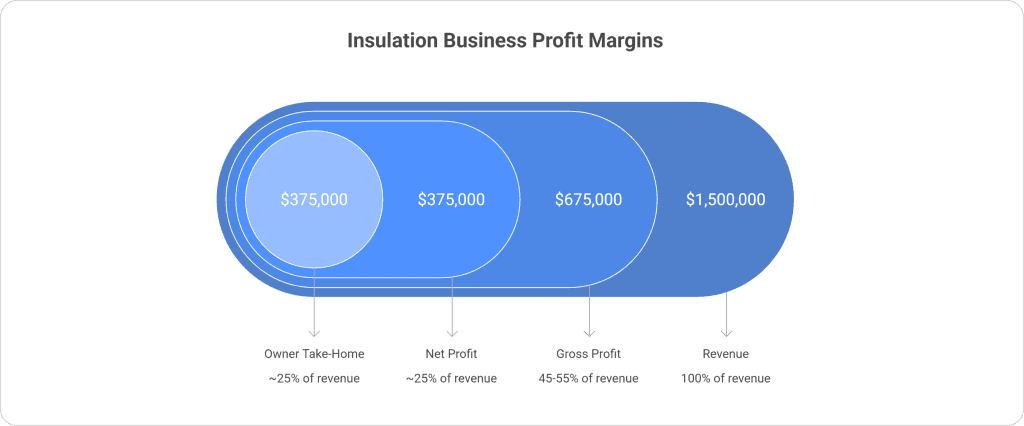
Gross Profit Margins: 45 to 55%
After accounting for materials and direct labor, established insulation businesses typically achieve gross margins between 45% and 55%. Spray foam jobs often hit the high end (50%+), while fiberglass and cellulose jobs trend lower (40 to 45%).
Net Profit Margins: ~25%
After overhead costs (insurance, marketing, equipment depreciation, admin labor, rent), successful insulation businesses net around 25% profit.
For a business doing $1.5M in annual revenue, that translates to roughly $375,000 in net profit, a strong return in the construction trades.
Franchise Owner Profit: $75,000 to $200,000/year
Franchise owners typically take home between $75,000 and $200,000 annually, depending on territory size, crew counts, and operational efficiency.
For a deeper look at how to price insulation and other field service jobs profitably, check out our service pricing guide.
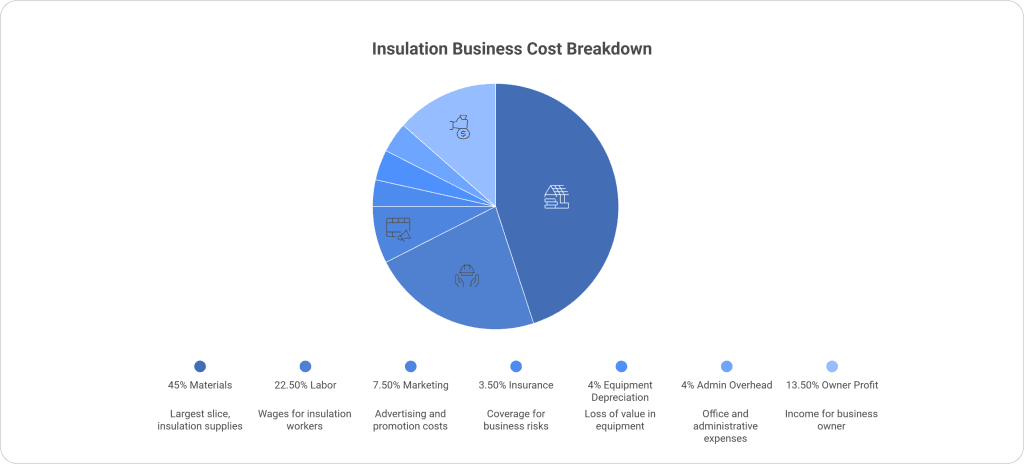
Here’s where the money actually goes in a typical insulation business:
| Expense Category | % of Revenue | Notes |
| Materials | 40 to 50% | Spray foam, fiberglass, cellulose, vapor barriers, adhesives |
| Labor (crew wages) | 20 to 25% | Installer wages, crew lead pay, payroll taxes |
| Insurance | 2 to 5% | General liability, workers comp, equipment coverage |
| Marketing | 5 to 10% | Local SEO, Google Ads, direct mail, vehicle wraps |
| Equipment depreciation | 3 to 5% | Spray rigs, blowing machines, trucks, trailers |
| Admin overhead | 3 to 5% | Office staff, software, bookkeeping, and rent |
| Owner salary/profit | 20 to 30% | What’s left after all expenses |
Annual Insurance Costs:
Materials are the single biggest variable cost. Spray foam materials cost significantly more than fiberglass or cellulose, but they also command higher prices, which keeps margins strong.
Many insulation contractors recoup their initial investment of $70,000 to $105,000 in fewer than 15 jobs. With average residential jobs around $5,500 and net margins of 25%, each job nets about $1,375 in profit.
Most insulation businesses achieve consistent monthly profitability within 2 to 3 years. Year one is about building a customer base, refining workflows, and establishing supplier relationships. By year three, most businesses hit a steady rhythm.
Established insulation contractors typically achieve full ROI (total startup costs recovered) within ~5 years, including owner salary, reinvestment, and growth expenses.
This is what most guides skip: what does a typical day actually look like?
Running an insulation business isn’t just about installing materials. It’s about managing crews, coordinating schedules, estimating jobs, ordering supplies, communicating with customers, and keeping everything on track without dropping the ball.
6:30 AM, Shop Check-In and Crew Assignments
The day starts at the shop or warehouse. Crew leads check equipment, review the day’s jobs, and confirm material availability. The owner or dispatcher assigns crews to jobs based on skills, certifications, and geographic proximity.
For a spray foam job, the crew verifies the rig is fueled, chemicals are loaded, and spray guns are functioning. For blown-in cellulose or fiberglass jobs, they load the blowing machine, bags of material, and hand tools.
7:00 AM, Truck Loading and Route Planning
Crews load trucks with materials, ladders, safety gear, and job-specific supplies. The dispatcher, or AI dispatch scheduling software, optimizes routes to minimize drive time between jobs.
8:00 AM, Job Site Arrival, Safety Briefing, and Site Assessment
Crews arrive on site, introduce themselves to the customer, and walk through a quick safety check. They confirm the scope of work, look for hazards (electrical wiring, existing moisture damage, rodent activity), and set up equipment.
On a spray foam attic job, the crew seals off HVAC vents, covers light fixtures, and sets up ventilation. Safety is critical because spray foam chemicals require respirators and protective suits.
8:30 AM to 3:30 PM, Installation Work
This is the core of the day. Depending on the job type:
Jobs vary in size. A small attic might take 3 to 4 hours. A whole-home spray foam job could take 2 days.
12:00 PM, Lunch Break (Often On-Site)
Crews take a quick lunch, often eating in their trucks or on-site. Insulation work is physically demanding. Installers are climbing into 120°F attics, crawling through tight crawl spaces, and carrying heavy materials all day.
3:30 PM, Clean-Up, Quality Check, and Customer Walkthrough
Once installation is complete, crews clean up debris, remove protective coverings, and conduct a quality inspection. They check for missed spots, proper R-value depth, and full coverage.
The crew lead walks the customer through the finished work, answers questions, and explains next steps (ventilation time for spray foam, attic access restrictions, etc.).
4:00 PM, End-of-Day Documentation and Next-Day Prep
Crews return to the shop to drop off equipment, unload unused materials, and document the completed job. Invoices are generated, either on paper or through field service invoicing software, and submitted for payment.
The dispatcher reviews the next day’s schedule, confirms materials are ordered, and assigns crews to upcoming jobs.
Evening, Office Work (Owner / Manager)
While crews head home, the business owner or office manager handles:
Efficient crew scheduling is the backbone of a profitable insulation business. Poor scheduling leads to wasted drive time, underutilized crews, and missed revenue.
Typical Crew Structure:
Scheduling Challenges:
AI job scheduling tools solve many of these headaches by automatically matching certified crews to jobs while balancing workload and geography. For more on running efficient field operations, see our guide to field service management strategies.
Technology is transforming how insulation businesses operate. Contractors who adopt the right tools gain a real edge in efficiency, customer satisfaction, and profitability.
The best insulation contractor software platforms handle scheduling, dispatching, CRM, invoicing, and customer communication in one system. FieldCamp, for example, uses AI to automatically match certified crews to jobs, optimize routes, and generate invoices, saving hours of manual work every day.
FLIR and similar thermal cameras show heat loss, air leaks, and insulation gaps in real time. Contractors use them for pre-installation assessments and post-installation verification, and they’re a powerful sales tool that builds instant credibility with customers.
Tools like FieldCamp’s quote management system speed up the quoting process. Contractors input job details, and the software generates professional estimates with material costs, labor hours, and pricing. You can also enhance your estimates with contracts, terms, and attachments to look more professional and close deals faster.
Modern contractors use mobile invoicing apps or FSM software to email invoices immediately after job completion. FieldCamp’s invoicing system integrates payment processing (credit cards, ACH) to reduce collection time and improve cash flow.
Route optimization tools minimize drive time between jobs. For businesses running multiple crews, this saves hours and fuel costs every week.
Field service reporting tools help you track job completion rates, crew utilization, revenue per job, and other key metrics that drive profitability.
Drones allow contractors to inspect roofs, soffits, and exterior walls without ladders. Especially useful for commercial buildings and older homes with steep or damaged roofs.
Every business has its challenges. Here are the biggest ones insulation contractors face, and how the successful ones navigate them.
Insulation work is seasonal, with demand peaking in late summer through fall as homeowners prepare for winter.
Month-by-Month Demand Patterns:
| Period | Demand Level | What to Do |
| Jan to Feb | Slow | Training, equipment maintenance, marketing ramp-up, and estimate follow-ups |
| Mar to Apr | Ramping up | Energy audit promotions, post-winter damage assessments, and lead generation |
| May to Jun | Full swing | Residential retrofit season, new construction projects |
| Jul to Aug | Peak (cold climates) | Commercial projects, maximum crew utilization |
| Sep to Oct | Peak | Pre-winter insulation rush, highest marketing ROI, close every qualified lead |
| Nov to Dec | Tapering (cold) / Steady (warm) | Holiday marketing, year-end planning, equipment upgrades |
How to Smooth Revenue:
Automate your off-season workflows
The best insulation businesses use slow seasons to optimize operations. FieldCamp automates invoicing, reminders, and follow-ups so you can focus on growth when peak months hit.
The construction industry has been adding fewer workers year over year. Finding and retaining skilled insulation installers is one of the biggest pain points in the industry right now.
Why It’s Hard:
How to Overcome It:
Not all insulation materials work in every climate. Closed-cell spray foam is ideal for humid regions (acts as a vapor barrier), while open-cell spray foam works better in dry climates. Fiberglass batts require proper vapor barriers in cold climates to prevent condensation. Get this wrong, and you’ll face callbacks, moisture issues, and unhappy customers.
New contractors often underprice to win business. This kills profit margins and makes it impossible to cover overhead. Use estimating software, track your actual costs, and price jobs at a level that ensures 45 to 55% gross margins.
Skipping workers’ comp or carrying only minimum liability limits is a recipe for disaster. One injury or lawsuit can bankrupt a small business. Budget $5,000 to $10,000/year for comprehensive coverage.
Every jurisdiction has specific insulation requirements (R-values, vapor barriers, fire ratings). Failing to meet code results in failed inspections, costly rework, and damaged reputation. Stay current on the 2024 IECC and your local amendments.
Insulation businesses buy materials upfront and often wait 30 to 60 days for payment. Without proper cash flow management, you can be profitable on paper but unable to make payroll. Solutions: require deposits, use invoice financing, automate collections.
Cash flow challenges are the #1 reason small businesses fail. Here’s how successful insulation contractors stay cash-positive:
For residential jobs over $5,000, collect a 25 to 50% deposit upfront. For large projects, structure progress payments (e.g., 50% upfront, 25% at midpoint, 25% on completion).
Email invoices immediately after job completion. The faster you invoice, the faster you get paid. FSM software automates this entire process.
Accept credit cards, ACH, checks, and financing (through partners like GreenSky, Wisetack, or Synchrony). Customers who can finance large jobs are far more likely to say yes.
Save 3 to 6 months of operating expenses during peak season to cover payroll, insurance, and overhead during slow months.
If you work with commercial clients or builders who pay Net-30 or Net-60, consider invoice factoring. Companies like BlueVine or Fundbox advance 80 to 95% of invoice value immediately, charging a small fee.
Thinking about jumping in? Here’s a quick overview of what it takes to get started.
Licensing: Over 30 states require some form of contractor licensing for insulation work. Requirements vary widely. Some states require specialty insulation licenses, while others require general contractor licenses. Common requirements include proof of experience, liability insurance, a surety bond, and passing a contractor exam.
Always check your state contractor board and local building department before starting. For a full state-by-state breakdown, see our insulation contractor license guide.
Insurance: General liability ($1M/$2M) costs $47 to $69/month. Workers’ compensation (required in nearly every state once you hire employees) costs ~$254/month. Budget $5,000 to $10,000/year for comprehensive coverage.
Equipment and Startup Costs: General insulation businesses cost $20,000 to $40,000 to start. Spray foam businesses require $70,000 to $250,000+ due to specialized equipment (spray rigs cost $55,000 to $125,000). Franchises (Koala, USA Insulation, iFoam) run $189,000 to $410,000.
Certifications That Set You Apart: BPI (Building Performance Institute) certifications, including BPI Building Analyst, BPI Retrofit Installer, and BPI Envelope Professional, significantly boost credibility and pricing power. RESNET HERS Rater certification qualifies you for ENERGY STAR Home Performance program partnerships and utility rebate programs.
SPFA Spray Foam Installer and OSHA 10/30-Hour certifications are also valuable. Certified contractors can charge 10 to 20% more per job and qualify for government weatherization contracts.
Bottom line: Starting an insulation business requires moderate capital, some certifications, and careful planning, but the ROI is strong. Most contractors recoup their initial investment in fewer than 15 jobs and hit full ROI within 5 years.
For professional estimates from day one, download our free insulation estimate template. And for invoicing, grab our free installation invoice template.
If you’re deciding which construction trade to enter, here’s an honest side-by-side look:
| Factor | Insulation | HVAC | Plumbing | Electrical | Roofing |
| Startup Cost | $20K to $250K | $50K to $150K | $30K to $100K | $30K to $100K | $40K to $150K |
| Licensing Complexity | Moderate | High | High | Very High | Moderate |
| Emergency Calls | Rare | Common | Very Common | Occasional | Seasonal (storms) |
| Seasonality | Moderate (peak fall) | Moderate (year-round w/ seasonal spikes) | Low | Low | High (weather-dependent) |
| Physical Demand | High | Moderate | Moderate | Moderate | Very High |
| Average Job Size | $5,500 | $8,000 to $15,000 | $300 to $5,000 | $500 to $8,000 | $8,000 to $20,000 |
| Recurring Revenue | Low | Moderate (maintenance) | Low (repairs) | Low | Low |
| Growth Outlook | Very Strong (8.58% CAGR) | Strong | Moderate | Strong | Moderate |
Insulation has lower licensing barriers than HVAC, plumbing, or electrical, but higher startup costs (especially for spray foam). It’s less seasonal than roofing, involves fewer emergency calls than plumbing, and has stronger growth than most other trades.
For entrepreneurs who don’t mind physically demanding work and want to enter a high-margin, fast-growing trade, insulation is one of the best options in construction right now.
Marketing and customer acquisition are critical for growth. Here’s how the successful insulation contractors generate leads and close jobs.
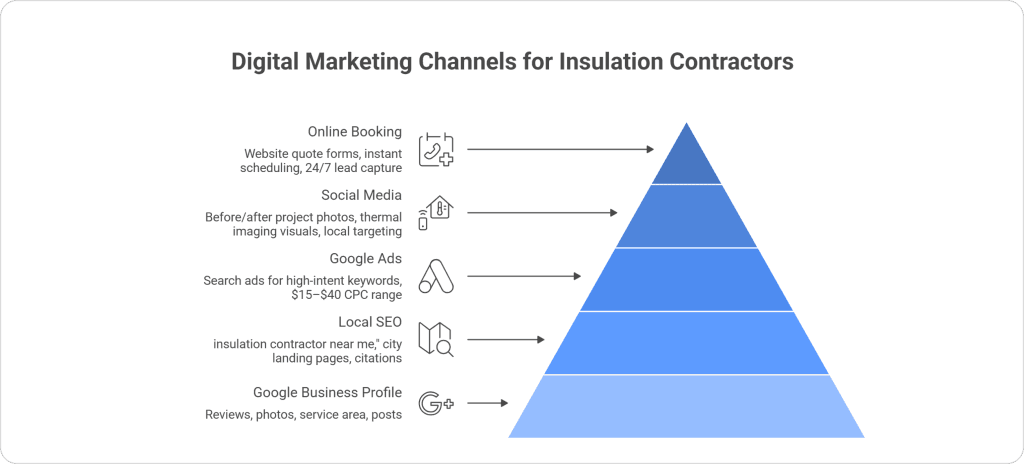
Google Business Profile (GBP)
97% of consumers research contractors online before hiring. A fully optimized Google Business Profile (with photos, reviews, service area, and hours) is non-negotiable. Insulation contractors with 20+ five-star reviews close 40% more jobs than those with fewer reviews.
Local SEO
Ranking in Google’s Local Pack (the map listings at the top of search results) drives high-intent leads. Optimize your website for keywords like “insulation contractor near me,” “spray foam insulation [city],” and “attic insulation [city].”
Google Ads (PPC)
Pay-per-click advertising on Google generates immediate leads. Target high-intent keywords like “attic insulation cost,” “spray foam contractor,” and “crawl space insulation.” Expect to pay $5 to $15 per click, with conversion rates of 5 to 10%.
Facebook and Instagram Ads
Visual platforms are perfect for before-and-after photos, educational videos (thermal imaging showing heat loss), and customer testimonials. Target homeowners aged 35 to 65 in your service area.
Online Booking
Adding online booking to your website lets potential customers schedule estimates 24/7, even after business hours. This captures leads that would otherwise call a competitor.
Realtor Partnerships
Real estate agents constantly encounter homes with energy efficiency issues during inspections. Partner with local realtors to provide pre-listing energy audits or post-inspection insulation upgrades.
General Contractor and Builder Relationships
New construction is a massive market. Build relationships with local builders and GCs to become their go-to insulation sub. Consistent quality and reliability lead to repeat business, and builders talk to each other.
Customer Referral Programs
Offer $100 to $250 referral bonuses to customers who send new business your way. Happy customers are still your best marketing channel.
Many utility companies offer free or subsidized energy audits to their customers. Partner with these programs to get direct referrals for insulation upgrades.
HERS raters and BPI-certified energy auditors are also great lead sources. If you’re not certified yourself, build partnerships with local auditors who can recommend your services. The ENERGY STAR Home Performance program connects certified contractors with homeowners seeking comprehensive energy upgrades.
The Weatherization Assistance Program (WAP) provides free weatherization services to low-income households. Contractors who qualify for WAP contracts get steady, predictable work, though margins are lower and paperwork is heavier.
State-level energy efficiency programs (often funded by utility surcharges) also contract with insulation businesses to deliver rebate-eligible upgrades.
Many utilities (electric and gas) offer rebates for insulation upgrades that reduce energy consumption. Becoming an approved contractor in these programs gives you access to leads, co-op marketing, and instant credibility.
Examples:
The insulation industry is evolving fast. Here are the trends shaping the next decade.
Insulation is no longer just about R-value. It’s becoming part of the smart building ecosystem. Emerging technologies include:
Contractors who understand smart building integration will win high-end residential and commercial projects.
The construction industry is under pressure to reduce carbon emissions. Insulation manufacturers are responding with:
These materials are still niche but growing fast. Contractors who offer sustainable options will appeal to eco-conscious homeowners and projects pursuing green building certifications (LEED, Passive House, Living Building Challenge).
The shift from the 25C tax credit to the HOMES and HEAR rebate programs is accelerating demand for whole-home energy upgrades. These programs require certified contractors, energy modeling, and verified savings, creating opportunities for insulation businesses that invest in BPI certifications and partnerships with HERS raters.
The 45L tax credit (for builders of energy-efficient homes) and 179D deduction (for commercial buildings) continue to drive demand on the new construction side through mid-2026.
Insulation contractors who embrace field service automation will dominate their markets. Key trends to watch:
Technology reduces administrative overhead, speeds up quoting, and improves customer satisfaction, all competitive advantages that compound over time.
An insulation business is one of the most profitable and fastest-growing opportunities in the construction trades. With 70 million under-insulated single-family homes, tightening energy codes, and unprecedented government incentives, demand has never been stronger.
But it’s not easy. The work is physically demanding. Crew management, seasonal cash flow, and skilled labor shortages are real challenges that don’t go away. Success requires operational discipline, strong marketing, and a commitment to quality work.
If you’re willing to invest in the right equipment, certifications, and systems, and you’re ready to embrace technology to streamline your operations, an insulation business can deliver strong margins, steady growth, and long-term profitability.
The contractors who win in 2026 and beyond will be the ones who combine field expertise with modern tools, customer-first service, and strategic positioning in a market that’s only getting bigger.
What’s Leaking More Than Uninsulated Walls? Your Profit Margins
Missed follow-ups, double-booked crews, and late invoices quietly eat into that 40–50% gross margin you worked hard to build. FieldCamp gives insulation contractors one platform to schedule, dispatch, invoice, and get paid, so nothing slips through the cracks
An insulation business is a field service company that installs, removes, and upgrades thermal insulation in buildings. Services include spray foam, fiberglass, cellulose, and mineral wool installation in attics, walls, crawl spaces, and other areas to improve energy efficiency and comfort.
Yes. Established insulation businesses earn gross margins of 45 to 55% and net margins around 25%. A single spray foam rig with a 2-person crew can generate $1 million+ in annual revenue. Average residential jobs are around $5,500. (Source: Wexford Insurance)
General insulation businesses cost $20,000 to $40,000 to start. Spray foam businesses require $70,000 to $250,000+ due to specialized equipment. Franchise investments range from $189,000 to $410,000, depending on the brand. (Source: StepByStepBusiness)
Insulation contractor licenses vary by state. Over 30 states require some form of contractor licensing. Common requirements include proof of experience, liability insurance, a surety bond, and passing a contractor exam. Check your state contractor board for specific rules.
Basic equipment includes insulation blowing machines ($3,000 to $15,000), safety gear (respirators, PPE), utility knives, moisture meters, and a work vehicle. Spray foam businesses need a spray rig ($55,000 to $125,000). (Source: Intech Equipment)
Franchise owners typically earn $75,000 to $200,000 in annual profit. Independent operators can earn more depending on volume. Average franchise revenues range from $409,000 (iFoam) to $1.14 million (USA Insulation). (Source: SharpSheets)
Yes. The U.S. insulation market is growing at 8.58% CAGR, projected to reach $24.94 billion by 2033. With 89% of single-family homes under-insulated and tightening energy codes, demand is accelerating. (Source: IBISWorld)
Main types include: spray foam specialists, blown-in/cellulose contractors, full-service installers, insulation removal companies, and energy audit + insulation combos. Businesses can focus on residential, commercial, or industrial markets.
Insulation businesses are seasonal, with peak demand from August through November. Smart operators diversify with energy audits, air sealing, and commercial contracts to maintain year-round revenue.
Spray foam insulation has the highest margins (50%+ gross) but requires the biggest investment ($70K to $250K). Energy audit + insulation combos are the fastest-growing niche with the best margins-to-startup-cost ratio. Franchises offer proven systems but cost $189K to $410K.
The U.S. insulation contractor market is worth $13.6 billion (2025). Globally, the insulation market is $65 to $75 billion and projected to exceed $128 billion by 2034. (Source: Precedence Research)
Top methods include local SEO, Google Ads, referral programs, partnerships with builders and realtors, energy audit lead generation, and government weatherization program contracts. 97% of consumers research contractors online before hiring.