

Free Roofing Estimate Template
About this template
FieldCamp’s free roofing estimate template helps you nail down project costs before the first shingle goes up. Calculate material costs, labor hours, and profit margins in minutes, not hours. Customize with your roofing company name, add detailed breakdowns for each roof section, and set clear project timelines.
Professional estimates that win more commercial roofing projects, protect your margins, and keep customers confident in your pricing. Built for roofers who measure twice and profit once.
Key Features
- Smart material cost calculator with waste factors
- Labor hour estimates by roof complexity
- Professional layouts with company branding
- Section-by-section pricing breakdowns
,
|
ESTIMATE
#1
Issued: 2026-04-11
Due: 2026-04-11
BILL TO:
Services Provided
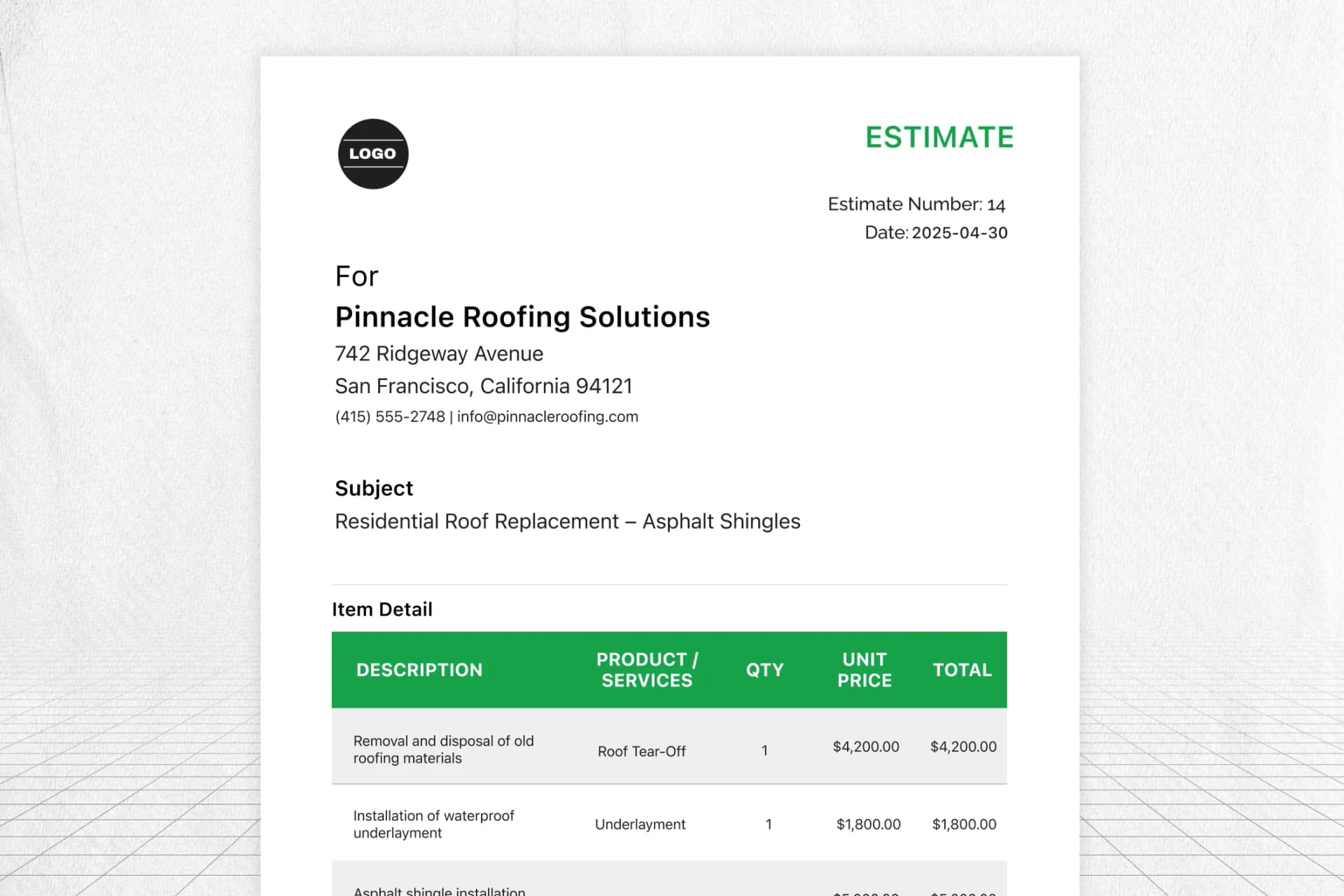
| DESCRIPTION | PRODUCT / SERVICE | QTY | UNIT PRICE | TOTAL |
|---|---|---|---|---|
| Remove existing roofing material, haul to dumpster | Tear-Off & Disposal | 1 | $150.00 | $150.00 |
| Synthetic underlayment + ice/water shield at eaves and valleys | Underlayment | 1 | $850.00 | $850.00 |
| Architectural shingles (e.g., GAF Timberline), 24 squares | Shingle Installation | 1 | $200.00 | $200.00 |
Built for Every Roofing Business Model
This free roofing estimate template helps contractors create professional quotes in minutes. Enter your project details: tear-off, materials, labor, and waste factor, and generate a polished PDF estimate your customers can sign on the spot. Works for:
- Residential re-roofs and new construction
- Roof repairs (storm damage, leaks, missing shingles)
- Commercial flat roof replacements (TPO, EPDM, modified bitumen)
- Full tear-off and overlay projects
- Insurance restoration estimates
Built for Every Type of Roofing Job
Not every roofing job is the same, and your estimates shouldn’t be either. This template adapts to the way you actually work.
Residential Re-Roofs
The bread and butter for most roofing companies. List out tear-off, underlayment, shingles, flashing, and ventilation as separate line items. Homeowners want to see the breakdown; it builds trust and makes your price easier to justify when you’re sitting at their kitchen table.
Roof Repairs
Storm damage, leaks, blown-off shingles, and repair estimates need to be fast and accurate. Use the template to quote specific sections of the roof without repricing the whole thing. Include a note about potential hidden damage and change order terms so there are no surprises once the crew starts pulling material.
Commercial Flat Roofs
TPO, EPDM, modified bitumen, and built-up roofing, commercial jobs need more detail than residential work. Add line items for insulation, membrane, penetration detailing, and edge metal. Include phasing if the building stays occupied during the work.
Insurance Restoration
When you’re working with adjusters, your estimate needs to match their format. Use detailed line items, include photos and measurements, and keep material specs precise. A clean, professional estimate speeds up approval and keeps the project moving instead of sitting in someone’s inbox.
For quick material and labor cost projections before you build your full estimate, run the numbers through our roofing cost calculator first. And once the job is approved and complete, convert your estimate into a polished invoice using the roofing invoice template.
How to Use This Roofing Estimate Template
Getting started takes about five minutes. Here’s the process:
Step 1 – Add Your Company Details
Enter your roofing company name, address, phone, and email. Upload your logo so every estimate goes out looking professional. This section auto-populates on every future estimate.
Step 2 – Fill In the Customer and Property Info
Add the homeowner’s name, property address, and contact details. Include the project address if it’s different from the mailing address — this matters for permit filings and insurance claims.
Step 3 – Build Your Line Items
This is where the estimate comes together. Add each component of the job as a separate line item — tear-off, underlayment, shingles, flashing, ventilation, cleanup. Include quantities, unit costs, and descriptions. The more detail you include here, the more confident the homeowner feels about your price.
Step 4 – Set Your Tax Rate and Margins
The template auto-calculates subtotals, applies your tax rate, and shows the final total. Adjust the discount field if you’re running a seasonal promotion or offering an early-signing incentive.
Step 5 — Generate and Send
Hit “Generate Free Estimate” to create a clean PDF. Send it to the homeowner via email, print it on-site, or save it for follow-up. If the customer accepts and you complete the work, convert it to an invoice with the roofing invoice template.
Estimates That Close on the Spot
Every roof starts with a winning quote. Create estimates so professional, so detailed, that customers sign before you leave the driveway.
What Should a Professional Roofing Estimate Include?
A complete roofing estimate isn’t just a price on a page. It’s the document that wins or loses the job, and it protects both you and the homeowner if anything goes sideways mid-project. Here’s what needs to be in every estimate you send out.
1. Property and Roof Details
Start with the basics — property address, total roof square footage, and number of roofing squares (1 square = 100 sq ft). Note the roof pitch, because a 6/12 slope takes meaningfully more labor than a 4/12. Document the current roofing material and its condition, how many layers are on the roof (many municipalities cap at two before requiring a full tear-off), and any visible deck damage. If plywood replacement looks likely, call it out now so it doesn’t become a surprise change order later.
2. Materials Breakdown
List every material by name and specification. Don’t just write “shingles” — write “GAF Timberline HDZ architectural shingles, Charcoal.” Customers can’t compare vague estimates, and specificity signals professionalism. Your materials section should cover:
- Shingle type, brand, and color
- Underlayment (synthetic vs. felt, plus ice & water shield at eaves, valleys, and penetrations)
- Flashing (step, counter, chimney, drip edge — specify the material: aluminum, galvanized, or copper)
- Ridge cap and starter strip
- Ventilation (ridge vent, soffit vents, box vents)
- Waste factor — 10% for simple gable roofs, 15% for hip roofs, 15–20% for complex rooflines with dormers and multiple valleys
3. Labor Breakdown
Break labor into its components: tear-off crew hours, installation crew hours, and any specialty work (chimney flashing, skylight flashing, etc.). Include your per-square labor rate or flat crew rate, and note any complexity adjustments for steep pitch, multi-story access, or limited equipment staging areas.
4. Additional Costs
Spell out the extras that most homeowners don’t think about — dumpster rental and disposal fees, permit costs ($100–500 depending on municipality), wood replacement per sheet of plywood or OSB, gutter re-attachment, and removal/reinstallation of satellite dishes, solar panels, or HVAC equipment sitting on the roof.
5. Terms and Protections
Include warranty details (manufacturer vs. workmanship — they’re different), payment schedule (50/50 is standard for residential, 30/40/30 for larger projects), project timeline with start and completion dates, your insurance and license information, and a change order policy that explains how scope additions are handled.
Pro tip: The more detail you put in the estimate upfront, the fewer disputes you deal with later. A thorough estimate is a contract that both sides can actually reference.
Roofing Estimate Examples by Project Type
Not sure what a finished roofing estimate should look like? Here are three examples covering the most common job types: residential replacement, storm damage repair, and commercial flat roof. Use these as benchmarks for your own pricing.
Residential Roof Replacement: Asphalt Shingles
Scenario: 2,800 sq ft ranch home in Charlotte, NC. Single-layer tear-off, 6/12 pitch, 2-car attached garage, one chimney.
| Line Item | Details | Cost |
|---|---|---|
| Tear-Off & Disposal | Remove 1 layer of 3-tab shingles, 30-yard dumpster | $1,800 |
| Underlayment | GAF FeltBuster synthetic + ice/water shield at eaves and valleys | $920 |
| Shingles | GAF Timberline HDZ architectural, Charcoal, 28 squares | $5,600 |
| Starter Strip & Ridge Cap | GAF Pro-Start + TimberTex ridge cap | $480 |
| Flashing | New drip edge, step flashing at chimney and sidewalls | $720 |
| Ventilation | 40 linear ft ridge vent + soffit intake repair | $450 |
| Pipe Boots & Penetrations | 4 pipe boots, 2 exhaust vent replacements | $280 |
| Plywood Replacement | Estimate 4 sheets OSB @ $65/sheet (if needed) | $260 |
| Permit | City building permit | $175 |
| Cleanup | Magnetic sweep, gutter cleanout, final debris haul | $200 |
| Subtotal | $10,885 | |
| Overhead + Profit (25%) | $2,721 | |
| Total Estimate | $13,606 |
Timeline: 2–3 days for a crew of 5. Start Monday, complete by Wednesday (weather permitting).
Beyond the Estimate: Getting the line items right is one thing; knowing what markup to apply is another. Our detailed guide to pricing roofing jobs covers profit margins, material markups, and what top roofing contractors actually charge per square in 2026.
Roof Repair: Storm Damage
Scenario: Wind damage to the south-facing slope of a 1,800 sq ft colonial in Dallas, TX. Insurance claim with adjuster documentation.
| Line Item | Details | Cost |
|---|---|---|
| Emergency Tarp | Secure damaged area to prevent further water intrusion | $350 |
| Shingle Replacement | Replace 4 squares of damaged architectural shingles | $1,200 |
| Underlayment Patch | Replace torn underlayment in damaged sections | $280 |
| Flashing Repair | Re-seal and re-fasten chimney step flashing | $320 |
| Ridge Cap Replacement | Replace 15 linear ft of blown-off ridge cap | $225 |
| Debris Cleanup | Remove fallen branches and old material from roof and yard | $150 |
| Total Estimate | $2,525 |
Note: Final cost may adjust after the tear-off reveals the full extent of deck damage. Change order terms apply per the agreement.
Commercial Flat Roof: TPO Replacement
Scenario: 5,000 sq ft retail strip center in Phoenix, AZ. Full tear-off, re-insulate, and recover with TPO membrane.
| Line Item | Details | Cost |
|---|---|---|
| Tear-Off | Remove existing EPDM membrane and insulation, 5,000 sq ft | $3,750 |
| Insulation | 3″ polyiso board, R-17.4 (2 layers, staggered joints) | $5,500 |
| TPO Membrane | 60-mil white TPO, mechanically fastened, 5,000 sq ft | $8,500 |
| Perimeter & Corner Fastening | Enhanced wind uplift zones per FM Global specs | $1,200 |
| Penetration Detailing | 8 HVAC curbs, 12 pipe penetrations, 2 scuppers | $2,400 |
| Coping & Edge Metal | New prefinished coping cap, 320 linear ft | $3,200 |
| Walkway Pads | 200 sq ft walkway pads at rooftop unit access paths | $600 |
| Permit & Engineering | Commercial building permit + wind uplift calculations | $850 |
| Total Estimate | $26,000 |
Timeline: 7–10 working days with a crew of 4. Work phased to minimize disruption to tenants.
These numbers are 2026 averages for their respective markets. Your actual costs will vary based on local labor rates, material suppliers, roof access, and project complexity. Use the roofing cost calculator to dial in the numbers for your specific situation.
Do More Than Roofing? If your company also handles framing, siding, or general contracting work, the construction estimate template is built for multi-trade projects with separate labor and material breakdowns per scope.
Frequently Asked Questions
What does a professional roofing estimate template include?
A solid roofing estimate template covers property details, roof measurements (in squares), material specifications with brand names, labor costs broken down by task, tear-off and disposal fees, permit costs, warranty information, and payment terms. The best templates also include space for photos, change order provisions, and insurance documentation for storm damage claims.
How do I create a roofing estimate for a customer?
Start by inspecting the roof and measuring total square footage. Divide by 100 to get roofing squares. Price out your materials from your supplier, calculate labor based on crew size and roof complexity, add overhead (15–20%), and apply your target profit margin (20–40%). Include a detailed line-item breakdown so the homeowner can see exactly where every dollar goes.
What’s the difference between a roofing estimate and a roofing quote?
A roofing estimate is an approximation based on initial inspection — it may change once work begins and hidden damage is discovered. A roofing quote (or bid) is typically a fixed price commitment. Most contractors start with an estimate and convert it to a firm quote after a thorough inspection. Either way, put it in writing with a detailed breakdown.
How much should a roofing estimate cost per square?
Material and labor costs per roofing square (100 sq ft) vary by material type: asphalt shingles run $350–500/square installed, metal roofing $600–1,200/square, tile $800–1,800/square, and flat roof systems (TPO/EPDM) $400–900/square. These figures include labor but not tear-off, disposal, or permits.
Should I include tear-off costs in my roofing estimate?
Always. Tear-off is one of the biggest variables in a roofing job. A single-layer tear-off on a standard roof runs $100–150 per square. Multiple layers cost more. Factor in dumpster rental ($350–600), disposal fees, and additional labor. Homeowners appreciate the transparency, and it prevents ugly surprises mid-project.
How do I estimate roofing materials with a waste factor?
Measure total roof area, divide by 100 for squares, then add your waste factor: 10% for simple gable roofs, 15% for hip roofs and moderate complexity, and 15–20% for complex rooflines with dormers, valleys, and multiple penetrations. Always round up — it’s cheaper to return a few bundles than to delay the job waiting for a delivery.
What’s a typical profit margin on a roofing estimate?
Most profitable roofing companies target 20–40% gross profit margin. After subtracting overhead (insurance, trucks, office, marketing), net profit usually lands at 8–15%. Don’t compete on price alone — compete on professionalism, warranty, and response time. A detailed, well-formatted estimate goes a long way toward justifying premium pricing.
Can I use this template for roof repair estimates?
Yes. For repair estimates, adjust the line items to reflect the specific scope: shingle replacement (by the square or per bundle), flashing repairs, pipe boot replacements, and targeted underlayment patches. Include a note about potential hidden damage that may require a change order once the existing material is removed.
How do I estimate labor costs for a roofing job?
Experienced roofing crews install 3–5 squares per hour depending on roof pitch, complexity, and weather conditions. For a 25-square residential re-roof, budget 5–8 crew-days. Calculate your loaded labor rate (base wage + workers’ comp + payroll taxes) and multiply by estimated hours. Steep roofs (8/12 pitch and above) take 30–50% longer.
What should I include in a commercial roofing estimate?
Commercial estimates need additional detail: building dimensions and roof access logistics, specification compliance (FM Global, UL), wind uplift calculations, insulation R-value requirements, phasing plans (if the building stays occupied), safety plan, and prevailing wage requirements if applicable. Include manufacturer warranty options (10, 15, or 20-year NDL).
How do I convert a roofing estimate to an invoice?
Once the job is approved and completed, update the estimate with final quantities (materials actually used), add any approved change orders, confirm final costs, change the document title from “Estimate” to “Invoice,” assign an invoice number, and update payment terms. FieldCamp’s roofing invoice template makes this conversion seamless.
Are there free downloadable roofing estimate templates?
Yes. FieldCamp offers a free roofing estimate template you can customize online and download as a PDF. Add your company logo, adjust line items for your specific services, set your tax rate and profit margin, and generate a professional-looking estimate in minutes. No account required to get started.