

Free Fence Invoice Template for Contractors
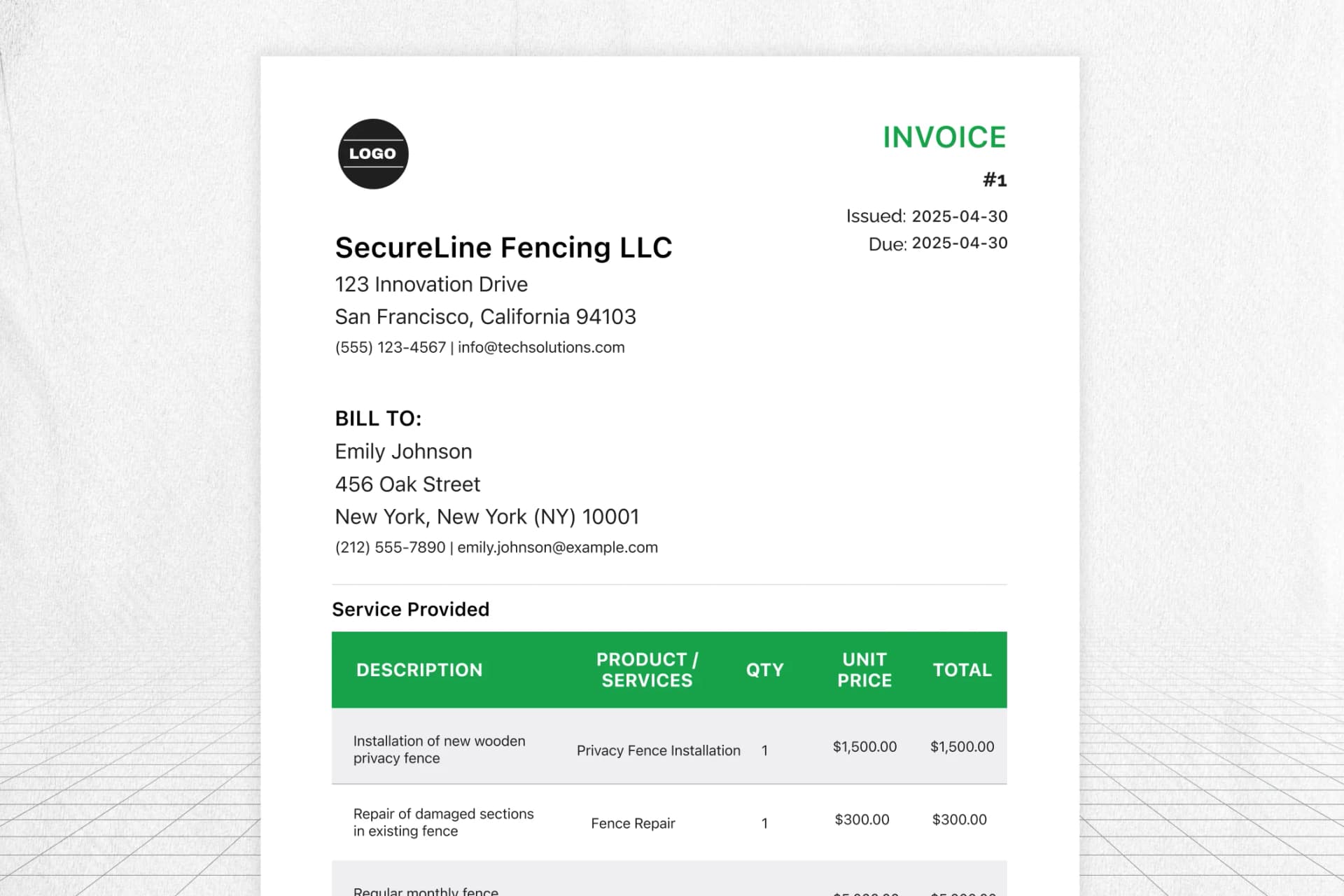
About this template
If you’re spending more time formatting invoices than actually building fences, something’s off. FieldCamp’s free fence invoice template gives fence contractors a clean, ready-to-use format that handles the billing side so you can get back to the job site.
Just plug in your client details, break down the materials, whether it’s cedar panels, vinyl posts, or chain link rolls, add your labor charges, and you’ve got a professional fencing invoice ready to send. It works for everything from a single gate repair to a full perimeter installation across multiple days.
Key Features
- Customizable line items for services & materials
- Clear breakdown of labor and material costs
- Simple invoice reuse for recurring jobs
- Download, or print with one click
,
|
INVOICE
#1
Issued: 2026-03-15
Due: 2026-03-15
BILL TO:
Services Provided
| DESCRIPTION | PRODUCT / SERVICE | QTY | UNIT PRICE | TOTAL |
|---|---|---|---|---|
| Installing 8-foot wooden fence posts around the property | Fence Post Installation | 1 | $15.00 | $15.00 |
| Installing pre-assembled fence panels for a secure boundary | Fence Panel Installation | 1 | $40.00 | $40.00 |
| Installing a custom wooden gate with hinges and a lock | Gate Installation | 1 | $250.00 | $250.00 |
How to Create a Fence Invoice?
Building a fence invoice is straightforward when you have the right format in front of you. Here’s how to do it step by step:
- Add your company details: Business name, address, phone number, and email. Upload your logo so the invoice carries your brand from the top.
- Enter the client information: Customer name, property address, and contact details. If it’s a repeat client, even faster, you already have everything on file.
- Set the invoice number and dates: Assign a unique invoice number for your records. Include the issue date and the payment due date so there’s no ambiguity about when payment is expected.
- Itemize your fencing services: This is where clarity pays off. Break down each part of the job individually: fence post installation, panel assembly, gate hardware, concrete for post holes, and labor hours. Clients trust invoices where they can see exactly what the money covers.
- Apply taxes and discounts: Enter your local tax rate and any agreed-upon discount. The template handles the totals, so you don’t have to pull out a calculator.
- Review and send: Look over the numbers one more time, then download the PDF or print it out. Email it to the client or hand it over on-site, whatever works for the job.
That’s it. Six steps, and you’ve got a professional fence invoice ready to go.
If you’re doing this regularly across multiple jobs and clients, FieldCamp’s invoicing software lets you create, send, and track everything from a single dashboard. Here’s a detailed walkthrough: Creating and Managing Invoices in FieldCamp.
What to Include in a Fence Invoice?
A good fence invoice doesn’t leave room for questions. When a client opens it, they should understand every charge without picking up the phone. Here’s what belongs on every fencing invoice you send:
- Your business information: Company name, address, phone, email, and contractor license number if your state requires it.
- Client details: Customer name and the property address where the fence was installed or repaired.
- Invoice number and date: Unique identifier for tracking purposes. Both you and the client need this for records and tax filing.
- Detailed service description: Skip vague line items like “fence work.” Instead, write something like “Installed 120 linear feet of 6-foot cedar privacy fence with 2 walk gates and 1 double-swing gate.” Specificity builds trust and prevents disputes.
- Materials list with costs: Posts, panels, rails, concrete mix, post caps, brackets, hinges, gate hardware. Itemize each material with quantity and unit price.
- Labor charges: Hours worked, number of crew members, and your hourly or flat rate. If you need a hand calculating what to charge for labor, FieldCamp’s labor cost calculator can help you land on the right number.
- Taxes and discounts: Show these as separate line items. Clients appreciate the transparency, and it keeps your bookkeeping clean.
- Total amount due: Clear, bold, and impossible to miss.
- Payment terms: When payment is due, what methods you accept, and what happens if payment is late. Spell it out upfront so there are no surprises.
Fence Contractor Pricing Guide
Getting your invoice totals right starts with knowing what to charge. Whether you’re putting together a fence quote or billing after the job is done, these numbers give you a solid reference point for 2026 pricing.
Average Fence Installation Costs Per Linear Foot
| Fence Type | Material Cost | Labor Cost | Total Per Linear Foot |
| Chain Link | $8 – $15 | $10 – $20 | $18 – $35 |
| Wood (Pine / Spruce) | $15 – $30 | $15 – $25 | $30 – $55 |
| Vinyl | $20 – $40 | $12 – $22 | $32 – $62 |
| Cedar | $25 – $45 | $18 – $30 | $43 – $75 |
| Aluminum | $30 – $50 | $15 – $25 | $45 – $75 |
| Wrought Iron | $40 – $80 | $20 – $35 | $60 – $115 |
These ranges depend on your region, supplier pricing, and job complexity. Use them as a starting point, then adjust for your local market.
Labor Cost Breakdown
Labor usually makes up 40–60% of a fencing job’s total cost. Here’s what a fully loaded hourly rate looks like for a typical fence installer:
- Base wage: ~$20/hour
- Payroll taxes (15%): ~$3/hour
- Workers’ compensation (8%): ~$1.60/hour
- Benefits allowance: ~$2.40/hour
- Loaded hourly rate: ~$27/hour
For time estimates, here’s what to expect per 100 linear feet:
- Chain link: 2–3 hours
- Wood: 4–6 hours
- Vinyl: 3–4 hours
- Wrought iron/custom work: 6–8 hours
When you’re building an invoice for a completed job, these benchmarks help you verify that your labor charges are in line with the actual work performed.
For a more detailed breakdown of pricing strategy, margins, and material markup, check out this guide on how to price a fencing job.
Waste and Profit Margins
Two things that separate profitable fence contractors from those scraping by: accounting for waste and protecting your margins.
- Material waste: Add 10–15% to your material costs on standard jobs. For projects with complex angles, slopes, or custom cuts, go with 15–20%. Waste happens on every job; pricing for it upfront means it doesn’t come out of your profit.
- Profit margin targets: Residential fence work typically targets 25–35%. Commercial projects run 20–30%. Custom builds and repair work can justify 35–50% margins because of the higher skill and planning involved.
Built for Every Fencing Job: From Repairs to Full Installs
It doesn’t matter if you’re a solo contractor replacing a damaged gate on a Saturday afternoon or a crew of ten wrapping up a commercial security fence. The way you handle invoicing says something about your business.
A clear, itemized fence invoice builds confidence. When a homeowner sees separate charges for cedar panels, post installation, and gate hardware, they understand the value. When a property manager gets a detailed breakdown of 400 feet of chain link with labor hours, materials, and removal fees, they don’t question the bill; they approve it.
This free fencing invoice template handles the structure. You just fill in the specifics for each job.
But if you’re running multiple crews, managing a backlog of estimates, and tracking payments across dozens of clients, doing this manually starts to break down fast. That’s the point where most fencing businesses move to dedicated software.
With FieldCamp, you can generate invoices directly from completed jobs, pull in client details automatically, track which invoices are paid and which are overdue, and even set up automatic payment collection for recurring maintenance contracts. Less chasing, more building.
Sample Fence Invoice Line Items
Knowing what to list is one thing. Knowing how to describe it clearly is what gets you paid without back-and-forth emails. Here are real examples for two common job types.
New Fence Installation Invoice Example
| Line Item | Qty | Unit | Rate | Total |
| 6′ cedar privacy fence panels | 24 | panels | $85.00 | $2,040.00 |
| 4×4 pressure-treated posts | 25 | each | $18.50 | $462.50 |
| Copper post caps | 25 | each | $8.00 | $200.00 |
| Concrete mix (80 lb bags) | 50 | bags | $6.50 | $325.00 |
| Post hole digging and setting | 25 | holes | $35.00 | $875.00 |
| Panel installation labor | 16 | hours | $45.00 | $720.00 |
| Walk gate with hardware | 1 | each | $275.00 | $275.00 |
| Double-swing driveway gate | 1 | each | $650.00 | $650.00 |
| Old fence removal and disposal | 1 | job | $400.00 | $400.00 |
| Permit fee (pass-through) | 1 | each | $75.00 | $75.00 |
| Subtotal | $6,022.50 | |||
| Sales tax (7%) | $421.58 | |||
| Total Due | $6,444.08 |
Fence Repair Invoice Example
| Line Item | Qty | Unit | Rate | Total |
| Remove the damaged fence section | 1 | section | $150.00 | $150.00 |
| Replace the broken 4×4 post | 2 | each | $65.00 | $130.00 |
| New dog-ear fence boards (6′) | 12 | boards | $7.50 | $90.00 |
| Concrete for post reset | 4 | bags | $6.50 | $26.00 |
| Labor — repair and alignment | 3 | hours | $45.00 | $135.00 |
| Subtotal | $531.00 | |||
| Sales tax (7%) | $37.17 | |||
| Total Due | $568.17 |
The more specific your line item descriptions, the fewer payment disputes you’ll deal with. “Replaced 2 broken posts and 12 boards along north property line” beats “fence repair” every time.
For a full breakdown of how to price every type of fencing job, check out FieldCamp’s guide on how to price a fencing job.
Common Fence Invoice Mistakes That Cost You Money
Even experienced contractors lose revenue from sloppy invoicing. Here are the five most common mistakes and how to avoid them.
1. Bundling everything into one line. Writing “Fence installation — $5,000” invites pushback. Clients want to see materials, labor, gates, concrete, and disposal as separate charges. A detailed breakdown builds trust and speeds up payment.
2. Forgetting disposal and permit fees. Old fence removal creates waste. Landfill dump fees, hauling costs, and local permit charges belong on the invoice as their own line items, not buried in your labor rate where they eat your margin.
3. Vague service descriptions. Write “Installed 150 linear feet of 6-foot cedar privacy fence along south property line” instead of just “fence installation.” If the client questions the charge six months later, your invoice is the documentation.
4. Skipping the property address. Especially important for property managers and real estate investors with multiple locations. Always list the service address on the invoice, separate from the billing address.
5. Unclear payment terms. “Due upon receipt” means something different to every client. Use specific dates instead: “Payment due by April 15, 2026. A late fee of 1.5% per month applies after the due date.” That’s enforceable. “Due upon receipt” is not.
The Invoice Shouldn’t Take Longer Than the Gate Repair.
Quick jobs deserve quick billing. But if your invoicing process takes longer than the work itself, something needs to change. FieldCamp lets you create, send, and track fence invoices in under a minute, so small jobs stay profitable and big jobs stay organized.
Frequently Asked Questions
How do I create a fencing invoice?
Start with your business name and contact details at the top, then add your client’s information and the property address. List each service separately, post installation, panel setup, gate work, with quantities and unit prices. Add material costs on their own lines, apply your tax rate, and include your payment terms. Use the free fence invoice template above to fill everything out in a few minutes, then download or print.
What should I look for in an invoicing tool for my fencing business?
At a minimum, you need customizable line items so you can separate materials from labor, automatic tax calculations, and the ability to save templates for repeat jobs. Beyond that, look for a platform that ties invoicing into the rest of your workflow. FieldCamp connects invoicing with scheduling, dispatching, client management, and job tracking, so your billing is always connected to the actual work being done. That eliminates double entry and keeps everything in one place.
Why should I use a fence invoice template instead of building invoices from scratch?
Because rebuilding the same layout every time you finish a job is a waste of your time. A template has the structure already set, services, quantities, unit costs, taxes, and totals, so you only fill in what’s specific to that project. Your invoices stay consistent across every client, which looks more professional and makes bookkeeping significantly easier when tax season rolls around.
How does using a fence invoice template help my business?
Consistent, detailed invoices get you paid faster. When clients can clearly see what they’re being charged for, and the numbers add up, they don’t sit on the payment. Beyond cash flow, a structured invoicing process cuts down on billing errors, reduces payment disputes, and saves you hours of admin work each month. That’s time you can spend on estimates, client calls, or actually building fences.
Can I send fencing invoices directly through FieldCamp?
Yes. FieldCamp lets you create an invoice from a completed job, email it to the client, and track whether it’s been viewed, paid, or is overdue, all from one dashboard. For recurring work like fence maintenance or annual inspections, you can set up automatic billing so payments process without you having to remember to send an invoice each cycle.
How do I invoice for fence repairs vs. new installations?
New installations are straightforward. List materials, labor, gates, concrete, and disposal on separate lines with per-unit pricing. Repairs need more context because every job is unique. Describe what was damaged (“2 broken posts and 12 damaged dog-ear boards along the north property line”), what caused it if relevant (storm damage, vehicle impact, rot), and exactly what you did to fix it. For warranty repairs, note whether the work is covered under the original installation warranty or is a new billable service call.
More Free Tools for Fence Contractors
- Free Service Price Calculator – Build accurate quotes for any fencing job
- Free Labor Cost Calculator – Calculate your true loaded labor rate, including insurance and taxes
- Free Profit Margin Calculator – Verify every fence install hits your target margins
- Free Construction Invoice Template – For contractors who handle fencing alongside general construction
- Free Roofing Invoice Template – If your crew takes on roofing work between fencing jobs