
Good Better Best Pricing: Strategy, Examples & Free Template for 2026
March 31, 2026 - 23 min read


March 31, 2026 - 23 min read

Table of Contents
| TL; DR: Good better best pricing gives every customer three options instead of one, and 66% of buyers choose the middle tier, while most of the remaining pick the premium. Harvard Business Review found this approach increases average purchase value by 15–25%. For a contractor running 100 jobs a month at a $3,000 average ticket, that’s an extra $45,000–$75,000 in monthly revenue just by changing how you present your prices. Below, you’ll find real dollar examples across six trades, the exact pricing formulas, the psychology that makes it work, and a free proposal template you can steal today. |
Picture this: you show up to a job, measure the space, run the Manual J, and hand the homeowner a single number. $6,800 for a 3-ton 14 SEER unit. They say they’ll “think about it.”
Two days later, the guy down the street closes the deal on the same house, same tonnage, because he showed three options on a clean proposal.
The homeowner picked the middle one at $8,200. That was more than your single quote, and the customer felt good about it.
That’s the power of good, better, best pricing on every single job. If you run an HVAC company, plumbing shop, electrical business, or any other field service operation, this strategy will change your revenue numbers.
Here’s exactly how.
That’s a lot of pricing tiers and trade examples. If you want a quick breakdown of which formulas and strategies apply to your specific trade, let AI filter it for you.
Get a quick pricing strategy summary for my tradeKEY HIGHLIGHTS
Good Better Best Pricing Strategy
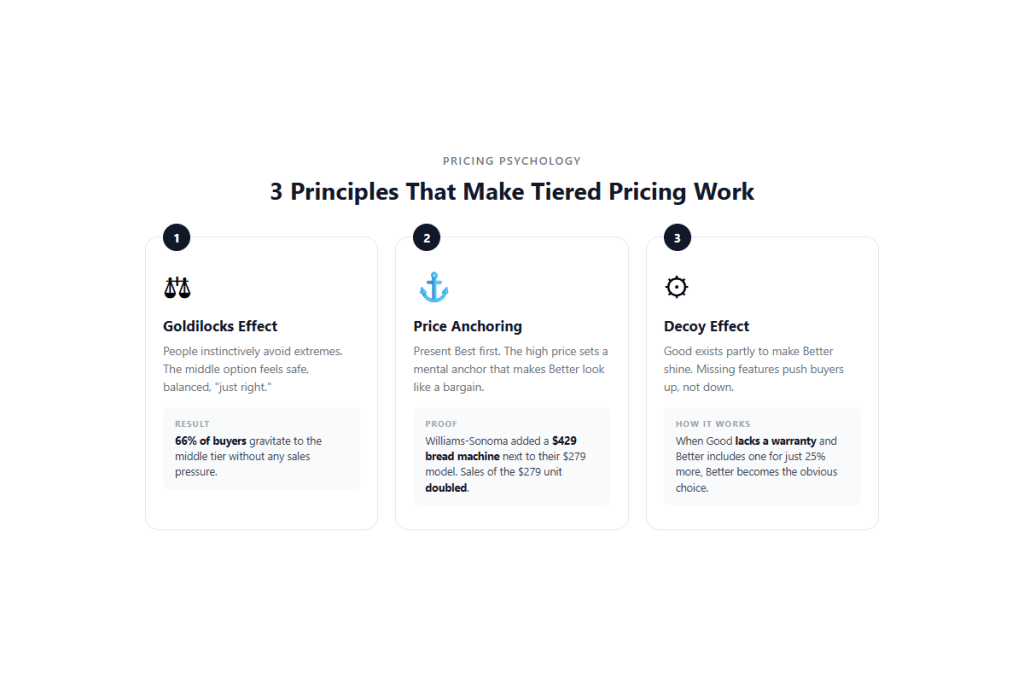
Let’s talk numbers, because that’s what actually matters when you’re trying to grow your field service business.
When you offer a single price, the customer’s decision is binary: buy or don’t buy. That’s a coin flip at best. When you offer three options, the decision shifts to “which one do I want?” and suddenly you’re closing deals with people who would have walked away from a take-it-or-leave-it number.
Research from Harvard Business Review shows that tiered pricing increases average purchase value by 15–25%. Southwest Airlines generated $73 million in incremental revenue in the first year after introducing its Business Select tier.
Here’s where it gets exciting. If your average HVAC install is $5,000 on a single-price model, moving to good, better, best pricing typically pushes that average to $5,750–$6,250, because a chunk of customers who would have gone with your standard option now upgrade to Better or Best.
Multiply that across your annual job volume, and the math gets serious fast. 200 installs per year x $1,000 higher average ticket = $200,000 in additional annual revenue without running a single extra lead.
The hardest objection in sales is “no.” When you present one price, a customer who can’t afford it has no choice but to say no and call someone cheaper. With three tiers, that same customer can say yes to your Good option, and you keep the job. You’d rather close a $3,500 job than lose a customer to a competitor because your only quote was $6,000.
Here’s what no other pricing guide gives you: actual dollar amounts across multiple trades. These are based on real market rates. Adjust for your local market and profit margin targets.
Scenario: 3-ton AC replacement for a 1,500 sq ft home
| Feature | Good ($5,200) | Better ($7,400) | Best ($10,500) |
| Equipment | 14 SEER, single-stage | 16 SEER, two-stage | 20 SEER, variable speed |
| Thermostat | Basic programmable | Wi-Fi smart thermostat | Premium smart thermostat with zoning |
| Warranty | 5-year parts (mfr standard) | 10-year parts + 2-year labor | 10-year parts + 5-year labor |
| Ductwork inspection | No | Visual inspection included | Full duct seal + insulation check |
| Maintenance plan | Not included | 1-year plan included | 2-year plan included |
| Priority scheduling | No | Yes | Yes + same-day guarantee |
| Financing | Not available | 12-month same-as-cash | 0% for 24 months |
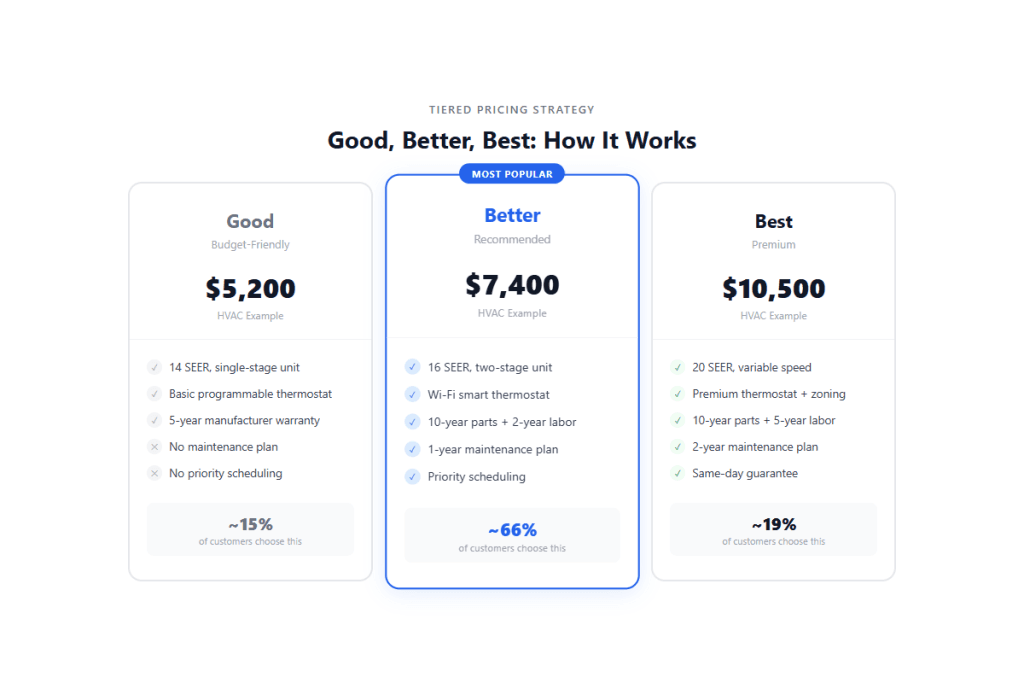
Notice how the Good tier is fully functional. It solves the customer’s problem.
But it’s missing things people want (warranty coverage, smart thermostat, maintenance).
That gap is what pulls 66% of buyers to the Better tier.
For more on structuring these numbers, see our detailed HVAC pricing guide.
Scenario: Water heater replacement (50-gallon tank)
| Feature | Good ($1,800) | Better ($2,650) | Best ($4,200) |
| Unit | Standard 50-gal gas | High-efficiency 50-gal gas | Tankless gas (endless hot water) |
| Energy factor | 0.58 UEF | 0.70 UEF | 0.93+ UEF |
| Warranty | 6-year tank (mfr) | 9-year tank + 1-year labor | 12-year tank + 3-year labor |
| Expansion tank | Not included | Included | Included |
| Water line flush | No | Yes | Yes + recirculation pump |
| Disposal of the old unit | Extra charge ($75) | Included | Included |
| Annual savings estimate | Baseline | ~$120/year energy savings | ~$300/year energy savings |
The Best tier (tankless) is a completely different product category, which justifies the price jump. The Better tier includes enough meaningful extras, the expansion tank, flushing, and disposal, that it feels like the obvious value pick.
For a deeper breakdown of these numbers, check out our how to charge for plumbing jobs.
Scenario: 200-amp electrical panel upgrade
| Feature | Good ($2,400) | Better ($3,200) | Best ($4,800) |
| Panel | Standard 200A, 30-space | 200A, 40-space | 200A, 42-space with integrated surge |
| Breakers | Standard | Standard + dedicated circuits for kitchen | Arc-fault breakers throughout |
| Whole-house surge protection | Not included | Not included | Included ($300+ value) |
| Inspection & code corrections | Minimum required | Full inspection + minor corrections | Full inspection + up to $500 in corrections |
| Warranty | 1-year labor | 2-year labor | 5-year labor |
| Smart panel monitoring | No | No | Yes (energy monitoring app) |
Learn how to apply these numbers in your business using our guide on how to charge electrical jobs.
Scenario: Weekly lawn maintenance (1/4-acre residential lot)
| Feature | Good ($140/mo) | Better ($220/mo) | Best ($350/mo) |
| Mowing frequency | Weekly | Weekly | Weekly |
| Edging & blowing | Every visit | Every visit | Every visit |
| Weed control | Not included | Quarterly application | Monthly application |
| Fertilization | Not included | 4x per year | 6x per year + soil test |
| Bush/hedge trimming | Not included | Quarterly | Monthly |
| Leaf cleanup (fall) | Extra charge | Included | Included |
| Aeration & overseeding | Not included | Not included | Annual service included |
| Irrigation check | No | Seasonal startup/shutdown | Monthly check + adjustments |
Landscaping is a natural fit for tiered pricing because recurring services stack cleanly. The Good tier covers the basics; each step up adds more “set it and forget it” convenience.
Learn how to structure pricing like a pro, how to price commercial lawn care jobs
Scenario: Bi-weekly residential cleaning (3-bed, 2-bath, ~1,800 sq ft)
| Feature | Good ($130/visit) | Better ($180/visit) | Best ($250/visit) |
| General cleaning | All rooms | All rooms | All rooms |
| Kitchen deep clean | Surface only | Appliance exteriors + countertops | Inside oven + fridge + appliance detailing |
| Bathrooms | Standard clean | Deep scrub + grout cleaning | Deep scrub + grout + shower glass treatment |
| Baseboards & blinds | Not included | Quarterly | Every visit |
| Inside windows | Not included | Not included | Quarterly |
| Laundry (wash, dry, fold) | Not included | 1 load per visit | 2 loads per visit |
| Bed making & linen change | Not included | Included | Included |
| Supplies provided | Customer provides | The company provides standard | The company provides eco-premium products |
Explore our complete guide to structuring these numbers how to charge for cleaning services.
Scenario: Full roof replacement (2,000 sq ft, moderate pitch)
| Feature | Good ($8,500) | Better ($12,000) | Best ($18,500) |
| Shingles | 3-tab (25-year) | Architectural (30-year) | Designer/premium (50-year lifetime) |
| Underlayment | Standard felt | Synthetic underlayment | Ice & water shield full deck |
| Ventilation | Existing (as-is) | Ridge vent upgrade | Ridge vent + solar attic fan |
| Flashing | Standard aluminum | Drip edge + step flashing | Premium metal flashing throughout |
| Warranty | Manufacturer only | Manufacturer + 5-year workmanship | Manufacturer + 10-year workmanship |
| Gutter guards | Not included | Not included | Included |
| Cleanup | Standard debris removal | Magnetic nail sweep + full cleanup | Magnetic nail sweep + landscaping restoration |
62% of high-profitability roofing companies already use the good better best method. If you’re still sending single-number estimates, you’re fighting the data. For more information, check out how to price roofing jobs.
We have prepared an example for you to catch-up quickly on the good better best pricing strategy.
Download Good Better Best Strategy Pricing Template
Here’s the part competitors don’t give you: the actual math. Stop guessing and use these formulas.
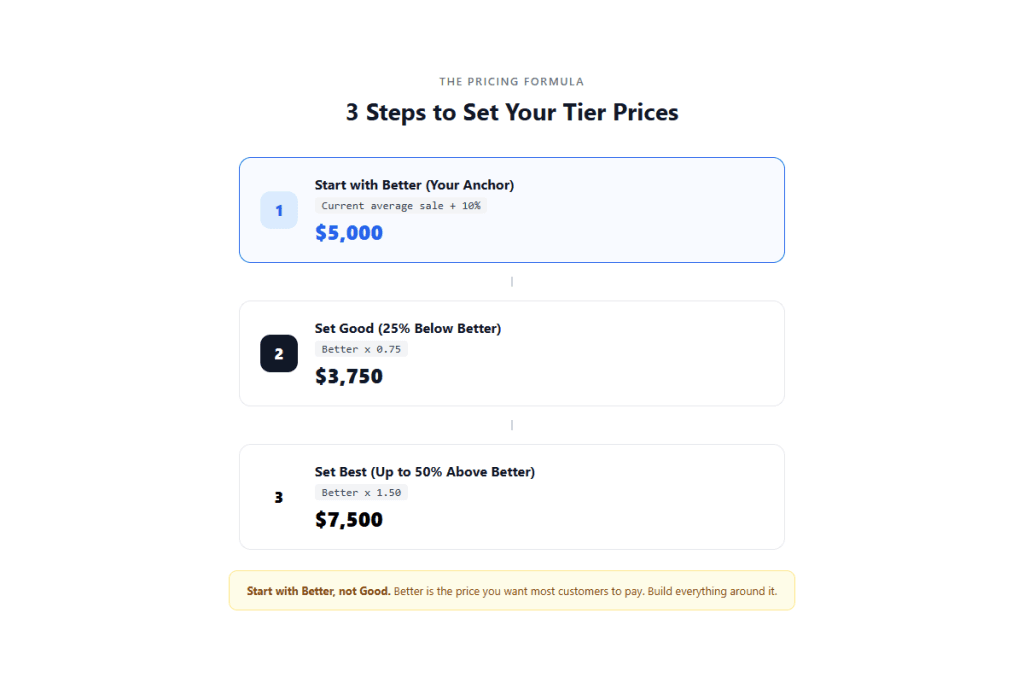
Your Better tier should be about 10% above your current average sale price. This is your anchor, the price you actually want most customers to pay.
If your average job right now is $4,500, your Better price = $4,950 (round to $5,000 for clean numbers).
Your Good tier should be no more than 25% below the Better price. Go lower than that, and you risk cannibalizing your own mid-tier sales.
Good = Better x 0.75
$5,000 x 0.75 = $3,750
Your Best tier can be up to 50% above Better. This gives aspirational buyers a clear upgrade path while positioning Better as the value play.
Best = Better x 1.50
$5,000 x 1.50 = $7,500
Let’s say you’re a plumber whose average re-pipe job is $4,000.
| Formula | Price | |
| Better (start here) | Current avg + 10% | $4,400 |
| Good | Better x 0.75 | $3,300 |
| Best | Better x 1.50 | $6,600 |
Now assign features that justify each jump:
The key is that each tier must offer clearly differentiated value. Nobody should look at Good and Better and wonder what the extra $1,100 buys them.
Use our service pricing guide for deeper benchmarks across trades.
Maintenance agreements are where good better best pricing really shines, because you’re building recurring revenue, not just closing one-time jobs. Here’s a real breakdown for an HVAC maintenance plan.
| Feature | Bronze ($25/mo) | Silver ($39/mo) | Gold ($59/mo) |
| Tune-ups per year | 2 (spring + fall) | 2 (spring + fall) | 2 (spring + fall) |
| Filter changes | Customer-provided | 2 included | 4 included (quarterly) |
| Parts discount | 10% off | 15% off | 20% off |
| Labor coverage | Not included | Diagnostic fee waived | Full labor covered |
| Priority scheduling | No | 24-hour priority | Same-day priority |
| After-hours rate | Standard rate | 50% off after-hours premium | No after-hours charge |
| Refrigerant top-off | Not included | Up to 1 lb included | Up to 2 lbs included |
| Indoor air quality check | No | No | Annual IAQ assessment |
| Transferable | No | To the new homeowner | To the new homeowner |
| Contract term | Month-to-month | 12-month | 12-month |
At $39/month x 12 months = $468/year per customer. Sign up 200 maintenance customers on Silver, and that’s $93,600 in predictable annual recurring revenue before you even pick up a wrench.
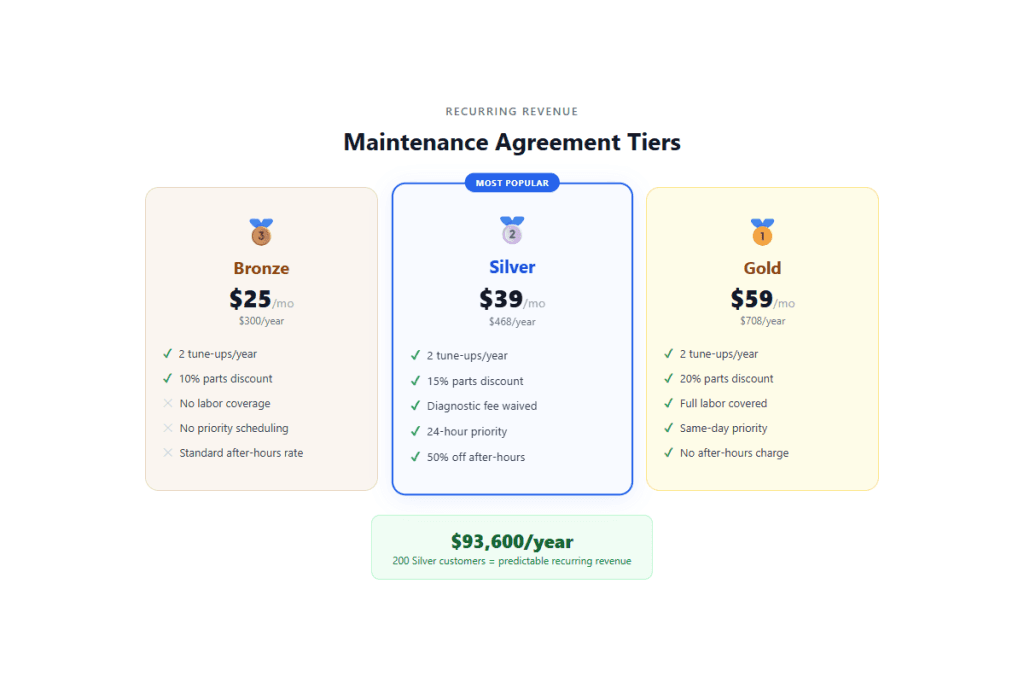
This is where “fence attributes” come in: features in the higher tiers that create real separation and make downgrading feel like a genuine sacrifice.
The most effective fence attributes for service businesses:
The goal isn’t to make Bronze terrible. It’s to make Silver and Gold obviously worth the money.
Having three great tiers means nothing if your tech mumbles through them on a clipboard. Presentation matters as much as pricing.
Always start by presenting the Best option first. This isn’t a sleazy upsell trick; it’s anchoring. When the customer hears “$10,500 for a variable-speed system with 5-year warranty and 2 years of maintenance included,” the $7,400 Better option sounds incredibly reasonable.
Pricing research from Impact Pricing confirms that presenting top-down increases both the average sale price and close rate compared to presenting bottom-up.
If you present Good first, you anchor low. The customer mentally locks in at $5,200, and everything above feels like an unnecessary splurge. Don’t do that to yourself.
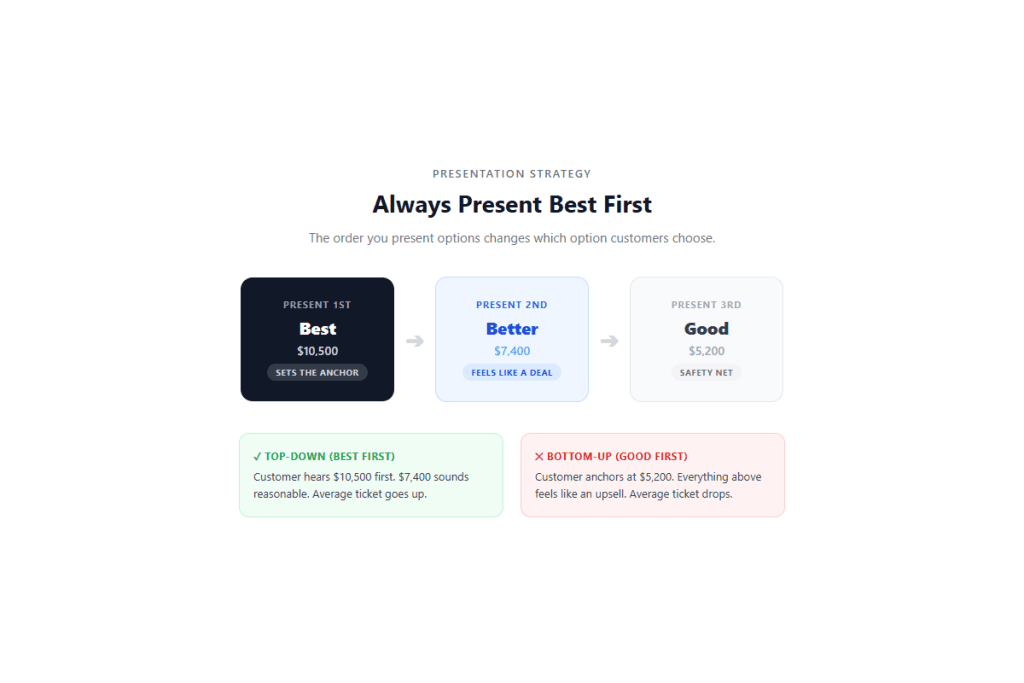
Here’s a framework your team can use on every call:
“Mr. Johnson, I’ve put together three options for your AC replacement based on what we discussed about your home and your priorities.”
[Start with Best] “Option three is our premium package: the 20 SEER variable speed system. This is the quietest, most efficient unit on the market. It comes with a 5-year full labor warranty and a 2-year Gold maintenance plan included.
Your energy bills will drop significantly, and you won’t pay a dime for service calls for five years. That’s $10,500 installed.”
[Move to Better] “Option two is our most popular choice — the 16 SEER two-stage system. You still get great efficiency, a smart thermostat, and a year of maintenance included. This one’s $7,400.”
[Finish with Good] “And option one is our standard package — the 14 SEER single-stage unit. It meets code, cools your home, and comes with the manufacturer’s 5-year warranty. That’s $5,200.”
[Close with a question, not pressure] “Based on what matters most to you — efficiency, warranty coverage, budget — which of these feels like the best fit?”
Notice: no pushy language. No “you should really go with…” Just clear value at each level, and a question that respects the customer’s autonomy.
Handwritten proposals on carbon paper don’t cut it anymore. Today’s customers expect clean, professional presentations, especially when you’re asking them to compare three options side by side.
FieldCamp’s quoting features let you build tiered proposals that display all three options in a clean comparison format.
The customer can see exactly what’s included at each level, tap to select, and sign digitally right there on the tech’s tablet. No confusion, no follow-up calls to clarify what was included.
Interactive proposals also boost close rates. Research from Proposify found that interactive pricing increases close rates by roughly 6% compared to static PDF proposals.
Not sure whether a proposal or a plain quote is the right move for your next job? Our guide on proposal vs quote differences breaks down when to use each.
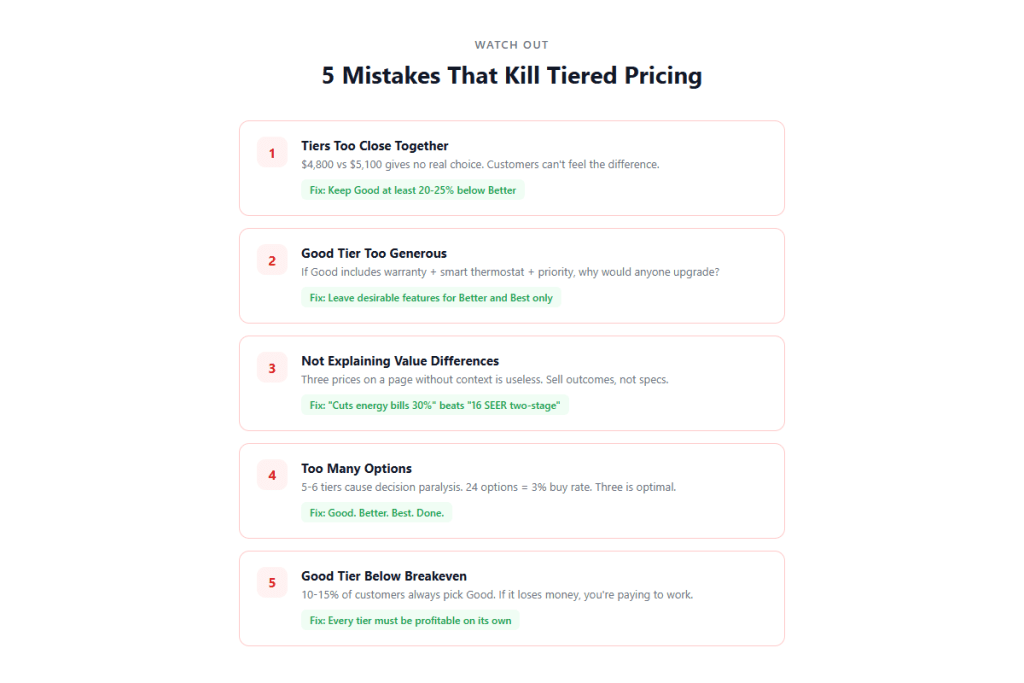
Contractors torpedo their own tiered pricing by making these mistakes all the time. Don’t be that guy.
If Good is $4,800 and Better is $5,100, why would anyone pick Good? There’s no meaningful price gap, so there’s no meaningful choice. Follow the 25% rule: Good should be at least 20–25% below Better. Customers need to feel the difference in their wallet for the psychology to work.
If your Good tier includes a warranty, smart thermostat, and priority scheduling, what exactly is the customer upgrading to? Your Good tier needs to be genuinely basic. Not bad. Not incomplete. Just… basic. The features you leave out of Good are what sell Better and Best.
Slapping three prices on a page without explaining what each tier includes is useless. Customers don’t buy features; they buy outcomes. Don’t say “16 SEER two-stage unit.” Say “cuts your energy bill by 30% and runs so quiet you’ll forget it’s on.” The value story is what moves people up tiers.
Some contractors get excited and build five or six tiers. Don’t. That famous jam study from Columbia University.pdf) showed that 24 choices tanked buying rates to 3%. Six options hit 30%. Three is optimal for service businesses. Good. Better. Best. Done.
Your Good tier still needs to be profitable. Some contractors price Good as a loss leader, hoping everyone picks Better. But 10–15% of customers will pick Good every time. If Good is below your breakeven, you’re paying to work. Run your numbers through a labor cost calculator before finalizing any tier.
Ready to roll this out? Here’s your step-by-step implementation plan.
1. Audit your current pricing. Pull your last 50 jobs. What’s your average ticket? That’s your Better baseline.
2. Define your three tiers. Use the formula (Good \= Better x 0.75, Best \= Better x 1.50) and assign specific features to each.
3. Build comparison tables. Create a clean visual (not a wall of text) that shows what’s included at each level.
4. Create proposal templates. Use FieldCamp’s estimate templates to build professional tiered proposals you can customize per job.
5. Train your team. Role-play the presentation script until every tech can deliver it naturally. Present Best first, always.
6. Track your numbers. Monitor which tier customers choose, your new average ticket, and your close rate. Adjust tiers quarterly.
7. Collect feedback. Ask customers why they chose their tier. Their answers will tell you if your value differentiation is working.
Building tiered proposals from scratch on every job is a time suck. The right software lets you template your Good/Better/Best packages, customize them per job, and present them professionally on-site.
FieldCamp makes this easy with built-in invoicing and quoting tools that let you create multi-option proposals in minutes.
Your tech shows up, assesses the job, selects the right template, adjusts for the specifics, and presents three polished options on a tablet.
The customer picks one, signs, and you’ve got a work order before you leave the driveway.
The biggest failure point in good better best pricing isn’t the pricing. It’s the presentation. Your techs need to understand:
Run a weekly role-play session for the first month. Pair new techs with your top closer. Record calls (with permission) and review them as a team. The companies that win with tiered pricing are the ones that train relentlessly.
Let’s quantify what switching to good, better, and best pricing could mean for your business.
Assumptions:
New average ticket calculation: (0.15 x $2,250) + (0.66 x $3,300) + (0.19 x $4,500) = $337.50 + $2,178 + $855 = $3,370.50
That’s a $370.50 increase per job. Over 100 jobs per month = $37,050 per month in additional revenue. Over a year = $444,600.
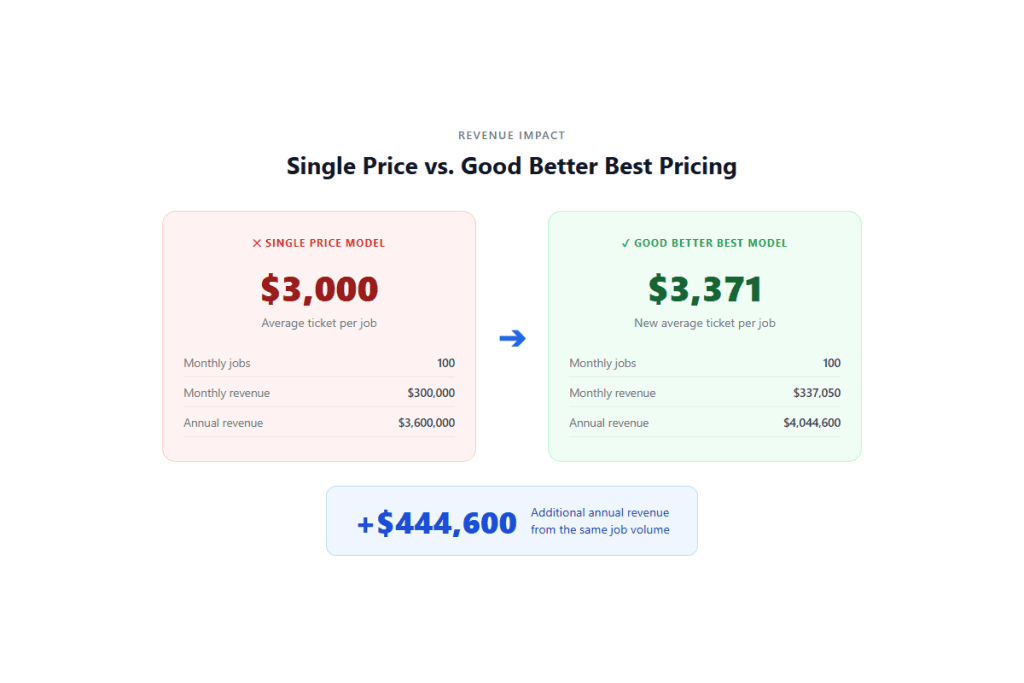
And that’s using conservative tier distribution numbers. Bain & Company research shows that companies relying on discounting instead of value-based tiering see margin erosion of up to 50%.
You’re not just making more; you’re protecting your margins. For a deeper look at where the rest of your money goes, read our guide on improving service business profitability.
Stop building proposals from scratch. Grab our free estimate template that’s pre-formatted for good, better, best pricing. It includes:
Pair it with FieldCamp’s AI-powered CRM to track which tier each customer selects, monitor your average ticket trends, and identify which techs are best at presenting tiered options.
Your good better best pricing shouldn’t be static year-round. Smart contractors adjust based on demand.
Peak season (summer for HVAC, spring for landscaping):
Slow season (winter for HVAC cooling, late fall for landscaping):
The tiers stay; the pricing and incentives flex with the market. Review and adjust quarterly at a minimum.
Still stuck with one-size-fits-all field service software?
AI-first field service software that adapts to you.
Good better best pricing is a tiered pricing strategy where you present customers with three options at different price points — a basic option (Good), a mid-range option (Better), and a premium option (Best). It works because it shifts the customer’s decision from “should I buy?” to “which option should I buy?” Research shows 66% of buyers choose the middle tier.
The Goldilocks pricing strategy is another name for good better best pricing. It’s based on the Goldilocks effect, the psychological tendency to avoid extremes and choose the middle option. Just like Goldilocks picked the porridge that was “just right,” most customers pick the option that’s neither the cheapest nor the most expensive. This makes your Better tier the most popular choice by design.
Three. Not two, not four, not six. Three options hit the sweet spot between giving customers meaningful choice and avoiding decision paralysis. Studies show that too many options (24+) drop purchase rates to just 3%, while a focused set of options (3–6) achieves purchase rates around 30%. For field service proposals, three tiers — Good, Better, Best — is the proven standard.
Use this formula: set your Better price at about 10% above your current average sale price. Then price Good at 25% below Better, and Best at up to 50% above Better. So if Better is $5,000, Good should be around $3,750 and Best around $7,500. The Better tier should land at roughly 60–70% of the Best price, making it feel like a strong value.
Absolutely. It works especially well for service businesses because you can differentiate tiers through warranty length, material quality, response time, maintenance inclusions, and scope of work, not just product features. HVAC, plumbing, electrical, roofing, landscaping, and cleaning companies all see measurable increases in average ticket and close rate when switching from single-price to tiered proposals.
The decoy effect is when one option exists primarily to make another option look more attractive. In good better best pricing, the Good tier often acts as a partial decoy. Its limited features and missing perks make the Better tier look like an outstanding value by comparison. For example, if Good doesn’t include a warranty but Better includes a 3-year warranty for just 25% more, most customers will see Better as the obvious choice.
Use “fence attributes”: features in your Better and Best tiers that create real, felt separation from Good. The most effective fences for service businesses are priority scheduling, labor warranty coverage, waived diagnostic fees, and after-hours access. These aren’t nice-to-haves; they’re features customers genuinely don’t want to go without. If more than 25–30% of customers are picking Good, your fence attributes aren’t strong enough, or your Good tier is too generous.