How to Improve Service Business Profitability in 2026: 12 Strategies That Actually Work
April 2, 2026 - 24 min read

April 2, 2026 - 24 min read

Table of Contents
| TL; DR: The average service business leaves 5–9% of annual revenue on the table through profit leaks they don’t even know about. Whether you run an HVAC, plumbing, electrical, or landscaping company, this guide breaks down real profit margin benchmarks by trade (spoiler: top performers hit 20–25% net margins while most hover at 8–12%), the 7 hidden profit leaks draining your bottom line, and a 90-day sprint plan to boost profitability without working more hours. |
You know the feeling. Your schedule is booked solid for weeks. Trucks rolling every morning. Phones ringing. And then you check your bank account at the end of the month and wonder where all the money went. Busy doesn’t mean profitable, and that’s a lesson most contractors learn the hard way.
If you’re running a field service business and feeling the squeeze between rising material costs, labor shortages, and customers shopping for the cheapest quote, this guide is for you. Not theory from a consulting firm: real strategies that move the needle.
That’s 12 strategies and a 90-day sprint plan. If you want a quick breakdown of which profit leaks and fixes matter most for your trade and team size, let AI prioritize it for you.
Get my personalized profitability action plan
KEY HIGHLIGHTS
Improve Service Business Profitability in 2026
Before talking about fixing profitability, it helps to agree on what it means. Plenty of service contractors confuse cash flow with profit, and that’s a dangerous mistake.
There are three numbers you need to care about:
Gross Profit Margin tells you how much you keep after paying direct job costs (materials, labor on-site, subcontractors). If you charge $5,000 for a job and spend $3,000 on materials and labor, your gross margin is 40%.
Formula: (Revenue – Direct Costs) / Revenue x 100
Operating Profit Margin factors in your overhead: rent, trucks, insurance, office staff, software, and marketing. This is the number that shows whether your business model actually works.
Formula: (Revenue – Direct Costs – Overhead) / Revenue x 100
Net Profit Margin is what’s left after everything: taxes, interest on loans, and depreciation. This is real money in your pocket.
According to Sageworks data via NYU Stern, net profit margins vary wildly by trade, and most contractors only track the first number while ignoring the other two.
This is the single most expensive misunderstanding in the trades.
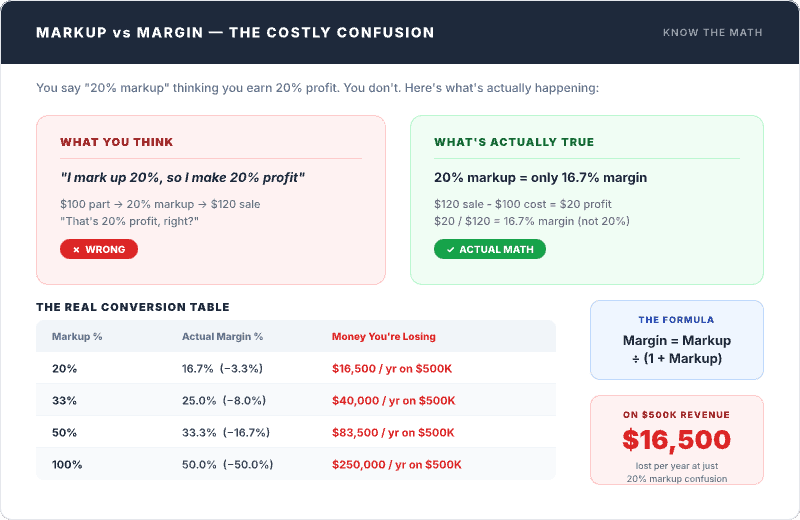
You hear it constantly on contractor forums: “I mark up 20%, so my margin is 20%.”
No. It isn’t.
Here’s the math that trips people up:
If you’re pricing at a 20% markup, thinking you’re making 20% profit, you’re actually netting 16.7%. On $500,000 in annual revenue, that misunderstanding costs you $16,500.
The conversion formula: Margin = Markup (1 + Markup)
| Markup % | Actual Margin % | Difference |
| 20% | 16.7% | -3.3% |
| 33% | 25.0% | -8.0% |
| 50% | 33.3% | -16.7% |
| 100% | 50.0% | -50.0% |
Use a labor cost calculator to make sure you’re accounting for your true costs before applying any markup.
Stop comparing yourself to generic “10–20% is healthy” advice. Here’s what the data actually shows for field service businesses:
| Trade | Gross Margin | Net Margin (Average) | Net Margin (Top Performers) |
| HVAC | 40–55% | 10–15% | 20–25% |
| Plumbing | 45–60% | 10–15% | 18–22% |
| Electrical | 40–50% | 8–12% | 15–20% |
| Landscaping | 45–55% | 10–14% | 18–22% |
| Cleaning | 50–65% | 15–20% | 25–31% |
| Roofing | 35–50% | 8–12% | 15–20% |
| General Contracting | 25–35% | 5–6% | 10–12% |
Sources: IBIS World Industry Reports, ACCA Contractor Benchmarking
The gap between average and top performers is 8–12 margin points. That’s not luck; it’s systems, pricing discipline, and operational efficiency.
These are called “hidden” because most contractors don’t even realize they’re bleeding money.
Together, these seven leaks account for that 5–9% average revenue leakage that research consistently identifies in service businesses.
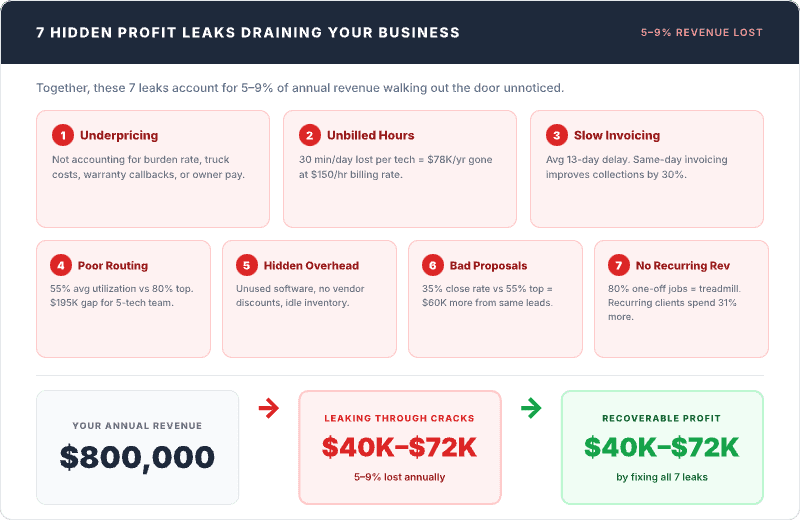
The most common and most expensive leak. You bid $3,500 for a job that should’ve been $4,200 because you didn’t account for:
If you’re unsure whether your prices cover actual costs, run the numbers through the service pricing guide.
“While you’re here, can you also look at…” Sound familiar? Scope creep is the silent killer.
Every 15 minutes of untracked, unbilled work adds up. If each of your four techs loses just 30 minutes a day to unbilled work, at a $150/hour billing rate, that’s $78,000 per year walking out the door.
The fix: detailed scoping on every proposal, change order processes that are easy to execute in the field, and time tracking that captures every billable minute.
According to QuickBooks research, the average small service business waits 13 days to send an invoice after completing a job. Every day you wait increases the chance of a dispute, a forgotten detail, or a slow payment.
Same-day invoicing improves collection rates by up to 30%. It’s one of the simplest profitability improvements you can make. FieldCamp’s invoicing software lets techs generate invoices on-site before they leave the job, and you can also grab the free invoice template to start today.
Your techs aren’t making you money when they’re driving. Utilization rate, the percentage of paid hours spent on billable work, is the KPI most contractors don’t track but should.
Industry average: 55–65% utilization Top performers: 75–85% utilization
On a team of 5 techs, increasing utilization from 60% to 75% on an average billing rate of $125/hour translates to roughly $195,000 in additional annual revenue. Route optimization alone can recover 1–2 hours of billable time per tech per day.
Every contractor knows about obvious overhead: rent, insurance, and truck payments. But the sneaky overhead kills margins:
Run a full overhead audit quarterly. Target a 35–45% overhead ratio (overhead/revenue). If yours is above 50%, you have a structural problem.
Average proposal close rate in field service: 30–40%. Top performers: 55–65%. The math is simple.
If you close 35% of $300K in annual proposals, you win $105K. At 55%, you win $165K. That’s $60,000 more from the same lead volume.
Better proposals don’t just look professional; they present options. Use an estimate template to give every customer three choices (more on this in the pricing section).
Not sure whether to send a proposal or a quote? The proposal vs quote guide breaks it down by trade.
FieldCamp’s quoting feature lets you build tiered proposals directly from the field.
It costs 5x more to acquire a new customer than to retain one. And recurring customers spend 31% more per transaction than first-time clients, according to Bain & Company research.
If 80% of your revenue comes from one-off jobs, your business is on a treadmill. Service agreements, maintenance contracts, and seasonal programs convert one-time buyers into predictable monthly revenue.
Pricing is the single biggest lever on profitability. A 1% price increase drops straight to your bottom line.
But most contractors set prices based on what the competition charges, not on what their costs actually require.
Before you set any price, you need to know your true hourly cost:
True Hourly Cost = (Burdened Labor + Overhead Allocation + Material Costs + Desired Profit) Billable Hours
Here’s a real example:
| Cost Component | Annual Amount | Per Billable Hour |
| Tech base wage ($28/hr x 2,080 hrs) | $58,240 | $37.60* |
| Burden (taxes, insurance, benefits @ 35%) | $20,384 | $13.16 |
| Overhead allocation (truck, tools, office) | $32,000 | $20.65 |
| Profit goal (15% net margin) | $16,593 | $10.71 |
| Total | $127,217 | $82.12 |
*Based on 1,550 billable hours (75% utilization of 2,080 paid hours)
So your minimum billing rate needs to be $82/hour just to hit a 15% margin. And that doesn’t include materials. If you’re charging $75/hour, you’re literally losing money on every hour worked.
For more on this calculation, including travel time charges, run the numbers with specificity.
Tiered pricing is the most effective pricing psychology tool for contractors. Instead of a single quote, present three options (the full good better best pricing guide has real dollar examples across six trades):
Good: Basic service, gets the job done, no extras. This is your entry price.
Better: Includes upgraded components, extended warranty, or preventive add-ons. 20–30% more than Good.
Best: Premium service with maximum value, priority scheduling, and maintenance plan. 50–75% more than Good.
Why it works: The middle option becomes the anchor. Research from the Journal of Marketing Research shows 60–70% of customers pick the middle tier, 20% pick the top, and only 10–20% choose the basic option. Your average ticket value jumps 15–25% overnight.
Example for a furnace replacement:
| Tier | Includes | Price |
| Good | Standard 80% AFUE furnace, basic thermostat, 1-year warranty | $4,200 |
| Better | 95% AFUE furnace, smart thermostat, duct inspection, 5-year warranty | $5,800 |
| Best | 98% AFUE furnace, smart thermostat, full duct sealing, 10-year warranty, annual maintenance plan | $7,500 |
Annual price increases of 3–5% should be standard. Your costs go up every year, so your prices should too. But timing and communication matter:
1. Give 30–60 days’ notice for existing service agreement customers
2. Lead with value. Explain what’s new or improved, not just that prices are going up
3. Grandfather loyal customers for 90 days if possible
4. Raise on new customers first. They don’t have a comparison point
5. Never apologize. Your prices reflect the quality, training, and reliability you deliver
If you lose 5% of customers from a 10% price increase, you still come out ahead. That math works out every single time.
These are ordered by impact-to-effort ratio. Start with 1–3, then add strategies as you build systems.
You can’t improve what you don’t measure. Total revenue tells you nothing about profitability. You need to know which jobs, which customers, and which service types make you money, and which ones lose it.
Start logging actual time, materials, and callbacks against original estimates for every job. Within 60 days, you’ll see patterns: certain job types consistently lose money, specific zip codes cost more in drive time, and some customers are simply unprofitable. FieldCamp’s reporting features make this tracking automatic.
Every truck roll costs $150–$300 in loaded labor, fuel, and opportunity cost. A callback on a job you already completed is pure profit destruction.
Industry average first-time fix rate: 70–75% Top performers: 88–92%
The gap usually comes down to three things:
(1) better pre-visit diagnostics so techs bring the right parts,
(2) well-stocked trucks, and
(3) ongoing technical training.
Even a 5-point improvement in FTFR can save a 5-tech team $25,000–$40,000 annually in eliminated callbacks.
This connects directly to Leak 4, the utilization rate. Smart routing reduces windshield time and increases the number of revenue-generating jobs per day.
The math: Adding just one additional job per tech per day at $250 average ticket = $1,250/day for a 5-tech team = $312,500 per year in additional revenue.
That’s not a fantasy number; that’s one extra job per person.
Your tech is already in the customer’s home. The hard part, earning trust and getting access, is done. Training techs to identify and recommend additional services is one of the highest-ROI activities in field service.
Average upsell acceptance rate when presented well: 25–35%. Average upsell value: $150–$400.
Create a checklist of 3–5 upsell items for each service type. Don’t make it pushy.
Frame it as “while I’m here, I noticed your [filter/outlet/seal] is showing wear. Want me to handle that now before it becomes a bigger issue?”
This is the profitability strategy that separates businesses that survive from businesses that thrive. Service agreements provide:
Target: 30–40% of total revenue from service agreements within 18 months. Start by offering every customer a maintenance plan at the point of service.
Review these areas quarterly:
Same-day invoicing isn’t just nice; it’s a profitability strategy. The data:
| Invoicing Speed | Average Collection Time | Dispute Rate |
| Same day | 14 days | 3% |
| Within 3 days | 23 days | 7% |
| Within a week | 34 days | 12% |
| 2+ weeks | 52+ days | 18% |
On $800K in annual revenue, reducing your average collection time by 20 days frees up roughly $44,000 in working capital at any given moment. That’s real money you can reinvest.
Better proposals = more revenue from the same marketing spend. Focus on:
The ROI bar for field service software is remarkably low. If a tool saves each tech 30 minutes per day and you bill at $125/hour, that’s:
5 techs x 0.5 hours x $125 x 250 working days = $156,250 per year in recovered billable time.
That makes a $100–$300/month software investment essentially free by the end of week one.
FieldCamp handles scheduling, dispatching, quoting, invoicing, and AI-powered CRM in a single platform, which also eliminates the overhead of paying for 5 separate tools.
Most field service techs have no idea whether a job makes money or loses it.
When you share basic financial literacy (“here’s what it costs to run your truck for a day, here’s our average ticket value, here’s why we price the way we do”), behavior changes.
Hold monthly 30-minute team meetings covering:
Techs who understand profit tend to waste less material, manage time better, and sell more confidently.
Not every customer is worth keeping. The bottom 10% of your customer base (serial complainers, slow payers, price shoppers who demand premium service) usually cost you money when you factor in callbacks, chasing payments, and the emotional drain.
Calculate per-customer profitability for your biggest accounts. If someone consistently generates negative or near-zero margins, raise their prices to reflect the true service cost or politely let them go.
The time and headspace you free up are worth more than the revenue.
Don’t put all your eggs in one service basket. The most profitable field service businesses build multiple revenue streams:
For a complete growth playbook, see how to grow your field service business.
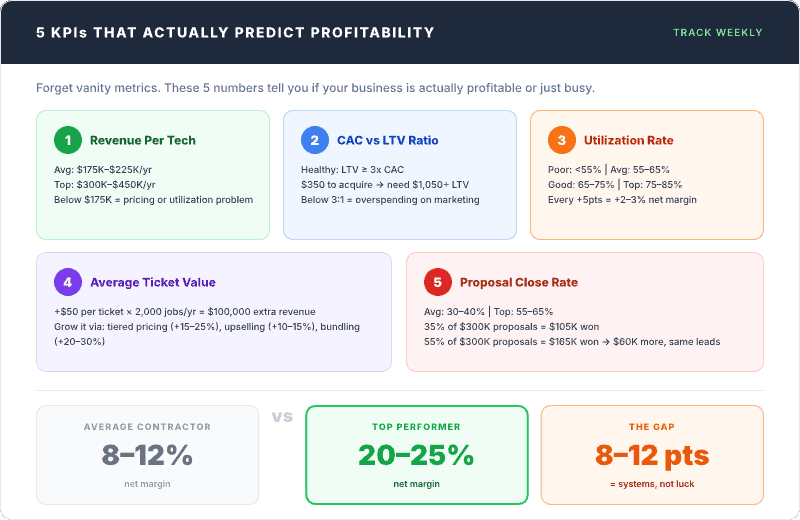
Forget vanity metrics. These five numbers tell you if your service business is actually on a profitable trajectory or just spinning its wheels. Track them weekly.
This is the single most important field service KPI. It tells you whether your capacity is generating adequate returns.
| Company Size | Average Revenue Per Tech | Top Performer Revenue Per Tech |
| 1–5 techs | $150,000–$200,000 | $250,000–$350,000 |
| 6–15 techs | $175,000–$225,000 | $275,000–$400,000 |
| 16+ techs | $200,000–$250,000 | $300,000–$450,000 |
If your revenue per tech is below $175K, you likely have a utilization problem, a pricing problem, or both. For detailed field service metrics and how to track them, check the dedicated guide.
CAC = Total marketing + sales spend / Number of new customers acquired
LTV = Average revenue per customer x Average retention period x Gross margin %
The healthy ratio: LTV should be at least 3x CAC. If you spend $350 to acquire a customer, their lifetime value should be $1,050+.
If your ratio is below 3:1, you’re either overspending on marketing or not retaining customers long enough.
Utilization Rate = Billable hours / Total paid hours x 100
| Rating | Utilization Rate | Impact |
| Poor | Below 55% | Losing money on labor |
| Average | 55–65% | Treading water |
| Good | 65–75% | Healthy returns |
| Excellent | 75–85% | Top performer territory |
Every 5-point increase in utilization rate translates to roughly 2–3% improvement in net margin.
Track this monthly by service type. Growing average ticket value is often easier than growing volume:
A $50 increase in average ticket value across 2,000 annual jobs = $100,000 in additional revenue.
This tells you how efficiently you’re converting opportunities into paying work.
Close Rate = Jobs won / Total proposals sent x 100
Track it by service type, by tech (if techs write proposals), and by lead source. A field service optimization approach should have your close rate trending upward month over month. If it’s declining, look at response speed, pricing, and proposal quality first.
Strategy without execution is just motivation. Here’s a concrete plan.
Days 1–30: Diagnose
Days 31–60: Fix the Big Three
Days 61–90: Optimize and Scale
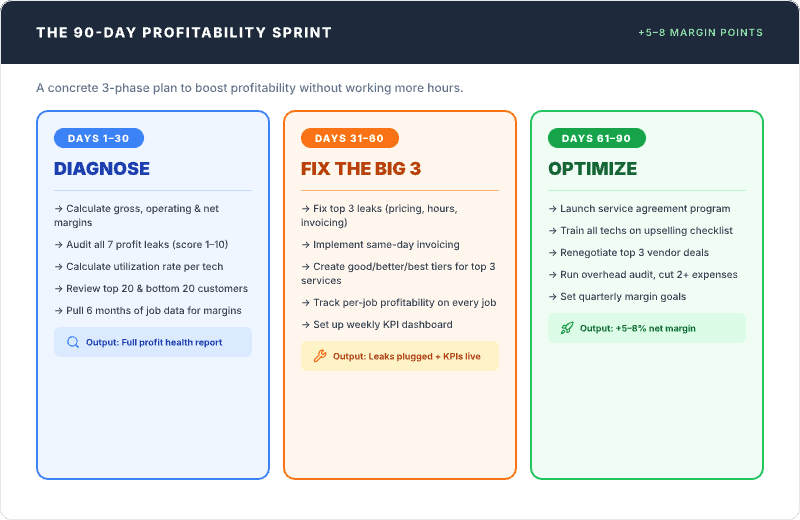
Don’t try to go from 8% net margin to 20% overnight. Here’s a realistic trajectory:
| Quarter | Margin Goal | Key Actions |
| Q1 (current) | +2–3 points | Fix pricing, same-day invoicing, and track per-job profitability |
| Q2 | +2–3 points | Launch service agreements, upsell training, and route optimization |
| Q3 | +1–2 points | Overhead reduction, vendor renegotiation, tech training |
| Q4 | +1–2 points | Fire unprofitable customers, diversify revenue, and refine systems |
Cumulative: 6–10 margin points of improvement in 12 months. On $800K revenue, 8 margin points = $64,000 more in your pocket from the same business.
Staying in the field service automation lane with modern tools makes most of this reporting automatic rather than manual.
Stop Finding Out It Was a Bad Quarter After the Quarter Ends
The contractors at 20%+ margins track five numbers every week. Not every April.
A healthy net profit margin for most field service businesses falls between 10–20%, depending on the trade. HVAC and plumbing companies typically target 10–15% net, while cleaning businesses can reach 25–31%. If your net margin is below 8%, you likely have a pricing or overhead problem that needs immediate attention. Top-performing contractors across trades consistently hit 18–25% by combining disciplined pricing with strong operational efficiency.
Net profit margin = (Total Revenue – All Expenses) Total Revenue x 100. Start by pulling your total revenue and subtracting all costs: direct labor, materials, overhead (rent, insurance, vehicles, software), and taxes. If your company did $600,000 in revenue and had $510,000 in total expenses, your net margin is ($600,000 – $510,000) $600,000 = 15%. Track this monthly, not just at tax time.
Markup is a percentage added to your cost to set your selling price. Margin is the percentage of the selling price that is profit. A 50% markup on a $100 cost gives you a $150 price, but that’s only a 33.3% margin. This confusion costs contractors thousands annually because they think they’re more profitable than they actually are. Always calculate your margin, not just your markup, when evaluating job profitability.
Focus on three levers: reduce unbilled hours by implementing strict time tracking and change order processes, increase utilization rate through optimized routing and scheduling, and speed up invoicing to improve cash flow. Cutting 30 minutes of unbilled time per tech per day and invoicing same-day can add 3–5 margin points without touching your prices.
The most common causes are underpricing (not accounting for full burden rate and overhead), unbilled hours from scope creep, slow invoicing leading to cash flow problems, low utilization rates (too much drive time vs. billable time), and relying entirely on one-time customers instead of building recurring revenue. Most contractors with low margins are undercharging by 15–25% because they don’t calculate their true hourly cost.
A solid benchmark is $200,000–$300,000 per tech per year for established service businesses. If a tech is generating less than $175,000 annually, investigate the utilization rate, average ticket value, and callback rates. Top performers see $350,000+ per tech. This number is the best single indicator of whether your field operations are running efficiently or leaving money behind.
Margin first, always. A $1 million company at 5% margin makes $50,000. A $600,000 company at 15% margin makes $90,000, with less stress, fewer employees, and lower risk. Revenue growth without margin improvement just means you’re scaling your problems. Fix pricing and efficiency first, then layer on smart growth. Check out field service trends to understand where the industry is heading in 2026 so you can grow in the right direction.
Dramatically. Same-day invoicing reduces average collection time from 52+ days to under 14 days and cuts dispute rates from 18% to around 3%. On $800,000 annual revenue, faster collections keep roughly $44,000 more in available working capital at any given time. Beyond cash flow, quick invoicing also reduces the administrative cost of chasing late payments. Those are hours your office staff could spend on activities that actually grow the business.