
How to Become a Plumber: Step-by-Step Career Guide for 2026
April 4, 2026 - 16 min read


April 4, 2026 - 16 min read

Table of Contents
| TL; DR: How to become a plumber in 2026: earn a high school diploma, complete a 4-5 year apprenticeship or trade school program, pass your journeyman licensing exam, and start working independently. The entire path takes 4-6 years, you earn a salary from day one, and the average plumber makes $62,970/year with strong job growth projected through 2034. |
KEY HIGHLIGHTS
Plumbing is one of the best career choices for people who want solid pay, job security, and no college debt. The trade consistently ranks among the top 10 highest-paying careers that do not require a four-year degree. With the right field service management software, modern plumbers run more efficient operations than ever before.
Here is why plumbing stands out in 2026:
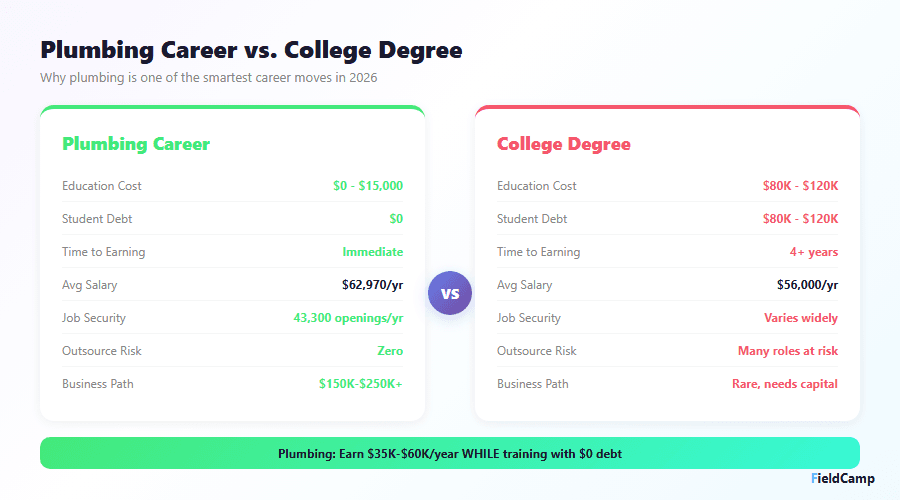
| Factor | Plumbing | Average Office Job |
| Education cost | $1,000-$15,000 (trade school) or $0 (paid apprenticeship) | $80,000-$120,000 (4-year degree) |
| Time to earning | Immediate (earn during training) | 4+ years (earn after graduation) |
| Average salary | $62,970/year | $56,000/year (median all occupations) |
| Job security | 43,300 annual openings, cannot be outsourced | Varies widely, many roles at automation risk |
| Business ownership | Clear path to $150K-$250K+ | Rare, requires capital |
The skilled labor shortage is real. Approximately 10,000 plumbers retire every year, and the industry is not replacing them fast enough. This means qualified plumbers have strong bargaining power for wages, benefits, and working conditions.
Unlike many careers, plumbing skills transfer anywhere. A licensed plumber can find work in any city, any state (with reciprocity or re-testing), and even internationally. Pipes do not care about economic downturns, they still break.
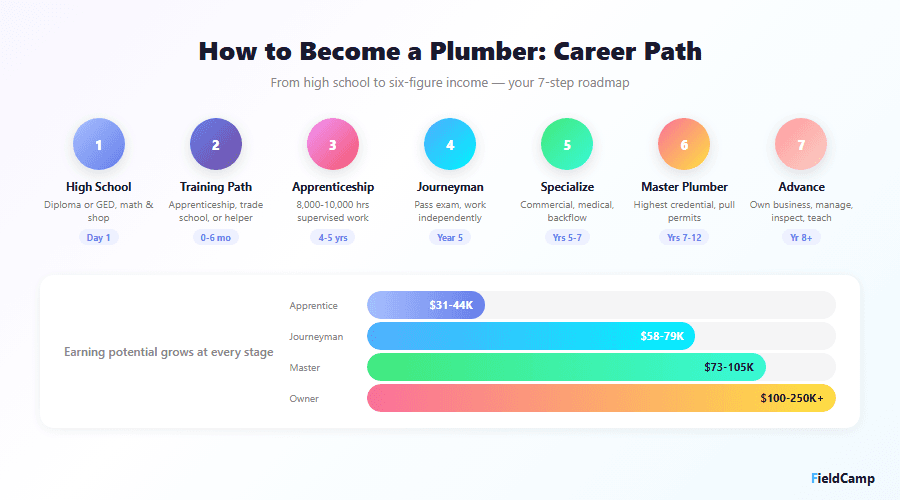
The first step to becoming a plumber is straightforward: earn your high school diploma or GED. Most apprenticeship programs and trade schools require it.
While still in high school, focus on these subjects:
You should also have a valid driver’s license and a clean driving record. Most plumbing jobs require driving between job sites, and many employers run background checks.
Age requirement: Most states require you to be at least 18 to begin a formal apprenticeship, though some allow 16-17 year olds to start as plumber’s helpers.
There are three main paths to enter the plumbing trade. Each has different costs, timelines, and advantages:
A plumbing apprenticeship combines paid on-the-job training with classroom instruction. This is the most traditional and widely recommended path.
Plumbing trade school gives you a head start on the classroom portion before entering an apprenticeship.
Some people enter the trade by working as a plumber’s helper or laborer for a licensed plumber. This is the least formal path.
| Training Path | Cost | Time to Journeyman | Starting Pay | Best For |
| Union apprenticeship | $0 | 4-5 years | $15-$22/hr | Best benefits, structured training |
| Non-union apprenticeship | $0 | 4-5 years | $14-$20/hr | More flexibility, varied experience |
| Trade school + apprenticeship | $1K-$20K | 3-5 years | $16-$24/hr | Faster advancement, competitive edge |
| Plumber’s helper | $0 | 5-7 years | $13-$18/hr | Immediate entry, learning by doing |
The apprenticeship path (Option A) is the best value for most people. You earn money from day one, pay nothing for training, and get hands-on experience that classroom learning cannot replace.
The plumber apprenticeship is where you build real skills. During your 4-5 year apprenticeship, you will learn:
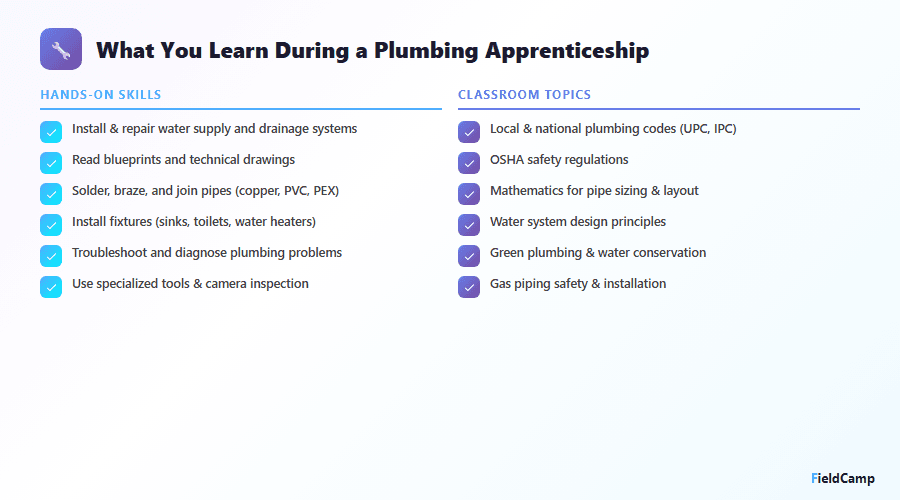
Hands-on skills:
Classroom topics:
Your pay increases each year as you gain experience. Most apprenticeship programs offer raises every 6-12 months:
| Year | Typical Hourly Rate | Annual Salary |
| Year 1 | $15-$18 | $31,000-$37,000 |
| Year 2 | $18-$21 | $37,000-$44,000 |
| Year 3 | $21-$25 | $44,000-$52,000 |
| Year 4 | $25-$30 | $52,000-$62,000 |
| Year 5 | $28-$34 | $58,000-$70,000 |
Keep a detailed log of every hour you work and every type of job you complete. You will need this documentation when applying for your journeyman license. Many apprentices lose track and end up delayed because they cannot verify their hours.
After completing your apprenticeship hours, you are eligible to take the journeyman plumber exam. This is the milestone that allows you to work independently without direct supervision. Many journeyman plumbers quickly discover that plumbing business management software helps them stay organized as they take on their own clients.
Plumber license requirements vary by state but generally include:
What the exam covers:
Pass rates: Most state journeyman exams have a 60-75% pass rate on the first attempt. Study materials are available through your state plumbing board, and many trade schools offer exam prep courses.
Warning: Licensing requirements differ significantly by state. Some states (like Texas and California) have strict, multi-tier licensing systems. Others (like Kansas and Missouri) have minimal state-level requirements but defer to local jurisdictions. Always check your state plumbing board’s requirements at Next Insurance’s state-by-state guide before planning your timeline.
With your journeyman license in hand, you can work independently on most residential and commercial plumbing projects. This is where you start building expertise in specific areas.
Common plumbing specializations include:
Specializing increases your earning potential. A general service plumber earning $60,000 can move to $75,000-$95,000 by adding a specialty certification. Using plumbing estimating software helps you price specialty work accurately and win more bids.
The master plumber license is the highest credential in the trade. It typically requires:
A master plumber license allows you to:
Total timeline from start to master plumber: 7-12 years, depending on your state and training path.
Once licensed, plumbers have several career advancement options:
Many master plumbers eventually start their own plumbing business. Business owners who build efficient teams earn $150,000-$250,000+ annually. The key is using technology to handle the operational side, AI scheduling for dispatch, route optimization to reduce drive time, and invoicing software to speed up payments.
Large plumbing companies need experienced plumbers as project managers, estimators, and operations managers. These roles pay $70,000-$100,000+ with less physical demand.
Government agencies and private firms hire licensed plumbers as inspectors. The role involves reviewing plumbing installations for code compliance. Inspector salaries range from $60,000-$85,000 with benefits and regular hours.
Trade schools and apprenticeship programs need experienced plumbers as instructors. Teaching roles offer stable hours, benefits, and the satisfaction of growing the industry.
With additional education, plumbers can move into plumbing design and engineering roles ($85,000-$107,000). These positions involve designing plumbing systems for commercial and industrial buildings. For more on growing your career, see our guide on how to grow a plumbing business.
Here is the complete timeline from start to each license level:
| Milestone | Time from Start | Requirements |
| Plumber’s helper | Day 1 | High school diploma, willing to learn |
| Apprentice | 0-6 months | Accepted into apprenticeship program |
| Journeyman plumber | 4-5 years | Complete apprenticeship + pass exam |
| Master plumber | 7-12 years | Journeyman experience + pass master exam |
| Business owner | 8-15 years | Master license + business setup |
Compare this to other career paths: a four-year college degree takes 4 years and $80,000-$120,000 in debt. A plumbing apprenticeship takes the same time but you earn $35,000-$60,000 per year while training and graduate with zero debt.
One of the biggest advantages of plumbing is the low barrier to entry:
| Expense | Cost Range | Notes |
| High school diploma/GED | $0-$200 | Free through public school, GED test fees vary |
| Trade school (optional) | $1,000-$20,000 | Community college on the lower end, private schools higher |
| Apprenticeship | $0 | Paid training, you earn money, not spend it |
| Tools (starter kit) | $500-$2,000 | Basic hand tools, some employers provide |
| Licensing exam fees | $50-$300 | Varies by state |
| Study materials | $50-$200 | Code books, practice tests |
| Total (apprenticeship path) | $600-$2,700 | Vs. $80,000+ for a college degree |
Many union apprenticeships provide tools and cover exam fees as part of the program. Ask about tool allowances during your interview, it can save you $1,000+ in the first year.
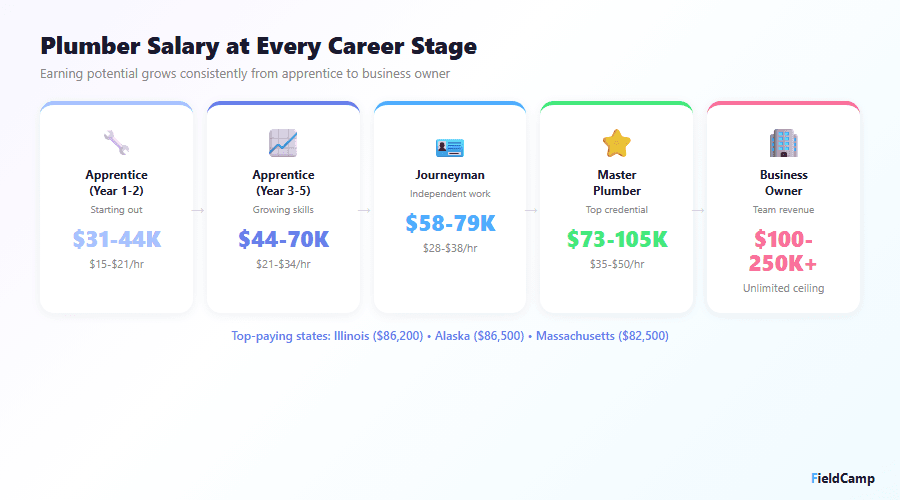
Understanding earning potential helps you plan your career path. Here is what plumbers make at each stage:
| Career Stage | Avg Hourly Rate | Avg Annual Salary | Earning Potential |
| Apprentice (Year 1-2) | $15-$21/hr | $31,000-$44,000 | Growing with each year |
| Apprentice (Year 3-5) | $21-$34/hr | $44,000-$70,000 | Approaching journeyman rates |
| Journeyman | $28-$38/hr | $58,000-$79,000 | Independent work, overtime available |
| Master plumber | $35-$50/hr | $73,000-$105,000 | Top of employee pay scale |
| Business owner | Varies | $100,000-$250,000+ | Revenue from team’s work |
For a deeper breakdown by state, specialty, and experience level, see our complete plumber salary guide.
Top-paying states for plumbers include Illinois ($86,200 average), Alaska ($86,500), and Massachusetts ($82,500). Southern states tend to pay less but also have lower costs of living.
The plumbing trade includes several distinct career tracks:
The most common type. You handle repairs, maintenance, and installations in homes, fixing leaks, replacing water heaters, clearing drains, and installing fixtures. Steady demand, direct customer interaction, and opportunities for emergency service premiums (1.5x-2x standard rate for after-hours calls).
Work on larger systems in offices, restaurants, hospitals, and industrial facilities. Commercial work pays 10-20% more than residential but involves more complex systems, stricter codes, and larger teams.
Install plumbing systems in new buildings from the ground up. This includes rough-in work (laying pipes before walls are closed) and finish work (installing fixtures). Pay is good but work can be seasonal.
A specialized branch focusing on high-pressure pipe systems for industrial applications, steam heating, and cooling systems. Pipefitters earn $72,000-$95,000 on average.
Review completed plumbing work for code compliance. Requires a master plumber license in most jurisdictions. Offers regular hours and benefits with less physical demand.
Understanding the daily reality helps you decide if plumbing is the right fit:
A typical day for a service plumber:
Physical demands: Plumbing is physically demanding work. You will crawl under houses, work in tight spaces, lift heavy materials (50+ pounds regularly), and spend time on your knees. Good physical condition matters.
Work environment: Indoor and outdoor work in all weather conditions. Residential service plumbers spend most time inside homes. Construction plumbers work on job sites exposed to the elements.
Schedule: Most plumbers work 40-hour weeks, Monday through Friday. Emergency and on-call work is common and pays premium rates. As your career progresses, scheduling tools help manage jobs efficiently so you spend more time on billable work and less time driving between sites.
Becoming a plumber is one of the most practical career decisions you can make. The path is clear: earn your high school diploma, complete a 4-5 year apprenticeship, pass your journeyman exam, and start building your career. You earn money from day one, skip the student debt, and enter a profession with 43,300 annual job openings and strong wage growth.
The plumbing trade rewards hard work, technical skill, and ambition. Whether you stay as an employed master plumber earning $80,000-$100,000+ or build your own company with a team of technicians, the ceiling is as high as your willingness to grow. The industry needs qualified plumbers now more than ever, and the demand is only increasing.
Becoming a licensed journeyman plumber takes 4-5 years through an apprenticeship program. If you attend trade school first, you may reduce this by 1-2 years depending on your state’s credit policies. Reaching master plumber status requires an additional 2-5 years of journeyman experience, making the total path 7-12 years.
Yes. There is no age limit for entering the plumbing trade. Many successful plumbers start their second career in their 30s or 40s. Your life experience, work ethic, and maturity are advantages that younger apprentices lack. The physical demands are manageable for most adults in reasonable health.
First-year plumber apprentices typically earn $15-$18 per hour ($31,000-$37,000 annually). Pay increases each year of the apprenticeship, reaching $28-$34/hour by year 4-5. Union apprenticeships generally pay more and include benefits like health insurance and pension contributions.
Plumbing is one of the strongest career choices in 2026. The BLS projects 43,300 annual job openings through 2034, the average salary exceeds $62,000, and the work cannot be outsourced or automated. The skilled labor shortage means qualified plumbers have excellent bargaining power. Plumbing also offers a clear path to business ownership and six-figure income. Check out our plumbing marketing strategies guide if you are planning to build your own client base.
No. Trade school is optional. The most common path is a direct apprenticeship where you learn on the job while earning a paycheck. Trade school can give you a competitive edge when applying for apprenticeships and may shorten your training timeline, but it is not required in most states.
As an apprentice, you need basic hand tools: pipe wrenches (14″ and 18″), channel locks, hacksaw, tape measure, level, screwdrivers, pliers, tubing cutter, and a good flashlight. Budget $500-$2,000 for a starter kit. Many employers and union programs provide specialized tools and power tools. As you advance, you will accumulate $5,000-$15,000 in tools over your career.
Both paths lead to a journeyman license. Union apprenticeships offer higher starting pay ($15-$22/hr vs. $14-$20/hr), structured training programs, health insurance, and pension benefits. Non-union apprenticeships offer more flexibility in choosing employers and may expose you to a wider variety of work types. In states with strong union presence (Illinois, New York, California), the union path typically provides better total compensation. —