
How to Become an HVAC Technician in 2026: The Complete Step-by-Step Career Guide
March 29, 2026 - 28 min read


March 29, 2026 - 28 min read

Table of Contents
| TL; DR: You can become an HVAC technician in as little as 6 months (trade school) or get paid from day one through a union apprenticeship at $0 cost. EPA 608 Universal certification is the one non-negotiable credential. Median pay is $59,810/year, with top earners clearing $91,000+ and business owners hitting $200K+. The industry is short 110,000 techs; demand has never been higher. |
The HVAC industry has a problem, and it’s your opportunity.
Right now, there are 110,000 fewer HVAC technicians than the industry needs. Over 25,000 techs leave the trade each year due to retirement alone.
Within five years, projections show 225,000 vacant positions across the country. The global HVAC market is on track to hit $228.74 billion by 2030, up from $157.71 billion in 2023.
Meanwhile, the median HVAC technician pulls in $59,810 a year. Top earners clear $91,000+. Business owners? $200K+ isn’t unusual.
No four-year degree required. No six-figure student debt. You can be earning a paycheck within months, or from day one if you go the apprenticeship route.
This guide covers every realistic path to becoming an HVAC technician in 2026, from training options and certification requirements to what your first week on the job actually looks like. No fluff, no vague advice, just the information you need to make a decision and get moving.
KEY HIGHLIGHTS
How to Become an HVAC Technician
Before you commit to any training, you should know what the day-to-day work feels like. Not the sanitized version from a career website, the real thing.
Your alarm goes off at 5:45 AM. By 6:30, you’re at the shop loading your van with recovery machine, manifold gauges, vacuum pump, sheet metal screws, and a fresh box of filters. You check your dispatch app, five calls today. Summer’s hitting hard, and every unit in the county picked the same week to quit.
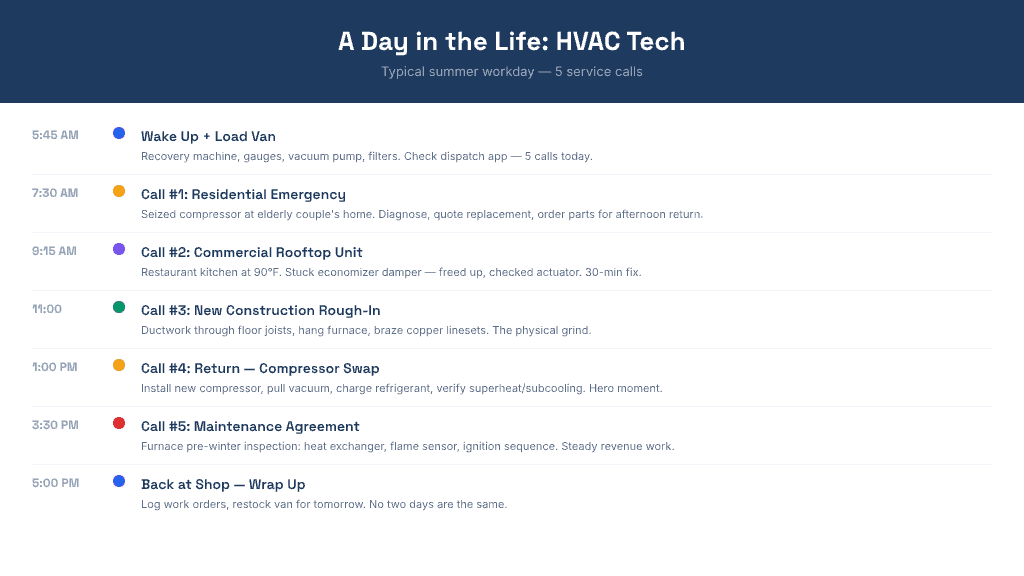
First call, 7:30 AM: An elderly couple’s AC died overnight. You check the thermostat, head to the condenser, and find a seized compressor. The fan motor’s still good. You pull refrigerant into your recovery tank, quote a compressor replacement, and explain the options.
They want it fixed today. You order the part, schedule a return trip for the afternoon, and head to call number two.
9:15 AM: Commercial rooftop unit at a strip mall. Restaurant owner says the kitchen’s at 90 degrees.
You’re on the roof in full sun, checking the economizer. Stuck damper, outdoor air is flooding the system.
You free it up, check the actuator, and get it cycling properly. Thirty minutes, problem solved.
11:00 AM: New construction rough-in. You’re running ductwork through floor joists, hanging a furnace, and brazing copper linesets.
This is the physical part with drilling, crawling, and lifting equipment into tight spaces. By noon, you’re soaked in sweat.
Lunch is 20 minutes in the van.
1:00 PM: Back to the elderly couple’s house with the new compressor. Swap it in, pull a vacuum on the system, charge it with refrigerant, and check your superheat and subcooling.
When cold air starts blowing, they look at you like you just performed a miracle.
3:30 PM: Last call. As a maintenance agreement customer, you’re inspecting a furnace before winter, checking the heat exchanger for cracks, cleaning the flame sensor, and testing the ignition sequence.
Straightforward work, but it’s what keeps the callbacks low and the revenue steady. (If you’re curious how these agreements work, check out our HVAC service contract template.)
You’re back at the shop by 5:00, logging your work orders and restocking the van for tomorrow.
That’s the job. Some days, you’re a detective tracing an electrical fault through a wiring diagram. Some days you’re a plumber sweating copper in a crawlspace. Some days you’re a salesman explaining why a 15-year-old system isn’t worth repairing. It’s physical, it’s mental, and two days are rarely the same.
Hard skills: Electrical troubleshooting, refrigerant circuit diagnosis, airflow measurement, brazing and soldering, reading wiring schematics, combustion analysis, and load calculation basics.
Soft skills: Problem-solving under pressure, clear communication with homeowners, time management across multiple calls, physical stamina (you’re lifting 50+ lb condensers onto rooftops and crawling through 120-degree attics).
The BLS reports 441,000+ HVAC technicians currently employed in the U.S., with about 40,100 openings projected annually through 2034.
That 8% growth rate outpaces most trades. The demand is real, and it’s not slowing down.
There’s no single “right” way into HVAC. The best path depends on your financial situation, how fast you need to start earning, and how deep you want to go technically. Here are the four main routes, with honest pros and cons for each.
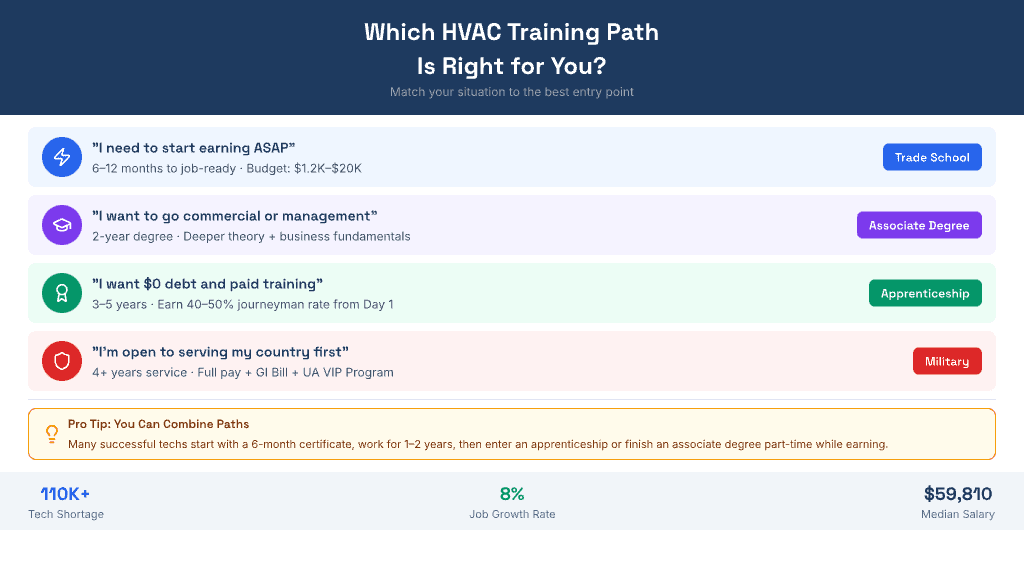
Duration: 6–12 months
Cost: $1,200–$20,000
Earning while training: No (full-time programs)
Trade schools and vocational programs give you concentrated, hands-on HVAC training. You’ll cover refrigeration fundamentals, electrical theory, system installation, and usually prep for the EPA 608 exam. Some programs include OSHA 10 certification.
Best for: People who want to get trained fast and don’t have a way into an apprenticeship yet. The 6-to-12-month timeline gets you job-ready quicker than any other classroom path.
Watch out for: Cost varies wildly. Community college certificate programs can be as low as $1,200. Private for-profit trade schools often charge $15,000–$20,000 for essentially the same curriculum. Research the program’s job placement rate before signing anything.
Duration: 2 years
Cost: $1,200–$5,000 (public) / $15,000–$35,000 (private)
Earning while training: No (though part-time work is possible)
An associate degree in HVAC technology covers everything a certificate program does, plus deeper coursework in building science, advanced controls, system design (including Manual J load calculations), and sometimes business fundamentals.
Best for: Techs who want to move into commercial/industrial work, building automation, or management roles. The extra education also gives you a leg up if you plan to start your own HVAC business down the road.
Watch out for: Two years is a long time to go without trade-specific income. If the budget is tight, get the HVAC certificate first, start working, and consider finishing the degree part-time later.
Duration: 3–5 years (union programs typically 5 years / 10,000 hours)
Cost: $0 tuition
Earning while training: Yes, 40–50% of journeyman rate to start, with roughly 10% annual raises
This is the path that gets overlooked the most and arguably delivers the most value.
Union apprenticeships through the United Association (UA) or local JATC (Joint Apprenticeship and Training Committee) programs combine paid on-the-job training with classroom instruction.
You earn while you learn, pay zero tuition, and typically receive full benefits, health insurance, pension contributions, the works.
Non-union apprenticeships through private HVAC companies run 3–4 years and also pay you from day one, though wages and benefits vary by employer.
Best for: Anyone who can get accepted. Seriously. Paid training with no debt is hard to beat. The five-year commitment is longer, but you come out the other side as a fully credentialed journeyman with thousands of hours of real-world experience.
Watch out for: Union programs are competitive. Application windows are often narrow — once a year in many areas.
You’ll need a high school diploma or GED, a valid driver’s license, and usually pass an aptitude test. Start researching your local JATC early.
Duration: 4+ years (active duty commitment)
Cost: $0
Earning while training: Yes — full military pay + benefits
Every branch has HVAC-related roles:
The training is rigorous, the experience is broad (you’ll work on systems most civilian techs never see), and you come out with zero debt plus GI Bill benefits for additional certifications.
The UA VIP Program deserves special mention: it’s an 18-week HVAC-R course offered at 8+ military bases for service members transitioning to civilian life. Graduates step directly into UA apprenticeship programs with advanced standing.
Best for: Young people open to military service, or current service members looking for a high-demand trade to transition into.
The GI Bill alone can cover EPA 608, NATE, and manufacturer certifications after you separate.
| Path | Duration | Cost | Paid While Training? | Debt Risk | Job Readiness |
| Trade School Certificate | 6–12 months | $1,200–$20,000 | No | Low–High | Basic |
| Community College (AAS) | 2 years | $1,200–$35,000 | No | Moderate–High | Intermediate |
| Union Apprenticeship (UA/JATC) | 5 years (10,000 hrs) | $0 | Yes (40–50% journeyman rate + raises) | None | Advanced |
| Non-Union Apprenticeship | 3–4 years | Varies | Usually yes | Low | Advanced |
| Military | 4+ years of service | $0 | Yes (full pay + benefits) | None | Advanced |
No matter which path you choose, factor in these extras:
Federal law requires anyone who handles refrigerants to hold EPA Section 608 certification. No exceptions. You cannot legally recover, recycle, or charge refrigerant without it.
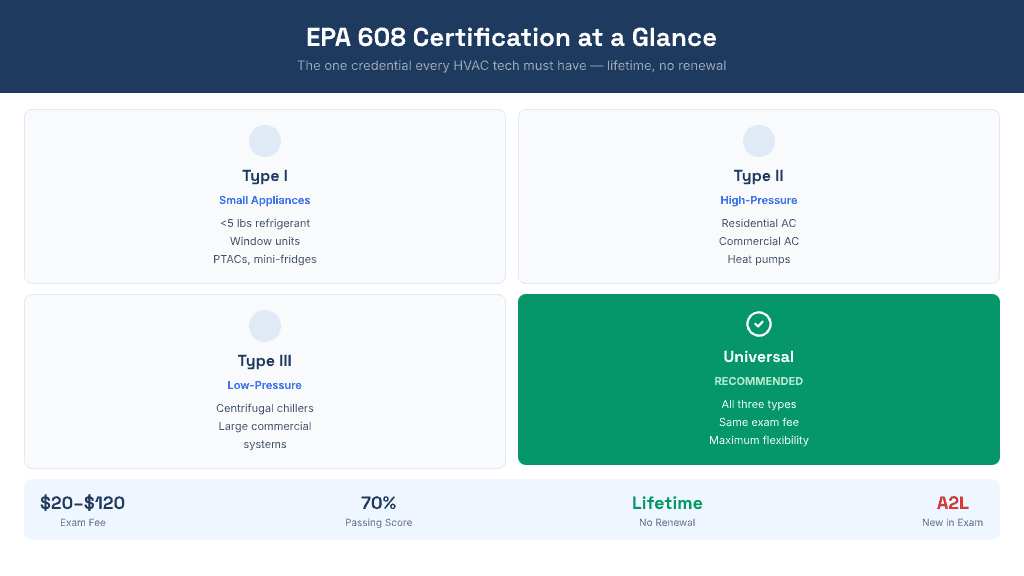
Get Universal. It costs the same exam fee ($20–$120 depending on the testing provider), covers all three types, and prevents you from ever turning down a job because you have the wrong certification level. The exam requires a minimum 70% score on each section.
EPA 608 is a lifetime credential without any renewal needed. Pass it once, and you’re done.
This matters right now. The EPA’s HFC phasedown is accelerating the shift away from R-410A toward lower-GWP (Global Warming Potential) refrigerants. The replacements you need to know:
The 2026 EPA 608 exam now includes questions on A2L refrigerant safety, handling procedures, and the HFC phasedown timeline. Study materials from even two years ago may not cover this.
Make sure your prep course or study guide addresses A2L refrigerants specifically.
What does A2L mean practically? These refrigerants are mildly flammable. That changes installation requirements like leak detection, charge limits per room size, and ventilation standards.
Techs who understand the new codes will be in higher demand than those who don’t. For a deeper dive into what’s changing, see our guide on new HVAC technology.
NATE (North American Technician Excellence) is the most recognized third-party certification in HVAC. Let’s be straightforward about where it fits.
NATE Ready-to-Work: A $60 entry-level exam designed for recent graduates. It validates basic knowledge but won’t turn heads on a resume.
Full NATE Certification: Costs around $500 total (exam fees, study materials). Requires renewal every two years. Covers specializations like air conditioning, heat pumps, gas furnaces, and air distribution.
NATE certification doesn’t replace experience. A tech with five years of field work and no NATE will out-diagnose a freshly certified tech every time.
That said, NATE does two things well:
1. Gets your resume past HR filters at larger companies; some employers require it or pay a premium for it
2. Validates your knowledge to customers, especially if you’re independent or building a client base
Recommendation: Don’t rush it. Focus on your EPA 608 and getting real field hours first. After 2+ years of hands-on experience, NATE certification becomes a worthwhile investment that actually means something. Before that, it’s a piece of paper.
Here’s where it gets complicated: HVAC licensing requirements vary dramatically by state. Some states require a state license to do any HVAC work.
Others only regulate contractors (business owners), not individual technicians.
A few have no statewide requirements at all, leaving it to counties and cities.
The common thread is this: virtually every state requires EPA 608 certification as a baseline. Beyond that, you may need:
We built a comprehensive guide covering every state’s requirements: HVAC License Requirements by State. Check it before you start training so you know exactly what your state demands.
You already know the training duration for each path.
But “completing training” and “becoming a fully independent HVAC technician” are two different things.
Here’s the full milestone timeline from day one through business ownership:
| Milestone | Timeline |
| Complete a trade school or certificate program | 6–12 months |
| Pass the EPA 608 Universal exam | During or immediately after training |
| Get hired as an entry-level tech / install helper | 6–12 months from start |
| Earn state license (where required) | 1–4 years (varies by state) |
| Reach independent technician level | 2–3 years |
| Complete apprenticeship (if applicable) | 3–5 years |
| Eligible for NATE certification (recommended) | 2+ years of experience |
| Senior technician/lead tech | 5–8 years |
| Service manager or business owner | 8–10+ years |
The training paths above gave you cost ranges. Now here’s the full picture, including the hidden costs nobody puts in the brochure.
| Cost Category | Trade School | Community College (Public) | Community College (Private) | Union Apprenticeship | Military |
| Tuition/Program Fee | $1,200–$20,000 | $1,200–$5,000 | $15,000–$35,000 | $0 | $0 |
| Books & Materials | $500–$1,000 | $500–$1,000/yr | $500–$1,000/yr | Provided | Provided |
| Starter Tool Kit | $600–$800 | $600–$800 | $600–$800 | Often provided | Provided |
| EPA 608 Exam | $20–$120 | $20–$120 | $20–$120 | Included | Included |
| NATE (Optional) | ~$500 | ~$500 | ~$500 | ~$500 | ~$500 (GI Bill) |
| Total Estimate | $2,320–$22,000 | $2,820–$7,420 | $16,620–$37,420 | $0–$500 | $0–$500 |
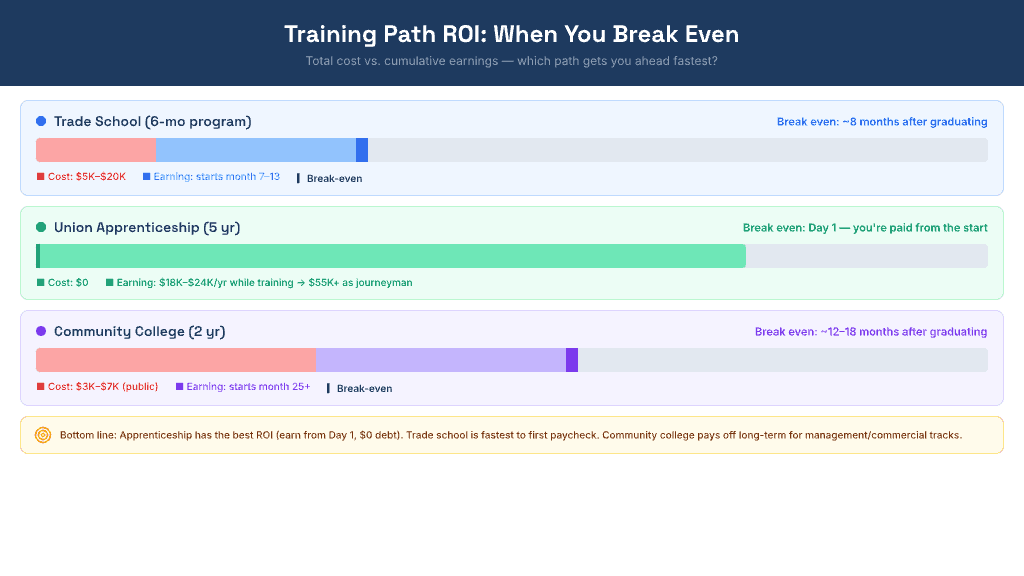
The contrast is stark. A union apprenticeship costs virtually nothing out of pocket and pays you while you train.
A private trade school or college can run $20,000–$37,000 with no income during the program.
This doesn’t mean trade school is a bad choice; the faster timeline has real value if you need to start earning quickly. But go in with your eyes open about the total investment.
You don’t necessarily have to pay out of pocket:
Every new tech needs a basic set of tools. Here’s what to buy first:
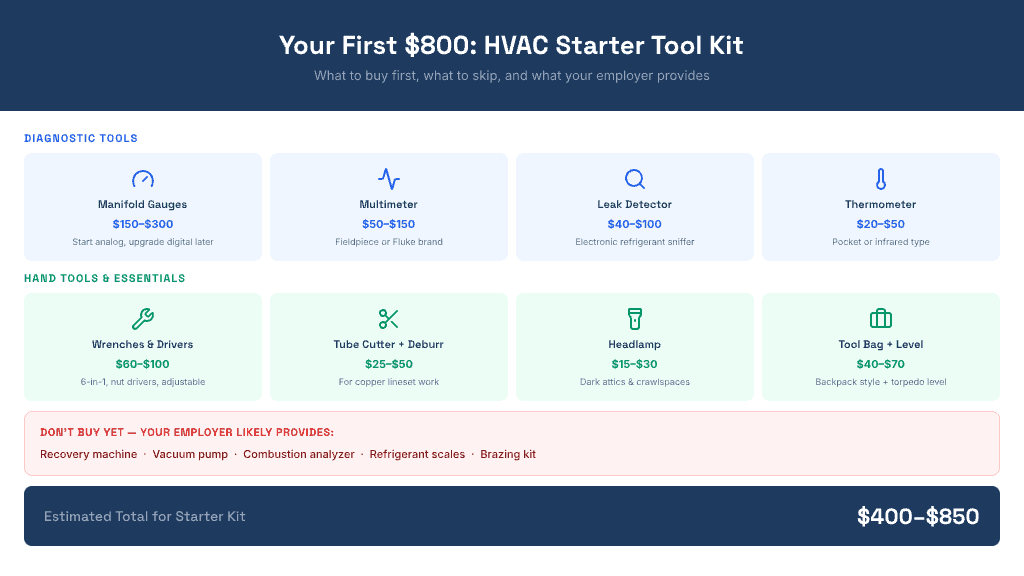
Don’t overbuy on day one. Your employer will likely have specialized equipment (recovery machines, vacuum pumps, combustion analyzers). Start with the essentials and add tools as you learn what you actually use daily.
The BLS reports a median annual wage of $59,810 ($28.75/hour) for HVAC technicians. But that median masks a wide range based on experience, location, and specialization.
The bottom 10% of HVAC techs earn under $39,130. The top 10% earn over $91,020.
Where you land on that spectrum is largely a function of how quickly you build diagnostic skills, what certifications you stack, and whether you’re willing to relocate for better markets.
For a deeper breakdown, including overtime, benefits, and metro-area data, see our full HVAC technician salary guide.
| State | Average Annual Salary |
| Alaska | $83,660 |
| Washington, D.C. | $83,390 |
| Massachusetts | $76,990 |
| Connecticut | $73,910 |
| Washington | $67,630 |
Keep in mind that high-salary states often have higher costs of living. Alaska pays the most, but you’re also dealing with extreme conditions and remote job sites.
D.C. and Massachusetts salaries reflect high-demand metro markets with significant commercial work.
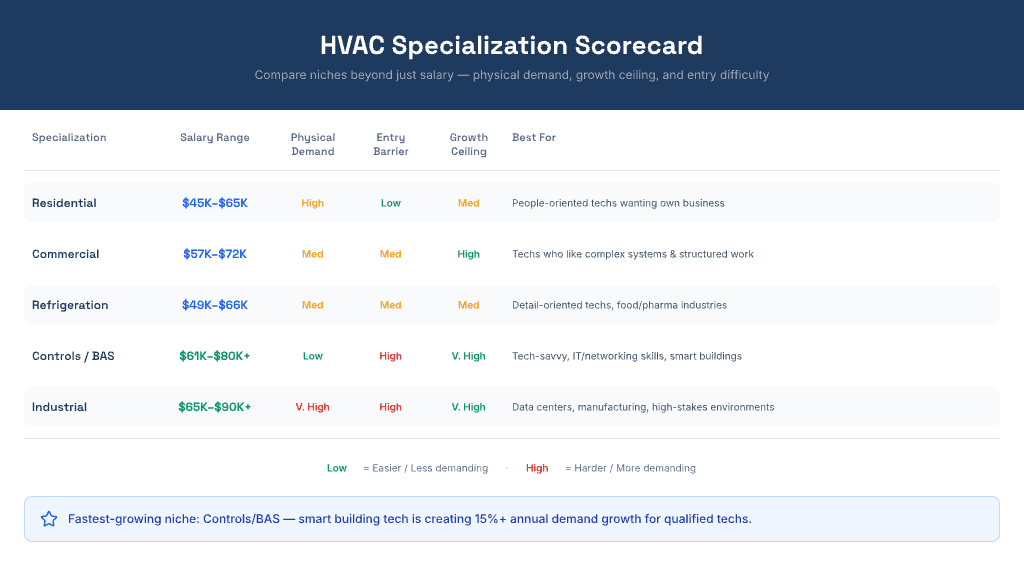
Your specialization has a direct impact on your earning ceiling. We break down each one in detail in the next section, but here’s the quick version: residential techs earn $45,000–$65,000, commercial runs $56,843–$71,827, and controls/building automation specialists pull $60,500–$80,000+.
Industrial HVAC, like data centers and manufacturing, is where the top 10% ($91,000+) typically work.
Once you’ve got your fundamentals down (usually 2–3 years in), you’ll naturally gravitate toward a specialization. Here’s what each one looks like in practice.
The bread and butter of the industry. You’re installing and servicing furnaces, air conditioners, heat pumps, and ductwork in single-family homes and small multi-family buildings.
The work is varied, one call you’re replacing a blower motor, the next you’re quoting a full system replacement.
Residential work is relationship-driven. Homeowners trust technicians who explain things clearly and don’t upsell unnecessary repairs.
If you’re good with people and want to build a loyal customer base, this is the lane. It’s also the fastest path to starting your own HVAC company.
Bigger systems, bigger paychecks, bigger complexity. You’re working on rooftop units, chillers, cooling towers, VRF systems, and packaged equipment serving office buildings, retail spaces, hospitals, and schools.
The troubleshooting gets more involved, you need to understand building pressurization, economizer controls, and multi-zone systems.
Commercial techs typically earn 15–25% more than their residential counterparts. The tradeoff is more structured work environments and less customer-facing variety.
Supermarkets, restaurants, cold storage warehouses, and pharmaceutical storage. Refrigeration techs maintain the walk-in coolers, freezers, and display cases that keep food safe and products viable.
The work is specialized, you’re dealing with different pressure ranges, defrost cycles, and temperature-critical environments where a system failure means thousands of dollars in spoiled inventory.
This is the field’s frontier and where the money is trending in 2026. BAS techs program and maintain the computerized systems that manage an entire building’s HVAC, lighting, and energy consumption.
You’re working with platforms like Trane Tracer, Honeywell Niagara, and Johnson Controls Metasys.
The barrier to entry is higher; you need both mechanical HVAC knowledge and IT/networking skills. But smart building systems, IoT integration, and energy management are creating demand for techs who can bridge mechanical and digital worlds.
BAS techs are increasingly in demand as the field service industry trends toward technology integration.
Power plants, manufacturing facilities, data centers, and clean rooms. Industrial HVAC involves massive equipment, stringent environmental controls, and specialized safety protocols.
The systems are complex, the stakes are high, and the pay reflects both. This is typically where the top 10% of earners ($91,000+) work.
Regardless of your specialization, manufacturer-specific training adds value.
The major programs:
These aren’t legally required, but they open doors to authorized dealer networks, warranty work, and preferred vendor status.
Most manufacturers offer the training free or at low cost; it’s in their interest to have certified techs installing their equipment correctly.
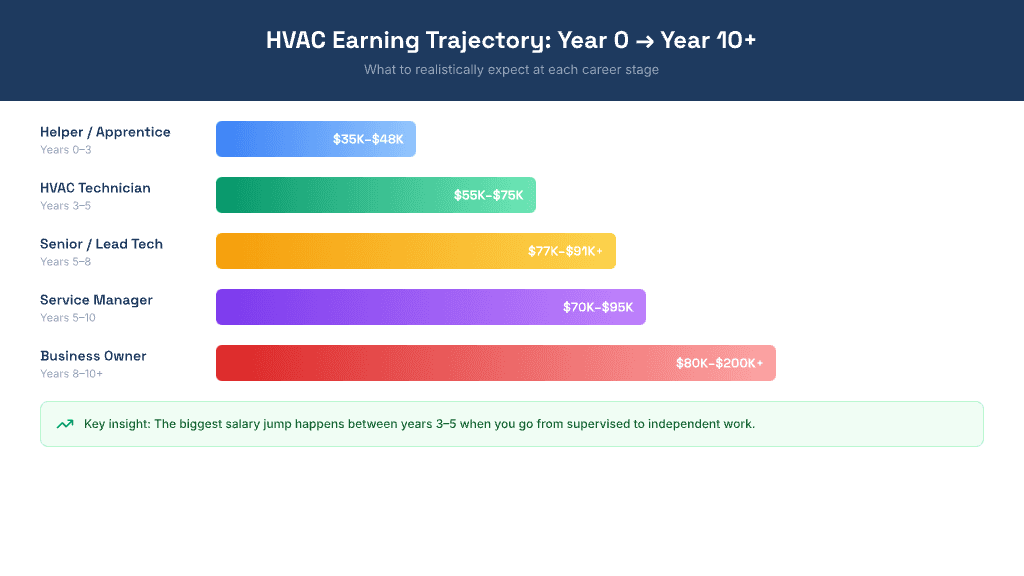
The HVAC career ladder is one of the most clearly defined in the trades. Here’s what a realistic trajectory looks like.
You’re learning. Carrying equipment, holding ductwork, and watching the lead tech diagnose problems. You’ll make mistakes, everyone does.
The techs who advance fastest are the ones who ask questions, study wiring diagrams on their own time, and volunteer for the jobs nobody else wants.
Your goal in this phase: learn to diagnose before you learn to sell. Build your technical foundation.
You’re running calls independently. Dispatched to homes and businesses, diagnosing problems, ordering parts, and completing repairs. This is where your soft skills start mattering as much as your technical ability.
Customers decide whether to trust your diagnosis and your recommendations. based on how you communicate.
At this stage, most techs specialize (residential vs. commercial) and start stacking certifications.
You’re the person newer techs call when they’re stuck. You handle the complex diagnostics, intermittent electrical faults, system design issues, and warranty disputes.
Some companies add “lead” or “senior” titles with corresponding pay bumps. Others let your callback rate and efficiency numbers speak for themselves.
Senior techs also start training apprentices, which develops the management skills needed for the next step.
If management appeals to you, service manager roles open up at the 5–10 year mark. You’re overseeing a team of technicians, managing dispatch schedules, handling escalated customer issues, and driving department revenue.
This is where operational tools become critical. Coordinating multiple technicians across daily routes, tracking job completion, managing invoicing and payment collection, the administrative side of HVAC gets complex fast.
Companies running their operations through field service platforms like FieldCamp handle this more efficiently than those juggling spreadsheets and paper work orders.
The ceiling comes off when you own the company. Many HVAC business owners started exactly where you are, without experience, connections, or just a willingness to learn the trade from the ground up.
Running a profitable HVAC business requires everything you’ve learned on the tools, plus sales, marketing, hiring, and financial management. HVAC profit margins typically range from 10–25%, depending on service mix and operational efficiency.
Owners who scale past a small crew and systematize their operations are the ones clearing six figures consistently. You’ll also need proper HVAC business insurance, general liability, workers’ comp, and commercial auto at a minimum.
If business ownership is on your radar, start with a solid HVAC business plan and pay attention to the business side early, such as how your current employer prices jobs, manages workflow, and retains customers.
That education happens on the job, long before you hang your own shingle. Understanding how to grow a field service business from the start puts you years ahead of owners who figure it out by trial and error.
Let’s weigh the evidence without the cheerleading.
Job security is exceptional. An 8% growth rate through 2034 with 40,100 annual openings means steady demand regardless of economic cycles. People need heating and cooling in recessions, booms, and everything in between.
The pay is strong and escalates quickly. Going from $35,000 at entry to $75,000+ within five years is realistic and possible without any college debt.
The barrier to entry is low. No four-year degree. No unpaid internships. Many paths pay you from day one.
The industry is modernizing. Heat pumps, smart thermostats, building automation, refrigerant transitions, and HVAC are increasingly a technology career, not just a manual labor career.
Multiple exit strategies exist. If you don’t want to turn wrenches forever, you can move into sales, management, inspection, building code enforcement, manufacturer rep roles, or business ownership.
The work is physically demanding. Attics in July. Crawlspaces in January. Rooftops in every kind of weather. Your body takes a beating, especially the knees and back.
The hours aren’t always predictable. Emergency calls happen evenings and weekends. Peak summer and winter seasons mean long days.
Continuous learning is mandatory, not optional. New refrigerants, new equipment platforms, evolving building codes, you’ll never stop studying. If that sounds exhausting rather than interesting, reconsider.
Early pay is modest. $35,000–$48,000 for the first few years requires careful budgeting, especially in high-cost-of-living areas.
For the right person, someone who likes solving problems, doesn’t mind physical work, and values a career with a clear progression, HVAC is one of the strongest trades you can enter in 2026.
The shortage of 110,000 technicians isn’t a statistic; it’s leverage. You’re entering a market where employers compete for you, not the other way around.
Your HVAC Career Starts With One Decision.
The industry is short 110,000 techs and adding 40,100 openings a year.
There’s never been a better time to get in. And when you’re ready to scale your own shop, FieldCamp keeps operations tight: scheduling, dispatch, invoicing, and CRM, all in one place.
Six months to five years, depending on your path. A trade school certificate gets you entry-level ready in 6–12 months. A union apprenticeship takes five years but pays you throughout and produces a fully qualified journeyman. Most people land their first HVAC job within 6–12 months of starting training.
As little as $0 through a union apprenticeship or military service, or up to $37,000+ at a private college. The most cost-effective classroom option is a community college certificate program at $1,200–$5,000. Factor in an additional $600–$800 for a starter tool kit and $20–$120 for the EPA 608 exam, regardless of which path you choose.
No. A college degree is not required to work as an HVAC technician in any state. You need a high school diploma or GED, EPA 608 certification, and whatever state-specific licensing your location requires. An associate degree can help with career advancement, but is not a prerequisite for entry.
EPA 608 certification is a federally required credential for anyone who handles refrigerants. Yes, you absolutely need it — it’s illegal to work with refrigerants without it. The exam costs $20–$120, requires a 70% passing score, and the certification lasts a lifetime with no renewal. Get the Universal certification to cover all equipment types.
Yes. Every HVAC technician started with no experience. Trade schools, community colleges, and apprenticeship programs are all designed for complete beginners. Apprenticeships are specifically built around learning on the job — you start as a helper and learn from experienced technicians while earning a paycheck.
Certification (like EPA 608 or NATE) validates your knowledge through a standardized exam. Licensing is a legal authorization from your state or local government to perform HVAC work. You typically need certifications to qualify for licensing. Check your state’s specific requirements in the license requirements guide linked above.
Yes. The industry is short 110,000 technicians right now, with 25,000+ retiring annually and not enough new techs entering the trade to replace them. Projections show 225,000 vacant positions within five years. This shortage directly benefits new technicians through higher starting wages, signing bonuses, and employer-funded training.
Industrial HVAC and building automation/controls work command the highest salaries, with experienced techs earning $65,000–$90,000+. Controls/BAS specialists in particular are seeing rapid salary growth as smart building technology expands. HVAC business owners who scale beyond a one-person operation can earn $150,000–$200,000+.
If you can get into one, the value is hard to beat — $0 tuition, paid training from day one, full benefits, and a structured path to journeyman status. The tradeoff is a five-year commitment and competitive acceptance. Apply to your local JATC (Joint Apprenticeship and Training Committee) early, as most accept applications only once per year.
R-454B, R-32, and R-466A are the key replacements for R-410A under the EPA’s HFC phasedown. R-454B and R-32 are classified as A2L (mildly flammable), which changes installation and service procedures. The 2026 EPA 608 exam includes questions on A2L safety protocols. Understanding these refrigerants early gives you an edge — many working technicians haven’t caught up yet.
HVAC offers faster entry (6 months vs. 4–5 years for licensed electricians in many states) and comparable pay. The BLS median for HVAC techs ($59,810) is on par with electricians ($61,590) and ahead of plumbers ($59,880). The key difference is demand — HVAC’s 110,000 technician shortage is larger than most trades, which means more leverage for job seekers. HVAC also has a clearer path to business ownership because residential service contracts create recurring revenue that plumbing and electrical typically don’t. The tradeoff: HVAC work is more seasonal, and the physical demands (attics, rooftops) are rougher than most electrical work. —